

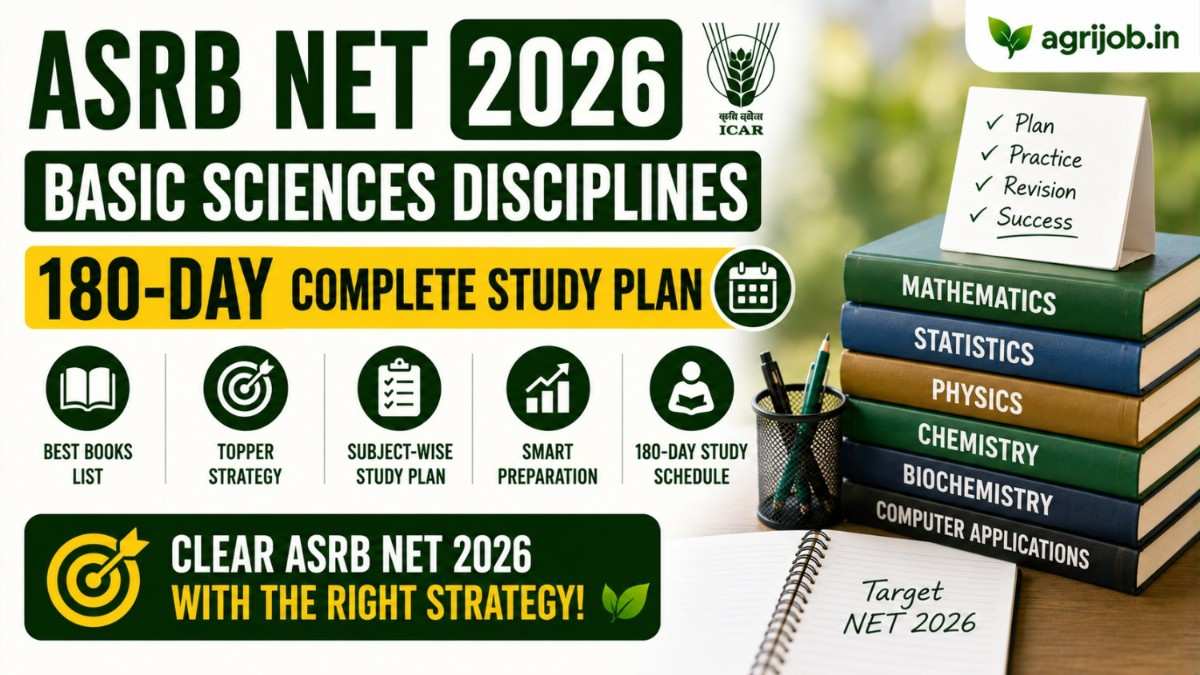
ASRB NET 2026 Basic Sciences Strategy – 180-Day Study Plan + Best Books
ASRB NET 2026 Basic Sciences disciplines — jisme Agricultural Statistics, Agricultural Biochemistry, Agricultural Microbiology, Agricultural Physics, Plant Physiology, Nematology, Agricultural Biotechnology, Plant Pathology, aur Genetics & Plant Breeding shamil hain — un lakhs PG graduates ke liye gateway hain jo Rs.56,100/month salary ke saath ICAR Scientist ya Agricultural University Lecturer banana chahte hain. Agricultural Scientists Recruitment Board (ASRB) 60 disciplines mein se har ek ke liye 150 MCQ, 150 marks, 2 hours ka same exam pattern rakhta hai — lekin har discipline ki preparation strategy bilkul alag hoti hai. Is complete guide mein aap padhenge: Basic Sciences disciplines ki poori list, discipline-wise exam unit breakdown, 180-day phased study plan, toppers ke proven secrets, subject-wise best books list, negative marking avoid karne ka formula, aur complete FAQ.

| Conducting Body | Agricultural Scientists Recruitment Board (ASRB) – asrb.org.in |
| Total Disciplines | 60 disciplines (Basic Sciences + Agriculture + Allied Sciences) |
| Exam Pattern (All Disciplines) | 150 MCQ / 150 Marks / 2 Hours / 1/3 Negative Marking |
| Syllabus Level | Master’s Degree Level (Theory + Applied + Recent Advances) |
| Total Vacancies (2025 Cycle) | 603 (ARS: 458, SMS T-6: 47, STO T-6: 98) |
| Basic Pay (Qualified) | Rs.56,100/month (Pay Level-10, 7th CPC) |
| Gross Salary | Rs.75,000–Rs.1,00,000+/month with HRA + DA + TA |
| NET Qualifying Marks (General) | ~50% (75/150); OBC ~45%; SC/ST/PwBD ~40% |
| Language | Bilingual – English & Hindi |
| Mode | Online CBT (Computer Based Test) |
- ASRB NET 2026 Basic Sciences – All Disciplines List & Unit Overview
- Exam Pattern – Prelims, Mains (ARS), Viva-voce
- Salary aur Career Scope – NET, ARS, SMS, STO 2026
- 180-Day Subject-wise Study Plan – Phase-by-Phase
- Topper Strategy – 10 Proven Secrets to Crack ASRB NET 2026
- Discipline-wise Syllabus Key Units – Basic Sciences
- Best Books List – Subject-wise for All Basic Sciences Disciplines
- Negative Marking Formula – Attempt vs Skip Strategy
- Who Should Apply for ASRB NET 2026 Basic Sciences?
- High-Value ASRB NET 2026 Terms You Must Know
- FAQ – ASRB NET 2026 Basic Sciences Complete Guide
ASRB NET 2026 Basic Sciences – All Disciplines List & Unit Overview
ASRB NET 2026 ke 60 disciplines mein se “Basic Sciences & Other Disciplines” category mein wo sab subjects aate hain jo core agricultural sciences se linked hain lekin fundamental science background rakhte hain. Neeche complete list hai jinke baare mein yeh guide strategies deti hai:
| Discipline | Key PG Background Required | Primary ICAR Posting Institutes |
|---|---|---|
| Agricultural Statistics | M.Sc. Agricultural Statistics / Statistics | IASRI (New Delhi), all ICAR institutes needing biometricians |
| Agricultural Physics | M.Sc. Agricultural Physics / Physics | IARI (New Delhi), soil physics divisions |
| Agricultural Biochemistry / Plant Biochemistry | M.Sc. Biochemistry / Plant Biochemistry | IARI, NBPGR, NIPB (New Delhi) |
| Agricultural Microbiology | M.Sc. Microbiology / Agricultural Microbiology | IARI, NBAIM (Mau), NBSS&LUP (Nagpur) |
| Plant Physiology | M.Sc. Plant Physiology / Botany | IARI, NIPB (New Delhi), CPCRI (Kasaragod) |
| Nematology | M.Sc. Nematology / Zoology | ICAR-NCIPM (New Delhi), all crop research institutes |
| Agricultural Biotechnology | M.Sc. Biotechnology / Agricultural Biotechnology | NIPB, NBPGR, NBAGR, NBFGR (various) |
| Plant Pathology | M.Sc. Plant Pathology / Mycology | NCIPM, IARI, CRIJAF, regional stations |
| Genetics & Plant Breeding | M.Sc. Genetics & Plant Breeding | NBPGR, IARI, IIMR, IIVR (various) |
| Agricultural Entomology | M.Sc. Entomology / Agricultural Entomology | NCIPM, IARI, ICAR-NBAIR (Bengaluru) |
| Environmental Science | M.Sc. Environmental Science / Ecology | NIASM, CAZRI, NBSS&LUP |
| Soil Science & Agricultural Chemistry | M.Sc. Soil Science | NBSS&LUP (Nagpur), IARI, CSSRI (Karnal) |
Important: Ek baar discipline select karne ke baad application submit ho jaane ke baad change nahi ho sakta. Isliye apna PG specialization carefully match karke discipline choose karein. Exam pattern sabke liye same hai — 150 MCQs, 150 marks, 2 hours, 1/3 negative marking — lekin syllabus completely discipline-specific hai.

ASRB NET 2026 Exam Pattern – Prelims, Mains (ARS), Viva-voce
| Stage | Applicable For | Marks | Duration | Type |
|---|---|---|---|---|
| Preliminary Exam (CBT) | NET + ARS + SMS + STO (All) | 150 marks (150 MCQs × 1) | 2 Hours | Online Objective – 1/3 Negative Marking |
| ARS Mains | ARS Only (Prelims qualifiers) | 240 marks | 3 Hours | Descriptive – Written (Offline) |
| Viva-voce (Interview) | ARS Only (Mains qualifiers) | 60 marks | ~30–45 minutes | Panel Interview |
| SMS/STO Final Selection | SMS (T-6) / STO (T-6) | Based on Prelims merit | – | Merit list from Prelims score |
| NET Certificate | NET Qualifiers | Pass/Fail basis | – | Digital certificate via DigiLocker |
Key Rule: Syllabus Prelims aur Mains dono ke liye same hai — sirf question format alag hai (objective vs descriptive). Iska matlab hai ek hi preparation dono stages serve karti hai. No sectional cut-offs hain NET mein — sirf overall score matters. In case of tie in ARS final merit, Mains marks prefer kiye jaate hain, aur phir Prelims marks.
Salary aur Career Scope – ASRB NET 2026 Basic Sciences
ASRB NET 2026 Basic Sciences qualify karna sirf ek certificate nahi — yeh ek lifetime career foundation hai. NET certificate holders State Agricultural Universities mein Lecturer/Assistant Professor ke liye eligible hote hain, jabki ARS qualify karne par ICAR ke 100+ institutes mein Scientist-B position milti hai.
| Post / Position | Basic Pay | Approx. Gross Salary | Where Posted |
|---|---|---|---|
| Lecturer / Asst. Professor (NET) | Rs.56,100/month | Rs.75,000–Rs.90,000/month | State Agricultural Universities across India |
| Scientist-B (ARS) | Rs.56,100/month | Rs.80,000–Rs.1,00,000/month | 100+ ICAR Institutes / Research Stations |
| SMS T-6 (Subject Matter Specialist) | Rs.56,100/month | Rs.75,000–Rs.95,000/month | ~730 KVKs (Krishi Vigyan Kendras) across India |
| STO T-6 (Senior Technical Officer) | Rs.56,100/month | Rs.75,000–Rs.90,000/month | ICAR Institutes / Research Farms |
Additional Perks: Government accommodation (or HRA), medical facilities (CGHS), pension under NPS, study leave for Ph.D., international deputation opportunities, research grants access, aur job security for life. Basic Sciences disciplines mein ARS Scientist ke liye IASRI (Statistics), IARI (Biochemistry, Microbiology, Physics), NIPB (Biotechnology), aur NCIPM (Entomology, Nematology) key postings hain.
180-Day Subject-wise Study Plan – ASRB NET 2026 Basic Sciences
Yeh 180-day plan universal structure hai jo kisi bhi Basic Sciences discipline ke aspirant apply kar sakta hai — sirf Phase 2 ke specific topics apni discipline ke according swap karein. Phase 1 aur Phase 4 sabke liye same hain.
Phase 1 – Foundation & Syllabus Mapping (Days 1–30)
- 📄 Days 1–3 (Syllabus Download + Analysis): asrb.org.in se apni discipline ka official syllabus PDF download karein. Har unit ko read karein aur ek master checklist banayein — har topic ke saamne tick box. Estimate karein ki PG mein yeh kitna cover kiya tha (Strong/Medium/Weak). Yeh step 180 days ki efficiency determine karta hai.
- 📚 Days 4–15 (Unit 1 – Foundation Topics): Har discipline ka Unit 1 typically foundational concepts cover karta hai — Biochemistry ke liye biomolecules, Statistics ke liye probability aur distributions, Microbiology ke liye cell structure aur classification, Physiology ke liye cell organelles. Standard PG textbooks se padhen. Daily 5-6 hours. End goal: Unit 1 complete with 50 MCQ self-test.
- 🔍 Days 16–30 (Unit 2 + PYQ Pattern Analysis): Unit 2 padhte hue parallel mein last 3 years ke PYQs solve karein. Pattern identify karein — kaunse units se zyada questions aaye, kaunse topic baar baar repeat hue. Yeh data Phase 2 mein time allocation guide karega. Weekly mock: 75 MCQ in 60 minutes (time pressure practice).
Phase 2 – Core Topics Deep Dive (Days 31–100) – Discipline-Specific
- 🔬 Agricultural Statistics (Days 31–100): ANOVA (one-way, two-way, split-plot, strip-plot, LSD), experimental designs (CRD, RBD, LSD, factorial experiments), probability distributions (Normal, Binomial, Poisson), sampling methods (SRS, stratified, cluster, PPS), regression aur correlation, non-parametric tests, time series analysis. Numericals daily mandatory — theory alone kafi nahi hai. Gomez & Gomez chapter-by-chapter cover karein.
- 🧫 Agricultural Microbiology (Days 31–100): Soil microbiology aur nutrient cycles (nitrogen – ammonification, nitrification, denitrification; phosphorus; sulfur), biological nitrogen fixation (Rhizobium genetics, nod genes, nif genes), biofertilizers (types, mode of action, quality control), PGPR mechanisms (IAA, phosphate solubilization, siderophore production), bioremediation, environmental microbiology, aur microbiological techniques (sterilization, staining, microscopy types). Scientific names aur gene names flashcard se yaad karein.
- 🌿 Plant Biochemistry (Days 31–100): Enzyme kinetics (Michaelis-Menten, Km, Vmax, inhibition types), photosynthesis (light reactions – cyclic/non-cyclic photophosphorylation, dark reactions – Calvin cycle, C4, CAM), respiration (glycolysis, TCA cycle, oxidative phosphorylation, ETC), phytohormones (auxin, gibberellin, cytokinin, ethylene, ABA — biosynthesis, mode of action), secondary metabolites, food biochemistry (post-harvest technology), vitamins aur their deficiency diseases.
- ⚗️ Agricultural Physics (Days 31–100): Soil physics (soil texture, structure, porosity, bulk density, particle density, water retention curves, field capacity, permanent wilting point), radiation physics (solar radiation, PAR, albedo, radiation balance), micrometeorology (evapotranspiration – Penman equation, Bowen ratio, aerodynamic method), soil temperature, heat flow, seed germination physics, physical methods of soil analysis. Calculations aur formulas daily practice karein.
- 🌱 Plant Physiology (Days 31–100): Water relations (water potential, osmotic potential, turgor, plasmolysis), mineral nutrition (essential elements, deficiency symptoms, Hoagland solution), photosynthesis (pigments, light reactions, carbon fixation), photorespiration, respiration (aerobic + anaerobic), nitrogen metabolism (GS-GOGAT pathway), phytohormones, seed dormancy aur germination, stress physiology (drought, salt, temperature, heavy metal tolerance mechanisms).
- 🐛 Nematology (Days 31–100): Morphology aur taxonomy of plant parasitic nematodes (Meloidogyne, Heterodera, Pratylenchus, Tylenchulus, Radopholus, Ditylenchus, Rotylenchulus), life cycles, pathogenesis mechanisms, host-parasite interaction, symptoms on crops, economic threshold levels, management strategies (biological, chemical, cultural, host resistance), nematicides (fumigant vs non-fumigant), nematode extraction aur identification techniques.
- 🧬 Agricultural Biotechnology (Days 31–100): Recombinant DNA technology (restriction enzymes, vectors, cloning, PCR, sequencing), tissue culture (media, totipotency, organogenesis, somatic embryogenesis, protoplast culture), transgenic plants (Agrobacterium-mediated, biolistic, gene gun), molecular markers (RFLP, RAPD, AFLP, SSR, SNP), genomics aur proteomics (DNA microarray, 2D-PAGE), plant genetic transformation, biosafety regulations (Cartagena Protocol), bioinformatics tools (BLAST, NCBI).
Phase 3 – Advanced Topics + Applied Concepts (Days 101–145)
- 🏭 Days 101–120 (Applied & Industrial Aspects): Har discipline ke industrial/applied applications cover karein. Microbiology ke liye fermentation technology, enzyme production, SCP. Biochemistry ke liye food preservation, nutraceuticals, antioxidants. Biotechnology ke liye biopesticides, bioremediation, GM crops regulatory framework. Statistics ke liye sampling surveys, agricultural surveys methodology. Yeh topics “recent advances” category se question laate hain jo high-scorers differentiate karte hain.
- 🌍 Days 121–135 (Current Affairs + Policy + National Programs): Apni discipline se related national programs cover karein: Biotechnology ke liye National Biotechnology Development Strategy, GEAC approvals (Bt cotton, Bt brinjal, etc.); Microbiology ke liye biofertilizer quality control orders; Statistics ke liye NSSO methodology, agricultural census, crop estimation surveys; Environmental Science ke liye Climate Change Action Plan, biodiversity hotspots. ICAR institute-specific research achievements bhi occasionally aate hain.
- 🔄 Days 136–145 (Cross-Linkage Topics): Har Basic Sciences discipline mein doosri disciplines se overlap hota hai — Biochemistry + Genetics, Microbiology + Plant Pathology, Statistics + Field Experiments. In cross-links ko identify karein aur bridge notes banayein. Yeh integration exam mein tricky questions solve karne mein help karta hai.
Phase 4 – Revision, PYQs & Mock Tests (Days 146–180)
- 📝 Days 146–160 (Rapid Revision – Flash Cards): Har unit ke liye 1-2 page summary notes banayein (A4 sheet). Key formulas, scientific names, definitions, numerical values, aur process steps — sab bullet points mein. Yeh flash cards Phase 4 mein primary study material hain — original books sirf doubt resolution ke liye.
- 📊 Days 161–173 (PYQ Marathon): Last 5 years ke official ASRB NET aur ICAR ARS papers apni discipline ke solve karein — timer ke saath. Har paper ke baad topic-wise error analysis karein. Recurring topics identify karein. Weak areas specifically re-study karein — targeted 30-minute sessions.
- 🎯 Days 174–180 (Full Mock Test Mode): Har 2 din mein 1 full mock (150 MCQ, 2 hours, strict timer). Real exam conditions: phone off, proper desk, no interruptions. Score track karein aur accuracy % maintain karein — target 85%+. Last 2 days: sirf flash card revision + adequate sleep (7-8 hours). Naya topic bilkul nahi.
| Phase | Days | Focus Area | Daily Hours | Weekly Target |
|---|---|---|---|---|
| Phase 1 – Foundation | 1–30 | Syllabus Analysis, Units 1-2, PYQ Pattern Study | 5–6 hrs | 1 unit + 75 MCQ PYQ |
| Phase 2 – Core Topics | 31–100 | Units 3-6 (Discipline-Specific Deep Dive) | 6–7 hrs | 1 unit + 100 MCQ practice |
| Phase 3 – Advanced | 101–145 | Applied Topics, Current Affairs, Cross-links | 6–7 hrs | 150 MCQ full practice test |
| Phase 4 – Mock Tests | 146–180 | Flash Card Revision, PYQ Marathon, Full Mocks | 7–8 hrs | 2 full mock tests (150 MCQ each) |
Topper Strategy – 10 Proven Secrets to Crack ASRB NET 2026 Basic Sciences
- 🎯 Official Syllabus = Your Only Bible: asrb.org.in se apni discipline ka official syllabus PDF download karein aur print karke desk par laga lein. Sirf syllabus mein mentioned topics padhen — outside-syllabus reading time waste hai. Toppers jo distinguish karte hain woh syllabus ko “letter by letter” follow karte hain.
- 📖 PYQs First, Theory Books Second: Preparation shuru karne ke pehle 2-3 years ke PYQs solve karein bina kuch padhe. Isse pata chalega ki kaunse concepts direct MCQ mein aate hain, kaunse theoretical, aur kaunse numerical. Yeh analysis baaki 178 days ki strategy set karta hai.
- 🔢 Numerical Disciplines ke liye Daily Problem Solving Mandatory: Agricultural Statistics aur Agricultural Physics candidates ke liye daily numerical practice non-negotiable hai. Theory samajhna kafi nahi — formulas derive karna, ANOVA table fill karna, aur numerical solve karna baar baar karein. 30 minutes numerical daily = exam mein 15-20 extra marks guaranteed.
- 🧠 Self-Explanation Technique: Jo concept padha hai use apne aap ko explain karein — jaise kisi student ko padhaa rahe ho. Agar explain nahi ho paaya, toh samajh nahi aaya. Yeh technique retention 50-70% improve karti hai aur MCQ trap options se bachati hai.
- 📊 Error Log Maintain Karein: Har mock test mein galat answers ek dedicated notebook mein likhein — concept, correct answer, aur explanation. Monthly is log ko review karein. Toppers apni most common mistake patterns identify karke unhe eliminate karte hain — yeh final exam mein 10-15 extra marks dilata hai.
- 🌐 ICAR Research Journal Reading: ICAR ने 2025-26 mein apni institutes mein kya research kiya — woh topics exam mein “recent advances” ke under aate hain. ICAR official website, Annual Reports, aur NABS (National Academy of Agricultural Sciences) publications monthly skim karein — sirf headlines aur key findings, depth nahi chahiye.
- 👥 Study Group + Peer Teaching: ASRB NET aspirants ka Telegram ya WhatsApp group join karein. Har topic par 5-minute voice note banana aur group mein share karna — dono sides ko benefit karta hai. Doosron ke doubts solve karne se apni understanding crystallize hoti hai.
- ⏱️ Time Management Per Question: 150 questions, 120 minutes = 48 seconds per question. Mock tests mein yeh timing maintain karein. Stuck questions par 90 seconds se zyada nahi ruka karein — flag karein aur aage badhen. Last 20 minutes mein flagged questions review karein.
- 📱 Last 30 Days Mein Digital Detox: Social media, news scrolling, aur unnecessary apps last 30 days mein minimum karein. Focus sirf mock tests, flash card revision, aur adequate sleep par. Yeh ek discipline habit hai jo consistently toppers follow karte hain.
- 😴 Sleep 7-8 Hours Strictly: Memory consolidation raat ko sone ke dauraan hoti hai — isliye sleep cut karna counterproductive hai. Exam night 8 hours sleep mandatory. Naye topic padh ke exam dena ek common mistake hai jo 10-15 marks cost karti hai confusion se.
Agricultural Statistics toppers ka common advice: “ANOVA aur experimental designs se milke 20-25 questions consistently aate hain — sirf yeh ek chapter perfect karo toh pass guaranteed hai.” Microbiology toppers kehtein hain: “Nitrogen cycle ke steps, enzymes (nitrogenase, nitrate reductase), aur gene names (nif genes, nod genes) — yeh ek page ke notes se 8-10 marks milte hain.” Biotechnology aspirants ke liye common tip: “Molecular markers (RFLP vs RAPD vs SSR) ki comparison table banao — exam mein comparison-based MCQs directly is table se solve ho jaate hain.” Statistics ke ek topper ne bataya: “Gomez & Gomez ki book sirf selected chapters (CRD, RBD, LSD, split-plot) baar baar padhi — baaki sab secondary tha.”
Discipline-wise Key Syllabus Units – ASRB NET 2026 Basic Sciences
Har discipline ke official syllabus mein 5-7 units hote hain. Neeche key units aur highest-yield topics discipline-wise hain — official complete syllabus asrb.org.in se download karein:
| Discipline | Highest-Yield Units (Exam MCQ Focus) | Est. Weightage |
|---|---|---|
| Agricultural Statistics | ANOVA (split-plot, strip-plot, LSD) | Experimental Designs (CRD, RBD, factorial) | Probability + Distributions | Regression & Correlation | Sampling Methods | Unit 1-3: ~60% of questions |
| Agricultural Physics | Soil Physics (water retention, pF curves, field capacity, PWP) | Radiation & Energy Balance | ET calculation methods (Penman, Thornthwaite) | Soil Temperature | Micrometeorology | Unit 1-2: ~50% of questions |
| Plant Biochemistry | Enzyme kinetics (Km, Vmax, inhibition) | Photosynthesis (light + dark reactions) | Phytohormones (biosynthesis + mode of action) | Secondary metabolites | Food biochemistry (post-harvest) | Unit 1-3: ~55% of questions |
| Agricultural Microbiology | Biological N2 Fixation | Soil Microbiology + Nutrient Cycles | Biofertilizers (types, mode of action) | PGPR mechanisms | Microbiological Techniques | Unit 2-3: ~55% of questions |
| Plant Physiology | Water relations (water potential) | Mineral nutrition + deficiency symptoms | Photosynthesis (C3, C4, CAM) | Phytohormones | Stress physiology (drought, salt, temperature) | Unit 1-4: ~65% of questions |
| Nematology | Taxonomy + morphology of plant parasitic nematodes | Life cycles (Meloidogyne, Heterodera) | Host-parasite interaction + symptoms | Management strategies | Nematode extraction techniques | Unit 1-3: ~60% of questions |
| Agricultural Biotechnology | Recombinant DNA + cloning vectors | PCR + molecular markers comparison | Transgenic plant methods (Agrobacterium vs biolistic) | Tissue culture (media types, organogenesis) | Biosafety regulations | Unit 1-3: ~55% of questions |
| Genetics & Plant Breeding | Mendelian genetics + extensions | Chromosome structure + mutation | Quantitative genetics | Plant breeding methods (hybridization, selection, mutation breeding) | Molecular breeding + marker-assisted selection | Unit 1-4: ~65% of questions |
Best Books List – ASRB NET 2026 Basic Sciences – Subject-wise
ASRB NET 2026 Basic Sciences ke liye sahi books chunna sabse critical preparation decision hai. Neeche discipline-wise recommended books hain jinhein toppers aur university faculty recommend karte hain:
| Discipline | Must-Read Books | Author(s) |
|---|---|---|
| Agricultural Statistics | A Textbook of Agricultural Statistics | R. Rangaswamy |
| Statistical Procedures for Agricultural Research (2nd Ed.) | Gomez & Gomez | |
| Statistical Methods (8th Ed.) | Snedecor G.W. & Cochran W.G. | |
| Agricultural Physics | Introduction to Environmental Physics | P. Smithson et al. |
| Soil Physics (6th Ed.) | D. Hillel | |
| Micrometeorology in Agricultural Systems | Rosenberg, Blad & Verma | |
| Plant Biochemistry / Agricultural Biochemistry | Biochemistry (9th Ed.) — Lehninger’s Principles | Nelson & Cox |
| Plant Biochemistry (4th Ed.) | Heldt H.W. & Piechulla B. | |
| Biochemistry of Plants (Vols. 1–16) | Stumpf & Conn (Academic Press) | |
| Agricultural Microbiology | Soil Microbiology, Ecology and Biochemistry (4th Ed.) | Paul E.A. |
| Microbiology: An Introduction (13th Ed.) | Tortora, Funke & Case | |
| Soil Microorganisms and Plant Growth (4th Ed.) | Subba Rao N.S. | |
| Plant Physiology | Plant Physiology (6th Ed.) | Taiz & Zeiger (Lincoln) |
| Plant Physiology & Development (6th Ed.) | Taiz, Zeiger, Møller & Murphy | |
| Plant Physiology (ICAR PG Textbook) | Various ICAR Authors | |
| Nematology | Plant Nematology (3rd Ed.) | Hunt D.J. & Perry R.N. |
| Nematology: Advances and Perspectives (Vol. 1 & 2) | Chen Z.X., Chen S.Y., Dickson D.W. | |
| Plant Parasitic Nematodes in Subtropical & Tropical Agriculture | Luc M., Sikora R.A., Bridge J. | |
| Agricultural Biotechnology | Molecular Biology of the Gene (7th Ed.) | Watson et al. |
| Plant Biotechnology & Genetics | C. Neal Stewart Jr. | |
| Principles of Gene Manipulation & Genomics (7th Ed.) | Primrose & Twyman | |
| Genetics & Plant Breeding | Principles of Genetics (8th Ed.) | Gardner, Simmons & Snustad |
| Principles of Plant Breeding (2nd Ed.) | R.W. Allard | |
| Introduction to Plant Breeding | Singh B.D. (Kalyani Publishers) |
MCQ Practice Books (All Disciplines): AgricultureNotes.com ke unit-wise MCQ eBooks, Testbook aur Adda247 ke discipline-wise practice sets, aur ICAR JRF/SRF previous year papers — yeh sab parallel mein use karein. ICAR approved PG textbooks jo university library mein milte hain unhe primary reference maanein.
Negative Marking Formula – Attempt vs Skip Strategy
ASRB NET 2026 Basic Sciences mein 1/3 negative marking sabse important factor hai jo scores differentiate karta hai. Yeh mathematical framework use karein:
| Confidence Level | Options Eliminated | Expected Score per Attempt | Decision |
|---|---|---|---|
| 80%+ (Very Sure) | 3 options eliminated | +0.80 – 0.07 = +0.73 | ✅ Always Attempt |
| 60-80% (Fairly Sure) | 2-3 options eliminated | Positive expected value | ✅ Attempt |
| 50% (2 options remain) | 2 options eliminated | 0.5 – 0.17 = +0.33 | ✅ Attempt (mathematically profitable) |
| 33% (3 options remain) | 1 option eliminated | 0.33 – 0.22 = +0.11 | ⚠️ Marginal – Skip if unsure |
| 25% (No elimination) | 0 options eliminated | 0.25 – 0.25 = 0.00 | ❌ Skip – Waste of attempt |
| Random Guess | Nothing eliminated | Zero or negative expected | ❌ Never attempt randomly |
Practical Target: 180 days ke baad well-prepared candidate ko 110-130 questions attempt karne chahiye with 85%+ accuracy. 100 questions × 85% accuracy = 85 correct – 15 wrong = 85 – 5 = 80 net marks — yeh NET qualifying marks (75) se above hai. 130 questions × 85% accuracy = 110 correct – 20 wrong = 110 – 6.67 = ~103 net marks — strong score hai.
Who Should Apply for ASRB NET 2026 Basic Sciences?
- 📊 M.Sc. Agricultural Statistics Graduates: Jo ICAR-IASRI, statistical divisions, aur agricultural universities mein biometrician ya statistician career chahte hain — Agricultural Statistics discipline mein ARS qualify karna best gateway hai.
- 🧪 M.Sc. Biochemistry / Plant Biochemistry Graduates: Jo IARI, NIPB, NBPGR jaise premier ICAR institutes mein biochemistry research ya university mein lecturer banana chahte hain — Plant Biochemistry ya Agricultural Biochemistry discipline choose karein.
- 🦠 M.Sc. Microbiology / Agricultural Microbiology Graduates: Jo soil microbiology, biofertilizer research, PGPR, ya environmental microbiology mein ICAR career banana chahte hain — Agricultural Microbiology discipline mein apply karein.
- ⚗️ M.Sc. Physics / Agricultural Physics Graduates: Jo soil physics, micrometeorology, aur agrometeorological research mein IARI ya state university faculty banana chahte hain.
- 🌿 M.Sc. Plant Physiology / Botany Graduates: Jo stress physiology, photosynthesis research, hormonal regulation, aur crop improvement research mein career banana chahte hain.
- 🐛 M.Sc. Nematology / Zoology Graduates: Jo nematode research, biocontrol, aur crop protection mein ICAR-NCIPM ya crop research institutes mein scientist banana chahte hain.
- 🧬 M.Sc. Biotechnology / Agricultural Biotechnology Graduates: Jo transgenic crops, molecular markers, tissue culture, aur genomics research mein NIPB, NBPGR, NBAGR jaise ICAR institutes mein career chahte hain.
- 👩🔬 Women PG Graduates in Basic Sciences: ASRB aur state agricultural universities mein women scientists ke liye special recruitment considerations hain — Basic Sciences disciplines mein women researchers ki demand consistently bani rehti hai ICAR research programs mein.
High-Value ASRB NET 2026 Basic Sciences Terms You Must Know
- 🔑 ANOVA (Analysis of Variance): Agricultural experiments ka core statistical tool — treatment effects separate karta hai residual error se. One-way, two-way, split-plot, strip-plot ANOVA tables fill karna exam mein directly poochha jaata hai. F-ratio calculation aur interpretation mandatory knowledge hai Agricultural Statistics aspirants ke liye.
- 🔑 Biological Nitrogen Fixation (BNF): Microbiology aur Soil Science ka most-asked topic — atmospheric N2 ko NH3 mein convert karna. Enzymes: nitrogenase (nifH, nifD, nifK genes). Organisms: symbiotic (Rhizobium-legume), free-living asymbiotic (Azotobacter, Clostridium), associative (Azospirillum, Herbaspirillum). Energy requirement: 16 ATP per N2 fixed.
- 🔑 PCR (Polymerase Chain Reaction): Biotechnology ka fundamental technique — DNA amplification, steps (denaturation 94°C, annealing 50-65°C, extension 72°C), components (Taq polymerase, primers, dNTPs), applications (diagnosis, fingerprinting, marker-assisted selection). Variations: RT-PCR, qPCR, RAPD, ISSR — sabke differences yaad rakhein.
- 🔑 Phytohormones: Plant Physiology aur Plant Biochemistry dono mein — Auxin (IAA: apical dominance, root initiation, polar transport), Gibberellin (GA3: stem elongation, seed germination, bolting), Cytokinin (cell division, shoot organogenesis, delay senescence), Ethylene (fruit ripening, abscission, triple response), ABA (stress response, stomatal closure, seed dormancy). Each hormone ka discovery history, biosynthesis pathway, aur receptor occasionally poochha jaata hai.
- 🔑 Michaelis-Menten Kinetics: Biochemistry ka mandatory topic — Km (substrate concentration at half Vmax), Vmax (maximum reaction rate), Lineweaver-Burk plot, enzyme inhibition types (competitive: Km increases, Vmax same; non-competitive: Km same, Vmax decreases; uncompetitive: both decrease). Numerical calculations direct exam mein aate hain.
- 🔑 Meloidogyne (Root-Knot Nematode): Most economically important nematode globally — Nematology ka centerpiece. M. incognita, M. javanica, M. arenaria, M. hapla (cold tolerant) — host range, life cycle (egg to adult: 4 juvenile stages — J1 in egg, J2 infective stage, J3, J4, adult), gall formation mechanism, management (carbofuran, fenamiphos, Pasteuria penetrans biocontrol). Perineal pattern differentiation species identification ke liye.
- 🔑 Field Capacity & Permanent Wilting Point: Agricultural Physics aur Soil Science ka common topic — Field capacity: ~-0.33 bar (1/3 atm); PWP: ~-15 bar (15 atm). Available water = FC – PWP. Tensiometer range, neutron moisture probe, TDR — soil water measurement methods exam mein frequently aate hain.
- 🔑 Marker-Assisted Selection (MAS): Biotechnology + Genetics overlap topic — DNA markers use karke breeding decisions lena. RFLP (first-generation, co-dominant), RAPD (dominant, cheap), AFLP (high polymorphism), SSR/microsatellites (co-dominant, highly reproducible), SNP (most abundant, next-gen sequencing based). Comparison table se exam MCQs seedhe solve hote hain.
- 🔑 C3, C4, CAM Photosynthesis: Plant Physiology aur Biochemistry dono mein — C3 (first stable product: 3-PGA, Calvin cycle, most crops — wheat, rice, soybean), C4 (first stable product: OAA, bundle sheath + mesophyll cells, high WUE — maize, sorghum, sugarcane), CAM (nocturnal CO2 fixation, succulent plants — cactus, pineapple). Enzymes: RuBisCO (C3+C4), PEP carboxylase (C4+CAM).
- 🔑 Experimental Designs (CRD, RBD, LSD): Agricultural Statistics ka highest-weight topic — CRD (completely randomized, no blocking, error df = N-t), RBD (one-way blocking, reduces error, df block = b-1), LSD (two-way blocking, df = (r-1)(t-1), requires r=t=b). Formula bank se ANOVA table construction practice daily karein.
FAQ – ASRB NET 2026 Basic Sciences Complete Guide
ASRB NET 2026 Basic Sciences mein kaunse disciplines cover hote hain?
ASRB NET 2026 Basic Sciences category mein ye key disciplines hain: Agricultural Statistics, Agricultural Physics, Agricultural Biochemistry (Plant Biochemistry), Agricultural Microbiology, Plant Physiology, Nematology, Agricultural Biotechnology, Plant Pathology, Genetics & Plant Breeding, Agricultural Entomology, Environmental Science, aur Soil Science & Agricultural Chemistry. In sab disciplines ke liye 150 MCQ, 150 marks, 2 hours, 1/3 negative marking ka same exam pattern lagoo hota hai. Official complete discipline list aur syllabus asrb.org.in par available hai — notification ke saath update hota hai.
ASRB NET 2026 Basic Sciences qualify karne par salary kitni milti hai?
ASRB NET 2026 Basic Sciences qualify karne par Pay Level-10 (7th CPC) par Rs.56,100 basic pay milti hai. Gross salary HRA + DA + TA ke saath Rs.75,000 se Rs.1,00,000+ per month hoti hai depending on posting location. ARS qualify karne par ICAR institutes mein Scientist-B position milti hai. Career growth path mein Scientist-B se C, D, E, aur SG positions tak Rs.1,77,500 tak basic pay ho sakti hai. Additional perks: CGHS medical, NPS pension, study leave, research grants access.
ASRB NET 2026 Agricultural Statistics ke liye kaunsi best books hain?
ASRB NET 2026 Agricultural Statistics ke liye best books: Rangaswamy R. – A Textbook of Agricultural Statistics (Indian context – must read), Gomez & Gomez – Statistical Procedures for Agricultural Research (experimental designs – most questions yahan se), Snedecor & Cochran – Statistical Methods (classical reference), Cochran & Cox – Experimental Designs (advanced reference), aur Das & Giri – Design and Analysis of Experiments. Numerical practice daily mandatory hai — theory alone kafi nahi. Previous year ICAR/ASRB Statistics papers solve karna equally important hai.
ASRB NET 2026 Agricultural Microbiology ke important topics kya hain?
ASRB NET 2026 Agricultural Microbiology ke highest-yield topics: Biological Nitrogen Fixation (Rhizobium symbiosis, nif genes, nitrogenase enzyme, energy requirement), Soil Microbiology (nutrient cycles – N, P, S), Biofertilizers (Azospirillum, Azotobacter, PSB, VAM — types, mode of action, PGPR mechanisms), Environmental Microbiology (bioremediation, biocontrol agents), aur Microbiological Techniques (sterilization, staining, microscopy types, culture media). Scientific names aur gene names ko flashcard method se yaad karein — direct MCQs aate hain inse.
ASRB NET 2026 Plant Biochemistry aur Agricultural Biochemistry mein kya fark hai?
ASRB NET 2026 mein Plant Biochemistry aur Agricultural Biochemistry technically alag disciplines hain lekin significant overlap hai. Plant Biochemistry specifically plants pe focus karta hai — phytohormones, photosynthesis pathways (C3/C4/CAM), secondary metabolites (alkaloids, terpenoids, phenolics), aur post-harvest biochemistry. Agricultural Biochemistry broader scope rakhta hai — enzymes, vitamins, hormones, food chemistry, soil biochemistry, analytical techniques. Candidates apna PG specialization check karein aur ussi discipline mein apply karein — discipline change application submit ke baad possible nahi hai.
ASRB NET 2026 mein 180-day study plan kaise follow karein agar working professional hain?
Working professionals ke liye modified 180-day plan: Weekdays 3-4 hours (morning 5-7 AM ya evening 9-11 PM), weekends 7-8 hours. Phase 1 (Days 1-45): Foundation — 1 unit per week. Phase 2 (Days 46-90): Core topics — 1 unit per 10 days. Phase 3 (Days 91-135): PYQ solving + weak area revision. Phase 4 (Days 136-180): Full mock tests (2 per week) + flash card revision. Key rule: weekends ko mock test + deep study ke liye completely reserve karein. Lunch break (20 min) aur commute time (15 min) flash card review ke liye use karein — yeh small time slots milke daily 40-50 MCQ practice possible banate hain.
ASRB NET 2026 Basic Sciences mein minimum qualifying marks kitne hain?
ASRB NET 2026 Basic Sciences mein minimum qualifying marks category-wise hain: General category ke liye approximately 50% (75/150 marks), OBC ke liye approximately 45% (67-68/150), SC/ST/PwBD ke liye approximately 40% (60/150). Lekin NET certificate milne se state agricultural university selection guarantee nahi hoti — universities apni merit list alag se banati hain. ARS ke liye cut-off typically zyada competitive hota hai kyunki Prelims ke baad Mains (240 marks) + Viva-voce (60 marks) bhi qualify karna hota hai. Exact qualifying marks official notification mein hote hain.
ASRB NET 2026 Basic Sciences ke liye PYQs kahan se milte hain?
ASRB NET 2026 Basic Sciences ke liye PYQs in sources se milte hain: asrb.org.in par official website se previous papers check karein, Testbook aur Adda247 platforms par discipline-wise PYQ practice sets milte hain, AgricultureNotes.com par unit-wise MCQ eBooks available hain, aur Telegram groups (ASRB NET, ICAR JRF/SRF) par PYQ PDFs share hote hain. Minimum last 5 years ke papers solve karna recommended hai. ICAR JRF/SRF ke papers bhi solve karein — syllabus overlap significant hai aur question difficulty comparable hai.
Official Resources aur Useful Links:
- 🔗 ASRB Official Website – asrb.org.in (Notification, Syllabus PDF Download, Admit Card, Results)
- 🔗 ICAR Official Website – icar.org.in (Institute-wise research programs, annual reports)
- 🔗 ICAR-IASRI New Delhi – iasri.res.in (Agricultural Statistics – premier research institute)
- 🔗 ICAR-IARI New Delhi – iari.res.in (Physics, Biochemistry, Microbiology, Physiology divisions)
Yeh guide regularly reviewed aur updated ki jaati hai. ASRB NET 2026 Basic Sciences notification, exam date, syllabus changes, aur latest updates ke liye is page ko bookmark karein.
Last Updated: June 2026