
TNPSC Group 4 Syllabus 2026 is the single most important document every Tamil Nadu government job aspirant needs right now. The Tamil Nadu Public Service Commission (TNPSC) has confirmed the exam date as 20 December 2026, with the official notification releasing on 6 October 2026 at tnpsc.gov.in. With over 20 lakh candidates expected to compete for approximately 3,935+ vacancies, your preparation strategy — built on the correct, updated syllabus — is the single biggest factor that separates toppers from the rest.

This guide is for 10th-pass and graduate aspirants aged 18–37 years who are serious about securing a VAO, Junior Assistant, Typist, or Forest Guard post in Tamil Nadu. Here you will find the complete subject-wise TNPSC Group 4 Syllabus 2026, full exam pattern breakdown, a data-driven PYQ (Previous Year Question) topic analysis, and a proven 4-phase preparation strategy for December 2026. If you are also preparing for a higher-grade post, see our complete guide on TNPSC CCSE-II Group 2 & 2A Syllabus 2026 — both exams share overlapping GS topics and can be prepared simultaneously.
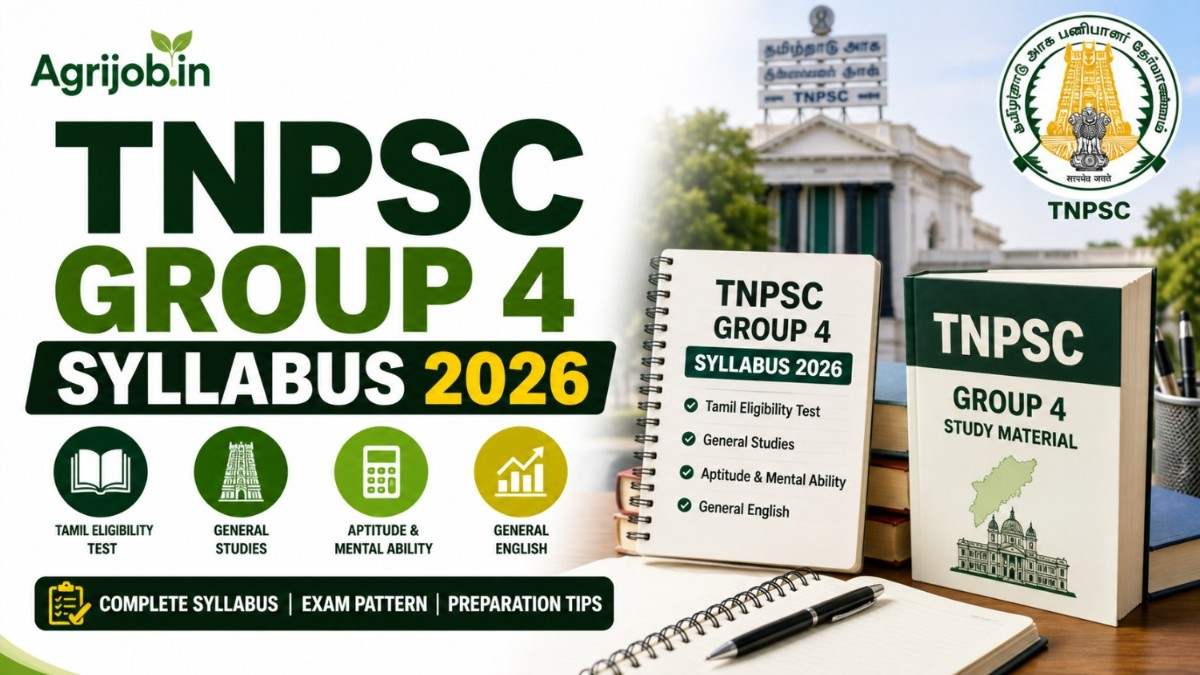
The TNPSC Group 4 Syllabus 2026 covers 3 parts: Part A — Tamil Eligibility Test (100 questions, 150 marks), Part B — General Studies (75 questions, 112.5 marks), and Aptitude & Mental Ability (25 questions, 50 marks). The total exam is 200 questions for 300 marks, conducted in 3 hours on 20 December 2026, with no negative marking. Notification releases 6 October 2026 at tnpsc.gov.in.
- Conducting Body: Tamil Nadu Public Service Commission (TNPSC)
- Exam Name: Combined Civil Services Examination – IV (CCSE-IV)
- Notification Date: 6 October 2026
- Application Deadline: 5 November 2026
- Hall Ticket Release: 10 December 2026
- Exam Date: 20 December 2026 (Single Shift: 9:30 AM – 12:30 PM)
- Total Questions: 200 (Objective / MCQ)
- Total Marks: 300
- Exam Mode: Offline (OMR / Pen-and-Paper)
- Negative Marking: None
- Minimum Qualifying Marks (Tamil Test): 90 out of 150 (for all categories)
- Salary Range: Rs.19,500 – Rs.75,900/month (post-wise)
- Previous Cycle Vacancies: 4,662 posts (2025 cycle)
- Application Fee: Rs.250 (General); Exempted for SC/ST/OBC
- Official Website: tnpsc.gov.in
📋 Table of Contents
- What is TNPSC Group 4?
- Who Should Read This Guide?
- Salary & Post-wise Pay Scale 2026
- Eligibility Criteria & Age Limit 2026
- TNPSC Group 4 Exam Pattern 2026
- Complete Subject-wise Syllabus 2026
- PYQ Analysis – Topic-wise Weightage (2019–2025)
- TNPSC Group 4 vs Group 2A – Key Differences
- Pros and Cons of TNPSC Group 4 Exam
- 4-Phase Preparation Strategy for December 2026
- Important Terms & Concepts
- Important Dates & Timeline 2026
- Important Links Table
- Conclusion
- Key Takeaways
- Frequently Asked Questions
What is TNPSC Group 4 (CCSE-IV) 2026?
TNPSC Group 4, officially called the Combined Civil Services Examination – IV (CCSE-IV), is a state-level recruitment exam conducted by the Tamil Nadu Public Service Commission to fill clerical and field-level government posts across Tamil Nadu departments. It is the most popular and accessible government job exam in Tamil Nadu, requiring only an SSLC (10th standard) qualification for most posts.

The TNPSC Group 4 Syllabus 2026 is structured at the SSLC/Class 10 standard, covering General Tamil (or General English for persons with disabilities), General Studies, and Aptitude & Mental Ability. The exam is a single-stage written test followed by document verification — no interview, no physical test for most posts. This makes it one of the most straightforward government exams in India in terms of selection stages.
Posts recruited under Group 4 include: Village Administrative Officer (VAO), Junior Assistant, Bill Collector, Typist, Steno-Typist, Personal Clerk, Field Assistant, Junior Executive, Junior Revenue Inspector, Forest Guard, Forest Watcher, Laboratory Assistant, Milk Recorder, and Receptionist-cum-Telephone Operator, among others.
Who Should Read This TNPSC Group 4 Guide?
- 🎓 10th-pass school leavers (18+) applying for their first government job in Tamil Nadu
- 🏛️ College students and graduates who want a stable state government job while continuing education
- 👨🌾 Rural and semi-urban aspirants targeting VAO or Field Assistant posts for community-level roles
- 🔄 Repeaters from previous TNPSC Group 4 cycles (2022, 2024, 2025) who want a data-driven strategy for 2026
- 👩💼 Working professionals in the 25–34 age bracket with BC/MBC/OBC category relaxation looking to switch to government service
- 📚 Tamil medium students who want to leverage their Tamil language advantage in Part A
- 🌲 Forest department aspirants targeting Forest Guard and Forest Watcher posts
- 🏦 Candidates from SC/ST categories (age limit up to 37 years) planning their first or next attempt
TNPSC Group 4 Salary & Post-wise Pay Scale 2026
The TNPSC Group 4 salary structure follows the Tamil Nadu Government’s 7th Pay Commission-revised scales. The monthly in-hand salary after deductions (including DA, HRA, and allowances) for Chennai-based postings ranges from Rs.32,000 to Rs.41,000/month, making it a highly attractive government job at the entry level.
| Post Name | Pay Level | Basic Pay Range (Rs.) | Gross Salary (Approx. Rs./month) |
|---|---|---|---|
| Village Administrative Officer (VAO) | Level 5 | 20,600 – 65,500 | 35,000 – 42,000 |
| Junior Assistant | Level 4 | 19,500 – 62,000 | 32,000 – 39,000 |
| Typist | Level 4 | 19,500 – 62,000 | 32,000 – 39,000 |
| Steno-Typist | Level 4 | 19,500 – 62,000 | 32,000 – 39,000 |
| Bill Collector | Level 4 | 19,500 – 62,000 | 32,000 – 38,000 |
| Forest Guard | Level 4 | 19,500 – 62,000 | 32,000 – 40,000 |
| Laboratory Assistant | Level 3 | 16,600 – 52,400 | 28,000 – 35,000 |
| Milk Recorder (Grade 3) | Level 3 | 16,600 – 52,400 | 27,000 – 34,000 |
In addition to the basic salary, Group 4 employees receive Dearness Allowance (DA), House Rent Allowance (HRA), Transport Allowance, Medical Allowance, and annual increments. Government job benefits including pension, job security, gratuity, and paid leave make the effective lifetime value significantly higher than the in-hand salary figure alone.
Eligibility Criteria & Age Limit for TNPSC Group 4 2026
Every aspirant must meet three core eligibility criteria before applying for TNPSC Group 4 2026: nationality, age, and educational qualification. Below is a complete breakdown of all eligibility conditions as per recent TNPSC notifications.
- ✅ Must be a citizen of India
- ✅ Must have passed SSLC / Class 10th from a recognized board
- ✅ Must be well-versed in Tamil (or have passed Tamil language test)
- ✅ Age calculated as of 1 July 2026
- ✅ Must complete One-Time Registration (OTR) at tnpsc.gov.in before applying
- ✅ Certain posts (VAO, Forest Guard) require minimum age of 21 years
| Category | Minimum Age | Maximum Age | Application Fee |
|---|---|---|---|
| General (UR) | 18 years | 32 years | Rs.250 |
| BC / OBC | 18 years | 34 years | Exempted |
| MBC / DC | 18 years | 34 years | Exempted |
| SC / ST / Destitute Widows | 18 years | 37 years | Exempted |
| Ex-Servicemen (General) | 18 years | 48 years | Exempted |
| Ex-Servicemen (SC/ST/OBC) | 18 years | 53 years | Exempted |
| VAO Post (All Categories) | 21 years | As per category above | As per category |
TNPSC Group 4 Exam Pattern 2026 – Full Breakdown
The TNPSC Group 4 Exam Pattern 2026 consists of a single written paper of 200 objective-type questions worth 300 marks, completed in 3 hours. There is no negative marking, and the question paper is available in both Tamil and English. The exam is conducted in OMR/pen-and-paper mode at centres across all districts of Tamil Nadu.
| Part | Subject | No. of Questions | Marks per Question | Total Marks |
|---|---|---|---|---|
| Part A | Tamil Eligibility-cum-Scoring Test | 100 | 1.5 | 150 |
| Part B | General Studies (GS) | 75 | 1.5 | 112.5 |
| Part B | Aptitude & Mental Ability | 25 | 2 | 50 |
| Total | 200 | 300 (approx.) |
Critical rule: The Tamil Eligibility Test is qualifying in nature. Candidates must score a minimum of 90 marks out of 150 in Part A (for all categories) to have their General Studies and Aptitude answers evaluated. Candidates who do not clear the Tamil qualifying threshold are disqualified regardless of their GS/Aptitude performance.
TNPSC Group 4 Complete Syllabus 2026 – Subject-wise
The TNPSC Group 4 Syllabus 2026 is set at the SSLC/Class 10 standard across all three parts. Questions are drawn primarily from Samacheer Kalvi textbooks (Classes 6–10) for the Tamil Nadu State Board curriculum. Below is the complete topic-by-topic breakdown for each part.
Part A – Tamil Eligibility-cum-Scoring Test (100 Questions, 150 Marks)
Tamil is the most high-stakes part of the paper — it carries 150 marks and must be cleared as a qualifier. Questions are SSLC-standard, drawn from grammar, literature, and comprehension.
| Unit | Topics Covered |
|---|---|
| Tamil Grammar (Ilakkanam) | Sandhi, Purathalaippeyar, Inam, Vagai, Peyar, Vinai, Idai, Uriyechi, Parts of Speech |
| Tamil Literature (Ilakkiyam) | Sangam literature (Akam, Puram), Thirukkural, Silappadikaram, Manimekalai, Tevaram, Divya Prabandham, Kambaramayanam |
| Tamil Scholars & Poets | Thiruvalluvar, Kambar, Avvaiyar, Subramania Bharati, Bharatidasan, contemporary Tamil authors |
| Tamil Prose & Comprehension | Reading comprehension passages, fill in the blanks, synonyms, antonyms, one-word substitutions |
| Tamil Vocabulary | Siru Pannattaar, Val elutthu, Uyirelutthu, Mel kelutthu, word meanings |
Part B – General Studies (75 Questions, 112.5 Marks)
| Subject | Key Topics |
|---|---|
| General Science | Physics (force, motion, electricity, optics), Chemistry (elements, compounds, fertilizers, metals), Biology (cell, plants, animals, human body, nutrition), Zoology (classification, wildlife), Role of Tamil Nadu scientists |
| History – India | Indus Valley, Vedic period, Mauryan & Gupta empires, Medieval history, Mughal era, British rule, Indian National Movement, Freedom struggle key events |
| History – Tamil Nadu | Sangam Age, Pallava/Chola/Pandya/Chera dynasties, Nayak period, social reform movements (Periyar, Ambedkar), contribution to freedom struggle, cultural heritage |
| Geography – India | Physical features, climate zones, rivers, soils, minerals, agriculture, population, transport, India’s neighbours |
| Geography – Tamil Nadu | Districts, rivers (Kaveri, Vaigai, Palar), agricultural crops, industries, wildlife sanctuaries, natural resources, geographical landmarks |
| Indian Polity | Constitution of India, Fundamental Rights, DPSP, Fundamental Duties, Parliament, Union & State government structure, Panchayati Raj, Electoral system, Supreme Court, High Courts |
| Indian Economy | National income, GDP, poverty, unemployment, Five Year Plans (NITI Aayog), agriculture economy, banking system (RBI, NABARD), government welfare schemes |
| Current Affairs | State/national/international events, awards, government schemes, sports events, science/tech developments, important appointments (last 12–18 months) |
| Indian National Movement | Non-Cooperation, Civil Disobedience, Quit India Movement, role of key leaders (Gandhi, Nehru, Bose, Ambedkar, Rajagopalachari), partition, independence |
| Development Administration – TN | Welfare schemes of Tamil Nadu government, social justice policies, health and education systems, women’s welfare, government organisations |
Part B – Aptitude & Mental Ability (25 Questions, 50 Marks)
| Topic Area | Sub-Topics |
|---|---|
| Simplification | BODMAS, fractions, decimals, percentage calculations |
| HCF and LCM | Finding HCF/LCM of numbers, word problems |
| Ratio and Proportion | Simple ratio, compound ratio, proportional division |
| Simple & Compound Interest | Interest calculations, principal, rate, time problems |
| Area and Volume | Perimeter, area of 2D shapes; volume of 3D solids |
| Time & Work | Individual and combined work rates, pipe and cistern |
| Logical Reasoning | Series completion, coding-decoding, analogies, blood relations, direction sense |
| Data Interpretation | Reading bar graphs, pie charts, tables, line graphs |
| Clock and Calendar | Clock angle problems, day/date calculations |
| Puzzles | Seating arrangement, syllogisms, order and ranking |
PYQ Analysis – Topic-wise Weightage (2019–2025)
Analyzing the last 6 years of TNPSC Group 4 previous year question papers (2019, 2022, 2024, 2025 cycles) reveals clear patterns in how questions are distributed across topics. Candidates who focus on high-frequency, high-difficulty topics gain a massive competitive advantage — especially since many questions are direct repeats or close variants from past papers.
| Subject / Topic | Approx. Questions (out of 75 GS) | Difficulty Level | Priority for 2026 |
|---|---|---|---|
| General Science (Physics, Chemistry, Bio) | 15–20 | Easy–Moderate | 🔴 Very High |
| History of Tamil Nadu | 10–15 | Moderate | 🔴 Very High |
| Current Affairs (State + National) | 10–12 | Moderate | 🔴 Very High |
| Indian Polity & Constitution | 8–10 | Moderate | 🟠 High |
| Geography (India + Tamil Nadu) | 7–10 | Easy–Moderate | 🟠 High |
| History of India & National Movement | 6–8 | Moderate | 🟠 High |
| Indian Economy | 4–6 | Moderate–Hard | 🟡 Medium |
| Development Admin – Tamil Nadu | 4–6 | Easy | 🟡 Medium |
Key PYQ insight: The 2025 exam (held 12 July 2025, 4,662 vacancies) saw a higher proportion of Tamil Nadu-specific History and Current Affairs questions than previous cycles. Science questions remained consistently easy — Class 9–10 Samacheer Kalvi level. Aptitude questions in the 2024 and 2025 papers were dominated by percentage, ratio, and simple interest problems (combined ~12–15 of 25 questions).
The 2025 TNPSC Group 4 exam had many questions that were repeated or closely related to papers from 2022 and 2019. Aspirants who had solved at least 7–10 years of PYQs reported the 2025 exam felt much easier. For the December 2026 exam, solving papers from 2019, 2022, 2024, and 2025 is non-negotiable. Focus specifically on Tamil Nadu History social reform movements (Periyar, Ambedkar, Rajagopalachari) — these topics appeared in every single paper since 2016.
TNPSC Group 4 vs TNPSC Group 2A – Key Differences
Many aspirants are confused about which TNPSC exam to target. Here is a clear side-by-side comparison of Group 4 and Group 2A to help you choose the right path based on your qualification and preparation level. For a detailed breakdown of Group 2A preparation, see our TNPSC CCSE-II Group 2 & 2A complete guide.
| Parameter | TNPSC Group 4 | TNPSC Group 2A |
|---|---|---|
| Qualification | SSLC / 10th Pass | Graduate (Any Stream) |
| Exam Standard | SSLC Level | Graduate Level |
| Selection Process | Written Exam + Document Verification | Written Exam + Document Verification |
| Interview | No | No |
| Total Questions | 200 | 200 |
| Total Marks | 300 | 300 |
| Syllabus Difficulty | SSLC Standard | Higher – Graduate Level GS |
| Salary Range | Rs.19,500 – Rs.75,900 | Rs.36,900 – Rs.1,16,600 |
| Competition Level | Very High (20+ lakh applicants) | High (10–15 lakh applicants) |
| Best For | First-time aspirants, 10th-pass candidates | Graduates targeting higher-grade posts |
For first-time Tamil Nadu government job aspirants with an SSLC background, TNPSC Group 4 is the clear starting point — it is accessible, has no interview stage, and the SSLC-level syllabus is manageable within 4–6 months of focused preparation. Graduates should simultaneously prepare for both Group 4 and Group 2A since the syllabi overlap significantly (especially in GS), effectively giving them two shots at government employment within the same preparation cycle.
Advantages & Disadvantages of TNPSC Group 4
Advantages (Pros)
- ✅ Minimum qualification is just 10th pass — widest eligibility of any state PSC exam in Tamil Nadu
- ✅ No interview stage — merit list is based solely on written test marks, reducing bias
- ✅ No negative marking — every question should be attempted; zero penalty for wrong answers
- ✅ Application fee exempted for SC/ST/OBC candidates — lowers financial barrier
- ✅ Strong job security, pension, government allowances, and medical benefits for life
- ✅ Lateral promotion opportunities — VAO → Revenue Inspector → Revenue Divisional Officer career path
Disadvantages (Cons)
- ❌ Extremely high competition — 20+ lakh applicants for under 5,000 vacancies (1:40+ ratio)
- ❌ Tamil mandatory qualifying test creates an additional hurdle for non-Tamil-medium candidates
- ❌ Notification released only once every 1–2 years, leaving limited chances per aspirant
- ❌ VAO and Forest Guard posts require physical presence in rural/remote areas
4-Phase Preparation Strategy for TNPSC Group 4 December 2026
With the notification releasing on 6 October 2026 and the exam on 20 December 2026, aspirants starting now (August 2026) have approximately 4 months for intensive preparation. Here is a proven, phase-wise strategy based on PYQ patterns and topper insights.
- Phase 1 – Foundation (August–September 2026): Read all Samacheer Kalvi textbooks from Classes 6 to 10 for Science, Social Science (History, Geography, Civics, Economics), and Tamil. Cover basic concepts thoroughly before moving to practice. Dedicate at least 2 hours daily to Tamil grammar and Sangam literature — this is the highest-score section (150 marks).
- Phase 2 – Topic-wise Deep Dive (September–October 2026): Focus on the 5 highest-weightage GS topics: General Science, Tamil Nadu History, Current Affairs, Indian Polity, and Geography. Use TNPSC’s official model question papers to test topic knowledge. Begin solving Aptitude problems daily — target 25/25 in this section as it carries 2 marks per question.
- Phase 3 – PYQ & Mock Tests (October–November 2026): Solve all Group 4 previous year papers from 2019, 2022, 2024, and 2025 under timed conditions. Analyse your errors topic-by-topic. Join at least one test series (available from TNPSC coaching institutes) for weekly full-length mock tests. Update current affairs knowledge weekly using a reliable source like PIB (Press Information Bureau).
- Phase 4 – Revision & Speed Drills (November–December 2026): Revise all key dates, personalities, scientific facts, and constitutional articles using short notes. Practice solving 200 questions in under 2.5 hours (target: 30 minutes buffer). Focus on Tamil question accuracy — every dropped Tamil mark directly impacts your total as it carries 1.5 marks each. On exam day (20 December 2026), attempt Tamil 100 questions first, then Aptitude 25, then GS 75 — this order maximises confidence and time management.
Important Terms & Concepts for TNPSC Group 4 2026
- CCSE-IV: Combined Civil Services Examination – IV — the official name of TNPSC Group 4 exam
- OTR (One-Time Registration): Mandatory one-time registration at tnpsc.gov.in before applying for any TNPSC exam; valid for 5 years (Rs.150 fee)
- Tamil Eligibility Test: The qualifying component of Part A — minimum 90/150 marks needed; non-Tamil-medium candidates must clear within 2 years of appointment
- VAO (Village Administrative Officer): The most competitive Group 4 post; handles land records, revenue collection, and village administration; minimum age 21 years
- Samacheer Kalvi: The Tamil Nadu State Board textbook series (Classes 1–12); primary reference for all TNPSC exam syllabi
- OMR Sheet: Optical Mark Recognition answer sheet — used in all TNPSC written exams; answers must be darkened with a black/blue ballpen carefully
- Merit List: Final list of selected candidates ranked by total marks; released after document verification
- Cutoff Marks: Minimum marks required for selection; varies by category (General cutoff historically ranges 170–190/300 for competitive posts)
- NABARD: Provides rural credit and development support — often appears in Economy questions in GS
- Panchayati Raj Institutions (PRIs): Three-tier local governance structure — frequently tested in Indian Polity section
TNPSC Group 4 2026 – Important Dates & Timeline
| Event | Date (2026) |
|---|---|
| Official Notification Release | 6 October 2026 |
| Online Application Opens | 6 October 2026 |
| Last Date to Apply | 5–6 November 2026 |
| Hall Ticket / Admit Card Release | ~10 December 2026 |
| Written Exam Date | 20 December 2026 |
| Exam Shift | Single Shift: 9:30 AM – 12:30 PM |
| Answer Key Release (Expected) | December 2026 / January 2027 |
| Result Declaration (Expected) | Early 2027 |
| Document Verification (Expected) | 2027 (Post-result) |
Important Links – TNPSC Group 4 Syllabus 2026
| Resource | Link |
|---|---|
| TNPSC Official Website | tnpsc.gov.in |
| Apply Online (TNPSC Exams Portal) | apply.tnpscexams.in |
| Press Information Bureau (Current Affairs) | pib.gov.in |
| India Gov Portal (Government Schemes) | india.gov.in |
| TNPSC CCSE-II Group 2 & 2A Syllabus Guide | TNPSC Group 2 Complete Guide – Agrijob.in |
| Agrijob.in – Tamil Nadu Govt Jobs Updates | agrijob.in |
Conclusion – Your TNPSC Group 4 2026 Action Plan
The TNPSC Group 4 Syllabus 2026 is well-defined, and the exam on 20 December 2026 gives aspirants a clear 4-month window for focused preparation starting now. With no negative marking, a qualifying Tamil test (90/150), and 200 objective MCQ questions worth 300 marks, the path to a government job in Tamil Nadu is structured and achievable for every determined aspirant. The key to cracking this exam in 2026 is understanding PYQ patterns, mastering Samacheer Kalvi basics, and solving as many past papers as possible under timed conditions.
Download the official syllabus PDF from tnpsc.gov.in once the notification releases on 6 October 2026, complete your One-Time Registration (OTR) in advance, and bookmark this page for updates every time official data changes.
- TNPSC Group 4 2026 exam is on 20 December 2026 — notification releases 6 October 2026 at tnpsc.gov.in
- The exam has 200 MCQ questions for 300 marks in 3 hours with no negative marking
- Tamil Eligibility Test minimum qualifying score is 90 marks out of 150 — clearing it is mandatory for all
- PYQ analysis shows General Science (15–20 Qs), Tamil Nadu History (10–15 Qs), and Current Affairs (10–12 Qs) are the highest-priority GS topics
- Salary ranges from Rs.19,500 to Rs.75,900/month depending on post; gross in-hand is approximately Rs.32,000–Rs.42,000/month
- Start preparation now with Samacheer Kalvi textbooks Classes 6–10 + last 7 years PYQs — 4 months is sufficient for a high scorer
Frequently Asked Questions About TNPSC Group 4 Syllabus 2026
What is the TNPSC Group 4 Syllabus 2026?
The TNPSC Group 4 Syllabus 2026 covers three parts: Part A is the Tamil Eligibility-cum-Scoring Test (100 questions, 150 marks) covering Tamil grammar, literature, and comprehension; Part B includes General Studies (75 questions covering Science, History, Geography, Polity, Economy, Current Affairs) and Aptitude & Mental Ability (25 questions covering arithmetic and reasoning). All topics are at SSLC/Class 10 standard, primarily from Samacheer Kalvi textbooks.
When is the TNPSC Group 4 exam 2026?
The TNPSC Group 4 exam 2026 is scheduled for 20 December 2026 in a single shift (9:30 AM to 12:30 PM). The official notification will be released on 6 October 2026, and the application window closes on 5–6 November 2026. Hall tickets are expected to be released around 10 December 2026 at apply.tnpscexams.in.
Is there negative marking in TNPSC Group 4 2026?
No, there is absolutely no negative marking in the TNPSC Group 4 exam 2026. Each correct answer earns 1.5 marks for Tamil and GS questions, and 2 marks per Aptitude question. Since wrong answers carry zero penalty, candidates should attempt all 200 questions — never leave any question blank regardless of certainty level.
What is the minimum qualifying marks for the Tamil test?
Candidates must score a minimum of 90 marks out of 150 in the Tamil Eligibility-cum-Scoring Test (Part A). This qualifying threshold is the same for all community categories. Only candidates who clear this minimum will have their General Studies and Aptitude answers evaluated. Failing the Tamil test disqualifies a candidate regardless of how well they perform in Parts B.
Which books are best for TNPSC Group 4 2026 preparation?
The most effective books for TNPSC Group 4 2026 are the Samacheer Kalvi (Tamil Nadu State Board) textbooks from Classes 6 to 10 for Science, Social Science (History, Geography, Civics, Economics), and Tamil. For Aptitude, standard books like R.S. Aggarwal’s Quantitative Aptitude are recommended. TNPSC’s own model question papers and previous year papers (available at tnpsc.gov.in) are indispensable for practice.
How many vacancies are expected in TNPSC Group 4 2026?
The exact vacancy count for TNPSC Group 4 2026 will be announced with the official notification on 6 October 2026. For reference, the 2025 cycle had 4,662 vacancies (later increased from an initial 3,935), while the 2024 cycle had vacancies across departments including Junior Assistant, Typist, VAO, and Forest Guard. Candidates should monitor tnpsc.gov.in for the official 2026 vacancy notification.
What is the age limit for TNPSC Group 4 2026?
For General category candidates, the age limit is 18 to 32 years (as of 1 July 2026). BC/MBC/OBC candidates can apply up to 34 years, while SC/ST and Destitute Widows can apply up to 37 years. Ex-servicemen have an extended age limit of up to 48 years (General) or 53 years (SC/ST/OBC). The minimum age for VAO and Forest Guard posts is 21 years instead of 18.
Which topics carry the most marks in TNPSC Group 4 General Studies?
Based on PYQ analysis from 2019–2025 exams, the highest-weightage GS topics are General Science (15–20 questions), Tamil Nadu History and Culture (10–15 questions), and Current Affairs covering state/national/international events (10–12 questions). Together, these three subject areas typically account for 35–47 of the 75 GS questions, making them the most critical study priorities for 2026 aspirants.
How many previous year papers should I solve for TNPSC Group 4 2026?
Toppers and coaching experts consistently recommend solving a minimum of 7–10 years of TNPSC Group 4 previous year question papers. Specifically for the 2026 exam, priority papers are from 2025 (12 July), 2024 (9 June), 2022, and 2019. Many questions in recent exams are direct repeats or close variants from papers 4–8 years prior. The TNPSC official website provides model question papers, and multiple coaching platforms host verified answer key PDFs.
What is the salary of TNPSC Group 4 Junior Assistant in 2026?
The TNPSC Group 4 Junior Assistant salary follows Pay Level 4 with a basic pay range of Rs.19,500 to Rs.62,000 per month. After adding Dearness Allowance (DA), House Rent Allowance (HRA), and other government allowances, the approximate gross in-hand salary in Chennai is Rs.32,000 to Rs.39,000 per month in 2026. The exact salary varies by posting location, as HRA differs between districts.
Last Updated: August 2026 | This guide is reviewed and updated regularly for accuracy. Bookmark this page for the latest TNPSC Group 4 Syllabus 2026 updates every time official data changes. All dates are based on the TNPSC Annual Planner 2026 — confirm final dates at tnpsc.gov.in.