

Controlled atmosphere storage technology 2026 is the single highest-ROI post-harvest investment available to apple, pear, and grape producers in India today. By reducing oxygen to 1–3% and raising CO₂ to 1–5% inside gas-tight refrigerated chambers, CA storage suppresses ethylene production — the ripening hormone — and extends apple shelf life from 3 months to 9–12 months, pear shelf life by 2–3 additional months, and grape storage up to 98 days. This guide is for progressive fruit growers, FPO boards, horticulture entrepreneurs, and cold chain investors in Himachal Pradesh, Jammu & Kashmir, Uttarakhand, and Maharashtra’s Nashik region who want a complete, data-backed ROI analysis before committing capital. It covers CA technology types, optimal gas parameters per fruit, detailed investment and cost structures, government subsidy stacking, real-world revenue uplift numbers, and the step-by-step application roadmap for NHB and PMKSY funding in 2026.

Controlled atmosphere storage technology 2026 extends apple shelf life to 9–12 months (vs 3 months in conventional cold storage) by maintaining 1–3% O₂ and 1–5% CO₂ at −1°C to 0°C. A 500 MT CA store costs Rs.80 lakh–Rs.1.2 crore (after 50% NHB subsidy in hilly states), commands Rs.400–600/quintal/month rental — 2–3× conventional rates — and pays back in 3–5 years.
- Apple Shelf Life (CA vs Conventional): 9–12 months vs 3 months
- Pear Shelf Life Extension (CA): Additional 2–3 months over refrigeration alone
- Grape Storage (CA + SO₂): Up to 98 days with minimal decay
- Optimal O₂ Level (Apple): 1–3% (ULO: 0.7–1%); CO₂: 1–5%
- Optimal Temperature (Apple/Pear): −1°C to 0°C; RH: 90–95%
- CA Storage Cost (Market, 500 MT): Rs.1.6–2.5 crore before subsidy
- CA vs Conventional Cost Premium: 30–50% higher CapEx per MT
- CA Rental Rate Premium: Rs.400–600/quintal/month vs Rs.150–250 (conventional)
- NHB Subsidy (Hilly States — HP, J&K, Uttarakhand): 50% of eligible project cost
- NHB Subsidy (General Areas): 35% of eligible project cost
- AIF Interest Subvention (Stackable): 3% on loans up to Rs.2 crore
- ROI Period (Post Subsidy): 3–5 years for 500–1,000 MT CA facility
- Revenue Uplift for Grower (CA vs Distress Sale): 25–40% higher net realisation
- CA Cold Storage Facilities — J&K (2024): ~45 units, mostly in Pulwama district
- India’s CA Capacity Gap: Massive; CA penetration <5% of total cold storage capacity
- What Is Controlled Atmosphere Storage Technology?
- Who Should Invest in CA Storage Technology?
- ROI Analysis — Apple, Pear and Grape Producers
- CA Technology Types — Standard, ULO, DCA and Low-Ethylene
- Optimal CA Parameters for Apple, Pear and Grape
- CA Storage Cost in India 2026 — Setup, OpEx and Per MT Cost
- Government Subsidies for CA Cold Storage — NHB, PMKSY and AIF
- How to Apply for NHB CA Storage Subsidy — Step by Step
- CA Storage vs Conventional Cold Storage — Full Comparison
- Advantages and Disadvantages of CA Storage Technology
- Key CA Storage Terms Every Investor Must Know
- Important Links
- Conclusion
- Key Takeaways
- Frequently Asked Questions About Controlled Atmosphere Storage Technology 2026
What Is Controlled Atmosphere Storage Technology and Why Does It Matter in 2026?
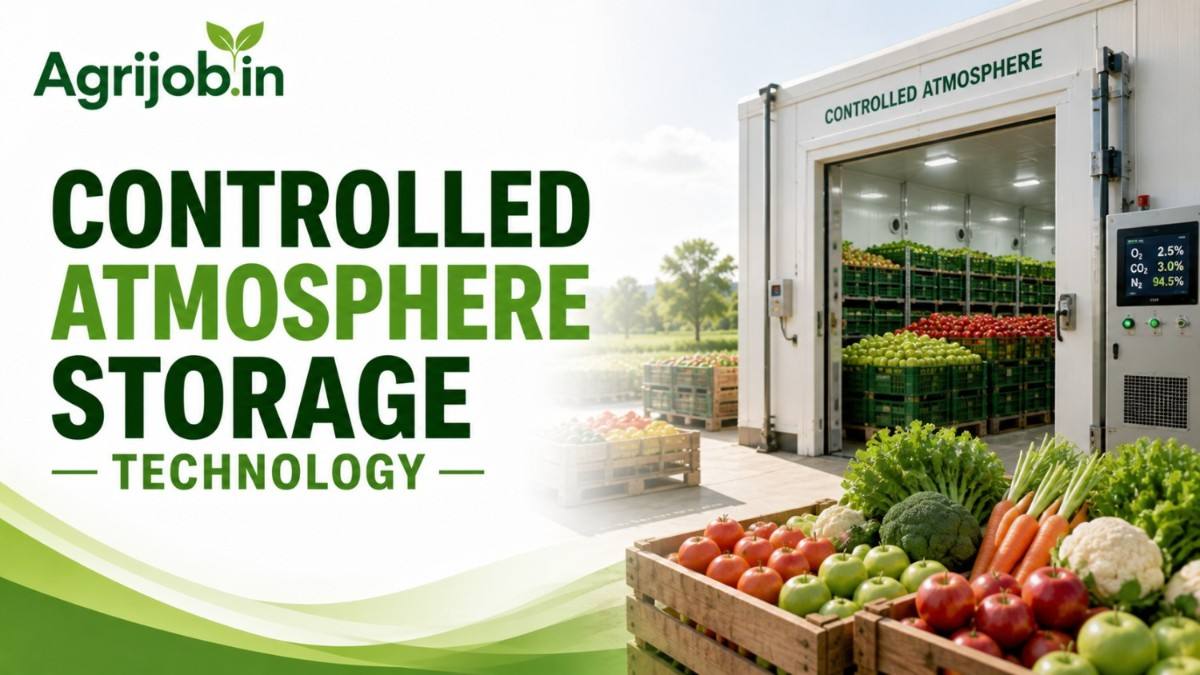
Controlled atmosphere (CA) storage technology is a process in which fresh fruits are stored under precisely defined environmental conditions — low oxygen (1–3%), elevated carbon dioxide (1–5%), regulated temperature (−1°C to 0°C for apple/pear), and high relative humidity (90–95%) — in gas-tight cold rooms. This atmospheric manipulation suppresses the synthesis and action of ethylene, the natural ripening hormone, slowing metabolic activity so dramatically that fruit remains in near-harvest condition for months longer than refrigeration alone can achieve. The National Horticulture Board’s technical standards — aligned with ISO 6949:1988(E) and WFLO Commodity Storage Manual — confirm that CA storage is recommended for long-term storage of apples, pears, kiwi, and cabbage for up to 10 months.
In the Indian context, CA storage addresses a structurally acute problem. India produces over 25 lakh metric tonnes of apples annually, the bulk from Kashmir (70%) and Himachal Pradesh. Yet post-harvest losses in apple are estimated at 15–30% due to inadequate or absent CA infrastructure. A farmer who sells at harvest earns distress prices; one who accesses CA storage sells in lean months at peak prices — capturing 25–40% higher net realisation on the same crop. Multiply this across lakh of producers in HP, J&K, and Uttarakhand, and the revenue at stake runs into thousands of crore annually.

For grape producers in Maharashtra’s Nashik region — India’s largest grape export hub contributing over 2 lakh metric tonnes annually to exports — CA-assisted storage and modified atmosphere packaging extends fresh shelf life sufficiently for EU, Gulf, and UK market access, where 3–4 weeks of transit time is irreducible. With grapes fetching Rs.150–250/kg in export markets vs Rs.40–80/kg domestic, the financial logic of CA investment for export-oriented producers is overwhelming.
Who Should Invest in CA Storage Technology?
Controlled atmosphere storage technology 2026 is not a generic cold chain investment — it is precision infrastructure for high-value horticulture. The following producer and investor profiles stand to gain most:
- 🍎 Apple Growers in Himachal Pradesh and Uttarakhand: HP’s Kinnaur, Shimla, and Kullu districts collectively produce high-premium apple varieties like Fuji, Golden Delicious, and Royal Delicious. CA access converts peak-harvest distress selling into strategic off-season release — earning 30–50% price premium over October spot prices.
- 🍏 Apple and Pear FPOs in Jammu & Kashmir: J&K already has ~45 CA units concentrated in South Kashmir’s Pulwama district — extending apple shelf life by 6–7 months. FPOs qualify for 50% NHB subsidy in the hilly and scheduled area category, making project equity requirements exceptionally low.
- 🍇 Table Grape Exporters in Nashik and Sangli: GlobalG.A.P.-certified grape producers targeting the UK, Netherlands, Germany, and Gulf markets need CA-compatible pack houses with controlled SO₂ environment to maintain colour, firmness, and Botrytis control through 3–4 weeks of transit.
- 🥝 Kiwi Producers in Himachal Pradesh and Arunachal Pradesh: Kiwi responds exceptionally well to CA storage at 0°C with 2% O₂ and 5% CO₂ — extending marketable life from 6 weeks to 6+ months. Nascent kiwi production zones in India lack CA infrastructure entirely, creating first-mover advantage for investors.
- 🏢 Horticulture Entrepreneurs and Agri-Investors: A 500–1,000 MT CA facility serving multiple fruit varieties in an underserved horticulture district can command 2–3× the rental rates of conventional cold storage — with demand strongly exceeding supply in almost every apple/pear/grape producing district of India.
- 🌾 State Government-Promoted Horticulture Cooperatives: HP AGROS, HPMC (Himachal Pradesh Horticultural Produce Marketing Corporation), and J&K Horticulture Development Corporation entities qualify for the highest subsidy slabs and lowest-cost NABARD financing — making large-scale CA park development genuinely viable.
- 🎓 Agri-Business Graduates and Cold Chain Technology Entrepreneurs: CA storage operation, gas monitoring calibration, and integrated post-harvest management for premium exporters are high-skill, high-income career paths in 2026 — with CA facility managers earning Rs.6–18 lakh annually at organised cold chain operators.
- 💊 PE Funds and Infrastructure Investors Seeking Agri-Assets: CA cold storage in India’s apple belt is a structurally undersupplied asset growing at 16–25% CAGR — combining government subsidy cover, inelastic demand, and premium rental rates into a compelling infrastructure investment thesis.
ROI Analysis — Controlled Atmosphere Storage for Apple, Pear and Grape Producers 2026
The financial case for CA storage technology hinges on three compounding revenue advantages: higher rental income (2–3× conventional), off-season price premium realisation for grower-operators, and access to premium export markets locked behind CA/MAP shelf-life requirements. Here is a complete ROI model for three representative producer archetypes:
| ROI Parameter | Apple Producer (500 MT CA, HP) | Pear Exporter (300 MT CA, HP/UK) | Grape Exporter (200 MT CA+MAP, Nashik) |
|---|---|---|---|
| Total Project Cost (before subsidy) | Rs.1.6–2.0 crore | Rs.1.2–1.5 crore | Rs.90 lakh–1.2 crore (incl. pack house) |
| NHB Subsidy (50% — hilly area) | Rs.80 lakh–1.0 crore | Rs.60–75 lakh | Rs.45–60 lakh (general area, 35%) |
| Effective Net Investment | Rs.80 lakh–1.0 crore | Rs.60–75 lakh | Rs.45–60 lakh |
| CA Rental Rate | Rs.400–500/quintal/month | Rs.350–450/quintal/month | Rs.500–600/quintal/month |
| Estimated Annual Revenue | Rs.30–45 lakh | Rs.20–30 lakh | Rs.18–28 lakh |
| Annual Operating Cost | Rs.10–15 lakh | Rs.8–12 lakh | Rs.8–10 lakh |
| Annual Net Income | Rs.20–30 lakh | Rs.12–18 lakh | Rs.10–18 lakh |
| Price Premium vs Distress Sale | 30–50% higher Oct–Nov realisation | 20–35% higher off-season price | 2–4× domestic price in export market |
| Estimated ROI Period (post-subsidy) | 3–4 years | 4–5 years | 3–5 years |
The apple producer model is the most compelling in the Indian context. A grower-operator in Kinnaur or Kullu district who builds a 500 MT CA facility can store their own crop through October–November (peak supply, lowest prices) and release in February–May when fresh apple availability falls sharply and prices climb 30–50% above harvest-time levels. The combination of CA rental income from neighbouring farmers and own-crop price premium realisation creates a dual revenue stream that conventional cold storage cannot replicate.
For grape exporters in Nashik, the ROI logic is export market access. Without CA-compatible infrastructure and GlobalG.A.P.-certified pack house capability, EU and UK import protocols exclude Indian growers entirely. With it, export realisation of Rs.150–250/kg dwarfs domestic market prices of Rs.40–80/kg — making the infrastructure investment recover within 3–4 seasons even on modest export volumes.
CA Technology Types — Standard CA, ULO, DCA and Low-Ethylene Storage
Controlled atmosphere storage technology 2026 is not monolithic — it encompasses four distinct technology variants, each with different gas targets, equipment requirements, and shelf-life outcomes. Understanding these differences is essential before specifying a CA facility for apple, pear, or grape storage:
- 🌡️ Standard CA Storage: The baseline technology. Maintains O₂ at 2–4% and CO₂ at 3–5% in gas-tight refrigerated chambers. Recommended for apples, pears, kiwi, and cabbage by NHB Technical Standards. Extends apple shelf life to 7–9 months. Equipment includes nitrogen generators, CO₂ scrubbers (activated carbon or lime), pressure equalisation bags, and automatic gas analysers. Most commercially deployed CA stores in India operate at this specification. Cost: approx. Rs.8,000–12,000 additional per MT capacity over conventional cold storage.
- ❄️ Ultra Low Oxygen (ULO) Storage: Advanced CA variant reducing O₂ to 0.7–1% (below 2%), putting fruit into a metabolic “near-coma.” ULO achieves 10–12 month storage for apple varieties like Fuji and Golden Delicious — 2–3 months longer than Standard CA. Also controls superficial scald without diphenylamine treatment. Requires more sophisticated automated gas control, higher capital cost (Rs.15,000–20,000 additional per MT vs conventional), and precise varietal knowledge. ULO technology is currently the global standard for premium apple storage in Netherlands, Washington State USA, and New Zealand.
- 📊 Dynamic Controlled Atmosphere (DCA): The most advanced CA variant. DCA monitors fruit’s real-time physiological stress response (chlorophyll fluorescence or respiratory quotient) and dynamically adjusts O₂ down to the lowest safe level for each specific batch and variety. This avoids both anaerobic damage (too low O₂) and sub-optimal storage (too high O₂). DCA extends storage further than ULO in many apple cultivars and reduces physiological disorders. Capital cost is highest — primarily sensing and control equipment. DCA is beginning to be adopted in advanced Indian export facilities, but widespread commercial deployment is still 2–4 years away.
- 🌿 Low-Ethylene CA Storage: Incorporates catalytic ethylene scrubbers or potassium permanganate ethylene absorbers alongside standard O₂/CO₂ control. Critical for varieties with high ethylene production (Delicious, Gala, Empire) where ethylene accumulation triggers accelerated ripening even under CA conditions. Also used for pear and kiwi where ethylene sensitivity is especially high. Cost premium: Rs.3,000–5,000 additional per MT vs Standard CA for the ethylene scrubber system and controls.
Optimal CA Storage Parameters for Apple, Pear and Grape — 2026 Technical Reference
Gas parameters in CA storage must be calibrated per species and variety — the same O₂ and CO₂ targets that preserve Fuji apple perfectly will damage Bartlett pear or Thompson Seedless grape. Here is the authoritative technical reference table based on NHB Technical Standards (NHB-CS-Type 03-2010), WFLO Commodity Storage Manual, ISO 6949:1988(E), and published peer-reviewed research:
| Commodity / Variety | Temperature (°C) | RH (%) | O₂ (%) | CO₂ (%) | CA Storage Life | Key Risk |
|---|---|---|---|---|---|---|
| Apple (Delicious, Golden Delicious) | −1 to 0 | 90–95 | 1–2 | 2–5 | 8–12 months | CO₂ injury above 5%; scald control needed |
| Apple (McIntosh, Cortland) | 2–3 | 90–95 | 2–3 | 2–4 | 5–7 months | Chilling sensitive — higher temp required |
| Apple (Fuji) | −1 to 0 | 90–95 | 1–2 | 1–3 | 8–10 months | Low CO₂ to avoid bitter pit |
| Apple (Gala) | 0–1 | 90–95 | 1–2 | 2–4 | 5–6 months | Monitor for core browning |
| Pear (Anjou) | −1 to 0 | 90–95 | 1–2 | <1 | 7–8 months | Needs 30 days cold before CA; senescent scald risk |
| Pear (Bartlett / Williams) | −1 to 0 | 90–95 | 2–3 | <1 | 3–4 months | Will not ripen at intermediate temps; cool rapidly |
| Pear (Packham’s Triumph, Bosc) | −1 to 0 | 90–95 | 1–2 | <1 | 5–7 months | Low CO₂ critical — pears very CO₂ sensitive |
| Table Grape (Red Globe, Thompson Seedless) | −1 to 0 | 90–95 | 2–5 | 5–10 | 3–4 months (up to 98 days with SO₂) | High CO₂ controls Botrytis; SO₂ pads essential |
| Kiwi (Hayward) | 0 | 90–95 | 2 | 5 | 5–7 months | Highly ethylene sensitive — low-ethylene CA mandatory |
A critical operating principle from NHB Technical Standards: apples should be placed under CA conditions within 5–7 days of harvest for maximum storage life benefit. A delay of just 3 days in a warm packing shed can shorten storage life by up to 30 days even if subsequently stored in CA at −1°C. Pre-cooling to reach 0–0.6°C fruit core temperature within 2–4 days of harvest is therefore not optional — it is the foundation of successful CA storage performance. Every CA facility must include forced-air pre-cooling capacity sized to handle peak harvest volumes.
CA Storage Cost in India 2026 — Setup Investment, Operating Cost and Per MT Analysis
Controlled atmosphere storage costs more to build and operate than conventional cold storage — but commands proportionally higher rental rates and delivers superior ROI when properly positioned in underserved horticulture districts. Here is a comprehensive cost breakdown for 2026:
| Cost Component | Conventional Cold Storage (per MT) | Standard CA Storage (per MT) | ULO Storage (per MT) |
|---|---|---|---|
| Civil construction & insulation (PUF panels) | Rs.3,000–5,000 | Rs.3,500–5,500 (gas-tight sealing adds cost) | Rs.4,000–6,000 |
| Refrigeration plant & ammonia system | Rs.3,000–4,500 | Rs.3,500–5,000 | Rs.4,000–5,500 |
| CA gas control equipment (N₂ generator, CO₂ scrubber, gas analyser, pressure equalisation) | Not applicable | Rs.8,000–12,000 | Rs.15,000–20,000 |
| Pre-cooling system (forced air) | Rs.1,500–2,500 | Rs.2,000–3,000 (mandatory for CA) | Rs.2,500–3,500 |
| Electrical, controls, DG set, civil ancillaries | Rs.1,500–2,500 | Rs.2,000–3,000 | Rs.2,500–3,500 |
| Total All-In CapEx Per MT (before subsidy) | Rs.9,000–14,000 | Rs.19,000–26,500 | Rs.28,000–38,500 |
| Annual Operating Cost (electricity, staff, maintenance) Per MT | Rs.800–1,200 | Rs.1,200–1,800 | Rs.1,500–2,200 |
| CA Rental Revenue Per MT Per Season | Rs.1,500–2,500/MT/season (conventional) | Rs.4,000–6,000/MT/season | Rs.5,000–7,000/MT/season (premium) |
A representative 500 MT Standard CA facility in Himachal Pradesh (general area) has a total project cost of approximately Rs.1.6–2.0 crore. With NHB’s 50% subsidy applicable in Himachal Pradesh (categorised as a hilly state), the effective net investment falls to Rs.80 lakh–1.0 crore — a figure that most progressive apple FPOs can mobilise through a combination of bank term loan and member equity. Annual revenue at 70% occupancy and Rs.450/quintal/month CA rental runs Rs.30–40 lakh, yielding payback in 3–4 years. The electricity bill is the largest controllable cost — typically 40–50% of total OpEx — and is best managed through energy-efficient compressor systems, maximum PUF insulation thickness (100 mm walls, per NHB specifications), and rooftop solar wherever feasible.
Government Subsidies for CA Cold Storage 2026 — NHB, PMKSY and AIF
India offers one of the most comprehensive government support structures in Asia for CA cold storage investment. Here is the complete 2026 subsidy and financing landscape relevant to controlled atmosphere technology:
- 🏛️ National Horticulture Board (NHB) — Capital Investment Subsidy: The most directly relevant scheme for CA storage. NHB provides credit-linked, back-ended subsidy at 35% of eligible project cost for general areas and 50% for North-Eastern states, hilly states (HP, Uttarakhand, J&K, Sikkim, Meghalaya, Himachal Pradesh), and scheduled area projects — specifically for cold storage and CA storage units with capacity from 5,000 MT up to 20,000 MT. The maximum subsidy per project is capped; subsidy is calculated on NHB’s published per-MT cost norms, not market quotes. Apply via nhb.gov.in.
- 🌿 MIDH (Mission for Integrated Development of Horticulture) / NHM — Smaller CA Units: For CA storage and cold room projects up to 5,000 MT capacity, the National Horticulture Mission under MIDH offers the same 35%/50% subsidy pattern through State Horticulture Missions. This is the most accessible entry point for first-time FPOs and individual entrepreneurs building small CA units of 50–500 MT capacity.
- 💰 PMKSY — Integrated Cold Chain and Value Addition Infrastructure (ICCVAI): For integrated cold chain projects (at least 2 components — e.g., CA storage + pre-cooling unit + sorting-grading line), PMKSY provides grant-in-aid at 35% of eligible cost in general areas and 50% for hilly states, FPOs, SC/ST, SHGs, and NE states — with a maximum Rs.10 crore grant per project. PMKSY total budget raised to Rs.6,520 crore in 2026. Importantly, PMKSY does not fund standalone CA stores — the project must be integrated. Apply via sampada-mofpi.gov.in.
- 💳 Agriculture Infrastructure Fund (AIF) — Interest Subvention: AIF provides 3% interest subvention on term loans up to Rs.2 crore for post-harvest infrastructure including CA cold storage, pre-cooling units, and pack houses. AIF can be legally stacked on top of NHB/NHM capital subsidy on the same project — dramatically reducing effective cost. Apply via agriinfra.dac.gov.in.
- 🏦 NABARD Warehouse Infrastructure Fund (WIF): NABARD provides concessional term loans at below-market interest rates for cold storage and CA storage construction — up to 95% of project cost for cooperatives, government-promoted entities, and FPOs. Tenure: 7 years or more. Particularly beneficial for HPMC, J&K Horticulture Development Corporation, and large cooperative-promoted CA parks.
| Scheme | Subsidy / Support | Max Capacity | Best For | Portal |
|---|---|---|---|---|
| NHB Capital Investment Subsidy | 35% (general) / 50% (hilly) | 5,000–20,000 MT CA | Standalone CA storage — apples, pears, kiwi | nhb.gov.in |
| MIDH/NHM | 35% (general) / 50% (hilly) | Up to 5,000 MT | Small FPO CA units, individual farmers | State Horticulture Mission |
| PMKSY–ICCVAI | 35–50%, max Rs.10 crore | No cap (integrated only) | CA store + pack house + pre-cooling (integrated) | sampada-mofpi.gov.in |
| Agriculture Infrastructure Fund | 3% interest subvention | Rs.2 crore loan | All CA storage & post-harvest infra | agriinfra.dac.gov.in |
| NABARD WIF | Concessional rate loan | 95% of project cost | Cooperatives, HPMC, J&K HDC | nabard.org |
How to Apply for NHB CA Storage Subsidy 2026 — Step by Step
The NHB capital investment subsidy for CA cold storage follows a well-defined process — back-ended release after commissioning and joint physical inspection. Here is the complete 2026 application roadmap:
- 🔍 Confirm Project Feasibility and Site Selection: Identify a location within 50 km of apple/pear/grape production clusters with reliable power supply (HT connection preferred for CA compressors), road access, and unencumbered land title. Engage a NABARD-empanelled cold chain consultant to assess commodity flow volumes in your district and validate the CA capacity size that matches real demand.
- 📋 Prepare the CA-Specific Detailed Project Report (DPR): CA DPRs are more complex than conventional cold storage DPRs — they must include the NHB Basic Data Sheet for CA Stores (NHB-CS-Type 03-2010), specifying commodity storage conditions (O₂%, CO₂%, temperature, RH%), chamber sizing, nitrogen generator and CO₂ scrubber specifications, pre-cooling system design, gas tightness methodology per ISO 6949:1988(E), and heat load calculations. This document must be certified by a qualified refrigeration engineer.
- 🏦 Obtain In-Principle Bank Loan Sanction: Approach NABARD-empanelled banks (SBI, PNB, J&K Bank, Himachal Pradesh State Co-operative Bank, Bank of Baroda) with the DPR for in-principle term loan approval. Banks conduct independent technical appraisal — align your DPR to the bank’s standard format to avoid delays. Simultaneously file an AIF application with the same bank for 3% interest subvention on the loan portion.
- 📎 Compile the Full Document Set: Land documents (Khasra/Khatauni with clear title), Aadhaar + PAN of promoter, entity registration certificate (FPO, cooperative, company as applicable), bank in-principle sanction letter, detailed heat load calculations, equipment vendor quotations, pollution control NOC (state-specific), and State Government recommendation letter where required by the State Horticulture Mission.
- 💻 Submit Online Application on NHB Portal: Register at nhb.gov.in, select the Capital Investment Subsidy for Cold Storage / CA Store, fill the online application with the project details matching the DPR exactly, and upload all documents. NHB scrutinises for technical conformity with NHB-CS-Type 03-2010 technical standards before issuing an In-Principle Approval (IPA).
- 🔎 Technical Appraisal and Project Sanction: NHB or its Project Management Agency conducts technical appraisal of the DPR. Projects conforming to NHB technical standards receive a formal project sanction letter specifying the approved capacity, subsidy amount, and implementation timeline (typically 24–36 months). Do not begin construction before IPA is received — work commenced without IPA is ineligible for subsidy.
- ✅ Commissioning, Physical Inspection, and Subsidy Release: After completing construction and commissioning, file for joint physical inspection. NHB/PMA officials verify the completed facility against DPR specifications. Upon satisfactory inspection, the back-ended subsidy is released — typically credited to the Subsidy Reserve Fund Account held with your lending bank and adjusted against the outstanding term loan balance.
Apple and pear producers in Himachal Pradesh, J&K, and Uttarakhand qualify for the highest 50% NHB subsidy slab. Layer this with AIF 3% interest subvention on the bank loan — legally permitted on the same project. For an FPO building a Rs.1.6 crore 500 MT CA facility in Kullu district: NHB subsidy covers Rs.80 lakh (50%), bank loan covers Rs.70 lakh, AIF reduces the loan interest by 3% saving approximately Rs.2.1 lakh/year in interest — and the FPO contributes only Rs.10–15 lakh of own equity. This is one of the most favourable capital structures available to any agri-entrepreneur in India today. Bookmark nhb.gov.in and agriinfra.dac.gov.in for 2026 EOI notifications.
CA Storage vs Conventional Cold Storage — Full Investment Comparison 2026
| Comparison Parameter | Controlled Atmosphere (CA) Storage | Conventional Cold Storage |
|---|---|---|
| CapEx Per MT (before subsidy) | Rs.19,000–38,500 (Standard CA to ULO) | Rs.9,000–14,000 |
| Government Subsidy (hilly states) | 50% NHB + 3% AIF stackable | 35–50% NHM/NHB + 3% AIF stackable |
| Apple Shelf Life | 9–12 months (CA); 10–12 months (ULO) | 2–4 months (refrigeration only) |
| Pear Shelf Life | 5–8 months (variety dependent) | 2–4 months |
| Grape Storage Duration | 3–4 months (CA + SO₂) | 4–6 weeks (refrigeration only) |
| Rental Rate (Apple Belt) | Rs.400–600/quintal/month | Rs.150–250/quintal/month |
| Commodity Range Stored | Apple, pear, kiwi, grape, some vegetables | Any perishable — broad multi-commodity use |
| Operational Complexity | High — daily gas monitoring, tight chamber management | Low — standard temperature control |
| Price Premium Capture for Growers | 30–50% higher off-season realisation vs harvest price | 10–20% (limited by 3–4 month window) |
| Export Market Eligibility | Yes — EU, UK, Gulf market access for apple, grape | Limited — domestic only for apple/pear |
| ROI Period (post-subsidy, hilly states) | 3–5 years | 4–6 years |
| Market Growth Rate | 25%+ CAGR (CA cold storage sub-segment) | 16–20% CAGR (overall cold storage) |
| Best For | Apple, pear, kiwi, grape producers in hilly states; export-oriented horticulture | Multi-commodity, potato, onion, dairy, pharma storage |
Advantages and Disadvantages of CA Storage Technology
A balanced assessment of controlled atmosphere storage technology 2026, covering both the compelling advantages and the real operational constraints investors and producers must plan for:
Advantages:
- ✅ Dramatic Shelf Life Extension: Apple shelf life extended from 3 months to 9–12 months; pear by 2–3 additional months; grapes to 3–4 months — enabling year-round supply and export market access impossible with refrigeration alone.
- ✅ Premium Rental Income: CA facilities command Rs.400–600/quintal/month vs Rs.150–250 for conventional cold storage — 2–3× higher revenue per MT of capacity.
- ✅ Off-Season Price Premium for Growers: Apple released in February–May commands 30–50% price premium over October harvest prices. This single benefit can transform the economics of apple farming for small producers.
- ✅ Export Market Access: EU, UK, Gulf, and SE Asian markets require CA-compatible post-harvest handling for apple, pear, and table grape imports. CA infrastructure is the gateway to export revenue that dwarfs domestic pricing.
- ✅ Reduced Storage Losses: CA conditions suppress fungal decay organisms and physiological disorders — reducing in-store losses by 30–50% compared to refrigeration-only storage for apple and pear.
- ✅ Strong Government Subsidy Support: 50% NHB subsidy in hilly states + 3% AIF interest subvention makes CA investment in India’s apple belt among the most capital-efficient agri-infrastructure investments available.
Disadvantages and Risks:
- ⚠️ High CapEx per MT: CA storage costs Rs.19,000–38,500/MT (before subsidy) vs Rs.9,000–14,000/MT for conventional — a 2–3× capital intensity difference that requires robust subsidy stacking to make viable for smaller operators.
- ⚠️ Operational Complexity: Daily gas monitoring and calibration, strict chamber fill protocols (3-day fill-in window), gas-tight door management, and emergency ventilation procedures are mandatory — requiring trained operators and equipment maintenance contracts that conventional cold storage does not need.
- ⚠️ Commodity Specificity: CA facilities optimised for apple/pear cannot easily switch to general multi-commodity use. Revenue concentration risk is higher than for multi-commodity conventional cold stores.
- ⚠️ Gas Injury Risk: CO₂ injury (above 5–8%), low O₂ injury (below 1% for extended periods), and anaerobic fermentation — if gas controls fail — can cause severe batch losses. Automatic gas control systems and backup monitoring are non-optional, adding cost.
Key CA Storage Terms Every Investor and Producer Must Know
- 🌡️ Controlled Atmosphere (CA) Storage: Precision storage maintaining specific O₂ (1–4%), CO₂ (1–5%), temperature (−1 to 0°C for apple/pear), and RH (90–95%) in gas-tight rooms — extending apple shelf life to 9–12 months vs 3 months in conventional cold storage.
- ❄️ Ultra Low Oxygen (ULO) Storage: Advanced CA variant with O₂ reduced to 0.7–1% — putting fruit into a metabolic near-coma. Extends apple shelf life to 10–12 months; controls superficial scald without chemical treatment. Cost: Rs.28,000–38,500/MT before subsidy.
- 📊 Dynamic Controlled Atmosphere (DCA): Most advanced CA technology — dynamically adjusts O₂ based on real-time fruit physiological response monitoring (chlorophyll fluorescence). Minimises storage disorders and maximises shelf life beyond ULO for sensitive varieties.
- 🌿 Ethylene: The ripening hormone produced naturally by fruit. CA storage’s primary mechanism of action is suppressing ethylene synthesis and blocking its receptor binding — halting the ripening cascade at near-harvest state.
- 🧪 Nitrogen Generator: Equipment that separates nitrogen from ambient air (via hollow-fibre membrane or pressure-swing adsorption) to flush CA chambers — rapidly reducing O₂ from 21% to target 1–3% levels within 5–7 days of loading. Essential equipment in every CA installation.
- 💨 CO₂ Scrubber: System (activated carbon or lime-based) that removes excess CO₂ from the CA chamber atmosphere to maintain target CO₂ levels. Without scrubbing, respiring fruit CO₂ output elevates chamber CO₂ beyond safe limits, causing CO₂ injury disorders.
- 🔬 Gas Tightness: The ability of CA chamber walls, ceiling, floor, and doors to maintain the specified O₂/CO₂ atmosphere without excessive gas leakage. NHB Technical Standards require testing per ISO 6949:1988(E) protocols. Poor gas tightness is the most common reason CA chambers fail to achieve design shelf-life targets.
- 📦 Pre-Cooling (Forced Air): Rapid cooling of harvested fruit from field temperature to storage temperature (−1 to 0°C) before loading into CA chambers. NHB standards specify achieving 7/8 cool (7/8 of the way from harvest temperature to storage temperature) before CA is initiated. A 1-day delay in pre-cooling can reduce apple storage life by 7–10 days.
- 🏛️ NHB — National Horticulture Board: Government of India body (Ministry of Agriculture) that administers the Capital Investment Subsidy scheme for CA cold storage — providing 35% (general) to 50% (hilly states) back-ended subsidy on eligible project costs for facilities from 5,000–20,000 MT. Visit nhb.gov.in for scheme guidelines.
- 💰 Agriculture Infrastructure Fund (AIF): GOI scheme providing 3% interest subvention on post-harvest infrastructure term loans up to Rs.2 crore, stackable with NHB/NHM capital subsidies on the same CA storage project. Apply via agriinfra.dac.gov.in.
Important Links
| Resource | Link |
|---|---|
| NHB Capital Investment Subsidy for CA Storage | nhb.gov.in |
| PMKSY Integrated Cold Chain Application (SAMPADA) | sampada-mofpi.gov.in |
| Agriculture Infrastructure Fund Portal | agriinfra.dac.gov.in |
| NABARD Warehouse Infrastructure Fund | nabard.org |
| NHB Technical Standards for CA Cold Stores (PDF) | NHB CS Type 03-2010 PDF |
| Cold Chain Infrastructure India 2026 — Investment Guide | Agrijob.in Cold Chain Guide |
| Cold Storage Business Plan India 2026 — NHM Subsidy Guide | Agrijob.in Cold Storage Business Plan |
| Agriculture Infrastructure Fund 2026 — Complete Apply Guide | Agrijob.in AIF Guide |
Conclusion — Controlled Atmosphere Storage Technology 2026 Is the Premium Play in Indian Horticulture
Controlled atmosphere storage technology 2026 represents the highest-return post-harvest infrastructure investment available to India’s apple, pear, and grape producers — combining a 9–12 month shelf life extension for apple, 2–3× higher rental income over conventional cold storage, and gateway access to EU, UK, and Gulf export markets that are closed to producers without CA-compliant infrastructure. With NHB’s 50% capital subsidy in hilly states (HP, J&K, Uttarakhand), stackable with AIF’s 3% interest subvention, the effective equity requirement for a 500 MT CA facility is within reach of serious FPOs and progressive fruit growers — not just corporate investors. For producers who currently sell apple at distress prices in October and watch the same variety fetch 30–50% more in February, CA storage technology is not an aspiration. It is the missing infrastructure that converts seasonal glut into year-round strategic supply and transforms a farming household’s income trajectory permanently.
Apply for NHB In-Principle Approval as your first concrete step. Bookmark this page — it is updated as NHB, PMKSY, and AIF scheme guidelines change in 2026.
- CA storage extends apple shelf life to 9–12 months (vs 3 months conventional) by suppressing ethylene via 1–3% O₂ and 1–5% CO₂ at −1°C to 0°C.
- CA storage commands Rs.400–600/quintal/month rental — 2–3× higher than conventional cold storage — delivering superior ROI despite higher CapEx.
- Apple producers in HP, J&K, and Uttarakhand qualify for 50% NHB subsidy (hilly state category) — the highest slab available — reducing CA facility equity to Rs.10–15 lakh for a 500 MT FPO project.
- AIF 3% interest subvention is legally stackable on the same CA project as NHB capital subsidy — stacking both is the most capital-efficient way to build a CA facility in 2026.
- J&K CA units increase apple shelf life by 6–7 months without quality loss — allowing growers to avoid October distress sales and capture 30–50% higher off-season prices.
- Apply at nhb.gov.in for NHB subsidy; simultaneously file AIF at agriinfra.dac.gov.in through your lending bank before starting construction.
Frequently Asked Questions About Controlled Atmosphere Storage Technology 2026
What is controlled atmosphere storage technology and how does it work?
Controlled atmosphere storage technology maintains low oxygen (1–3%), elevated carbon dioxide (1–5%), precise temperature (−1°C to 0°C for apple and pear), and high humidity (90–95%) inside gas-tight refrigerated chambers. By suppressing ethylene — the natural ripening hormone — CA storage slows fruit respiration and metabolic activity so dramatically that apples and pears remain in near-harvest quality for 9–12 months instead of 3 months with refrigeration alone. The technology is adopted from ISO 6949:1988(E) and the WFLO Commodity Storage Manual, forming the basis of NHB Technical Standards for CA stores in India.
How long can apples be stored in controlled atmosphere storage?
Apples stored in standard CA (1–2% O₂, 2–5% CO₂, −1°C to 0°C) achieve 8–12 months storage for chilling-tolerant varieties like Delicious, Golden Delicious, and Fuji. Chilling-sensitive varieties like McIntosh achieve 5–7 months in CA at 2–3°C. In Ultra Low Oxygen (ULO) storage at 0.7–1% O₂, Fuji and Golden Delicious achieve the full 10–12 month window. Without CA — in conventional refrigeration only — the same varieties deteriorate in 2–4 months. The NHB Technical Standards confirm that CA facilities in India can achieve up to 10 months storage for apples, pears, and kiwi.
What is the cost of setting up a CA cold storage unit in India in 2026?
A Standard CA cold storage unit in India costs Rs.19,000–26,500 per MT of capacity (before subsidy) in 2026 — compared to Rs.9,000–14,000 per MT for conventional cold storage. A representative 500 MT Standard CA facility costs Rs.1.6–2.0 crore total. ULO storage is more expensive at Rs.28,000–38,500 per MT. After NHB 50% subsidy (applicable in HP, J&K, and Uttarakhand), the effective net investment for a 500 MT CA facility falls to Rs.80 lakh–1.0 crore — competitive with subsidy-supported conventional cold storage at the same scale.
What is the difference between CA storage and conventional cold storage for apple?
Conventional cold storage maintains apple at −1°C to 0°C in normal air — achieving 2–4 months shelf life. Controlled atmosphere storage adds gas control (1–3% O₂, 1–5% CO₂) in gas-tight chambers, extending apple shelf life to 9–12 months. CA rental rates are Rs.400–600/quintal/month vs Rs.150–250 for conventional — 2–3× higher. CA storage also reduces in-store decay losses by 30–50%, enables off-season premium pricing (30–50% above harvest price for apple released in February–May), and is required for export market access to EU, UK, and Gulf countries.
What government subsidy is available for CA cold storage in India?
National Horticulture Board provides credit-linked back-ended subsidy at 35% of eligible project cost for general areas and 50% for hilly states (Himachal Pradesh, J&K, Uttarakhand, Sikkim, NE states) for CA storage units of 5,000–20,000 MT. For smaller units up to 5,000 MT, MIDH/NHM offers the same 35%/50% slab through State Horticulture Missions. PMKSY-ICCVAI provides up to 50% grant (max Rs.10 crore) for integrated CA projects including pack house and pre-cooling. Agriculture Infrastructure Fund provides an additional 3% interest subvention stackable with NHB/NHM capital subsidy on the same project.
What is the ROI of CA cold storage for apple producers in India?
A 500 MT CA facility in Himachal Pradesh (50% NHB subsidy) has an effective net investment of Rs.80 lakh–1.0 crore. At 70% occupancy and Rs.450/quintal/month CA rental, annual revenue is Rs.30–40 lakh, annual operating costs Rs.10–15 lakh — yielding annual net income of Rs.20–30 lakh and payback in 3–4 years. Grower-operators who store their own apple crop capture an additional 30–50% price premium by releasing in February–May vs October harvest distress pricing — further accelerating ROI beyond the rental income model alone.
Can grapes be stored in controlled atmosphere storage?
Yes. Table grapes (Red Globe, Thompson Seedless, and other varieties) are stored in CA at −1°C to 0°C with 2–5% O₂ and 5–10% CO₂, combined with SO₂-releasing pads for Botrytis control. Under optimal CA conditions, grape storage extends to 3–4 months, and with advanced SO₂ technology trials in Nashik, up to 98 days of storage with minimal decay has been demonstrated. For Indian Nashik grape exporters, CA infrastructure is the pathway to the UK, Netherlands, and Gulf markets where 3–4 weeks transit time makes conventional refrigeration-only approaches unviable for quality preservation.
What is ULO storage and how is it different from CA storage?
Ultra Low Oxygen (ULO) storage reduces O₂ below 2% — typically to 0.7–1% — placing fruit in a near-anaerobic metabolic state that dramatically slows ripening beyond what Standard CA achieves. While Standard CA extends apple storage to 9–10 months, ULO achieves 10–12 months for varieties like Fuji and Golden Delicious. ULO also controls superficial scald without diphenylamine treatment — an important advantage for export market compliance. ULO requires more sophisticated automatic gas control systems and costs Rs.28,000–38,500 per MT before subsidy (vs Rs.19,000–26,500 for Standard CA), making it most viable for premium export-oriented facilities with higher revenue capture.
Which states in India are best for CA cold storage investment in 2026?
Himachal Pradesh, Jammu & Kashmir, and Uttarakhand offer the most compelling CA storage investment environment in India: highest NHB subsidy (50%), co-located with India’s largest apple and pear production zones, severe shortage of existing CA infrastructure, and strong grower willingness to pay premium CA rental rates to avoid distress harvest sales. Maharashtra’s Nashik and Sangli districts are the priority zones for grape CA investment — driven by EU and UK export markets. Arunachal Pradesh and Sikkim are emerging opportunities for kiwi CA storage as these states scale up kiwi cultivation with central support under Horticulture Development schemes.
Last Updated: August 2026 | This guide is reviewed and updated regularly for accuracy. Bookmark this page for the latest CA storage subsidy scheme updates, NHB guidelines, and post-harvest technology developments for 2026.
Disclaimer: This article provides general information for educational purposes. Subsidy figures, scheme guidelines, and cost norms are subject to revision by NHB, MoFPI, and state horticulture departments. Always verify current scheme details at official portals (nhb.gov.in, sampada-mofpi.gov.in, agriinfra.dac.gov.in) before making investment decisions. This is not financial or legal advice.