

Cold Chain Infrastructure India 2026 – Investment & Post-Harvest Tech Guide
Cold chain infrastructure India 2026 represents the single largest addressable investment gap in Indian agriculture — and one of the most compelling business opportunities of this decade. India loses over Rs.92,000 crore worth of agricultural produce every year due to inadequate cold storage, broken temperature-controlled logistics, and missing post-harvest processing links. Yet the country produces over 300 million metric tonnes of fruits and vegetables annually, is the world’s largest milk producer, and the second-largest fish producer. The gap between production scale and cold chain capacity is not just a food security crisis — it is a multi-crore investment opportunity growing at 16–25% CAGR. This complete 2026 guide covers the cold chain market size, critical infrastructure gaps, all government subsidy schemes, ROI analysis, post-harvest technologies, investment models, who should invest, and step-by-step application process for PMKSY and AIF funding.

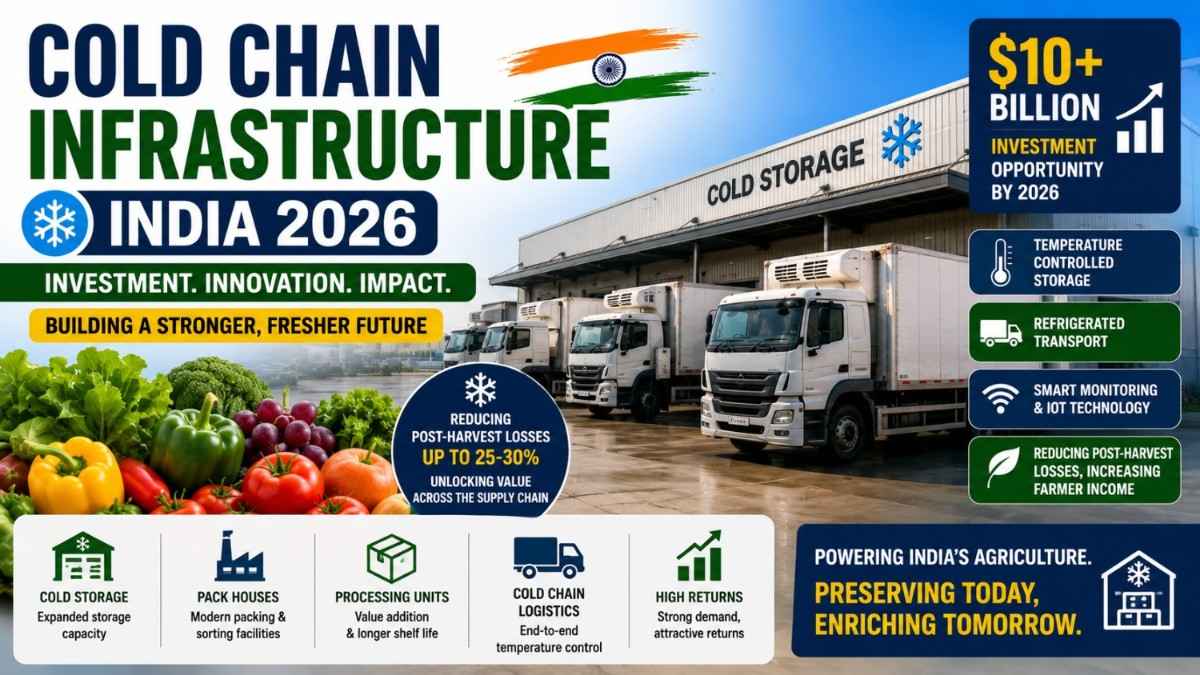
- Cold Chain Infrastructure India 2026 – Market Overview
- Post-Harvest Loss Crisis – The Rs.92,000 Crore Problem
- Critical Infrastructure Gaps in India’s Cold Chain 2026
- Cold Chain Investment Models – Costs & Returns
- Government Subsidy Schemes for Cold Chain Investment
- Post-Harvest Technologies Transforming India’s Cold Chain
- How to Apply for PMKSY Cold Chain Subsidy – Step by Step
- Who Should Invest in Cold Chain Infrastructure India 2026?
- Cold Chain vs Traditional Storage – Investment Comparison
- High-Value Cold Chain & Agri-Business Terms to Know
- FAQ – Cold Chain Infrastructure India 2026
| India Cold Chain Market (2025) | USD 12,775 million (~Rs.1.06 lakh crore) |
| Projected Market by 2033 | USD 74,502 million (~Rs.6.2 lakh crore) |
| Market CAGR (2026–2033) | 16–25% (multiple estimates) |
| Annual Post-Harvest Loss | Rs.92,000 crore+ (fruits, vegetables, dairy, fish) |
| Current Cold Storage Capacity | ~39 million MT (across 8,200+ facilities) |
| Capacity Gap (World Bank) | Additional 30 million MT needed immediately |
| PMKSY Subsidy (General Areas) | 35% grant (max Rs.10 crore/project) |
| PMKSY Subsidy (SC/ST/FPO) | 50% grant (max Rs.10 crore/project) |
| AIF Interest Subvention | 3% on cold chain infrastructure loans |
| PMKSY Budget 2026 | Rs.6,520 crore (raised from Rs.4,600 crore) |
| Cold Storage ROI Period | 3–4 years (Rs.1–1.5 crore investment) |
| Jobs Created (ICCVAI) | 2.23 lakh jobs across 372 approved projects |
Cold Chain Infrastructure India 2026 – Market Overview
India’s cold chain infrastructure market is on an exceptional growth trajectory in 2026, driven by converging forces: a surging middle class demanding fresh and processed food, a quick commerce revolution requiring sub-30-minute cold delivery, pharmaceutical biologics and vaccine distribution needs, and the government’s aggressive push through PMKSY, AIF, and NABARD financing. The market generated USD 12,775 million in 2025 and is projected to reach USD 74,502 million by 2033 at a 25% CAGR — making India one of the fastest-growing cold chain markets globally.
Cold chain storage dominates with a 68% segment share, while refrigerated transportation is the fastest-growing sub-segment driven by quick commerce platforms (Zepto, Blinkit, Swiggy Instamart) and e-grocery demand. The private sector commands 72% of market revenues, with major expansion underway by Snowman Logistics, Mahindra Logistics, and Adani Logistics. The Invest India government portal identifies cold chain as one of India’s top 5 priority infrastructure investment categories for 2026–2030, with FDI up to 100% allowed under the automatic route.

Post-Harvest Loss Crisis – The Rs.92,000 Crore Problem
India’s post-harvest loss problem is staggering in scale. The country produces over 300 million metric tonnes of fruits and vegetables annually — more than any country except China — yet approximately 30% of that produce spoils before reaching consumers due to inadequate cold chain coverage. This translates to over Rs.92,000 crore in annual agricultural losses — a figure that dwarfs the entire PMKSY budget many times over.
The loss distribution is uneven and reveals the most urgent investment zones:
- 🍅 Fruits and Vegetables: 30–40% post-harvest loss, with horticulture sector losses reaching 40% in states with no nearby cold chain. 16 million metric tonnes of fruits and vegetables wasted annually.
- 🐟 Fisheries: 90% cold chain capacity shortage; India is among the world’s largest fish producers yet exports far below potential due to cold chain gaps from port to market.
- 🥛 Dairy: 80% capacity shortage in dairy cold chain; significant seasonal milk surpluses spoil in dairy-dominant states during flush season due to absence of chilled bulk handling infrastructure.
- 🌾 Food Grains: Storage losses of 10–15% post-procurement, particularly in deficit states with inadequate silo and controlled-atmosphere warehouse coverage.
- 🥩 Meat and Poultry: Fastest-growing cold chain demand segment at 20%+ CAGR, yet infrastructure remains concentrated in just 6–8 metro cities with almost no rural cold chain presence.
According to NABARD, cold chain access can significantly boost farmer income realisation — research shows farmers with access to nearby cold storage earn 15–35% higher net income on perishable crops compared to those who must sell immediately at harvest, when prices are lowest.
Critical Infrastructure Gaps in India’s Cold Chain 2026
Despite impressive recent growth, India’s cold chain infrastructure in 2026 has 5 structural gaps that simultaneously represent the biggest investment opportunities:
| Infrastructure Gap | Current Status | Requirement | Deficit |
|---|---|---|---|
| Total Cold Storage Capacity | ~39 million MT (8,200+ facilities) | 50+ million MT | 11 million MT shortfall |
| Multi-Commodity Cold Storages | Only 12% of facilities are multi-product | 50%+ multi-commodity | Massive gap; most are single-commodity (potato) |
| Reefer (Refrigerated) Vehicles | ~70,000 reefer vehicles | 2.5 lakh+ needed | 3.5x shortfall |
| Farm-Level Pre-Cooling Units | Very few; concentrated near export clusters | 1 unit per 5,000 MT production zone | Critical gap in horticulture belts |
| Rural Farmer Cold Chain Access | 70%+ farmers lack nearby cold storage | Cold storage within 50 km of every farm cluster | Most acute in Bihar, MP, Odisha, NE states |
The geographic concentration of cold chain infrastructure compounds the problem. Over 50% of India’s cold storage facilities are concentrated in just 2 states — Uttar Pradesh and West Bengal — primarily for potato storage. States with high horticulture output but low cold chain density — Maharashtra, Karnataka, Andhra Pradesh, Himachal Pradesh — represent the highest-return greenfield investment zones in 2026.
Cold Chain Investment Models – Costs & Returns 2026
Cold chain infrastructure investment in India is accessible across a wide range of capital sizes — from a Rs.20–30 lakh small cold room for a first-time entrepreneur to a Rs.50 crore integrated cold chain park for institutional investors. Here is a tiered breakdown of investment models and expected returns in 2026:
| Investment Model | Setup Cost | After Subsidy (PMKSY 35%) | Annual Revenue Potential | ROI Period |
|---|---|---|---|---|
| Small Cold Room (5–20 MT) | Rs.20–50 lakh | Rs.13–32 lakh | Rs.3–8 lakh/yr | 4–6 years |
| Medium Cold Storage (500–1000 MT) | Rs.1–1.5 crore | Rs.65 lakh–97 lakh | Rs.20–40 lakh/yr | 3–4 years |
| Large Cold Storage (5,000 MT) | Rs.4–5 crore | Rs.2.6–3.25 crore (after Rs.1.75 cr grant) | Rs.60–80 lakh/yr | 3–5 years |
| Integrated Cold Chain (Pack House + Storage + Reefer) | Rs.10–25 crore | Rs.6.5–16 crore | Rs.2–5 crore/yr | 4–6 years |
| Cold Chain Park (Mega Project) | Rs.50–200 crore | PPP / FDI models | Rs.15–50 crore/yr | 5–8 years |
The most compelling investment sweet spot for first-time entrepreneurs in 2026 is the 500–2,000 MT multi-commodity cold storage in an underserved horticulture district. With PMKSY capital subsidy (35%), AIF 3% interest subvention layered on top, and NABARD financing up to 95% of project cost for eligible entities, the effective out-of-pocket equity for a Rs.1.5 crore project can be reduced to Rs.20–25 lakh — while annual revenues of Rs.25–40 lakh deliver break-even in under 3 years.
Government Subsidy Schemes for Cold Chain Investment 2026
India has the most comprehensive government support architecture for cold chain investment anywhere in Asia. Here is the complete 2026 subsidy and financing landscape — with all 5 major schemes explained:
- 🏛️ PMKSY – Integrated Cold Chain & Value Addition Infrastructure (ICCVAI): The flagship scheme under the Ministry of Food Processing Industries (MoFPI). Provides capital grant at 35% of eligible project cost for general areas (max Rs.10 crore per project) and 50% for SC/ST promoters, FPOs, SHGs, projects in NE states, Himalayan states, ITDP areas, and islands. Total PMKSY budget raised to Rs.6,520 crore in 2026, including Rs.1,000 crore for 50 new food irradiation units. Standalone cold storages are NOT covered — projects must be integrated (covering at least 2 components of the cold chain).
- 💰 Agriculture Infrastructure Fund (AIF): Provides collateral-free term loans up to Rs.2 crore and 3% interest subvention on loans for cold chain infrastructure including cold storages, primary processing centres, ripening chambers, and sorting-grading units. The AIF interest subvention can be layered on top of PMKSY capital subsidy on the same project — dramatically reducing effective cost. Visit agriinfra.dac.gov.in for AIF applications.
- 🏦 NABARD Warehouse Infrastructure Fund (WIF): Direct lending by NABARD at concessional rates for construction of cold storages, silos, and other cold chain infrastructure. Government of India/Producer Company-sponsored entities can avail loans up to 95% of total project cost. Tenure: 7 years or more. Particularly beneficial for cooperative-promoted cold chain projects in the Eastern and North Eastern states.
- 🌿 National Horticulture Board (NHB) Scheme: Targeted at horticulture-linked cold storage for fruits, vegetables, flowers, and spices. Subsidy of 35–50% on cold room and pre-cooling unit construction, with special incentives for pack houses near horticulture production clusters in HP, J&K, Maharashtra, and AP.
- 🔧 National Agriculture Infrastructure Financing Facility: Provides low-interest loans for construction and renovation of post-harvest operations including cold stores, ripening chambers, sorting-grading facilities, and refrigerated transport. Loans worth Rs.67,717 crore had been sanctioned as of 2024, making this one of the most utilised post-harvest financing windows in India.
| Scheme | Subsidy/Grant | Max Amount | Best For | Application Portal |
|---|---|---|---|---|
| PMKSY – ICCVAI | 35% (General) / 50% (SC/ST/FPO) | Rs.10 crore/project | Integrated cold chain projects | sampada-mofpi.gov.in |
| Agriculture Infrastructure Fund (AIF) | 3% interest subvention | Rs.2 crore (collateral-free) | Cold storage, pack houses, ripening chambers | agriinfra.dac.gov.in |
| NABARD WIF | Concessional rate loan | 95% of project cost | Cooperatives, govt-sponsored entities | nabard.org |
| NHB Scheme | 35–50% subsidy | Rs.3–5 crore | Horticulture cold storage & pack houses | nhb.gov.in |
| National Agri Infrastructure Facility | Low-interest loan | Project-specific | Cold stores, ripening chambers, reefer vehicles | Via participating banks |
Post-Harvest Technologies Transforming India’s Cold Chain 2026
Beyond physical cold storage capacity, India’s cold chain revolution in 2026 is being driven by post-harvest technology innovations that reduce losses, cut operating costs, and improve produce quality all the way to the consumer. Here are the 8 key technologies reshaping the sector:
- 📡 IoT-Based Cold Chain Monitoring: Sensor networks inside cold storage facilities and reefer vehicles that track temperature, humidity, and CO2 levels in real time — alerting operators instantly to any deviation. IoT integration reduces spoilage inside cold chains by 20–35% and is increasingly mandated by pharma-grade and export cold chain protocols.
- ☀️ Solar-Powered Cold Storage: Cold storage units running on rooftop solar panels combined with battery storage — eliminating grid power dependency and reducing operational costs by up to 60%. Particularly transformative for rural cold chain where grid reliability is poor. PMKSY and AIF both support solar cold storage investments.
- 🤖 Automated Pack Houses: Computer-vision-equipped sorting, grading, and packing lines that process 5–15 tonnes per hour with 95%+ accuracy in quality grading. Replacing manual sorting reduces labour costs by 50% and improves export quality compliance for EU and US markets.
- ☢️ Food Irradiation Units: Gamma or electron beam irradiation extends shelf life of mangoes, grapes, onions, and spices by 2–4x without chemicals. The Union Cabinet approved Rs.1,000 crore for 50 new food irradiation units across India in 2026 — directly targeting the mango and grape export opportunity.
- 🍌 Controlled Atmosphere (CA) & Modified Atmosphere (MA) Storage: Precisely controlled oxygen, CO2, and ethylene levels inside cold rooms that extend apple, pear, kiwi, and pomegranate shelf life from 3 months to 9–12 months. CA cold storage commands 2–3x higher rental rates than conventional cold storage.
- 🚛 Reefer Last-Mile Vehicles (Electric Reefer Trucks): Battery-electric refrigerated trucks for urban last-mile cold delivery — reducing fuel costs by 70% vs diesel reefer. Quick commerce platforms are accelerating adoption, with Blinkit, Zepto, and Swiggy Instamart all expanding electric reefer fleets in 2026.
- 🧊 Ripening Chambers: Ethylene-controlled chambers for uniform, demand-synchronized ripening of bananas, mangoes, tomatoes, and papayas — allowing farmers and traders to release produce to market at optimal price moments rather than flood-harvesting. A 50–100 MT ripening chamber investment of Rs.20–40 lakh pays back within 18 months in high-demand urban markets.
- 🌐 Blockchain-Enabled Cold Chain Traceability: End-to-end digital records of temperature, handling, and location of perishable shipments — enabling compliance with EU Farm-to-Fork regulations, FSSAI requirements, and buyer due-diligence for high-value export markets like the UAE, UK, and USA.
How to Apply for PMKSY Cold Chain Subsidy 2026 – Step by Step
PMKSY cold chain subsidy applications follow a structured EOI (Expression of Interest) process. Capital subsidy is back-ended — released after project commissioning and physical inspection, typically 4–8 months post-commissioning. Here is the complete application roadmap for 2026:
- 🔍 Monitor the SAMPADA Portal for EOI: Visit sampada-mofpi.gov.in regularly. Ministry of Food Processing Industries publishes Expression of Interest (EOI) calls periodically based on fund availability. Hard deadlines are strictly enforced — late applications are not considered.
- 📋 Prepare a Detailed Project Report (DPR): The DPR must cover: project description and scope, site location and land ownership proof, complete cost estimates with equipment specifications, cold chain component details (minimum 2 components required for integrated project), technical feasibility, marketing linkages, and projected revenue and financials for 7 years.
- 🏦 Obtain In-Principle Bank Loan Sanction: Approach your preferred bank (SBI, PNB, Bank of Baroda, NABARD-empanelled banks) for in-principle loan sanction covering 50–65% of project cost. Banks conduct their own technical and financial appraisal; align your DPR to their standard format.
- 📎 Gather All Required Documents: Land documents with NA (Non-Agricultural) permission if applicable; Aadhaar and PAN of promoter/entity; Company/FPO/cooperative registration certificate; Pollution control NOC for applicable facilities; Bank sanction letter with detailed appraisal report; and State Government consent letter where required by state policy.
- 💻 Submit EOI Online on SAMPADA Portal: Register on the portal, select the relevant PMKSY component (ICCVAI for cold chain), and submit the EOI online with all documents before the published deadline. Applications are screened for basic eligibility before being called for DPR submission.
- 🔎 Technical Appraisal & Project Sanction: Shortlisted projects are appraised by the Project Management Agency (PMA). After approval, a formal project sanction letter with subsidy amount is issued. Implement the project within the sanctioned timeline (typically 24–36 months).
- ✅ Commissioning, Inspection & Subsidy Release: After commissioning, apply for final inspection by MoFPI/PMA officials. Capital subsidy is released in tranches post-inspection — directly to your bank account. Simultaneously apply for AIF 3% interest subvention through your lending bank to layer additional savings on your loan EMIs.
Who Should Invest in Cold Chain Infrastructure India 2026?
Cold chain infrastructure investment in 2026 suits a wide range of investor profiles — from first-time agri-entrepreneurs to institutional funds. Here is a clear breakdown of who stands to gain most and which model fits each profile:
- 🏪 First-Time Agri-Entrepreneurs (Tier-2 / Tier-3 Towns): A 500–1,000 MT multi-commodity cold storage in an underserved horticulture district is the best entry point. With PMKSY + AIF stacking, effective equity outlay is Rs.20–40 lakh on a Rs.1–1.5 crore project — with Rs.20–35 lakh annual revenue and 3–4 year ROI.
- 🌾 Farmer Producer Organisations (FPOs): FPOs qualify for the highest 50% PMKSY subsidy slab. An FPO cold storage serving 500+ member farmers can dramatically increase collective bargaining power — storing produce at harvest and releasing to market when prices peak, improving net farmer realisation by 20–40%.
- 🏢 Food Processing Companies & Exporters: Integrated cold chain infrastructure (pack house + CA cold storage + reefer fleet) provides the quality-compliance backbone for EU/US fresh produce exports — mangoes, grapes, pomegranates, onions — where even 1-week shelf-life extension translates to crores in additional export revenue.
- 💊 Pharmaceutical Distributors & Vaccine Supply Chain Operators: The pharmaceutical cold chain sub-segment is growing at 13.5% CAGR in India — driven by biologics, biosimilars, and vaccine distribution. GDP (Good Distribution Practice)-compliant cold storage with 2°C–8°C stability is in severe shortage outside metro cities.
- 🛵 Quick Commerce / E-Grocery Logistics Startups: Dark store cold storage with 15-minute last-mile reefer delivery is the fastest-growing cold chain sub-segment in 2026. Quick commerce platforms (Zepto, Blinkit) are actively leasing cold storage capacity and electric reefer vehicle services in Tier-1 and Tier-2 cities.
- 🏗️ Infrastructure Funds & PE Investors: India’s cold chain sector — growing at 16–25% CAGR with strong government backing and structural demand — is increasingly attractive to domestic PE funds, infrastructure investment trusts (InvITs), and foreign institutional investors through 100% FDI-permitted cold chain logistics platforms.
- 👩🌾 Women Entrepreneurs & SHG Federations: Women-promoted cold chain projects qualify for the highest 50% PMKSY subsidy. Women SHG federations in UP, MP, Odisha, and Bihar can set up 100–500 MT community cold rooms at minimal equity — enabling member farmers to access cold storage for the first time.
- 🎓 Agri-Business Graduates & MBA (Agri) Professionals: Careers in cold chain management, supply chain analytics, cold chain technology sales, and agri-logistics consulting are among the fastest-growing agri-sector roles in 2026, with packages of Rs.4–15 lakh at companies like Snowman Logistics, Mahindra Logistics, and NBHC.
Cold Chain vs Traditional Storage – Investment Comparison 2026
| Parameter | Cold Chain Infrastructure | Traditional Warehouse / Godown |
|---|---|---|
| Setup Cost (1,000 MT) | Rs.1–1.5 crore (before subsidy) | Rs.20–50 lakh (dry warehouse) |
| Government Subsidy | 35–50% (PMKSY) + 3% AIF subvention | Limited; WDRA warehousing subsidy only |
| Commodities Served | Fruits, vegetables, dairy, fish, pharma, meat | Grains, pulses, dry commodities only |
| Annual Revenue (1,000 MT) | Rs.25–45 lakh (Rs.200–400/quintal/month) | Rs.8–15 lakh (Rs.80–150/quintal/month) |
| Commodity Price Realisation | 15–35% higher (sell at peak price season) | Minimal; dry commodities price-stable |
| Market Growth Rate | 16–25% CAGR (2026–2033) | 5–8% CAGR (grain storage) |
| Competition | Low in underserved districts | High in most areas |
| Operational Complexity | Higher (temperature management, power backup) | Low (minimal active management) |
| ROI Period | 3–4 years (with subsidy) | 5–8 years (typical) |
High-Value Cold Chain & Agri-Business Terms Every Investor Must Know
- ❄️ Integrated Cold Chain: A seamless, unbroken temperature-controlled system from farm gate (pre-cooling) through processing, storage, transport, and retail — covering at least 2 functional components. PMKSY only funds integrated cold chain projects (not standalone cold storages).
- 🏭 PMKSY – Integrated Cold Chain & Value Addition Infrastructure (ICCVAI): India’s largest food processing infrastructure subsidy scheme under MoFPI — providing up to Rs.10 crore capital grant at 35–50% of project cost for eligible cold chain projects across India.
- 💰 Agriculture Infrastructure Fund (AIF): Government of India scheme providing 3% interest subvention on post-harvest infrastructure loans — the most widely used cold chain financing tool in 2026, with Rs.67,717 crore sanctioned through 2024.
- 🌡️ Controlled Atmosphere (CA) Storage: Premium cold storage technology maintaining specific oxygen, CO2, and nitrogen levels to extend shelf life of apples, pears, and kiwis from 3 months to 9–12 months. Commands Rs.400–600/quintal/month rental vs Rs.150–250 for conventional cold storage.
- 🚛 Reefer Vehicle (Refrigerated Truck): Temperature-controlled transport vehicle essential for the “last mile” of cold chain logistics. India needs 2.5 lakh reefer vehicles but has only 70,000 — creating an immediate fleet expansion opportunity eligible for AIF financing and PMKSY transport component subsidies.
- 📦 Pack House: Post-harvest facility for sorting, grading, washing, packaging, and primary processing of fresh produce before cold storage or direct export. A modern pack house handling 5 tonnes/hour costs Rs.1–3 crore and is eligible for PMKSY integrated cold chain subsidy.
- 🌿 Ripening Chamber: Ethylene-controlled facility for uniform artificial ripening of bananas, mangoes, tomatoes, and papayas — allowing market timing optimisation. 50–100 MT chamber investment: Rs.20–50 lakh; payback period: 12–18 months in high-demand urban markets.
- 🔬 Food Irradiation: Using gamma radiation or electron beams to extend shelf life and eliminate pathogens without chemicals. 50 new irradiation units approved under PMKSY 2026 (Rs.1,000 crore allocation). Critical for mango, grape, and spice exports to the USA and EU, which mandate irradiation treatment.
- 📊 Post-Harvest Loss (PHL): The percentage of agricultural produce lost between harvest and consumption. India’s overall PHL stands at 15–40% depending on commodity. Reducing PHL by even 10% nationally would save over Rs.9,200 crore annually — the core economic rationale for every cold chain investment.
- 🏦 NABARD Warehouse Infrastructure Fund (WIF): NABARD’s dedicated concessional lending programme for cold storages, silos, and agri-warehouses — offering loans up to 95% of project cost for cooperatives and government-sponsored entities, with tenures of 7 years or more.
FAQ – Cold Chain Infrastructure India 2026
What is cold chain infrastructure in India and why does it matter?
Cold chain infrastructure India 2026 is the end-to-end network of temperature-controlled systems — pre-cooling units, pack houses, cold storages, ripening chambers, reefer vehicles, and distribution hubs — preserving perishable produce from farm to consumer. India loses over Rs.92,000 crore worth of agricultural produce annually due to inadequate cold chain coverage; only 12% of total produce enters cold storage. The World Bank estimates India needs 30 million additional tonnes of cold storage capacity immediately to close the gap and prevent this ongoing food and income loss.
What is the market size of cold chain industry in India in 2026?
The cold chain infrastructure India market generated USD 12,775 million (approximately Rs.1.06 lakh crore) in 2025 and is projected to reach USD 74,502 million by 2033, growing at a 25% CAGR — making it one of the fastest-growing infrastructure markets in Asia. Cold chain storage holds a 68% segment share. The private sector leads with 72% of revenues. Uttar Pradesh, Maharashtra, and West Bengal are the top 3 state markets, collectively accounting for 34.3% of national revenues.
What subsidy is available for cold storage investment in India 2026?
Multiple government schemes are available: PMKSY-ICCVAI provides 35% capital grant for general area projects and 50% for SC/ST, FPOs, and SHGs (max Rs.10 crore per project). The Agriculture Infrastructure Fund (AIF) provides collateral-free loans up to Rs.2 crore with 3% interest subvention. NABARD’s Warehouse Infrastructure Fund offers concessional loans up to 95% of project cost for cooperatives. NHB provides 35–50% subsidy on horticulture cold storage. AIF and PMKSY subsidies can be legally stacked on the same project to maximise benefit.
What is the ROI of cold storage business in India?
Cold storage investment in India delivers break-even within 3–4 years for a Rs.1–1.5 crore facility (500–1,000 MT). Annual revenues of Rs.25–40 lakh at Rs.200–400/quintal/month rental rates make this one of the strongest ROI agri-infrastructure investments available. After PMKSY 35% subsidy and AIF 3% interest subvention on the same 5,000 MT Rs.5 crore project, the effective promoter equity can be as low as Rs.1.5–2 crore — meaning real-world ROI is often 50–100% higher than headline calculations suggest.
How do I apply for PMKSY cold chain subsidy in 2026?
Monitor the SAMPADA portal (sampada-mofpi.gov.in) for EOI publications. When an EOI is open, prepare a Detailed Project Report (DPR), obtain in-principle bank loan sanction, and submit your application online before the hard deadline. After technical appraisal and project sanction, implement within the approved timeline. Capital subsidy is back-ended — released after commissioning and physical inspection (4–8 months post-commissioning). Engage a NABARD-empanelled consultant to maximise DPR quality and reduce rejection risk.
What are the biggest gaps in India’s cold chain infrastructure?
India’s cold chain infrastructure India 2026 has 5 critical gaps: a capacity deficit of 11 million MT against the World Bank-recommended requirement; 88% of cold storage facilities being single-commodity (potato-dominated) rather than multi-product; a reefer vehicle shortage of 1.8 lakh trucks against the 2.5 lakh required; near-total absence of farm-level pre-cooling infrastructure outside export clusters; and 70%+ of farmers lacking access to cold storage within 50 km of their farm — making rural post-harvest losses the most severe and most addressable opportunity in 2026.
Which post-harvest technologies are being adopted in India’s cold chain 2026?
Key post-harvest technologies in India’s cold chain infrastructure in 2026 include IoT real-time temperature monitoring (reducing spoilage 20–35%), solar-powered cold storage units (cutting operating costs by 60%), automated pack houses with computer-vision grading, food irradiation units (50 new units approved under PMKSY), controlled atmosphere (CA) storage extending shelf life to 12 months, electric reefer last-mile vehicles, and blockchain-based cold chain traceability for export compliance. Together these technologies are transforming Indian cold chain from simple refrigeration to intelligent, data-driven post-harvest management.
Who are the major players in India’s cold chain logistics market?
Major players in cold chain infrastructure India 2026 include Snowman Logistics (largest pure-play cold chain operator), Mahindra Logistics, DHL Supply Chain India, Adani Logistics, CONCOR Cold Chain, and National Bulk Handling Corporation (NBHC). The quick commerce sector — Blinkit, Zepto, Swiggy Instamart — is driving rapid expansion of dark store cold storage and electric reefer fleets in Tier-1 and Tier-2 cities. The pharmaceutical cold chain sub-segment is growing fastest at 13.5% CAGR, attracting specialized players focused on GDP-compliant biologics and vaccine distribution.
Last Updated: May 2026 | This guide is regularly reviewed and updated for accuracy. Bookmark this page for the latest cold chain infrastructure India 2026 scheme updates, PMKSY EOI alerts, and post-harvest technology news.