
Hemp farming profitability 2026 numbers show an enormous spread: CBD-rich floral hemp can return more than $40,000 an acre in the best cases, while grain and fiber hemp typically bring in $200 to $1,200 an acre. The difference between a profitable hemp farm and a break-even one almost always comes down to which market you grow for — not how well the crop grows. This guide is for progressive farmers, agri-entrepreneurs, and landowners in India and abroad evaluating hemp as a diversification crop for the 2026 season. Below, we break down real per-acre revenue, licensing rules, growing costs, and which hemp market — CBD, grain, or fiber — actually pays best for your land, budget, and risk appetite.

Hemp farming profitability 2026 varies hugely by market: CBD/floral hemp can pay $2,500 to over $40,000 per acre, grain hemp typically nets $200–$1,200 per acre, and fiber hemp returns $300–$1,000 per acre. For most first-time growers — especially in India, where cultivation is legal only in a handful of licensed states — grain and fiber hemp offer the more realistic path to profit in 2026.
- Best-paying market: CBD/floral hemp — $2,500 to $40,000+ per acre
- Steadiest market: Grain hemp — $200 to $1,200 per acre
- Most industrial-scale market: Fiber hemp — $300 to $1,000 per acre
- US industrial hemp value (2024): $445 million, up 40% from 2023
- US average floral hemp yield (2024): 1,757 lbs/acre
- US average grain hemp yield (2024): 702 lbs/acre
- India industrial hemp market size (2024): approx. USD 219.79 million, growing near 18–21% CAGR
- Indian states with licensed hemp cultivation: Uttarakhand, Himachal Pradesh, Madhya Pradesh, Uttar Pradesh
- Legal THC ceiling for industrial hemp: 0.3% (India and most global markets)
- Global industrial hemp market (2025): roughly $7–9 billion, growing at double-digit CAGR
- What Is Hemp Farming and Why Does Profitability Vary So Much?
- Who Should Consider Hemp Farming as a Business?
- Hemp Farming Profitability 2026: Money and Revenue Per Acre
- Hemp Cultivation License and Eligibility Requirements
- How Hemp Farming Works: Step-by-Step Process
- CBD Hemp vs Grain Hemp vs Fiber Hemp: Full Comparison
- Pros and Cons of Hemp Farming
- Important Terms Related to Hemp Farming
- Hemp Farming Timeline and Growing Calendar
- Important Links for Hemp Farmers
- Conclusion: Is Hemp Farming Profitable in 2026?
- Frequently Asked Questions
What Is Hemp Farming and Why Does Profitability Vary So Much?
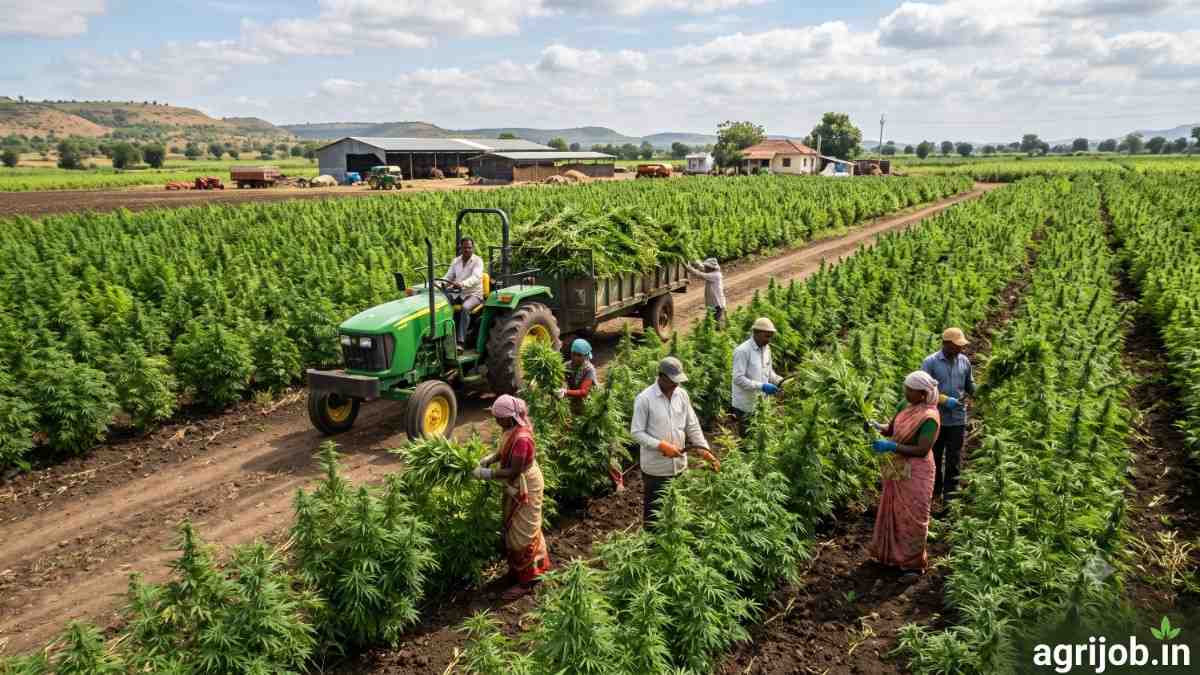
Hemp farming is the cultivation of low-THC Cannabis sativa (0.3% THC or less) for three distinct commercial outputs: CBD-rich floral biomass, grain (seed), and fiber. Each output is effectively a different business, with its own planting density, harvest method, buyer network, and price structure — which is exactly why hemp farming profitability 2026 estimates range so widely, from a few hundred dollars an acre to tens of thousands.
Growers plant CBD hemp at low density (1,000–2,500 plants/acre) to encourage bushy, flower-heavy plants, while grain and fiber hemp are sown far more densely — closer to a wheat or soybean field — because the goal is stalk or seed volume, not individual plant size. That single decision at planting time locks in most of a farm’s cost structure and revenue ceiling for the season.

| Hemp Type | Grown For | Typical Planting Density |
|---|---|---|
| CBD / Floral Hemp | Cannabinoid-rich flower for extraction | 1,000–2,500 plants/acre |
| Grain Hemp | Seed for food, oil, protein | Drilled like a grain crop (high density) |
| Fiber Hemp | Stalk for textile, paper, hempcrete | 400,000+ plants/acre (dense stand) |
Who Should Consider Hemp Farming as a Business?
Hemp isn’t a fit for every farm. Here’s who tends to succeed with it in 2026:
- 🌾 Farmers in a licensed state (Uttarakhand, Himachal Pradesh, Madhya Pradesh, Uttar Pradesh) who can legally apply for a cultivation permit
- 💧 Growers in water-stressed regions looking for a crop that needs less irrigation than cotton
- 🏭 Agri-entrepreneurs with processing access — a decortication mill, extraction lab, or a signed offtake contract
- 🌱 Crop-rotation farmers who want a deep-rooted crop to break up compacted soil between grain seasons
- 💰 Investors seeking diversification into a fast-growing global commodity rather than a single high-risk cannabinoid bet
- 📦 Textile and construction-material buyers looking to vertically integrate fiber supply
- 🥗 Food and nutraceutical businesses that can use the FSSAI-recognized hemp seed, oil, and flour category
- ⚠️ Growers who are NOT chasing a quick CBD windfall without a buyer already lined up — this is the group most likely to lose money
Hemp Farming Profitability 2026: Money and Revenue Per Acre
This is the section that actually decides hemp farming profitability 2026 for your land. Revenue per acre differs by a factor of 40 or more between the CBD and fiber markets, and cost structure differs almost as much.
| Hemp Market | Typical Revenue/Acre | Best-Case Revenue/Acre | Main Cost Driver |
|---|---|---|---|
| CBD / Floral Hemp | $2,500 – $10,000 | Up to $40,000–$75,000 | Extraction, feminized clones, hand-harvest labor |
| Grain Hemp (seed) | $200 – $700 | Up to $1,200 | Combine harvesting, food-grade cleaning |
| Fiber Hemp | $300 – $600 | Up to $1,000 | Retting, decortication, transport |
| Dual-Purpose (Grain + Fiber) | $400 – $580 | Up to $700 | Balanced equipment for both harvests |
According to the USDA’s 2024 National Hemp Report, total US industrial hemp production value reached $445 million in 2024 — up 40% from 2023 — with floral hemp yields averaging 1,757 lbs/acre and grain hemp averaging 702 lbs/acre. Earlier USDA Economic Research Service modeling found fiber hemp returns ranging from roughly $170 to $759 per acre depending on stalk price and yield — numbers that still hold up as a realistic floor-to-ceiling range in 2026.
India’s picture is smaller but growing fast. The country’s broader industrial hemp market was valued at close to USD 219.79 million in 2024 and is projected to expand at roughly 18–21% CAGR through the early 2030s, driven mainly by textile-grade fiber and the newly FSSAI-recognized hemp seed food category — not yet by CBD, which remains commercially restricted.
Hemp Cultivation License and Eligibility Requirements
Hemp cultivation in India is legal only under a state-issued license, and it is not open to every farmer in every state. Under Sections 10 and 14 of the NDPS Act, 1985, state governments — not the central government — decide whether and how to permit cannabis cultivation for industrial or scientific purposes.
- Cultivation is currently permitted, with varying degrees of clarity, in Uttarakhand (the first and most established program, since 2018), Himachal Pradesh, Madhya Pradesh, and Uttar Pradesh
- THC content in the standing crop must stay at or below 0.3% — crops testing above this threshold can be ordered destroyed
- Applications typically go to the District Magistrate or state excise/agriculture department, not the central government
- Required documents generally include land ownership/lease records, a character certificate, storage-facility proof, seed-source details, and a THC-testing undertaking
- License validity is usually seasonal or annual and must be renewed before the next sowing cycle
- License fees and specific paperwork vary by state — as per the official notification, check your state’s agriculture or excise department portal for the current fee schedule
On the cost side, early-stage financial models for dedicated fiber-and-grain operations put initial capital requirements — including seed, basic equipment, and land preparation, excluding land purchase — at roughly $300,000–$350,000 for a 50-acre start-up, while CBD-focused operations require significantly more due to extraction and compliance infrastructure. Smaller, fiber-only trial plots can be started for a few hundred dollars per acre in direct input costs.
How Hemp Farming Works: Step-by-Step Process
Here is the realistic sequence for launching a hemp farming operation in a licensed state, from paperwork to payment.
- Confirm your state allows cultivation and identify the licensing authority (state excise or agriculture department)
- Line up a buyer or processor first — a signed letter of intent for grain, fiber, or biomass before you plant
- Apply for the cultivation license with land records, ID proof, and a THC-compliance undertaking
- Source certified, low-THC seed matched to your target market (grain, fiber, or feminized floral genetics)
- Prepare land and sow — density depends entirely on whether you’re growing for grain, fiber, or CBD
- Manage the crop through a 60–120 day growth cycle, monitoring for pests and, in floral hemp, removing male plants
- Arrange pre-harvest THC testing as required by your state to confirm compliance before cutting
- Harvest on schedule — grain by combine, fiber by mower/baler, floral biomass by hand or specialized harvester
- Dry, ret, or process the crop as required by your buyer’s specifications
- Deliver to your buyer and settle payment against your pre-arranged contract or spot price
Lock in your buyer before you plant, not after. Hemp farming profitability collapses fast when raw fiber, grain, or biomass has nowhere to go — processing capacity in India is still limited, so a signed offtake agreement with a processor or fiber mill is worth more than any yield projection.
CBD Hemp vs Grain Hemp vs Fiber Hemp: Full Comparison
Choosing between CBD, grain, and fiber hemp is really a choice between three different risk profiles. The table below lines them up side by side.
| Factor | CBD / Floral Hemp | Grain Hemp | Fiber Hemp |
|---|---|---|---|
| Revenue per acre (2026 est.) | $2,500 – $40,000+ | $200 – $1,200 | $300 – $1,000 |
| Startup cost per acre | High ($3,000–$8,000+) | Moderate ($400–$700) | Low–Moderate ($300–$500) |
| Labor intensity | Very high (hand harvest, drying, trimming) | Low (combine harvestable) | Low–Moderate |
| THC compliance burden | High — frequent testing required | Low | Low |
| Processing required | Extraction lab or third-party processor | Seed cleaning/hulling mill | Retting + decortication facility |
| Price volatility | Very high | Moderate | Low–Moderate |
| Market maturity in India | Early-stage / restricted | Very early-stage | Most established (existing textile base) |
| Time to first revenue | Approx. 4–5 months | Approx. 4–5 months | Approx. 3–4 months |
| Best For | Growers with extraction access and risk appetite | Diversified, food-grade or dual-purpose growers | Risk-averse growers near textile/construction buyers |
For most Indian and first-time growers, grain hemp or a dual-purpose grain-and-fiber crop is the more realistic 2026 entry point — lower capital risk, simpler compliance, and a growing FSSAI-recognized food market. CBD/floral hemp can out-earn both on paper, but its profitability depends on extraction access and price stability that most new growers don’t yet have.
Pros and Cons of Hemp Farming
Advantages of Hemp Farming
- Uses up to 50% less water than cotton and needs minimal pesticide input, which suits water-stressed farming regions
- Offers multiple revenue streams from one crop — grain, fiber, hurd, and biomass can all be sold separately
- Deep taproots improve soil structure and support crop rotation with grain or pulse crops
- Sits inside a global market projected to keep growing at double-digit CAGR through the early 2030s
- Government interest is rising — FSSAI now recognizes hemp seed, oil, and flour as legal food, and more states are exploring licensing
Disadvantages of Hemp Farming
- Legal cultivation is restricted to a handful of licensed Indian states — most farmers cannot legally grow it yet
- CBD/floral prices are highly volatile; oversupply has crashed prices in more mature markets like the US
- Processing infrastructure — decortication mills, extraction labs — is still limited in India, pushing many growers into low-margin raw-material contracts
- CBD-focused operations require high upfront investment in feminized seed, testing, and compliance before the first rupee of revenue arrives
Important Terms Related to Hemp Farming
- THC (Tetrahydrocannabinol): the psychoactive compound capped at 0.3% for a crop to legally qualify as industrial hemp
- CBD (Cannabidiol): the non-intoxicating compound that drives demand and pricing in the wellness/floral hemp segment
- Decortication: the mechanical process that separates hemp fiber from the woody hurd inside the stalk
- Retting: controlled field or water decomposition that loosens fiber from the stalk before processing
- Dual-purpose hemp: varieties bred to be harvested for both grain and fiber from the same planting
- Feminized seed: seed bred to produce only female plants, essential for CBD/floral production
- Hemp hurd: the woody core byproduct of fiber processing, used in hempcrete and animal bedding
- NDPS Act, 1985: India’s central law under which state governments license industrial hemp cultivation
- FSSAI Standard 2.16: the food-safety regulation that permits hemp seed, oil, and flour to be sold as food in India
- Hempcrete: a bio-composite building material made from hemp hurd, lime, and water
Hemp Farming Timeline and Growing Calendar
| Activity | Typical Window |
|---|---|
| License application submission | 60–90 days before sowing |
| Sowing — grain or fiber hemp | March–May (region dependent) |
| Sowing — CBD/floral hemp (transplanted) | April–May |
| Vegetative growth period | 60–90 days |
| Flowering / CBD harvest window | August–September |
| Grain harvest | September–October |
| Fiber harvest (stalk cutting) | 70–90 days after sowing, before seed set |
| Retting period (fiber) | 2–4 weeks post-harvest |
| License renewal | Annually, before the next sowing season |
As with all cultivation calendars, treat these as planning ranges rather than fixed rules — as per the official notification, always confirm exact sowing and licensing windows with your state agriculture department for the current season.
Important Links for Hemp Farmers
| Resource | Link |
|---|---|
| USDA National Hemp Report 2024 (NASS) | Official Report (PDF) |
| Industrial Hemp Market Potential (USDA ERS) | Official Study (PDF) |
| NDPS Act, 1985 — Full Text | IndiaCode Official Text (PDF) |
| FSSAI Gazette Notification — Hemp Seed, Oil & Flour | Official Notification (PDF) |
| Department of Revenue — NDPS Offences & Penalties | Official Page |
| Related: Makhana Business Profit Per Acre 2026 | Read the Full Breakdown |
| Related: Kisan Loan & Agriculture Subsidy Guide 2026 | See KCC & NABARD Options |
| Related: eNAM Portal — Sell Crops Online | Learn How It Works |
| More Farm Business Guides | Agrijob.in Knowledge Hub |
Conclusion: Is Hemp Farming Profitable in 2026?
Hemp farming profitability 2026 is real, but it isn’t uniform — CBD/floral hemp offers the highest ceiling, grain and fiber hemp offer the steadier floor, and the right choice depends on your license status, capital, and access to a buyer. For most new growers, especially in India’s still-developing hemp market, starting with grain or fiber and a secured offtake contract is the lower-risk way to prove the model before scaling into higher-value floral production. Bookmark this page — we update it as USDA data, FSSAI rules, and state licensing policies change, and read our related guide on agriculture loans and subsidies to plan your financing before you apply for a license.
- CBD/floral hemp pays the most per acre (up to $40,000+) but carries the highest cost, labor, and price-volatility risk
- Grain and fiber hemp are steadier, with typical returns of $200–$1,200 per acre in 2026
- US industrial hemp production value hit $445 million in 2024, up 40% year-on-year (USDA NASS)
- In India, commercial hemp cultivation is legal only under state licenses (Uttarakhand, Himachal Pradesh, Madhya Pradesh, Uttar Pradesh), capped at 0.3% THC
- FSSAI now permits hemp seed, oil, and flour to be sold as food, opening a new domestic demand channel
- Secure your license and your buyer before you plant — profitability depends more on your offtake contract than your yield
Frequently Asked Questions About Hemp Farming Profitability 2026
Is hemp farming profitable in 2026?
Yes, hemp farming can be profitable in 2026, but returns vary enormously by market. CBD/floral hemp can pay $2,500 to over $40,000 per acre, while grain and fiber hemp typically return $200 to $1,200 per acre. Profitability depends heavily on having a secured buyer, the right license, and realistic cost planning before planting.
How much can you make per acre growing hemp?
Per-acre returns range from roughly $200 for fiber and grain hemp to more than $40,000 for high-quality CBD/floral hemp in strong-price years, based on USDA and industry data. Most growers, especially newcomers, should plan around the lower-to-middle end of these ranges rather than the best-case CBD figures.
Is CBD hemp more profitable than grain or fiber hemp?
CBD hemp has a much higher revenue ceiling per acre than grain or fiber hemp, but it also carries far higher startup costs, labor demands, and price volatility. Grain and fiber hemp are generally more profitable on a risk-adjusted basis for growers without existing extraction or processing access.
Is hemp farming legal in India?
Hemp farming is legal in India only under a state-issued license, permitted under Sections 10 and 14 of the NDPS Act, 1985. It is not automatically legal nationwide — farmers must apply through their state’s excise or agriculture department and keep THC content at or below 0.3%.
Which states in India allow hemp cultivation?
Uttarakhand, Himachal Pradesh, Madhya Pradesh, and Uttar Pradesh currently permit licensed industrial hemp cultivation, with Uttarakhand having the most established program since 2018. Rules, fees, and approval timelines differ by state, so farmers should verify current requirements directly with their state agriculture or excise department.
How much does it cost to start hemp farming?
Fiber and grain hemp can be started for a few hundred dollars per acre in direct input costs, while a dedicated 50-acre fiber-and-grain operation may need roughly $300,000–$350,000 in initial capital for seed, equipment, and land preparation. CBD-focused operations cost significantly more due to feminized genetics, testing, and extraction access.
What licenses do you need to grow hemp?
You need a state-issued cultivation license, typically obtained through the District Magistrate or state excise/agriculture department, along with land ownership or lease proof, a character certificate, storage-facility documentation, and a THC-compliance undertaking. Requirements vary by state and should be confirmed with the local licensing authority.
Can you grow hemp for both grain and fiber?
Yes, dual-purpose hemp varieties are bred to be harvested for both grain and fiber from the same planting, typically returning $400 to $580 per acre. This approach spreads risk across two markets and is often recommended for growers entering hemp farming for the first time.
What is the biggest risk in hemp farming?
The biggest risk is growing a crop with no confirmed buyer, especially in the CBD/floral segment where prices are volatile and processing capacity is limited. Regulatory risk — including THC testing failures that can trigger crop destruction — is the second major factor growers must manage carefully.
Where can farmers sell hemp fiber or grain in India?
Farmers typically sell through direct contracts with textile mills, hempcrete manufacturers, or food processors, since India’s hemp trading infrastructure is still early-stage compared to established crops. Platforms like eNAM can help with broader crop marketing, though dedicated hemp marketplaces are still developing alongside the licensing framework.
Last Updated: August 2026. This guide is reviewed and updated regularly as USDA, FSSAI, and state hemp policies evolve. Bookmark this page for the latest hemp farming profitability data.
Disclaimer: This article by NITISH SINGH for Agrijob.in is for general informational and educational purposes only and does not constitute financial, legal, or agronomic advice. Hemp cultivation is a regulated activity in India — verify current licensing rules with your state agriculture or excise department, and current market prices with local processors, before making any investment or planting decision. Figures are sourced from official government data and industry reports cited above and may vary by region, season, and market conditions.