

India USA Agricultural Trade 2026 – Exports, Tariffs & Deal
India USA agricultural trade 2026 is at a transformational moment — a landmark interim trade deal signed in February 2026 has slashed US reciprocal tariffs on Indian goods from 50% to 18%, granted zero tariff access to 75% of Indian agricultural exports, and committed India to a $500 billion purchase package from the US over 5 years. With bilateral agri trade already valued at $6.21 billion in 2024 and growing 24.1% year-on-year in early 2025, the 2026 deal reshapes the trade landscape for Indian farmers, exporters, and agri-professionals alike. This complete guide covers top Indian agricultural exports, US import tariff structures, what the 2026 India-US trade deal means for each commodity, US agri products flowing into India, government career opportunities in the export sector, and expert analysis of the road ahead.

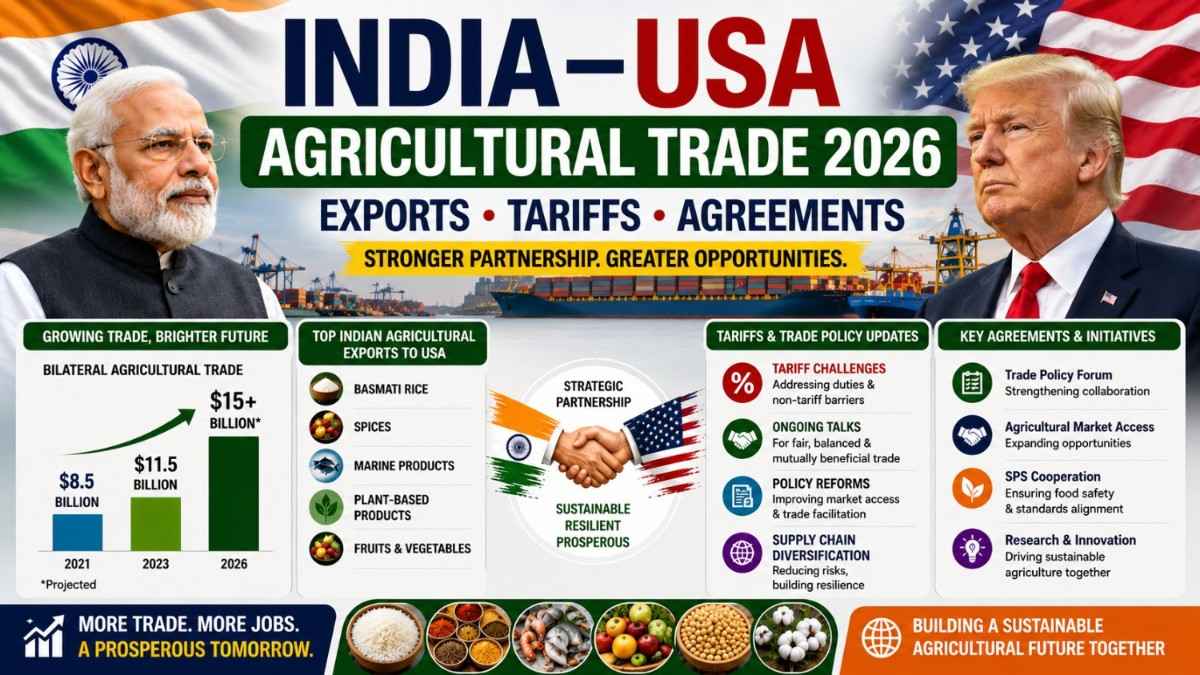
- Key Facts at a Glance – India USA Agricultural Trade 2026
- India USA Agricultural Trade Overview 2026
- Top Indian Agricultural Exports to the USA in 2026
- US Agricultural Products India Imports in 2026
- US Import Tariffs on Indian Agri Products – 2026 Structure
- India-US Interim Trade Deal February 2026 – Key Terms
- Sectors India Protected from Tariff Cuts in the 2026 Deal
- Who Should Follow India USA Agricultural Trade 2026
- India-US Agri Trade vs India-China Agri Trade – Comparison
- High-Value Agri Trade & Export Terms You Must Know
- Frequently Asked Questions (FAQs)
Key Facts at a Glance – India USA Agricultural Trade 2026
| Total Bilateral Agri Trade (2024) | $6.21 billion (USDA data) |
| Growth Rate (Jan–Jun 2025 vs 2024) | +24.1% ($3.47B vs $2.80B) |
| US Rank as India Agri Export Market | #1 destination (USA, UAE, China) |
| India Rank as US Agri Export Market | #12 (US exports $2.25B to India, 2024) |
| 2026 Trade Deal Tariff Reduction | 50% → 18% reciprocal tariff on Indian goods |
| Zero-Tariff Indian Agri Exports (2026) | 75% of Indian agri export items (SBI report) |
| India WTO Bound Agri Tariff (avg) | 113.1% (up to 300% on select items) |
| India $500B Commitment to USA | 5-year total purchase (energy, tech, agri) |
India USA Agricultural Trade Overview 2026
India USA agricultural trade 2026 sits within a broader bilateral goods trade relationship that reached $129.2 billion in 2024 — making the United States India’s single largest trading partner. Agriculture accounts for approximately 5% of total bilateral goods trade, yet it is disproportionately strategic: it feeds millions, employs tens of millions of Indian farmers, and is a politically sensitive battleground in both countries’ domestic politics.
India’s 2024 agricultural trade deficit with the US stood at $1.3 billion — meaning India exported more agri goods to the US than it imported. US Agriculture Secretary Brooke Rollins acknowledged this at the time of the February 2026 deal, stating that reducing this deficit was a core American objective. The interim trade agreement directly targets this imbalance, with India committing to open its market more broadly to US farm products such as DDG, red sorghum, nuts, soybean oil, and various fruits.

From India’s perspective, the US is its most valuable agricultural export market. Indian agri-exports to the US surged 24.1% in the first half of 2025, reaching $3.47 billion compared to $2.80 billion in the same period of 2024. This momentum was threatened by the escalating US tariff regime — first 25%, then 50% — before the February 2026 deal defused tensions and restored preferential access for Indian exporters.
Top Indian Agricultural Exports to the USA in 2026
India’s agricultural export basket to the USA is diverse, high-value, and growing. The following table summarises the top commodities by value, volume, and 2026 tariff status following the interim trade deal:
| Commodity | Approx. Export Value | Key States | 2026 US Tariff Status |
|---|---|---|---|
| Shrimp & Marine Products | $5.17 billion (FY2024-25 total global) | Andhra Pradesh, Gujarat, West Bengal | Reduced to 18%; zero-tariff access under deal |
| Basmati Rice | $5.94 billion (global, FY24) | Punjab, Haryana, Uttar Pradesh | Zero tariff in US; rice protected from import side |
| Spices (Cumin, Turmeric, Chilli, Psyllium) | $4.72 billion globally; US top 3 buyer | Rajasthan, Gujarat, Andhra Pradesh | Zero tariff under February 2026 deal |
| Cashew Nuts | Significant; part of $1.12B US tree nut trade | Kerala, Goa, Karnataka | Zero tariff under February 2026 deal |
| Coffee | Part of plantation crop basket | Karnataka, Kerala, Tamil Nadu | Zero tariff under February 2026 deal |
| Tea | Part of plantation crop basket | Assam, West Bengal, Tamil Nadu | Zero tariff under February 2026 deal |
| Non-Basmati Rice | $6.12 billion (global, FY24) | West Bengal, Telangana, Punjab | Subject to 18% reciprocal tariff |
| Tropical Fruits (Mango, Banana, Papaya) | Growing category for Indian diaspora market | Maharashtra, Andhra Pradesh, Kerala | Zero tariff under February 2026 deal |
Shrimp remains India’s single most critical agricultural export item to the US, accounting for more than 40% of India’s total shrimp outflows globally. India exported $5.17 billion worth of shrimp in FY2024-25. The tariff escalation to 50% in mid-2025 forced many shrimp farmers in Andhra Pradesh to pivot temporarily to fish farming — a disruption that the February 2026 deal aims to reverse. India is the world’s top spice exporter, and the US is consistently among the top 3 buyers of Indian spices including cumin (jeera), psyllium husk (isabgol), turmeric, and chilli powder.
US Agricultural Products India Imports in 2026
The USA exported $2.25 billion worth of agricultural products to India in 2024, making India the 12th largest US agricultural export market, growing at a compound annual rate of 6% since 2015. The 2026 interim trade deal commits India to significantly expand these imports, particularly in high-value categories where Indian domestic production is inadequate. Here is the breakdown of the top US agricultural exports to India:
| US Agri Product | 2024 Export Value to India | 10-Year Growth | 2026 Deal Impact |
|---|---|---|---|
| Tree Nuts (Almonds, Walnuts, Pecans) | $1.12 billion | +84% | New tariff lines for pecans; increased access |
| Non-Beverage Ethanol | $420.89 million | +477% | Continues; India committed to reduce tariffs on DDG |
| Cotton | $209 million | +82% | Stable; India maintains high domestic production |
| Pulses | $73.41 million | –46% (volatility) | India reducing import dependency via Mission Aatmanirbharta |
| Essential Oils | $67.19 million | +230% | Growing; new tariff lines facilitate tracking |
| Dairy Products | $52.65 million | +230% | Dairy sector explicitly EXCLUDED from 2026 deal tariff cuts |
| Soybean Oil | $37.53 million | +47,578% (from near zero) | India committed to reducing tariffs on soybean oil |
| Fresh Fruit (Apples, Cherries, Blueberries) | $40.07 million | –64% | New tariff lines for cranberries and blueberries; market opening |
Tree nuts — primarily almonds and walnuts from California — are by far the largest US agricultural export to India, at $1.12 billion in 2024, with 84% growth over the decade. The February 2026 trade deal creates 44 new tariff lines in India’s Union Budget 2026-27 customs schedule specifically to better track products like pecan nuts, fresh cranberries, and blueberries — all US-origin items that India has agreed to open up. The US Department of Agriculture’s Foreign Agricultural Service (USDA-FAS) projects significant growth in US tree nut and specialty fruit exports to India following the deal.
US Import Tariffs on Indian Agri Products – 2026 Structure
Understanding the tariff structure is essential to grasping where India USA agricultural trade 2026 stands. The tariff history over 2025-2026 was turbulent — but the February 2026 deal has brought significant clarity. Here is the complete timeline and current structure:
| Period | US Tariff on Indian Goods | Key Driver |
|---|---|---|
| Pre-April 2025 | Standard MFN rates (avg ~3–5% for agri) | WTO Most-Favoured-Nation rules |
| April 2025 | +25% reciprocal tariff added | US cites India’s high tariffs & Russia energy ties |
| August 27, 2025 | 50% total (25% + additional 25%) | India’s continued Russian crude purchases |
| February 7, 2026 | 25% punitive tariff removed; 18% reciprocal remains | India-US interim trade deal; India stops Russian oil |
| Post-Deal (2026 onwards) | 18% baseline; 0% on 75% of Indian agri items | Interim agreement; full BTA negotiations ongoing |
India’s own tariff structure on agricultural imports from the US remains among the highest globally. The US Trade Representative’s 2026 National Trade Estimate (NTE) Report, released March 31, 2026, flagged India’s WTO bound tariff average of 113.1% on agricultural products — ranging up to 300% on specific items. The NTE report highlighted that India can change applied tariff rates at any time due to the large gap between bound and applied rates, creating uncertainty for US agri exporters. The 2026 deal partially addresses this by locking in tariff reductions on specific agreed commodities.
India-US Interim Trade Deal February 2026 – Key Agricultural Terms
The India-US Interim Trade Agreement of February 6, 2026 is the most significant bilateral trade development between the two countries in decades. Announced jointly via a White House fact sheet and Commerce Minister Piyush Goyal’s press briefing, the deal’s agricultural provisions restructure the entire India USA agricultural trade 2026 landscape. Here is a step-by-step breakdown of what was agreed:
- 🤝 Punitive 25% tariff removed (February 7, 2026): President Trump signed an executive order removing the additional 25% tariff on Indian imports, recognising India’s commitment to halt Russian crude oil purchases. This immediately restored Indian competitiveness in the US market.
- 📉 Reciprocal tariff cut from 50% to 18%: The remaining 25% reciprocal tariff was further reduced to 18% — Commerce Minister Goyal confirmed India now faces lower tariffs than China, Pakistan, Bangladesh, and Vietnam in the US market.
- 🌾 Zero tariff on 75% of Indian agri exports: An SBI research report confirmed that under the deal, three-quarters of all Indian agricultural export line items now enjoy duty-free access in the US — a historic breakthrough for Indian spice, plantation crop, and marine product exporters.
- 🇺🇸 India reduces tariffs on select US agri products: India committed to lower or eliminate tariffs on Dried Distillers Grains (DDG), red sorghum, tree nuts, fruits, soybean oil, and wine/spirits. India created 44 new tariff lines in Budget 2026-27 to implement and track these changes.
- 💰 $500 billion US purchase commitment: India committed to purchasing $500 billion worth of US products over 5 years — covering energy, technology, defence, and agriculture — described by President Trump as “Buy American at a much higher level.”
- 🔒 Full BTA negotiations ongoing: The February deal is an interim framework. Both nations are working toward a comprehensive Bilateral Trade Agreement (BTA) to permanently lock in benefits and address remaining barriers including non-tariff measures, IP, and digital trade.
Sectors India Protected from Tariff Cuts in the 2026 Deal
A critical and politically sensitive aspect of India USA agricultural trade 2026 is what India refused to concede. The government’s Commerce Department confirmed via official social media posts that the following sectors were explicitly excluded from tariff reduction commitments in the interim agreement — protecting millions of Indian farmers’ livelihoods:
- 🌾 Wheat and Rice: India’s food security staples — the core of PMGKAY and NFSA — are fully protected. No tariff cuts on US wheat or rice imports into India.
- 🌽 Millets, Corn, and Soya Meal: India’s push for millet promotion and domestic oilseed self-sufficiency (Mission Aatmanirbharta) meant these were kept off the tariff-reduction table.
- 🥛 Dairy Sector — Fully Excluded: India’s 8 crore dairy farmer households and the cooperative sector (led by AMUL) were protected entirely. No market access opening for US dairy products.
- 🐔 Poultry Sector — Fully Excluded: India’s poultry industry, which supports rural livelihoods across 28 states, was explicitly shielded from US competition.
- 🌶️ Spices (as Import Category): While India grants zero tariff on its own spice exports to the US, India did not open its domestic spice market to US competition — protecting 3 million spice farmers across Rajasthan, Gujarat, and southern states.
- 🥔 Potato and Major Fruits: Key horticulture commodities were excluded from liberalisation to protect growers in UP, West Bengal, Gujarat, and Maharashtra.
- 🥦 Select Frozen and Preserved Vegetables: India maintained tariff protection on frozen processed vegetables, shielding small-scale processors and contract farmers.
Who Should Follow India USA Agricultural Trade 2026?
India USA agricultural trade 2026 matters to a wide range of professionals and students. Here are 8 profiles who need to stay closely informed:
- 🎓 UPSC & State PSC Aspirants: India-US trade, WTO negotiations, APEDA, and agricultural export policy are high-frequency GS Paper 2 and Paper 3 topics appearing in both Prelims and Mains.
- 🌾 Farmers & Farmer Producer Organisations (FPOs): Shrimp farmers in AP, spice growers in Gujarat/Rajasthan, and rice farmers in Punjab directly benefit from zero-tariff US market access — knowing how to leverage APEDA and MPEDA export channels is now essential.
- 👩💼 Government Job Seekers in Agri-Export Departments: APEDA, MPEDA, NAFED, NABARD, and Ministry of Commerce recruit export promotion officers, quality analysts, and trade policy researchers — salaries range from Rs.35,000 to Rs.1,20,000/month.
- 📦 Agri-Entrepreneurs & Startups: The India-US deal opens a $500 billion trade pipeline. Agri-processing, cold chain logistics, organic certification, and specialty food businesses have a once-in-a-generation market entry opportunity.
- 🏦 Agricultural Finance & Banking Professionals: NABARD, SBI Agri, and cooperative banks will see rising demand for export credit, crop insurance, and trade finance products linked to US market expansion.
- 📰 Journalists & Policy Analysts: India-US agricultural trade intersects with geopolitics (Russia oil), domestic food policy (NFSA, PMGKAY), and WTO negotiations — making it the most complex economic-policy story of 2026.
- 🌍 Agri-Researchers & Students: Understanding tariff economics, commodity trade flows, and bilateral trade agreements is foundational for MSc Agriculture Economics, MBA Agribusiness, and development economics programmes.
- 🏘️ Rural SC/ST/OBC Communities in Export Commodity Belts: Shrimp farming (Andhra Pradesh), spice cultivation (Gujarat, Rajasthan), and cashew processing (Kerala, Karnataka) are livelihood activities for historically marginalised communities — the 2026 deal directly improves their income potential.
India-US Agri Trade vs India-China Agri Trade – 2026 Comparison
How does India USA agricultural trade 2026 compare to India’s agricultural trade relationship with China — its other major partner?
| Parameter | India-USA Agri Trade 2026 | India-China Agri Trade 2026 |
|---|---|---|
| Total bilateral agri trade value | $6.21 billion (2024, growing) | Smaller; primarily India imports from China |
| India’s top agri export item | Shrimp, Basmati Rice, Spices | Sesame seeds, seafood, cotton |
| Trade surplus/deficit for India | India surplus ($1.3B in India’s favour) | India deficit (large import dependence) |
| Trade agreement status | Interim deal signed Feb 2026; BTA in progress | No FTA; tensions post-2020 border conflict |
| Zero-tariff provisions | 75% of Indian agri items duty-free in US | No comparable provision |
| US agri exports to India (top) | Tree nuts, ethanol, cotton, dairy | N/A (China exports to India, not vice versa) |
| Geopolitical risk | De-escalating after Feb 2026 deal | High; India-China border tensions ongoing |
| Best for Indian exporters | Marine products, spices, plantation crops | Limited; India diversifying away |
High-Value Agri Trade & Export Policy Terms You Must Know
Mastering these terms will make you a more informed participant in India USA agricultural trade 2026 — essential for UPSC, agricultural career interviews, and export business planning:
- 🏛️ APEDA (Agricultural & Processed Food Products Export Development Authority): The Govt. of India’s nodal agency for promoting agricultural exports. Manages Rs.10,900 crore in branding support, export certification, and market development for Indian agri products globally. Regularly recruits officers at Rs.40,000–Rs.80,000/month.
- 🦐 MPEDA (Marine Products Export Development Authority): The nodal agency for India’s seafood export sector — overseeing shrimp, fish, and marine product quality certification, market promotion, and dispute resolution. India exported $5.17 billion in shrimp in FY2024-25 under MPEDA’s oversight.
- 📋 WTO Bound Tariff Rate: The maximum tariff a WTO member has legally committed never to exceed. India’s agricultural bound rate averages 113.1% — the actual applied rates are much lower, but the gap creates policy flexibility that the US finds concerning.
- 🌾 Most Favoured Nation (MFN) Tariff: The standard WTO tariff rate a country applies to all trading partners equally. US-India agricultural trade prior to 2025 was governed by MFN rates (typically 3–5% on the US side for most agri items).
- 🤝 Bilateral Trade Agreement (BTA): A comprehensive, permanent trade deal between 2 countries that locks in tariff rates, addresses non-tariff barriers, and provides a dispute resolution framework. India and the US are negotiating a full BTA following the February 2026 interim deal.
- 🌱 DDG (Dried Distillers Grains): A byproduct of US ethanol production used as animal feed. India agreed to reduce tariffs on DDG imports under the 2026 deal — beneficial for India’s growing livestock and poultry sector and US corn farmers. Current US DDG exports to India: approximately $43.73 million annually.
- 📦 Countervailing Duty (CVD): A tariff imposed to offset foreign government subsidies. In February 2026, the US imposed preliminary CVDs of 126% on Indian solar cells — a separate trade friction running parallel to the agricultural trade deal negotiations.
- 🥛 Non-Tariff Barriers (NTBs): Regulatory restrictions beyond tariffs — including import bans, sanitary and phytosanitary (SPS) requirements, labelling rules, and licensing. FSSAI’s labelling regulations (updated January 2026) are among the NTBs flagged in the US Trade Representative’s 2026 NTE Report.
- 📊 Agri Trade Deficit/Surplus: India ran a $1.3 billion agricultural trade surplus with the US in 2024 — exporting more than it imported. The US aims to eliminate or reverse this through the 2026 deal by expanding US agri exports to India.
- 🌍 FSSAI (Food Safety and Standards Authority of India): India’s food regulatory body governing all agri imports. Updated its labelling policy on January 6, 2026 — all labelling regulation changes now take effect annually on July 1, providing more predictability for US exporters navigating the Indian market.
Frequently Asked Questions – India USA Agricultural Trade 2026
What is the total value of India USA agricultural trade in 2026?
India USA agricultural trade in 2026 was valued at $6.21 billion in 2024 according to USDA data, growing at a rapid 24.1% pace in the first half of 2025 ($3.47 billion vs $2.80 billion a year earlier). The February 2026 interim trade deal is expected to significantly accelerate this growth further as zero-tariff provisions and reduced barriers take effect. India’s Commerce Ministry aims to take overall India-US bilateral trade to Rs.45 lakh crore (approximately $540 billion) in the coming years.
What are India’s top agricultural exports to the USA in 2026?
India’s top agricultural exports to the USA in 2026 are shrimp and marine products (India’s single-largest agri export item — 40%+ of total shrimp outflows, worth $5.17 billion globally in FY2024-25), basmati rice ($5.94 billion global value), spices including cumin, turmeric, chilli and psyllium husk ($4.72 billion global exports, US is top 3 buyer), cashews, coffee, tea, and tropical fruits like mango, banana, and papaya. Under the February 2026 deal, 75% of these items now attract zero US tariff.
What did the India-US trade deal 2026 change for agriculture?
The India-US interim trade deal of February 6, 2026 is transformational for agriculture. The punitive 25% tariff on Indian goods was removed on February 7, and the remaining reciprocal tariff was cut from 50% to 18%. For Indian agricultural exporters, 75% of all agri export items now enjoy zero-duty US market access. India committed to tariff cuts on US products like DDG, red sorghum, nuts, fruits, and soybean oil, while protecting wheat, rice, dairy, and poultry from any liberalisation. India also created 44 new tariff lines in Budget 2026-27 to precisely track newly opened import categories.
What US agricultural products does India import in 2026?
India’s top imports of US agricultural products in 2024 are tree nuts at $1.12 billion (almonds, walnuts, now pecans) — the largest single category growing 84% over 10 years — followed by non-beverage ethanol at $420.89 million (+477% growth), cotton at $209 million, pulses at $73.41 million, essential oils at $67.19 million, dairy at $52.65 million, and soybean oil at $37.53 million. The 2026 deal adds cranberries, blueberries, DDG, and red sorghum as newly opened categories.
What are India’s WTO bound tariff rates on agricultural imports?
India’s WTO bound tariff rates on agricultural products average 113.1%, ranging as high as 300% on specific items — among the highest of any major economy. The US Trade Representative’s 2026 NTE Report highlighted this as a source of significant uncertainty for US exporters since India can raise its applied tariff rates to the bound ceiling at any time. The February 2026 interim deal partially addresses this by locking in tariff cuts on specific agreed items, providing more certainty for US agricultural exporters planning India market entry.
Which Indian agricultural products now enjoy zero tariff in the USA?
Under the February 2026 India-US interim trade deal, spices, tea, coffee, cashew nuts, chestnuts, avocados, bananas, mangoes, kiwi, and papaya now attract zero tariff in the United States. Commerce Minister Piyush Goyal confirmed that 75% of all Indian agricultural export items — as per the SBI research report — now enjoy duty-free US market access, making Indian agri products significantly more competitive against Thailand, Vietnam, and other competitor nations.
What government jobs are available in India’s agricultural export sector in 2026?
India USA agricultural trade 2026 expansion is creating strong demand for government professionals in export-facing agencies. APEDA recruits assistant directors, quality analysts, and market development officers at Rs.40,000–Rs.80,000/month. MPEDA recruits inspection officers and development officers for the seafood sector. NABARD finances agri-export infrastructure and recruits Grade A and B officers at Rs.44,500–Rs.89,000/month. The Ministry of Commerce hires trade policy research officers. Visit Agrijob.in for the latest 2026 notifications across all these departments.
What sectors did India protect from tariff cuts in the 2026 US trade deal?
India explicitly excluded wheat, rice, millets, corn, soya meal, potato, and major fruits from import-side tariff cuts in the February 2026 deal. The entire dairy sector (protecting 8 crore dairy farmer households) and the poultry sector were kept out of liberalisation. Selected frozen and preserved vegetables were also shielded. India’s Commerce Department confirmed these protections place farmers’ interests at the forefront — ensuring that the India-US trade deal does not undermine domestic food security or rural livelihoods.
This guide is regularly reviewed and updated for accuracy. Bookmark this page for the latest India USA agricultural trade 2026 updates, tariff notifications, and government job alerts.
Related Reads on Agrijob.in: NABARD Recruitment 2026 | Food Security in India 2026 | ICAR Recruitment 2026
Last Updated: May 2026 | Source: USDA-FAS, White House Fact Sheet, Lexology, Business Standard, Deccan Herald, SBI Research, USTR NTE Report 2026, PIB India