

Vertical Farming Business India 2026
The vertical farming business in India 2026 is no longer an experiment — it is a commercially viable, rapidly growing industry with a market projected to reach USD 1,926.1 million (Rs.16,050 crore) by 2033, growing at a 23.5% CAGR. With setup costs starting at just Rs.5 lakh for a home-based unit and commercial farms generating net monthly profits exceeding Rs.1 lakh from premium crops like microgreens, lettuce, and basil, vertical farming offers one of India’s most compelling agri-business opportunities for entrepreneurs, agriculture graduates, and investors. This complete 2026 guide covers everything: setup cost breakdowns by scale, the most profitable crops with real price data, ROI analysis, government subsidies up to 50%, leading companies, and a step-by-step launch roadmap for starting your vertical farm in India.

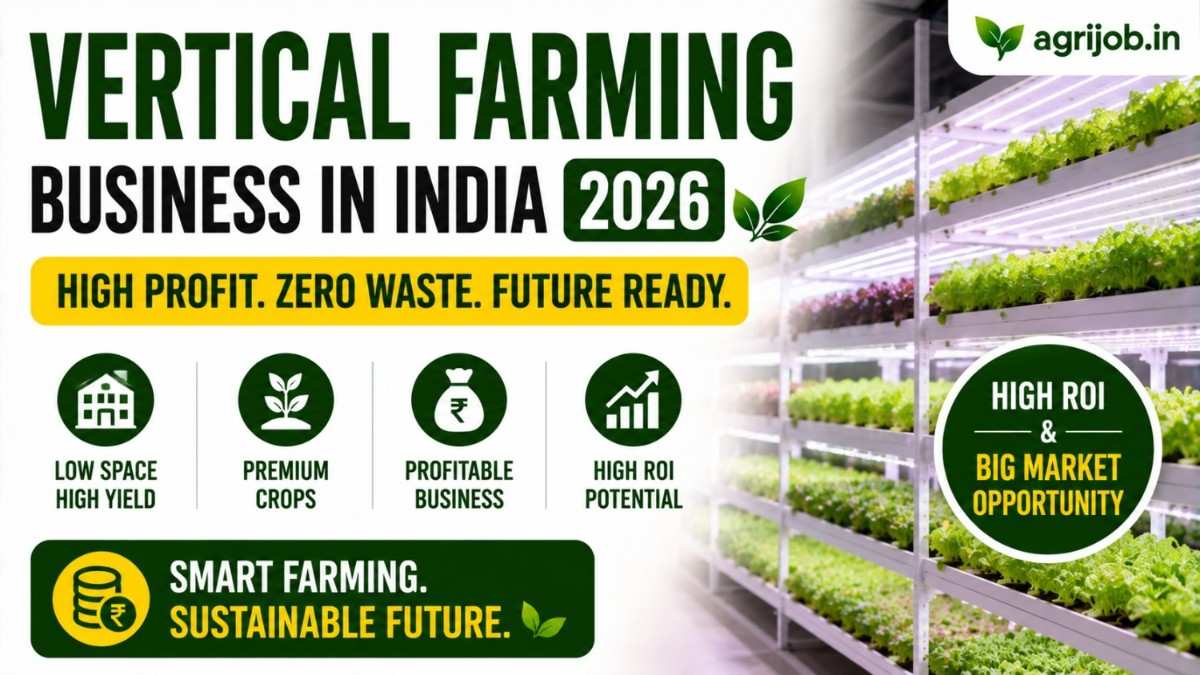
- India Vertical Farming Market 2026 – Size & Growth
- 5 Types of Vertical Farming Systems – India Guide
- Vertical Farming Setup Cost India 2026 – Complete Breakdown
- Best Crops for Vertical Farming in India – Price & Profit Data
- ROI & Profitability Analysis – 3 Scale Scenarios
- Top 8 Vertical Farming Companies in India 2026
- Government Subsidies for Vertical Farming India 2026
- Eligibility Criteria & Application Fee
- Who Should Start a Vertical Farming Business?
- How to Start Vertical Farming in India – Step-by-Step
- Vertical Farming vs Traditional Farming vs Greenhouse – Comparison
- High-Value Vertical Farming Career & Business Terms 2026
- Frequently Asked Questions (FAQs)
India Vertical Farming Market 2026 – Size, Growth & Opportunity
India’s vertical farming industry is in a strong growth phase. The market generated revenue of USD 358.6 million in 2025 and is projected to reach USD 1,926.1 million (approximately Rs.16,050 crore) by 2033, expanding at a CAGR of 23.5% — one of the fastest growth rates among all emerging agricultural sectors in India. India accounts for 3.7% of the global vertical farming market, with the Asia Pacific region (which includes India, China, and Japan) contributing 24.80% to the global market at a valuation of USD 2.11 billion in 2025.
| India Vertical Farming Market (2025) | USD 358.6 Million (~Rs.2,988 Crore) |
| Projected Market Size (2033) | USD 1,926.1 Million (~Rs.16,050 Crore) |
| Market CAGR (2026–2033) | 23.5% |
| Dominant System | Hydroponics (56% global market share) |
| Fastest Growing Segment India | Building-Based Vertical Farms |
| Setup Cost Range | Rs.5 lakh (basic) to Rs.1.5 crore+ (commercial) |
| Most Profitable Crop | Microgreens (Rs.500–Rs.1,500/kg; harvest in 7–14 days) |
| Govt Subsidy (MIDH/NHM) | 40–50% of setup cost |
| ROI Period (Commercial Farm) | 14–36 months (crop-dependent) |
Six structural forces are powering India’s vertical farming boom in 2026. India’s population exceeded 1.4 billion with over 35% urban — creating intense demand for fresh, locally grown produce in cities. Groundwater depletion, erratic monsoons, and climate volatility are making conventional outdoor farming increasingly risky. Premium consumer segments in metros actively seek pesticide-free, residue-free vegetables and are willing to pay 2–3x conventional prices. The cost of LED grow lights — the biggest energy cost in vertical farming — has fallen 90% since 2015, dramatically improving farm economics. The government’s Digital Agriculture Mission and MIDH scheme are providing capital subsidies and technology support for controlled environment agriculture (CEA). And India’s booming food delivery and organic grocery platforms — BigBasket, Natures Basket, Swiggy Instamart, and Blinkit — create instant scale-ready market access for vertical farm produce.

5 Types of Vertical Farming Systems – India Guide 2026
Choosing the right growing system is the most consequential decision in starting a vertical farming business. Here are the 5 main systems used by Indian vertical farms in 2026, with their cost, suitability, and best crops:
- 💧 Hydroponics (Most Popular – 56% Market Share): Plants grow in nutrient-rich water without soil. The most widely adopted system in India for urban vertical farms. Sub-types include NFT (Nutrient Film Technique), DWC (Deep Water Culture), and Dutch Bucket — each suited to different crop types and farm sizes. Setup cost: Rs.800–Rs.2,000 per sq. ft. Best crops: lettuce, spinach, basil, herbs, tomatoes, bell peppers. Water saving vs soil: 70–90%. The ideal starting system for Indian agri-entrepreneurs in 2026 due to its balance of cost, yield, and technical accessibility.
- 🌫️ Aeroponics (Highest Yield, Highest Cost): Plant roots are suspended in air and periodically misted with a fine nutrient solution. Delivers the highest yields of any system — 30–40% more than hydroponics — and uses 95% less water than soil farming. Setup cost: Rs.2,000–Rs.5,000 per sq. ft. Best crops: lettuce, herbs, strawberries, microgreens. Recommended for experienced operators with capital and technical expertise, or large commercial vertical farms targeting export-quality produce.
- 🐟 Aquaponics (Integrated Ecosystem): A closed-loop system combining fish farming (aquaculture) with plant growing (hydroponics). Fish waste provides organic nutrients for plants; plants clean the water for fish. Setup cost: Rs.1,500–Rs.4,000 per sq. ft. Best crops/products: leafy vegetables + tilapia/catfish. Best suited for eco-conscious entrepreneurs, restaurant-integrated farm concepts, and educational farm projects. India’s aquaponics segment is growing in Kerala, Goa, and coastal Karnataka.
- 📦 Container Farming (Largest Revenue Segment in India 2025): Standard ISO shipping containers (20-foot or 40-foot) converted into fully climate-controlled, self-contained vertical farms. Highly portable, scalable, and deployable without permanent building infrastructure. Container farm cost: Rs.15–Rs.40 lakh per unit (excluding transport). Best crops: microgreens, lettuce, herbs, strawberries. Brands like Agricool India (Bangalore) have pioneered this model. Ideal for quick deployment in urban vacant lots, rooftops, or campus settings.
- 🌊 NFT (Nutrient Film Technique) – Most Popular for India: A thin, continuous film of nutrient solution flows along sloped channels where plant roots dangle. Simple, low-cost, easy to maintain, and scalable. Setup cost: Rs.500–Rs.1,500 per sq. ft. Best crops: lettuce, spinach, basil, mint, coriander, fenugreek. The NFT system is the recommended entry point for most Indian vertical farming startups in 2026 — combining low capital requirement, ease of operation, and consistent yield potential.
Vertical Farming Setup Cost India 2026 – Complete Breakdown by Scale
The setup cost of a vertical farming business in India varies significantly based on farm size, automation level, and technology choice. Here is the definitive 2026 cost breakdown across 3 scales:
| Cost Component | Small (500 sq. ft.) | Medium (1,000–2,000 sq. ft.) | Commercial (3,000–5,000 sq. ft.) |
|---|---|---|---|
| Space / Infrastructure | Rs.50,000–Rs.2 lakh (rent or own) | Rs.2–Rs.8 lakh | Rs.10–Rs.30 lakh |
| Hydroponic/Aeroponic System | Rs.1.5–Rs.3 lakh | Rs.5–Rs.15 lakh | Rs.20–Rs.50 lakh |
| LED Grow Lights | Rs.80,000–Rs.2 lakh | Rs.3–Rs.10 lakh | Rs.12–Rs.30 lakh |
| Climate Control (HVAC + Humidity) | Rs.30,000–Rs.1 lakh | Rs.1–Rs.4 lakh | Rs.5–Rs.15 lakh |
| IoT Sensors + Automation | Rs.20,000–Rs.80,000 | Rs.80,000–Rs.3 lakh | Rs.3–Rs.10 lakh |
| Seeds, Nutrients (Year 1) | Rs.30,000–Rs.60,000 | Rs.60,000–Rs.1.5 lakh | Rs.1.5–Rs.4 lakh |
| Packaging + Branding | Rs.20,000–Rs.50,000 | Rs.50,000–Rs.1 lakh | Rs.1–Rs.3 lakh |
| Working Capital (3 months) | Rs.50,000–Rs.1 lakh | Rs.2–Rs.5 lakh | Rs.5–Rs.15 lakh |
| Total Setup Investment | Rs.5–Rs.10 lakh | Rs.20–Rs.60 lakh | Rs.70 lakh–Rs.1.5 crore |
Key ongoing monthly costs for a 1,000 sq. ft. commercial hydroponic vertical farm: Electricity/LED lighting: Rs.25,000–Rs.60,000; Nutrients and seeds: Rs.8,000–Rs.20,000; Labour (1–2 technicians): Rs.15,000–Rs.30,000; Space rental (if not owned): Rs.20,000–Rs.60,000 (Rs.20–Rs.60 per sq. ft./month in metro cities); Packaging and delivery: Rs.10,000–Rs.20,000. Total monthly operating cost: approximately Rs.78,000–Rs.1.90 lakh. Revenue from premium crops can generate Rs.1.5–Rs.3.5 lakh/month on 1,000 sq. ft., yielding net margins of 25–45%.
Best Crops for Vertical Farming in India – Price & Profit Data 2026
Crop selection is the single most impactful decision for vertical farming profitability in India. High-value, fast-turnover crops targeting premium urban markets deliver the best return on the high infrastructure investment. Here is the 2026 crop guide with real market prices:
| Crop | Harvest Time | Annual Cycles | Market Price (Rs./kg) | Revenue per Sq. Ft. per Year | Best Sales Channel |
|---|---|---|---|---|---|
| Microgreens | 7–14 days | 20–26 cycles/year | Rs.500–Rs.1,500 | Rs.1,500–Rs.3,000 | Restaurants, health stores, online D2C |
| Basil & Exotic Herbs | 25–35 days | 10–14 cycles/year | Rs.800–Rs.1,000 | Rs.1,000–Rs.2,000 | Hotels, Italian restaurants, supermarkets |
| Lettuce (Multiple Varieties) | 28–35 days | 10–13 cycles/year | Rs.200–Rs.500 | Rs.500–Rs.1,500 | Supermarkets, cloud kitchens, QSR chains |
| Spinach / Kale / Arugula | 25–35 days | 10–14 cycles/year | Rs.80–Rs.200 | Rs.300–Rs.800 | Retailers, organic stores, D2C delivery |
| Strawberries | 90–120 days | 3–4 cycles/year | Rs.300–Rs.800 | Rs.1,000–Rs.3,000 | Premium supermarkets, hotels, online |
| Cherry Tomatoes | 60–80 days | 4–5 cycles/year | Rs.120–Rs.250 | Rs.400–Rs.900 | Supermarkets, restaurants, salad bars |
| Bell Peppers (Capsicum) | 70–90 days | 4 cycles/year | Rs.100–Rs.150 | Rs.300–Rs.600 | Supermarkets, food processing, hotels |
| Mint / Coriander / Fenugreek | 20–30 days | 12–18 cycles/year | Rs.60–Rs.200 | Rs.400–Rs.1,000 | D2C subscription, local restaurants |
Expert Recommendation for 2026: Start with a 60-30-10 crop mix — 60% fast-turnover leafy greens and herbs (weekly revenue stream), 30% microgreens (premium weekly revenue), and 10% strawberries or cherry tomatoes (premium monthly revenue). This mix balances cash flow frequency, revenue per square foot, and market risk. Avoid staple grains (wheat, rice) — they are not economically viable in vertical systems at Indian market prices.
Vertical Farming ROI & Profitability Analysis – 3 Scale Scenarios India 2026
Here is a data-driven ROI analysis for starting a vertical farming business in India across 3 realistic scale scenarios in 2026:
🌱 Vertical Farming Profitability Calculator – India 2026
| Parameter | Home Unit (500 sq. ft.) | Commercial (1,500 sq. ft.) | Scaled (4,000 sq. ft.) |
|---|---|---|---|
| Primary Crops | Microgreens + Herbs | Lettuce + Basil + Microgreens | Full Mix + Strawberries |
| Total Setup Investment | Rs.8 lakh | Rs.35 lakh | Rs.1.1 crore |
| Monthly Gross Revenue | Rs.40,000–Rs.80,000 | Rs.1.5–Rs.3 lakh | Rs.5–Rs.9 lakh |
| Monthly Operating Costs | Rs.15,000–Rs.30,000 | Rs.60,000–Rs.1.2 lakh | Rs.2–Rs.4 lakh |
| Monthly Net Profit | Rs.25,000–Rs.50,000 | Rs.90,000–Rs.1.8 lakh | Rs.3–Rs.5 lakh |
| Annual Net Profit | Rs.3–Rs.6 lakh | Rs.10.8–Rs.21.6 lakh | Rs.36–Rs.60 lakh |
| ROI / Payback Period | 18–24 months | 20–36 months | 22–36 months |
| After Subsidy (50% MIDH) | Rs.4 lakh net | Rs.17.5 lakh net | Rs.55 lakh net |
| Payback (Post-Subsidy) | 10–14 months | 12–18 months | 14–22 months |
*Assumes premium crop mix (microgreens 30% + herbs/lettuce 50% + specialty 20%), direct sales to premium channels (restaurants, organic stores, D2C delivery). Numbers are estimates — actual results depend on market access, crop management, energy costs, and location. Applying MIDH subsidy dramatically improves payback economics.
An important profitability insight from India’s most successful vertical farms in 2026: market access beats farm efficiency. A well-connected farm selling directly to 5–10 premium restaurants at Rs.400–Rs.600/kg for basil and Rs.1,000–Rs.1,500/kg for microgreens generates 2–3x the revenue of the same farm selling into commodity vegetable mandis. Invest 30–40% of your first-year effort in building direct sales relationships before investing in farm expansion.
Top 8 Vertical Farming Companies in India 2026
India’s vertical farming ecosystem is growing fast, with over 100 active vertical farming companies identified across the country in 2026. Here are the 8 most significant companies shaping the sector:
- 🏙️ UrbanKisaan (Hyderabad / Bengaluru): India’s most recognised vertical farming brand, operating a network of indoor farms using hydroponics and aeroponics. UrbanKisaan uses 95% less water and less than 1% of land compared to outdoor farming, saving an estimated 2,16,000 litres of water per farm per month at their 2,000 sq. ft. farms. The company offers pesticide-free produce through a subscription model and has built a proprietary stack of plant science, energy management, and IoT process control to maximise yields and flavour. In January 2026, UrbanKisaan expanded its urban farm network as part of a strategic push toward building hyper-local farms across all major Tier-1 and Tier-2 Indian cities.
- 📦 Agricool India (Bengaluru): Specialises in container-based vertical farming — converting 20-foot and 40-foot shipping containers into fully climate-controlled micro-farms. Each container produces premium leafy greens, herbs, and strawberries year-round with zero pesticide use. The container model enables rapid urban deployment without building infrastructure investment, making it ideal for vacant urban plots, campus settings, and corporate cafeteria supply chains.
- 🌿 Simply Fresh India: A key player in India’s controlled environment agriculture (CEA) market, Simply Fresh operates hydroponic greenhouse farms producing premium lettuce, cherry tomatoes, bell peppers, and herbs for retail chains and hotel groups. The company is known for consistent quality, year-round supply, and premium packaging that commands 2–3x conventional produce prices in organised retail.
- 🏗️ Rise Hydroponics: Developing India’s largest 15-acre soilless farm — a landmark project that signals the transition from pilot-scale to large-scale commercial vertical farming in India. Rise Hydroponics grows a diverse range of herbs, leafy greens, and vegetables through innovative soilless methods, positioning itself as a wholesale supplier to food processing companies and large retail chains across South and West India.
- 🌱 Clover Ventures: Focuses on localised farming solutions specifically suited to Indian climates, microclimates, and crop varieties. Clover has developed grow protocols specifically for Indian exotic vegetable varieties and is a preferred partner for urban farming pilots supported by state governments in Maharashtra and Karnataka. Known for technology-assisted crop management and strong grower-to-market vertical integration.
- 🌾 UGF Farms (Urban Greens Farm): Pioneered micro-farming in urban dead spaces — transforming empty plots between buildings, restaurant backyards, and underutilised urban areas into productive hydroponic micro-farms. UGF produces zero carbon footprint crops including leafy vegetables and microgreens. The company runs educational workshops for schools and corporates on urban farming, creating an additional revenue stream beyond crop sales.
- 💧 Oxygreens: Focuses on clean, chemical-free produce grown in urban vertical environments for premium consumers in Delhi-NCR and Bengaluru. Oxygreens distributes through direct farm-to-consumer subscription boxes, partnering with organic grocery platforms and premium apartment complexes for weekly fresh produce deliveries.
- 🔬 Nature’s Miracle (Mumbai): Operates vertical hydroponic farms catering to both individual consumers and corporate/institutional buyers. Specialises in lettuce, herbs, and exotic greens in climate-controlled indoor environments. Nature’s Miracle has built direct relationships with Mumbai’s premium hotel kitchens and high-end restaurant groups — the most lucrative sales channel for urban vertical farm produce in India.
Government Subsidies for Vertical Farming India 2026 – MIDH, NHM & NABARD
The Indian government offers significant financial support for vertical farming and controlled environment agriculture (CEA) through multiple central and state schemes in 2026. Here is the complete subsidy guide:
| Scheme | Administering Body | Subsidy % | Maximum Subsidy | Eligible Infrastructure | Application Portal |
|---|---|---|---|---|---|
| MIDH – NHB (National Horticulture Board) | NHB + Banks | 40–50% | Credit-linked, project-based | Hydroponics, polyhouse, CEA infrastructure | nhb.gov.in |
| MIDH – NHM (National Horticulture Mission) | State Horticulture Mission | 40–50% | Up to Rs.30 lakh (small projects) | Protected cultivation, shade nets, CEA | State horticulture portals |
| NABARD (Refinance / Credit) | NABARD + Scheduled Banks | 3% Interest Subvention | Project-based loan refinance | All agri-infrastructure incl. CEA | NABARD / bank branch |
| Agriculture Infrastructure Fund (AIF) | Ministry of Agri + Banks | 3% Interest Subvention | Loan up to Rs.2 crore | Post-harvest, CEA, agri-tech infrastructure | agriinfra.dac.gov.in |
| State Top-Up Subsidies | State Agriculture / Horticulture Dept. | 10–20% additional | State-specific caps | Hydroponics, greenhouses, vertical farms | State-specific portals |
Key MIDH Subsidy Points for Vertical Farming Entrepreneurs in 2026: MIDH subsidy for protected cultivation (which includes hydroponics and CEA) is a back-ended, credit-linked subsidy — meaning you first secure a bank loan, construct the infrastructure, undergo a Joint Inspection, and then the subsidy amount is credited to your loan account. This reduces your effective loan principal significantly. For projects under Rs.30 lakh, some states allow non-credit-linked direct subsidy in two instalments. Always apply at the beginning of the financial year (April–June) for best allocation chances. States offering the best top-up subsidies in 2026 include Haryana (HodaHaryana portal), Gujarat (I-Khedut portal), Maharashtra (MahaDBT), Rajasthan (RajKisan portal), and Karnataka (state horticulture portal).
Eligibility Criteria for Vertical Farming Subsidies India 2026
- 🌾 Individual Farmers and Agri-Entrepreneurs: Indian citizen aged 18–60 with land ownership or long-term lease agreement (minimum 7 years) for the proposed farm location. No prior default on agricultural loans. Basic technical understanding of controlled environment agriculture. Crops must fall under MIDH-covered categories (fruits, vegetables, herbs, flowers, mushrooms).
- 🏢 Agri-Startups and Private Companies: Must be registered under Companies Act 2013 or LLP Act. Business should be primarily in agriculture, horticulture, or food processing. Project location must be in India. For NHB projects, minimum investment threshold of Rs.25 lakh generally applies for commercial vertical farm subsidies.
- 👨👩👦 FPOs and Cooperatives: Registered FPOs under Companies Act (Section 8) or cooperative societies are eligible for enhanced subsidy rates. Must demonstrate collective benefit to member farmers. Minimum 200 member-farmers for FPO-category enhanced support.
- 🎓 Agriculture Graduates and Agri-Entrepreneurs (RKVY-RAFTAAR): BSc/MSc Agriculture graduates aged 20–40 can apply for RKVY-RAFTAAR grants (up to Rs.25 lakh) for agritech startup ideas including vertical farming. Applications through state ATMA offices or agricultural universities.
- 💰 Application Fee: All government subsidy applications for vertical farming (MIDH, NHM, AIF) are completely free of charge. There is no registration or application fee for any central government horticulture subsidy scheme. Beware of consultants charging upfront fees for “guaranteed subsidy processing” — these are not legitimate government-authorised services.
Who Should Start a Vertical Farming Business in India 2026?
- 🏙️ Urban entrepreneurs in metro and Tier-1 cities (Mumbai, Bengaluru, Delhi-NCR, Hyderabad, Pune, Chennai) who have access to premium consumer markets — restaurants, organic grocery chains, hotel chains, cloud kitchens, and premium delivery platforms — and can command 2–3x conventional produce prices for pesticide-free, locally grown greens and herbs.
- 🎓 BSc/MSc Agriculture and Horticulture graduates who want to combine agricultural science knowledge with entrepreneurship — vertical farming provides a direct application of agronomy, plant physiology, and crop management skills in a technology-driven, high-value commercial context.
- 👩🌾 Women agri-entrepreneurs who benefit from enhanced MIDH subsidy rates (50% vs 40% for general category) and targeted state schemes for women in horticulture. The indoor, climate-controlled, non-physically-intensive nature of vertical farming is particularly well-suited for women-led enterprises.
- 🏨 Hotel and restaurant operators who want to integrate a micro-farm into their establishment — growing signature herbs, microgreens, edible flowers, and specialty salad ingredients on-site. A 500 sq. ft. in-house vertical farm supplying a premium kitchen can save Rs.30,000–Rs.70,000 monthly on fresh produce costs while creating a compelling guest experience narrative.
- 🏗️ Real estate developers and commercial property owners with unutilised rooftop or basement space in high-value urban locations — converting dead space into productive vertical farms that supply nearby premium residential complexes creates both direct crop revenue and significant brand value for the property.
- 🔬 Agritech entrepreneurs who want to build data-driven, technology-intensive farm businesses — vertical farming generates rich datasets on plant growth, nutrient uptake, and yield response that can be monetised through SaaS advisory platforms, consultation services, and technology licensing to other farm operators.
- 💼 Corporate CSR and sustainability-focused companies investing in sustainable food production as part of their environmental commitments. Campus vertical farms at tech companies, university campuses, and hospital complexes are a growing segment in Bengaluru, Hyderabad, and Pune in 2026.
- 🌿 Organic farming advocates and health-focused entrepreneurs who want to build a direct-to-consumer brand around certified pesticide-free, chemical-free, hyperlocal produce — subscription models delivering weekly farm-fresh boxes to 200–500 households can generate Rs.1.5–Rs.3 lakh monthly revenue from a single 1,000 sq. ft. farm.
How to Start a Vertical Farming Business in India – 7-Step Guide 2026
- Define Your Crop Mix and Target Market (Week 1–2): Before spending a rupee on infrastructure, decide which crops you will grow and who you will sell to. Visit 10–20 potential buyers — premium restaurants, organic stores, hotel purchase managers, and cloud kitchen operators — and confirm demand, price expectations, and order frequency. Build a committed buyer list for at least 60% of your projected first-harvest volume before construction begins. Microgreens and basil for restaurant supply, or lettuce and spinach for supermarket supply, are the lowest-risk starting combinations in Indian urban markets in 2026.
- Select Your Location and System Type (Week 2–4): Choose a location that minimises electricity costs (essential — LED lighting is 30–40% of operating cost), has reliable power supply (consider solar backup), is within 30–60 minutes of your primary buyers, and has stable temperature (30–45°C ambient Indian heat requires significant HVAC investment — basements and ground floors are naturally cooler and cheaper to climate-control than rooftops). Select NFT hydroponics for leafy greens or DWC for herbs as your system type for the first phase.
- Apply for Government Subsidy Before Construction: Prepare a Detailed Project Report (DPR) with crop plan, system specifications, infrastructure drawings, and revenue projections. Submit to your State Horticulture Mission office or NHB for projects above Rs.25 lakh. Apply at the beginning of the financial year (April–June 2026 window is now active). Subsidy approval takes 60–120 days — plan your construction timeline accordingly. For AIF loan application (Rs.2 crore limit, 3% interest subvention), approach your nearest scheduled commercial bank or NABARD regional office at agriinfra.dac.gov.in.
- Set Up Infrastructure and Install Systems (Month 2–4): Commission your growing system (NFT/DWC channels, pumps, reservoirs), LED grow light installation (full-spectrum, 400–700nm wavelength for optimal photosynthesis), climate control (AC + dehumidifier + CO2 enrichment if budget allows), IoT monitoring (temperature, humidity, EC, pH sensors with smartphone alerts), and packaging area. Engage a DGCA-approved vertical farming consultant or established company like UrbanKisaan or Simply Fresh for turnkey setup if you are a first-time operator — their proprietary grow protocols significantly reduce the learning curve.
- Execute Trial Runs and Optimise Protocols (Month 4–5): Run your first 2–3 crop cycles as learning cycles — tracking germination rate, growth rate, yield per square foot, water and nutrient consumption, and electricity usage. Optimise light cycles (typically 16 hours on / 8 hours off for most leafy greens), nutrient solution EC and pH (EC 1.2–2.0; pH 5.5–6.5 for most crops), and irrigation frequency. Join the India Hydroponics Association or connect with local vertical farming communities on LinkedIn for peer learning during this phase.
- Build Sales Channels and Direct Market Access (Month 3–6, parallel): Launch your farm-brand on Instagram and WhatsApp Business with harvest photos, behind-the-scenes content, and direct ordering capability. Register as a seller on BigBasket (marketplace for fresh produce brands), Milkbasket, Blinkit, and local organic community groups. Approach 5-star hotels and premium restaurant chains with complimentary sample boxes — this is the single fastest route to premium pricing contracts. Offer a weekly subscription model (Rs.800–Rs.2,000 per week per household) for mixed vegetable + herb boxes to apartment complexes near your farm. Reference: Ministry of Agriculture for agri-enterprise market linkage support.
- Scale, Automate, and Diversify (Year 2 onwards): Once the farm is cash-flow positive (typically Month 6–14 depending on scale and market access), reinvest profits into additional growing capacity, automation (automated pH/EC dosing systems, conveyor harvest tables), and product diversification (add processed formats like baby greens salad mixes, herb pastes, or freeze-dried microgreens for longer shelf-life and higher margins). Consider adding training workshops and farm visits as an additional revenue stream — corporate team-building events at urban farms command Rs.500–Rs.1,500 per person.
Vertical Farming vs Traditional Farming vs Greenhouse – Full Comparison 2026
| Parameter | Vertical Farming (Indoor CEA) | Traditional Outdoor Farming | Greenhouse / Polyhouse |
|---|---|---|---|
| Land Requirement | Minimal – stacked layers (500–5,000 sq. ft.) | Large – 1–10 acres minimum | Medium – 1,000–10,000 sq. ft. |
| Water Use | 95% less than outdoor farming | Baseline (100% reference) | 50–70% less than outdoor |
| Yield Per Square Foot | 10–15x traditional farming | Baseline | 3–5x traditional farming |
| Crop Cycles Per Year | 10–26 cycles (crop-dependent) | 1–3 cycles | 3–6 cycles |
| Pesticide Use | Zero (fully controlled environment) | High | Low to moderate |
| Weather Dependence | Zero – fully climate-controlled | Very High | Low – partially controlled |
| Setup Cost | High – Rs.800–Rs.5,000 per sq. ft. | Low – Rs.50,000–Rs.2 lakh per acre | Medium – Rs.500–Rs.2,000 per sq. ft. |
| Energy Cost | High – LED lights 30–40% of costs | Low – solar/rain based | Low to moderate |
| Market Price Premium | 2–5x conventional produce prices | Commodity price | 1.5–3x premium possible |
| Best Location | Urban, peri-urban, any weather zone | Agricultural land, rural | Semi-rural, peri-urban |
| Best Crops | Leafy greens, herbs, microgreens, strawberries | All crops incl. grains | Tomatoes, capsicum, cucumber |
High-Value Vertical Farming Career & Business Terms 2026
- 🌿 Controlled Environment Agriculture (CEA): The umbrella term for all indoor, climate-controlled farming systems including vertical farms, hydroponic greenhouses, and container farms. CEA is the official classification used by MIDH, NHB, and NHM for subsidy eligibility. Understanding this term is essential for navigating government subsidy applications in India.
- 💡 LED Grow Lights (Full-Spectrum): Artificial light sources replicating the sun’s photosynthetically active radiation (PAR) spectrum for indoor plants. Represent 30–40% of vertical farm operating costs. LED costs have fallen 90% since 2015, making indoor farming commercially viable. Key specification: 400–700 nm wavelength, minimum 200–400 µmol/m²/s PPFD for leafy greens.
- 🧪 Nutrient Film Technique (NFT): The most widely used hydroponic method for Indian urban vertical farms — a thin stream of nutrient solution flows continuously over plant roots in sloped channels. Low capital cost, easy to scale, and ideal for leafy greens and herbs. Standard entry point for new Indian vertical farm operators in 2026.
- 🌡️ HVAC (Heating, Ventilation & Air Conditioning): Critical and often underestimated cost in Indian vertical farms. India’s ambient temperatures of 30–48°C in summer require substantial cooling investment — typically Rs.5,000–Rs.15,000 per sq. ft. of farm area for commercial-grade climate control. Factor HVAC operating cost into all India-specific ROI models.
- 📱 D2C (Direct-to-Consumer) Farm Model: Urban vertical farms selling directly to households via weekly subscription boxes, WhatsApp orders, or app-based platforms — bypassing mandis and middlemen to retain 80–90% of the retail price. The highest-margin distribution model for urban vertical farms in 2026, with successful operators in Bengaluru and Mumbai charging Rs.800–Rs.3,000/week for premium fresh produce subscriptions.
- 🐟 Aquaponics: A sustainable farming system combining hydroponics and fish cultivation. Fish waste provides natural nitrogen nutrients for plants; plant roots clean the water for fish. India’s aquaponics segment is growing in coastal states. Produces both vegetables and fish from a single system — relevant for restaurants wanting dual supply from one integrated unit.
- 📊 MIDH (Mission for Integrated Development of Horticulture): India’s central government umbrella scheme for horticulture development, subsuming NHM, NHB, CDB, and other programmes. The primary government subsidy pathway for vertical farming and CEA infrastructure in India. All state horticulture missions implement MIDH at the ground level. Apply via nhb.gov.in or your State Horticulture Mission.
- 🔬 Hydroponics Agronomist: A specialised agronomy career role managing nutrient solutions, pH and EC levels, plant growth protocols, pest/disease management (in CEA context), and crop planning for hydroponic and vertical farms. One of India’s fastest-growing agri-career specialisations in 2026. Salary: Rs.4–10 LPA at entry; Rs.10–18 LPA with 5+ years CEA experience.
- 🌱 Microgreens: The single highest-ROI crop for Indian vertical farms in 2026 — harvested in 7–14 days after germination, selling at Rs.500–Rs.1,500/kg to premium restaurants, health food stores, and direct consumers. One square foot of microgreen production can generate Rs.200–Rs.500 in revenue per cycle. Entry-level vertical farmers in India are advised to start with 50% microgreens production to generate immediate revenue while their other crops mature.
- 🏗️ Container Farm: A shipping container (20-ft or 40-ft) converted into a self-contained, climate-controlled vertical farm. The largest revenue segment in India’s vertical farming market in 2025. Offers portable deployment without permanent building modifications. Cost: Rs.15–Rs.40 lakh per unit (excluding transport). Deployed by Agricool India and other companies across Bengaluru, Mumbai, and Delhi-NCR.
Frequently Asked Questions – Vertical Farming Business India 2026
What is the setup cost of vertical farming in India?
The setup cost of vertical farming in India ranges from Rs.5–Rs.10 lakh for a basic 500 sq. ft. home-based unit (microgreens/herbs) to Rs.70 lakh–Rs.1.5 crore for a fully automated 3,000–5,000 sq. ft. commercial vertical farm. The most popular entry point for Indian entrepreneurs in 2026 is a 1,000–2,000 sq. ft. hydroponic unit costing Rs.20–Rs.60 lakh before government subsidy. After applying 40–50% MIDH subsidy, net investment reduces to Rs.10–Rs.30 lakh — with payback achievable in 12–24 months for high-value crop mixes sold through premium channels.
Which crops are most profitable in vertical farming in India?
The most profitable crops for vertical farming in India in 2026 are microgreens (Rs.500–Rs.1,500/kg, harvested in 7–14 days), basil and exotic herbs (Rs.800–Rs.1,000/kg), lettuce varieties (Rs.200–Rs.500/kg), strawberries (Rs.300–Rs.800/kg), and cherry tomatoes (Rs.120–Rs.250/kg). Hydroponically grown leafy greens and microgreens have the highest profit margins at 40% globally. Start with microgreens and basil for fastest payback, then expand to lettuce and strawberries as you scale.
What is the ROI and payback period for vertical farming in India?
For high-value crops like microgreens and premium herbs in a 1,000 sq. ft. urban setup, ROI is achievable within 14–18 months after applying MIDH subsidy. Without subsidy, payback for medium commercial farms (1,500–2,000 sq. ft.) typically takes 24–36 months. Annual net profit from a well-managed 1,500 sq. ft. commercial vertical farm targeting premium channels ranges from Rs.10–Rs.22 lakh. For the home-based (500 sq. ft.) scale, annual net profit of Rs.3–Rs.6 lakh is achievable with minimal overhead.
What government subsidies are available for vertical farming in India 2026?
Multiple government schemes support vertical farming in India in 2026. MIDH (NHB/NHM) offers 40–50% back-ended credit-linked subsidy for protected cultivation including hydroponics and CEA infrastructure — apply at nhb.gov.in or your State Horticulture Mission. The Agriculture Infrastructure Fund (AIF) provides loans up to Rs.2 crore with 3% interest subvention at agriinfra.dac.gov.in. NABARD offers refinance for bank loans on CEA projects. State governments in Maharashtra, Haryana, Gujarat, and Karnataka offer additional 10–20% top-up subsidies. All applications are free of charge.
What are the different types of vertical farming systems?
The 5 main types of vertical farming systems in India are: Hydroponics (56% global market share — plants in nutrient water, most popular in India); Aeroponics (roots misted with nutrients — highest yield, highest cost); Aquaponics (fish + plants integrated closed-loop system); Container Farms (shipping containers converted to climate-controlled farms — largest revenue segment in India 2025); and NFT (Nutrient Film Technique) — the recommended starting system for most Indian vertical farming entrepreneurs due to its balance of cost, simplicity, and yield performance.
What is the vertical farming market size in India?
India’s vertical farming market generated USD 358.6 million in 2025 and is projected to reach USD 1,926.1 million by 2033 at a CAGR of 23.5% (Grand View Research, 2026). India accounts for 3.7% of the global vertical farming market. Asia Pacific (including India) contributed 24.80% to global vertical farming revenue in 2025. The building-based vertical farm segment is the fastest-growing structure in India, while container farms held the largest revenue share in 2025. North India leads in current adoption.
How do I start a vertical farming business in India?
Start a vertical farming business in India by: (1) choosing a premium crop mix (microgreens + herbs + lettuce) and confirming buyer demand from restaurants and organic stores; (2) selecting NFT hydroponics as your system; (3) setting up in a 500–2,000 sq. ft. space with reliable power; (4) applying for MIDH/NHM subsidy at nhb.gov.in before construction; (5) building direct sales relationships before first harvest; and (6) registering on BigBasket, Swiggy Instamart, and local organic platforms for online revenue. Budget: Rs.5 lakh (basic) to Rs.60 lakh (commercial scale) before subsidy.
What careers are available in vertical farming in India?
Vertical farming in India is creating well-paying career roles. Key profiles include Hydroponics Farm Manager (Rs.4–10 LPA), CEA Agronomist / Plant Scientist (Rs.6–14 LPA), Indoor Farm Operations Executive (Rs.3.5–7 LPA), CEA Engineer (Rs.8–18 LPA), Vertical Farm Business Development Manager (Rs.6–12 LPA), and AgriTech Product Specialist (Rs.8–16 LPA). Entrepreneurship is the highest-return path — a well-managed 1,000 sq. ft. urban vertical farm targeting premium channels generates Rs.90,000–Rs.1.8 lakh net monthly profit in 2026.
This guide on vertical farming business India 2026 is regularly reviewed and updated for accuracy. Bookmark this page for the latest market data, subsidy scheme updates, crop price benchmarks, and career guidance in controlled environment agriculture. For government agriculture job notifications and agritech career guides, visit Agrijob.in — India’s #1 agriculture job portal. For subsidy applications, visit NHB (nhb.gov.in) and Ministry of Agriculture & Farmers Welfare (agricoop.gov.in). This guide is regularly reviewed and updated — bookmark for the latest 2026 updates.