
KPSC Gazetted Probationers syllabus 2026 covers two Prelims papers worth 400 marks, seven Mains papers worth 1,275 marks in total, and a 25-mark Personality Test — making it Karnataka’s most competitive state civil services exam with 319 Group A and Group B vacancies announced on 31 July 2026. This guide is for Karnataka graduates aged 21–35 who want a complete, verified picture of the syllabus, exam pattern, marking scheme, and a phase-wise preparation plan before the Prelims on 15 November 2026. You will find the official topic-wise breakdown for both Prelims papers, the full Mains paper structure, salary details, eligibility rules, and 7 proven strategies to maximise your score at every stage.

The KPSC Gazetted Probationers 2026 exam has 3 stages: Prelims (2 objective papers, 400 marks total), Mains (7 descriptive papers, 1,250 marks counted for merit), and a Personality Test (25 marks), for a grand total of 1,275 marks. The Prelims Exam is tentatively on 15 November 2026; a total of 319 vacancies (117 Group A + 202 Group B) are open.
- Conducting Body: Karnataka Public Service Commission (KPSC)
- Notification Date: 31 July 2026
- Total Vacancies: 319 (117 Group A + 202 Group B)
- Application Window: 1 August – 31 August 2026
- Prelims Exam Date: 15 November 2026 (Tentative)
- Prelims Papers: 2 (Objective, 200 questions, 400 marks)
- Mains Marks (for merit): 1,250 marks (Essay + GS I–IV)
- Personality Test: 25 marks
- Grand Total for Ranking: 1,275 marks
- Group A Salary: Rs.56,100–Rs.1,00,000+ per month
- Age Limit: 21–35 years (General); relaxation for OBC, SC/ST
- Application Fee: Rs.600 (General); Rs.300 (2A/2B/3A/3B); Rs.50 (Ex-Military); Nil (SC/ST/PwD)
- Official Website: kpsc.kar.nic.in
📋 Table of Contents
- What Is the KPSC Gazetted Probationers Exam?
- Who Should Apply for KPSC KAS 2026?
- KPSC KAS Salary 2026 – Group A and Group B Pay Scale
- Eligibility Criteria – Age, Qualification, Attempts
- KPSC KAS Selection Process 2026 – Step by Step
- KPSC KAS Exam Pattern 2026 – Prelims and Mains
- KPSC KAS Syllabus 2026 – Topic-Wise Breakdown
- KPSC KAS vs UPSC CSE – Key Differences
- Advantages and Disadvantages of the KAS Career
- Important Terms Related to KPSC KAS 2026
- Important Dates and Timeline
- Important Links
- Conclusion
- Key Takeaways
- Frequently Asked Questions
What Is the KPSC Gazetted Probationers Exam?
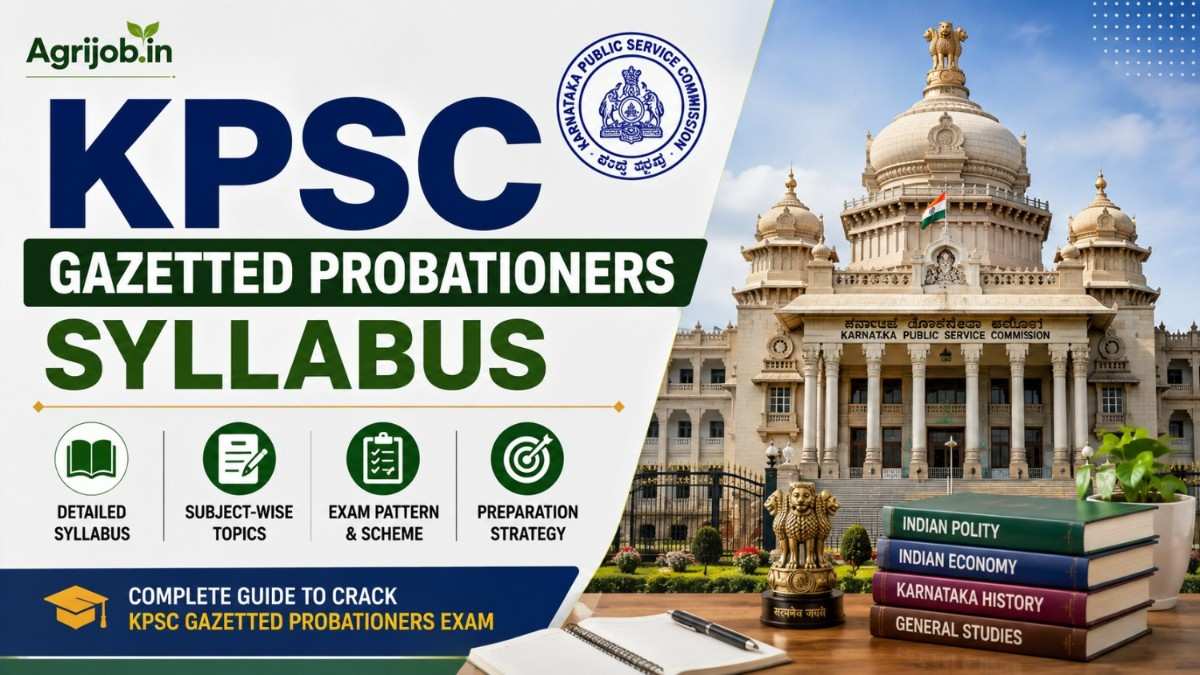
The KPSC Gazetted Probationers Competitive Examination — commonly called the KAS exam (Karnataka Administrative Service) — is conducted by the Karnataka Public Service Commission (KPSC) to recruit officers for more than 20 prestigious Group A and Group B posts in the Karnataka State Government. Governed under the Karnataka Gazetted Probationers (Appointment by Competitive Examinations) Rules, 1997, this is considered Karnataka’s equivalent of the UPSC Civil Services Examination.
Successful candidates are appointed as Assistant Commissioner, Tahsildar (Grade 2), Commercial Tax Officer, Deputy Superintendent of Excise, Section Officer, Assistant Director, Assistant Registrar, and many more. The 2026 notification (No. KPSCKA/EXA1/EXMF/9/2026-EXAM-1/I/251710/2026), released on 31 July 2026, covers 319 vacancies across 117 Group A and 202 Group B posts for the year 2026–27.

The exam is held in three stages: a screening Prelims, a merit-determining Mains, and a Personality Test. Optional papers were removed post-2016 amendment; the current Mains has only Essay and four General Studies papers counted for merit. All papers are available in both Kannada and English medium.
Who Should Apply for KPSC KAS 2026?
- 🎓 Any Graduate or Post-Graduate from a recognized university who wants a prestigious state civil services career in Karnataka Government departments
- 📋 UPSC CSE aspirants seeking a parallel preparation pathway — the KAS exam closely mirrors UPSC CSE in structure, making combined prep highly efficient
- 🏛️ Candidates targeting Group A officer roles such as Assistant Commissioner, DSP, or Assistant Labour Commissioner with Rs.56,100–Rs.1,00,000+ monthly salary
- 📚 Kannada-medium aspirants who prefer to answer in Kannada — all papers are available in Kannada and English both
- 🌾 Rural Karnataka candidates seeking prestigious administrative roles at district and taluka level; Tahsildar posts have direct rural governance impact
- 🔄 General category candidates aged 21–35 with up to 5 attempts remaining, and OBC candidates (up to 7 attempts) who want to convert a serious attempt into selection
- 👩💼 Women candidates seeking high-security government careers with pension, HRA, DA, and child care leave under Karnataka Government service rules
- 🎯 Final-year degree students who can appear for Prelims now and submit their completion certificate before the Mains stage
KPSC KAS Salary 2026 – Group A and Group B Pay Scale
KPSC KAS Group A and Group B officers draw salaries based on the 7th Pay Commission pay levels under Karnataka Government rules. Group A posts (Level 10–12) start at Rs.56,100 per month basic pay, while the total in-hand salary including DA, HRA, and TA ranges from Rs.70,000 to Rs.1,00,000+ depending on posting location. Group B posts start at Level 13 with a basic pay of Rs.43,100 per month.
| Post Category | Pay Level | Basic Pay (per month) | Approx. In-Hand Salary |
|---|---|---|---|
| Group A – Assistant Commissioner / DSP | Level 10–12 | Rs.56,100 – Rs.70,000 | Rs.75,000 – Rs.1,00,000+ |
| Group B – Tahsildar Grade 2 / Commercial Tax Officer | Level 13 | Rs.43,100 – Rs.56,100 | Rs.55,000 – Rs.80,000 |
| Senior Scale (after 8–10 yrs service) | Level 14–16 | Rs.78,800+ | Rs.1,00,000 – Rs.1,25,000 |
| Training Period Salary – Group A | Probationary | Stipend | Rs.50,000 – Rs.60,000 |
| Training Period Salary – Group B | Probationary | Stipend | Rs.35,000 – Rs.50,000 |
In addition to basic pay, KAS officers receive Dearness Allowance (DA), House Rent Allowance (HRA: 8–24% of basic pay), Travel Allowance (TA), Medical benefits, National Pension System (NPS), and study leave provisions. The annual CTC for entry-level Group A posts ranges between Rs.9 lakh and Rs.15 lakh. Posting in Bengaluru attracts higher HRA, taking in-hand salary above Rs.1 lakh per month even at the entry stage.
Eligibility Criteria – Age, Qualification, and Number of Attempts
Candidates must verify all eligibility parameters from the official KPSC notification before applying, as certain details are notification-specific. The broad criteria for KPSC KAS 2026 are as follows:
Educational Qualification: A Bachelor’s Degree or Master’s Degree from any recognized university established by law in India, or an equivalent qualification. Candidates appearing in the final year of their qualifying degree are eligible for Prelims but must produce the degree certificate before the Mains stage.
- Age Limit (General/GM): 21 to 35 years as on the cut-off date specified in the notification
- OBC (Category 2A/2B/3A/3B): Up to 38 years (3-year relaxation)
- SC / ST / Category 1: Up to 40 years (5-year relaxation)
- Persons with Disability (PwD): 10-year relaxation over the base limit
- Ex-Servicemen: Military service period deducted from actual age
- Nationality: Indian Citizen
| Category | Maximum Age | Max Attempts | Application Fee |
|---|---|---|---|
| General Merit (GM) | 35 years | 5 | Rs.600 |
| OBC (Category 2A/2B/3A/3B) | 38 years | 7 | Rs.300 |
| SC / ST / Category 1 | 40 years | Unlimited (within age limit) | Nil |
| Ex-Military | Standard limit after deduction | As per rules | Rs.50 |
| Persons with Disability (PwD) | +10 years over base | As per rules | Nil |
Note: Every appearance in the Preliminary Examination counts as one attempt, regardless of whether the candidate qualifies for Mains. Candidates must track their attempt count carefully before applying.
KPSC KAS Selection Process 2026 – Step by Step
The KPSC Gazetted Probationers Recruitment 2026 follows a three-stage selection process. Marks from the Preliminary stage are used only for shortlisting and are not added to the final merit. Final ranking is based exclusively on Mains merit papers (1,250 marks) plus the Personality Test (25 marks).
- Submit Online Application: Apply through the official KPSC OTR (One Time Registration) portal at kpsconline.karnataka.gov.in. Upload all required documents, pay the application fee, and save the payment confirmation receipt before 31 August 2026.
- Appear for Preliminary Examination (Screening Stage): Sit for Paper I and Paper II — 100 MCQ questions each, 200 marks each, 2 hours each. Negative marking of 0.25 marks per wrong answer applies. This stage is only a screening filter; Prelims marks are NOT counted in the final merit.
- Shortlisting for Mains: KPSC shortlists candidates in a ratio of 1:15 against notified vacancies, category-wise. For 319 vacancies, approximately 4,785 candidates are admitted to Mains. The cutoff is category-specific.
- Appear for Main Examination (Merit Stage): Write 7 descriptive papers spread over multiple days. Two papers (Kannada and English) are qualifying with a 35% minimum each. The remaining 5 papers (Essay + GS I–IV) carry 250 marks each and form the basis of your merit score (1,250 marks total).
- Shortlisting for Personality Test: Candidates are called for the interview in a ratio of 1:3 against vacancies, based on Mains merit. For 319 vacancies, approximately 957 candidates appear for the interview.
- Personality Test (Interview): Conducted at KPSC headquarters in Bengaluru, the interview carries 25 marks and tests leadership potential, awareness of Karnataka’s administration, and communication skills. Dress professionally; prepare your Detailed Application Form (DAF) thoroughly.
- Final Merit and Appointment: The final select list is prepared based on combined Mains + Interview marks (1,275 marks). Probationers undergo 12–24 months of training at the Administrative Training Institute (ATI), Mysuru, before posting.
General Merit candidates get only 5 attempts at KPSC KAS. Treat every attempt seriously. Begin structured preparation at least 10–12 months before the Prelims date, and start answer writing practice 5 months before Mains. A wasted attempt significantly reduces your window for selection within the age limit.
KPSC KAS Exam Pattern 2026 – Prelims and Mains
The KPSC KAS 2026 exam pattern covers two stages of examination with distinct formats. The Prelims is objective-type (MCQ), while the Mains is fully descriptive (essay-style written answers). Both stages are crucial for different reasons: Prelims filters, Mains decides your rank.
KAS Prelims Exam Pattern 2026: Two papers, 100 questions each at 2 marks per question. Total Prelims marks: 400. Duration: 2 hours per paper. Negative marking: 0.25 marks per wrong answer. Paper I covers national/international General Studies and Humanities; Paper II covers State-level General Studies, General Science, and General Mental Ability. All questions are at degree level except General Mental Ability (SSLC standard).
| Paper | Subject Area | Questions | Marks | Duration |
|---|---|---|---|---|
| Paper I | General Studies – National & International | 40 | 80 | 2 hours |
| Paper I | Humanities (History, Geography, Polity, Economy) | 60 | 120 | |
| Paper I Total | 100 | 200 | ||
| Paper II | General Studies – State Importance | 40 | 80 | 2 hours |
| Paper II | General Science, Technology, Environment & Ecology | 30 | 60 | |
| Paper II | General Mental Ability | 30 | 60 | |
| Paper II Total | 100 | 200 | ||
| Prelims Grand Total | 200 | 400 |
KAS Mains Exam Pattern 2026: Seven descriptive papers. Two are qualifying (Kannada and English, 150 marks each, minimum 35% required). Five are merit papers — Essay (250 marks) and General Studies I, II, III, IV (250 marks each). No optional subjects exist since the 2016 amendment. All merit papers are at degree level.
| Paper | Subject | Nature | Marks | Duration |
|---|---|---|---|---|
| Qualifying Paper 1 | Kannada (First Language, SSLC standard) | Qualifying (35% min) | 150 | 2 hours |
| Qualifying Paper 2 | English (First Language, SSLC standard) | Qualifying (35% min) | 150 | 2 hours |
| Paper 1 | Essay | Merit | 250 | 3 hours |
| Paper 2 | General Studies 1 | Merit | 250 | 3 hours |
| Paper 3 | General Studies 2 | Merit | 250 | 3 hours |
| Paper 4 | General Studies 3 | Merit | 250 | 3 hours |
| Paper 5 | General Studies 4 | Merit | 250 | 3 hours |
| Total Counted for Merit (Essay + GS 1–4) | 1,250 | |||
| Personality Test (Interview) | 25 | |||
| Grand Total for Ranking | 1,275 | |||
KPSC KAS Syllabus 2026 – Complete Topic-Wise Breakdown
The KPSC KAS syllabus for Prelims is officially published in the 31 July 2026 notification. The detailed topic-wise Mains syllabus (GS I–IV) is published separately on the KPSC website at kpsc.kar.nic.in/Syllabus. Candidates must verify the Mains syllabus from that page, as GS paper content can be revised between cycles.
Prelims Paper I Syllabus – National, International & Humanities:
- Current Events – National & International: Major political, economic, scientific, and social events at national and global level; India’s foreign policy and bilateral relations; international organisations (UN, WTO, IMF, WHO)
- History of India: Ancient, Medieval, and Modern Indian History with emphasis on social, economic, cultural, and political aspects; Indian National Movement with special focus on Karnataka’s role (Mysore Kingdom, Tippu Sultan, Karnataka unification movement)
- World Geography: Physical features, climate zones, rivers, natural resources; major geopolitical regions; India’s physical geography with Karnataka-specific focus (Western Ghats, Deccan Plateau, coastal districts)
- Indian Polity: Constitution of India, Fundamental Rights and Duties, DPSP, Parliament, Union and State relations, Panchayati Raj, Election Commission; Karnataka-specific polity (Zilla Panchayat, Gram Panchayat structure)
- Indian Economy: Economic planning, Five-Year Plans, NITI Aayog, economic reforms (1991 and post-liberalization), rural development, poverty alleviation, agriculture sector, Karnataka state economy and budget, NABARD’s role in rural finance
- Sustainable Development: SDGs, climate change, green economy, India’s NDCs under Paris Agreement
Prelims Paper II Syllabus – State, Science, Technology & Mental Ability:
- Current Events – Karnataka State Importance: Karnataka Government schemes and programmes; state budget; major policy announcements; important appointments and state-level events
- General Science & Technology: Contemporary developments in science and technology at everyday observation level (not specialised); applications in daily life; IT and digital initiatives; space technology (ISRO missions); biotechnology basics
- Environment & Ecology: Biodiversity and its conservation; environmental laws and regulations; climate change impacts; national parks and wildlife sanctuaries in Karnataka (Bandipur, Nagarhole, Bhadra); Western Ghats ecology
- General Health: Common diseases and preventive healthcare; government health programmes (Ayushman Bharat, Arogyasri); nutrition basics
- General Mental Ability: Comprehension; logical reasoning and analytical ability; decision-making and problem-solving; basic numeracy (numbers, ratios, percentages — SSLC level); data interpretation (bar graphs, pie charts, tables)
Mains Syllabus Overview (GS I–IV + Essay): The Mains papers test degree-level understanding. GS Paper 1 typically covers Indian Heritage and Culture, History, and Geography. GS Paper 2 covers Governance, Constitution, Polity, Social Justice, and International Relations. GS Paper 3 covers Technology, Economic Development, Biodiversity, Environment, Security, and Disaster Management. GS Paper 4 (Ethics) covers Ethics, Integrity, and Aptitude with Karnataka administrative case studies. The Essay paper requires writing two essays (one each from two sections) on social, economic, political, and philosophical themes. Always verify the exact GS I–IV topic breakdown from the official KPSC syllabus page at kpsc.kar.nic.in before the Mains stage.
KPSC KAS vs UPSC CSE 2026 – Key Differences
| Parameter | KPSC KAS 2026 | UPSC CSE 2026 |
|---|---|---|
| Conducting Body | Karnataka Public Service Commission | Union Public Service Commission |
| Jurisdiction | Karnataka State Government | All-India Services (IAS, IPS, IFS) |
| Vacancies (2026) | 319 (Group A + B) | ~1,000 (approx.) |
| Prelims Format | 2 papers, 400 marks, MCQ | 2 papers, 400 marks, MCQ (GS + CSAT) |
| Mains Format | 7 papers, 1,250 marks for merit (no optional) | 9 papers, 1,750 marks for merit (1 optional) |
| Language in Mains | Kannada or English; Kannada qualifying paper compulsory | English or Hindi; regional language qualifying |
| Highest Entry Post | Assistant Commissioner / DSP | IAS / IPS (District Collector / SP after training) |
| Entry Salary | Rs.56,100/month (Group A) | Rs.56,100/month (IAS Level 10) |
| Age Limit (General) | 21–35 years | 21–32 years |
| Max Attempts (General) | 5 | 6 |
| Karnataka-Specific Content | High – dedicated Paper II (State) + Kannada required | None (national focus) |
| Difficulty Level | High; comparable to UPSC in Mains depth | Very High (national competition) |
| Best For | Karnataka aspirants wanting state-level admin roles | Aspirants targeting All-India Services |
If you are a Karnataka-based aspirant between 28–35 years, KPSC KAS is your best bet — the age limit is 3 years more generous than UPSC (35 vs 32 for General category), the Mains has no optional paper, and the Karnataka-specific content gives local aspirants a natural edge. UPSC CSE is the superior target if you are under 30 with 3+ solid years to invest. Ideally, prepare both simultaneously since the GS syllabus overlaps significantly — only the Karnataka-specific paper requires separate preparation.
Advantages and Disadvantages of Targeting KPSC KAS 2026
Advantages (Pros):
- ✅ Prestigious Group A post: Assistant Commissioner and DSP rank equivalent to IAS/IPS at the district level in Karnataka
- ✅ Generous salary with allowances: In-hand salary of Rs.75,000–Rs.1,00,000+ per month for Group A at entry; guaranteed annual increments
- ✅ No optional subject: Post-2016 removal of optional papers means KAS Mains is fairer and less subject-specific — any graduate can compete equally
- ✅ Concurrent UPSC preparation: 70–80% of the KAS syllabus overlaps with UPSC CSE GS, making joint preparation highly efficient
- ✅ Kannada medium advantage: Local Karnataka aspirants can answer in Kannada in Mains, a natural advantage over national-level exams
- ✅ Job security and NPS pension: Karnataka Government service rules provide structured career progression, departmental exams for promotion, and NPS pension benefits
Disadvantages (Cons):
- ❌ Limited attempts for General category: Only 5 attempts for General Merit candidates, making early start and serious preparation critical
- ❌ Compulsory Kannada paper in Mains: Non-Karnataka-native candidates or those with weak Kannada face a qualifying hurdle — 35% minimum (52.5/150) is mandatory
- ❌ Long selection cycle: From notification to final appointment typically spans 18–24 months, requiring sustained preparation discipline
- ❌ Irregular frequency: KPSC KAS notifications are not annual — gaps of 2–3 years between cycles have occurred historically, creating uncertainty
Important Terms Related to KPSC KAS 2026
- KAS (Karnataka Administrative Service): The premier Group A state civil service in Karnataka, recruiting officers for district administration, revenue, police, and allied departments through KPSC.
- Gazetted Probationers: The official designation for newly recruited KAS officers during their probationary period (typically 2 years) before confirmation in service.
- KPSC OTR (One Time Registration): Karnataka PSC’s online registration system through which candidates create a permanent profile and apply for multiple exams using one registration ID.
- ATI Mysuru (Administrative Training Institute): The training academy for KAS probationers located in Mysuru where Group A officers undergo 12–24 months of induction training before field posting.
- Karnataka Gazetted Probationers Rules 1997: The statutory rules governing KPSC recruitment to Group A and Group B gazetted posts through competitive examination.
- General Mental Ability (GMA): A 30-question section in Prelims Paper II covering reasoning, numeracy (SSLC level), and data interpretation — a scoring section that can differentiate rank with consistent practice.
- 7th Pay Commission: The government pay revision committee whose recommendations determine the basic pay, DA, HRA, and other allowances for Karnataka State Government employees including KAS officers.
- Dearness Allowance (DA): A component of the salary revised twice yearly; for Karnataka State Government, DA is approximately 50%+ of basic pay — significantly boosting total emoluments above the basic pay figure.
- Featured Snippet Paragraph: The exam is conducted in 3 stages: Prelims (MCQ, 400 marks), Mains (descriptive, 1,250 marks for merit), and Personality Test (25 marks), totalling 1,275 marks for final ranking.
- Karnataka Unification (Ekikarana): A critical topic in KAS History — the merger of Kannada-speaking regions into a unified Karnataka state in 1956; frequently tested in Paper I (History) and the Kannada qualifying paper.
Important Dates and Timeline – KPSC KAS 2026
| Event | Date |
|---|---|
| Official Notification Released | 31 July 2026 |
| Online Application Opens | 1 August 2026 |
| Last Date to Apply Online | 31 August 2026 |
| KPSC KAS Admit Card Release | 2–3 weeks before exam (tentative) |
| Preliminary Examination | 15 November 2026 (Tentative) |
| Prelims Result & Mains Shortlist | To be announced on kpsc.kar.nic.in |
| Main Examination | Expected: Mid-2027 (tentative) |
| Personality Test (Interview) | After Mains result |
| Final Select List | After all stages complete |
| ATI Mysuru Training Commencement | After appointment orders |
Important Links – KPSC KAS 2026
| Link Name | URL |
|---|---|
| KPSC Official Website | kpsc.kar.nic.in |
| KPSC Online Application Portal (OTR) | kpsconline.karnataka.gov.in |
| Official KAS Syllabus PDF | kpsc.kar.nic.in/Syllabus |
| Karnataka Government Official Portal | karnataka.gov.in |
| KPSC KAS Notification 2026 PDF | Download from kpsc.kar.nic.in |
| Agrijob.in – Karnataka Government Jobs Guide | Karnataka Govt Jobs on Agrijob.in |
| Agrijob.in – KPSC Recruitment Updates | KPSC Recruitment on Agrijob.in |
| Agrijob.in – State PSC Exam Guides | State PSC Guides on Agrijob.in |
Conclusion – KPSC KAS 2026 Syllabus and Strategy
The KPSC Gazetted Probationers 2026 exam is a structured, three-stage selection for 319 prestigious Karnataka Government posts — with Prelims on 15 November 2026 and a final ranking based on 1,275 marks. Mastering the official syllabus, building Karnataka-specific knowledge, practising negative-marking-aware Prelims strategies, and writing full-length Mains answers with 5 months of advance practice are the four pillars of clearing this exam. Bookmark kpsc.kar.nic.in for the Mains syllabus, admit card, and result updates — we update this guide every time official data changes.
- KPSC KAS 2026 has 319 vacancies (117 Group A + 202 Group B); Prelims tentatively on 15 November 2026.
- Prelims: 2 MCQ papers, 400 marks total, 0.25 negative marking — Prelims marks are NOT counted in final merit.
- Mains: 7 papers; only Essay + GS I–IV (1,250 marks) count for ranking; Kannada and English are qualifying (35% minimum each).
- Group A KAS salary starts at Rs.56,100/month basic, with in-hand pay of Rs.75,000–Rs.1,00,000+ after DA and HRA.
- General Merit candidates have 5 attempts maximum; OBC get 7; SC/ST candidates have unlimited attempts within the age limit.
- Download the official Mains syllabus from kpsc.kar.nic.in/Syllabus — start Prelims prep now and Mains answer writing at least 5 months before Mains date.
Frequently Asked Questions About KPSC Gazetted Probationers Syllabus 2026
What is the KPSC Gazetted Probationers syllabus 2026?
The KPSC Gazetted Probationers syllabus 2026 covers two Prelims papers: Paper I (National/International General Studies and Humanities — History, Geography, Polity, Economy) and Paper II (Karnataka State General Studies, General Science and Technology, Environment and Ecology, and General Mental Ability). The Mains syllabus includes qualifying Kannada and English papers and five merit papers — Essay and General Studies I through IV at degree level. The detailed Mains topic-wise syllabus is published separately at kpsc.kar.nic.in/Syllabus.
How many vacancies are there in KPSC KAS Recruitment 2026?
KPSC KAS Recruitment 2026 has a total of 319 vacancies — 117 Group A posts (including Assistant Commissioner, DSP, Assistant Labour Commissioner, Assistant Director, and related positions) and 202 Group B posts (including Tahsildar Grade 2 and equivalent posts in various Karnataka Government departments).
What is the exam pattern for KPSC KAS 2026?
The KPSC KAS 2026 exam has three stages. Prelims consists of 2 objective-type papers (200 questions, 400 marks total, 0.25 negative marking). Mains consists of 7 descriptive papers — 2 qualifying (Kannada and English, 150 marks each) and 5 merit papers (Essay + GS I–IV, 250 marks each, total 1,250 marks). The Personality Test carries 25 marks. The grand total for final ranking is 1,275 marks.
Is there negative marking in KPSC KAS Prelims 2026?
Yes, negative marking applies in the KPSC KAS Prelims 2026. For every wrong answer, 0.25 marks (one-fourth of the 2-mark question value) are deducted. Questions left unattempted carry no penalty. Marking more than one answer for a single question is also treated as wrong and penalised similarly. No negative marking applies to the descriptive Mains papers.
What is the age limit for KPSC KAS 2026?
The age limit for KPSC KAS 2026 is 21 to 35 years for General Merit candidates. OBC (Category 2A/2B/3A/3B) candidates get 3 years relaxation (up to 38 years), while SC/ST and Category 1 candidates get 5 years relaxation (up to 40 years). Persons with Disability (PwD) receive an additional 10-year relaxation. Ex-Servicemen get credit for military service period deducted from their actual age.
What is the KPSC KAS salary for Group A posts in 2026?
The KPSC KAS Group A salary starts at a basic pay of Rs.56,100 per month under Pay Level 10–12 of the 7th Pay Commission. After adding Dearness Allowance (approximately 50%+ of basic), House Rent Allowance (8–24% depending on city), and Transport Allowance, the in-hand salary for a freshly appointed Group A officer ranges from Rs.75,000 to Rs.1,00,000+ per month. Officers posting in Bengaluru receive higher HRA.
How many attempts are allowed for KPSC KAS exam?
General Merit (GM) candidates are allowed a maximum of 5 attempts for the KPSC KAS exam. OBC candidates (Category 2A/2B/3A/3B) are allowed 7 attempts. SC/ST and Category 1 candidates have no fixed attempt limit and can appear as many times as they remain within the age limit. Every appearance in the Preliminary Examination counts as one attempt, regardless of whether the candidate qualifies for Mains.
Is Kannada compulsory for KPSC KAS 2026?
Yes, Kannada is compulsory in the KPSC KAS Mains as a qualifying paper. Candidates must score a minimum of 35% (52.5 out of 150 marks) in the Kannada qualifying paper independently to be eligible for the Personality Test. The Kannada paper is at SSLC (Class 10 First Language) standard. Failing this paper disqualifies a candidate from the interview even with a high GS/Essay score. All KAS exam papers are, however, available in both Kannada and English medium for answering.
What is the best preparation strategy for KPSC KAS 2026?
The most effective KPSC KAS 2026 preparation strategy involves seven steps: first, map the official syllabus to your study plan before touching any book; second, build a separate Karnataka-specific current affairs habit (Paper II demands state-level awareness distinct from national news); third, read Karnataka State Board Social Science textbooks (6th–10th standard from KTBS website) for local History and Geography; fourth, practice full mock tests with negative marking to calibrate your attempt strategy in Prelims; fifth, dedicate 30–40% of total study time to Karnataka-specific topics; sixth, begin Mains answer writing practice at least 5 months before the expected Mains date; and seventh, never neglect the Kannada and English qualifying papers — a 35% minimum in each is non-negotiable.
What posts are recruited through KPSC Gazetted Probationers 2026?
KPSC Gazetted Probationers 2026 recruits for over 20 Group A and Group B posts in Karnataka Government departments. Key Group A posts include Assistant Commissioner (Revenue/Administrative), Deputy Superintendent of Police (DSP), Assistant Labour Commissioner, District Social Welfare Officer, District Backward Classes Welfare Officer, and Assistant Director in multiple departments. Key Group B posts include Tahsildar Grade 2 under Karnataka Administrative Service, Commercial Tax Officer, Deputy Superintendent of Excise, Section Officer, and Assistant Registrar, among others.
What is the shortlisting ratio for KPSC KAS Mains and Interview?
For Mains shortlisting, KPSC admits candidates in a ratio of 1:15 against notified vacancies, category-wise. For 319 vacancies, approximately 4,785 candidates are shortlisted for Mains from the Prelims. For the Personality Test (Interview), candidates are called in a ratio of 1:3 against vacancies based on Mains merit — meaning approximately 957 candidates appear for the interview across all categories for 319 final selections.
Last Updated: September 2026 | This guide is reviewed and updated every time KPSC releases official changes to the notification, syllabus, or exam schedule. Bookmark this page for the latest KPSC KAS 2026 information.
Disclaimer: This article is for informational purposes only. All salary figures, vacancy counts, exam dates, eligibility criteria, and attempt limits are sourced from the KPSC official notification dated 31 July 2026 and other publicly available sources. Candidates are advised to verify all details from the official KPSC website (kpsc.kar.nic.in) before taking any decisions. Career choices should be made based on personal assessment and official information.