

India’s Pulses Mission 2026 — officially called Mission for Aatmanirbharta in Pulses — is a 6-year, Rs.11,440 crore Central Sector Scheme launched by Prime Minister Narendra Modi on 11 October 2025 to end India’s import dependence on dal and make the country fully self-sufficient in pulse production by 2030–31. Despite being the world’s largest producer of pulses, India imports 47 lakh tonnes of dal every year. This mission changes that equation — and it creates one of the biggest income opportunities for pulse farmers in a decade.

This guide is for farmers growing tur, urad, masoor, chana, or moong who want to understand the scheme’s benefits, profit potential, MSP rates, and how to register — and for agri-entrepreneurs who want to claim the Rs.25 lakh dal mill subsidy. It covers every benefit, eligibility condition, and step-by-step application process in full detail.
The Mission for Aatmanirbharta in Pulses (Dalhan Mission) is a Rs.11,440 crore government scheme running from 2025–26 to 2030–31 that guarantees 100% MSP procurement of tur, urad, and masoor through NAFED and NCCF, gives farmers Rs.10,000/hectare incentive, distributes 88 lakh free seed kits, and subsidises 1,000 dal mills at up to Rs.25 lakh each — targeting 35 MT pulse production and 957 kg/hectare yield by 2030–31.
- Scheme Name: Mission for Aatmanirbharta in Pulses (Dalhan Aatmanirbharta Mission)
- Launched By: PM Narendra Modi at IARI, New Delhi — 11 October 2025
- Nodal Ministry: Ministry of Agriculture and Farmers Welfare
- Total Budget: Rs.11,440 crore (2025–26 to 2030–31)
- Duration: 6 years (FY 2025–26 to FY 2030–31)
- Focus Crops: Tur (Arhar), Urad (Black Gram), Masoor (Red Lentil)
- Current Yield (2025–26): 957 kg/hectare (up from 926 kg/ha in 2024–25)
- Target Yield by 2030–31: 1,130 kg/hectare
- Production Target: 35 MT by 2030–31 (up from 24.2 MT in 2023–24)
- MSP — Tur 2025–26: Rs.8,000 per quintal
- MSP — Urad 2025–26: Rs.7,800 per quintal
- MSP — Masoor 2025–26: Rs.6,700 per quintal
- MSP — Chana 2026–27 Rabi: Rs.5,875 per quintal
- Farmer Incentive: Rs.10,000 per hectare for pulse cultivation
- Seed Kits: 88 lakh free mini seed kits distributed to farmers
- Dal Mill Subsidy: Up to Rs.25 lakh per processing unit (1,000 units planned)
- Procurement Agency: NAFED and NCCF under PM-AASHA (Price Support Scheme)
- Cluster Districts: 416 focused districts across India
- Farmers to Benefit: Approx. 2 crore farmers
- What Is the Pulses Mission India 2026?
- Who Should Apply for Pulses Mission Benefits?
- Dal Farming Income and Profit Potential 2026
- Eligibility Criteria and Required Documents
- How to Register and Get Pulses Mission Benefits (Step-by-Step)
- Pulses Mission vs NFSM — How the New Scheme Compares
- Advantages and Challenges of Growing Pulses in 2026
- Key Terms Every Pulse Farmer Must Know
- Important Dates
- Important Links
- Conclusion
- Key Takeaways
- Frequently Asked Questions
What Is the Pulses Mission India 2026 — and Why Does It Matter?
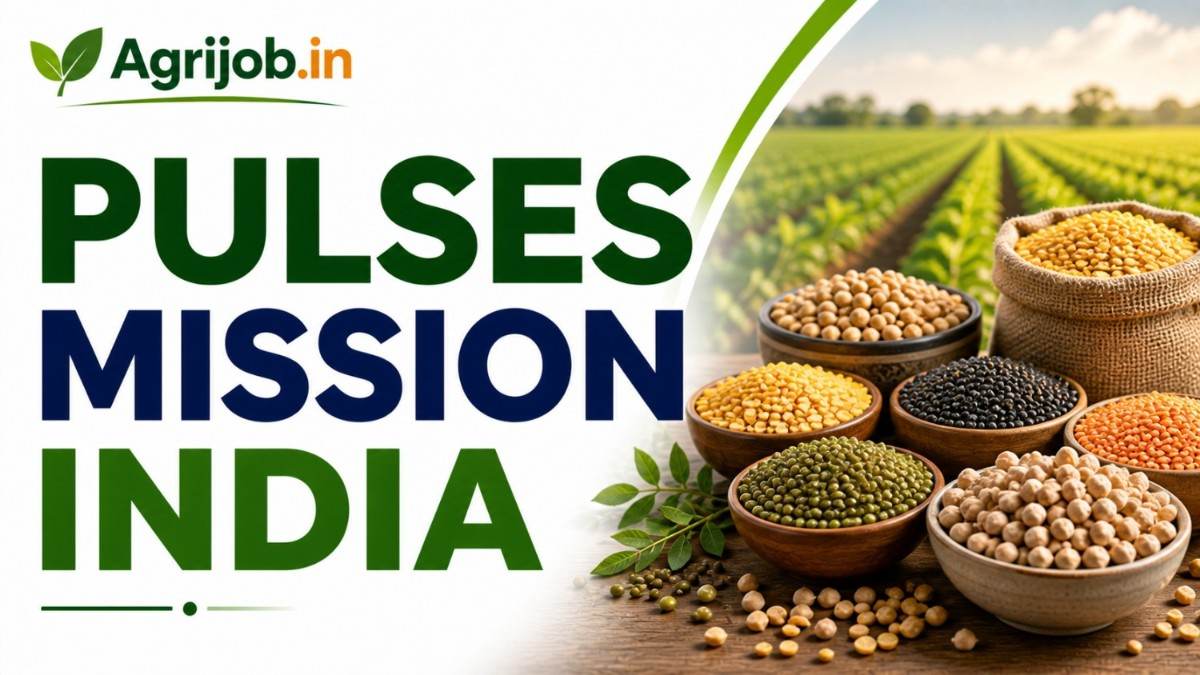
The Mission for Aatmanirbharta in Pulses, commonly called the Dalhan Aatmanirbharta Mission or National Pulses Mission, is India’s most ambitious intervention in the dal sector in two decades. It was first announced by Finance Minister Nirmala Sitharaman in the Union Budget 2025–26 and formally approved by the Union Cabinet on 1 October 2025. PM Modi officially launched the mission at IARI (Indian Agricultural Research Institute), New Delhi, on 11 October 2025.

India is the world’s largest producer of pulses — accounting for 27.4% of global production — but it is also the world’s largest importer, bringing in over 47 lakh tonnes every year from Canada, Myanmar, and Africa. This supply-demand gap costs India valuable foreign exchange and exposes consumers to global price shocks. The mission directly targets this gap by boosting domestic production to 35 million tonnes by 2030–31 from the current 24.2 MT baseline.
The mission builds on India’s earlier success. Under the National Food Security Mission (NFSM) Pulses component launched in 2007, production rose from 14.8 MT to 26 MT between 2005–06 and 2022–23 — a 59% gain. But rising incomes increased consumption faster than production could keep pace. The new mission corrects course with three core pillars: assured MSP procurement, quality seed distribution, and post-harvest processing infrastructure.
| Metric | 2023–24 (Baseline) | 2024–25 | 2025–26 | Target 2030–31 |
|---|---|---|---|---|
| Total Pulse Production | 24.2 MT | 25.23 MT | ~27 MT (projected) | 35 MT |
| Yield (kg/hectare) | 881 kg | 926 kg | 957 kg | 1,130 kg |
| Cultivation Area | 24.2 lakh ha | ~25 lakh ha | ~26 lakh ha | 31 lakh ha |
| Import Volume | 47 lakh MT | 67 lakh MT (peak) | Declining | Near Zero |
The yield data from the uploaded Ministry of Agriculture report confirms real progress: productivity jumped from 926 kg/hectare in 2024–25 to 957 kg/hectare in 2025–26 — a 3.4% annual gain that, if sustained, will close the gap to the 1,130 kg target by 2030–31.
Who Should Apply for Pulses Mission Benefits in 2026?
The mission is broad in scope, covering multiple beneficiary categories. Here is exactly who qualifies and what benefit applies to each profile.
- 🌾 Small and Marginal Farmers Cultivating Tur, Urad, or Masoor: Eligible for free certified seed kits, Rs.10,000/hectare incentive, and guaranteed MSP procurement via NAFED/NCCF registration. Minimum cultivated area is 0.5 hectare.
- 🧑🌾 Progressive and Model Farmers: Farmers cultivating at least 1 hectare of pulse crops receive a direct Rs.10,000 per hectare cash incentive deposited via DBT into their Aadhaar-linked bank account.
- 👩🌾 Women Farmers in Pulse-Growing States: Specifically targeted in the cluster-based approach — states like Maharashtra, Uttar Pradesh, Bihar, and Madhya Pradesh have identified women-farmer clusters for priority seed kit distribution and NITI Aayog monitoring through CSCs.
- 🌿 Farmers in Rice Fallow Areas: The mission targets 35 lakh hectares of currently under-utilized rice fallow land for pulse cultivation — eligible for free seed kits and area expansion support without needing to shift from their main paddy crop.
- 🏭 Agri-Entrepreneurs and FPOs Seeking Dal Mill Setup: Individuals, Farmer Producer Organizations (FPOs), SHGs, or cooperatives planning to set up a pulse processing unit are eligible for a subsidy of up to Rs.25 lakh per unit under the 1,000 processing units target.
- 🌱 Farmers in Intercropping and Diversification Programs: Pulses grown as intercrop with sugarcane, cotton, or cereals qualify for seed support and yield improvement inputs under the cluster-based approach.
- 📦 Seed Village and Seed Hub Operators: Farmers and cooperative societies established as certified seed villages receive priority support for seed multiplication, storage infrastructure, and certification assistance under the SATHI portal.
- 🏘️ Farmers in 416 Priority Cluster Districts: The mission operates through a cluster-based approach across 416 focused districts in major pulse-producing states — including Madhya Pradesh (assigned Rs.354 crore), Maharashtra, Rajasthan, Uttar Pradesh, Karnataka, Andhra Pradesh, Telangana, Bihar, and Chhattisgarh.
Dal Farming Income and Profit Potential 2026 — Complete Breakdown
With MSPs at record highs and 100% procurement guaranteed, pulse farming in 2026 offers the most predictable income in the crop’s history. Here is a realistic income analysis based on current MSP rates, average yields, and input costs for the three focus crops.
MSP Rates 2025–26 for Focus Pulse Crops
| Crop | MSP 2025–26 (Rs./Quintal) | Increase from Previous Year | Season |
|---|---|---|---|
| Tur (Arhar/Pigeon Pea) | Rs.8,000 | +Rs.450 (+5.96%) | Kharif |
| Urad (Black Gram) | Rs.7,800 | +Rs.400 (+5.41%) | Kharif |
| Moong (Green Gram) | Rs.8,768 | +Rs.86 (+0.99%) | Kharif |
| Masoor (Red Lentil) | Rs.6,700 | Revised | Rabi |
| Chana (Chickpea) | Rs.5,875 | Rabi 2026–27 | Rabi |
Crop-Wise Profit Estimate Per Hectare (2025–26 Season)
| Parameter | Tur (Arhar) | Urad | Masoor | Chana |
|---|---|---|---|---|
| Average Yield (kg/ha) | 957 kg | 800 kg | 900 kg | 1,100 kg |
| MSP Rate (Rs./Quintal) | Rs.8,000 | Rs.7,800 | Rs.6,700 | Rs.5,875 |
| Gross Revenue at MSP (Rs./ha) | ~Rs.76,560 | ~Rs.62,400 | ~Rs.60,300 | ~Rs.64,625 |
| Typical Input Cost (Rs./ha) | ~Rs.35,000–40,000 | ~Rs.28,000–32,000 | ~Rs.25,000–30,000 | ~Rs.30,000–35,000 |
| Govt Incentive (Rs./ha) | Rs.10,000 | Rs.10,000 | Rs.10,000 | Rs.10,000 |
| Estimated Net Profit (Rs./ha) | ~Rs.46,000–51,000 | ~Rs.40,000–44,000 | ~Rs.40,000–45,000 | ~Rs.39,000–44,000 |
| Procurement Assurance | 100% via NAFED/NCCF | 100% via NAFED/NCCF | 100% via NAFED/NCCF | Via PM-AASHA |
Key insight: Tur farming at current MSP and average national yield delivers approximately Rs.46,000–51,000 net profit per hectare — competitive with many cereals and significantly more profitable when accounting for the Rs.10,000/hectare government incentive. For a 2-hectare pulse farm, that translates to Rs.92,000–1,02,000 annual net income from pulses alone.
Dal Mill — Value Addition Profit Opportunity
Beyond farming, the Rs.25 lakh dal mill subsidy opens a significant agri-enterprise opportunity. A mini dal mill processing 2–3 MT of raw dal per day generates value addition of Rs.3,000–5,000 per tonne by converting raw pulses into cleaned, dehusked, split dal. With 1,000 processing units being set up nationwide in identified pulse clusters in Madhya Pradesh, Maharashtra, Rajasthan, and Karnataka, early movers benefit most from the subsidy and cluster-level supply.
Under the NAFED/NCCF procurement portal launched for tur and urad, farmers must register BEFORE sowing begins to be eligible for assured MSP procurement. Farmers who register and enter procurement agreements get priority in government purchase operations, especially when market prices fall below MSP. Early registration also qualifies farmers for the first round of free seed kit distribution from seed villages and hubs in their cluster district.
Eligibility Criteria and Required Documents
The mission targets pulse-cultivating farmers in priority states and districts. Here is the complete eligibility matrix and document checklist for each benefit category.
- Crop Eligibility: Farmer must be cultivating tur (arhar), urad, masoor, chana, or moong in the current Kharif or Rabi season in a notified district under the mission cluster.
- Minimum Area: 0.5 hectare (for seed kits and MSP procurement registration). Rs.10,000 incentive applies to farmers cultivating 1 hectare or more.
- Annual Income: Farmers with annual household income above Rs.10 lakh from non-agricultural sources are excluded from the direct farmer incentive component.
- Tenant and Sharecropper Farmers: Eligible with valid tenancy agreement or state-issued tenancy certificate in states that recognize tenant cultivation rights for scheme benefits.
- Dal Mill Subsidy Eligibility: Any individual farmer, FPO, SHG, cooperative, or agri-entrepreneur proposing to set up a pulse processing unit in an identified pulse cluster district is eligible for the Rs.25 lakh subsidy.
Documents Required for Registration
| Document | Purpose |
|---|---|
| Aadhaar Card | Identity and DBT bank account linkage |
| Land Records / Khatauni | Proof of pulse crop cultivation area |
| Bank Passbook (Aadhaar-linked) | For DBT of Rs.10,000 incentive and MSP payment |
| PM Kisan ID (optional but recommended) | Expedited registration and cross-scheme integration |
| Mobile Number (registered) | OTP verification and DBT alerts |
| Tenancy Agreement (for tenant farmers) | Proof of cultivation rights on leased land |
| DPR / Business Plan (dal mill applicants) | Technical and financial feasibility for processing unit subsidy |
How to Register and Get Pulses Mission Benefits — Step-by-Step
There are three distinct registration pathways under the mission — for MSP procurement, for seed kits and incentives, and for the dal mill subsidy. Follow the correct path for your benefit category.
- Visit the Dalhan Mission Portal: Go to the official Dalhan Mission Portal (launched to provide digital access to technology, seeds, and scheme benefits). Your state’s agriculture department website will have a direct link. For NAFED/NCCF MSP procurement registration, use the dedicated tur/urad procurement portal launched with DBT integration.
- Complete Aadhaar eKYC Verification: Enter your Aadhaar number and complete OTP-based eKYC. Link your Aadhaar to your bank account if not already done through your bank branch or the UIDAI portal. This step is mandatory for DBT-based incentive transfer and MSP payment.
- Enter Land and Crop Details: Input your cultivated area, crop type (tur/urad/masoor/chana/moong), district, village, and Khasra number from your land records. Tenant farmers must upload their tenancy agreement at this stage.
- Register for NAFED/NCCF Procurement Agreement (for Tur, Urad, Masoor): To access 100% MSP procurement, register and enter a procurement agreement with NAFED or NCCF before sowing begins in your district. Once registered, you can sell to either NAFED/NCCF at MSP or the open market — whichever is higher. If the open market price exceeds MSP, an averaged formula rate applies.
- Apply for Free Seed Kit: At your registered cluster district’s Agriculture Extension Office or through the Common Service Centre, submit your Aadhaar and land record to receive free certified seed kits from the mission’s 88 lakh seed kit distribution pool. Kits are crop-specific and variety-matched to your agro-climatic zone.
- Apply for the Rs.10,000 Hectare Incentive: After sowing verification by the local agriculture officer (done via field visit or geo-tagged selfie upload on the portal), the Rs.10,000 per hectare cash incentive is credited directly to your Aadhaar-linked bank account via DBT. This is separate from MSP payment.
- Apply for Dal Mill Subsidy (if applicable): Submit your Detailed Project Report (DPR) to your District Agriculture Officer (DAO) or the State Implementation Agency of the Dalhan Mission. The Rs.25 lakh subsidy is disbursed in installments linked to construction and equipment milestones. Madhya Pradesh alone is setting up 55 dal mills under this allocation (Rs.354 crore state budget).
- Also Enrol in PMFBY Crop Insurance: Register for Pradhan Mantri Fasal Bima Yojana before the Kharif 2026 deadline (31 July 2026 in most states) to protect your pulse crop against drought, flood, pest attack, or unseasonal rain losses. Pulse crops are notified under PMFBY in all major growing states — and PMFBY and Dalhan Mission benefits stack independently. See our complete guide on PMFBY benefits for farmers 2016–2025 for the full claims and premium data.
Pulses Mission 2026 vs NFSM-Pulses — How the New Scheme Compares
The Mission for Aatmanirbharta in Pulses replaces and supersedes the earlier National Food Security Mission (NFSM) Pulses component. Here is a head-to-head comparison of what changed — and why the new mission is significantly stronger for farmers.
| Parameter | Mission Aatmanirbharta in Pulses (2025–31) | NFSM-Pulses (Earlier Scheme) |
|---|---|---|
| Total Budget | Rs.11,440 crore (6 years) | Smaller annual allocations under NFSM umbrella |
| MSP Procurement Guarantee | 100% — NAFED/NCCF buy all registered farmer produce | MSP declared but procurement limited to 25% of production |
| Focus Crops | Tur, Urad, Masoor (special focus) | All pulses without crop-specific prioritization |
| Farmer Incentive | Rs.10,000 per hectare (new) | No direct per-hectare cash incentive |
| Free Seed Kits | 88 lakh free mini seed kits | Subsidised seeds (not free) |
| Dal Mill Subsidy | Rs.25 lakh per unit, 1,000 units nationwide | No dedicated processing unit subsidy |
| District Clusters | 416 focused districts with cluster approach | General state-wide implementation |
| Procurement Agencies | NAFED and NCCF with pre-sowing registration | State agencies with limited coordination |
| Portal / Digital Access | Dalhan Mission Portal with DBT integration | No dedicated digital portal |
| Self-Sufficiency Target | 35 MT by 2030–31; 1,130 kg/ha yield | Incremental targets without a firm deadline |
The single most transformative feature of the new Pulses Mission over NFSM is the 100% procurement guarantee from NAFED and NCCF. Under NFSM, MSP was declared but procurement was capped at 25% — meaning 75% of farmers still faced market price risk. The new mission eliminates that risk for tur, urad, and masoor farmers who register. Combined with the Rs.10,000/hectare direct incentive and free seed kits, pulse farming in 2026 has shifted from a price-risk crop to one of India’s most income-secure agricultural choices — provided you register on the Dalhan Mission portal before sowing.
Advantages and Challenges of Growing Pulses Under the Mission
Advantages for Farmers
- Income Security Through Guaranteed MSP: 100% procurement at MSP for 4 years removes the price uncertainty that deterred farmers from planting pulses. For tur, the MSP of Rs.8,000/quintal is more than double the 2014 rate.
- Reduced Input Cost via Free Seeds: 88 lakh free certified seed kits eliminate seed cost — typically Rs.4,000–8,000/hectare — directly improving net profit margins from the very first season.
- Low Water Requirement: Pulses are predominantly rain-fed crops requiring far less irrigation than paddy or wheat — reducing input costs and making them suitable for dryland farming areas where groundwater is scarce.
- Soil Health Benefit (Nitrogen Fixation): Pulse crops fix atmospheric nitrogen in the soil — reducing chemical fertilizer need in subsequent seasons and improving soil organic carbon for long-term farm productivity.
- Rs.10,000/Hectare Direct Cash Benefit: The government incentive is a direct, no-condition payment that stacks on top of MSP income — effectively subsidising the cost of cultivation by 25–30%.
- Cluster Infrastructure Access: 416 priority districts receive shared processing, storage, seed hub, and extension service infrastructure — reducing post-harvest losses typically running at 20–30% in unorganised pulse markets.
- Export Opportunity: Rising global demand for plant protein and India’s improving pulse quality through certified seeds positions registered farmers for premium export markets through APEDA channels. See our APEDA Registration 2026 guide for export licensing details.
Challenges to Watch Out For
- Rain Dependency: Nearly 80% of pulse cultivation is rain-fed, making production vulnerable to erratic monsoon patterns. In a drought year, even guaranteed MSP procurement does not prevent crop loss — making PMFBY crop insurance coverage mandatory, not optional.
- Import Policy Volatility: The government’s history of allowing duty-free imports to control food inflation has in the past crashed domestic tur and urad prices — as seen in FY25 when import surges pushed tur market prices 30–40% below MSP. The mission must maintain import duty discipline to protect the procurement guarantee’s value.
- Registration Is a Prerequisite: Unlike MSP for rice and wheat (where infrastructure exists), pulse MSP procurement under this mission is available only to farmers who register in advance. Farmers who miss registration before sowing lose procurement guarantee access for that season.
- Competing Crop Economics: In states like Maharashtra and Uttar Pradesh, sugarcane and wheat command higher absolute revenue per hectare and have longer-established procurement infrastructure — making farm-by-farm economics the real test of the mission’s incentive structure.
Key Terms Every Pulse Farmer and Agri-Entrepreneur Must Know
Understanding these terms ensures you correctly navigate procurement portals, subsidy applications, and insurance registrations without losing benefits due to paperwork errors.
- MSP (Minimum Support Price): The government-guaranteed floor price at which NAFED and NCCF purchase your pulse crop. For tur, the 2025–26 MSP is Rs.8,000/quintal — a legally binding purchase obligation for registered farmers under this mission.
- PM-AASHA (Pradhan Mantri Annadata Aay Sanrakshan Abhiyan): The overarching price assurance umbrella scheme under which the Pulses Mission’s MSP procurement by NAFED and NCCF operates. PM-AASHA’s Price Support Scheme (PSS) component funds government purchases when market prices fall below MSP.
- NAFED (National Agricultural Cooperative Marketing Federation of India): The Central government’s primary nodal agency for pulse procurement. Farmers who register on NAFED’s portal enter a procurement agreement ensuring price protection regardless of market conditions.
- NCCF (National Cooperative Consumers Federation of India): Joint nodal agency with NAFED for pulse procurement under this mission. NCCF also distributes subsidised ‘Bharat Dal’ (chana, moong, masoor) through retail outlets to keep consumer prices in check.
- SATHI Portal (Seed Authentication, Traceability and Holistic Inventory): The centralized Ministry of Agriculture portal that tracks the entire pulse seed lifecycle — from production to certification to sale. Seed kits distributed under the mission carry SATHI-certified traceability codes ensuring quality and variety accuracy.
- Dalhan Mission Portal: The dedicated digital platform providing farmers with access to scheme registration, technology advisories, certified seed sourcing, and DBT-linked incentive claims for the Mission for Aatmanirbharta in Pulses.
- DBT (Direct Benefit Transfer): The mechanism through which the Rs.10,000/hectare farmer incentive and MSP payment are deposited directly into the registered farmer’s Aadhaar-linked bank account — bypassing middlemen and ensuring full benefit delivery.
- Seed Replacement Rate (SRR): The percentage of total crop area sown using certified/quality seeds. India’s current SRR for pulses is low — the mission’s 88 lakh free seed kits and 126 lakh quintals of certified seed distribution aim to raise SRR to 35% and above, a key driver of yield improvement.
- Bharat Dal: Affordable dal distributed by NAFED and NCCF at subsidised prices through government outlets using their buffer stocks of chana, moong, and masoor — the consumer-side intervention that complements the farmer-side mission.
- PSF (Price Stabilization Fund): A dedicated government fund used to build buffer stocks of sensitive commodities including pulses and edible oils, enabling price intervention when retail prices spike — providing market stability for both farmers and consumers.
Important Dates — Pulses Mission 2026
| Event | Date / Period |
|---|---|
| Mission Announced in Union Budget | February 2025 |
| Union Cabinet Approval | 1 October 2025 |
| Official Mission Launch (PM Modi, IARI) | 11 October 2025 |
| Mission Duration | FY 2025–26 to FY 2030–31 (6 years) |
| NAFED/NCCF Procurement Registration — Tur | Before Kharif 2026 sowing (check portal) |
| Kharif 2026 PMFBY Crop Insurance Deadline | 31 July 2026 (most states — verify state notification) |
| Free Seed Kit Distribution | Ongoing — contact District Agriculture Office |
| Dal Mill Subsidy Applications | Rolling basis through District Agriculture Officer |
| Yield Target Milestone (Productivity) | 1,130 kg/hectare by 2030–31 |
| Production Self-Sufficiency Target | 35 MT by FY 2030–31 |
| Current Yield Achievement (2025–26) | 957 kg/hectare (up from 926 in 2024–25) |
Important Links
| Resource | Link |
|---|---|
| PM India Official Mission Announcement | pmindia.gov.in — Mission Approval |
| Ministry of Agriculture & Farmers Welfare | agricoop.nic.in |
| ICAR (Research on Pulse Varieties) | icar.org.in |
| NAFED (MSP Procurement Registration) | nafed-india.com |
| PMFBY Crop Insurance Portal | pmfby.gov.in |
| PIB — Official Press Release (Mission) | pib.gov.in |
| Agrijob.in — PMFBY Complete Benefits Guide | PMFBY Farmer Benefits 2016–2025 |
| Agrijob.in — APEDA Agriculture Export Guide | APEDA Registration 2026 Guide |
| Agrijob.in — Soil Health & Yield Improvement | Soil Testing for Farmers Complete Guide |
Conclusion — Is Pulse Farming Worth It in 2026?
The Mission for Aatmanirbharta in Pulses 2026 has fundamentally changed the economics of dal farming in India. With Rs.11,440 crore in government backing, guaranteed MSP procurement at Rs.8,000/quintal for tur, a direct Rs.10,000/hectare incentive, free certified seed kits, and a Rs.25 lakh dal mill subsidy — the mission has converted pulse farming from a price-uncertain crop into one of India’s most income-secure agricultural choices for 2025–2030. The productivity data confirms the momentum: yields rose from 926 to 957 kg/hectare in a single year, tracking toward the 1,130 kg target.
For farmers in the 416 cluster districts — particularly in Madhya Pradesh, Maharashtra, Rajasthan, Uttar Pradesh, and Bihar — the action step is clear: register on the Dalhan Mission Portal and NAFED procurement portal before sowing begins this Kharif season. Stack the incentive with PMFBY crop insurance to fully protect your income. Bookmark this page — it is updated every season with the latest MSP rates, district allocation data, and registration deadlines.
- Mission for Aatmanirbharta in Pulses is a Rs.11,440 crore, 6-year Central scheme launched October 2025, targeting 35 MT dal production by 2030–31.
- Tur MSP for 2025–26 is Rs.8,000/quintal — a 5.96% hike — with 100% procurement guaranteed via NAFED and NCCF for registered farmers.
- Pulse yield rose from 926 kg/ha (2024–25) to 957 kg/ha (2025–26), confirming measurable mission progress in Year 1.
- Farmers receive Rs.10,000 per hectare incentive + free certified seed kits + access to 1,000 subsidised dal mills (up to Rs.25 lakh each).
- Register with NAFED/NCCF before sowing and enrol in PMFBY crop insurance before 31 July 2026 to fully secure your pulse farming income.
- Early-moving agri-entrepreneurs in 416 cluster districts can claim the Rs.25 lakh dal mill subsidy to build a processing business alongside farming.
Frequently Asked Questions About Pulses Mission India 2026
What is the Mission for Aatmanirbharta in Pulses India 2026?
The Mission for Aatmanirbharta in Pulses is a 6-year Central Sector Scheme approved by the Union Cabinet on 1 October 2025 and launched by PM Narendra Modi on 11 October 2025. With a total budget of Rs.11,440 crore for FY 2025–26 to FY 2030–31, it aims to make India fully self-sufficient in pulse production by boosting production from 24.2 MT to 35 MT, expanding cultivation area to 31 lakh hectares, and raising yield from 881 to 1,130 kg per hectare. The mission focuses specifically on tur (arhar), urad, and masoor as the three crops with the widest demand-supply gap.
How much income can a farmer earn from pulse farming under this mission?
At the 2025–26 MSP of Rs.8,000 per quintal for tur with average national yield of 957 kg/hectare, a farmer earns approximately Rs.76,560 in gross revenue per hectare before deducting input costs of Rs.35,000–40,000. After adding the Rs.10,000/hectare government incentive, net profit per hectare from tur farming is approximately Rs.46,000–51,000. A 2-hectare pulse farm can generate Rs.92,000–1,02,000 in net annual income, with procurement risk eliminated by NAFED/NCCF guaranteed purchase.
What is the MSP for tur, urad, and masoor in 2025–26?
The Minimum Support Prices declared for the 2025–26 Kharif marketing season are: Tur (Arhar) — Rs.8,000 per quintal (up Rs.450 from previous year), Urad — Rs.7,800 per quintal (up Rs.400), and Moong — Rs.8,768 per quintal. For Rabi pulses, Masoor (Red Lentil) MSP is Rs.6,700 per quintal and Chana (Gram) is Rs.5,875 per quintal for Rabi 2026–27. These rates are declared by the Cabinet Committee on Economic Affairs (CCEA) and represent the minimum guaranteed purchase price under PM-AASHA procurement.
How do farmers register for NAFED/NCCF pulse procurement under the mission?
Farmers must register on the dedicated NAFED tur dal procurement portal before sowing begins in their district. Registration requires Aadhaar eKYC, land record (Khatauni), Aadhaar-linked bank account details, and a cultivation declaration for the current season. Once registered and an agreement is entered, NAFED or NCCF is obligated to purchase the farmer’s produce at MSP. Farmers can still sell in the open market if prices are higher — the MSP serves as a guaranteed floor, not a ceiling.
Who gets the Rs.25 lakh dal mill subsidy under the Pulses Mission?
Any individual farmer, Farmer Producer Organization (FPO), Self-Help Group (SHG), cooperative, or agri-entrepreneur proposing to set up a pulse processing and packaging unit in an identified pulse cluster district is eligible for a government subsidy of up to Rs.25 lakh per unit. The government plans to establish 1,000 such processing units nationwide, with 55 units allocated to Madhya Pradesh alone. Applications are submitted to the District Agriculture Officer (DAO) with a Detailed Project Report (DPR) covering unit capacity, location, and financing plan.
How does the Pulses Mission help with seed quality improvement?
The mission distributes 88 lakh free mini seed kits and 126 lakh quintals of certified seeds to farmers across 416 cluster districts. All seeds are tracked through the SATHI portal (Seed Authentication, Traceability and Holistic Inventory) — a Ministry of Agriculture system ensuring variety accuracy, pest resistance, and quality certification. ICAR and ICARDA (International Center for Agricultural Research in the Dry Areas) are jointly developing new climate-resilient, short-duration varieties of tur, urad, and masoor specifically for the mission — targeting 18–20 quintals/hectare yields against the current national average of 9.57 quintals/hectare.
Which states are priority states under the Pulses Mission 2026?
The mission operates through 416 focused cluster districts across India’s major pulse-producing states. The highest-priority states with dedicated district clusters include Madhya Pradesh (Rs.354 crore allocated, 55 dal mills), Maharashtra (9 priority districts), Uttar Pradesh (12 priority districts), Bihar (5 priority districts), Rajasthan, Karnataka, Andhra Pradesh, Telangana, Gujarat, Chhattisgarh, and Jharkhand. Together, these states account for over 90% of India’s total pulse production and are where the free seed kits, processing subsidies, and cluster infrastructure investments are concentrated.
Should pulse farmers also enrol in PMFBY crop insurance?
Yes — combining the Dalhan Mission’s MSP procurement guarantee with Pradhan Mantri Fasal Bima Yojana (PMFBY) crop insurance creates a complete income protection stack for pulse farmers. While the mission guarantees price (MSP), PMFBY protects against yield loss from drought, flood, hailstorm, or pest attack — risks that affect 80% of rain-fed pulse cultivation. Pulse crops are notified under PMFBY in all major growing states, and the farmer premium is only 2% of sum insured for Kharif crops. The Kharif 2026 PMFBY enrollment deadline is 31 July 2026 in most states. Read our full guide on PMFBY benefits and claims data 2016–2025.
What is India’s current pulse production and what is the yield trend?
India’s total pulse production in 2024–25 was approximately 25.23 MT — about 4% higher than 2023–24 — driven by better rainfall and expanded acreage. The 2025–26 advance estimates project production reaching approximately 27 MT. Critically, yield has risen from 926 kg/hectare in 2024–25 to 957 kg/hectare in 2025–26 — confirming that the Pulses Mission’s seed and technology interventions are already delivering measurable results in Year 1 of the 6-year programme. The mission targets 1,130 kg/hectare by 2030–31.
📅 Last Updated: August 2026 | Data sourced from Ministry of Agriculture and Farmers Welfare, PM India official press release (1 October 2025), PIB.gov.in, and official MSP notifications by CCEA. This guide is reviewed and updated regularly — bookmark for latest MSP rates, district allocation updates, and registration deadlines.