

A Jersey cow gives 15-25 litres of milk a day at 4.5-5.2% fat, an HF cow gives 20-30 litres at 3.2-4% fat, and a Murrah buffalo gives 10-16 litres at 6.8-8.2% fat — and that fat gap is the real profit story. This Jersey vs HF vs Murrah comparison is built for Indian dairy farmers, dairy loan applicants, and rural entrepreneurs deciding which animal to buy in 2026. Below, you will find daily milk income, feed cost, NABARD subsidy eligibility, a 10-row comparison table, and a breed-by-breed profit breakdown. Fat content, not litres alone, decides your milk cheque under India’s Fat-SNF pricing system, and that single fact changes which animal wins for your specific setup.

In the Jersey vs HF vs Murrah comparison for 2026, HF cows deliver the highest daily milk revenue (around Rs.900+/day from 24 litres), Murrah buffalo delivers the best margin per litre (around Rs.32/litre) due to 7-8% fat, and Jersey cows offer the fastest return on investment because they need the least feed and the lowest purchase price (Rs.40,000-Rs.75,000).
- Jersey cow milk yield: 15-25 litres/day, 4.5-5.2% fat
- HF cow milk yield: 20-30 litres/day, 3.2-4% fat
- Murrah buffalo milk yield: 10-16 litres/day, 6.8-8.2% fat
- Jersey cow price: Rs.40,000-Rs.75,000
- HF cow price: Rs.40,000-Rs.1,50,000
- Murrah buffalo price: Rs.90,000-Rs.2,50,000
- Cow milk procurement rate: Rs.36-Rs.45/litre (fat-based)
- Buffalo milk procurement rate: Rs.48-Rs.62/litre (fat-based)
- NABARD dairy subsidy: 25% general / 33.33% SC-ST (back-ended)
- What Is a Jersey Cow, HF Cow and Murrah Buffalo?
- Who Should Read This Comparison?
- Milk Income and Profit Margin Comparison
- Eligibility and Subsidy for Buying Dairy Animals
- How to Choose the Right Breed for Your Farm
- Full Comparison Table
- Pros and Cons of Each Breed
- Important Terms Every Dairy Farmer Should Know
- Best Time to Buy and Farm Calendar
- Important Links and Resources
- Conclusion
- Frequently Asked Questions
What Is a Jersey Cow, HF Cow and Murrah Buffalo?
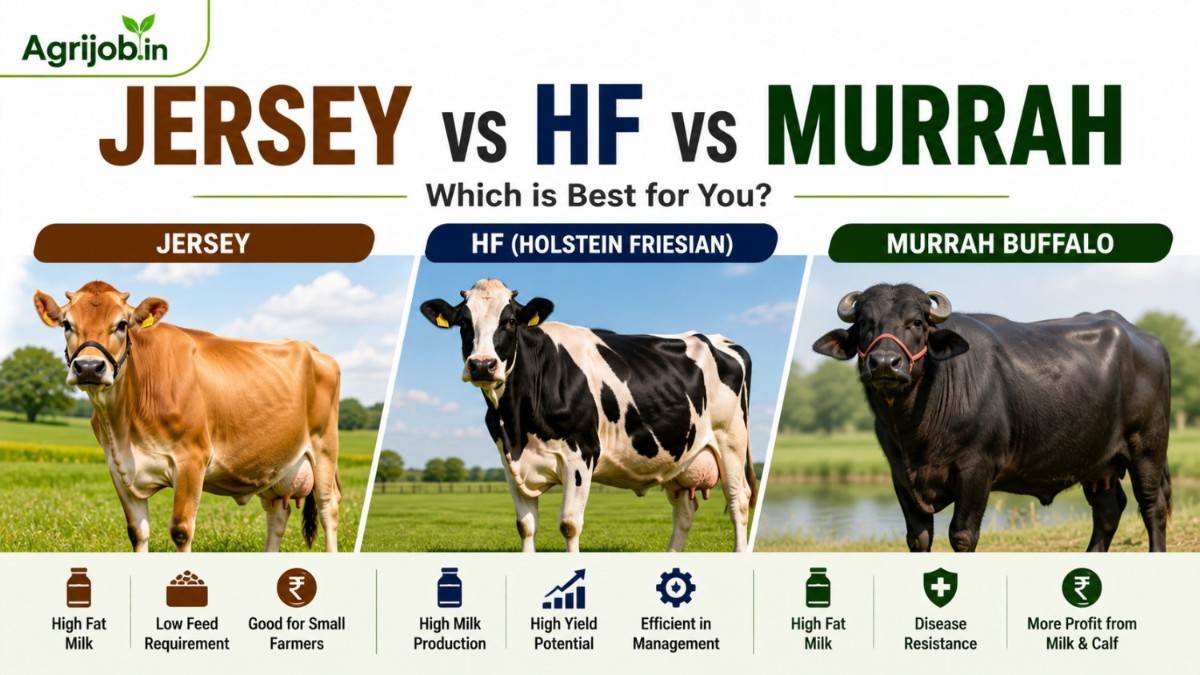
Jersey, HF (Holstein Friesian) and Murrah are the three dairy breeds most commonly compared by Indian farmers for milk profit. Jersey and HF are exotic cattle breeds bred for high milk volume, while Murrah is India’s own premier buffalo breed, bred for high milk fat. All three are now bred and cross-bred across Indian dairy states.
The Jersey cow originated on the Island of Jersey and reached India through crossbreeding programmes aimed at improving milk output from local stock. It is a compact animal, weighing 350-450 kg, known for high butterfat and good heat tolerance. The HF cow, or Holstein Friesian, originated in the Netherlands and is the world’s highest-volume dairy breed, recognisable by its black-and-white coat and large 500-700 kg frame. The Murrah buffalo is a native Indian breed from Haryana’s Rohtak, Hisar, Jind and Bhiwani districts and Punjab’s Patiala and Nabha, prized for its jet-black coat, tightly curled horns, and unmatched milk fat content.

Each breed suits a different kind of dairy operation. Jersey suits low-input, small-holding farms. HF suits commercial, high-volume operations with reliable cooling and feed supply. Murrah suits farmers selling to cooperatives that pay on fat content, or those making ghee, paneer and khoya where fat is the main value driver.
Who Should Read This Comparison?
This Jersey vs HF vs Murrah guide is written for the following readers:
- 🐄 First-time dairy farmers deciding which animal to buy with a NABARD or Pashu KCC loan
- 🐃 Farmers switching from country cattle to a high-yield crossbred or graded buffalo
- 💰 Rural entrepreneurs comparing daily milk income before applying for a dairy loan
- 🧑🌾 Small and marginal farmers with limited fodder land choosing a low-input breed
- 🏭 Investors planning a 10-20 animal commercial dairy unit under AHIDF
- 🧈 Farmers producing ghee, paneer or khoya who need a high-fat milk source
- 📊 Anyone comparing cow vs buffalo dairy farming profit before investing capital
Milk Income and Profit Margin: Jersey vs HF vs Murrah
HF cows generate the highest daily milk revenue, Murrah buffalo earns the highest margin per litre, and Jersey cows need the smallest capital outlay. All three numbers matter, and the “most profitable” answer depends on which one matters most to your situation.
Under India’s two-axis Fat-SNF milk pricing system used by cooperatives, farmers are paid separately for fat percentage and solids-not-fat, not for litres alone. A real dairy union procurement circular shows buffalo milk (7.0% fat, 9.4% SNF) purchased at roughly Rs.60/litre against cow milk (4.0% fat, 8.6% SNF) at roughly Rs.37/litre — a 60%+ price gap per litre in favour of buffalo milk. This is why a Murrah buffalo giving fewer litres than an HF cow can still out-earn it per litre of milk sold.
| Metric (average animal) | Jersey Cow | HF Cow | Murrah Buffalo |
|---|---|---|---|
| Avg. daily milk yield | 18 litres | 24 litres | 13 litres |
| Avg. fat-based milk price | Rs.42/litre | Rs.38/litre | Rs.58/litre |
| Daily gross milk revenue | ~Rs.756 | ~Rs.912 | ~Rs.754 |
| Daily feed cost | Rs.220-260 | Rs.280-340 | Rs.300-380 |
| Feed-adjusted daily margin | ~Rs.510 | ~Rs.600 | ~Rs.410 |
| Net margin per litre | ~Rs.28 | ~Rs.25 | ~Rs.32 |
These figures cover milk revenue minus feed cost only — the single biggest cost, at 55-70% of total operating expense on most Indian dairies. They exclude shed rent, labour, veterinary care, insurance and the non-lactating dry period, so treat them as an operating margin, not final take-home profit. For a fully costed model including shed construction and the dry period, see our 10-cow dairy farm business plan and setup cost guide.
Real-world capital payback, once shed, labour, health cover and the 2-3 month dry period are added in, typically runs 12-24 months per animal for a well-managed unit, based on published dairy project reports. A high-yielding Murrah at 12+ litres/day and Rs.60/litre milk, for instance, is documented to break even in 18-24 months in our detailed Murrah buffalo price and NABARD loan guide.
Eligibility and Subsidy for Buying Dairy Animals
Any Indian farmer, Self Help Group, FPO or dairy cooperative member can apply for a subsidised loan to buy a Jersey cow, HF cow or graded Murrah buffalo through NABARD-backed bank schemes. Eligibility does not depend on which breed you pick — it depends on land, shed readiness, and bank documentation.
- Applicant must be an Indian citizen aged 18+ with land ownership or a lease document for the shed site
- A minimum unit size of 2 animals and a maximum of 10 animals per scheme unit
- A bankable Detailed Project Report (DPR) approved by the lending branch
- No default history on any earlier agricultural or dairy loan
- SC/ST applicants qualify for a higher subsidy slab (33.33% vs 25% general)
- Existing Kisan Credit Card (KCC) holders can add a Pashu KCC limit for working capital such as feed and vaccination
| Scheme | Subsidy / Benefit | Applicable To |
|---|---|---|
| NABARD DEDS-model capital subsidy | 25% general, 33.33% SC/ST (back-ended) | Jersey, HF, crossbred cows & graded Murrah, 2-10 animal units |
| AHIDF (Animal Husbandry Infra. Dev. Fund) | 3% interest subvention for 8 years, up to 90% of project cost | Larger dairy units, processing & breed multiplication farms |
| Rashtriya Gokul Mission | Up to 50% capex subsidy on breed multiplication farm cost | Indigenous & graded breeding stock projects |
| Pashu Kisan Credit Card (Pashu KCC) | Working-capital loan against milch animal value | Feed, fodder, vaccination & day-to-day running cost |
As per official scheme guidelines available in 2026, the subsidy is back-ended — credited to your loan account only after 12 months of satisfactory unit operation, not paid upfront. Read our complete NABARD dairy farm loan subsidy and interest rate guide for the full application process, and check the official portal for the latest state-wise scale of finance before applying.
How to Choose the Right Breed for Your Farm
Choosing between Jersey, HF and Murrah comes down to your buyer type, climate, and available capital — follow these 7 steps before you buy.
- Check whether your local buyer pays on litres (private/informal market) or on Fat-SNF (cooperative) — fat-based buyers favour Murrah.
- Assess your shed’s cooling and ventilation — HF cows need shade and cooling; Jersey and Murrah tolerate heat far better.
- Calculate your usable capital and loan eligibility — Jersey needs the least upfront investment.
- Match herd size to your fodder land — a Murrah or HF needs more dry matter per day than a Jersey.
- Visit the animal in person and verify at least 15 days of milk yield records before purchase.
- Apply for your NABARD DEDS-model subsidy or Pashu KCC limit before, not after, the purchase.
- Buy from a registered breeder or state animal husbandry farm, and insure the animal immediately after purchase.
Never buy a milch animal without a written 15-day milk yield record from the seller. A distress-sale animal that “looks productive” but lacks records is the single most common reason first-time dairy farmers lose money in the first six months.
Jersey vs HF vs Murrah Buffalo — Full Comparison Table
Here is a direct 10-point comparison covering every factor that affects your buying decision, from milk yield to disease resistance.
| Factor | Jersey Cow | HF Cow | Murrah Buffalo |
|---|---|---|---|
| Milk yield/day | 15-25 litres | 20-30 litres | 10-16 litres |
| Milk fat content | 4.5-5.2% | 3.2-4.0% | 6.8-8.2% |
| Body weight | 350-450 kg | 500-700 kg | 500-600+ kg |
| Purchase price | Rs.40,000-75,000 | Rs.40,000-1,50,000 | Rs.90,000-2,50,000 |
| Daily feed cost | Rs.220-260 | Rs.280-340 | Rs.300-380 |
| Heat tolerance | High | Low – needs cooling | High |
| Disease resistance | Good | Moderate | Excellent |
| Calving interval | ~13 months | 13-14 months | 15-16 months |
| Best milk use | Butter, ghee, curd | Liquid milk, dairies | Ghee, paneer, khoya |
| Best For | Small farmers, low input | Commercial high-volume units | Fat-based cooperative markets |
For farmers targeting raw litreage and liquid-milk contracts, the HF cow wins on volume. For farmers selling to a Fat-SNF cooperative or making ghee and paneer, the Murrah buffalo wins on margin per litre. For a first-time, low-capital, low-input farmer, the Jersey cow wins on return on investment because it needs the smallest shed, the least feed, and the lowest purchase price.
Pros and Cons of Each Breed
Jersey Cow: Pros and Cons
- ✅ Lowest purchase price and lowest daily feed cost of the three breeds
- ✅ Best feed-to-milk conversion ratio, reducing overall input cost
- ✅ High heat tolerance — performs well across Indian tropical plains
- ✅ Shorter calving interval and earlier maturity than HF or Murrah
- ❌ Lowest raw litre yield among the three, capping maximum daily revenue
- ❌ Smaller frame means slightly shorter productive lifespan than Murrah
- ❌ Needs consistent quality green fodder to maintain its high fat percentage
HF Cow: Pros and Cons
- ✅ Highest raw milk volume of the three breeds — up to 30+ litres/day
- ✅ Best suited to liquid-milk supply contracts and urban dairies
- ✅ Well-established breeding and AI support across Punjab, Haryana and Maharashtra
- ✅ Strong secondary market for high-yield HF heifers and calves
- ❌ Lowest fat content of the three, reducing per-litre income at Fat-SNF cooperatives
- ❌ Poor heat tolerance — needs shade, fans or coolers, raising input cost
- ❌ Highest feed and veterinary cost per animal among the three breeds
Murrah Buffalo: Pros and Cons
- ✅ Highest milk fat content (6.8-8.2%) — commands the best per-litre price
- ✅ Excellent disease resistance and tolerance of poor-quality roughage
- ✅ High demand for ghee, paneer, khoya and mozzarella-grade fat
- ✅ Long 11-12 year productive lifespan when well managed
- ❌ Highest purchase price of the three breeds
- ❌ Lowest litre yield per day, limiting volume-based income
- ❌ Longer calving interval (15-16 months) and late maturity (25-32 months)
Important Terms Every Dairy Farmer Should Know
Fat-SNF Pricing: A two-axis payment system where cooperatives pay separately for fat% and solids-not-fat%, meaning buffalo milk at 7% fat typically earns Rs.15-20/litre more than cow milk at 4% fat.
Back-Ended Capital Subsidy: A NABARD-model subsidy of 25% (33.33% for SC/ST) credited to your loan account after 12 months of satisfactory operation, not paid as an upfront grant.
AHIDF: The Animal Husbandry Infrastructure Development Fund, a central scheme with a Rs.29,610.25 crore outlay offering 3% annual interest subvention for 8 years on loans up to 90% of project cost.
Rashtriya Gokul Mission: A central breed-improvement scheme that allows up to 50% capex subsidy on the cost of setting up a breed multiplication farm.
Scale of Finance (SoF): The official per-animal loan amount fixed each year by the District Level Technical Committee (DLTC), which decides how much loan your bank branch can sanction per Jersey, HF or Murrah animal.
305-Day Lactation Yield: The standard measure used across Indian dairy science to record total milk produced by one animal in one lactation cycle, used to compare breed productivity fairly.
Feed Conversion Ratio (FCR): The amount of feed an animal needs to produce one litre of milk — Jersey cows typically have the most efficient FCR of the three breeds.
Calving Interval: The gap between two successive calvings; a shorter interval means more lactation cycles and more lifetime income per animal.
Dry Period: The 2-3 month non-milking rest period before calving, during which the animal still needs full feed but produces no milk income.
Best Time to Buy and Farm Calendar
Timing your purchase and fodder cycle correctly improves the profit outcome of any Jersey, HF or Murrah unit.
| Activity | Recommended Timing |
|---|---|
| Best season to buy a milch animal | Post-monsoon, October-December (verified yield records available) |
| Rabi green fodder sowing (berseem, lucerne) | October-November |
| Kharif green fodder sowing (maize, jowar) | June-July |
| FMD & HS vaccination cycle | Bi-annual — pre-monsoon and pre-winter |
| NABARD/AHIDF loan application | Year-round, subject to branch empanelment — check nearest branch before applying |
Bookmark this page — this guide is reviewed and updated regularly for accuracy as milk procurement rates and subsidy slabs change through the year.
Important Links and Resources
| Resource | Link |
|---|---|
| Murrah Buffalo Price & NABARD Loan Guide | Read guide |
| Holstein Friesian HF Cow — Milk, Price & Farm Guide | Read guide |
| Best Dairy Cow Breeds in India — Full Comparison | Read guide |
| 10-Cow Dairy Farm Business Plan & Setup Cost | Read guide |
| NABARD Dairy Farm Loan — Subsidy & Interest Rate | Read guide |
| NABARD Official — Dairy Entrepreneurship Development Scheme | Visit NABARD |
| DAHD Official — AHIDF & Rashtriya Gokul Mission Booklet | View PDF |
| ICAR-NDRI Karnal — Animal Genetics & Breeding (Murrah research) | Visit ICAR-NDRI |
| Dairy Farm Category — More Agrijob.in Dairy Guides | Browse category |
Conclusion
There is no single winner in the Jersey vs HF vs Murrah comparison — the right animal depends on your buyer, your climate, and your starting capital. HF delivers the highest daily litreage, Murrah delivers the highest price per litre, and Jersey delivers the fastest, lowest-risk entry point for a first-time farmer. Match the breed to your fodder land, your cooling infrastructure and your milk buyer’s pricing method before you spend a single rupee. Apply for your NABARD subsidy or Pashu KCC limit first, verify the animal’s milk records in person, and start with 2-3 animals to test your management before scaling up.
- HF cow gives the highest daily milk revenue at ~Rs.900+/day from 24 litres
- Murrah buffalo earns the best margin per litre (~Rs.32) due to 6.8-8.2% fat
- Jersey cow needs the lowest capital (Rs.40,000-75,000) and lowest daily feed cost
- NABARD subsidy covers 25% (33.33% SC/ST) of project cost across all three breeds
- Fat-SNF cooperative buyers favour Murrah; liquid-milk contracts favour HF
- Verify 15-day milk records before buying, and apply for subsidy before purchase
Frequently Asked Questions About Jersey vs HF vs Murrah
Which is more profitable: Jersey cow, HF cow or Murrah buffalo?
It depends on your goal. HF cows earn the most daily revenue from raw volume (~Rs.900+/day from 24 litres), Murrah buffalo earns the best margin per litre (~Rs.32/litre) due to its 6.8-8.2% fat content, and Jersey cows offer the fastest return on investment because of their low purchase price and low feed cost.
How much milk does a Jersey cow give per day in India?
A well-managed Jersey cow in India gives 15-25 litres of milk per day, with 4.5-5.2% fat content, making it valuable for butter, ghee and curd production despite lower raw litreage than HF.
What is the price of a Murrah buffalo in 2026?
Murrah buffalo prices in 2026 range from Rs.90,000 for a young lactating animal to Rs.2,50,000+ for a high-yielding buffalo giving 15-20 litres/day, with price depending on age, pedigree and verified milk records.
Is HF cow suitable for hot Indian climates?
HF cows can adapt to Indian conditions but need proper shade, ventilation and cooling during summer, since they are less heat-tolerant than Jersey or Murrah. Without adequate cooling, HF cows show reduced milk yield and higher heat stress.
Which breed gives the highest fat content milk?
Murrah buffalo gives the highest fat content at 6.8-8.2%, followed by Jersey cow at 4.5-5.2%, and HF cow has the lowest fat content among the three at 3.2-4.0%.
How much subsidy is available to buy dairy cows or buffaloes under NABARD?
NABARD-model schemes offer a back-ended capital subsidy of 25% for general category farmers and 33.33% for SC/ST farmers on the approved project cost, applicable to Jersey cows, HF cows and graded Murrah buffaloes alike, up to a 10-animal unit.
What is the daily feed cost for Jersey cow vs Murrah buffalo?
A Jersey cow typically costs Rs.220-260 per day to feed, while a Murrah buffalo costs Rs.300-380 per day, because buffaloes need a higher dry-matter intake and more concentrate per litre of milk produced.
Which breed is best for small and marginal farmers?
Jersey cow is generally best for small and marginal farmers because it needs the lowest purchase price, the smallest shed, the least feed, and adapts well to India’s hot climate without special cooling infrastructure.
Can I use a Kisan Credit Card to buy a Jersey cow or Murrah buffalo?
Yes, the Pashu Kisan Credit Card (Pashu KCC) provides a working-capital loan against the value of milch animals including Jersey cows, HF cows and Murrah buffaloes, mainly for feed, fodder and vaccination costs, separate from the capital subsidy loan used to buy the animal itself.
Last Updated: August 2026. This guide is reviewed and updated regularly for accuracy as milk procurement rates, feed prices and NABARD subsidy slabs change. Bookmark this page for the latest Jersey vs HF vs Murrah comparison.
Disclaimer: This article is for general educational and informational purposes only and does not constitute financial or veterinary advice. Milk prices, feed costs, subsidy percentages and loan terms vary by state, bank branch and season. Always verify current rates with your local dairy cooperative, animal husbandry department and lending bank before making a purchase or loan decision.