
Livestock insurance scheme 2026 now offers dairy farmers and cattle owners across India up to 50% premium subsidy, protecting cows, buffaloes, and other milch animals against death and disability. This guide is built for small and marginal dairy farmers, KCC loan holders, and FPOs who want to protect their herd while securing bank credit without risk. The biggest benefit: a farmer paying full premium out of pocket can now pay as little as 15% of the cost in many states, while the government covers the rest. This guide covers everything from eligibility and the premium calculator logic, to required documents, the claim timeline, herd vs individual policies, and the full list of insurance companies operating under this scheme in 2026.

📋 Table of Contents
- What Is the Livestock Insurance Scheme 2026?
- Key Facts at a Glance
- Premium, Subsidy & Sum Insured (Money Pillar)
- Eligibility & Documents Required (Eligibility Pillar)
- How to Apply: Step-by-Step Process (Process Pillar)
- Mandatory vs Voluntary Insurance for Dairy Loans
- Individual Animal Policy vs Herd Insurance
- Claim Process & Claim Time Limit
- Who Should Apply for Livestock Insurance 2026?
- Livestock Insurance vs No Insurance: Expert Comparison
- High-Value Livestock Insurance Terms You Must Know
- FAQs on Livestock Insurance Scheme 2026
What Is the Livestock Insurance Scheme 2026?
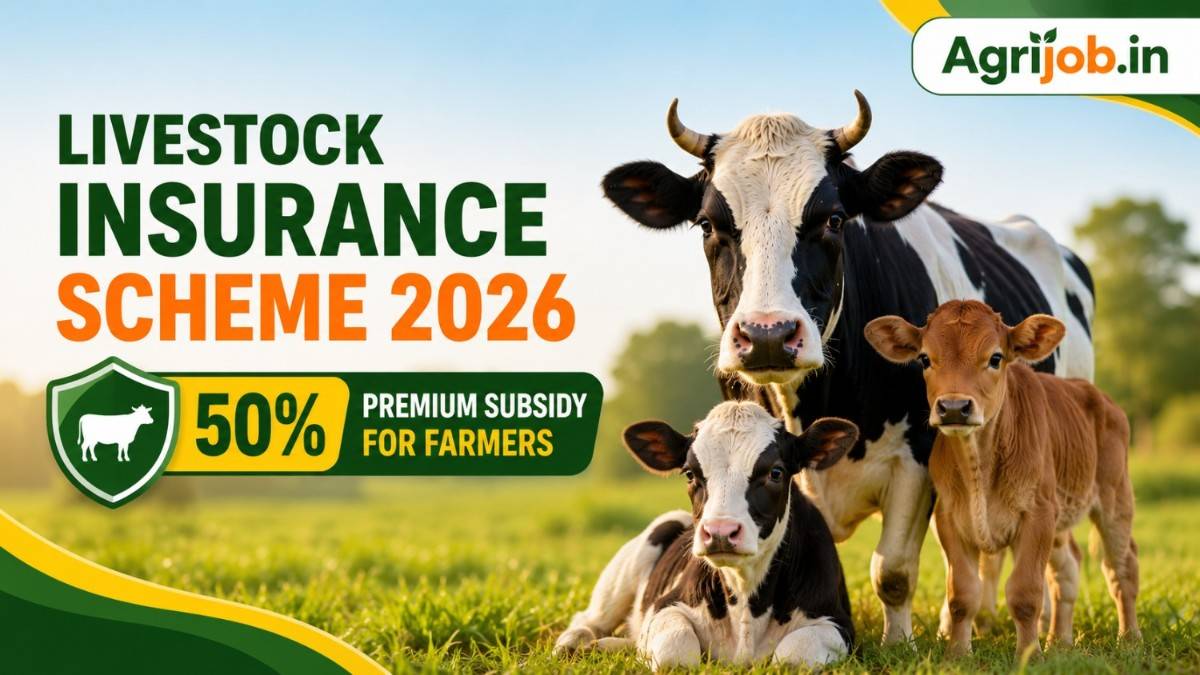
The livestock insurance scheme india 2026 is implemented as Activity III under the National Livestock Mission (NLM), run by the Department of Animal Husbandry and Dairying (DAHD), Government of India. It insures cattle, buffaloes, sheep, goats, pigs, and other animals against death due to disease, accident, or natural calamity. Under the latest update, the beneficiary’s premium share has been cut to a flat 15% instead of the earlier 20-50% slab, with the rest shared between Centre and State at 60:40 (general states), 90:10 (Himalayan/NER states), and 100% Centre-funded for Union Territories. Some state boards, including Uttar Pradesh and Haryana, continue running a parallel 50% premium subsidy model for crossbred and high-yielding cattle, which is why this scheme is also referred to locally as पशुधन बीमा योजना 2026 or Pashu Bima Yojana.

The scheme was first piloted in 2005-06 in 100 districts and has since expanded nationwide. The number of animals eligible for the subsidy under NLM has now been raised from 5 cattle units to 10 cattle units per household for most species, with pigs and rabbits capped at 5 units. This guide is regularly reviewed and updated for accuracy. Bookmark this page for the latest livestock insurance notifications.
Key Facts at a Glance
⚡ Key Facts at a Glance – Livestock Insurance Scheme 2026
- 🏢 Implementing Body: Department of Animal Husbandry & Dairying (DAHD), Govt. of India, under National Livestock Mission
- 🐄 Animals Covered: Cattle, buffalo, sheep, goat, pig, rabbit, camel, horse, donkey, mule
- 💰 Farmer’s Premium Share: As low as 15% (NLM model) or up to 50% (select State Board model)
- 📊 Govt. Funding Ratio: 60:40 (regular states), 90:10 (Himalayan/NER), 100% (UTs)
- 🔢 Animals Eligible per Household: Up to 10 cattle units (5 for pig/rabbit)
- 📅 Policy Duration: 1 to 3 years per policy
- 🎓 Eligibility: Crossbred & high-yielding cows/buffaloes certified healthy by a vet
- 🖥️ Application Mode: Online via State Livestock Development Board / bank branch / CSC
Premium, Subsidy & Sum Insured (Money Pillar)
The most important number in this scheme is what you actually pay. The livestock insurance 50% subsidy model and the newer 15%-beneficiary-share NLM model run in parallel depending on your state, so always confirm with your local Animal Husbandry office which model applies. Below is an illustrative cattle insurance premium calculator table showing how subsidy reduces your out-of-pocket cost for a typical milch animal insured at market value.
| Animal Market Value (Sum Insured) | Typical Annual Premium Rate | Full Premium (Rs.) | Farmer Share @ 15% (Rs.) | Farmer Share @ 50% (Rs.) |
|---|---|---|---|---|
| Rs. 30,000 (local cow) | 4% | Rs. 1,200 | Rs. 180 | Rs. 600 |
| Rs. 60,000 (crossbred cow) | 4% | Rs. 2,400 | Rs. 360 | Rs. 1,200 |
| Rs. 90,000 (high-yield buffalo) | 4.5% | Rs. 4,050 | Rs. 608 | Rs. 2,025 |
| Rs. 1,20,000 (HF/Jersey cow) | 4.5% | Rs. 5,400 | Rs. 810 | Rs. 2,700 |
| Rs. 1,50,000 (Murrah buffalo) | 5% | Rs. 7,500 | Rs. 1,125 | Rs. 3,750 |
Note: actual premium rates vary by insurer, breed, region, and the policy tenure (1-year vs 3-year). A 3-year policy is usually cheaper per annum than renewing a 1-year policy three times, since it locks in the rate and avoids repeat administrative charges. Annual earning protection matters too — a dairy farmer earning Rs. 15,000-Rs. 25,000/month from 2-3 milch animals stands to lose their entire monthly cash flow if even one high-yielding buffalo dies uninsured.
Eligibility & Documents Required (Eligibility Pillar)
Eligibility for the livestock insurance scheme 2026 is fairly inclusive, but the animal and the owner both must meet specific conditions before a policy can be issued.
- 🐄 The animal must be a crossbred or high-yielding cow/buffalo (or other eligible species) certified healthy by a registered veterinary surgeon
- 🏷️ The animal must be tagged with a unique ear tag before the policy is issued — this is mandatory for any future claim
- 👨🌾 The applicant must be the legal owner of the animal, including individual farmers, FPOs, SHGs, JLGs, or cooperative dairy members
- 📜 The animal should not already be covered under any other active insurance policy
- 🔞 Calves below 90 days of age are typically not eligible; lactating animals are generally insurable up to the 4th lactation
- 📍 Category-wise age relaxation and fee concessions for SC/ST/OBC/EWS/PwBD beneficiaries are applicable as per state NLM guidelines
Here is the complete list of documents required, often searched in Hindi as पशु बीमा के लिए आवश्यक दस्तावेज:
| Document | Purpose | Mandatory? |
|---|---|---|
| Duly filled Proposal/Application Form | Formal request for insurance cover | Yes |
| Veterinary Health Certificate | Confirms the animal is disease-free and fit for cover | Yes |
| Aadhaar Card of applicant | Identity verification | Yes |
| Bank Passbook / Cancelled Cheque | Premium subsidy and claim disbursal | Yes |
| Photograph of animal with visible ear tag | Identification proof for claim stage | Yes |
| Purchase Receipt / Valuation Certificate | Establishes the market value (sum insured) | Yes |
| Caste/Category Certificate | For SC/ST/OBC/EWS fee concession | If applicable |
| Loan Sanction Letter (for KCC/dairy loan cases) | Links insurance to the financed animal | If financed |
How to Apply: Step-by-Step Process (Process Pillar)
Here is the complete livestock insurance application form process, step by step:
- Visit your nearest State Livestock Development Board office, Animal Husbandry Department, bank branch, or Common Service Centre (CSC)
- Collect or download the livestock insurance proposal form and the document checklist
- Get the animal examined by a government (or empanelled private) veterinary surgeon for a health certificate
- Submit the proposal form along with all required documents listed above
- Pay your subsidised premium share (15% or 50% depending on the applicable model in your state)
- The insurer or its agent applies a unique ear tag to the animal — do not lose this tag
- Policy is typically issued within 15 days of submission, once the formalities and premium payment are complete
- Keep the policy certificate, tag number, and veterinary certificate safely until the policy matures or a claim arises
💡 Pro Tip: Always opt for a 3-year policy if you can afford the upfront premium share — it is usually more economical per year than renewing annually, and it avoids the risk of a coverage gap if you forget to renew on time.
Mandatory vs Voluntary Insurance for Dairy Loans
One of the most searched questions on this topic is whether mandatory insurance dairy farm loan rules apply to every borrower. The answer depends on how the animal is financed:
- 🏦 Financed animals (loan-linked): When a dairy animal is purchased using a bank loan, KCC for Animal Husbandry, or NABARD-refinanced credit, insurance is almost always made mandatory by the lender, since the animal is the primary security against the loan
- 🐄 Self-owned animals (no loan): For farmers who already own their cattle outright and are not borrowing against them, insurance under the scheme remains voluntary, though strongly recommended
- 📑 Bank’s protection angle: If an uninsured financed animal dies, the bank has no recovery mechanism for the outstanding loan, which is why most loan sanction letters explicitly list animal insurance as a pre-disbursement condition
- 👨🌾 Farmer’s protection angle: Insurance protects the farmer too — without it, the farmer remains liable to repay the full loan even after losing the income-generating animal
This dual protection is exactly why insurance is built into cattle insurance for loan products structured by nationalised banks and NABARD-linked institutions — it is not just paperwork, it is the mechanism that keeps both the bank’s recovery and the farmer’s livelihood intact in the event of an animal’s death.
Individual Animal Policy vs Herd Insurance
Farmers researching how to insure dairy animals often get confused between two distinct product structures:
| Feature | Individual Animal Policy | Herd Policy |
|---|---|---|
| Best suited for | 1-2 high-value animals (e.g. a single Murrah buffalo) | Dairy farms or cooperatives with multiple animals |
| Premium per animal | Higher (individual underwriting) | Generally lower due to risk pooling |
| Documentation | Separate proposal per animal | Single master policy listing all animals |
| Claim process | Simpler, single-animal verification | Requires identifying the specific tagged animal from the herd list |
| Ideal user | Small farmer with 1-2 milch animals | FPOs, SHGs, cooperative/corporate dairies |
For most small and marginal dairy farmers with one or two cows or buffaloes, an individual policy is simpler to manage. For cooperative dairies, FPOs, or farmers with five or more animals, herd insurance reduces administrative load and often brings a better effective premium rate.
Claim Process & Claim Time Limit
The livestock insurance claim time limit is the single most important detail farmers tend to miss, and it is the most common reason genuine claims get rejected.
- Intimate the death or disability to the insurance company’s helpline or local agent immediately — most policies require formal notice within 7 days of the animal’s death
- Call a registered veterinary surgeon to conduct an examination and issue a death certificate
- Arrange a post-mortem examination report if the insurer requires one for the cause of death
- Surrender the animal’s ear tag along with the claim form — under the strict “no tag, no claim” rule, a missing tag can lead to outright rejection
- Submit the duly completed claim form, death certificate, post-mortem report, and original policy document
- The insurer’s veterinary officer may independently inspect the case before approval
- Once documents are verified, claim settlement is typically processed within 15 days, though some policies cap indemnity at up to 75% of the sum insured for certain causes of death
💡 Pro Tip: Take a clear photograph of the dead animal with the ear tag visible, and preserve the tag itself, before disposal. This single step resolves the majority of claim disputes farmers face.
Who Should Apply for Livestock Insurance 2026?
- 🐄 Dairy farmers owning crossbred or high-yielding cows and buffaloes
- 🏦 Farmers taking a Kisan Credit Card (Animal Husbandry) or NABARD-linked dairy loan
- 👩🌾 Women-led Self Help Groups running community dairy units
- 🤝 Farmer Producer Organisations (FPOs) managing herd-scale dairy operations
- 🏘️ Landless and marginal farmers depending on 1-2 milch animals for primary income
- 🎓 SC/ST/OBC/EWS/PwBD category farmers eligible for additional fee concessions
- 🐐 Sheep, goat, and pig rearers covered under the broader NLM insurance activity
- 🚜 New entrants planning to purchase a tractor or other farm asset using livestock as informal collateral strength
Livestock Insurance vs No Insurance: Expert Comparison
| Factor | With Livestock Insurance | Without Insurance |
|---|---|---|
| Financial loss on animal death | Covered up to sum insured (often 75-100%) | 100% loss borne by farmer |
| Loan repayment risk | Claim proceeds can offset outstanding loan | Farmer remains liable for full loan |
| Upfront cost | Farmer pays only 15-50% subsidised premium | Zero cost, but full risk exposure |
| Bank loan approval | Smoother approval; often a precondition | Loan may be rejected or delayed |
| Recovery time after loss | Claim payout within ~15 days of documentation | No structured recovery; relies on savings/borrowing |
| Best for | Loan-financed animals and high-value milch cattle | Not recommended for any income-generating animal |
✅ Expert Verdict: For any dairy animal purchased on credit, insurance is not optional in practice — it is the financial backbone that protects both the farmer’s livelihood and the bank’s recovery. Even for self-owned animals, the subsidised 15% premium share makes insurance one of the cheapest risk-protection tools available to a rural household today.
High-Value Livestock Insurance Terms You Must Know
- Sum Insured: The animal’s certified market value, which forms the ceiling for any claim payout — typically Rs. 30,000 to Rs. 1,50,000 for milch cattle
- Cattle Unit: A standard measure used by NLM to define how many animals qualify per household — currently up to 10 cattle units
- No Tag No Claim: The strict rule under which a claim is rejected if the ear tag cannot be surrendered at the time of death intimation
- Beneficiary Share: The portion of premium the farmer pays out of pocket, now reduced to 15% under NLM in most states
- Herd Policy: A single master policy covering multiple animals owned by one entity, common among FPOs and dairy cooperatives
- Post-Mortem Certificate: A mandatory document for most claims, for which the government pays vets an incentive of around Rs. 100 per animal
- NAC (National Apprenticeship Certificate): Not directly linked to insurance, but often referenced alongside skill-linked dairy and BFSI training schemes
- Indemnity Limit: The maximum percentage of sum insured payable on a claim — many policies cap this at 75% for certain causes
- Market Valuation Certificate: The document used to fix the insured value of the animal at the time of policy issuance
- Buffalo Insurance India: A growing category given the high market value of Murrah and other high-yield buffalo breeds, often insured individually rather than under a herd policy
FAQs on Livestock Insurance Scheme 2026
What is the Livestock Insurance Scheme 2026?
The Livestock Insurance Scheme 2026 is a centrally sponsored scheme under the National Livestock Mission that protects farmers against financial loss from the death of cattle, buffalo, and other animals by subsidising the insurance premium.
How much premium subsidy is available under the Livestock Insurance Scheme 2026?
The farmer’s beneficiary share of premium has been reduced to a flat 15% in most states under NLM, with the rest funded by the Central and State Governments. Some state-specific schemes still operate on a 50% subsidy model.
Is livestock insurance mandatory for a dairy farming loan?
Yes, most banks and NABARD-linked lenders make livestock insurance mandatory when sanctioning a dairy loan or Kisan Credit Card for Animal Husbandry, since the insured animal serves as security for the loan amount.
What documents are required for livestock insurance?
Required documents include the duly filled proposal form, a health certificate from a registered veterinary surgeon, Aadhaar card, bank passbook, photograph of the animal with an ear tag, and the purchase receipt or valuation certificate.
What is the claim time limit for livestock insurance?
Farmers must intimate the insurance company about an animal’s death immediately, and most policies require formal claim intimation within 7 days, along with a veterinary death certificate and surrendered ear tag, under the “no tag no claim” rule.
What is the difference between individual animal policy and herd insurance?
An individual animal policy insures a single high-value cow or buffalo at its market price, while a herd policy covers a group of animals under one master policy, which usually lowers the per-animal premium for dairy farms with multiple cattle.
Can buffaloes be insured under the Livestock Insurance Scheme?
Yes, crossbred and high-yielding buffaloes are eligible for insurance under the scheme at their current market value, similar to cattle, provided they are certified healthy by a veterinary doctor before the policy is issued.
How is the premium for cattle and buffalo insurance calculated?
Premium is calculated as a percentage of the animal’s insured market value, which is typically fixed using its milk yield, breed, and age; the farmer then pays only the subsidised share after government support is applied.
Which companies offer livestock insurance in India?
Livestock insurance in India is offered by public insurers like New India Assurance, Oriental Insurance, National Insurance, and United India Insurance, as well as private players such as HDFC ERGO, ICICI Lombard, and IFFCO Tokio.
What happens if the insured animal dies and the ear tag is lost?
Most insurers follow a strict “no tag no claim” policy, meaning the claim can be rejected if the ear tag is not surrendered along with the death certificate, so farmers must preserve the tag carefully until the claim is settled.
External resources for verification: National Livestock Mission official guidelines (DAHD), PIB press release on premium subsidy reduction, Special Livestock Insurance Scheme on myScheme.gov.in, NABARD official website, and New India Assurance Cattle Insurance terms.
This guide is regularly reviewed and updated for accuracy. Bookmark this page for the latest livestock insurance scheme 2026 notifications.
Last Updated: June 2026