
Organic Food Business India 2026 – Rs.50,000 to Rs.5 Lakh Monthly
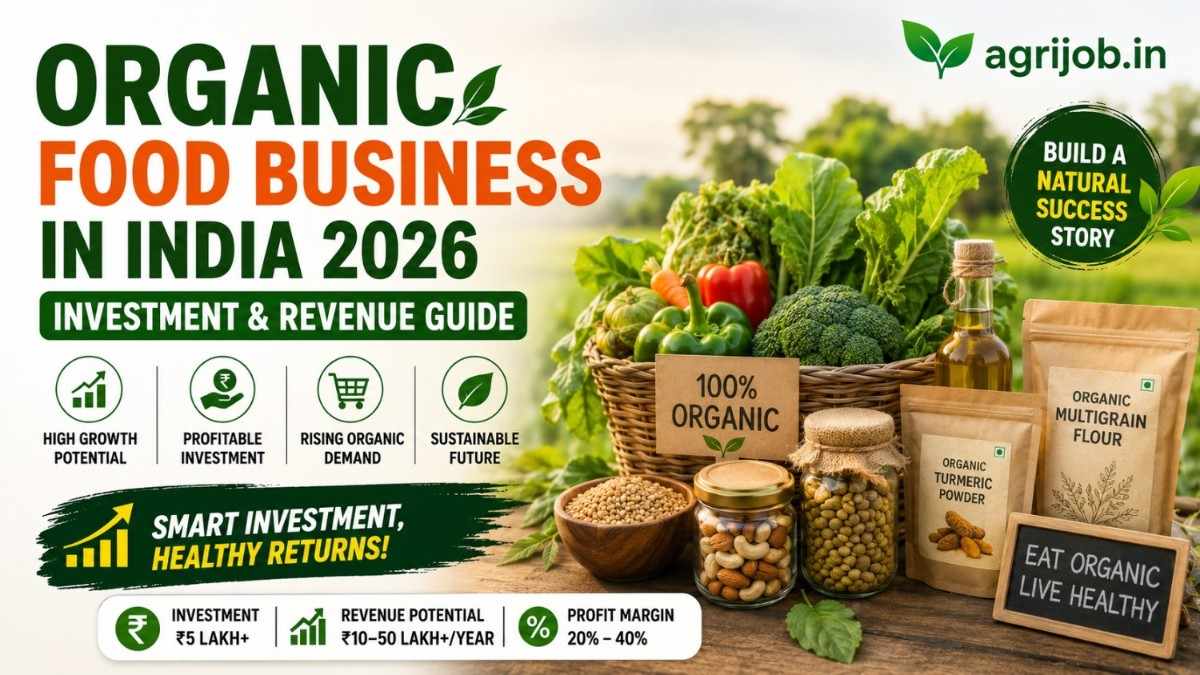
The organic food business in India 2026 is one of the most compelling low-investment, high-margin opportunities available to agriculture graduates, homemakers, farmers, and aspiring entrepreneurs. India’s organic food market was valued at USD 2,303 million in 2025 and is growing at a CAGR of 19.32% — making it one of the fastest-growing food segments in the world. With a starting capital as low as Rs.50,000, a focused D2C organic food brand in spices, ghee, cold-pressed oils, or millets can realistically generate Rs.5 lakh or more in monthly revenue within 12–18 months. This complete 2026 guide covers the top 7 product ideas by profit margin, step-by-step FSSAI registration, NPOP and PGS-India organic certification, PKVY government subsidy (Rs.31,500/ha), PM-FME capital subsidy, D2C selling channels, a realistic revenue model, who should start, and a comparison of business models — everything you need to launch and scale a profitable organic food business in India this year.
- India Organic Food Market Opportunity 2026
- Top 7 Organic Food Products by Profit Margin
- Investment vs Revenue Model – Rs.50,000 to Rs.5 Lakh/Month
- FSSAI Registration for Organic Food Business
- Organic Certification – NPOP, PGS-India & Unified India Organic Logo
- PKVY Govt Subsidy – Rs.31,500/ha for Organic Farmers
- How to Start an Organic Food Business in India – 8 Steps
- How to Sell Organic Food Online in India 2026
- Who Should Start an Organic Food Business 2026?
- D2C vs Marketplace vs Wholesale – Business Model Comparison
- High-Value Organic Food Business Terms You Must Know
- Frequently Asked Questions
| India Organic Food Market (2025) | USD 2,303 million — growing at 19.32% CAGR through 2034 |
| Minimum Starting Investment | Rs.50,000 (home-based D2C organic spices or millet packaging) |
| Realistic Monthly Revenue (12 months) | Rs.2–5 lakh/month (D2C brand with 200–500 loyal customers) |
| Gross Profit Margin | 40–70% depending on product (spices 50–65%, ghee 35–50%) |
| FSSAI Basic Registration Fee | Rs.100/year (turnover below Rs.12 lakh) — fully online at fssai.gov.in |
| PKVY Subsidy | Rs.31,500/ha over 3 years for organic farming inputs + free PGS-India certification |
| NPOP Certification Cost | Rs.10,000–Rs.25,000/year (small farmer); group FPO certification reduces cost |
| Best D2C Channel (2026) | WhatsApp Business (98% open rate) + Instagram Reels for brand building |
| PM-FME Subsidy | 35% capital subsidy up to Rs.10 lakh for food processing units |
| Organic Logo (India 2026) | Unified “India Organic” logo — launched by FSSAI + APEDA in 2024 |
India Organic Food Market Opportunity 2026
The organic food business in India is entering its most explosive growth decade. The India organic food market reached USD 2,303 million in 2025 and is projected to hit USD 11,296 million by 2034 at a CAGR of 19.32% — nearly 5x growth in under a decade. India is among the global top-3 fastest-growing organic food markets, ranked alongside China. This surge is driven by 4 structural forces that are still accelerating in 2026:
- 🏥 Post-pandemic health consciousness: Urban Indian consumers aged 25–45, especially in Tier-1 and Tier-2 cities, are actively switching from conventional to chemical-free food, viewing organic products as a long-term investment in preventive health. This shift is permanent, not cyclical.
- 📱 D2C and quick-commerce infrastructure: Farmers and niche organic brands are bypassing middlemen and selling directly via WhatsApp, Instagram, and quick-commerce platforms like Blinkit and Zepto. This means founders with zero retail experience can build a Rs.2–5 lakh/month organic food brand from home with Rs.50,000 in starting capital.
- 🏛️ Government policy support: Schemes like PKVY, PM-FME, RKVY-RAFTAAR, and AIF provide Rs.50 lakh to Rs.2 crore in non-dilutive grants, subsidies, and low-interest loans specifically for organic food entrepreneurs — significantly reducing the capital barrier to entry.
- 🌍 Export demand: India is the world’s leading producer of certified organic spices, tea, and basmati rice. The Unified India Organic logo (launched 2024) simplifies domestic and export certification, opening direct access to premium export markets in Europe and the Middle East for small organic food brands.
Top 7 Organic Food Products by Profit Margin in India 2026
Choosing the right product is the single most important decision for your organic food business in India 2026. The following 7 products offer the best combination of high margin, growing demand, low perishability, and suitability for D2C sales:
| Product | Farm/Wholesale Price | D2C Retail Price | Gross Margin | Starting Investment |
|---|---|---|---|---|
| Organic Turmeric & Spice Blends | Rs.60–150/kg | Rs.500–1,200/kg | 55–65% | Rs.30,000–50,000 |
| A2 Desi Cow Ghee | Rs.400–600/kg (bulk) | Rs.1,000–2,500/kg | 40–55% | Rs.50,000–1,00,000 |
| Cold-Pressed Oils (groundnut, sesame, coconut) | Rs.80–150/litre | Rs.300–600/litre | 45–60% | Rs.75,000–1,50,000 |
| Millet Products (ragi flour, jowar atta, bajra) | Rs.25–60/kg | Rs.80–200/kg | 40–55% | Rs.30,000–60,000 |
| Organic Honey (forest / multiflora) | Rs.150–300/kg (beekeepers) | Rs.400–1,200/kg | 50–65% | Rs.30,000–50,000 |
| Organic Jaggery & Jaggery Powder | Rs.40–80/kg | Rs.150–350/kg | 50–60% | Rs.20,000–40,000 |
| Organic Pulses & Lentils (moong, masoor, chana) | Rs.70–120/kg | Rs.200–400/kg | 40–55% | Rs.40,000–80,000 |
Raw organic turmeric is available in wholesale markets at approximately Rs.60 per kg and retails as branded, packaged organic turmeric powder at Rs.500–1,200/kg. This 8–20x value addition through cleaning, drying, grinding, and branded packaging is the foundation of a highly profitable organic spices business achievable with Rs.30,000–50,000 in starting capital.
Investment vs Revenue Model – Rs.50,000 to Rs.5 Lakh/Month
Here is a realistic, verified revenue model for an organic food business in India 2026, starting with Rs.50,000 and scaling to Rs.5 lakh/month within 12–18 months. The example below uses an organic spices + millet D2C brand as the base case:
| Phase | Timeline | Investment | Monthly Revenue | Gross Profit (50% margin) |
|---|---|---|---|---|
| Phase 1 — Launch (WhatsApp + Instagram) | Month 1–3 | Rs.50,000 (stock + packaging + FSSAI) | Rs.30,000–60,000 | Rs.15,000–30,000 |
| Phase 2 — Traction (50–100 loyal customers) | Month 4–6 | Rs.50,000–1,00,000 (marketing + stock scale) | Rs.80,000–1,50,000 | Rs.40,000–75,000 |
| Phase 3 — Growth (Amazon + BigBasket listing) | Month 7–12 | Rs.1,00,000–2,00,000 (FSSAI state license + catalog expansion) | Rs.2,00,000–3,50,000 | Rs.1,00,000–1,75,000 |
| Phase 4 — Scale (subscription + B2B + exports) | Month 13–18 | Rs.2,00,000–5,00,000 (NPOP cert + cold-pressed oil machine) | Rs.4,00,000–6,00,000 | Rs.2,00,000–3,00,000 |
The key to scaling from Rs.50,000 to Rs.5 lakh/month is a subscription model — customers who subscribe to a monthly organic basket (Rs.1,500–Rs.3,000/month) create predictable recurring revenue with a customer lifetime value (LTV) 3–5x higher than one-time buyers. D2C organic food brands with subscription penetration above 30% consistently achieve gross margins of 50–70% and reach profitability much faster than marketplace-only sellers who pay 15–25% platform commission on every order.
FSSAI Registration for Organic Food Business in India 2026
All food businesses in India — including home-based organic food ventures — are required to be registered with FSSAI (Food Safety and Standards Authority of India). The registration is simple, affordable, and fully online. There are 3 tiers based on annual turnover and business scale:
| FSSAI License Type | Annual Turnover | Annual Fee | Processing Time | Best For |
|---|---|---|---|---|
| Basic Registration | Below Rs.12 lakh | Rs.100/year | 7 days | Home-based organic food startup (Phase 1–2) |
| State License | Rs.12 lakh – Rs.20 crore | Rs.2,000–5,000/year | 30–60 days | Growing D2C brand with interstate sales (Phase 3) |
| Central License | Above Rs.20 crore or interstate manufacturing | Rs.7,500/year | 30–60 days | Large-scale organic food processor or exporter |
- 🌐 Apply online: Visit foscos.fssai.gov.in (FSSAI’s FoSCoS portal) to submit your application. The FoSCoS system covers all states and handles Basic Registration in approximately 7 business days.
- 📄 Documents required for Basic Registration: Aadhaar card / PAN, passport-size photo, proof of business address (rental agreement / utility bill), and a list of food products you intend to sell. No factory inspection is required at the Basic level.
- 🏷️ Organic labelling rules: From 2024, all packaged organic food sold in India must display the unified “India Organic” logo (combining the former India Organic and Jaivik Bharat logos) along with FSSAI licence number. Domestic organic claims must be backed by either NPOP certification or PGS-India certification. Misleading “natural” or “chemical-free” labels without certification attract FSSAI penalties.
- 💰 GST on organic food: Most organic food products attract 0–5% GST under India’s food-friendly GST framework. Unprocessed cereals, pulses, vegetables, and milk attract nil GST. Branded packaged goods typically attract 5% GST, keeping operational costs low for organic food startups.
Organic Certification – NPOP, PGS-India & Unified India Organic Logo 2026
Organic certification is the single most important trust signal for your organic food business in India 2026. Without certification, you cannot legally use the word “organic” on your label. India offers 2 main certification pathways, with FSSAI and APEDA having unified the consumer-facing logo in 2024:
- 🌿 PGS-India (Participatory Guarantee System): A farmer-centric, community-based certification administered by the National Centre for Organic and Natural Farming (NCOF), Ghaziabad. Under PKVY, PGS-India certification is fully funded by the government — farmers pay nothing out of pocket. PGS-India is valid for the domestic Indian market. Farmers join a local group of 20+ hectares, conduct peer inspections annually, and achieve “PGS Green (Organic)” status by Year 3. Register at pgsindia-ncof.gov.in.
- 🏆 NPOP (National Programme for Organic Production): India’s third-party certification standard for export markets and premium domestic retail, implemented by APEDA under the Ministry of Commerce. Annual cost: Rs.10,000–Rs.25,000 for small farmers; group certification via FPOs significantly reduces per-farmer cost. NPOP covers the full value chain — production, processing, trading, and exports. Essential for selling in Europe (India has equivalency with EU Organic), and required if you plan to list on premium platforms that demand NPOP-certified sourcing.
- 🏷️ Unified India Organic Logo (2024–2026): FSSAI and APEDA launched the unified “India Organic” logo in 2024, replacing the separate India Organic (NPOP) and Jaivik Bharat (PGS-India) logos. This single logo simplifies domestic labelling and improves consumer recognition. Both NPOP and PGS-India certified products are eligible to use the new unified logo.
PKVY Government Subsidy – Rs.31,500/ha Free Money for Organic Farmers
The Paramparagat Krishi Vikas Yojana (PKVY) is the Government of India’s most direct subsidy for organic food entrepreneurs who own or lease farmland. Launched in 2015 under the National Mission for Sustainable Agriculture, PKVY has disbursed over Rs.2,265 crore and covered 25 lakh farmers across 59.74 lakh hectares as of early 2025. In 2026, PKVY remains one of the most underused subsidies available to organic food business founders:
| PKVY Support Component | Amount per Hectare | Duration | What It Covers |
|---|---|---|---|
| On-farm organic inputs (Direct DBT) | Rs.15,000/ha | 3 years | Bio-fertilisers, bio-pesticides, vermicompost, traditional seeds |
| Value addition, marketing & publicity | Rs.4,500/ha | 3 years | Packaging, branding, local market linkage for organic produce |
| PGS-India certification | Rs.2,700/ha | 3 years | Regional Council fees, peer review inspections, certificate |
| Training, capacity building & handholding | Rs.7,500/ha | 3 years | Farmer training, cluster management, technical guidance |
| Cluster-level off-farm organic inputs | Rs.1,800/ha | 3 years | Botanical extracts, bio-agents for shared cluster use |
| Total PKVY Support | Rs.31,500/ha | 3 years | Complete organic transition support including free certification |
For organic food entrepreneurs sourcing from PKVY-certified farmer clusters, these farmers become your most credible, cost-competitive, and certifiably organic raw material suppliers. The combination of PKVY subsidy (reducing farm-level input costs) and the PGS-India certification (providing domestic market credibility) directly reduces your cost of goods and strengthens your brand’s “farm-to-fork” narrative for D2C selling.
How to Start an Organic Food Business in India 2026 – 8 Steps
Here is the complete step-by-step process to launch your organic food business in India in 2026 — from Rs.50,000 starting capital to your first 100 paying customers:
- Step 1 — Choose Your Niche Product: Pick 1–2 products to start with (not 10). The most successful organic D2C brands in India 2026 started with a single signature product — organic turmeric, A2 ghee, or cold-pressed oil — and built their reputation before expanding. Choose based on your local sourcing access, processing capability, and shelf life (longer shelf life = lower spoilage loss in the early stage).
- Step 2 — Source Certified Organic Raw Material: Locate PKVY-certified farmer clusters in your district through the local Krishi Vigyan Kendra (KVK) or District Agriculture Officer. Connect with FPOs on the Jaivik Kheti Portal (jaivikkheti.in) — India’s official government marketplace connecting organic farmers directly to buyers. Negotiate a minimum order and price agreement before investing in packaging.
- Step 3 — Register Your Business: Start as a Sole Proprietorship (simplest, cheapest) or Partnership for co-founders. Register Udyam (MSME) online at udyamregistration.gov.in — free, takes under 30 minutes, and gives you priority lending and government procurement benefits. Graduate to LLP or Pvt Ltd when turnover exceeds Rs.20–25 lakh/year.
- Step 4 — Get FSSAI Basic Registration: Apply online at foscos.fssai.gov.in. Fee: Rs.100/year. Documents: Aadhaar, address proof, product list. Approved in 7 business days. This is the legal licence to manufacture, package, and sell food products in India — no exceptions.
- Step 5 — Design Packaging and Apply for Organic Certification: Invest Rs.8,000–15,000 in professional label design — clean, minimal, with farm origin story. Apply for PGS-India certification (free under PKVY if you own land) or NPOP certification (Rs.10,000–25,000/year) for export-ready branding. Display the unified India Organic logo once certified. FSSAI licence number is mandatory on every pack.
- Step 6 — Build Your D2C Sales Channel: Create a WhatsApp Business account with a product catalogue. Build a 200–500 person broadcast list of health-conscious contacts in your city. Open an Instagram account and post 3 Reels/week — farm visits, processing videos, recipe content, and customer testimonials. The goal in Month 1–3 is 30–50 repeat customers, not viral reach.
- Step 7 — List on Online Marketplaces: After 3 months of D2C validation, list on Amazon (Seller Central), BigBasket, and Jiomart Organic. These platforms require FSSAI licence, GST registration, and NPOP/PGS certification for organic claims. Platform commission: 10–25%. Amazon’s “Amazon Organic” tag dramatically boosts visibility for certified organic products.
- Step 8 — Apply for Government Funding: Once you have 3–6 months of sales data, apply for the PM-FME scheme (35% capital subsidy up to Rs.10 lakh) to upgrade your processing equipment — a cold-press oil machine (Rs.1.5–3 lakh), spice grinding unit (Rs.80,000–1.5 lakh), or vacuum packaging machine (Rs.40,000–80,000). Simultaneously apply for RKVY-RAFTAAR pre-seed grant (Rs.5 lakh) at your nearest R-ABI incubator to fund brand development and marketing.
Do NOT try to build a 10-product catalogue from Day 1. The most profitable Indian organic D2C brands — Two Brothers Organic Farms, Natureland Organics, Tru Millets — all started with 2–3 hero products and built their story around those products for at least the first 18 months. Your first 100 customers buy because they trust you and your story — not because you have 40 SKUs. One perfectly packaged, certified organic turmeric powder that you can source from a PKVY-certified farmer and ship to 100 families every month is worth more than 20 average products. This guide is regularly reviewed and updated for accuracy. Bookmark this page for the latest organic food business scheme updates.
How to Sell Organic Food Online in India 2026
In 2026, Indian organic food entrepreneurs have more D2C selling channels than ever — and each channel has distinct margin, reach, and effort profiles. Here are the top 5 channels ranked by margin for a new organic food business:
- 📱 WhatsApp Business (Highest Margin — 0% commission): India has 500 million+ active WhatsApp users. WhatsApp messages achieve a 98% open rate and 35% click-through rate. For organic food D2C brands, building a community of 200–500 health-conscious subscribers on WhatsApp is the single most capital-efficient revenue channel. Set up a WhatsApp Business profile, create a product catalogue, and broadcast weekly “harvest updates” and limited-quantity offers. Implement subscription boxes (Rs.1,500–3,000/month) for predictable monthly revenue with zero platform fees.
- 📷 Instagram + Reels (Brand Building — 0% commission, indirect revenue): Farm-to-plate storytelling, certification process videos, farmer partner features, and recipe content consistently outperform product-only posts for organic food brands. Post 3 Reels/week showing your sourcing, processing, and packaging. Add a link-in-bio to your WhatsApp or Shopify store. Many Indian organic food founders earn Rs.1–2 lakh/month from Instagram-driven WhatsApp orders within 6–9 months of consistent content.
- 🛒 Amazon Fresh / Flipkart Supermart (Largest Reach — 15–25% commission): The largest reach but the lowest margin channel. Best for non-perishable organic products — spices, ghee, honey, oils, and packaged millets. Requires FSSAI state licence, GST, barcode (EAN/GTIN), and NPOP certification for “Amazon Organic” tag. Competition is higher but the organic category in India on Amazon is growing 25–30% year-on-year as of 2026.
- 🥗 BigBasket & JioMart Organic (Premium Positioning — 18–22% commission): Both platforms have dedicated organic sections with health-conscious urban shoppers who are specifically searching for certified organic products — making them higher-quality buyer pools than general marketplaces. BigBasket’s “BB Royal Organic” section and JioMart’s organic category both require NPOP or PGS-India certification, FSSAI licence, and a minimum order quantity guarantee.
- 🌐 Own D2C Website — Shopify / Instamojo (Zero Commission, Full Control): Building your own D2C website (Shopify: Rs.1,600–3,200/month; Instamojo: free basic plan) gives you full control over customer data, zero platform commission, and the ability to run subscription programmes. Best suited for Phase 3 onwards (Rs.1.5 lakh+ monthly revenue) when investing Rs.5,000–15,000/month in digital marketing is justified by the margin saved.
Who Should Start an Organic Food Business in India 2026?
India’s organic food market in 2026 is broad enough to support entrepreneurs from many backgrounds. Here are the 8 ideal profiles for an organic food business founder:
- 🌾 Farmers with 1–5 Acres of Land: The most advantaged position — you control the raw material supply chain. Apply for PKVY (Rs.31,500/ha over 3 years), get PGS-India certification for free, and sell directly to urban D2C consumers at 5–10x the wholesale farm price. A 1-acre organic turmeric farm can generate Rs.3–6 lakh/year in D2C revenue vs Rs.40,000–80,000 in mandis.
- 👩🍳 Homemakers and Kitchen Entrepreneurs: Home-based organic spice blending, millet flour packaging, or organic pickle-making are ideal Rs.50,000 investment businesses. FSSAI allows home kitchen-based food businesses with Basic Registration — no separate factory is required at the startup stage.
- 🎓 BSc / MSc Agriculture Graduates: Your academic knowledge of soil health, crop production, and post-harvest technology is a genuine competitive advantage in sourcing, quality control, and farmer relationship management for an organic food D2C brand. Combine your technical background with content marketing — farm-science Reels consistently outperform generic food content.
- 🏢 Working Professionals Seeking a Side Business: Organic food D2C is one of the best side businesses for working professionals — WhatsApp and Instagram selling can be managed on weekends in the first 6 months. Many founders run Rs.1–2 lakh/month organic food businesses as a side income before transitioning full-time at the Rs.3–5 lakh/month revenue mark.
- 👨👩👧 Rural Women and SHG Members: NABARD’s Rural Innovation Fund and state agri startup policies offer priority funding for women-led agri-food businesses. SHGs of 10–15 women producing organic spice blends, millet products, or organic jaggery collectively can access NABARD SHG loans at subsidised rates and list their products on the government’s Jaivik Kheti Portal and e-commerce platforms under a collective brand.
- 🌿 Organic Farming Enthusiasts in Urban Areas: Urban entrepreneurs without farmland can build highly profitable organic food businesses by partnering directly with PKVY-certified farmer clusters within 200–500 km of their city. You act as the aggregator, processor, packager, and marketer — while the certified farmer provides the organic raw material. This model scales faster than farm-ownership models because capital is deployed on brand-building, not land.
- 📦 Existing Food Business Owners Looking to Premiumise: If you already run a spice trading, dairy, or grain business, adding a certified organic line under a premium sub-brand is one of the fastest paths to margin improvement. Organic variants of your existing products can command 2–4x the price of conventional equivalents with the same production infrastructure.
- 🚀 Agritech Founders Building Food-Tech Platforms: D2C organic food brands with 200+ active customers and a strong social media presence qualify for DPIIT startup recognition, RKVY-RAFTAAR seed grants (Rs.25 lakh), and NABARD Rural Innovation Fund support — creating a path to tech-enabled scale through subscription logistics, AI-based demand forecasting, and FPO aggregation platforms.
D2C vs Marketplace vs Wholesale – Organic Food Business Model Comparison
Choosing the right business model for your organic food business in India determines your margin, growth speed, and capital requirement. Here is a detailed comparison of the 3 main models:
| Parameter | D2C (WhatsApp / Instagram / Own Website) | Online Marketplace (Amazon / BigBasket) | Wholesale / B2B (Retailers / Organic Stores) |
|---|---|---|---|
| Gross Margin | 50–70% | 30–50% (after 15–25% commission) | 15–25% |
| Starting Capital Needed | Rs.50,000–1,00,000 | Rs.1,00,000–3,00,000 (brand + inventory + listing fees) | Rs.2,00,000–5,00,000 (bulk inventory required) |
| Customer Ownership | Full — you own the customer data and relationship | None — platform owns the customer | Partial — retailer handles the final customer |
| Revenue Predictability | High (subscriptions) to Medium (D2C orders) | Medium — algorithm-dependent | High if B2B contracts secured |
| Certification Required | PGS-India sufficient for domestic D2C; FSSAI mandatory | NPOP strongly preferred; FSSAI mandatory | NPOP for premium organic stores; FSSAI mandatory |
| Competition Level | Low — personalised, community-driven | High — large national brands present | Medium — regional competition |
| Scalability | Medium — limited by founder bandwidth | High — nationwide reach instantly | Medium — limited by geography and relationships |
| Best For | Founders starting with Rs.50,000–1 lakh; first 6–12 months | Phase 3 onwards; established products with 50+ reviews | High-volume, low-margin commodity organic products |
| Monthly Revenue Ceiling | Rs.5–20 lakh (solo founder); Rs.50 lakh+ (with team) | Rs.20 lakh–5 crore (with ad spend and strong reviews) | Rs.10 lakh–1 crore (with distribution network) |
The optimal strategy in 2026 is to start D2C, validate on marketplaces, then build subscription. Month 1–6: build your first 50–100 loyal WhatsApp customers using 3 hero organic products. Month 7–12: list on Amazon and BigBasket to expand reach and generate social proof (reviews). Month 13+: build a subscription model (organic basket, monthly spice kit, or millet meal plan) to convert one-time buyers into Rs.1,500–3,000/month recurring customers. A well-run organic food D2C brand with 100 subscription customers paying Rs.2,500/month generates Rs.2.5 lakh in predictable monthly revenue before you even count one-time orders.
High-Value Organic Food Business Terms You Must Know in 2026
Mastering these 10 terms will help you write better applications for government schemes, negotiate more effectively with certification bodies and farmers, and market your organic food business in India with the credibility that urban health-conscious consumers demand:
- 🌿 NPOP (National Programme for Organic Production) — India’s official third-party organic certification for export markets, administered by APEDA. Annual cost Rs.10,000–25,000 for small farmers. Mandatory for selling organic products in Europe and essential for premium domestic retail listings on BigBasket and Amazon Organic.
- 🤝 PGS-India (Participatory Guarantee System for India) — Community-based peer-review organic certification for the domestic market. Free under PKVY. Recognised for the Unified India Organic logo. Ideal first certification for new organic food businesses sourcing from local PKVY-certified farmer clusters.
- 🏷️ Unified India Organic Logo — The single standardised organic label launched by FSSAI and APEDA in 2024, combining the former India Organic (NPOP) and Jaivik Bharat (PGS-India) logos. Mandatory on all NPOP and PGS-certified organic packaged food from 2024 onwards for domestic market sale.
- 📜 FSSAI (Food Safety and Standards Authority of India) — The mandatory food safety regulator for all food businesses in India. Basic Registration (Rs.100/year) covers home-based and small organic food businesses below Rs.12 lakh turnover. No organic food can be legally manufactured, packaged, or sold without FSSAI registration.
- 🌾 PKVY (Paramparagat Krishi Vikas Yojana) — Government of India scheme providing Rs.31,500/ha over 3 years for organic farming inputs plus free PGS-India certification. The best route for farmers with land to transition to organic and for food entrepreneurs to secure certified organic raw material at subsidised farm costs.
- 🏭 PM-FME (Pradhan Mantri Formalisation of Micro Food Enterprises) — Central government scheme providing 35% capital subsidy up to Rs.10 lakh for micro food processing startups including organic spice grinding, cold-pressed oil, dairy processing, and millet flour units. One of the most underused capital subsidies for organic food entrepreneurs in India 2026.
- 🛒 D2C (Direct-to-Consumer) — A business model where organic food brands sell directly to the end customer via WhatsApp, Instagram, or their own website — eliminating retailers and marketplace commissions. D2C organic food brands consistently achieve 50–70% gross margins vs 30–50% on Amazon and 15–25% in wholesale.
- 📦 A2 Ghee / A2 Milk — Ghee or milk produced from indigenous desi cow breeds (Gir, Sahiwal, Rathi) that produce only the A2 beta-casein protein variant — as opposed to the A1 variant in crossbred breeds. A2 organic ghee retails at Rs.1,000–2,500/kg and is one of the highest-margin organic food products available in India in 2026, driven by strong demand among health-conscious urban consumers.
- 🌾 Jaivik Kheti Portal — Government of India’s official online marketplace at jaivikkheti.in connecting certified organic farmers to buyers. Free listing for PGS-India and NPOP certified farmers. Essential sourcing tool for organic food entrepreneurs looking to build transparent, verified farm-to-fork supply chains.
- 📊 FPO (Farmer Producer Organisation) — A collective of 500–1,000 farmers registered as a producer company or cooperative. Partnering with an FPO gives organic food entrepreneurs access to bulk certified organic raw material, group NPOP certification at reduced per-farmer cost, and SFAC Venture Capital Assistance (Rs.25–50 lakh). India has 7,500+ active FPOs in 2026, many of which are PKVY or NPOP certified.
Frequently Asked Questions – Organic Food Business India 2026
How to start an organic food business in India in 2026?
Starting an organic food business in India 2026 requires 6 steps: choose a niche product (spices, ghee, millets), register your business (Sole Proprietorship or LLP), get FSSAI Basic Registration (Rs.100/year at foscos.fssai.gov.in), obtain organic certification (PGS-India free under PKVY, or NPOP at Rs.10,000–25,000/year), build a D2C sales channel via WhatsApp and Instagram, and then list on Amazon or BigBasket after 3–6 months of validation. Starting capital of Rs.50,000 is sufficient for a home-based D2C organic spices or millet packaging business.
What is the profit margin in organic food business in India?
Organic food businesses in India earn gross profit margins of 40–70% depending on the product. Organic spices and masalas earn 55–65%, organic ghee 40–55%, cold-pressed oils 45–60%, millet products 40–55%, and organic honey 50–65%. D2C brands selling directly via WhatsApp achieve 50–70% gross margins by eliminating platform commissions, while marketplace sellers on Amazon earn 30–50% after 15–25% commission deduction.
What is PKVY and how does it help organic food business?
PKVY (Paramparagat Krishi Vikas Yojana) is a Government of India scheme providing Rs.31,500 per hectare over 3 years for organic farming inputs — bio-fertilisers, vermicompost, bio-pesticides, traditional seeds — plus free PGS-India certification. Since 2015, PKVY has covered 25 lakh farmers across 59.74 lakh hectares and disbursed Rs.2,265 crore. Organic food entrepreneurs can partner with PKVY-certified farmer clusters as certified organic raw material suppliers, reducing procurement costs and strengthening brand certification claims.
What is FSSAI registration for organic food business?
FSSAI registration is mandatory for all food businesses in India including organic food. There are 3 tiers: Basic Registration (turnover below Rs.12 lakh; Rs.100/year; approved in 7 days) for startups, State License (Rs.12 lakh to Rs.20 crore; Rs.2,000–5,000/year) for growing brands, and Central License (above Rs.20 crore; Rs.7,500/year) for large processors. Apply at foscos.fssai.gov.in. From 2024, all organic food products must display the Unified India Organic logo along with the FSSAI licence number.
What is NPOP organic certification in India?
NPOP (National Programme for Organic Production) is India’s third-party organic certification for export markets, implemented by APEDA under the Ministry of Commerce since 2001. NPOP certification costs Rs.10,000–25,000/year for small farmers, with group certification via FPOs significantly reducing per-farmer cost. NPOP is mandatory for organic exports to Europe (India has equivalency with EU Organic) and strongly preferred by premium domestic platforms like BigBasket. The Unified India Organic logo (2024) covers both NPOP and PGS-India certified products.
Which organic food products are most profitable in India 2026?
The top 5 most profitable organic food products in India 2026 are: (1) Organic turmeric and spice blends — Rs.500–1,200/kg retail vs Rs.60–150/kg wholesale; (2) A2 desi cow ghee — Rs.1,000–2,500/kg retail; (3) Cold-pressed groundnut, sesame, or coconut oil — Rs.300–600/litre; (4) Millet products like ragi flour and jowar atta — Rs.80–200/kg; and (5) Organic forest or multiflora honey — Rs.400–1,200/kg. All five offer gross margins of 40–65% and are suitable for D2C WhatsApp and Instagram selling with Rs.50,000 starting capital.
How to sell organic food online in India in 2026?
Organic food entrepreneurs in India can sell through 5 digital channels in 2026: (1) WhatsApp Business — zero commission, 98% open rate, best for subscriptions; (2) Instagram and Reels — content-driven brand building; (3) Amazon Fresh and Flipkart Supermart — largest reach but 15–25% commission; (4) BigBasket and JioMart Organic — premium organic buyers; and (5) Own D2C website on Shopify or Instamojo — zero commission, full customer data ownership. The optimal strategy is to start with WhatsApp D2C for the first 6 months, then add marketplace listings, and finally build your own subscription website.
What government support is available for organic food business in India?
Multiple government schemes support organic food businesses in India 2026: PKVY provides Rs.31,500/ha over 3 years for organic farming inputs and free PGS-India certification; PM-FME offers 35% capital subsidy up to Rs.10 lakh for food processing equipment; RKVY-RAFTAAR provides Rs.5–25 lakh non-dilutive grants for agri startups; Agriculture Infrastructure Fund (AIF) gives Rs.2 crore loans at 3% interest subvention for cold storage and processing units; and NABARD’s Rural Innovation Fund covers Rs.5–50 lakh for rural agri-food entrepreneurs. Combined, a well-planned organic food business can access Rs.50 lakh to Rs.2 crore in government funding. Apply via startupindia.gov.in, foscos.fssai.gov.in, and rkvy.dac.gov.in.
For related opportunities, explore our guides on Agri Startup India 2026 – NABARD Grant & Funding and NABARD Recruitment 2026. For official scheme details, visit Jaivik Kheti Portal (jaivikkheti.in) and PGS-India Portal (pgsindia-ncof.gov.in).
Last Updated: June 2026 | This guide is regularly reviewed and updated for accuracy. Bookmark this page for the latest organic food business scheme updates, PKVY notifications, and NPOP certification news.