

Canada’s agri-environment schemes in 2026 pay farmers between C$20 and C$220 per acre per year through ALUS, and between C$30 and C$25,000 per acre (one-time or annual) through the Resilient Agricultural Landscape Program (RALP) under ECCC’s Sustainable Canadian Agricultural Partnership. Exact rates depend on your province, project type (wetland, riparian buffer, pollinator habitat, reduced tillage), and local Partnership Advisory Committee decisions.
- ALUS Annual Payment Range: C$20–C$220 per acre (set by local PAC)
- RALP Payment Range: C$30/acre (reduced tillage) to C$25,000/acre (new wetland, Ontario)
- ALUS Active Communities: 38+ communities across 6 provinces (PEI, QC, ON, MB, SK, AB)
- RALP Funding Framework: Sustainable CAP 2023–2028 — C$3.5 billion total federal-provincial investment
- ALUS Contract Length: 3–5 years, renewable
- ALUS Max Eligible Land: Up to 20% of a farm’s workable acres
- RALP Minimum Grant: C$2,000 per project; maximum C$150,000 for primary producers
- RALP Maximum Grant: C$300,000 for grazing associations, community pastures, and approved Indigenous applicants
- Carbon Credits: Farmers using sustainable practices earn roughly C$8–C$13/acre in carbon credits (net farmer share: C$2–C$4/acre)
- Primary Funder: ECCC (Environment and Climate Change Canada) + provincial governments
Canada’s agri-environment scheme is one of the most farmer-friendly conservation programs in North America — and in 2026, two major streams dominate: ALUS Canada (the voluntary per-acre ecosystem services program) and ECCC’s RALP under the Sustainable Canadian Agricultural Partnership. This guide is for Canadian farmers, ranchers, agricultural landowners, and Indigenous producers aged 25–65 who want to understand actual payment rates, eligibility rules, and how to apply before each intake deadline closes.

This article covers: exact per-acre payment rates by province and project type, ALUS vs. RALP comparison, eligibility criteria, the step-by-step application process, and a full FAQ addressing the most-searched questions about Canada’s agri-environment payment programs in 2026.
- What Is Canada’s Agri-Environment Scheme?
- Who Should Apply for ALUS or RALP?
- Actual Payment Rates Per Acre — ALUS + RALP 2026
- Eligibility Requirements for Canadian Farmers
- How to Apply — Step-by-Step Process 2026
- ALUS vs. RALP — Which Program Pays More?
- Pros and Cons of Canada’s Agri-Environment Schemes
- Important Terms Related to Agri-Environment Schemes
- Important Dates and Deadlines 2026
- Important Links
- Conclusion
- Key Takeaways
- Frequently Asked Questions
What Is Canada’s Agri-Environment Scheme in 2026?
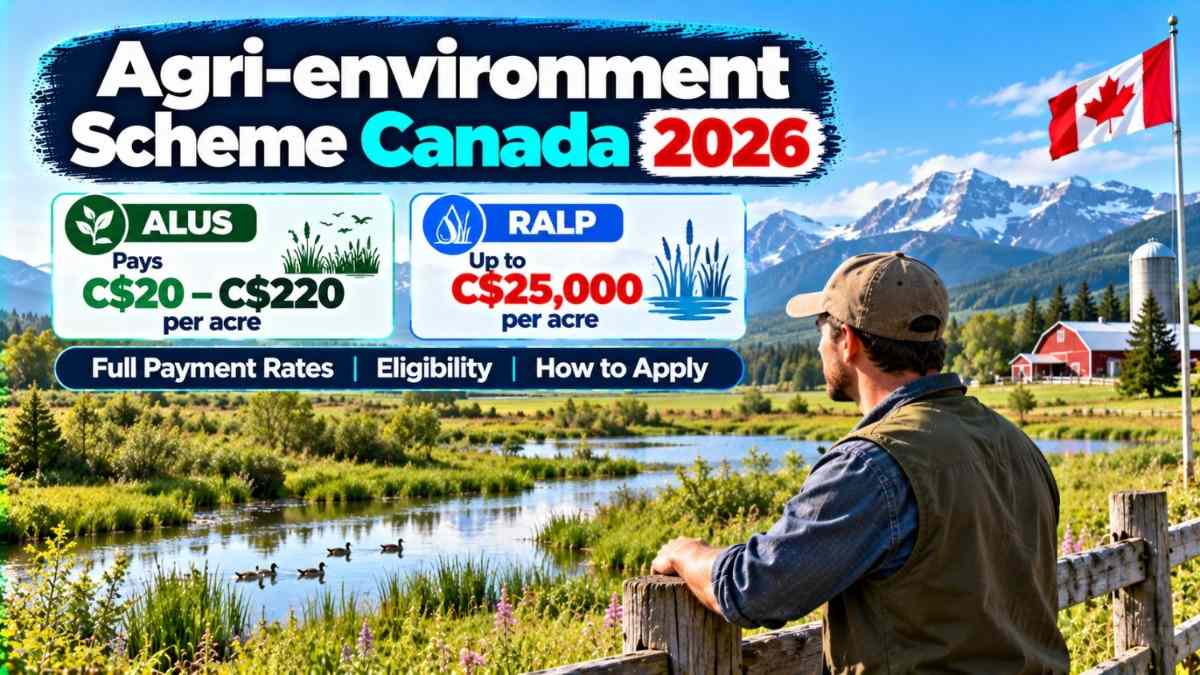
Canada’s agri-environment scheme refers to a suite of federal and provincial programs that pay farmers annual or one-time per-acre fees in exchange for delivering ecological goods and services (EG&S) — such as wetland restoration, riparian buffer maintenance, carbon sequestration, pollinator habitat creation, and biodiversity improvement. The two dominant programs in 2026 are ALUS Canada and the Resilient Agricultural Landscape Program (RALP), both operating under the Sustainable Canadian Agricultural Partnership (Sustainable CAP) 2023–2028 framework.

Rather than a subsidy or incentive model, ALUS uses a fee-for-service approach: farmers are compensated at fair market value for the measurable environmental benefits their land produces. RALP, administered through ECCC and provincial agriculture departments, takes a cost-share or acreage-payment approach aimed at accelerating the adoption of Beneficial Management Practices (BMPs) that maximize carbon sequestration and climate resilience on working farmland.
ALUS launched in Manitoba in 2006 through a partnership between Delta Waterfowl Foundation and Keystone Agricultural Producers. By 2026, it operates in 38+ communities across six provinces — PEI, Quebec, Ontario, Manitoba, Saskatchewan, and Alberta — with over 1,400 farmers enrolled and nearly 38,000 acres under active conservation agreements.
Who Should Apply for ALUS or RALP?
Both programs are designed for working agricultural producers, but they serve slightly different profiles. Here is who benefits most from Canada’s agri-environment payment schemes in 2026:
- 🌿 Grain and canola farmers with marginal or low-yield acres that are costly to crop but ecologically valuable (wetlands, riparian edges)
- 🐮 Livestock ranchers in Alberta, Saskatchewan, and Manitoba with large land bases containing native grasslands, riparian corridors, or wetland complexes
- 🌱 Mixed farm operators in Ontario and PEI who want to convert less productive headlands, buffer strips, or sloped land into paid conservation projects
- 🌻 Horticulture producers interested in establishing pollinator habitat on crop borders to improve yields while earning per-acre payments
- 🌎 Indigenous producers and First Nations land managers who qualify for enhanced RALP maximums of up to C$300,000 per project
- 📊 Farmers seeking carbon credit revenue in addition to government payments — ALUS transfers carbon and ecological offset credits back to the program, but farmers receive annual payments that account for all EG&S produced
- 🏗️ New farmers and beginning agricultural producers who generate at least C$25,000 in annual farm commodities and want to reduce input costs on marginal acres
- 🪰 Grazing Reserve Associations and Community Pasture operators eligible for RALP’s expanded maximum of C$300,000 per project
Actual Payment Rates Per Acre — ALUS + RALP 2026
This is the data most Canadian farmers search for and rarely find consolidated in one place. Below are the actual verified per-acre payment rates for Canada’s two main agri-environment schemes in 2026, sourced from official provincial program guidelines and ALUS Canada’s published FAQ.
ALUS Canada — Per-Acre Payment Rates by Province/Region
ALUS payment rates are set locally by Partnership Advisory Committees (PACs), which are composed of at least 50% farmers plus community technical advisors. The PAC considers local land rental rates, project type, and ecological priority. Rates typically run from C$20 to C$220 per acre per year, though regional figures are:
| Province / Region | Project Type | Annual Rate Per Acre (C$) |
|---|---|---|
| Norfolk County, Ontario | Wetland / Habitat retirement | C$150/acre |
| Ontario East | General ALUS projects | C$100/acre |
| Alberta (Red Deer County, Rocky View, Saddle Hills) | General per-acre (up to) | C$2–C$100/acre |
| PEI (province-wide) | Buffer zone / land retirement | C$60–C$75/acre |
| PEI — grassed headlands | Grassed headland retirement | C$75/acre |
| PEI — high-sloped land | Erosion-risk land retirement | C$60/acre |
| PEI — tree planting | Buffer zone tree planting | C$75/acre |
| Quebec (ALUS Montérégie) | Wetland, riparian buffer, hedgerow, pollinator | Up to C$303/acre (C$750/hectare) |
| National range (all communities) | All project types | C$20–C$220/acre |
RALP (Resilient Agricultural Landscape Program) — Per-Acre Rates by Activity 2026
RALP operates under the Sustainable CAP framework and is delivered province by province. The following rates are drawn from the 2026–2027 program guidelines for Nova Scotia, Alberta, Saskatchewan, New Brunswick, and Ontario:
| Activity / Stream | Province | Per-Acre Rate (C$) | Notes |
|---|---|---|---|
| Reduced Tillage | NS, NB, AB, SK | C$200/acre OR 50% cost-share | Whichever is lesser |
| Pollinator Habitat Establishment | NS, NB | C$600/acre (areas over 0.5 acres) | Split: C$300 at setup + C$300 in future year |
| Riparian Buffer (establishment) | NS, NB, SK | Up to C$1,500/acre | Includes seed and labour |
| Riparian Buffer (crop land out of production) | NS, NB | C$5,000/acre | One-time land-rent payment, year 5 |
| Wetland Establishment (new wetland) | ON (RALP) | Up to C$25,000/acre | Highest-value activity in Ontario |
| Wetland (flat-rate, Alberta) | AB | C$1,000/acre (flat rate) | Wetland cost determination |
| Tree Establishment | Multiple provinces | Up to C$1,500/acre (100% cost) | Annual payments up to C$500/acre/year |
| Grass/Forage Seeding (tame) | SK, NS | C$30/acre (up to C$30,000 max) | 50% cost-share stream |
| Grass/Forage Seeding (native, 90%) | SK | 90% cost-share up to C$30,000 | Native forage stream |
| Cover Crop Incentive (Canada Nature Fund) | ON (local CAP) | C$15/acre performance payment | Max C$1,500 per applicant (100 acres) |
| pH Adjustment / Lime | NS, NB | C$40/acre (one-time) | As part of reduced tillage setup |
In several provinces, farmers can stack ALUS per-acre payments with RALP project establishment cost-shares. For example, a Saskatchewan farmer could receive RALP cost-sharing for native forage seeding AND then enroll those same acres in a local ALUS program for annual per-acre payments — maximizing return on marginal land. Always confirm with your provincial ALUS coordinator and RALP program officer before applying to both on the same acres.
Eligibility Requirements for Canadian Farmers
Eligibility criteria differ between ALUS and RALP but share several common foundations. Review both sets of requirements before choosing which program to apply for first:
ALUS Canada — Eligibility
- Must be a farmer, rancher, or farmland owner located in an active ALUS community (38+ communities in PEI, QC, ON, MB, SK, AB as of 2026)
- Land must contain areas suitable for conservation projects: wetlands, riparian areas, marginal cropland, grasslands, or ecologically sensitive zones
- Maximum eligible land: up to 20% of your farm’s total workable acres (exceptions made for projects of high ecological value)
- Must agree to a 3–5 year renewable Conservation Agreement with ALUS
- If applying on leased land, must provide a signed form from the landowner confirming eligibility to receive annual payments
- ALUS carbon and ecological offset credits produced during the contract are transferred to ALUS Canada for the duration of the agreement
RALP (Sustainable CAP) — Eligibility
- Must be a primary producer responsible for day-to-day management of a crop, bee, or livestock operation in an eligible province
- Must generate at least C$25,000 in annual farm commodities
- Must hold a current Environmental Farm Plan (EFP) certificate, or agree to complete one before the end of the project term
- Eligible land must be privately owned farmland, land rented from a private third party, or Indigenous lands managed for agricultural production
- Grazing Reserve Associations and Community Pasture operators qualify for the enhanced maximum of C$300,000
- Approved Indigenous applicants (First Nations, Métis Nation, Inuit) also qualify for the C$300,000 maximum
- Minimum grant payment is C$2,000 per project
Application Fee Table — RALP 2026
| Applicant Category | Application Fee | Maximum Grant |
|---|---|---|
| Active primary producer (individual / corporation) | Nil | C$150,000 |
| Grazing Reserve Association | Nil | C$300,000 |
| Community Pasture operator | Nil | C$300,000 |
| Approved Indigenous applicant | Nil | C$300,000 |
| Post-secondary institution / applied research association | Nil | C$150,000 |
How to Apply — Step-by-Step Process 2026
The application processes for ALUS and RALP are distinct. Follow the correct pathway for your chosen program:
How to Apply for ALUS Canada (2026)
- Confirm your community is active: Visit alus.ca and locate your province and county. ALUS operates in 38+ communities — if your area is not yet active, you can contact ALUS to explore starting a new community program.
- Contact your local ALUS coordinator: Each community has a dedicated coordinator. Submit an Expression of Interest through your ALUS community coordinator or via the community’s online portal.
- Site assessment: An ALUS advisor will visit your farm to assess which acres qualify for conservation projects and what payment rates apply under your local PAC structure.
- Complete the ALUS New Feature Enrollment form (Appendix A): For new participants, fill out and submit the ALUS General Application Form including Appendix A to enroll new properties or features.
- Sign a Conservation Agreement: Once approved, you sign a multi-year (3–5 year) Conservation Agreement outlining enrolled acres, project type, annual payment, and maintenance obligations.
- Annual payments begin: Payments are made annually based on enrolled acres, project type, and local PAC rate. Re-enrollment is possible at agreement expiry.
How to Apply for RALP (Sustainable CAP) 2026
- Obtain or confirm your Environmental Farm Plan (EFP): A current EFP certificate is mandatory. Contact your provincial agricultural office or the relevant farm organization (e.g., Nova Scotia Federation of Agriculture, Ontario Soil and Crop Improvement Association) to complete your EFP if you do not already have one.
- Check your province’s intake window: RALP intake periods vary by province. Most non-wetland BMPs run February 1–November 30. Wetland categories typically have extended intakes. Alberta’s Year 3 intake (non-wetland) closed November 30, 2025; 2026–2027 intakes are expected to reopen February 2026.
- Select your eligible activity: Choose from reduced tillage, pollinator habitat, riparian buffers, tree establishment, wetland creation, forage seeding, or grazing management — based on what your land supports and your provincial guidelines allow.
- Calculate your per-acre payment: Use your province’s RALP funding list (available on provincial agriculture department websites) to calculate: Implementation Costs + Opportunity Cost + Impact Adjustment.
- Submit your application: Apply through your province’s online portal or submit a paper application to your regional RALP program office. Applications are reviewed on a continuous or annual intake basis depending on the province.
- Enter a Contribution Agreement: Approved applicants enter a 3-year Contribution Agreement. Funding is paid as per-acre grants over the project term.
ALUS vs. RALP — Which Program Pays More?
Both programs deliver real per-acre value to Canadian farmers, but they differ significantly in structure, frequency, and ceiling. The table below compares them across 9 critical dimensions:
| Criteria | ALUS Canada | RALP (Sustainable CAP) |
|---|---|---|
| Payment type | Annual per-acre payment | One-time or 3-year project cost-share |
| Rate range | C$20–C$220/acre/year | C$30–C$25,000/acre (activity-dependent) |
| Maximum per project | No stated cap (PAC-determined) | C$150,000–C$300,000 |
| Contract length | 3–5 years, renewable | 3 years (non-renewable as-is) |
| Carbon credits | Transferred to ALUS (payment covers EG&S) | Not directly involved |
| Best for | Ongoing marginal-land conservation with long-term income | One-time BMP establishment (tillage, wetlands, buffers) |
| Who decides rates? | Local PAC (farmer-majority) | Provincial program guidelines (standardized) |
| Eligible provinces | PEI, QC, ON, MB, SK, AB (38+ communities) | All provinces and territories |
| Coverage ceiling | Max 20% of workable acres | Full eligible project area |
For ongoing annual income from marginal or retired land, ALUS delivers better long-term value — especially in Ontario (C$100–C$150/acre/year) and Quebec (up to C$303/acre/year in Montérégie). For large-scale one-time BMP adoption — especially new wetland creation or riparian buffer establishment — RALP’s higher per-acre ceilings (up to C$25,000/acre for Ontario wetlands) make it the stronger program for capital-intensive projects. Where your province allows it, applying to both programs on eligible acres is the highest-return strategy available in 2026.
Pros and Cons of Canada’s Agri-Environment Schemes
Advantages
- Real income from marginal acres: Land that costs money to crop can instead generate C$60–C$220/acre annually through ALUS — turning a farm cost into a revenue stream
- Farmer-governed rate setting (ALUS): PACs are at least 50% farmers, ensuring payment rates reflect local land rental values rather than bureaucratic minimums
- No application fee: Both ALUS and RALP are free to apply for; there is no upfront cost to participate
- Technical support included: ALUS provides professional project design and maintenance support at no charge to participants
- Stackable with carbon markets: In some provinces, ALUS participants can also pursue external carbon credit revenue independently (confirm terms with your ALUS coordinator)
Disadvantages
- Geographic gaps: ALUS is only available in 38 communities; farmers outside these areas cannot currently access ALUS payments regardless of land quality
- Carbon credit transfer (ALUS): All carbon and ecological offset credits produced on ALUS acres are transferred to ALUS Canada for the contract duration — farmers do not retain these for private sale
- RALP intake timing: Wetland categories have separate intake windows; missing the deadline means waiting another full year
Important Terms Related to Agri-Environment Schemes in Canada
Understanding the following terms is essential to maximizing your payment under Canada’s agri-environment programs:
- EG&S (Ecological Goods and Services): The environmental benefits farmland delivers — clean water, carbon storage, wildlife habitat, flood mitigation, and pollinator support — that ALUS and RALP pay farmers to produce
- PAC (Partnership Advisory Committee): The local farmer-majority body that sets ALUS payment rates and project priorities in each community
- BMP (Beneficial Management Practice): An agricultural practice proven to deliver environmental benefits — such as cover cropping, reduced tillage, buffer strip establishment, or wetland restoration — that RALP funds under Sustainable CAP
- EFP (Environmental Farm Plan): A mandatory farm-level assessment required for RALP eligibility, covering soil health, water quality, biodiversity, and climate risks
- Sustainable CAP: The Sustainable Canadian Agricultural Partnership — a C$3.5 billion, five-year (2023–2028) federal-provincial cost-sharing framework that funds RALP and other agri-environment programs
- Carbon sequestration payment: Compensation received for land-use practices that pull atmospheric CO2 into soil or biomass; farmers using sustainable practices earn roughly C$8–C$13 in carbon credits per acre before deductions
- Opportunity cost: The income a farmer forgoes by enrolling marginal acres in conservation instead of crop production — RALP’s payment formula explicitly accounts for this in addition to implementation costs
- Riparian buffer: A vegetated strip of land along a watercourse that protects water quality and reduces erosion; one of the highest-paid RALP activities (up to C$5,000/acre in some provinces)
Important Dates and Deadlines — 2026
| Program / Activity | Province | Key Date / Status 2026 |
|---|---|---|
| ALUS PEI — Delayed Cutting (forage) | PEI | Intake closes June 1, 2026 for 2026–2027 fiscal |
| RALP (non-wetland BMPs) | AB, NS, NB | Intake: February 1 – November 30, 2026 |
| RALP (wetland category) | AB | Separate intake: February 1, 2026 – January 31, 2027 |
| RALP | ON | Rolling intake — apply any time via OSCIA |
| RALP 2026–2027 guidelines | NS, NB | Confirmed continuing; new rates effective 2026–2027 |
| Sustainable CAP framework | All provinces | Active 2023–2028; annual renewals expected each February |
| ALUS New Community applications | New communities | Rolling — contact ALUS Canada at alus.ca |
Important Links
| Resource | URL |
|---|---|
| ALUS Canada Official Site | alus.ca |
| ALUS Canada FAQ (payment rates) | alus.ca/frequently-asked-questions |
| PEI ALUS Program (Government of PEI) | princeedwardisland.ca |
| ECCC 2026–2027 Departmental Plan | canada.ca/ECCC-2026-27 |
| Nova Scotia RALP 2026–2027 Guidelines (PDF) | novascotia.ca/RALP-guidelines |
| Saskatchewan RALP Program Page | saskatchewan.ca/RALP |
| Agrijob.in — Canadian Farm Jobs & Schemes Guide | agrijob.in |
Conclusion — Final Thoughts on Canada’s Agri-Environment Schemes 2026
Canada’s agri-environment scheme landscape in 2026 gives working farmers a genuine opportunity to earn C$20 to over C$25,000 per acre by converting marginal or ecologically sensitive land into paid conservation projects. ALUS Canada is the right first call for farmers with wetlands, riparian areas, or marginal acres in the 38 active communities; RALP is the go-to for one-time BMP investments — especially wetland creation, pollinator strips, and riparian buffers — anywhere in Canada under the Sustainable CAP framework.
The most important next step: check whether an active ALUS community covers your farm, then confirm your province’s current RALP intake window with your provincial agriculture office. Apply before the November 30, 2026 non-wetland deadline where applicable. Bookmark this page — it is updated as new program guidelines and payment rates are released.
- ALUS Canada pays farmers C$20–C$220 per acre per year — with Quebec’s Montérégie region reaching up to C$303/acre — for delivering measurable ecological goods and services
- RALP (Sustainable CAP) pays one-time or 3-year per-acre grants from C$30/acre (reduced tillage) to C$25,000/acre (new wetland establishment in Ontario)
- ALUS contracts run 3–5 years and are renewable; RALP Contribution Agreements run 3 years
- RALP minimum grant is C$2,000; maximum is C$300,000 for grazing associations and Indigenous applicants
- Stacking ALUS annual payments with RALP establishment funding is allowed in some provinces and can significantly increase total per-acre return — confirm with your provincial program coordinators
Frequently Asked Questions About Agri-Environment Scheme Canada 2026
What is Canada’s agri-environment scheme and how does it work?
Canada’s agri-environment scheme refers to programs that pay farmers annual or project-based fees in exchange for environmental land management practices — such as wetland restoration, riparian buffers, carbon sequestration, and pollinator habitat creation. In 2026, the two primary streams are ALUS Canada (annual per-acre fee-for-service payments of C$20–C$220/acre) and the Resilient Agricultural Landscape Program (RALP) under ECCC’s Sustainable CAP framework (C$30–C$25,000/acre for one-time or 3-year BMP projects). Both are voluntary, require no application fees, and are open to eligible primary producers across Canada.
How much does ALUS Canada pay per acre in 2026?
ALUS Canada pays between C$20 and C$220 per acre per year, with rates set by local Partnership Advisory Committees (PACs). In Norfolk County, Ontario, the rate is C$150/acre. Ontario East pays C$100/acre. Quebec’s ALUS Montérégie program pays up to C$303/acre per year (C$750/hectare). Alberta rates run C$2–C$100/acre depending on the county and project type. PEI province-wide rates are C$60–C$75/acre for most land retirement activities.
What is the RALP per-acre payment rate for wetlands in Canada?
RALP wetland payment rates vary sharply by province. In Ontario, new wetland establishment can attract up to C$25,000 per acre — the highest per-acre rate of any agri-environment activity in Canada. In Alberta, RALP uses a flat rate of C$1,000 per acre for the wetland funding category. In Nova Scotia and New Brunswick, riparian buffer establishment (closely related to wetland management) attracts up to C$5,000/acre for cropland taken out of production. All wetland intakes must be applied for within the designated provincial intake window, which often differs from non-wetland BMP applications.
Who is eligible for ALUS Canada in 2026?
Eligibility for ALUS Canada requires that your farm be located within one of the 38+ active ALUS communities in PEI, Quebec, Ontario, Manitoba, Saskatchewan, or Alberta. You must be a farmer, rancher, or farmland owner (or have a signed landowner agreement if farming leased land). Up to 20% of your total workable acres can be enrolled per contract. There is no minimum farm size or income requirement specified at the national level — rates and eligible projects are determined locally by your PAC.
Do I need an Environmental Farm Plan to apply for RALP?
Yes. A current Environmental Farm Plan (EFP) certificate or letter is mandatory for RALP eligibility under the Sustainable CAP framework. However, you do not need to have your EFP completed before submitting your application — you must obtain one before the end of the project term. The name on the EFP does not need to match the grant applicant’s name, but it must be for the same farm operation.
Can I apply for both ALUS and RALP on the same acres?
In some provinces and for some project types, stacking ALUS annual payments with RALP establishment cost-shares is possible — allowing farmers to receive RALP funding for upfront BMP implementation costs and then enroll the same acres in ALUS for ongoing annual per-acre income. However, the rules on combining programs vary by province and project type. Always confirm with your provincial RALP program officer and local ALUS coordinator before applying to both for the same acres to ensure there is no double-funding restriction in your jurisdiction.
What are the RALP application deadlines for 2026?
For most non-wetland BMP activities, RALP intake windows run from February 1 to November 30, 2026 in Alberta, Nova Scotia, and New Brunswick. The wetland funding category has a separate window: February 1, 2026 to January 31, 2027 in Alberta. Ontario’s RALP (administered by the Ontario Soil and Crop Improvement Association) operates on a rolling intake — you can apply at any time. Check your provincial agriculture department website for the latest intake status, as windows can close early if funding is exhausted.
How does ALUS handle carbon credits from enrolled acres?
Under standard ALUS contracts, all carbon and ecological offset credits produced by enrolled acres are transferred to ALUS Canada for the duration of the agreement. ALUS may sell these credits on carbon markets, and the annual per-acre payments farmers receive are structured to account for all EG&S and credits produced. Farmers do not separately retain or sell carbon credits for enrolled ALUS acres during the contract period. This is a key structural difference from some private carbon agreements — farmers trade away credit ownership in exchange for guaranteed annual cash payments at a locally negotiated rate.
Is ALUS available in British Columbia or the Atlantic provinces outside PEI?
As of 2026, ALUS Canada does not have active communities in British Columbia, Nova Scotia, New Brunswick, Newfoundland, or the three territories. The program currently operates in 38+ communities across six provinces: PEI (province-wide), Quebec, Ontario, Manitoba, Saskatchewan, and Alberta. Farmers in provinces without ALUS communities can still access agri-environment payments through RALP and other Sustainable CAP programs offered provincially — and can contact ALUS Canada to explore the process of establishing a new community in their area.
Last Updated: October 2026. This guide is reviewed and updated regularly for accuracy. Bookmark this page for the latest agri-environment scheme payment rates, intake deadlines, and program changes across Canada.
Disclaimer: Payment rates and program terms are set by local PACs (ALUS) or provincial program guidelines (RALP) and are subject to change. Always confirm current rates and eligibility directly with your ALUS community coordinator or provincial RALP program office before making land management decisions. This guide is for informational purposes only.