

Top AgTech startups in 2026 are attracting record-breaking venture capital even as the broader funding climate tightens. The global agri-food tech venture ecosystem is estimated at USD 26.4 billion in 2026, growing at a 9.4% CAGR through 2036. This guide covers the 20 most important VC-backed agricultural technology companies reshaping how the world grows, processes, and distributes food — chosen for funding size, commercial traction, and real-world impact.

This guide is for investors, agribusiness professionals, agricultural science graduates, startup founders, and anyone tracking the future of food technology. It covers every company’s funding, valuation, core technology, and why it matters in 2026.
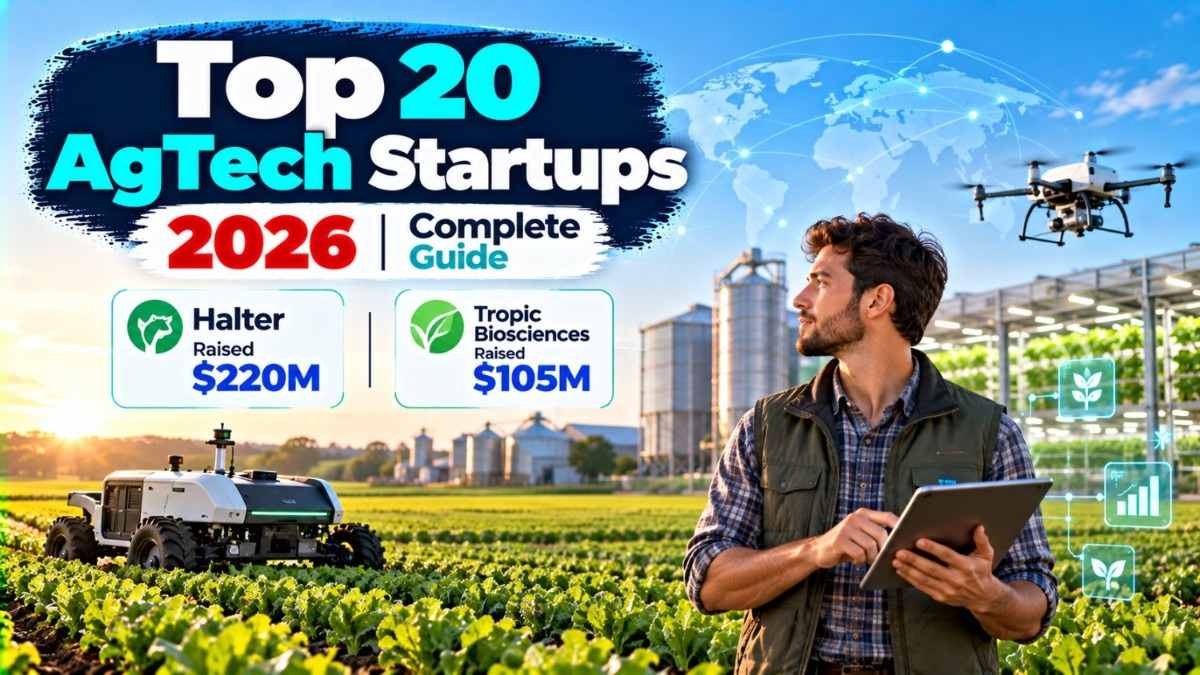
The top AgTech startup to watch in 2026 is Halter (New Zealand), which raised a $220 million Series E at a $2 billion valuation in March 2026 — the largest single AgTech round of the year. Overall, 163 AgTech startups raised a combined $1.89 billion in Q1 2026 alone, with funding increasingly concentrated in livestock automation, precision robotics, and gene-edited crops.
- Global AgTech Market Size (2026): USD 26.4 billion (agri-food tech VC ecosystem)
- Largest Single Round (2026): Halter — $220M Series E (March 2026)
- Q1 2026 Total Raised: $1.89 billion across 163 startups
- Top-5 Rounds Share: 48.2% of all 2026 AgTech funding
- Hottest Categories: Livestock automation, precision robotics, gene editing, vertical farming
- Fastest-Growing Segment: AI-powered field robotics (100%+ headcount growth at leaders)
- Top VC Firms Active: Founders Fund, Forbion Capital, DCVC Bio, S2G Investments, AgFunder
- Market CAGR (2026–2036): 9.4% projected growth
- Precision Agriculture Market (2026): USD 29.22 billion
- Key Geography: US leads funding; New Zealand, UK, France, India rising fast
- What Is AgTech and Why Does It Matter in 2026?
- Who Should Read This AgTech Startup Guide?
- Top 20 AgTech Startups to Watch in 2026
- AgTech Funding Breakdown — Where VC Money Is Going
- How AgTech Startups Attract Venture Capital — Step-by-Step
- AgTech Startups vs Traditional Agriculture Companies
- Pros and Cons of Investing in AgTech Startups
- Important AgTech Terms Every Investor Should Know
- Important Links — Official Sources and Resources
- Conclusion — Which AgTech Startups to Watch in 2026
- Frequently Asked Questions About Top AgTech Startups 2026
What Is AgTech and Why Does It Matter in 2026?
AgTech (Agricultural Technology) refers to the application of technology — including artificial intelligence, robotics, biotechnology, IoT sensors, satellite data, and precision farming software — to improve every stage of food production, from seed genetics to supply chain delivery. In 2026, AgTech is no longer experimental; it is operational infrastructure for global food security.

The global precision agriculture market alone is valued at USD 29.22 billion in 2026, growing at 10.2% annually. With 10 billion people expected on Earth by 2050, the United Nations Food and Agriculture Organization estimates food production must increase by 70% — and AgTech startups are building the tools to make that possible without proportionally expanding farmland or chemical inputs.
In 2026, three forces are accelerating AgTech investment: climate disruption forcing farmers to adopt resilient practices, labor shortages creating urgent demand for automation, and AI maturation enabling solutions that were impossible three years ago. The sector raised $16.2 billion globally in 2025, with upstream farm technology accounting for 56% of total investment.
Who Should Read This AgTech Startup Guide?
- 🌱 Agribusiness professionals seeking to partner with or adopt cutting-edge agricultural tools
- 💰 Impact investors and VC analysts tracking the most fundable AgTech categories in 2026
- 🎓 Agriculture science graduates looking for career opportunities at high-growth startups
- 🏗️ Farm equipment manufacturers evaluating acquisition or partnership targets
- 📊 Startup founders benchmarking against funded competitors in precision farming and food tech
- 🌾 Large-scale commercial farmers assessing which technologies to pilot on their operations
- 📰 Journalists and analysts covering the future of food, sustainability, and venture capital
- 🏛️ Government and policy professionals tracking food security and agricultural innovation programs
Top 20 AgTech Startups to Watch in 2026
These 20 companies were selected based on verified funding rounds, commercial traction, technological differentiation, and investor quality. Data is sourced from Crunchbase, AgFunder, CropLife, and company announcements as of October 2026.
1. Halter — Smart Livestock Management ($220M Series E, $2B Valuation)
Country: New Zealand | Founded: 2016 | Lead Investor: Founders Fund (Peter Thiel)
Halter develops solar-powered smart collars for cattle that enable GPS-based virtual fencing and real-time animal monitoring — eliminating the need for physical fencing infrastructure. In March 2026, Halter raised $220 million in a Series E at a $2 billion valuation, the largest AgTech round of the year. The company has deployed over 1 million collars across 2,000+ farms and is expanding aggressively into the US market.
2. Tropic Biosciences — Gene-Edited Tropical Crops ($105M Series C)
Country: United Kingdom | Founded: 2017 | Lead Investors: Forbion Capital Partners, Corteva Catalyst
Tropic Biosciences applies gene editing (non-GMO methods) to develop disease-resistant, climate-adapted tropical crop varieties including coffee and bananas. The company raised $105 million in a Series C in March 2026, bringing cumulative funding to $178.5 million. Its proprietary RNAi-based platform allows accelerated crop trait development without introducing foreign DNA.
3. Oishii — Premium Vertical Farming ($151.6M Series C, $1.5–1.7B Valuation)
Country: USA | Founded: 2017 | Lead Investors: Various institutional VCs
Oishii has bucked the vertical farming collapse that took down Bowery, Plenty, and AppHarvest. The company raised $151.6 million in a Series C in Q2 2026, with a valuation estimated at $1.5–1.7 billion. Oishii focuses on premium indoor strawberries grown with Japanese farming techniques in highly automated facilities, proving that niche premium positioning can sustain vertical farming economics.
4. Ecorobotix — AI Precision Spraying ($230M+ Total Funding)
Country: Switzerland | Founded: 2014 | Lead Investors: Highland Europe, multiple institutional funds
Ecorobotix has raised over $230 million across Series B, C, and D funding rounds. Its ARA smart spraying system uses computer vision to apply pesticides on a plant-by-plant basis, reducing chemical usage by up to 95% compared to conventional broadcast spraying. The technology is now operational in 20+ countries across Europe, the US, and Oceania — a rare commercial-scale achievement in farm robotics.
5. Inari — AI-Driven Gene Editing Platform ($103M Equity, $1.65B Valuation)
Country: USA | Founded: 2016 | Lead Investors: Flagship Pioneering, Leaps by Bayer
Inari raised $103 million in new equity at a $1.65 billion valuation, recognized on TIME’s list of America’s Top GreenTech Companies 2026. Inari’s SEEDesign platform uses predictive AI and multiplex gene editing to design seeds with improved yield, drought tolerance, and nitrogen efficiency — targeting the row crop market (corn, soy, wheat) with total addressable market exceeding $50 billion.
6. Pivot Bio — Microbial Nitrogen Fertilizer ($618M+ Total, $2B Valuation)
Country: USA | Founded: 2010 | Lead Investors: DCVC, Temasek, Breakthrough Energy Ventures
Pivot Bio has raised over $618 million including a landmark $430 million Series D. Its microbial nitrogen products enable crops to fix nitrogen directly from the atmosphere, reducing synthetic fertilizer use and associated greenhouse gas emissions. At a valuation of approximately $2 billion, Pivot Bio is one of the most commercially mature biological input companies in the sector.
7. Carbon Robotics — AI Laser Weeding ($143.9M Total Funding)
Country: USA | Founded: 2018 | Lead Investors: BOND, NVentures, Anthos Capital
Carbon Robotics’ LaserWeeder autonomous robots use AI vision to identify and eliminate weeds with precision laser pulses — eliminating 5,000 weeds per minute without herbicides. The company has raised $143.9 million across Series A through D. Its robots directly address two agricultural crises simultaneously: herbicide resistance (affecting 500+ weed species globally) and farm labor shortages driving up operational costs.
8. Upside Robotics — Autonomous Crop Nutrition Robots ($7.5M Seed, +118% Headcount Growth)
Country: USA | Founded: 2022 | Lead Investors: Early-stage VCs
Upside Robotics is the fastest-growing AgTech startup by headcount in 2026, with 118% team growth in 12 months. The company raised a $7.5 million seed round in February 2026 to develop autonomous field robots for precision crop nutrition delivery. It represents a new generation of ultra-targeted robotic systems operating at row level rather than field level.
9. Innovafeed — Black Soldier Fly Protein ($509M+ Total, Series Growth Funding 2026)
Country: France | Founded: 2016 | Lead Investors: Creadev, QIA, Temasek
Innovafeed has raised over $509 million to scale insect-derived protein production using Black Soldier Fly larvae fed on agricultural waste streams. In 2026, the company received $59 million in growth funding to expand industrial plant construction and integrate IoT systems across its production facilities. Insect protein is increasingly adopted as a sustainable feed ingredient for aquaculture and livestock.
10. Freshflow — AI Fresh Food Demand Forecasting ($10M Series A, +64% Headcount)
Country: USA | Founded: 2020 | Founder: Avik Mukhija
Freshflow raised a $10 million Series A in June 2026, growing its team 64% in 12 months. The company’s AI platform forecasts demand for fresh produce at the SKU-store level, enabling retailers to cut food waste by up to 30% while reducing out-of-stock events. With fresh food representing $200B+ in annual US retail losses to waste, Freshflow’s addressable market is substantial.
11. AgZen — Ultra-Precise Spray Adhesion Technology ($Series B, DCVC Bio)
Country: USA | Founded: 2021 | Lead Investors: DCVC Bio, Material Impact, Astanor
AgZen raised a Series B in March 2026 led by DCVC Bio. The company’s technology improves how liquid pesticides and herbicides adhere to plant surfaces, potentially reducing the total chemical volume needed per application by 50–70%. Its solution works with existing spray equipment — a critical advantage for adoption since it requires no hardware replacement.
12. Sistema.bio — Biodigester Infrastructure for Smallholder Farms ($53M, Mar 2026)
Country: Mexico | Founded: 2010 | Investors: Multiple impact and climate VCs
Sistema.bio raised $53 million in March 2026 to expand biodigester infrastructure across Latin America and Africa. Its systems convert organic farm waste into biogas (for cooking and energy) and liquid fertilizer, enabling smallholder farmers to reduce input costs while generating on-farm energy. Operating in 50+ countries, Sistema.bio is one of the most globally scaled climate-smart agriculture companies.
13. GrubMarket — AI-Powered Food Supply Chain ($50M Series G, $753M+ Total)
Country: USA | Founded: 2014 | Recent Funding: $50M Series G (February 2026)
GrubMarket has raised over $753 million in total funding, most recently a $50 million Series G to expand its AI-powered B2B food supply chain platform. The company connects farms directly with food service operators, retailers, and distributors — removing inefficiencies that add 20–40% to food distribution costs. Its acquisition strategy has consolidated dozens of regional food distributors onto a single technology backbone.
14. Tomorrow.io — AI Climate Intelligence for Agriculture ($175M+ Series F)
Country: USA | Founded: 2016 | Lead Investors: Stonecourt Capital, HarbourVest Partners
Tomorrow.io raised $175 million in a Series F at a $1 billion valuation in February 2026. Its real-time weather intelligence platform helps agricultural businesses predict and respond to climate threats with hyperlocal forecasting — critical as extreme weather events become more frequent. Farmers use Tomorrow.io to optimize planting, irrigation, and harvest timing decisions.
15. Regrow Ag — Carbon and Sustainability Intelligence ($63.6M Total)
Country: USA | Founded: 2016 | Investors: Multiple climate and agtech VCs
Regrow Ag has raised $63.6 million to build measurement, reporting, and verification (MRV) infrastructure for agricultural carbon markets. As corporate sustainability commitments require verified emissions reductions, Regrow’s platform enables large food companies and agribusinesses to track and monetize soil carbon sequestration across their supply chains — a market estimated to reach $50 billion by 2030.
16. Loam Bio — Microbial Soil Carbon Sequestration ($113M Total)
Country: Australia | Founded: 2019 | Lead Investors: Lowercarbon Capital, CEFC, Wollemi Capital
Loam Bio has raised $113 million to commercialize microbial seed treatments that increase soil organic carbon — sequestering atmospheric CO₂ while simultaneously improving crop yield and soil health. The company’s approach integrates directly into existing farming practices as a seed coating, requiring zero change in equipment or workflow from farmers.
17. Shinkei Systems — AI-Powered Humane Fish Processing ($22M Series A)
Country: USA | Founded: 2020 | Recent Funding: $22M Series A
Shinkei Systems is the third-fastest-growing AgTech startup by headcount in 2026. The company applies the Japanese Ikejime technique — a humane fish stunning method — using AI-guided robotics to process several thousand pounds of fish per week. Its robots improve both fish welfare and product quality (reducing stress hormones that degrade meat texture), while slashing labor requirements in seafood processing facilities.
18. WayCool — India’s AI-Powered Farm-to-Market Platform ($22.7M, Mar 2026)
Country: India | Founded: 2015 | Investors: Multiple VCs including impact funds
WayCool raised $22.7 million in March 2026, one of three Indian AgTech companies in Q1 2026’s top 11 deals globally. The company connects 50,000+ smallholder farmers directly to retailers and food service companies through AI-driven logistics, price discovery, and quality grading technology. India’s massive agricultural output and fragmented supply chain represent an enormous market for WayCool’s platform.
19. Pairwise — Consumer-Facing Gene-Edited Produce
Country: USA | Founded: 2017 | Investors: Flagship Pioneering, others
Pairwise is pioneering consumer-ready gene-edited produce — bringing improved flavor, convenience, and nutrition to grocery shelves without GMO regulatory barriers. The company’s mustard greens with reduced bitterness were the first CRISPR-edited food commercially available in the US. In 2026, Pairwise is expanding its product pipeline with gene-edited berries and leafy greens targeting mainstream retail channels.
20. AgroStar — Digital Agri-Input Platform for India ($119.9M Total)
Country: India | Founded: 2013 | Total Funding: $119.9M | Last Round: Venture
AgroStar has raised nearly $120 million to build India’s largest digital platform for agri-inputs — delivering seeds, crop protection products, and agronomic advice directly to smallholder farmers via mobile app. With over 5 million registered farmers and 100,000+ active monthly users, AgroStar represents the largest direct-to-farmer digital commerce platform in India, a country where 600 million people depend on agriculture.
AgTech Funding Breakdown — Where VC Money Is Going in 2026
AgTech venture funding in 2026 is more concentrated than any previous year. According to AgFunder’s 2026 Global AgriFoodTech Investment Report and Crunchbase data, the five largest rounds account for 48.2% of all measurable 2026 AgTech capital — a level of concentration that signals investors are doubling down on proven leaders rather than spreading bets across early-stage experiments.
| Category | 2026 Capital Share | Notable Companies |
|---|---|---|
| Livestock Automation / Virtual Fencing | ~40% | Halter, NoFence |
| Gene Editing / Crop Biotech | ~18% | Tropic Biosciences, Inari, Pairwise |
| Vertical / Controlled Environment Farming | ~15% | Oishii, Gotham Greens |
| Field Robotics / Precision Spraying | ~12% | Ecorobotix, Carbon Robotics, Upside Robotics |
| Climate / Carbon Intelligence | ~8% | Tomorrow.io, Regrow Ag, Loam Bio |
| Food Supply Chain / Distribution | ~7% | GrubMarket, WayCool, Freshflow |
The most fundable AgTech categories in 2026 all share one trait: they reduce a verifiable, measurable cost. Halter’s virtual fencing saves ranchers an estimated $200–$800 per head per year in fencing and labor. Ecorobotix saves 70–95% on pesticide spend. Carbon Robotics eliminates herbicide costs entirely in zones where herbicide-resistant weeds have made chemical control impractical. Follow the cost-reduction narrative, not the buzzword.
How AgTech Startups Attract Venture Capital — Step-by-Step Process
- Identify a verifiable agricultural problem — not theoretical but backed by economic data (e.g., herbicide resistance costs US farmers $43 billion annually)
- Build a technology solution with measurable ROI — VCs require clear proof that the technology generates economic return for the farmer or food company within 12–36 months
- Run pilot programs on real farms — commercial-scale pilots with measurable outcomes (yield improvement %, cost reduction %) are essential for Series A and beyond
- Demonstrate seasonally validated data — unlike software, AgTech products must prove performance across multiple growing seasons, meaning fundraising cycles take longer than pure SaaS
- Build regulatory pathway clarity — especially for biotech (gene editing) and crop protection products, investors need to see a clear regulatory timeline to commercialization
- Show co-manufacturing or production readiness — hardware-linked companies must prove they can scale production without quality degradation
- Approach specialist AgTech VCs first — firms like S2G Investments ($2.8B AUM), AgFunder (Fund IV at $102M), and Omnivore (Fund III at $150M) understand agricultural seasonality and regulatory cycles that generalist VCs often underestimate
AgTech Startups vs Traditional Agriculture Companies
| Dimension | AgTech Startups | Traditional Agribusiness (Syngenta, Bayer, Corteva) |
|---|---|---|
| Innovation Speed | Fast (12–36 month product cycles) | Slow (5–15 year R&D cycles) |
| Capital Efficiency | High (software + hardware leverage) | Low (heavy infrastructure, distribution) |
| Regulatory Exposure | Moderate-High (biotech, pesticides) | Very High (established compliance burden) |
| Farmer Adoption Friction | High (new behavior required) | Low (familiar products, established trust) |
| Scalability | Very High (platform models) | Moderate (constrained by physical distribution) |
| Climate Adaptability | High (built-in AI adjustment) | Low (fixed-formula products) |
| Funding Model | VC / impact investing | Debt, retained earnings, public markets |
| Best For | Disruptive long-term bets | Reliable near-term exposure to agriculture |
Traditional agribusinesses are not being replaced — they are being forced to acquire or partner with AgTech startups. Corteva co-led Tropic Biosciences’ $105M Series C. Bayer’s Leaps by Bayer is an investor in Inari. The strategic acquirer landscape means that many of today’s top AgTech startups will deliver returns through M&A exits to Syngenta, Bayer, BASF, or Corteva rather than through IPO — a fundamentally different exit pathway than enterprise software VC.
Pros and Cons of Investing in AgTech Startups
Advantages of AgTech Startup Investment
- ✅ Massive addressable market — global food system represents $10+ trillion; even a 1% efficiency improvement is a $100 billion opportunity
- ✅ Strategic acquisition premium — major agribusiness players (Syngenta, Corteva, Bayer) pay significant premiums for proven technologies
- ✅ Regulatory moat — biotech and precision agriculture regulatory approvals create high barriers to entry once cleared
- ✅ Climate tailwinds — government mandates and corporate ESG commitments are creating new revenue streams for carbon and sustainability-linked AgTech
- ✅ Hardware + software recurring revenue — companies like Halter combine hardware sales with subscription SaaS, creating predictable revenue growth
Disadvantages and Risks
- ❌ Long validation cycles — agricultural seasons mean 12–18 months between experimental results, extending time-to-market significantly
- ❌ Weather and climate dependency — even the best AgTech product cannot perform in drought years without additional climate adaptation features
- ❌ Farmer adoption resistance — changing deeply embedded farming practices requires extensive education, trialing, and trust-building
- ❌ High capital intensity — physical hardware (robots, sensors, collars) requires significant manufacturing investment before revenue can scale
Important AgTech Terms Every Investor Should Know
Understanding these terms is essential for evaluating AgTech startup pitches, investment theses, and technology differentiation in 2026:
- Precision Agriculture: Data-driven farming that applies the right input (water, fertilizer, pesticide) at the right place and time — reducing waste by 20–50% while maintaining or improving yield
- Gene Editing (CRISPR): Technology that modifies existing crop DNA without introducing foreign genes — not classified as GMO in most jurisdictions, enabling faster regulatory pathways
- Virtual Fencing: GPS-enabled livestock management where animals are guided by sound/vibration cues from a collar rather than physical fence lines — saves $500–$1,000 per mile vs traditional fencing
- Controlled Environment Agriculture (CEA): Indoor farming systems (vertical farms, greenhouses) where temperature, humidity, light, and nutrients are fully managed — enables year-round production independent of climate
- Microbial Biologicals: Microorganism-based products that replace or supplement synthetic fertilizers and pesticides — the fastest-growing crop input category, estimated at $6 billion globally in 2026
- Carbon Insetting: Process by which companies reduce emissions within their own agricultural supply chain and claim those reductions toward corporate sustainability targets — the mechanism Regrow Ag and Loam Bio facilitate
- AgFunder: The leading global AgTech investment research and venture fund firm, publishing the annual AgriFoodTech Investment Report that tracks every major funding round in the sector
- Insect Protein (BSF): Black Soldier Fly larvae processing technology — converting food and agricultural waste into high-protein animal feed, with 100x lower land use than conventional protein sources
Important Links — Official Sources and AgTech Resources
| Resource | Link |
|---|---|
| AgFunder 2026 AgriFoodTech Investment Report | agfunder.com |
| FAO — Global Food Security Data | fao.org/food-agriculture-statistics |
| CropLife — Q1 2026 AgTech VC Round Up | croplife.com |
| USDA Economic Research Service — Precision Ag Adoption Data | ers.usda.gov |
| Crunchbase — AgTech Funding Database | crunchbase.com |
| Halter Official — Series E Announcement | halter.io |
Conclusion — Which AgTech Startups to Watch in 2026
The top AgTech startups in 2026 share a common thread: they solve expensive, measurable agricultural problems at commercial scale, not just in pilot programs. Halter’s $220M Series E, Tropic Biosciences’ $105M Series C, and Ecorobotix’s $230M+ total raise all reflect investor confidence in hardware-software platforms with verified on-farm economics. The global agri-food tech VC ecosystem, valued at $26.4 billion in 2026, continues to reward companies that combine deep scientific expertise with practical farmer adoption.
For investors, the strategic M&A angle is as important as the growth story — Corteva, Bayer, Syngenta, and BASF are all actively co-investing in or acquiring AgTech startups, creating strong exit visibility. Bookmark this page for quarterly updates as new funding rounds are announced throughout 2026.
- Halter raised $220M at a $2B valuation — the single largest AgTech funding round of 2026
- Global agri-food tech VC ecosystem is valued at USD 26.4 billion in 2026, growing at 9.4% CAGR
- Just 5 companies captured 48.2% of all 2026 AgTech funding — concentration is at a record high
- Livestock automation, gene editing, precision robotics, and vertical farming are the top 4 investment categories
- Strategic acquirers (Bayer, Corteva, Syngenta) are co-investing — M&A is the dominant exit pathway for top AgTech startups
- Bookmark this guide and follow agrifunder.com for quarterly investment updates
Frequently Asked Questions About Top AgTech Startups 2026
Which AgTech startup raised the most money in 2026?
Halter raised the largest single AgTech funding round of 2026 — a $220 million Series E in March 2026 at a $2 billion valuation, led by Peter Thiel’s Founders Fund. The New Zealand company develops GPS-enabled smart collars for cattle that enable virtual fencing and real-time livestock monitoring without physical infrastructure.
What is the total AgTech startup funding raised in Q1 2026?
According to CropLife’s Q1 2026 analysis of Crunchbase data, 163 AgTech startups raised a combined $1.89 billion in Q1 2026. However, funding was highly concentrated — Halter’s $220M round alone nearly equalled the entire Animal Health category’s full-year 2025 funding, highlighting how mega-rounds skew total figures.
What are the most promising AgTech categories for investment in 2026?
The four most VC-active AgTech categories in 2026 are: (1) livestock automation and virtual fencing, driven by Halter; (2) gene editing and crop biotechnology, with Tropic Biosciences and Inari leading; (3) AI-powered field robotics, with Ecorobotix and Carbon Robotics dominating; and (4) vertical and controlled environment farming, where Oishii stands out after many competitors failed.
Is AgTech funding increasing or decreasing in 2026?
Overall AgTech funding is consolidating rather than growing. Global agri-food tech investment held roughly flat at $16.2 billion in 2025, following a 53% drop from the $34 billion peak in 2022. In 2026, fewer deals are being completed but at larger individual sizes — the number of transactions is down significantly while average deal size is rising, meaning capital is concentrating in proven leaders rather than early-stage experiments.
Which AgTech VCs are most active in 2026?
The most active AgTech investors in 2026 include S2G Investments ($2.8B AUM, $1B Solutions Fund I closed May 2026), AgFunder (Fund IV oversubscribed at $102M), Omnivore (Fund III at $150M in India), Founders Fund (led Halter’s $220M Series E), DCVC Bio (AgZen Series B), and Forbion Capital Partners (co-led Tropic Biosciences’ $105M Series C).
What is vertical farming and which startups are still viable in 2026?
Vertical farming grows crops in multi-level indoor facilities under controlled artificial light, eliminating weather dependency and dramatically reducing water use (by up to 95% versus field agriculture). Despite major failures (Bowery, Plenty, AppHarvest, Infarm), Oishii remains viable in 2026 with a $151.6M Series C and an estimated $1.5–1.7B valuation, due to its premium positioning in specialty crops rather than commodity produce.
How does gene editing differ from GMO in AgTech?
Gene editing (CRISPR and related tools) modifies a crop’s own existing DNA without introducing any genetic material from another species — unlike traditional GMO processes. This distinction is legally significant: the US, UK, Japan, and Australia do not classify CRISPR-edited crops as GMOs, enabling faster regulatory approval and consumer acceptance. Companies like Inari, Tropic Biosciences, and Pairwise all use gene editing specifically to avoid GMO regulatory burdens.
Which Indian AgTech startups made the global top funding list in 2026?
Three Indian AgTech companies ranked among Q1 2026’s 11 largest global deals: Arya Collateral (agri-warehousing and post-harvest finance), WayCool (AI-powered farm-to-market platform, raised $22.7M), and Varaha (regenerative agriculture carbon credits). This represents India’s growing prominence in agricultural technology, driven by its 600 million agriculture-dependent population and an underserved smallholder farmer market.
What makes Ecorobotix different from other precision agriculture companies?
Ecorobotix’s ARA spraying system operates at the individual plant level — using computer vision to identify specific weeds or crop plants and applying pesticide or fertilizer with a spray footprint of just a few centimeters. This plant-by-plant precision reduces chemical use by up to 95% versus conventional broadcast spraying. With $230M+ in total funding and commercial deployment in 20+ countries, Ecorobotix is the most globally scaled precision spraying platform available to farmers today.
Last Updated: October 2026 | This guide is reviewed and updated regularly as new AgTech funding rounds are confirmed. Bookmark this page for the latest data.
Disclaimer: This article is for informational purposes only and does not constitute investment advice. All funding figures are based on publicly available disclosures from Crunchbase, AgFunder, CropLife, and company announcements. Verify all data independently before making investment decisions.