
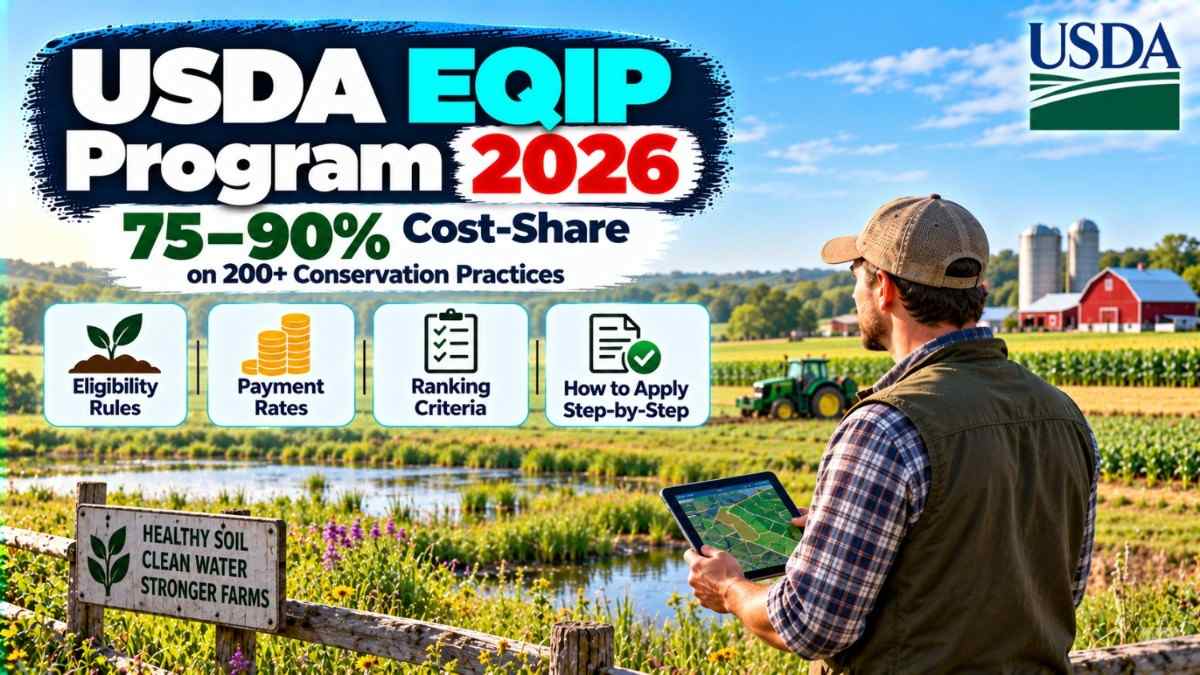
USDA EQIP program 2026 is the largest working-lands conservation program in America, distributing approximately $1.6 billion annually to farmers, ranchers, and forest landowners who implement approved conservation practices. If you grow crops, raise livestock, or manage private forestland, EQIP can reimburse 75% to 90% of your conservation costs — with no firm cap on total payments under the current FY2026 farm bill extension.

This complete guide is for U.S. agricultural producers, beginning farmers, ranchers, and non-industrial private forestland owners who want to understand exactly how EQIP works, who qualifies, how payments are calculated, and how to submit a competitive application. We cover the full process: from first contact with your local NRCS office through contract signing and payment collection.
The USDA EQIP program 2026 pays 75% of average conservation practice costs for most producers, and up to 90% for beginning, socially disadvantaged, limited-resource, and veteran farmers. With no current statutory payment cap under the FY2026 farm bill extension, a large operation implementing multiple structural and land-management practices can realistically receive $150,000 or more over a single EQIP contract. Apply through your local USDA Service Center using Form CPA-1200.
- Administering Agency: USDA Natural Resources Conservation Service (NRCS)
- Program Type: Cost-share reimbursement (pay first, get reimbursed after NRCS certification)
- Standard Payment Rate: 50%–75% of average practice cost
- Historically Underserved Rate: Up to 90% of average practice cost
- Current Payment Cap: No statutory cap under FY2026 farm bill extension (previously $450,000)
- Contract Length: Up to 10 years
- Annual Program Funding: Approximately $1.6 billion (Farm Bill baseline, FY2025)
- First National Ranking Deadline FY2026: January 15, 2026
- Application Form: CPA-1200 (filed at local USDA Service Center)
- Eligible Practices: Approximately 200 unique conservation practices
- Advance Payment Option: 50% upfront for historically underserved producers
- Official Website: nrcs.usda.gov
- What Is the USDA EQIP Program?
- Who Should Apply for EQIP 2026?
- EQIP Payment Rates and Limits 2026
- EQIP Eligibility Requirements 2026
- How to Apply for EQIP: Step-by-Step Process
- Top Conservation Practices Funded by EQIP
- EQIP vs CSP: Which Program Is Right for You?
- Pros and Cons of the EQIP Program
- Important Terms Related to USDA EQIP
- Important Dates and Deadlines 2026
- Important Links
- Conclusion
- Frequently Asked Questions About USDA EQIP Program 2026
What Is the USDA EQIP Program and How Does It Work in 2026?
The Environmental Quality Incentives Program (EQIP) is USDA’s flagship voluntary conservation program, administered by the Natural Resources Conservation Service (NRCS). EQIP provides financial and technical assistance to agricultural producers and private forestland owners who implement approved conservation practices that address natural resource concerns such as soil erosion, water quality, air quality, and wildlife habitat.

EQIP operates as a cost-share reimbursement program: you implement a NRCS-approved conservation practice on your land, NRCS inspects and certifies the work, and then reimburses you a percentage of the established payment rate for that practice. You do not receive payment in advance except through the Advance Payment Option available to historically underserved producers. Payment rates are set each fiscal year at the state level and published in official NRCS payment schedules.
The program was first established in the 1996 Farm Bill, merging earlier conservation programs into a unified structure. Today it funds approximately 200 distinct conservation practices across all 50 states, from cover crops and no-till farming to fencing, water wells, waste storage facilities, and irrigation management systems. The USDA Economic Research Service reported that cover cropping has been the single top-funded EQIP practice every year from fiscal years 2014 through 2025 in total dollars obligated.
How EQIP Ranking and Funding Work
EQIP is a competitive program — not every applicant receives funding. Applications are accepted on a continuous basis year-round, but NRCS evaluates them during set batching periods using the Conservation Assessment and Ranking Tool (CART). CART scores each application based on the severity of resource concerns on your land and the cost-effectiveness of your proposed practices. Applications are then funded from highest to lowest ranking score until available funds run out. This means timing your application before a ranking deadline and working with your NRCS conservationist to identify high-priority practices is critical to getting funded.
Who Should Apply for EQIP in 2026?
EQIP serves a broad range of agricultural producers. The following producer profiles are the best fits for the program in 2026:
- 🌽 Crop farmers experiencing soil erosion, nutrient runoff, or poor water retention who want to fund cover crops, no-till conversion, filter strips, or grassed waterways
- 🐄 Livestock and cattle ranchers needing to fund prescribed grazing plans, fencing to exclude cattle from waterways, livestock pipelines, or heavy use area protection
- 🌲 Non-industrial private forestland owners seeking help with tree establishment, brush management, prescribed burning, or riparian forest buffers
- 🌱 Beginning farmers and ranchers (in operation 10 years or fewer) who qualify for up to 90% cost-share and advance payment options
- 👨🌾 Socially disadvantaged and limited-resource producers who also qualify for 90% cost-share, advance payments, and priority ranking points
- 🧑🍳 Organic producers and those transitioning to organic who need help with nutrient management, pest management, or organic transition planning
- 💧 Irrigated crop producers in water-stressed regions who want to fund irrigation water management systems, irrigation reservoirs, or drainage water management
- 🦅 Wildlife habitat producers participating in NRCS initiatives like Working Lands for Wildlife who want to fund conservation cover, wildlife habitat planting, or prescribed grazing to benefit specific species
EQIP Payment Rates and Limits 2026: How Much Can You Receive?
Under the FY2026 farm bill extension (P.L. 119-37, passed November 2025), EQIP and CSP payment limits have been removed for the current program year. This means there is no statutory ceiling on total payments a producer can receive in FY2026 — a significant change from the previous $450,000 lifetime cap that applied under the 2018 Farm Bill structure. However, note that the House Agriculture Committee’s proposed new farm bill would restore a $450,000 payment limit, so producers should confirm the current cap with their local NRCS office before contracting.
| Producer Category | Standard Cost-Share Rate | Advance Payment Option | Notes |
|---|---|---|---|
| General producers | 50%–75% of practice rate | Not available | Reimbursed after NRCS certification |
| Beginning farmers/ranchers | Up to 90% | 50% upfront | Farming 10 years or fewer |
| Socially disadvantaged producers | Up to 90% | 50% upfront | Defined under Section 2501 of the Food, Agriculture, Conservation and Trade Act |
| Limited-resource producers | Up to 90% | 50% upfront | Must qualify via USDA LRF determination tool |
| Veteran farmers/ranchers | Up to 90% | 50% upfront | Military veterans engaged in farming |
| Organic transition producers | 75%–90% | 50% upfront (HU only) | Organic Initiative pools may have separate caps; verify with NRCS |
Payment rates are set at the state level each fiscal year and published in NRCS payment schedules at nrcs.usda.gov/getting-assistance/payment-schedules. Rates reflect the average cost to implement a practice in your region — not your actual invoice. You receive payment based on the published rate, not on receipts, meaning cost-efficient producers can capture the margin between their actual cost and the published rate as additional income.
To illustrate realistic payment levels: a producer implementing a combination of cover crops ($50,000/year cap on that practice in some states), fencing for livestock exclusion, water wells, and prescribed grazing across a mid-sized row crop and cattle operation could accumulate over $150,000 in a single EQIP contract, particularly at the 90% historically underserved rate. Always review your specific state payment schedule and confirm with your NRCS conservationist before projecting totals.
EQIP Eligibility Requirements 2026: Who Qualifies?
Agricultural producers and owners of non-industrial private forestland are eligible to apply for EQIP. To qualify for FY2026 EQIP funding, applicants must meet all of the following requirements before the relevant ranking deadline:
- Control or own eligible agricultural land — You must have operational control or ownership of cropland, pastureland, rangeland, non-industrial private forestland, or other farmland for the duration of the EQIP contract (up to 10 years). If you lease land, you need written permission from the landowner.
- Have current crop and producer records on file with USDA FSA — You need an established Farm and Tract Number from the Farm Service Agency (FSA). New producers must register at Farmers.gov before applying.
- Be in compliance with Highly Erodible Land (HEL) and Wetland Conservation (WC) requirements — USDA will not fund producers who are out of compliance with conservation compliance provisions. An FSA or NRCS determination is required.
- Comply with Adjusted Gross Income (AGI) provisions — The FY2026 farm bill extension removed the previous AGI limitation that barred producers with incomes over $900,000 from participating. Confirm the current AGI rule with your NRCS office, as this may change with new legislation.
- Develop an NRCS EQIP Plan of Operations — Your NRCS conservationist will help you develop this plan, which identifies resource concerns on your land and the conservation practices that will address them. The plan becomes the basis of your EQIP contract.
- Not be enrolled in a conflicting USDA conservation program for the same practice on the same land — Land in CRP, Wetland Reserve Easement (WRE), or other programs for the identical practice is ineligible for EQIP payment on that practice.
| Eligibility Criterion | Detail |
|---|---|
| Eligible land types | Cropland, pastureland, rangeland, non-industrial private forestland, other farmland |
| Minimum acreage | None — EQIP has no minimum acreage requirement |
| Ownership requirement | Must have operational control (lease OK with written landowner permission) |
| FSA records required | Yes — Farm and Tract Number must be established with FSA |
| Conservation compliance | Must be compliant with HEL and wetland conservation provisions |
| AGI limitation | Removed for FY2026 — confirm current status with NRCS |
| Program conflicts | Cannot receive EQIP payment for same practice on same land as CRP or WRE |
How to Apply for USDA EQIP 2026: Step-by-Step Process
Applying for EQIP is a multi-step process that begins at your local USDA Service Center. Do not start any conservation work before completing your application and signing an EQIP contract — any work started before contract execution is ineligible for reimbursement.
- Create or update your Farmers.gov account. If you are new to USDA, create a free account at Farmers.gov. This is where you manage all your USDA program interactions and it links your producer identity to USDA’s system.
- Establish your Farm Record with the Farm Service Agency (FSA). Visit your local USDA Service Center and ask FSA to assign you a Farm and Tract Number. If you already have one, ensure your records are current for the 2026 program year.
- Contact your local NRCS office and express interest in EQIP. An NRCS conservation planner will schedule a site visit to assess resource concerns on your land. This site assessment is free and required before ranking.
- Complete an NRCS Conservation Plan. Working with your NRCS conservationist, you will identify the specific resource concerns on your land (soil erosion, water quality issues, wildlife habitat gaps) and select the conservation practices that will address them most cost-effectively.
- Submit Form CPA-1200 (EQIP Application). Your NRCS conservationist will help you complete and electronically submit this application. Only electronic signatures are accepted on CPA-1200. Organic producers must also provide documentation from a USDA-accredited certifying agent if claiming organic ranking preference points.
- Complete eligibility verification. NRCS will confirm your HEL compliance, AGI status, and any other eligibility requirements. This must be completed before ranking, not after.
- Application is entered into CART for ranking. Your application is scored using the Conservation Assessment and Ranking Tool based on resource concern severity, practice cost-effectiveness, and applicable state and local priorities. Applications are ranked from highest to lowest score.
- Await funding notification. If your application ranks high enough, NRCS will contact you with a contract offer. If not funded in the first ranking cycle, your application rolls forward to the next batching period automatically.
- Sign your EQIP contract and begin implementation. Once you accept the contract offer, you may begin implementing the listed conservation practices. Work must follow NRCS technical standards exactly as written in your Plan of Operations.
- Request payment after NRCS certifies each practice. After each practice is completed, an NRCS staff member inspects and certifies it meets technical standards. Payment is issued after certification. Historically underserved producers who chose the Advance Payment Option receive 50% upfront and the balance upon certification.
EQIP funds are allocated to multiple ranking pools at the state level — for example, separate pools for crop production, grazing, wildlife habitat, and historically underserved producers. A single application can be considered in multiple pools simultaneously, significantly improving your chances of funding. Work with your NRCS conservationist to structure your application to be eligible for every pool your practices qualify for. Submitting by January 15, 2026 (the first national batching deadline) gives you the maximum number of funding cycles.
Top Conservation Practices Funded by USDA EQIP in 2026
EQIP funds approximately 200 distinct conservation practice standards (CPS), organized into structural, vegetative, and land management categories. Payment rates vary by state and practice. The following are the most widely funded practices nationally, based on USDA ERS data through FY2025:
| Practice Code | Practice Name | Category | Typical Use |
|---|---|---|---|
| 340 | Cover Crop | Land Management | Soil health, erosion control, nutrient retention (top-funded practice nationally FY2014–2025) |
| 382 | Fence | Structural | Excluding livestock from waterways, controlled grazing |
| 314 | Brush Management | Vegetative | Pasture improvement, wildlife habitat restoration |
| 442 | Sprinkler System | Structural | Irrigation efficiency, water conservation |
| 313 | Waste Storage Facility | Structural | Manure storage for livestock operations, runoff control |
| 329 | Residue and Tillage Management, No-Till | Land Management | Soil carbon, erosion reduction, moisture retention |
| 528 | Prescribed Grazing | Land Management | Rotational grazing systems, pasture health |
| 390/391 | Riparian Herbaceous Cover / Riparian Forest Buffer | Vegetative | Stream bank protection, water quality, wildlife corridors |
| 590 | Nutrient Management | Land Management | Fertilizer efficiency, water quality, soil health |
| 642 | Water Well | Structural | Livestock water access away from natural waterways |
| 325 | High Tunnel System | Structural | Season extension for specialty crops, reduced pesticide use |
| 554 | Drainage Water Management | Land Management | Reducing nutrient loss from tile-drained cropland |
EQIP vs CSP 2026: Which USDA Conservation Program Is Right for You?
EQIP and the Conservation Stewardship Program (CSP) are USDA’s two largest working-lands conservation programs. They serve different producer situations and complement each other rather than compete.
| Factor | USDA EQIP 2026 | USDA CSP 2026 |
|---|---|---|
| Purpose | Pay producers to adopt NEW conservation practices | Pay producers to maintain and enhance EXISTING conservation systems |
| Payment structure | Cost-share reimbursement per practice | Annual payment for whole-farm conservation performance |
| Best for | Farms with identified resource problems needing new infrastructure or practices | Farms already using strong conservation that want to earn for existing efforts |
| Contract length | Up to 10 years | 5-year renewable contracts |
| Payment cap FY2026 | No cap (current extension) | No cap (current extension) |
| Application form | CPA-1200 | CPA-1200 |
| Ranking tool | CART (Conservation Assessment and Ranking Tool) | CART |
| Advance payment | Yes — for historically underserved producers | No advance payment option |
| Who qualifies | Producers with resource concerns on eligible land | Producers who already meet a baseline stewardship threshold |
| Combined use | Can be combined with CSP on same land (different practices) | Can follow EQIP contract on same land |
If you are just beginning your conservation journey, have identifiable resource problems, or need to fund major infrastructure like fencing, waste storage, or irrigation systems, start with EQIP. Once you have implemented several EQIP-funded practices and built a strong conservation baseline, apply for CSP to receive ongoing annual payments for maintaining that conservation system. Many of the most successful conservation farms use both programs sequentially — EQIP to build the foundation, CSP to sustain and expand it over time.
Advantages and Disadvantages of the USDA EQIP Program
EQIP is a powerful conservation funding tool, but it comes with real trade-offs producers should understand before committing to a contract.
Advantages of EQIP
- High reimbursement rates: 75%–90% cost-share means you retain most of the conservation benefit while the federal government covers most of the cost.
- No payment cap currently in effect: Large operations can access substantial total funding under the FY2026 farm bill extension.
- Free technical assistance: NRCS conservationists provide site assessments, conservation plans, and implementation guidance at no charge to you.
- Flexible practice menu: With approximately 200 eligible practices, EQIP can fund almost any legitimate conservation need on agricultural land.
- Priority support for underserved producers: Beginning farmers, socially disadvantaged, veteran, and limited-resource producers receive higher payment rates and advance payment options.
- Multiple ranking pools: Applications can be evaluated simultaneously in multiple funding pools, improving chances of funding in competitive states.
Disadvantages of EQIP
- Reimbursement program — you pay upfront: Except for historically underserved producers with advance payment, you must fund conservation work out of pocket and wait for NRCS certification before receiving payment. This can create cash flow challenges.
- Highly competitive in many states: Not all qualified applications receive funding. In states with high demand and limited allocations, even well-prepared applications may not rank high enough in a given cycle.
- Payment caps may return: If Congress passes a new farm bill restoring the $450,000 limit, operations that planned for uncapped payments will face reduced totals. Always plan conservatively.
- Practice standards are non-negotiable: You must implement practices exactly to NRCS technical standards. Deviations can result in reduced or denied payments after the work is complete.
Important Terms Related to USDA EQIP Program 2026
Understanding these key EQIP terms will help you navigate the application process and communicate effectively with your NRCS conservationist:
- NRCS (Natural Resources Conservation Service): The USDA agency that administers EQIP and provides technical and financial assistance to producers on private land.
- Conservation Practice Standard (CPS): An NRCS-defined technical standard describing how a specific conservation practice must be designed and installed to qualify for EQIP payment.
- CART (Conservation Assessment and Ranking Tool): The NRCS software tool used to score and rank EQIP applications based on resource concern severity, practice cost-effectiveness, and priority factors.
- Plan of Operations: The NRCS-developed document that describes the conservation practices, schedule, and technical specifications in your EQIP contract. You must implement practices exactly as specified in this plan.
- CPA-1200: The official EQIP application form (now electronically signed), used to express your interest in EQIP and initiate the planning process.
- Historically Underserved (HU) Producer: A producer who qualifies as a beginning farmer, socially disadvantaged farmer, limited-resource farmer, or veteran farmer, entitling them to higher payment rates and advance payment options.
- Payment Rate: The per-unit dollar amount NRCS will pay for an implemented practice, set annually at the state level in the NRCS payment schedule. Payment does not require receipts — it is based on the average cost to implement the practice in your region.
- Advance Payment Option: An EQIP provision allowing historically underserved producers to receive 50% of their contracted practice payment upfront, before implementation, to cover material or service costs.
- Batching Period: The periodic windows during which NRCS evaluates and ranks EQIP applications for funding. The first national batching deadline for FY2026 was January 15, 2026. Applications submitted after a cutoff date are carried forward to the next cycle.
- Ranking Pool: A designated funding category within EQIP that targets specific resource concerns (e.g., cropland, grazing, wildlife habitat, organic). A single application may be ranked in multiple pools simultaneously.
Important Dates and Deadlines: EQIP 2026 Timeline
| Date | Event |
|---|---|
| January 15, 2026 | First national EQIP application ranking deadline (FY2026) — applications entered by this date are evaluated in the first funding cycle |
| February 27, 2026 | Eligibility forms due for general EQIP funding in some states (verify with your state NRCS office) |
| April 3, 2026 | Ranking deadline for select EQIP initiatives (Working Lands for Wildlife — Sage Grouse, Cheatgrass Challenge, Water Conservation group projects) |
| April 24, 2026 | EQIP application ranking completed via CART (national timeline) |
| May 11, 2026 | FY2026 EQIP pre-approvals released |
| October 1, 2026 | Second sign-up deadline in several states including Pennsylvania — apply by this date to be in the next funding cycle |
| October 23, 2026 | Massachusetts EQIP application deadline for next funding cycle |
| December 4, 2026 | All FY2026 EQIP contract cancellation and termination requests must be completed |
| September 30, 2026 | End of FY2026 — current farm bill extension expires; new legislation expected |
Important Links: USDA EQIP 2026
| Resource | Link |
|---|---|
| USDA NRCS EQIP Main Page | nrcs.usda.gov — EQIP |
| Get Started with NRCS (How to Apply) | nrcs.usda.gov/getstarted |
| EQIP Payment Schedules by State | nrcs.usda.gov/payment-schedules |
| Find Your Local USDA Service Center | nrcs.usda.gov/find-a-service-center |
| Application Ranking Dates by State | nrcs.usda.gov/ranking-dates |
| USDA Farmers.gov — Create Account | farmers.gov |
| Limited Resource Farmer Determination Tool | USDA LRF Determination Tool |
| USDA ERS — EQIP Program Data and Analysis | ers.usda.gov/conservation-programs |
Conclusion: Is USDA EQIP 2026 Worth Applying For?
The USDA EQIP program 2026 represents one of the most accessible and financially meaningful conservation funding opportunities available to American farmers and ranchers today. With 75%–90% cost-share on approximately 200 conservation practices, no current payment cap under the FY2026 extension, and free technical support from NRCS conservationists, virtually any operation with genuine resource concerns stands to benefit from participation. The most important step is contacting your local USDA Service Center immediately — the earlier you begin your conservation plan and application, the better positioned you are for the next available funding cycle.
Bookmark this page for ongoing updates as EQIP regulations evolve under new farm bill negotiations. This guide is reviewed and updated regularly to reflect the most current NRCS program rules, payment rates, and application deadlines.
- USDA EQIP 2026 distributes approximately $1.6 billion annually in cost-share payments to farmers implementing conservation practices on private working lands
- Standard producers receive 50%–75% cost-share; beginning, socially disadvantaged, veteran, and limited-resource producers qualify for up to 90%
- The FY2026 farm bill extension removed the previous $450,000 payment cap — large operations can now access significantly higher total payments this year
- EQIP is a competitive, reimbursement-based program: you implement practices first and receive payment after NRCS certifies completion (except advance payment for historically underserved producers)
- The first FY2026 national ranking deadline was January 15, 2026; additional funding cycles continue throughout the year — apply now for the next available cutoff
Frequently Asked Questions About USDA EQIP Program 2026
What is the USDA EQIP program and what does it pay for?
The Environmental Quality Incentives Program (EQIP) is a USDA NRCS voluntary cost-share program that pays farmers, ranchers, and private forestland owners to implement conservation practices that address natural resource concerns such as soil erosion, water quality, air quality, and wildlife habitat. EQIP pays a percentage — typically 50% to 75%, or up to 90% for qualifying underserved producers — of the average cost of each approved conservation practice. Eligible practices include cover crops, no-till, prescribed grazing, fencing, water wells, irrigation systems, waste storage facilities, and approximately 200 other conservation practice standards.
How much can I receive from EQIP in 2026?
Under the FY2026 farm bill extension (P.L. 119-37), the previous $450,000 EQIP payment limit has been removed, meaning there is no current statutory cap on total EQIP payments for FY2026. In practice, the amount you receive depends on which conservation practices you implement, the payment rates published in your state’s NRCS payment schedule, and how many practices are included in your EQIP contract. A mid-to-large operation implementing a combination of structural and land-management practices at a 90% historically underserved rate could realistically receive $150,000 or more in a single contract. Always confirm current limits with your local NRCS office, as legislation may change.
Who is eligible for USDA EQIP?
Agricultural producers — including crop farmers, livestock producers, and ranchers — and owners of non-industrial private forestland are eligible for EQIP. To qualify, you must have control or ownership of eligible agricultural land, have current FSA farm records, be in compliance with highly erodible land and wetland conservation provisions, and develop an NRCS EQIP Plan of Operations. There is no minimum acreage requirement. The FY2026 farm bill extension removed the previous adjusted gross income (AGI) limitation that previously barred producers earning over $900,000 annually from participating.
How do I apply for EQIP 2026?
To apply for EQIP, visit your local USDA Service Center or go to nrcs.usda.gov/getstarted. You will need to establish or update your Farmers.gov account and ensure you have an FSA Farm and Tract Number. An NRCS conservationist will then conduct a site assessment, develop a conservation plan with you, and help you complete and electronically sign Form CPA-1200, the EQIP application. Applications are accepted year-round but evaluated during set ranking periods — the first FY2026 national deadline was January 15, 2026, with additional cycles available throughout the year. Do not begin any conservation work before your application is submitted and a contract is signed.
What is the EQIP advance payment option?
The EQIP advance payment option allows historically underserved producers — defined as beginning farmers, socially disadvantaged producers, limited-resource farmers, or veteran farmers — to receive at least 50% of their contracted practice payment upfront, before implementing the practice. This option is designed to reduce out-of-pocket conservation costs for producers who may not have the capital to fund conservation work before reimbursement. The advance payment must be spent within 90 days of receipt, and the practice must be completed exactly as agreed in the EQIP Plan of Operations. All EQIP practices are eligible for the advance payment option.
Is EQIP competitive? What happens if I am not funded?
Yes, EQIP is a competitive program. Applications are ranked using NRCS’s Conservation Assessment and Ranking Tool (CART), which scores each application based on the severity of resource concerns on the land and the cost-effectiveness of proposed practices. Funding goes to applications in order from highest to lowest score until available funds for a ranking pool are exhausted. If your application is not funded in a given ranking cycle, it is automatically carried forward to the next batching period — you do not need to reapply. To maximize your ranking score, work closely with your NRCS conservationist to document all resource concerns thoroughly and select practices that directly and cost-effectively address state and local conservation priorities.
Can I stack EQIP with other USDA programs?
EQIP funds may be combined with other USDA funding sources, but EQIP will not pay for the same conservation practice on the same land that is already receiving payment from another USDA Farm Bill conservation program. For example, land enrolled in the Conservation Reserve Program (CRP) or a Wetland Reserve Easement (WRE) for the same practice is ineligible for EQIP payment on that practice. However, you may be able to use EQIP alongside the Regional Conservation Partnership Program (RCPP) or receive assistance from the Agricultural Marketing Assistance program (AMA) on the same operation. Consult your NRCS conservationist for a detailed compatibility analysis for your specific situation.
What are the highest-paid conservation practices in EQIP?
Cover crops (Practice Code 340) have been the single top-funded EQIP practice nationally from fiscal years 2014 through 2025 in total dollars obligated, according to USDA ERS data. Fencing (382) for livestock exclusion from waterways, brush management (314), sprinkler irrigation systems, and waste storage facilities (313) are also consistently among the top five funded practices. Structural practices as a category account for approximately 51% of total EQIP spending, reflecting the high per-unit costs of infrastructure like waste storage, irrigation systems, and water development facilities. Payment rates for specific practices in your county are available in your state’s annual NRCS payment schedule at nrcs.usda.gov/getting-assistance/payment-schedules.
Does EQIP pay for organic farming practices?
Yes. EQIP includes an Organic Initiative that provides dedicated funding for certified organic producers and producers transitioning to organic. Eligible practices under the Organic Initiative include organic nutrient management, pest management conservation systems, conservation planning for organic transition, and other practices aligned with organic production methods. Producers transitioning to or maintaining organic certification may receive priority ranking points and higher payment rates. Note that as of the FY2026 farm bill extension, the NRCS Organic Initiative page still references a $140,000 payment cap for organic contracts from the 2018 farm bill period — confirm the current cap for organic-specific contracts with your NRCS office, as it may differ from the general EQIP payment limit.
Last Updated: October 2026. This guide is reviewed and updated regularly for accuracy as USDA NRCS program rules, payment schedules, and farm bill legislation evolve. Bookmark this page for the latest EQIP 2026 information.
Disclaimer: This article is for general informational purposes only. EQIP payment rates, eligibility rules, payment caps, and application deadlines vary by state and are subject to change with new legislation. Always consult your local USDA NRCS Service Center and review official NRCS program documentation before making financial or operational decisions based on EQIP participation.