
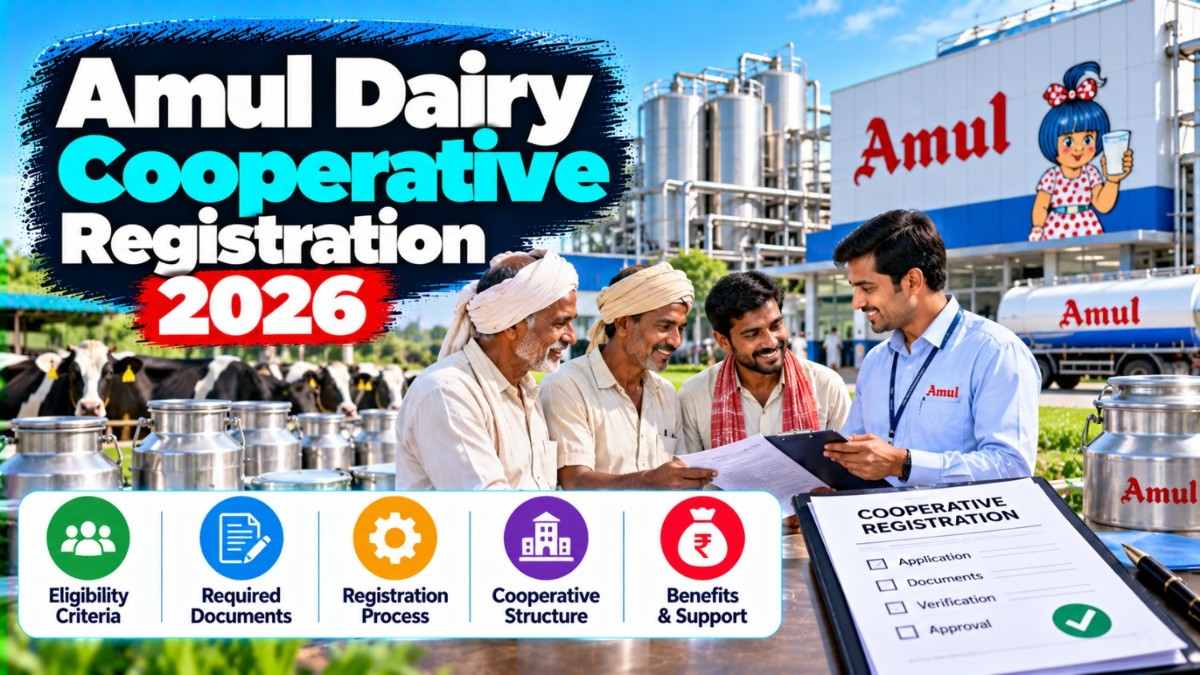
Amul dairy cooperative registration 2026 is open to all milk producers across India who own at least one cow or buffalo and want to earn a stable, government-backed income from milk. With 3.6 million farmer-members already enrolled and a record procurement price of Rs.1,035 per kg fat declared for FY 2025–26, joining the Amul cooperative network remains one of the most financially rewarding decisions a dairy farmer can make. This guide is for farmers, rural landowners, and agricultural entrepreneurs aged 18 and above who want to understand the registration process, eligibility criteria, current milk rates, and realistic monthly income from Amul’s three-tier cooperative system.

Inside this guide, you will find: the complete step-by-step registration process, 2026 milk procurement rates, monthly income estimates, eligibility and documents required, a comparison of Amul vs private dairies, FAQs, and all important official links — updated as of October 2026.
Amul dairy cooperative registration 2026 begins at the village level — a milk producer must be at least 18 years old, own a cow or buffalo, reside in the society’s area, pay a registration fee of Re.1, and commit to daily milk delivery. Amul currently procures buffalo milk at Rs.54.05–Rs.63.06 per litre and cow milk at Rs.36.68–Rs.38.68 per litre (revised June 1, 2026), with 80% of consumer revenue returned directly to farmers.
- Organisation: Gujarat Cooperative Milk Marketing Federation (GCMMF) — markets Amul brand
- Total Farmer Members: 36.4 lakh (3.64 million) across Gujarat
- Village Cooperative Societies: 18,600+ across 33 districts
- Daily Milk Procurement: ~310 lakh litres/day (FY 2025–26)
- Buffalo Milk Rate (2026): Rs.54.05/litre (6% fat) to Rs.63.06/litre (7% fat)
- Cow Milk Rate (2026): Rs.36.68/litre (3.5% fat) to Rs.38.68/litre (4% fat)
- Record Procurement Price FY 2025–26: Rs.1,035 per kg fat (highest ever)
- Farmer Revenue Share: 80% of every consumer rupee returned to milk producers
- GCMMF Turnover FY 2025–26: Over Rs.1 lakh crore
- Registration Fee (Farmer Member): Re.1 at village society level
- Minimum Daily Milk Supply: Village must collectively supply 350 litres/day to affiliate
- Official Website: amul.com / amuldairy.com
- What Is the Amul Dairy Cooperative and How Does It Work?
- Who Should Join the Amul Dairy Cooperative in 2026?
- Amul Milk Procurement Rate 2026 – Complete Income Breakdown
- Eligibility Criteria to Register with Amul Dairy Cooperative
- How to Register with Amul Dairy Cooperative – Step-by-Step Process 2026
- Amul Cooperative vs Private Dairy – Which Pays More in 2026?
- Advantages and Disadvantages of Joining Amul Dairy Cooperative
- Important Terms Related to Amul Dairy Cooperative Registration
- Important Links – Amul Dairy Cooperative 2026
- Conclusion
- Key Takeaways
- Frequently Asked Questions About Amul Dairy Cooperative Registration 2026
What Is the Amul Dairy Cooperative and How Does It Work?
The Amul dairy cooperative is a farmer-owned, three-tier cooperative structure formally known as the Anand Pattern of Cooperative Societies, through which milk producers across Gujarat collectively own and govern India’s largest dairy brand. The Gujarat Cooperative Milk Marketing Federation (GCMMF), which markets all products under the Amul brand, is the apex body of this structure and reported a turnover exceeding Rs.1 lakh crore in FY 2025–26 — making it one of India’s largest FMCG companies, entirely farmer-controlled.

The three tiers work as follows: at the base, Village Dairy Cooperative Societies (VDCS) collect raw milk from member farmers twice daily. These village societies are federated under District Cooperative Milk Producers’ Unions (DCMPU) — currently 18 district unions covering all 33 districts of Gujarat — which handle milk processing, quality testing, and chilling. At the apex tier, GCMMF handles marketing, distribution, branding, and exports of finished Amul products nationally and internationally. As of 2026, this structure spans 18,600+ village societies with 36.4 lakh registered farmer-members supplying approximately 310 lakh litres of milk per day.
What sets this model apart is its ownership structure: farmers are not just suppliers — they are owners. Every milk producer who joins a village society becomes a member-owner with voting rights. Elected farmer representatives govern the village society, which in turn elects representatives to the district union board, which elects the GCMMF board. This democratic governance ensures that pricing, policy, and profit distribution decisions always favour the milk producers at the grassroots level.
| Tier | Name | Function | Count (2026) |
|---|---|---|---|
| Tier 1 (Village) | Village Dairy Cooperative Society (VDCS) | Milk collection from farmers, initial quality check | 18,600+ |
| Tier 2 (District) | District Cooperative Milk Producers’ Union (DCMPU) | Milk processing, chilling, testing, procurement | 18 unions |
| Tier 3 (State) | GCMMF (Gujarat Cooperative Milk Marketing Federation) | Marketing, distribution, branding, exports under Amul brand | 1 federation |
Who Should Join the Amul Dairy Cooperative in 2026?
The Amul dairy cooperative is designed for a specific set of milk producers and rural stakeholders. If you belong to any of the profiles below, registering with your nearest village society in 2026 is a financially sound decision.
- 🐄 Small dairy farmers with 1–5 animals — Farmers owning even a single cow or buffalo qualify. The cooperative accepts any quantity of milk, making it accessible to micro-scale producers.
- 👩🌾 Rural women in dairy farming — Women comprise a significant majority of Amul’s village society members. The cooperative actively supports women’s membership, with many societies entirely women-led.
- 🌾 Marginal and landless farmers — You do not need agricultural land to join. Milk production is the only qualification, making this ideal for landless rural households who own cattle.
- 🏘️ Residents of Gujarat’s rural villages — All 33 districts of Gujarat are covered by Amul’s 18 district unions. Any villager who meets the basic criteria can join a nearby VDCS.
- 💡 Farmers switching from private dairies — Those currently selling milk to private contractors or agents at lower rates can switch to Amul’s cooperative to access better procurement prices and direct farmer payments.
- 🚜 New dairy entrepreneurs starting in 2026 — Anyone planning to start a dairy unit of 2–10 animals who wants a guaranteed, regulated buyer for their milk output.
- 📦 Village-level entrepreneurs forming new societies — Groups of 10+ farmers in a village not yet covered by an existing society can initiate the process of forming a new Village Dairy Cooperative Society.
- 🎓 Agricultural graduates and rural youth — Young professionals who want to contribute to dairy cooperative management, field operations, or cooperative extension activities at the village level.
Amul Milk Procurement Rate 2026 – Complete Income Breakdown
Amul dairy declared a record final procurement price of Rs.1,035 per kg fat for the financial year 2025–26 — the highest in its history and among the highest milk procurement rates in the Indian dairy sector. Effective June 1, 2026, the cooperative also increased milk procurement prices by Rs.10 per kg fat across all categories, providing a direct income boost to lakhs of dairy farmers amid rising fodder and livestock maintenance costs.
| Milk Type | Fat % | Rate per Litre (June 2026) | Change from Previous Rate |
|---|---|---|---|
| Buffalo Milk | 6% fat | Rs.54.05/litre | +Rs.0.61/litre |
| Buffalo Milk | 7% fat | Rs.63.06/litre | +Rs.0.72/litre |
| Cow Milk | 3.5% fat | Rs.36.68/litre | +Rs.0.43/litre |
| Cow Milk | 4% fat | Rs.38.68/litre | +Rs.0.45/litre |
| Record FY26 Final Price | Per kg fat | Rs.1,035/kg fat | Highest ever declared |
Monthly income estimate for a dairy farmer with 3 buffalo (each yielding 5 litres/day at 7% fat):
| Parameter | Calculation | Amount |
|---|---|---|
| Daily milk production (3 buffalo × 5 litres) | 15 litres/day | — |
| Amul procurement rate (7% fat buffalo) | Rs.63.06/litre | — |
| Daily income from milk | 15 × Rs.63.06 | Rs.945.90/day |
| Monthly income (30 days) | Rs.945.90 × 30 | ~Rs.28,377/month |
| Annual income (milk alone) | Rs.28,377 × 12 | ~Rs.3,40,524/year |
| Bonus/incentive payments (cooperative dividend) | Declared annually by union | Additional Rs.10,000–Rs.25,000/year |
For a farmer with 5 high-yield buffalo averaging 7 litres/day at 7% fat, monthly milk income from Amul cooperative can reach Rs.44,000–Rs.66,000 per month. The GCMMF structure also ensures farmers receive 80 paise of every consumer rupee spent on Amul products — a direct-to-farmer transfer model unmatched by any private dairy in India as of 2026.
Amul pays farmers using the FAT + SNF (Solid Not Fat) pricing method. The higher the fat percentage in your milk, the higher your per-litre rate. Feeding balanced, protein-rich fodder to your cattle and testing milk fat before delivery ensures you receive the maximum procurement rate. Request a fat meter test at your village society every morning for best results.
Eligibility Criteria to Register with Amul Dairy Cooperative
To become a member of an Amul-affiliated Village Dairy Cooperative Society (VDCS), a milk producer must satisfy all of the following eligibility conditions as prescribed by the Kaira District Co-operative Milk Producers’ Union (Amul Dairy) and applicable state cooperative society acts:
- ✅ Must be a resident of the specific village where the society operates
- ✅ Must be at least 18 years of age
- ✅ Must own at least one cow or buffalo
- ✅ Must commit in writing to deliver milk regularly to the society
- ✅ Must pay a registration fee of Re.1 (one rupee) at the village society
- ✅ Must not be a defaulter of any other cooperative society
- ✅ Must be willing to accept and abide by the society’s bylaws
- ✅ For new society formation: minimum 10 founding members from the same village are required
For forming a new Village Dairy Cooperative Society in a village not currently covered by the Amul network, the village must collectively demonstrate the ability to supply a minimum of 350 litres of milk per day to the district union. This is verified by a feasibility study team from the cooperative’s District Department before the society is formally constituted.
| Eligibility Condition | Requirement |
|---|---|
| Age | Minimum 18 years |
| Residence | Must belong to the village covered by the society |
| Animal ownership | At least 1 cow or buffalo |
| Written commitment | Must commit to regular milk delivery |
| Registration fee | Re.1 (one rupee) |
| Cooperative default | Must not be defaulter in any other society |
| Minimum members (new society) | 10 founding members from same village |
| Minimum milk supply (new society) | Village capacity of 350 litres/day |
How to Register with Amul Dairy Cooperative – Step-by-Step Process 2026
There are two registration scenarios: (A) joining an existing Village Dairy Cooperative Society, and (B) forming a brand-new society in a village not yet affiliated with Amul. Follow the relevant steps below.
A) Joining an Existing Amul Village Dairy Cooperative Society
- Locate your nearest Village Dairy Cooperative Society (VDCS) — Contact your block-level agriculture office, the nearest Amul district union, or visit amuldairy.com to find the society operating in your village or nearest village.
- Attend the village society meeting — Visit the society’s premises (usually held at the milk collection centre) and meet the Society Secretary or Chairman to express your interest in joining.
- Fill the membership application form — Complete the standard membership form with your name, address, Aadhaar number, animal ownership details, and declare your commitment to deliver milk regularly to the society.
- Submit required documents — Provide: (a) Aadhaar Card or Voter ID as identity and residence proof, (b) animal ownership certificate or veterinary health record, (c) bank passbook copy for direct payment linkage, (d) passport-size photograph.
- Pay the membership registration fee of Re.1 — This is the official registration fee for a farmer member at the village cooperative society level. Obtain a receipt.
- Receive membership approval from the Management Committee — The society’s elected Management Committee reviews and approves new memberships. Approval is typically granted within 7–15 working days.
- Start milk delivery — Once approved, begin delivering milk at the society’s collection point twice daily (morning and evening sessions). Milk is tested for fat and SNF content, and payment is credited to your linked bank account (usually fortnightly or monthly, depending on the society’s payment cycle).
B) Forming a New Village Dairy Cooperative Society
- Send a formal intimation to the district union — A written request from the village expressing willingness to form a cooperative society is sent to the concerned Amul District Cooperative Milk Producers’ Union.
- Feasibility assessment by cooperative team — A team from the union’s Cooperative Department visits the village to study the number of cattle, potential daily milk output, and interest among farmers. The minimum required output is 350 litres per day from the village.
- Organise a Gram Sabha of milk producers — If feasibility is confirmed, the cooperative team helps organise a gram sabha of all interested milk producers. Key resolutions passed include: entry fee, location of the milk society, appointment of temporary staff, election of Management Committee and Chairman, banking authority, and preparation of bylaws.
- Operate for one full quarter — The newly formed society operates informally for the first three months under the union’s supervision, submitting milk to the district union and maintaining financial records.
- Submit registration application to District Registrar — After successful first-quarter operation, the society submits: financial reports, member list, share status, four copies of the bylaw, and the registration application to the District Registrar of Cooperative Societies.
- Pay registration fee (1% of authorized share capital) — Submit the registration fee via treasury challan as per the state’s Cooperative Societies Act. The Registrar processes the application within 60 days of receipt.
- Receive Certificate of Registration — The Registrar issues a Certificate of Registration and sealed bylaws by registered post, formally constituting the society as an independent cooperative legal entity under the state’s Cooperative Societies Act.
Amul Cooperative vs Private Dairy – Which Pays More in 2026?
A common question among dairy farmers is whether selling milk to Amul’s cooperative system offers better financial returns than selling to private dairies or contractors. The comparison below covers 2026 data across key parameters.
| Parameter | Amul Dairy Cooperative (2026) | Typical Private Dairy (2026) |
|---|---|---|
| Buffalo milk rate (7% fat) | Rs.63.06/litre | Rs.50–58/litre (varies by contractor) |
| Cow milk rate (4% fat) | Rs.38.68/litre | Rs.28–35/litre (varies) |
| Payment schedule | Fortnightly/monthly — direct bank transfer | Weekly/monthly — may involve delays |
| Farmer revenue share | 80% of consumer price returned to farmers | No fixed policy — depends on contractor margin |
| Annual bonus/dividend | Yes — declared annually by union | Rarely offered |
| Ownership rights | Farmer is member-owner with voting rights | No ownership — pure supplier relationship |
| Rate transparency | Fat + SNF-based pricing — fully transparent | Often opaque — flat rate set by contractor |
| Veterinary services | Provided by union to member villages | Not provided |
| Cattle insurance | Often available through cooperative | Not available |
| Price guarantee | Minimum price guaranteed by cooperative structure | No price guarantee — market-dependent |
For any dairy farmer in Gujarat currently selling to private contractors, switching to an Amul-affiliated village cooperative society in 2026 is strongly advisable. The cooperative consistently pays Rs.5–10 more per litre than typical private contractors, guarantees fortnightly payment directly to your bank account, provides farmer ownership rights, and offers additional support services including veterinary assistance and cattle insurance. The Re.1 registration fee makes the entry barrier essentially zero. For farmers outside Gujarat in states covered by other Amul-model cooperatives (such as NDDB-affiliated unions), the same comparison holds true.
Advantages and Disadvantages of Joining Amul Dairy Cooperative
Advantages of Joining Amul Dairy Cooperative
- ✅ Highest procurement rates in India: Rs.1,035 per kg fat declared as the record FY 2025–26 final procurement price — the highest in Amul’s 80-year history.
- ✅ 80% farmer revenue share: GCMMF officially returns 80% of consumer payments back to milk producers, ensuring farmers receive the maximum possible benefit from retail prices.
- ✅ Direct bank payment — no middlemen: Payments are credited directly to the farmer’s bank account, eliminating the risk of contractor manipulation or delayed payments.
- ✅ Farmer ownership and democratic governance: Every member has voting rights and can participate in the election of the Management Committee, ensuring farmer interests always drive cooperative policy.
- ✅ Additional services — vet, cattle insurance, fodder: Member farmers access subsidised veterinary services, AI (artificial insemination) for cattle improvement, and cattle insurance schemes not available to private dairy suppliers.
- ✅ Annual bonus and price revisions: Beyond the base procurement price, the union declares an annual bonus/dividend. The June 2026 revision added Rs.10 per kg fat to all procurement prices.
Disadvantages of Joining Amul Dairy Cooperative
- ⚠️ Geographic limitation: Amul’s direct cooperative network (GCMMF) currently operates across Gujarat only. Farmers in other states must affiliate with NDDB-promoted cooperatives under Operation Flood, which follow a similar but separately governed model.
- ⚠️ Minimum daily supply obligation: Members must deliver milk every day (morning and evening). Irregular supply can affect membership standing and payment calculations.
- ⚠️ New society requires 350+ litre threshold: Forming a new village society requires the entire village to collectively supply 350 litres/day — this can be challenging for very small or remote settlements.
Important Terms Related to Amul Dairy Cooperative Registration
Understanding the following terms will help you navigate the registration process, milk pricing, and cooperative governance more effectively.
- GCMMF (Gujarat Cooperative Milk Marketing Federation): The apex state-level body that markets Amul brand products. GCMMF recorded a turnover of over Rs.1 lakh crore in FY 2025–26 and represents 36.4 lakh farmer-members across 18 district unions in Gujarat.
- VDCS (Village Dairy Cooperative Society): The primary (village-level) cooperative society where a farmer directly registers as a member. This is Tier 1 of the Amul three-tier model. There are 18,600+ VDCS operating across Gujarat as of 2026.
- DCMPU (District Cooperative Milk Producers’ Union): The Tier 2 body that processes and tests milk collected from village societies. Gujarat has 18 DCMPUs covering all 33 districts. Examples include Amul Dairy (Anand), Dudhsagar Dairy (Mehsana), Sabhag Dairy (Sabarkantha), and Sarhad Dairy (Kutch).
- Anand Pattern: The cooperative model developed in Anand, Gujarat, by Dr. Verghese Kurien. It separates farmer ownership from professional management across three tiers, ensuring maximum price transfer to milk producers at the grassroots. The Anand Pattern is now replicated across India through NDDB’s Operation Flood.
- FAT + SNF Pricing: Amul pays farmers using a fat and solid-not-fat content-based pricing system. Milk with higher fat percentage commands a higher per-litre rate. As of June 2026, buffalo milk with 7% fat earns Rs.63.06/litre versus Rs.54.05/litre for 6% fat milk.
- Procurement Price per kg fat: The fundamental unit of Amul’s farmer payment system. The final FY 2025–26 price was Rs.1,035 per kg fat — the highest ever declared. Buffalo milk with 6% fat contains approximately 60g of fat per litre, so the per-litre rate is derived from this per-kg-fat benchmark.
- Operation Flood: India’s White Revolution programme launched by NDDB in 1970 under Dr. Kurien, which replicated the Amul/Anand Pattern across 22 states, making India the world’s largest milk producer. Over 848,000 cooperatives are active in India as of January 2026 as a result.
- Bylaws of Society: The legal document that governs a village cooperative society’s operations, membership criteria, fee structure, management committee powers, and banking operations. Four copies must be submitted to the District Registrar at the time of formal registration.
- District Registrar of Cooperative Societies: The government authority under the State’s Cooperative Societies Act that grants legal registration to new cooperative societies. The Registrar must issue a Certificate of Registration within 60 days of a complete application.
- SNF (Solid Not Fat): The non-fat component of milk including proteins, lactose, and minerals. Along with fat, SNF content determines the quality-adjusted payment a farmer receives per litre under Amul’s pricing method.
Important Links – Amul Dairy Cooperative 2026
| Resource | Link |
|---|---|
| Amul Official Website | www.amul.com |
| Amul Dairy (Kaira Union) – Village Society Process | amuldairy.com/dairyvisit.php |
| GCMMF – Our Cooperative | amul.com/our-cooperative |
| NDDB (National Dairy Development Board) – Official | www.nddb.coop |
| Ministry of Fisheries, Animal Husbandry & Dairying – Official | dahd.gov.in |
| Dairy Knowledge Portal (Government of India) | www.dairyknowledge.in |
| India Cooperative Dairy Scheme – india.gov.in | www.india.gov.in |
| Animal Husbandry Department – Dairy Cooperative Registration (Assam) | animalhusbandry.assam.gov.in |
Conclusion
Amul dairy cooperative registration 2026 remains one of the most accessible and financially rewarding pathways for dairy farmers across India. With a record procurement price of Rs.1,035 per kg fat for FY 2025–26, revised milk rates effective June 1, 2026, a Re.1 registration fee at the village society level, and an 80% farmer revenue share built into the cooperative’s structure, the Amul model continues to offer unmatched financial returns and ownership rights to milk producers. Whether you are joining an existing Village Dairy Cooperative Society or forming a new one, the step-by-step process detailed in this guide will ensure you complete your registration correctly and begin earning within weeks.
Start by contacting your nearest Amul District Union or visiting amuldairy.com to locate the village cooperative society closest to you. Bookmark this page — milk procurement rates are reviewed and updated each time Amul declares a revision.
- Amul cooperative registration costs just Re.1 — the lowest entry barrier of any organised dairy system in India.
- As of June 2026, Amul pays Rs.63.06/litre for buffalo milk (7% fat) — up Rs.0.72 from the previous rate.
- The record FY 2025–26 final procurement price is Rs.1,035 per kg fat, the highest in Amul’s 80-year history.
- GCMMF returns 80% of every consumer rupee to its 36.4 lakh farmer-members — a structural advantage no private dairy can match.
- A new village cooperative society requires 10 founding members and proof that the village can supply 350 litres/day collectively.
- Farmers with 3 high-yield buffalo can earn approximately Rs.28,000–Rs.30,000 per month from Amul milk payments alone in 2026.
Frequently Asked Questions About Amul Dairy Cooperative Registration 2026
What is the registration fee to join an Amul dairy cooperative society?
The membership registration fee at the village dairy cooperative society level is Re.1 (one rupee). This is the official fee as prescribed by the Kaira District Co-operative Milk Producers’ Union (Amul Dairy). There is no additional application fee for an individual farmer joining an already-registered village society. For forming a brand-new cooperative society, a separate registration fee of 1% of the proposed authorized share capital is payable to the District Registrar of Cooperative Societies by treasury challan.
What is Amul’s current milk procurement rate per litre in 2026?
Effective June 1, 2026, Amul dairy cooperative procures buffalo milk at Rs.54.05/litre (6% fat) and Rs.63.06/litre (7% fat). Cow milk is procured at Rs.36.68/litre (3.5% fat) and Rs.38.68/litre (4% fat). These rates followed a revision of Rs.10 per kg fat across all categories. Additionally, Amul declared a final FY 2025–26 procurement price of Rs.1,035 per kg fat — the highest in the cooperative’s history. Rates are reviewed periodically and farmers can check the latest prices at their village society or at amuldairy.com.
Can I join Amul cooperative if I am not from Gujarat?
GCMMF’s direct cooperative network under the Amul brand currently operates exclusively within Gujarat, covering all 33 districts through 18 district unions and 18,600+ village societies. However, the Anand Pattern cooperative model has been replicated across India through NDDB’s Operation Flood programme. Dairy farmers outside Gujarat can join equivalent state-level cooperative systems — such as Verka (Punjab), Nandini (Karnataka), Aavin (Tamil Nadu), Sudha (Bihar), or Saras (Rajasthan) — which follow the same three-tier structure and offer comparable procurement benefits. Contact your state’s animal husbandry department or the nearest district milk union for registration details.
How much can a dairy farmer earn monthly by joining Amul cooperative?
Monthly earnings depend on the number of animals, milk yield per animal, and fat content. As a practical example: a farmer with 3 buffalo averaging 5 litres/day at 7% fat earns approximately Rs.28,000–Rs.30,000 per month from milk payments alone at the June 2026 procurement rate of Rs.63.06/litre. A farmer with 5 high-yield buffalo averaging 7 litres/day can earn Rs.44,000–Rs.66,000 per month. Additional annual bonuses and cooperative dividends declared by the union add Rs.10,000–Rs.25,000 per year over and above base milk payments.
What documents are required to register with Amul dairy cooperative?
To join an existing village cooperative society, you typically need: (1) Aadhaar Card as identity and residence proof, (2) Voter ID or Ration Card as alternative address proof, (3) proof of animal ownership (veterinary certificate or passbook), (4) bank passbook or account details for direct payment transfer, and (5) a recent passport-size photograph. For forming a new village cooperative society, four copies of proposed bylaws, minutes of the founding gram sabha meeting, identity proofs and declarations of all 10+ founding members, and share capital deposit confirmation are additionally required.
What is the minimum number of animals required to join Amul cooperative?
There is no minimum animal count specified for joining an existing village cooperative society as an individual farmer member. Even a farmer with a single cow or buffalo qualifies for membership, provided they reside in the village covered by the society and meet the other eligibility conditions. The cooperative accepts milk from all quantities — this inclusiveness is one of the Anand Pattern’s core principles, enabling even the poorest dairy households to participate in India’s largest dairy cooperative network.
How long does Amul dairy cooperative registration take to complete?
For joining an existing village society, the process typically takes 7–15 working days from application submission to Management Committee approval. For forming a new village cooperative society, the timeline is longer: the feasibility study, gram sabha, first-quarter operation, and formal registration with the District Registrar together take approximately 6–12 months. The District Registrar is legally required to issue the Certificate of Registration within 60 days of receiving a complete application.
Does Amul cooperative provide veterinary services to farmer members?
Yes. Amul’s district unions provide several support services to member farmers beyond just milk procurement. These include subsidised veterinary services, artificial insemination (AI) for cattle breed improvement, animal health camps, cattle insurance schemes, and balanced feed supply through the cooperative’s own cattle feed plants. The Kaira District Union (Amul Dairy) and other affiliated unions run dedicated Cattle Development programmes that are available exclusively to registered member farmers — a major advantage over selling milk to private contractors who offer no such support.
What percentage of Amul’s revenue goes back to farmers?
GCMMF officially returns 80% of the money received from consumers back to milk producers through procurement prices, bonuses, and dividends. This figure was reaffirmed by the federation in its May 2026 announcement regarding the latest retail price revision. The cooperative structure is designed to maximize farmer payment by limiting the retention at the union and federation levels to only what is operationally necessary for processing, marketing, and infrastructure investment. This 80% farmer revenue share stands in sharp contrast to typical private dairy chains where farmer payment often represents 50–60% of the consumer price.
Can women register as members of Amul dairy cooperative?
Yes, and women are actively encouraged to join. Women constitute a significant majority of Amul’s village-level cooperative membership, and many societies are entirely women-led. Female milk producers who own cattle and reside in the village covered by the society have equal membership rights, including voting rights, eligibility to stand for Management Committee elections, and access to all cooperative services. GCMMF and its affiliated district unions have run Women Dairy Leadership Programmes that further strengthen women’s participation and governance in the cooperative system.
Last Updated: October 2026. This guide is reviewed and updated regularly to reflect the latest official Amul procurement rates, cooperative registration processes, and GCMMF policy changes. Bookmark this page for the latest information.
Disclaimer: Milk procurement rates mentioned in this article are based on official announcements by GCMMF and affiliated district unions as of June–October 2026. Rates are subject to periodic revision by the cooperative. Always verify current procurement prices at your village society, the relevant district union, or the official Amul website before making financial decisions. This guide is for informational purposes only and does not constitute financial or investment advice.