
Nakul Swasthya Patra is India’s official government-issued animal health card, covering 8.5 crore milch animals under the Pashu Sanjivani programme. Launched under the National Mission on Bovine Productivity (NMBP) by the Ministry of Fisheries, Animal Husbandry and Dairying, this card assigns every registered animal a 12-digit Unique ID (AUID) and stores all health, breeding, and productivity records on the INAPH national database. This guide is for cattle and buffalo farmers, dairy entrepreneurs, veterinary professionals, and agriculture graduates across India who want to understand how to access free government veterinary services in 2026. It covers what the card is, who qualifies, how to get it, the full range of free services available, and how the new National Digital Livestock Mission upgrades the system.

Nakul Swasthya Patra is a free government-issued animal health card provided to milch cattle and buffalo owners under the Pashu Sanjivani component of India’s Rashtriya Gokul Mission. Each card carries a 12-digit AUID (Animal Unique ID) and links the animal to the INAPH national database — recording health history, vaccinations, artificial insemination, and breeding data. As of 2026, over 8.5 crore animals in milk across India are targeted for registration, and all associated veterinary services including vaccination are provided free of cost at the farmer’s doorstep.
- Scheme Name: Nakul Swasthya Patra (Animal Health Card)
- Parent Programme: Pashu Sanjivani under Rashtriya Gokul Mission (RGM)
- Launched By: Ministry of Fisheries, Animal Husbandry and Dairying, Govt. of India
- Initiating Year: November 2016 (under NMBP)
- Current Status (2026): Active and extended under revised RGM upto September 2026
- Target Animals: 8.5 crore milch cows and buffaloes in India
- Animal ID System: 12-digit AUID (Animal Unique Identification) / Pashu Aadhaar ear tag
- Database: INAPH (Information Network for Animal Productivity and Health)
- Digital App (2026): Bharat Pashudhan App (field workers) · 1962 Livestock Owner App (farmers)
- Cost to Farmer: FREE — 100% grant-in-aid by Central Government
- RGM Total Outlay: Rs.2,400 crore (2021–22 to 2025–26); extended for 2026–27
- Implementing Body: DAHD through State Livestock Development Boards and NDDB
- What Is Nakul Swasthya Patra and How Does It Work?
- Who Should Get the Nakul Swasthya Patra?
- Free Government Veterinary Services Covered in 2026
- Eligibility and Animal Categories
- How to Get Nakul Swasthya Patra — Step-by-Step Process
- Nakul Swasthya Patra vs Pashu Aadhaar — What Changed in 2026?
- Advantages and Disadvantages of the Scheme
- INAPH Database and National Digital Livestock Mission 2026
- Important Terms Related to Animal Health Services
- Important Dates and Programme Timeline
- Important Links
- Conclusion
- Key Takeaways
- Frequently Asked Questions
What Is Nakul Swasthya Patra and How Does It Work?
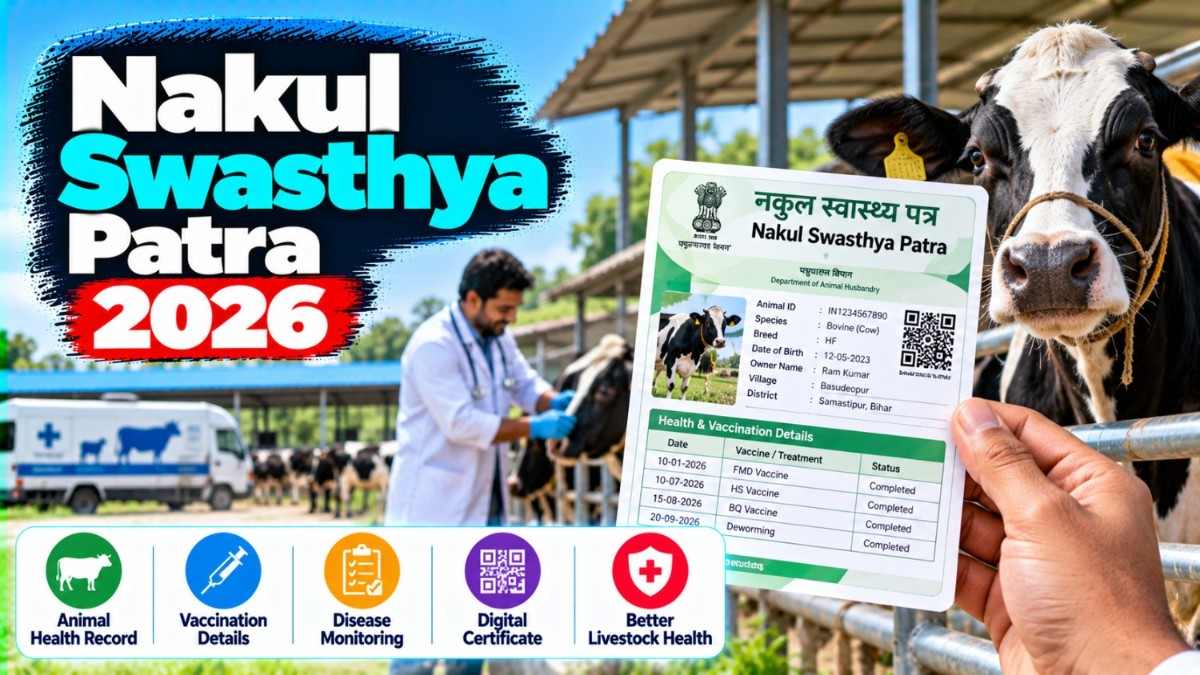
Nakul Swasthya Patra is a government-issued physical animal health card that serves as a lifelong identity and medical record document for individual milch cattle and buffalo in India. Each card is printed on colour-coded paper — orange for indigenous milch cows, green for crossbred milch cows, and grey for milch buffaloes — and is placed inside a transparent plastic jacket for field durability.
The card records an animal’s owner details, issuing authority, current health status, vaccination history, artificial insemination events, pregnancy diagnosis, and calving records. All this data is simultaneously uploaded to the INAPH (Information Network for Animal Productivity and Health) national database, managed by the National Dairy Development Board (NDDB), creating a permanent digital record that moves with the animal across its productive life.

The core idea behind Nakul Swasthya Patra is traceability and disease control. When every animal has a known identity and documented health history, it becomes possible to trace disease outbreaks, verify vaccination coverage, certify animals for trade, and support farmers with targeted government services. India’s dairy sector — the world’s largest milk producer — depends on this kind of systematic animal health management to achieve disease-free status and enable export of milk and milk products.
| Card Colour | Animal Category |
|---|---|
| Orange | Indigenous milch cows (e.g. Gir, Sahiwal, Tharparkar) |
| Green | Crossbred milch cows (HF, Jersey crosses) |
| Grey | In-milk buffaloes (Murrah, Nili-Ravi, Surti, etc.) |
Who Should Get the Nakul Swasthya Patra?
The Nakul Swasthya Patra and the associated free government veterinary services are relevant to a wide range of farmers and livestock stakeholders across India.
- 🐄 Dairy farmers with one or more milch cows or buffaloes — the card directly protects their primary income-generating asset by ensuring documented health and vaccination records.
- 🌾 Small and marginal farmers in rural and semi-urban areas — who cannot afford private veterinary consultations and rely on government services for animal health care.
- 👩🌾 Women dairy farmers and self-help group (SHG) members — especially those involved in cooperative dairy models where animal traceability improves milk pricing and quality premiums.
- 🏘️ Farmers in districts with less than 50% artificial insemination (AI) coverage — who are priority beneficiaries under the National Artificial Insemination Programme (NAIP).
- 🐃 Buffalo rearers in Uttar Pradesh, Rajasthan, Punjab, and Haryana — where buffalo-based dairying is the dominant livelihood model.
- 🎓 Agriculture and veterinary graduates seeking to understand government schemes — for IBPS AFO, NABARD, and state animal husbandry department examination preparation.
- 🏥 Veterinary professionals and para-vets (AI technicians) — who are the frontline implementers of the Pashu Sanjivani programme and issue Nakul Swasthya Patra during field visits.
- 📱 Farmers wanting to access digital livestock services — via the 1962 Livestock Owner App or Bharat Pashudhan platform to view their animal’s records remotely.
Free Government Veterinary Services Covered in 2026
One of the most significant benefits of the Nakul Swasthya Patra ecosystem is that it unlocks a full range of free veterinary services, delivered either at government veterinary hospitals and dispensaries or at the farmer’s doorstep through Mobile Veterinary Units (MVUs). As of 2026, the Livestock Health and Disease Control Programme (LHDCP) with an outlay of Rs.3,880 crore for FY 2024–25 and 2025–26 underpins this service delivery infrastructure.
| Service | Cost to Farmer | Delivery Mode |
|---|---|---|
| Foot-and-Mouth Disease (FMD) vaccination | Free | Doorstep / Camp |
| Brucellosis vaccination (Brucella abortus) | Free | Doorstep / Hospital |
| PPR (Peste des Petits Ruminants) vaccination | Free | Camp / Dispensary |
| Lumpy Skin Disease (LSD) vaccination | Free | Doorstep / Camp |
| Classical Swine Fever (CSF) vaccination | Free (swine) | Dispensary / Camp |
| Haemorrhagic Septicaemia (HS) vaccination | Free | Camp / Dispensary |
| Artificial Insemination (AI) at doorstep | Free under NAIP | AI technician (doorstep) |
| Pregnancy diagnosis and calving follow-up | Free | AI technician / MVU |
| AUID ear tagging and INAPH registration | Free | AI technician / Vet |
| First veterinary aid and treatment (MVU) | Free (MVU service) | Mobile Veterinary Unit (1962) |
| Generic veterinary medicine (Pashu Aushadhi) | Subsidised / Free | PM Kisan Samridhi Kendras / Cooperatives |
To access the Mobile Veterinary Unit (MVU) for doorstep treatment, call the national livestock helpline 1962 from your mobile. The MVU, equipped with a mobile operation theatre, lab, scanning unit, and oxygen support, will come to your location. This service is especially critical for emergency calvings, injury treatment, and post-AI follow-up — all free of charge under the government scheme.
Eligibility and Animal Categories
The Nakul Swasthya Patra is issued to animals enrolled under the Pashu Sanjivani component of Rashtriya Gokul Mission and the National Artificial Insemination Programme. Eligibility is based on the animal’s status and the programme’s district coverage.
- Species covered: Cattle (cows) and buffalo only under RGM/NMBP — not goats, sheep, or poultry under this specific card.
- Animal status: The animal must be a milch (in-milk) bovine or a breedable female bovine targeted for AI.
- District coverage: Priority given to 597 identified districts with less than 50% AI coverage under NAIP-III. Hilly, NE states, and UTs have separate guidelines.
- UID requirement: Animal must be tagged with a 12-digit AUID ear tag (Pashu Aadhaar) before the card is issued — this is done simultaneously by the AI technician or veterinary officer at the time of first AI or health visit.
- No income restriction: Any cattle/buffalo-owning farmer in a covered district is eligible — there is no Below Poverty Line (BPL) or landholding requirement specifically for this card.
- Document required from farmer: Aadhaar Card, mobile number, and details of the animal (species, breed, approximate age).
| Category | Eligible? | Fee |
|---|---|---|
| All cattle/buffalo farmers (in covered districts) | Yes | Free |
| SC/ST farmers | Yes (priority) | Free |
| Women dairy farmers / SHG members | Yes (priority) | Free |
| Farmers with exotic breeds only (Jersey/HF pure) | Partial — AI programme eligible | Free |
| Farmers outside covered districts | Apply through State DAHD | Free |
How to Get Nakul Swasthya Patra — Step-by-Step Process
Getting a Nakul Swasthya Patra does not require any online application form or fee. The card is issued directly by government field functionaries — AI technicians, veterinary officers, or Para-Vets — during programme visits. Here is the exact process as updated for 2026.
- Contact your local District Animal Husbandry Officer (DAHO) or District Veterinary Officer (DVO). Ask about the ongoing Pashu Sanjivani or NAIP programme in your block/district. Their name and mobile number must be made publicly available in every covered district.
- Alternatively, call helpline 1962 — the national livestock owner helpline — to request registration of your animal and a doorstep visit by the nearest AI technician or veterinary team.
- Arrange for the AI technician’s visit. The technician is assigned village-wise and will come to your location. Keep your Aadhaar card and animal ready for identification.
- Animal is physically examined and AUID-tagged. The technician applies a 12-digit barcoded ear tag (Pashu Aadhaar) to the animal and records its details — owner name, species, breed, age, colour, parity — using the INAPH LITE mobile application on a government-issued tablet or smartphone.
- Health status is recorded and card is issued. The technician records the current health status, any existing vaccination history, and issues the printed Nakul Swasthya Patra with a transparent plastic jacket on the spot or within a few working days through the government district office.
- First AI and vaccination are provided simultaneously. If the animal is in the AI programme, artificial insemination is performed and recorded. Applicable vaccinations (FMD, HS, Brucellosis) are administered free of cost.
- All data is uploaded to INAPH database. Every event — AI, pregnancy diagnosis, calving, vaccination, treatment — is recorded on the INAPH LITE app immediately or within 24 hours, building the animal’s permanent digital health record.
- Access your animal’s records via the 1962 Livestock Owner App (2026). The 1962 app (which replaced the earlier e-Gopala app for farmers) allows you to view your registered animal’s full records, track upcoming vaccination schedules, and access government breeding services from your mobile.
Nakul Swasthya Patra vs Pashu Aadhaar — What Changed in 2026?
Many farmers confuse Nakul Swasthya Patra with the newer Pashu Aadhaar system. Both are part of the same ecosystem but serve different functions. As the National Digital Livestock Mission (NDLM) rolled out nationwide in 2025–26, the animal identification and record system was significantly upgraded.
| Feature | Nakul Swasthya Patra (NSP) | Pashu Aadhaar / NDLM (2026) |
|---|---|---|
| Format | Physical printed health card (A4, 160 GSM) | 12-digit barcoded ear tag (physical + digital) |
| Database | INAPH (via INAPH LITE app) | Bharat Pashudhan platform (upgraded INAPH) |
| Farmer App | e-Gopala app (earlier version) | 1962 Livestock Owner App (2026) |
| Field Worker App | INAPH LITE on tablet | Bharat Pashudhan App (AI, vaccination, e-prescriptions) |
| Animals Covered | Milch cattle and buffalo (NMBP focus) | All livestock species (cattle, buffalo, goat, poultry, etc.) |
| Scope | Health records, AI, vaccination | Health, breeding, product traceability, insurance, credit |
| Livestock Owners Registered | Targeted: 8.5 crore animals in milk | 9.5 crore livestock owners registered (NDLM, 2025–26) |
| Traceability | Animal-level health traceability | Full supply chain traceability (milk, meat, dairy products) |
| Cost to Farmer | Free | Free |
| Best For | Dairy farmers wanting health and AI records | All farmers wanting complete digital livestock management |
Nakul Swasthya Patra is the foundation; Pashu Aadhaar and the NDLM are the evolved digital superstructure built on it. For a dairy farmer in 2026, the practical difference is minimal — the ear tag is the Pashu Aadhaar, the health card is the Nakul Swasthya Patra, and both are issued together during the same AI technician visit. Farmers should ensure both the physical card and the AUID ear tag are obtained simultaneously to access the full range of government services and future benefits under credit and insurance schemes linked to the NDLM platform.
Advantages and Disadvantages of the Nakul Swasthya Patra Scheme
Like any large government programme, the Nakul Swasthya Patra scheme has significant strengths but also implementation challenges that farmers should be aware of.
Advantages (Pros)
- ✅ Completely free to farmers — no registration fee, no card fee, no vaccination charge under the programme.
- ✅ Lifetime health record for the animal — vaccination history, AI events, pregnancy records, and treatment data are stored permanently on INAPH, accessible even if the farmer changes location or sells the animal.
- ✅ Reduces animal disease spread — systematic vaccination and traceability help prevent devastating outbreaks like FMD, Lumpy Skin Disease, and Brucellosis that can wipe out a farmer’s entire herd income in days.
- ✅ Enables milk export quality certification — as nine states are being declared FMD-free zones in 2026, documented vaccination via INAPH supports India’s ambition to export milk and dairy products.
- ✅ Gateway to other government benefits — AUID-tagged animals are eligible for livestock insurance (National Livestock Mission), NABARD credit linkage, and future direct benefit transfers linked to dairy schemes.
- ✅ Doorstep delivery model — no need for the farmer to travel; AI technicians and MVUs come to the village, reducing time loss and transport costs.
Disadvantages / Challenges (Cons)
- ⚠️ Uneven implementation across states — coverage is stronger in dairy-progressive states like Gujarat, Punjab, and Karnataka and weaker in remote tribal districts; check with your local DAHO for actual status in your block.
- ⚠️ Physical card durability issues — A4 paper cards with plastic jackets can deteriorate in high-moisture farm environments; the shift to the Pashu Aadhaar ear tag system is partly a response to this.
- ⚠️ App literacy barrier — the INAPH LITE and 1962 apps require smartphone access and data connectivity, which remains a challenge for farmers in low-connectivity zones of Bihar, Odisha, and northeastern states.
INAPH Database and National Digital Livestock Mission 2026
The INAPH — Information Network for Animal Productivity and Health — is the technological backbone behind Nakul Swasthya Patra. Developed and managed by the National Dairy Development Board (NDDB), INAPH is a centralised national database that stores animal-level records for breeding, health, nutrition, and productivity. Every event recorded on the Nakul Swasthya Patra feeds into INAPH in real time through the INAPH LITE app used by field workers.
In 2025–26, the Government of India took INAPH several steps further by rolling out the National Digital Livestock Mission (NDLM) nationwide. The NDLM consolidates all livestock data — cattle, buffalo, goats, poultry, sheep — into a unified Bharat Pashudhan platform. Key features of the upgraded 2026 system include a Pashu Aadhaar unique ear tag, the Bharat Pashudhan App for AI technicians and vets, and the 1962 Livestock Owner App for farmers. As of 2025–26, 9.5 crore livestock owners have been registered on the NDLM platform, making it one of the world’s largest animal identification and data systems.
The IMAP web portal (also developed by NDDB) provides a geographic dashboard of district-wise animal registration coverage against animal population, AI programme status, NADCP vaccination progress, and service delivery metrics — giving policymakers and farmers alike a transparent view of programme performance across every district in India.
Important Terms Related to Animal Health Services India
Understanding the key terms in India’s livestock health ecosystem will help farmers and professionals get maximum benefit from government schemes and prepare for competitive examinations.
- INAPH (Information Network for Animal Productivity and Health): National digital database maintained by NDDB that records breeding, AI, health, and nutrition data for individual animals identified by AUID. Every Nakul Swasthya Patra event is uploaded here.
- AUID (Animal Unique Identification): 12-digit unique identity number assigned to each registered bovine. Functions like Aadhaar for animals — linking ownership, health, breeding, and productivity data in one place.
- Pashu Sanjivani: The animal wellness programme under RGM/NMBP that issues Nakul Swasthya Patra, tags animals with AUID, and uploads data to INAPH. The programme also deploys Mobile Veterinary Units (MVUs) for doorstep healthcare.
- NADCP (National Animal Disease Control Programme): Rs.13,343 crore central programme targeting 100% vaccination coverage against FMD and Brucellosis across India — directly linked to the Nakul Swasthya Patra vaccination records system.
- LHDCP (Livestock Health and Disease Control Programme): The umbrella central scheme (Rs.3,880 crore outlay 2024–26) covering NADCP, LH&DC, and the new Pashu Aushadhi component for subsidised/free generic veterinary medicines.
- Pashu Aushadhi: New 2025 component under LHDCP approved by Union Cabinet — provides high-quality generic veterinary medicines (similar to Jan Aushadhi for humans) distributed through PM Kisan Samridhi Kendras and cooperatives.
- Mobile Veterinary Unit (MVU): Equipped vehicle with a mobile operation theatre, laboratory, scanning unit, and oxygen support. Farmers call 1962 to request doorstep service. Deployed in all districts under LHDCP.
- NAIP (National Artificial Insemination Programme): Covers 597 low-AI-coverage districts; AI is provided free at the farmer’s doorstep; all inseminated animals receive a Nakul Swasthya Patra.
- Rashtriya Gokul Mission (RGM): Launched in December 2014, total outlay Rs.2,400 crore (2021–26), extended through 2026–27. Covers indigenous breed conservation, Gokul Grams, semen stations, IVF labs, e-Pashu Haat, Pashu Sanjivani, and the Nakul Swasthya Patra system.
- FMD-Free Zone: A district or state certified to be free of Foot-and-Mouth Disease based on systematic NADCP vaccination records and surveillance — enabling export of livestock products from that zone. Nine states are in the process of FMD-free certification in 2026.
Important Dates and Programme Timeline
| Year / Date | Key Milestone |
|---|---|
| December 2014 | Rashtriya Gokul Mission (RGM) launched by DAHD |
| November 2016 | National Mission on Bovine Productivity (NMBP) launched; Nakul Swasthya Patra introduced under Pashu Sanjivani component |
| 2021–22 | Revised RGM launched with Rs.2,400 crore allocation for 2021–22 to 2025–26; NAIP-III begins in 597 districts |
| March 2025 | Additional ₹1,000 crore sanctioned, total RGM outlay revised to Rs.3,400 crore; revised RGM approved through 2025–26 |
| October 2024 – Feb 2025 | 21st Livestock Census conducted (first fully tablet-based digital census) |
| 2025–26 | National Digital Livestock Mission (NDLM) rolled out nationwide; Bharat Pashudhan App and 1962 Livestock Owner App launched; 9.5 crore livestock owners registered |
| 2025–26 | Union Cabinet approves Pashu Aushadhi under LHDCP; generic veterinary medicines via PM Kisan Samridhi Kendras |
| March 2026 | RGM extended under administrative approval upto September 2026 (2026–27 continuation) |
| Ongoing 2026 | Free FMD, Brucellosis, LSD, and PPR vaccination drives continuing across states; 9 states on FMD-free zone certification track |
Important Links
| Link Name | URL |
|---|---|
| DAHD Official Website (Ministry of AH&D) | dahd.gov.in |
| DAHD Livestock Health & Disease Control Scheme | dahd.gov.in/lh-dc |
| NDDB Official Website (INAPH / e-Gopala / NDLM) | nddb.coop |
| Vikaspedia – Rashtriya Gokul Mission Guide | vikaspedia.in/rashtriya-gokul-mission |
| NAIP-III Guidelines (DAHD Official PDF) | NAIP-III Official Guidelines PDF |
| 1962 Livestock Helpline (call for MVU / vet services) | Dial 1962 from any mobile |
| Agrijob.in – NABARD Recruitment Guide | agrijob.in |
| Agrijob.in – Animal Husbandry Government Jobs | agrijob.in/animal-husbandry-jobs |
Conclusion — Final Thoughts on Nakul Swasthya Patra 2026
Nakul Swasthya Patra is far more than a paper card — it is the entry point into India’s entire digital livestock health ecosystem, connecting 8.5 crore milch animals to a national database, free vaccination drives, doorstep AI services, and the upcoming NDLM-linked credit and insurance benefits. For any dairy farmer, having their animal registered under Pashu Sanjivani and holding a valid Nakul Swasthya Patra in 2026 is effectively free income protection: disease prevention, better breeding outcomes, and access to subsidised veterinary medicines under the new Pashu Aushadhi programme — all at zero cost.
If your animal is not yet registered, call 1962 today or contact your District Animal Husbandry Officer to request a Pashu Sanjivani field visit. Bookmark this page — it is updated regularly as DAHD releases new guidelines and programme expansions.
- Nakul Swasthya Patra is a free government animal health card issued under Pashu Sanjivani (RGM) to 8.5 crore milch cattle and buffalo across India.
- Every registered animal receives a 12-digit AUID ear tag and has its health, AI, vaccination, and breeding records uploaded to the INAPH national database.
- Free services include FMD, Brucellosis, LSD, and PPR vaccination, doorstep artificial insemination, Mobile Veterinary Unit (MVU) first aid via helpline 1962, and now generic medicines under Pashu Aushadhi.
- As of 2025–26, the NDLM has registered 9.5 crore livestock owners; the 1962 Livestock Owner App replaced e-Gopala for farmers to access digital animal records.
- RGM is extended through September 2026 with a total revised outlay of Rs.3,400 crore — call your local DAHO or dial 1962 to get your animal enrolled today.
Frequently Asked Questions About Nakul Swasthya Patra 2026
What is Nakul Swasthya Patra?
Nakul Swasthya Patra is a government-issued animal health card provided free of cost under the Pashu Sanjivani component of India’s Rashtriya Gokul Mission. The card carries a unique 12-digit AUID for the animal and records its complete health history — vaccinations, AI events, pregnancy diagnosis, calving, and treatment — which is simultaneously uploaded to the INAPH national database managed by NDDB.
Which animals are covered under Nakul Swasthya Patra?
The Nakul Swasthya Patra specifically covers milch cattle and buffalo — that is, cows and buffaloes that are in-milk or are breedable females targeted for artificial insemination. The card is issued in three colour variants: orange for indigenous milch cows, green for crossbred milch cows, and grey for milch buffaloes. A target of 8.5 crore animals in milk across India has been set for registration.
Is the Nakul Swasthya Patra free of cost?
Yes, the Nakul Swasthya Patra and all associated services — AUID ear tagging, INAPH registration, AI at doorstep, vaccinations, and Mobile Veterinary Unit first aid — are completely free of cost to the farmer. The scheme is funded on a 100% grant-in-aid basis by the Central Government under Rashtriya Gokul Mission. Farmers should never pay any middleman or unofficial agent for these services.
How do I get my animal registered for Nakul Swasthya Patra?
Call the national livestock helpline 1962 from your mobile or contact your District Animal Husbandry Officer (DAHO) / District Veterinary Officer (DVO). A government AI technician will visit your location, tag your animal with a Pashu Aadhaar ear tag (AUID), record details on the INAPH LITE app, administer due vaccinations, and issue the Nakul Swasthya Patra — all in one visit. You need only your Aadhaar card and the animal’s approximate details.
What is the INAPH database and what does it store?
INAPH stands for Information Network for Animal Productivity and Health. It is a centralised national digital database developed and maintained by the National Dairy Development Board (NDDB). For every registered animal, INAPH stores details such as owner identity, animal species and breed, AUID, AI records, pregnancy diagnosis events, calving data, vaccination history, nutritional guidance, and treatment follow-ups. In 2025–26, INAPH was upgraded and integrated into the broader Bharat Pashudhan platform under the National Digital Livestock Mission.
What is the difference between Nakul Swasthya Patra and Pashu Aadhaar?
Nakul Swasthya Patra is the physical printed health card (A4 colour-coded paper in a plastic jacket) that records an animal’s health history. Pashu Aadhaar is the 12-digit barcoded ear tag (physical identification tag) attached to the animal. Both are issued together during the same field visit as part of the Pashu Sanjivani programme. The ear tag serves as the animal’s permanent digital identity, while the card is the portable health record document the farmer keeps. Under the 2026 NDLM system, the Pashu Aadhaar tag has become the dominant identification method, but both records coexist.
Which government scheme covers free vaccination for cattle in India in 2026?
Free vaccination for cattle in India in 2026 is covered under two main programmes: the National Animal Disease Control Programme (NADCP) for FMD and Brucellosis vaccination, and the Livestock Health and Disease Control Programme (LHDCP) for other diseases including PPR, Lumpy Skin Disease, HS, and Classical Swine Fever. Both programmes provide vaccination free of cost through government veterinary camps, hospitals, and doorstep delivery via Mobile Veterinary Units. All vaccination events are recorded on the animal’s INAPH record and Nakul Swasthya Patra.
What is the 1962 app and how is it related to Nakul Swasthya Patra?
The 1962 Livestock Owner App is a government mobile application launched in 2025–26 under the National Digital Livestock Mission. It replaced the earlier e-Gopala app for farmers and allows livestock owners to view their AUID-registered animals’ complete health records, track vaccination schedules, and connect with government breeding and veterinary services. Farmers can also call the 1962 helpline directly to request a Mobile Veterinary Unit home visit. All records viewable on the app are the same records linked to the animal’s Nakul Swasthya Patra on the INAPH database.
Can I get Nakul Swasthya Patra benefits if my district is not in the 597 covered districts?
The 597 priority districts under NAIP-III have direct central funding for AI and Nakul Swasthya Patra registration. However, state governments implement Rashtriya Gokul Mission components across all districts using state DAHD budgets and NDDB support. Farmers outside the 597 priority districts should approach their State Livestock Development Board (SLDB) or State DAHD directorate for programme availability. The LHDCP vaccination drives and MVU services operate in all districts regardless of NAIP-III coverage.
⚠️ Disclaimer: This article is for informational purposes only based on publicly available government data from DAHD, NDDB, and official parliamentary sources. Scheme eligibility, coverage, and benefits are subject to current official notifications. Always verify current details with your District Animal Husbandry Officer or the official DAHD portal at dahd.gov.in before making decisions.