

Dairy farm income tax exemption 2026 is one of the most searched and most misunderstood tax topics among Indian farmers and livestock owners. Millions of dairy farmers across India believe their milk income is automatically exempt from income tax — just like crop farming. That belief is wrong, and it is costing many dairy owners thousands of rupees every year in missed filings, penalties, and incorrect returns.

This guide is for dairy farm owners, milk parlour operators, livestock farmers, and mixed-income farmers in India who want to know exactly how their income is taxed for FY 2025-26 (AY 2026-27). It covers Section 10(1) of the Income Tax Act, why dairy income does NOT qualify for agricultural income exemption, how to use Section 44AD to reduce your compliance burden, which ITR form to file, and what legitimate tax-saving options are available to you in 2026.
Dairy farm income (milk sales, cattle sales, dairy product sales) is NOT exempt under Section 10(1) of the Income Tax Act — it is fully taxable business income (PGBP). Section 10(1) exempts only agricultural income derived from land, and dairy income fails the land-derivation test. For AY 2026-27, dairy farmers with turnover up to Rs. 3 crore can use Section 44AD presumptive taxation and declare 8% of turnover as taxable income, drastically reducing compliance burden.
- Is dairy income agricultural income? No — it is business income (PGBP)
- Applicable Section: Section 44AD (presumptive) or regular PGBP books
- Section 10(1) exemption applies? ❌ Not to milk/dairy income
- Presumptive Tax Rate (Section 44AD): 8% of turnover (6% for digital receipts)
- Turnover limit for Section 44AD: Rs. 3 crore (FY 2025-26, if 95% digital)
- ITR Form — No Business Income: ITR-2 (if agri income > Rs. 5,000)
- ITR Form — With Business Income: ITR-3 or ITR-4 (presumptive)
- Basic Exemption (New Regime): Rs. 4 lakh (FY 2025-26 / AY 2026-27)
- Dairy Co-operative Section 80P benefit: Full profit deduction on milk supply to federal co-op
- New Income Tax Act 2025: Section 44AD mapped to Section 58 (same rules)
- What Is Section 10(1) Agricultural Income Exemption?
- Is Dairy Farm Income Agricultural Income Under Tax Law?
- Who Should Read This Guide?
- Types of Dairy Farm Income and Their Tax Treatment
- Section 44AD Presumptive Taxation for Dairy Businesses
- Which ITR Form to File for Dairy Farm Income?
- Dairy Income vs Agricultural Income — Key Differences
- Legal Tax-Saving Tips for Dairy Farm Owners in 2026
- Dairy Cooperative Societies — Section 80P Exemption
- Important Tax Terms Every Dairy Farmer Must Know
- Important Links
- Conclusion
- Key Takeaways
- Frequently Asked Questions
What Is Section 10(1) Agricultural Income Exemption in India?
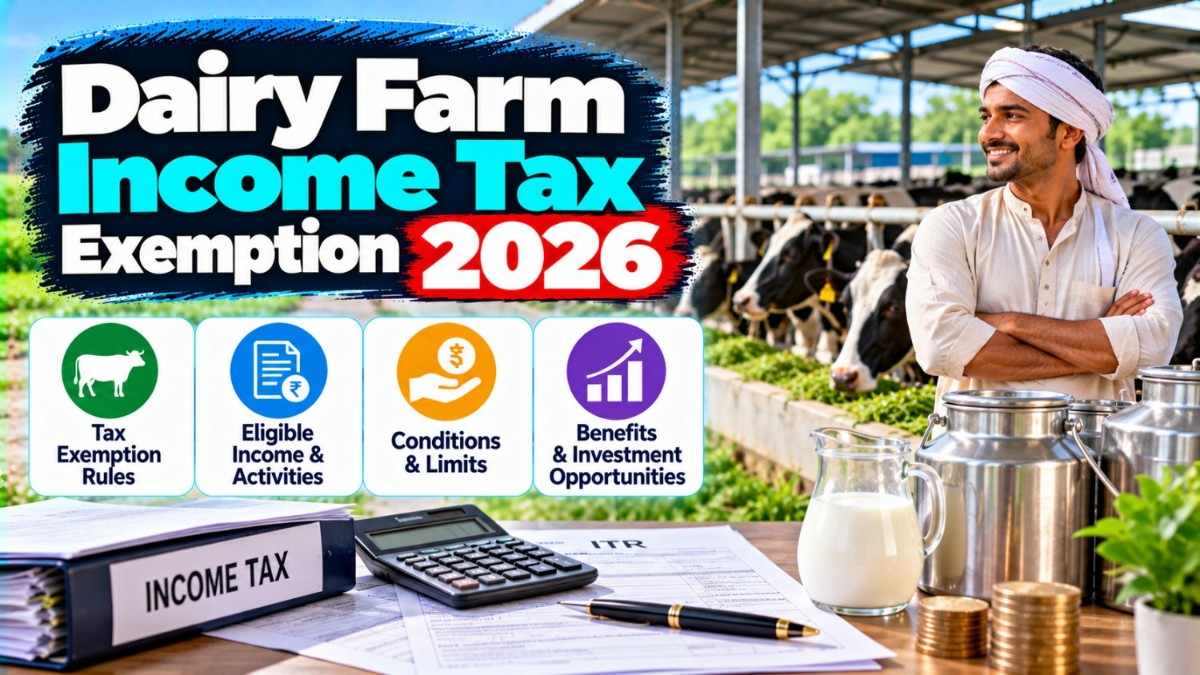
Section 10(1) of the Income Tax Act, 1961 (now mapped to Schedule II of the Income Tax Act, 2025) exempts agricultural income from income tax with no monetary ceiling. Even if a farmer earns Rs. 1 crore from wheat, paddy, or sugarcane cultivation on Indian land, every rupee of that income is exempt from central income tax. This is one of the most powerful tax exemptions in India.

Agricultural income is defined under Section 2(1A) of the Income Tax Act, 1961. For income to qualify under Section 10(1), it must meet all three conditions below:
- The income must be derived from land situated in India (land outside India does not qualify)
- The land must be used for agricultural purposes — cultivation must be the core activity
- The income must result from cultivation of crops or management of farm buildings essential to agricultural operations
Agricultural income that typically qualifies under Section 10(1) includes: rent from agricultural land, income from growing crops (wheat, rice, cotton, vegetables), income from orchards and plantations (with partial exemptions for tea and coffee), and income from farm buildings used for agricultural operations.
What does NOT qualify as agricultural income? The Income Tax Act is explicit: income from dairy farming, poultry, fisheries, animal husbandry, bee-keeping, and wool rearing does not qualify as agricultural income — even if these activities are carried out on farmland. The reason is simple: these activities do not involve cultivation of land, and the income does not derive from the land itself.
Is Dairy Farm Income Agricultural Income Under India’s Tax Law?
No — dairy farm income is not agricultural income under the Income Tax Act. Milk production, cattle rearing, sale of dairy products (paneer, ghee, butter, curd), and sale of cattle are all classified as business income under the head “Profits and Gains of Business or Profession” (PGBP) and are fully taxable. This classification has been consistently upheld by Income Tax Appellate Tribunals across India.
The critical legal reason: dairy income fails the land-derivation test. Under Section 2(1A), income must be derived from land. Milk comes from cows and buffaloes — not from land. Even if your dairy farm is built on agricultural land, and even if you grow fodder on that same land, the income from selling milk or dairy products is treated as a separate business activity and taxed accordingly.
What About Mixed Farms — Where Dairy and Crop Farming Happen Together?
If you run a farm that includes both crop cultivation and dairy cattle, you have two separate streams of income: (1) agricultural income from crops — exempt under Section 10(1), and (2) business income from dairy operations — fully taxable. You must maintain separate accounts and report them under the correct heads. Growing fodder on agricultural land can be treated as agricultural income, but the milk produced from cattle fed that fodder is still business income.
Who Should Read This Dairy Farm Tax Guide?
- 🐄 Individual dairy farm owners with 5–50 cows or buffaloes selling milk to co-operatives or local markets
- 🏪 Milk parlour and dairy booth operators running retail outlets for branded or fresh milk
- 🌾 Mixed farmers who grow crops on their land AND maintain dairy animals, and are confused about which income is taxable
- 👨👩👧👦 HUF (Hindu Undivided Family) dairy operations seeking clarity on how family-run dairy income is taxed
- 🤝 Members of dairy cooperative societies (Amul, Mother Dairy, state co-ops) who want to understand Section 80P benefits
- 📊 Large-scale dairy entrepreneurs with annual turnover above Rs. 50 lakh exploring audit requirements and tax efficiency
- 📝 Chartered accountants and tax advisors serving rural and agri-business clients in India
- 🎓 Agriculture graduates and young entrepreneurs planning to start dairy businesses and understand the tax framework before investing
Types of Dairy Farm Income and Their Tax Treatment (2026)
Every dairy farm generates multiple streams of income. Each stream has a different tax classification. The table below summarises how each type of dairy income is taxed for AY 2026-27:
| Income Type | Tax Classification | Taxable? | Applicable Section |
|---|---|---|---|
| Sale of milk (raw) | Business Income (PGBP) | ✅ Yes — fully taxable | Section 28 / 44AD |
| Sale of processed dairy products (ghee, paneer, butter, curd) | Business Income (PGBP) | ✅ Yes — fully taxable | Section 28 |
| Sale of cattle, calves, heifers | Business Income (PGBP) | ✅ Yes — cattle = stock-in-trade | Section 28 |
| Income from fodder crops grown on own land | Agricultural Income | ❌ Exempt under Section 10(1) | Section 10(1) |
| Crop income from the same farm (wheat, paddy) | Agricultural Income | ❌ Exempt under Section 10(1) | Section 10(1) |
| Rent from agricultural land | Agricultural Income | ❌ Exempt under Section 10(1) | Section 10(1) |
| Manure/dung cake sales | Business Income (PGBP) | ✅ Yes — ancillary business income | Section 28 |
| Subsidy from NABARD/State Government (capital subsidy) | Capital Receipt / Business Income | Subject to conditions — often non-taxable if capital in nature | Sec 2(24) / Sec 41 |
Section 44AD Presumptive Taxation — The Best Option for Dairy Business Owners
Section 44AD of the Income Tax Act (mapped to Section 58 under the Income Tax Act, 2025) is the most practical tax option for small and medium dairy farm owners in India. Under this presumptive scheme, you declare 8% of your gross turnover as taxable income (or 6% if all receipts are through digital/banking channels), without needing to maintain detailed books of account. This eliminates the burden of tracking every expense, and avoids mandatory tax audit for eligible businesses.
For FY 2025-26 (AY 2026-27), the turnover limit for Section 44AD is Rs. 3 crore — provided that at least 95% of your business receipts come through banking or digital channels (cheque, NEFT, UPI, etc.). If you receive more than 5% of receipts in cash, the limit is Rs. 2 crore.
Section 44AD Eligibility for Dairy Farm Owners
- ✅ Resident individual, Hindu Undivided Family (HUF), or resident partnership firm (not LLP)
- ✅ Engaged in an eligible business — dairy farming qualifies as a business under PGBP
- ✅ Turnover does not exceed Rs. 3 crore in FY 2025-26 (with 95%+ digital receipts)
- ❌ Not applicable to LLPs, companies, or non-resident taxpayers
- ❌ Not applicable to those claiming deductions under Sections 80HH to 80RRB
- ⚠️ If you opted out of Section 44AD in any previous year, you cannot re-enter for 5 years
Section 44AD Tax Calculation Example — Dairy Farm (AY 2026-27)
| Particulars | Amount (Rs.) |
|---|---|
| Annual milk sales (gross turnover) | 12,00,000 |
| Presumptive taxable income @ 8% (cash receipts) | 96,000 |
| Presumptive taxable income @ 6% (digital receipts) | 72,000 |
| Basic exemption limit (New Regime, AY 2026-27) | 4,00,000 |
| Tax payable (presumptive income below exemption) | Rs. 0 (NIL) |
| Need to maintain books of account? | No |
| Tax audit required? | No |
If you receive milk payment through cooperative society bank transfers, NEFT, or UPI — use the 6% presumptive rate (not 8%). On a turnover of Rs. 12 lakh, this reduces your presumptive income from Rs. 96,000 to Rs. 72,000. If your total income including dairy income stays under Rs. 12 lakh (new regime + rebate under Section 87A for AY 2026-27), your effective tax liability can be zero. Always accept milk payments digitally to maximise this benefit.
Which ITR Form Should Dairy Farm Owners File? (AY 2026-27)
Selecting the correct ITR form is critical for dairy farm owners. The wrong form triggers scrutiny notices and can result in defective return notices from the Income Tax Department. Here is the correct form to file for AY 2026-27 based on your income profile:
| Income Profile | Correct ITR Form | Key Notes |
|---|---|---|
| Only dairy business income, turnover under Rs. 50 lakh, using Section 44AD | ITR-4 (SUGAM) | Simplest option; no books of account needed |
| Dairy business + agricultural income (crops) | ITR-3 | If agricultural income > Rs. 5,000 and business income is also present |
| Only agricultural income (crops) + dairy income < Rs. 5,000 | ITR-2 | Use Schedule EI for agricultural income |
| Dairy business income, turnover above Rs. 50 lakh (not using 44AD) | ITR-3 | Full books of account + audit above Rs. 1 crore |
| Dairy cooperative member — only salary/commission income | ITR-1 (Sahaj) | Only if no business income and agri income ≤ Rs. 5,000 |
| HUF running a dairy business | ITR-3 or ITR-4 | HUFs cannot use ITR-1; choose based on whether 44AD is opted |
How to Report Agricultural Income in ITR When You Also Have Dairy Income
If you have both agricultural income (crops) and dairy business income, you must report them separately. In ITR-3, report dairy income under Part B — PGBP (Profits and Gains of Business or Profession). Report agricultural income under Schedule EI (Exempt Income) with the correct category and amount. Also be aware of the partial integration rule: if your net agricultural income exceeds Rs. 5,000 AND your non-agricultural income exceeds the basic exemption limit, the agricultural income is used to determine the effective tax rate on your non-agricultural income — even though the agricultural income itself remains exempt.
Dairy Income vs Agricultural Income — Complete Comparison
| Parameter | Agricultural Income (Crops) | Dairy Farm Income (Milk/Cattle) |
|---|---|---|
| Tax Status | Exempt under Section 10(1) | Fully taxable as PGBP |
| Income Source | Derived from land (crops, rent) | Derived from animals (milk, cattle) |
| Land Derivation Test | ✅ Passes | ❌ Fails |
| ITR Form (standalone) | ITR-1 (if ≤ Rs. 5,000) / ITR-2 | ITR-4 (44AD) or ITR-3 |
| Books of Account | Not required for exempt income | Required (unless Section 44AD opted) |
| State Government Tax | May be taxable by state | Taxed by Central Govt |
| Partial Integration Rule | Applies (if agri income > Rs. 5,000) | Does not apply — taxed directly |
| Applicable to Fodder Crops | ✅ Fodder crops on own land = agricultural income | ❌ Milk from cattle fed that fodder = business income |
| Cooperative Society Benefit | N/A | Section 80P deduction for primary co-ops |
The single biggest tax mistake dairy farmers make is assuming milk income is agricultural income. It is not — and has never been treated as such under Indian income tax law. The Income Tax Appellate Tribunal has repeatedly upheld this position. If you have been filing incorrect returns treating dairy income as exempt, file a revised return immediately for open assessment years. Use Section 44AD going forward to minimise your tax liability legally without complex bookkeeping.
Legal Tax-Saving Tips for Dairy Farm Owners in 2026
Even though dairy income is fully taxable, smart dairy farm owners in India can legally reduce their tax burden significantly through proper planning. Here are the most effective and legally valid strategies for AY 2026-27:
- Opt for Section 44AD Presumptive Taxation: Declare only 8% of turnover (6% for digital receipts) as taxable income. On a turnover of Rs. 20 lakh, your taxable income is just Rs. 1.6 lakh — well below the Rs. 4 lakh basic exemption under the new tax regime.
- Maximise digital receipts: Accept all milk payments through UPI, NEFT, or bank transfers to qualify for the lower 6% presumptive rate instead of 8%.
- Separate agricultural income from dairy income: If you grow crops on your land, maintain separate records. The crop income is fully exempt under Section 10(1), reducing your total taxable income significantly.
- Claim depreciation on assets under regular taxation: If you do NOT opt for Section 44AD and maintain full books, you can claim depreciation on cattle sheds, milking equipment, refrigeration units, and transport vehicles. Dairy cattle are treated as business assets (block of assets) and depreciation is claimable under Section 32.
- Deduct all allowable business expenses: Under regular PGBP taxation (not 44AD), claim expenses for cattle feed, veterinary costs, insurance, labour, electricity, and transport to reduce net taxable income.
- Form a dairy cooperative: Primary cooperative societies supplying milk to a federal cooperative can claim the full profit related to milk supply as a deduction under Section 80P — this can eliminate tax liability for the cooperative entirely.
- Use the new tax regime’s higher rebate: Under the new regime for AY 2026-27, income up to Rs. 12 lakh is effectively tax-free (after rebate under Section 87A). Dairy farmers with modest incomes benefit significantly from this provision.
Dairy Cooperative Societies — Section 80P Tax Exemption
If you are a member of or managing a dairy cooperative society (such as a state milk union affiliated to NDDB, or a village-level primary dairy cooperative), Section 80P of the Income Tax Act provides powerful tax deductions that can effectively make the cooperative’s dairy income tax-free.
The Union Budget 2026-27 extended additional benefits to dairy cooperatives. Key provisions now in force include:
- Section 80P full deduction: Primary cooperative societies supplying milk to a federal cooperative society can claim a deduction for their entire profit related to milk supply to union societies
- Reduced surcharge: Surcharge for cooperative societies with income above Rs. 1 crore and up to Rs. 10 crore has been reduced from 12% to 7%
- Lower Alternate Minimum Tax: AMT for cooperative societies reduced from 18.5% to 15%, bringing them on par with companies
- Cattle feed deduction: The Union Budget 2026-27 extended Section 80P deductions to cover cattle feed — a direct benefit for primary cooperatives supplying about 102 lakh metric tonnes of cattle feed annually
- Dividend income: Income from dividends received by one cooperative society from another is now deductible under the new tax regime, provided it is distributed onward to members
Important Tax Terms Every Dairy Farm Owner Must Know
Understanding these key tax terms will help you file your ITR correctly and communicate effectively with your CA or tax advisor:
- PGBP (Profits and Gains of Business or Profession): The income tax head under which dairy business income is taxed. All dairy farm income — milk sales, cattle sales, dairy product sales — falls under PGBP.
- Section 10(1) Exemption: The provision that exempts agricultural income derived from land situated in India. Dairy income does NOT qualify under this section.
- Section 44AD Presumptive Taxation: A simplified scheme for small businesses allowing declaration of 8% (or 6% digital) of turnover as taxable income, without maintaining detailed accounts. Turnover limit: Rs. 3 crore for FY 2025-26.
- Schedule EI (Exempt Income): The schedule in ITR where you report agricultural income and other exempt income. Dairy income is NOT reported here — it goes under PGBP.
- Partial Integration Rule: When agricultural income exceeds Rs. 5,000 AND non-agricultural income exceeds the basic exemption limit, agricultural income is added to non-agricultural income only to compute the effective tax rate, not the actual tax base.
- Section 80P: Deduction available to cooperative societies on income from specified activities, including milk supply by primary dairy cooperatives to federal cooperatives.
- Business Code 01009: The official Income Tax Department business code for “Rearing of animals and production of animal products” — this is the code dairy farm owners should use in their ITR under nature of business.
- Tax Audit (Section 44AB): Mandatory for businesses with turnover above Rs. 1 crore (or Rs. 3 crore with 95%+ digital receipts) who do not opt for Section 44AD. If you opt for Section 44AD, no audit is required as long as you declare income at or above the presumptive rate.
- AY vs FY: Financial Year (FY) 2025-26 is the year you earn income (April 2025 – March 2026). Assessment Year (AY) 2026-27 is the year you file your ITR for that income.
- New Regime Basic Exemption (AY 2026-27): Rs. 4,00,000 — income up to this limit attracts zero tax. Combined with Section 87A rebate, income up to Rs. 12 lakh is effectively tax-free for most individual taxpayers.
Important Links for Dairy Farm Income Tax Filing
| Resource | Link |
|---|---|
| Income Tax Department — Official ITR Filing Portal | www.incometax.gov.in |
| Income Tax India — Benefits for Farmers (Section 10(1)) | incometaxindia.gov.in — Farmer Benefits |
| NABARD — Dairy Financing and Subsidies | www.nabard.org |
| NDDB — National Dairy Development Board | www.nddb.coop |
| Department of Animal Husbandry & Dairying — India | dahd.nic.in |
| Agrijob.in — Agriculture Jobs & Farming Guides | www.agrijob.in |
Conclusion — What Dairy Farmers Must Do About Taxes in 2026
The bottom line on dairy farm income tax exemption 2026 is clear: dairy income is taxable business income, not exempt agricultural income under Section 10(1). The sooner dairy farm owners accept this and file correct returns, the better — incorrect filings can attract scrutiny, penalties, and interest under Sections 234A, 234B, and 234C. The good news is that Section 44AD presumptive taxation dramatically simplifies compliance for most small and medium dairy farmers, and with the new tax regime’s Rs. 12 lakh effective tax-free threshold, many dairy farmers may owe zero tax legally.
Your next steps: review your income profile, choose the correct ITR form from the table above, and either opt for Section 44AD for simple compliance or consult a CA if your turnover exceeds Rs. 50 lakh. Bookmark this page — it is updated every time official rules change under the Income Tax Act or Union Budget.
- Dairy farm income (milk, cattle, dairy products) is NOT exempt under Section 10(1) — it is fully taxable business income
- Section 10(1) exempts only income derived from land — milk comes from animals, so dairy income fails the land-derivation test
- Small dairy farmers with turnover up to Rs. 3 crore can use Section 44AD and declare only 6–8% of turnover as taxable income
- For AY 2026-27, use ITR-4 (Section 44AD) or ITR-3 (full books) — never ITR-1 if dairy is your business income
- Dairy cooperative societies supplying milk to federal co-ops can claim full profit deductions under Section 80P — effectively making cooperative dairy income tax-free
- The Union Budget 2026-27 boosted animal husbandry funding by 16% to Rs. 6,153 crore — verify current subsidy schemes at dahd.nic.in before applying
Frequently Asked Questions About Dairy Farm Income Tax Exemption 2026
Is dairy farm income exempt from income tax in India?
No. Dairy farm income — including milk sales, cattle sales, and sale of dairy products — is fully taxable as business income under the head “Profits and Gains of Business or Profession” (PGBP). The Section 10(1) exemption for agricultural income does not apply to dairy operations because milk is derived from animals, not from the land itself. This position is consistently upheld by Indian income tax law and tribunal rulings.
What is Section 10(1) of the Income Tax Act and does it apply to dairy farmers?
Section 10(1) of the Income Tax Act, 1961 (now Schedule II of the Income Tax Act, 2025) exempts agricultural income from central income tax with no upper limit. It applies to income derived from cultivating land situated in India — such as income from crops, orchards, and rent from agricultural land. Dairy farming, poultry, fisheries, and animal husbandry are explicitly excluded from the definition of agricultural income under Section 2(1A) of the Act. So no, Section 10(1) does not exempt dairy farm income.
Which ITR form should a dairy farm owner file for AY 2026-27?
Dairy farm owners should generally file ITR-4 (SUGAM) if their turnover is below Rs. 50 lakh and they opt for Section 44AD presumptive taxation. Those with turnover above Rs. 50 lakh, or who also have capital gains or other complex incomes, should file ITR-3. If you have both dairy business income and agricultural income from crops, ITR-3 is the correct form regardless of turnover. Never use ITR-1 if dairy farming is your primary business.
Can I use Section 44AD for my dairy business?
Yes. Dairy farming is treated as an eligible business under Section 44AD. As a resident individual, HUF, or partnership firm (not LLP) with total dairy turnover up to Rs. 3 crore (FY 2025-26 / AY 2026-27 — 95%+ digital receipts required), you can opt for Section 44AD and declare 8% of turnover (or 6% for fully digital receipts) as your taxable income. This eliminates the need for detailed bookkeeping and tax audit, provided you declare income at or above the presumptive rate.
What is the income tax rate for dairy farm income in 2026?
Dairy business income is taxed at the applicable individual income tax slab rates. Under the new tax regime for FY 2025-26 (AY 2026-27): income up to Rs. 4 lakh is exempt, Rs. 4–8 lakh is taxed at 5%, Rs. 8–12 lakh at 10%, Rs. 12–16 lakh at 15%, Rs. 16–20 lakh at 20%, Rs. 20–24 lakh at 25%, and above Rs. 24 lakh at 30%. Most small dairy farmers using Section 44AD will find their presumptive taxable income falls well below the Rs. 4 lakh exemption limit, resulting in zero tax liability.
Is income from growing fodder crops on my farm taxable?
No. Income from growing fodder crops on agricultural land in India qualifies as agricultural income under Section 10(1) and is exempt from central income tax. The exemption applies to the crop income from the land, not to the milk produced by cattle fed that fodder. So a mixed farmer can legitimately separate their fodder crop income (exempt) from their dairy milk income (taxable) — provided proper records are maintained for both activities.
Are dairy cooperative societies exempt from income tax?
Dairy cooperative societies are not automatically exempt, but they can claim significant deductions under Section 80P of the Income Tax Act. Primary cooperative societies that supply milk to a federal cooperative society can deduct their entire profit from milk supply, effectively making that portion tax-free. The Union Budget 2026-27 also extended the Section 80P deduction to cover cattle feed sold by primary cooperatives, and reduced the surcharge on co-ops from 12% to 7% for incomes between Rs. 1 crore and Rs. 10 crore.
Do I need to maintain books of account for my dairy business?
If you opt for Section 44AD presumptive taxation, you are not required to maintain detailed books of account as long as you declare income at the prescribed presumptive rate (8% or 6% of turnover). However, if your actual profit is lower than the presumptive rate and you want to declare the lower actual income, you must maintain full books and get a tax audit done under Section 44AB. Businesses with turnover above Rs. 3 crore (or Rs. 1 crore without digital payment compliance) must mandatorily maintain books and get them audited.
What happens if I have incorrectly filed dairy income as agricultural income in previous years?
If you have treated dairy income as exempt agricultural income in past ITR filings, you may have filed incorrect returns. You can file a revised return for assessment years that are still open (generally up to 2 years from the end of the relevant assessment year). It is strongly advisable to consult a Chartered Accountant to assess your exposure, calculate any interest under Sections 234A, 234B, 234C, and file revised returns before the Income Tax Department initiates scrutiny. Voluntary disclosure and correction attracts lesser penalties compared to assessment-initiated correction.
Is the NABARD dairy farming subsidy taxable?
Capital subsidies received under government schemes (NABARD-linked state schemes, Rashtriya Gokul Mission, AHIDF) are generally treated as capital receipts and are not taxable as income if they are used to set up fixed assets. However, if you deduct the cost of the asset (including the subsidised portion) as depreciation and later receive the subsidy, the subsidy amount may become taxable. The specific tax treatment depends on the scheme terms and how the subsidy is accounted. It is advisable to consult a tax professional for your specific situation. Note that the old NABARD DEDS scheme offering 25–33% direct subsidy was discontinued from FY 2020-21; current dairy support is routed through Rashtriya Gokul Mission and state animal husbandry schemes.
Last Updated: October 2026 | This guide is reviewed and updated regularly for accuracy. Bookmark this page for the latest dairy farm income tax rules and ITR filing information.
Disclaimer: This article is for general informational purposes only and does not constitute professional tax or legal advice. Tax laws are subject to change with each Union Budget and Finance Act. Consult a qualified Chartered Accountant or tax advisor for advice specific to your income profile and filing situation. All figures and rules cited are as per Income Tax Act, 1961 / Income Tax Act, 2025 and Union Budget 2026-27 provisions available as of October 2026.