

Wasabi cultivation outside Japan 2026 is finally becoming commercially realistic, with fresh Wasabia japonica rhizomes fetching up to $160 per kilogram in the United States alone. Real wasabi remains one of the rarest crops on earth, and Japan’s own production has fallen by roughly 70% over the past two decades as farmers age out and summers grow hotter. This guide is for agri-entrepreneurs, hill-region farmers, polyhouse investors, and exporters who want to evaluate wasabi as a high-value niche crop for Western sushi and specialty-food markets. You’ll find the real cultivation requirements, setup costs, a step-by-step growing process, and where in the world — including India’s Himalayan belt — this notoriously fussy plant might actually work in 2026.

Wasabi cultivation outside Japan 2026 is achievable in cool, shaded, high-humidity sites with constant clean water between 8–20°C (46–70°F). Commercial growers in the USA, UK, New Zealand, Taiwan, and Canada now supply fresh rhizomes at $100–$300/kg, with US-grown wasabi reaching $160/kg. A small trial setup (about 120 sq ft) costs $4,000–$7,000, while a full climate-controlled farm can run close to $500,000, and harvest takes 18–24 months outdoors or as little as 10 months in advanced controlled-environment systems.
- Botanical name: Wasabia japonica / Eutrema japonicum (Brassicaceae family)
- Fresh rhizome price: $100–$300/kg globally; up to $160/kg in the USA (~₹15,300/kg at ~₹95.7/USD)
- Genuine wasabi powder: $200–$400/kg (organic lots can exceed $500/kg)
- Global market size: $0.56 billion (2026) → $1.17 billion by 2035 (8.58% CAGR)
- Ideal temperature: 8–20°C (46–70°F); ideal water pH: 6.5–7.5
- Time to harvest: 18–24 months traditional; ~10 months in climate-controlled systems
- Countries growing outside Japan: USA, UK, Canada, New Zealand, Taiwan, South Korea, Netherlands, Israel, Brazil, Colombia, Iceland, Thailand
- Small-farm startup cost: $4,000–$7,000; large climate-controlled farm: up to $500,000
- Shelf life after harvest: 3–4 weeks refrigerated
- Japan’s own production: down roughly 70% over the last 20 years
- 1. What Is Wasabi Cultivation Outside Japan?
- 2. Who Should Explore Wasabi Cultivation Outside Japan?
- 3. Wasabi Price Per Kg 2026: The Money Behind the Crop
- 4. Climate, Site & Investment Requirements
- 5. How to Grow Wasabi: Step-by-Step Process
- 6. Sawa vs Oka Wasabi Cultivation
- 7. Pros and Cons of Wasabi Cultivation
- 8. Important Terms Every Grower Should Know
- 9. Wasabi Growing Timeline
- 10. Important Links for Wasabi Growers
- 11. Conclusion
- 12. FAQs
What Is Wasabi Cultivation Outside Japan? The Wasabia Japonica Basics
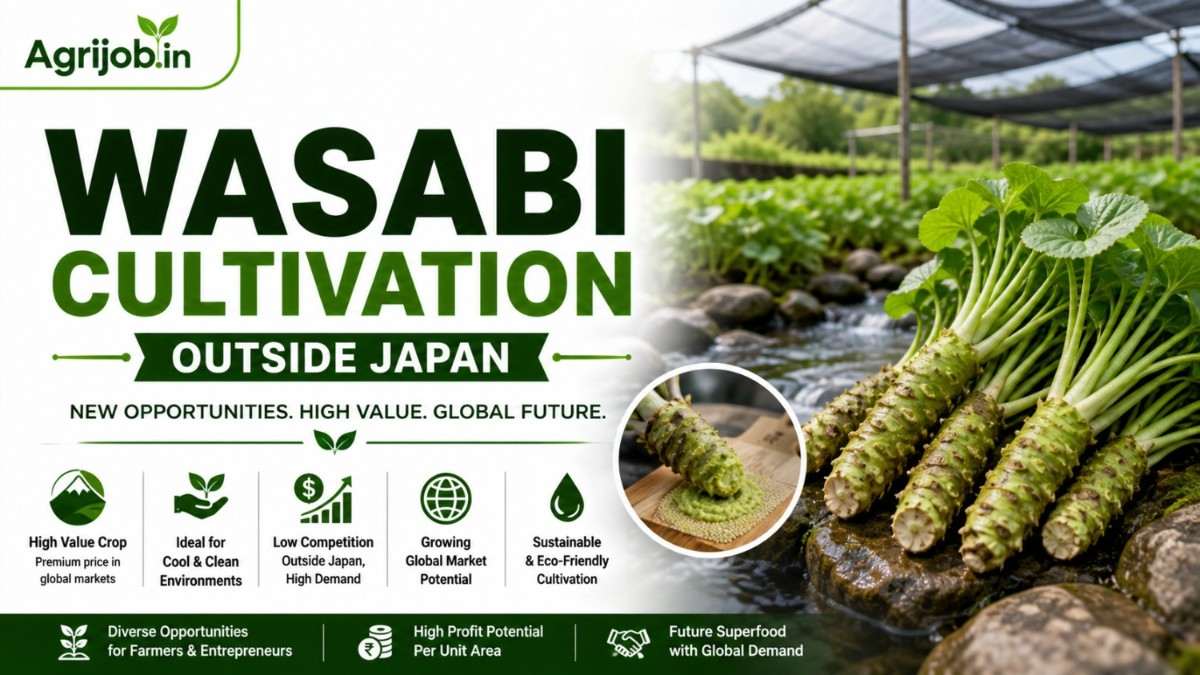
Wasabi cultivation outside Japan means growing genuine Wasabia japonica (also called Eutrema japonicum) — the pungent Brassicaceae rhizome used in real sushi condiment — in countries such as the USA, UK, Canada, New Zealand, and Taiwan instead of its native Japanese mountain streams, where, per Britannica, cultivation is concentrated in Shizuoka’s Izu Peninsula and the Iwate and Nagano prefectures.
Most of what’s served as “wasabi” in restaurants outside Japan isn’t wasabi at all — it’s a mix of horseradish, mustard powder, and green dye, because genuine rhizomes are scarce and expensive. True wasabi shares the Brassicaceae family with horseradish and mustard, but it’s a distinct, slower-growing, far pickier plant native to Japan, South Korea, and Sakhalin, Russia.

Outside Japan, commercial wasabi is now grown in Taiwan, South Korea, New Zealand, Iceland, Thailand, Colombia, Israel, Brazil, Canada, the USA, the Netherlands, and the United Kingdom. Notable farms include Real Wasabi’s 75-acre operation in Cullowhee Mountain, North Carolina, and the Wasabi Company’s stream-fed plantings in Hampshire and Dorset, England.
- Sawa (semi-aquatic): grown in flowing mountain-stream-bed gravel — produces the highest-quality, sushi-grade rhizome
- Oka (field): grown in soil beds without flowing water — lower quality, mostly used for industrial or processed wasabi products
Who Should Explore Wasabi Cultivation Outside Japan?
- 🌱 Hill-region farmers in Sikkim, Himachal Pradesh, Uttarakhand, or the Nilgiris with access to cold spring water and shaded land
- 🏭 Polyhouse and greenhouse investors looking to diversify beyond tomatoes, capsicum, and strawberries into a higher-margin niche crop
- 🍣 Exporters and agri-entrepreneurs targeting booming Japanese-restaurant demand in the USA, UK, and EU
- 🎓 Horticulture researchers, FPOs, and SHGs evaluating exotic, climate-resilient specialty crops
- 💰 Investors seeking a long-horizon (18–24 month) crop with premium, comparatively recession-resistant pricing
- 🧪 Controlled-environment agriculture (CEA) and vertical-farming operators with spare climate-controlled space
- 🌏 NRIs or diaspora entrepreneurs looking to link Indian production with Western specialty-food buyers
- 🚫 Not a fit for first-time farmers without dependable clean water and real shade — wasabi has one of agriculture’s steepest learning curves
Wasabi Price Per Kg 2026: The Money Behind the $160/kg Crop
Fresh wasabi rhizome sells for $100–$300 per kilogram worldwide, with US-grown rhizome reaching $160/kg (roughly ₹15,300/kg at current exchange rates) and South Korean growers reporting prices near $300/kg. Genuine wasabi powder commands $200–$400/kg, and organic or single-origin batches can exceed $500/kg.
| Product / Form | Typical Price Range |
|---|---|
| Fresh rhizome (Japan) | $100–$300/kg |
| Fresh rhizome (USA) | Up to $160/kg |
| Fresh rhizome (South Korea) | ~$300/kg |
| Genuine wasabi powder | $200–$400/kg |
| Premium / organic powder | $500+/kg |
| Imitation wasabi powder (horseradish blend) | $8–$30/kg |
| Global wasabi market size (2026) | $0.56 billion |
| Projected market size (2035) | $1.17 billion (8.58% CAGR) |
This pricing gap is exactly why cultivation outside Japan is attracting investment. Japan’s domestic wasabi output has fallen by roughly 70% over the past two decades as its farming population ages and summers grow too hot for the crop, while demand keeps climbing. Japanese restaurants in the US grew 37% since before the pandemic, and nearly 58% of sushi restaurants outside Asia now serve real or blended wasabi.
Climate, Site & Investment Requirements for Growing Wasabi
Before you plant a single rhizome, your site needs to pass a basic climate test. Wasabi tolerates almost no deviation from its native mountain-stream habitat, so skipping this step is the single biggest reason first attempts fail.
- Temperature: 8–20°C (46–70°F) year-round; sustained heat above 26–27°C stresses the plant
- Humidity: consistently high, especially through summer
- Light: dappled shade or 80%+ shade cloth — direct sun scorches the leaves
- Water: constant flow of clean, mineral-rich, oxygenated water; pH 6.5–7.5
- Substrate: gravel, coarse loam, or well-draining media — never stagnant soil
- Space: minimum ~120 sq ft (11 sqm) for a viable small trial batch
- Disease control: blackleg fungal disease and root rot are the two biggest risks
| Setup Scale | Estimated Investment |
|---|---|
| Small hobby/trial setup (100–200 rhizomes/year, ~120 sq ft) | $4,000–$7,000 |
| 10,000 sq ft climate-controlled greenhouse shell | $200,000–$300,000 |
| Large commercial farm (40m × 40m, ~40,000 plants) | ~$500,000 |
Costs scale roughly with plant count and how much climate control you build in. Get on-site quotes from a local greenhouse contractor and a water/agronomy consultant before committing capital — costs vary sharply by region, labour rates, and existing infrastructure. For guidance on structuring a formal project report before you approach a bank or investor, see our farm project report guide.
How to Grow Wasabi Outside Japan: Step-by-Step Process
Growing wasabi is less about gardening skill and more about environmental control. Follow this sequence to move from bare land to your first harvest.
- Test your site’s water and climate. Confirm year-round 8–20°C air temperature, high humidity, and access to constant, clean, mineral-rich water before investing further.
- Source certified, tissue-cultured rhizomes or starter plants. Uncertified grocery-store roots have roughly half the success rate of tissue-cultured stock.
- Build a shade structure. Use 80%+ shade cloth, a natural forest canopy, or a climate-controlled greenhouse, matched to your budget tier.
- Set up the growing bed. Choose sawa (semi-aquatic, stream-fed gravel) for premium quality, or oka (field beds) for lower-cost, lower-grade output.
- Plant and monitor closely. Maintain steady water flow, watch for blackleg and root rot, and keep substrate consistently moist but never waterlogged.
- Wait for maturity. Allow 18–24 months outdoors, or roughly 10 months in advanced climate-controlled systems, for rhizomes to bulk up.
- Harvest by hand. Mature rhizomes are cut individually since the plant does not ripen uniformly across a bed.
- Cold-chain and sell fast. Fresh rhizome stays usable for only 3–4 weeks refrigerated, so line up restaurant or specialty-grocer buyers before harvest.
Don’t build a full commercial bed on your first attempt. Start with a 6–12 rhizome trial in a shaded container setup using a pot at least 6–8 inches deep and a mix of compost, fine bark, and perlite. It lets you learn your microclimate’s failure points before committing real capital.
Sawa vs Oka Wasabi Cultivation: Which Method Wins?
Every wasabi grower has to pick a method early, because it determines your infrastructure cost, output quality, and buyer market. Here’s how the two compare.
| Dimension | Sawa (Semi-Aquatic) | Oka (Field) |
|---|---|---|
| Growing medium | Flowing stream-bed gravel | Soil beds |
| Rhizome quality | Premium, sushi-grade | Lower grade, industrial use |
| Water requirement | Constant clean flow required | Regular irrigation, no flow needed |
| Setup cost | Higher (water infrastructure) | Lower |
| Time to maturity | 18–24 months | Similar, sometimes faster |
| Edible raw | Yes | Often inedible raw; processed only |
| Typical end use | Fresh rhizome for sushi/sashimi | Powder, paste, processed flavoring |
| Best for | Premium export & restaurant supply | Bulk processed-wasabi manufacturers |
For growers targeting Western restaurant and specialty-retail markets at $100–$300/kg, sawa cultivation is worth the extra infrastructure cost — that’s where the $160/kg US pricing lives. Oka cultivation only makes sense if you’re supplying bulk processors, where margins are thinner.
Pros and Cons of Wasabi Cultivation Outside Japan
Pros:
- Genuinely scarce crop with premium, comparatively recession-resistant pricing ($100–$300+/kg)
- Global demand is rising over 8% annually while Japan’s own supply keeps shrinking
- A mature bed keeps producing rhizomes for years once established
- Multiple revenue streams — fresh rhizome, leaves, stems, and flowers are all sellable
Cons:
- Extremely narrow environmental tolerance — small climate mistakes can kill the crop
- High upfront capital for water infrastructure or climate control ($4,000 to $500,000+)
- Long 18–24 month wait before first revenue
- Susceptible to blackleg disease, which spreads fast and can wipe out an entire bed
Important Terms Every Wasabi Grower Should Know
- Wasabia japonica / Eutrema japonicum: the botanical name for true wasabi — a Brassicaceae plant, not a chili or pepper.
- Rhizome: the thick underground stem that’s harvested and grated — the part worth up to $160/kg.
- Sawa cultivation: semi-aquatic, stream-bed growing method that produces premium-grade rhizome.
- Oka cultivation: field-grown method producing lower-grade, mostly industrial-use rhizome.
- Isothiocyanates (ITCs): the pungent, antimicrobial compounds — including 6-MSITC and allyl isothiocyanate — behind wasabi’s heat. Peer-reviewed research has found these compounds active against foodborne pathogens like E. coli O157:H7 and S. aureus, and a 2024 review covers ongoing study into 6-MSITC for anti-inflammatory and anticancer applications.
- Myrosinase: the plant enzyme that reacts with damaged tissue to release isothiocyanates when wasabi is grated.
- Blackleg: a fast-spreading fungal disease and the leading cause of commercial wasabi crop loss.
- Shade house: a mesh or lath structure providing 80%+ shade — the lowest-cost entry point for wasabi cultivation.
- GIAHS: Globally Important Agricultural Heritage System status — Shizuoka’s traditional wasabi terraces hold this FAO designation.
- Cold chain: refrigerated logistics needed because fresh rhizome stays usable for only 3–4 weeks after harvest.
For growers exploring related niche and government-backed crop opportunities, see our National Makhana Board 2026 guide and our PMFME food-processing scheme guide for niche crops — both cover a similar high-value, low-competition crop-diversification playbook.
Wasabi Growing Timeline: From Rhizome to Harvest
| Stage | Traditional Outdoor | Climate-Controlled |
|---|---|---|
| Planting | Month 0 | Month 0 |
| Root establishment | Months 1–4 | Months 1–3 |
| Vegetative growth | Months 4–12 | Months 3–6 |
| Rhizome bulking | Months 12–20 | Months 6–9 |
| Harvest-ready | Months 18–24 | ~Month 10 |
| Shelf life post-harvest | 3–4 weeks refrigerated | 3–4 weeks refrigerated |
The climate-controlled timeline reflects results reported by emerging vertical-farm operators such as Cai Foods (USA), who describe cutting the traditional 24-month cycle to roughly 10 months using precise water, light, and nutrient control. Treat this as an industry-reported figure, not a guarantee — check current data with your equipment supplier, since results vary by system and region.
Important Links for Wasabi Growers
| Resource | Link |
|---|---|
| FAO Shizuoka Wasabi GIAHS Profile | sfcs.fao.org |
| ICAR Research Complex for NEH Region, Sikkim Centre | icarneh.icar.gov.in |
| PubMed: Antibacterial Activity of Wasabi (E. coli, S. aureus) | ncbi.nlm.nih.gov |
| PubMed: Wasabi’s 6-MSITC — Cancer, Alzheimer’s & Obesity Review | ncbi.nlm.nih.gov |
| Britannica: Wasabi Overview | britannica.com |
| Related: National Makhana Board 2026 Guide | Read guide |
| Related: Dairy Farm Project Report Guide | Read guide |
Conclusion: Is Wasabi Cultivation Outside Japan Worth It in 2026?
Wasabi cultivation outside Japan 2026 is no longer a novelty experiment — the USA, UK, Canada, New Zealand, and Taiwan already run profitable commercial farms, and India’s cool Himalayan and Nilgiri pockets show a similar climate profile to regions where saffron and cardamom pilot projects have succeeded in Sikkim and Arunachal Pradesh. The barrier isn’t demand or price; genuine rhizome at $100–$300/kg comfortably outruns almost any other horticultural crop. The real barrier is discipline — constant clean water, real shade, and 18–24 months of patient capital. Start with a small trial bed, verify your local water and climate data, and check the official research linked above before you commit further funds.
- Fresh wasabi rhizome sells for $100–$300/kg worldwide, up to $160/kg in the US
- The global wasabi market is projected to grow from $0.56B (2026) to $1.17B by 2035
- Small trial setups cost $4,000–$7,000; full commercial farms can run to $500,000
- Sawa (stream-bed) cultivation yields premium-grade rhizome; oka (field) cultivation is lower grade
- Harvest takes 18–24 months outdoors, or roughly 10 months in advanced climate-controlled systems
- Bookmark this guide and consult ICAR-NEH or your local KVK before starting a pilot plot in India
Frequently Asked Questions About Wasabi Cultivation Outside Japan 2026
What is wasabi cultivation outside Japan?
Wasabi cultivation outside Japan means growing genuine Wasabia japonica rhizomes in countries such as the USA, UK, Canada, New Zealand, and Taiwan by recreating its native cool, shaded, high-humidity stream-bed environment through shade houses, greenhouses, or controlled-environment systems.
How much does real wasabi cost per kg in 2026?
Fresh wasabi rhizome typically costs $100–$300 per kg worldwide. US-grown rhizome sells for up to $160/kg, while South Korean growers report prices near $300/kg. Genuine wasabi powder costs $200–$400/kg, and premium organic grades can exceed $500/kg.
Can wasabi be grown in India?
There is no large, established commercial wasabi farm in India as of 2026, but small suppliers already sell wasabi plants and hydroponic wasabi from Kerala. India’s cool, humid Himalayan and Nilgiri micro-climates — the same zones where ICAR’s North Eastern Hill Region centre and the DST’s NECTAR initiative have piloted saffron, cardamom, and orchid cultivation in Sikkim and Arunachal Pradesh — theoretically fit wasabi’s requirements, but no large-scale ICAR wasabi trial has been publicly documented. Consult your local Krishi Vigyan Kendra (KVK) or ICAR-NEH centre before investing.
How long does it take to grow wasabi?
Traditional outdoor wasabi cultivation takes 18–24 months from planting to harvest. Some advanced climate-controlled and vertical-farm systems report cutting this to roughly 10 months by precisely managing water, light, and nutrients, though results vary by system.
What is the difference between real wasabi and horseradish paste?
Real wasabi comes from the Wasabia japonica rhizome and has a milder, more complex, slightly sweet heat that fades quickly. Most “wasabi” served outside Japan is actually horseradish, mustard powder, and green food coloring, which delivers a sharper, longer-lasting burn and lacks wasabi’s specific isothiocyanate profile.
How much does it cost to start a wasabi farm?
A small trial setup of roughly 120 sq ft producing 100–200 rhizomes per year costs about $4,000–$7,000. A fully climate-controlled 10,000 sq ft greenhouse shell runs $200,000–$300,000, and a large commercial operation housing around 40,000 plants can cost close to $500,000.
What is the difference between sawa and oka wasabi?
Sawa wasabi is grown semi-aquatically in flowing stream-bed gravel and produces premium, sushi-grade rhizome. Oka wasabi is field-grown in soil without flowing water, costs less to set up, but yields a lower-grade rhizome mainly used for processed wasabi products.
Is wasabi farming profitable?
Wasabi can be profitable given its $100–$300/kg pricing and a global market growing at an 8.58% CAGR, but profitability depends on hitting strict climate and water conditions, surviving the 18–24 month wait for first revenue, and securing buyers willing to pay premium prices for a niche product.
What diseases affect wasabi plants?
Blackleg, a fast-spreading fungal pathogen, is the most serious wasabi disease and can kill a bed quickly. Root rot from stagnant or poorly drained water is the second major risk, which is why constant clean water flow and good drainage are non-negotiable.
Where can I sell fresh wasabi rhizome?
The primary buyers are Japanese and high-end sushi restaurants, specialty grocers, and direct-to-chef delivery services, since fresh rhizome only stays usable for 3–4 weeks refrigerated. Lining up these buyers before your first harvest is essential, as the short shelf life leaves little room for unsold stock.
Last Updated: August 2026. This guide is reviewed and updated regularly as global wasabi pricing, cultivation techniques, and market data evolve. Bookmark this page for the latest information.
Written and reviewed by Nitish Singh, Agrijob.in.
Disclaimer: This article is for general educational and informational purposes only and does not constitute financial, agricultural, or investment advice. Cultivation success depends heavily on local climate, water quality, and management practices. Verify all costs, yields, and regulatory requirements — including plant-import and quarantine rules — with ICAR, your state horticulture department, or a qualified agronomist before investing.