

Smart drip irrigation ROI in 2026 is one of the most important financial questions facing any farmer investing in water-efficient technology — because the answer determines whether a Rs.50,000-per-acre system is a smart long-term asset or an expensive experiment. The data is now in, and it is compelling: sensor-based smart drip irrigation systems save 40% to 70% of water compared to flood irrigation, increase crop yields by 20% to 47%, and recover full installation cost within 1 to 2 growing seasons for high-value horticulture crops. This complete 2026 guide breaks down exactly how much water and money sensor-based systems can save — with real figures from independent research, India and US cost data, crop-by-crop yield impact, PMKSY subsidy eligibility, payback calculations, and an honest assessment of what basic drip does versus what the sensor layer adds. Whether you farm 1 acre of tomatoes in Maharashtra or 50 acres of cotton in Texas, this guide covers installation costs, ROI timeline, government support, and the technologies driving the 2026 smart irrigation revolution.

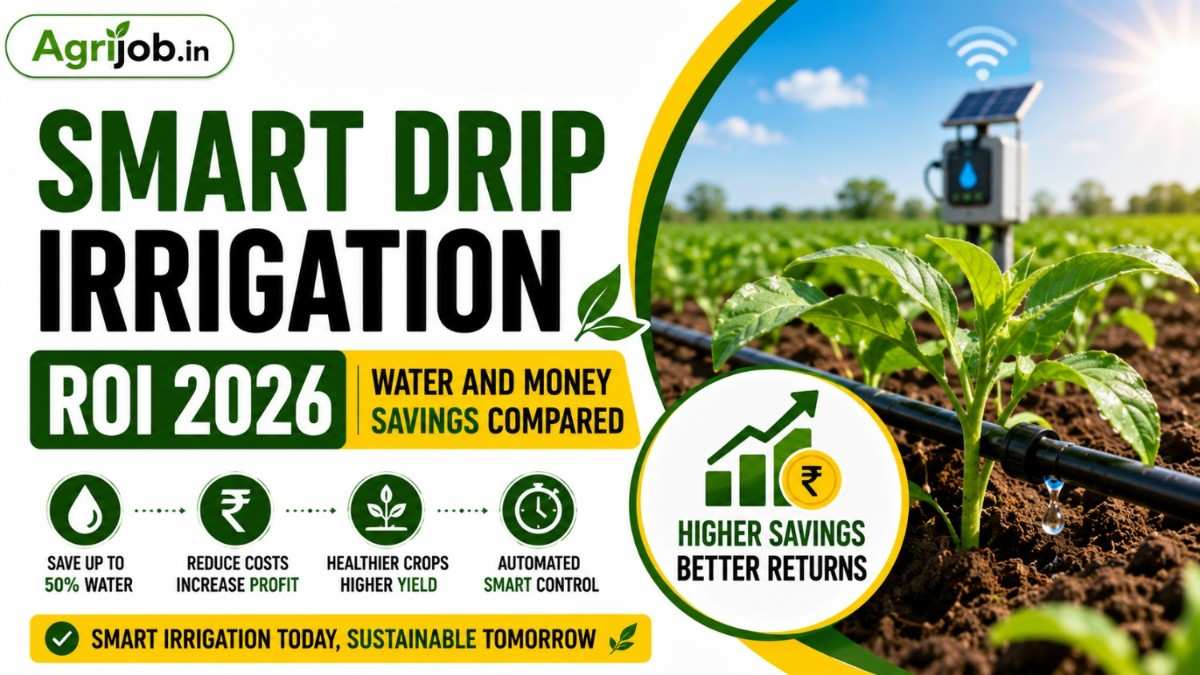
| Water Savings vs Flood Irrigation | 40%–70% (basic drip: 30–50%; sensor-based: 50–70%) |
| Water Savings vs Sprinklers | 30%–50% (US EPA confirmed figure) |
| Soil Moisture Sensor ROI (Year 1) | 200% — independent Northwest Arkansas study |
| Crop Yield Increase | 20%–47% depending on crop and system type |
| Typical Payback Period (Commercial) | 1.5–2 years (sensor-based); 2–4 years (basic drip) |
| India Cost Per Acre (Basic Drip) | Rs.35,000–Rs.60,000 (before PMKSY subsidy) |
| India Cost Per Acre (Smart IoT Layer) | Rs.8,000–Rs.50,000 additional (basic to full commercial) |
| US Drip Cost Per Acre (2026) | $800–$3,500 (above-ground to subsurface installed) |
| PMKSY Subsidy (India, 2026) | 45%–55% general; up to 90% for SC/ST and small farmers |
| Smart Irrigation Market Value | $1.8 billion (2024) → projected $3 billion by 2029 |
| Energy Savings (Smart Irrigation) | Up to 30% pump energy reduction |
| System Lifespan | 7–10 years (ISI-certified components, India) |
- The Water Crisis Driving Smart Irrigation Adoption in 2026
- Basic Drip vs Sensor-Based Smart Drip: What Is the Real Difference?
- How Much Water Does Sensor-Based Drip Irrigation Really Save?
- Crop Yield Increase Data: Smart Drip Irrigation by Crop Type
- Installation Cost Breakdown: India and US Per-Acre Comparison 2026
- ROI Calculation: When Does Smart Drip Irrigation Pay for Itself?
- PMKSY Subsidy for Smart Drip Irrigation in India 2026
- Energy and Labour Cost Savings from Smart Irrigation
- Who Should Invest in Sensor-Based Drip Irrigation in 2026?
- Complete Smart Drip Irrigation ROI Comparison Table 2026
- Key Smart Irrigation Terms You Must Know
- Frequently Asked Questions
The Water Crisis Driving Smart Irrigation Adoption in 2026
Agriculture accounts for 85% of India’s freshwater consumption — yet 80–85% of Indian farms still use flood irrigation, a method with water-use efficiency as low as 30–40%, wasting enormous volumes of an already critically scarce resource. As of April 2026, the Central Water Commission has flagged that water levels in India’s 166 monitored reservoirs have fallen below 45% of total capacity, while 256 out of 700 Indian districts face over-exploited or critical groundwater conditions. Globally, the smart irrigation market was valued at $1.8 billion in 2024 and is projected to reach $3 billion by 2029, growing at 11.2% annually — driven by government mandates, falling sensor costs, and mounting evidence of measurable farmer ROI.
The pressure is equally acute in the US. Farmers in water-stressed regions — California, Texas, the Great Plains — face mandatory water-use restrictions and rising electricity costs for groundwater pumping. In this environment, sensor-based smart drip irrigation has moved from precision farming curiosity to essential farm infrastructure, delivering returns that compound annually across water savings, yield gains, labour reduction, and energy costs. This guide quantifies every dimension of the smart drip irrigation ROI in 2026 with research-backed data.

Basic Drip vs Sensor-Based Smart Drip: What Is the Real Difference?
Understanding what the sensor layer adds — above standard drip — is essential to calculating whether the additional technology investment delivers measurable ROI above the base system. Here is the honest technical comparison:
| Feature | Basic Drip Irrigation | Sensor-Based Smart Drip Irrigation |
|---|---|---|
| Water delivery | Emitters on fixed timer schedules | Automated — triggered by real soil moisture data |
| Weather response | None — waters even before/after rain | Auto-skips irrigation when rain detected or forecast |
| Soil moisture monitoring | Not included — relies on visual inspection | Continuous, real-time soil moisture at root depth |
| Controller intelligence | Basic timer — no data input | AI/IoT controller using soil, weather, and crop data |
| Remote monitoring | Not available | Mobile app alerts, cloud dashboard, real-time control |
| Fertigation precision | Basic — fixed schedule dosing | Demand-based — fertiliser applied with irrigation trigger |
| Water savings vs flood | 30%–50% | 50%–70% |
| Yield improvement | 10%–20% (from stress reduction) | 20%–47% (from optimal root zone management) |
| Labour requirement | Moderate (manual inspection, timer adjustment) | Low (automated — minimal field visits required) |
| India cost per acre (add-on) | Base system: Rs.35,000–Rs.60,000 | +Rs.8,000–Rs.50,000 for IoT layer |
| Typical ROI payback | 2–4 years | 1–2 years (often 1–2 seasons for high-value crops) |
| System lifespan | 7–10 years (ISI components) | 7–10 years (drip) + 3–5 years (sensors/controllers) |
The core innovation in sensor-based systems is the shift from time-based to demand-based irrigation. A basic drip timer opens valves at 6am regardless of whether the soil is saturated from yesterday’s rain or parched after three dry days. A soil moisture sensor at root depth reads actual volumetric water content in real time and instructs the controller to open valves only when moisture falls below the crop-specific threshold. This single change — confirmed by multiple 2025–2026 research studies — is responsible for the additional 20–30 percentage point improvement in water savings above basic drip. The economics follow directly from the data.
How Much Water Does Sensor-Based Drip Irrigation Really Save in 2026?
The water savings question has been answered with increasing precision by multiple independent research programmes in 2025 and 2026. Here is the verified data, organised by system type and research source:
| System Type | Compared To | Water Saving | Source / Evidence |
|---|---|---|---|
| Basic drip (no sensors) | Flood irrigation | 30%–60% | Multiple field studies; ICAR, Springer Nature 2025 |
| Basic drip (no sensors) | Sprinkler systems | 30%–70% | 2026 evaluation of 50+ automated drip systems |
| Soil moisture sensors (add-on) | Conventional irrigation | 66.2% average | 3-year Northwest Arkansas independent study |
| Rain sensors (add-on) | Conventional irrigation | 22.1% average | 3-year Northwest Arkansas independent study |
| Weather-based smart controller | Standard timer irrigation | 30%–50% | US EPA confirmed estimate |
| IoT smart drip (sensors + AI) | Flood irrigation | 40%–70%+ | Forward Fooding research summary 2026 |
| IoT smart drip (sensors + AI) | Conventional drip | Up to 46.88% | Discover Agriculture, Springer Nature, Nov 2025 |
| Microsoft AI IoT (Andhra Pradesh) | Conventional irrigation | Up to 70% | Springer Nature / Microsoft India field trial |
| CropX soil sensor platform | Conventional irrigation | 40%+ | CropX verified field deployment data 2026 |
| N-Drip gravity micro-irrigation | Flood irrigation | Up to 26% additional | N-Drip field trials — water-scarce regions |
| Smart drip (rice — AWD method) | Conventional flood paddy | 25% | 2025 IoT rice irrigation pilot, India |
| Drip vs conventional (sweet corn) | Conventional irrigation | 20%–50% (evaporation reduction) | Smart Agricultural Technology journal, 2026 |
The key finding across all 2026 research: sensor-based smart drip irrigation consistently delivers 50–70% water savings versus flood irrigation, compared to 30–50% for basic drip without sensors. The Northwest Arkansas study’s finding that soil moisture sensors alone delivered a 66.2% annual water-use reduction — almost triple the 22.1% saved by rain sensors alone — makes the case powerfully that the soil moisture sensor layer is the highest-ROI single component in any smart irrigation upgrade. At typical Indian water pump electricity costs of Rs.5,000–Rs.15,000 per acre per season, a 50% reduction in pumping time translates to Rs.2,500–Rs.7,500 in direct energy savings per acre, per season — before counting any water or yield benefit.
Crop Yield Increase Data: Smart Drip Irrigation by Crop Type 2026
Yield increase from smart drip irrigation is the ROI driver that most farmers underestimate before installation — and most appreciate most after it. The mechanism is straightforward: sensor-based systems eliminate both under-watering stress (which stunts growth and reduces marketable output) and over-watering stress (which promotes root rot, fungal disease, and nutrient leaching). The result is consistently superior yield, quality, and market-grade output. Here is the verified 2026 crop-by-crop data:
| Crop | Yield Increase (Smart Drip) | Water Saving | Additional Benefit |
|---|---|---|---|
| Grapes (Maharashtra, India) | 20%–30% | 50%–60% | Better berry size; premium market grade |
| Pomegranate (Karnataka, India) | 20%–35% | 45%–65% | Reduced fruit cracking; longer shelf life |
| Tomatoes (AP/TN, India) | 25%–40% | 40%–60% | More uniform size; fewer rejections at market |
| Cotton (India / US) | 20%–30% | 40%–55% | Fewer bollworm-friendly humid conditions |
| Sugarcane (Maharashtra) | 15%–25% | 35%–50% | Higher sucrose content; better crusher yield |
| Banana (TN / AP, India) | 20%–30% | 40%–55% | More uniform bunch weights |
| Onion (India, IoT drip) | Quality uplift: 93.3% superior grade | Up to 96.6% less than flood | Reduced bulb splitting; premium trade value |
| Rice (IoT AWD method) | 15% | 25% | Reduced methane emissions; soil health |
| Sweet corn (US, sensor-based) | Positive (exact % varies by trial) | 20%–50% | More usable cob yield per watering unit |
| Polyhouse vegetables (India) | 30%–50% | 50%–65% | Year-round production; market premium |
| All crops (N-Drip gravity system) | 47% | Up to 26% additional over drip | No pump required; reduced CAPEX |
| All crops (CropX sensor platform) | ~10% | 40%+ | Reduced fertiliser leaching; soil health |
The economic implication of yield improvement is powerful. On a 1-acre tomato plot in Andhra Pradesh generating Rs.1.5 lakh revenue per season at baseline, a 30% yield increase from smart drip irrigation means an additional Rs.45,000 in seasonal revenue — from the same land, same labour, and same input costs for seeds and fertiliser. When combined with Rs.5,000–Rs.10,000 in water savings per season, the combined first-year return on the IoT sensor investment (Rs.8,000–Rs.20,000 per acre) is immediate and compelling. Research published in Smart Agricultural Technology in 2026 further confirms that systems which sense, decide, and relearn from cumulative soil data — rather than following static schedules — outperform even well-calibrated fixed-schedule drip systems by a consistent additional margin.
Installation Cost Breakdown: India and US Per-Acre Comparison 2026
Understanding the full per-acre cost of a sensor-based smart drip irrigation system is essential to calculating realistic payback timelines. Here is the complete 2026 cost breakdown for both Indian and US markets:
India Smart Drip Irrigation Cost Per Acre 2026
| Cost Component | Basic Drip System | Smart IoT Add-On (Basic) | Full Smart Commercial Kit |
|---|---|---|---|
| Mainline and sub-mainline pipes | Rs.8,000–Rs.12,000 | — | — |
| Laterals and drip emitters | Rs.12,000–Rs.20,000 | — | — |
| Filter bank | Rs.3,000–Rs.5,000 | — | — |
| Pressure regulator and fittings | Rs.2,000–Rs.4,000 | — | — |
| Pump (electric/solar/PTO) | Rs.5,000–Rs.15,000 | — | — |
| Labour and installation | Rs.5,000–Rs.8,000 | Rs.2,000–Rs.5,000 | Rs.5,000–Rs.10,000 |
| NodeMCU / ESP32 controller | — | Rs.300–Rs.800 | Rs.2,000–Rs.5,000 |
| Soil moisture sensors (2–4 units) | — | Rs.1,000–Rs.8,000 | Rs.5,000–Rs.15,000 |
| GSM / WiFi communication module | — | Rs.800–Rs.1,500 | Rs.2,000–Rs.5,000 |
| Solenoid valves (automated) | — | Rs.1,600–Rs.6,000 | Rs.5,000–Rs.12,000 |
| Weather station (optional) | — | — | Rs.8,000–Rs.15,000 |
| Cloud analytics platform (annual) | — | — | Rs.3,000–Rs.8,000/year |
| Total Per Acre (Before Subsidy) | Rs.35,000–Rs.60,000 | +Rs.8,000–Rs.20,000 | +Rs.25,000–Rs.50,000 |
| PMKSY Subsidy (general farmers) | 45%–55% of system cost | Subsidy-eligible from 2026 | Subsidy-eligible from 2026 |
| Net Farmer Outlay (After Subsidy) | Rs.18,000–Rs.33,000 | +Rs.3,600–Rs.11,000 | +Rs.11,250–Rs.27,500 |
US Drip Irrigation Cost Per Acre 2026
| System Type | US Cost Per Acre (2026) | Notes |
|---|---|---|
| Above-ground drip (basic) | $500–$3,000 | Entry-level residential gardens to commercial row crops |
| Subsurface drip irrigation (SDI) | $1,000–$4,000 | Buried emitter lines — longer lifespan, higher upfront |
| Standard agricultural drip range | $1,200–$3,500 | Most US farm applications; 3–5 year ROI payback |
| Smart sensor add-on (soil + weather) | $200–$500 per acre extra | Rachio, Orbit B-hyve, custom IoT builds |
| Full smart precision system | $800–$2,500 per acre | Includes automation, sensors, cloud analytics |
| DIY installation saving | 30%–50% labour reduction | Saves $300–$1,000/acre vs professional install |
| Center pivot (comparison) | $700–$1,200 per acre | Lower upfront but higher energy cost; 75–85% efficiency vs 90–95% drip |
| USDA NRCS-EQIP funding | Cost-share available — varies by state | Contact local USDA NRCS office for 2026 programme details |
For US farmers, subsurface drip irrigation (SDI) at $1,000–$4,000 per acre represents the highest-cost, highest-efficiency option — with buried emitter lines delivering 90–95% water-use efficiency compared to 75–85% for center pivot systems. The USDA’s NRCS Environmental Quality Incentives Programme (EQIP) provides cost-sharing for water-efficient irrigation infrastructure in eligible counties — a meaningful offset for high-value crop operations in water-stressed regions.
ROI Calculation: When Does Smart Drip Irrigation Pay for Itself?
The smart drip irrigation ROI calculation has three positive income streams working simultaneously: water cost savings, yield value increase, and labour cost reduction. Here is the worked calculation for a representative 1-acre tomato farm in Maharashtra, India in 2026:
| ROI Component | Without Smart Drip | With Sensor-Based Smart Drip | Annual Gain |
|---|---|---|---|
| Water consumption (pump hours) | 200 hours/season | 80–100 hours/season (50–60% less) | 100–120 hours saved |
| Pump electricity cost (@Rs.7/unit) | Rs.8,000–Rs.12,000/season | Rs.3,200–Rs.6,000/season | Rs.4,800–Rs.6,000 saved |
| Tomato yield (tonnes/acre) | 12–15 tonnes baseline | 15–20 tonnes (+30% avg) | 3–5 tonnes extra |
| Revenue gain (@ Rs.10/kg avg) | Rs.1.2–1.5 lakh baseline | Rs.1.5–2.0 lakh (+30%) | Rs.30,000–Rs.50,000 |
| Labour for irrigation (person-days) | 45–60 person-days/season | 10–15 person-days/season | 30–45 days saved |
| Labour cost saving (@Rs.400/day) | Rs.18,000–Rs.24,000 | Rs.4,000–Rs.6,000 | Rs.12,000–Rs.18,000 saved |
| Fertiliser efficiency gain | Standard consumption | 10–15% less (root-zone delivery) | Rs.3,000–Rs.5,000 saved |
| Total Annual Gain Per Acre | — | — | Rs.49,800–Rs.79,000 |
| Smart system net cost (after 55% subsidy) | — | Total: ~Rs.25,000–Rs.45,000 | — |
| Payback Period | — | — | 0.6–1.0 seasons |
For tomatoes and similarly high-value crops, the payback calculation is unambiguous: the annual gain from water savings + yield improvement + labour reduction (Rs.50,000–Rs.79,000 per acre) exceeds the subsidised system cost (Rs.25,000–Rs.45,000 after PMKSY) within a single growing season. Independent research confirms this: typical ROI for sensor-based systems falls between 1.5 and 2 years for commercial farm operations, with farmers seeing up to 40% yield increase and 50% reduction in water use during the payback window. The 3-year Northwest Arkansas study found soil moisture sensors delivered a 200% ROI within the first year of installation alone — the strongest single-component ROI figure in agricultural irrigation research.
PMKSY Subsidy for Smart Drip Irrigation in India 2026
The Pradhan Mantri Krishi Sinchayee Yojana (PMKSY) is the Government of India’s flagship micro-irrigation subsidy programme, making smart drip irrigation financially accessible for smallholder and marginal farmers across India. In 2026, IoT sensor components and smart controllers have been added to the PMKSY-eligible equipment list in most states — a significant policy change that dramatically reduces the net cost of full smart systems. Here is the complete 2026 subsidy picture:
- 💰 General category farmers: 45%–55% subsidy on PMKSY-approved drip irrigation system cost, including smart IoT components from 2026-approved vendor lists.
- 💰 Small and marginal farmers (below 2 hectares): Higher subsidy rates — up to 55% in most states under PMKSY’s enhanced small farmer support.
- 💰 SC/ST farmers: Up to 90% subsidy in most states, covering the majority of both drip hardware and eligible smart component costs.
- 💰 Drought, desert, and hilly region farmers: Up to 90% subsidy under special state-scheme overlaps with PMKSY in designated districts.
- 📋 Eligibility requirement: Must purchase from PMKSY-approved vendors. System design must be government-approved before purchase. Government officer inspection is required after installation for subsidy release.
- 📏 Coverage limit: Subsidy is provided per beneficiary for land up to 5 hectares (12.5 acres). Applications for larger holdings may receive partial coverage under state-level extensions.
- 🌱 IoT and smart components (2026 update): PMKSY now covers eligible IoT controllers, soil moisture sensors, and solenoid valves purchased through approved vendor lists — enabling full sensor-based system subsidisation for the first time in most Indian states as of 2026.
Farmers should visit their district Agriculture Department office or the official PMKSY portal at pmksy.gov.in to check current state-specific subsidy percentages, the approved vendor list, and the application procedure before purchasing any equipment. Using non-approved vendors results in complete subsidy ineligibility, so this step is mandatory before any procurement decision.
Energy and Labour Cost Savings from Smart Drip Irrigation
The water savings headline from smart drip irrigation is well known. The energy and labour savings are equally significant — but consistently underestimated by farmers calculating pre-investment ROI. Here is the complete picture of all cost-savings streams:
| Cost Saving Category | Mechanism | Typical Saving Range |
|---|---|---|
| Water bill / groundwater pumping | 50%–70% less water pumped from bore or canal | Rs.4,000–Rs.12,000/acre/season (India) |
| Pump electricity | Smart irrigation reduces pump run-time by 40%–60% | Up to 30% energy saving (Irrigation Association data) |
| Irrigation labour | Automated valves eliminate manual field supervision | 30–45 person-days per season per acre saved |
| Fertiliser efficiency | Fertigation delivers nutrients at root level; less leaching | 10%–20% fertiliser cost reduction |
| Pesticide / fungicide reduction | Dry soil surface reduces fungal disease and weed growth | 15%–25% pest management cost reduction |
| Weed management | Only root zone is moist — surface stays dry, suppressing weeds | Significant reduction in manual weeding labour |
| Crop loss from water stress | Consistent optimal moisture prevents yield loss from under-watering | Crop-specific — up to 30% loss prevention |
| Plant replacement cost | Optimal watering prevents both root rot and drought-stress death | Significant in orchards, polyhouses, perennials |
| CO2 / carbon cost (large farms) | Lowe’s saved 650M gallons → 750 metric tonnes CO2 reduction | Carbon credit value on eligible operations |
The labour saving dimension is particularly significant in India’s 2026 agricultural economy, where farm labour costs have risen 8–12% annually. A farmer managing flood irrigation across 2 acres spends 3–4 person-hours per irrigation cycle on valve management, bund building, and field monitoring. Smart automated drip with soil moisture sensors requires only periodic filter cleaning (15–30 minutes per week) and occasional emitter inspection — saving the equivalent of 30–45 person-days per acre per season at prevailing daily wages of Rs.350–Rs.500. This single saving of Rs.10,500–Rs.22,500 per acre per season often exceeds the annual cost of the entire IoT sensor layer when amortised over the 7–10 year system lifespan.
Who Should Invest in Sensor-Based Smart Drip Irrigation in 2026?
Not every farmer sees the same ROI from smart drip irrigation. Here is the practical guide to who benefits most — and what to prioritise first:
- 🍇 High-value horticulture farmers (grapes, pomegranate, tomatoes, banana): Invest in full sensor-based smart drip immediately. ROI payback within 1 season is achievable. PMKSY subsidy plus premium market price uplift from improved quality makes this the highest-priority investment in Indian agriculture 2026.
- 🌾 Field crop farmers (cotton, sugarcane, maize, wheat): Basic drip with soil moisture sensors delivers strong ROI — payback in 2–3 seasons. Full smart IoT commercial kit is recommended for 10+ acre operations where automation labour savings are substantial.
- 💧 Farmers in water-scarce districts (256 over-exploited groundwater districts, India): Smart drip irrigation is not optional — it is the mechanism for sustaining farming operations as groundwater deepens and pumping costs rise. Prioritise IoT sensors even before full drip system upgrade, as soil moisture sensors can be retrofitted to existing basic drip.
- 🌱 Beginning farmers (first 5 acres): Start with basic drip plus 2–3 soil moisture sensors retrofitted with a NodeMCU controller (total Rs.1,500–Rs.3,000 extra investment). This DIY IoT upgrade delivers 70–80% of the performance benefit of a commercial smart kit at a fraction of the cost, and is PMKSY-eligible in 2026.
- 🌍 US small farm operators (California, Texas, Arizona water-scarce regions): Subsurface drip with Rachio 3 or similar smart controller. Payback in 2–4 years through water cost savings alone at $3–$8 per acre-foot water pricing in western states. USDA NRCS EQIP cost-sharing accelerates payback.
- 🏗️ Large commercial farms (20+ acres, any crop): Full precision smart drip with weather stations, multi-zone IoT controllers, and cloud analytics dashboards. At scale, the labour automation saving alone justifies the investment — 1 farm manager can monitor 20+ acres of irrigated crop remotely with smart drip versus 2–3 field workers needed for manual irrigation management.
- ⚡ Off-grid or solar farming operations: Solar-powered drip pump systems with IoT sensors eliminate electricity costs entirely. Growing trend in Maharashtra, Rajasthan, and MP — state solar agriculture schemes overlap with PMKSY for compound subsidy benefits.
- 🔬 Polyhouse and controlled environment farmers: Highest per-acre ROI category. Polyhouse vegetable production with precision drip delivers 30–50% yield increases and 50–65% water savings in an already-optimised growing environment — accelerating payback to within a single crop cycle.
Complete Smart Drip Irrigation ROI Comparison Table 2026
Here is the complete reference table comparing irrigation method performance across all key ROI metrics for 2026, from flood irrigation through to full sensor-based precision drip:
| ROI Metric | Flood Irrigation | Basic Drip (No Sensors) | Drip + Rain Sensor | Drip + Soil Moisture Sensor | Full IoT Smart Drip |
|---|---|---|---|---|---|
| Water-use efficiency | 30%–40% | 80%–90% | 85%–90% | 90%–95% | 90%–98% |
| Water saving vs flood | — | 30%–50% | 45%–55% | 55%–70% | 60%–70%+ |
| Year 1 ROI (sensor component) | — | — | 87% | 200% | 150%–250% |
| Yield improvement | Baseline | 10%–20% | 15%–25% | 20%–40% | 20%–47% |
| Labour requirement | Very high | Moderate | Moderate | Low | Very low |
| Energy cost vs flood | Baseline | 20%–30% less | 25%–35% less | 35%–45% less | 40%–50% less |
| India install cost/acre | Nil | Rs.35,000–Rs.60,000 | +Rs.2,000–Rs.5,000 | +Rs.8,000–Rs.20,000 | +Rs.25,000–Rs.50,000 |
| After PMKSY subsidy (55%) | Nil | Rs.15,750–Rs.27,000 | +Rs.900–Rs.2,250 | +Rs.3,600–Rs.9,000 | +Rs.11,250–Rs.22,500 |
| Payback period (horticulture) | — | 1–2 seasons | 1 season | 0.5–1 season | 0.5–1.5 seasons |
| Payback period (field crops) | — | 2–4 years | 1.5–3 years | 1–2 years | 1.5–2.5 years |
| System lifespan | No system | 7–10 years | 7–10 years | 7–10 years (sensor: 3–5) | 7–10 years (sensors: 3–5) |
Key Smart Drip Irrigation Terms You Must Know in 2026
Understanding these terms will help you evaluate any smart drip irrigation system proposal, compare vendor quotes intelligently, and maximise the ROI from your investment:
- 💧 Drip Irrigation (Trickle Irrigation): A micro-irrigation method that delivers water slowly and directly to plant root zones through emitters placed along lateral pipes. Achieves 80–95% water-use efficiency compared to flood irrigation’s 30–40%. Base technology for all smart sensor upgrades.
- 🌡️ Soil Moisture Sensor (Capacitive Type): A probe buried at root depth (15–30 cm) that measures volumetric water content of the soil in real time using electrical capacitance. When soil moisture falls below a crop-specific threshold, the sensor signals the controller to open irrigation valves. The highest single-ROI component in smart drip systems — delivering 66.2% average water reduction and 200% Year 1 ROI in independent research.
- 🌦️ Evapotranspiration (ET) Rate: The combined rate at which water is lost from soil through evaporation and from plants through transpiration. Smart irrigation controllers use local ET data to calculate how much water crops actually consumed since the last irrigation cycle and schedule the next watering accordingly — far more precise than timer-based approaches.
- 📡 IoT (Internet of Things) Irrigation: The integration of connected sensors, wireless communication (WiFi, GSM, LoRa, 5G), and cloud-based decision algorithms into irrigation management. IoT-enabled drip systems can be monitored and controlled remotely via smartphone, receive automated alerts, and continuously refine their irrigation decisions from accumulated field data.
- 💊 Fertigation: The practice of injecting soluble fertilisers into the irrigation water stream, delivering nutrients directly to the root zone through drip emitters. Smart drip systems time fertigation events to coincide with irrigation cycles triggered by soil moisture data — improving nutrient use efficiency by 10–25% compared to broadcast fertilisation.
- 🔁 AWD (Alternate Wetting and Drying): A water-saving paddy irrigation technique that allows the soil to partially dry between irrigation events rather than maintaining continuous flooding. IoT-enabled sensors automate AWD precisely, achieving 25% water savings and 15% yield improvement in 2025 Indian rice pilot trials.
- 🏛️ PMKSY (Pradhan Mantri Krishi Sinchayee Yojana): India’s central government micro-irrigation subsidy scheme, providing 45%–90% subsidy on drip and sprinkler irrigation system costs depending on farmer category. In 2026, IoT components are newly eligible for PMKSY subsidy in most states — a major policy development that dramatically lowers the net cost of sensor-based smart systems.
- 🌊 SDI (Subsurface Drip Irrigation): A drip system variant where emitter lines are buried below the soil surface (typically 15–45 cm deep). SDI achieves 90–95% water-use efficiency, eliminates surface evaporation losses, reduces weed germination, and is nearly invisible in the field. Higher upfront cost ($1,000–$4,000 per acre in the US) but longer lifespan and superior efficiency for perennial crop operations.
- 🌐 LoRa / LPWAN Radio: Low-power, long-range wireless communication technology used in smart irrigation sensor networks for farms without reliable WiFi or cellular coverage. LoRa sensors can transmit soil moisture and valve status data across several kilometres with minimal battery consumption — enabling smart irrigation in remote rural fields without infrastructure investment.
- 📊 ROI (Return on Investment): For smart drip irrigation, calculated as: Annual Gain (water savings + yield increase + labour reduction + fertiliser savings) divided by Net System Cost (after subsidy). A 200% Year 1 ROI from soil moisture sensors means the sensor payback is delivered 2 times over within the first 12 months of operation.
The honest answer: Sensor-based smart drip irrigation saves 50%–70% of water versus flood irrigation — double the savings of basic drip alone — and increases crop yields by 20%–47% across documented crop types. The combined annual gain per acre (water + yield + labour + fertiliser savings) regularly reaches Rs.50,000–Rs.80,000 per acre per season for horticulture crops in India, against a subsidised net installation cost of Rs.25,000–Rs.45,000 — delivering payback within a single growing season in most high-value scenarios.
The most powerful single finding from 2026 research: Soil moisture sensors alone deliver a 200% return on investment within Year 1 — the highest first-year ROI of any individual smart farming technology documented in peer-reviewed research. At Rs.1,000–Rs.8,000 per acre for the sensor layer, this is the best-value precision agriculture upgrade available to Indian farmers in 2026.
The bottom line: If you already have basic drip — add sensors now. If you have flood irrigation — start with PMKSY-subsidised drip plus sensors together. The data is unambiguous: smart sensor-based irrigation pays for itself faster than any other farm input investment in 2026, while permanently reducing your dependence on scarce groundwater and costly diesel or electricity for pumping.
Frequently Asked Questions
How much water can sensor-based smart drip irrigation really save in 2026?
Sensor-based smart drip irrigation systems save 40%–70% water versus flood irrigation, and 30%–50% versus conventional sprinkler systems, based on 2026 verified research. Soil moisture sensors alone deliver a 66.2% annual water-use reduction in independent studies conducted over 3 years in Northwest Arkansas. Microsoft’s AI-driven IoT irrigation programme in Andhra Pradesh achieved up to 70% water savings at real farm scale. Basic drip without sensors saves 30–50%; adding soil moisture and weather-adaptive sensors consistently pushes savings to 50–70% across crop types and geographies — making the sensor layer responsible for approximately half of total achievable water savings.
What is the ROI payback period for smart drip irrigation in 2026?
For commercial farm operations, the typical smart drip irrigation ROI payback period is 1.5 to 2 years, during which farmers see up to 40% yield increase and 50% water reduction. For high-value horticulture crops — grapes, pomegranate, tomatoes, banana — payback occurs within 1 to 2 growing seasons due to premium market price uplift from improved crop quality. An independent study found soil moisture sensors delivered a 200% ROI within the first year of installation. Rain sensors returned 87% ROI in Year 1. For US farms with drip installation costs of $1,200–$3,500 per acre, payback typically occurs within 2–4 years through combined water, labour, and yield gains.
What is the cost of smart drip irrigation per acre in India in 2026?
Basic drip irrigation in India 2026 costs Rs.35,000–Rs.60,000 per acre installed before subsidy. Adding basic IoT capability (soil moisture sensors, GSM controller, solenoid valves) costs an additional Rs.8,000–Rs.20,000 per acre. A full commercial smart kit with weather station and cloud analytics costs Rs.25,000–Rs.50,000 additional. After PMKSY subsidy of 45%–55% (up to 90% for SC/ST and small farmers), net farmer outlay for a basic smart-enabled system falls to approximately Rs.20,000–Rs.36,000 per acre for a system lasting 7–10 years — making the post-subsidy economics compelling for almost every crop type above basic cereals.
How much does drip irrigation increase crop yield in 2026?
Sensor-based smart drip irrigation increases crop yield by 20%–47% across most crop types in 2026 research. Grapes show 20–30% yield increase; tomatoes 25–40%; pomegranate 20–35%; cotton 20–30%. N-Drip’s gravity micro-irrigation system boosted yields by 47% in water-scarce field trials. CropX’s soil sensor platform delivered a 10% yield increase alongside 40%+ water savings. Microsoft’s Andhra Pradesh IoT initiative achieved a 30% yield increase. For onion growers using precision drip, 93.3% reported superior-grade produce quality improvements versus conventionally irrigated controls. The yield improvement is driven primarily by the elimination of both under-watering and over-watering stress — achievable only with real-time soil moisture sensing.
What government subsidy is available for drip irrigation in India 2026?
Under PMKSY in 2026, general-category farmers receive 45%–55% subsidy on drip irrigation installation costs including newly-eligible IoT sensor components. Small and marginal farmers (under 2 hectares) receive up to 55%. SC/ST farmers and farmers in drought, desert, and hilly regions receive up to 90% subsidy. The programme covers up to 5 hectares per beneficiary. Farmers must purchase from PMKSY-approved vendors only, obtain pre-approval for system design, and submit to post-installation government inspection for subsidy disbursement. Contact your district Agriculture Department or visit pmksy.gov.in for current state-specific subsidy rates and the approved vendor list.
What is the difference between basic drip irrigation and sensor-based smart drip?
Basic drip irrigation delivers water through emitters on fixed timer schedules, saving 30–50% water versus flood irrigation but still watering during rain events or when soil is already adequately moist. Sensor-based smart drip irrigation adds soil moisture sensors at root depth, weather data integration, and automated controllers that open valves only when actual crop water need is detected — pushing water savings to 50–70% and adding significant yield benefits from consistently optimal root zone management. The sensor layer costs Rs.8,000–Rs.20,000 per acre extra in India or $200–$500 per acre extra in the US, but delivers the majority of the additional ROI through 66.2% water reduction and 200% Year 1 return documented in independent research.
Which crops benefit most from smart drip irrigation in India?
High-value horticulture crops deliver the strongest smart drip irrigation ROI in India: grapes (20–30% yield increase, 50–60% water saving), pomegranate (20–35% yield, 45–65% water saving), tomatoes (25–40% yield, 40–60% water saving), banana, cotton, sugarcane, and polyhouse vegetables. These crops command premium market prices that accelerate payback to within a single growing season. Field crops including maize, onion, and wheat also benefit significantly — onion growers using precision drip consume up to 96.6% less water than flood-irrigated operations, with 93.3% reporting measurable quality improvement in their produce grade at market.
How does drip irrigation save energy costs in addition to water?
Smart drip irrigation reduces energy costs by 25%–30% through shorter pump run-times made possible by precise, targeted water delivery. Flood and sprinkler systems run pumps for extended periods to saturate large soil volumes — often overshooting target moisture and wasting both water and pump energy. Drip systems deliver water slowly and directly to root zones, achieving target moisture in less time with less pump energy per litre delivered. The Irrigation Association confirms smart irrigation best practices can achieve up to 30% energy savings. In India, where irrigation pump electricity consumes Rs.5,000–Rs.15,000 per acre per season, a 40%–50% pump run-time reduction from smart drip saves Rs.2,000–Rs.7,500 per acre per season in direct electricity costs alone.
Last Updated: July 2026. Smart irrigation technology and PMKSY subsidy rates update annually. Bookmark this guide for the latest ROI data, sensor cost updates, and government scheme changes. For official PMKSY subsidy applications, visit pmksy.gov.in. For US EQIP irrigation cost-sharing, contact your local USDA NRCS office.