

Smart Irrigation Systems India 2026 – IoT Drip Cost & Water Savings
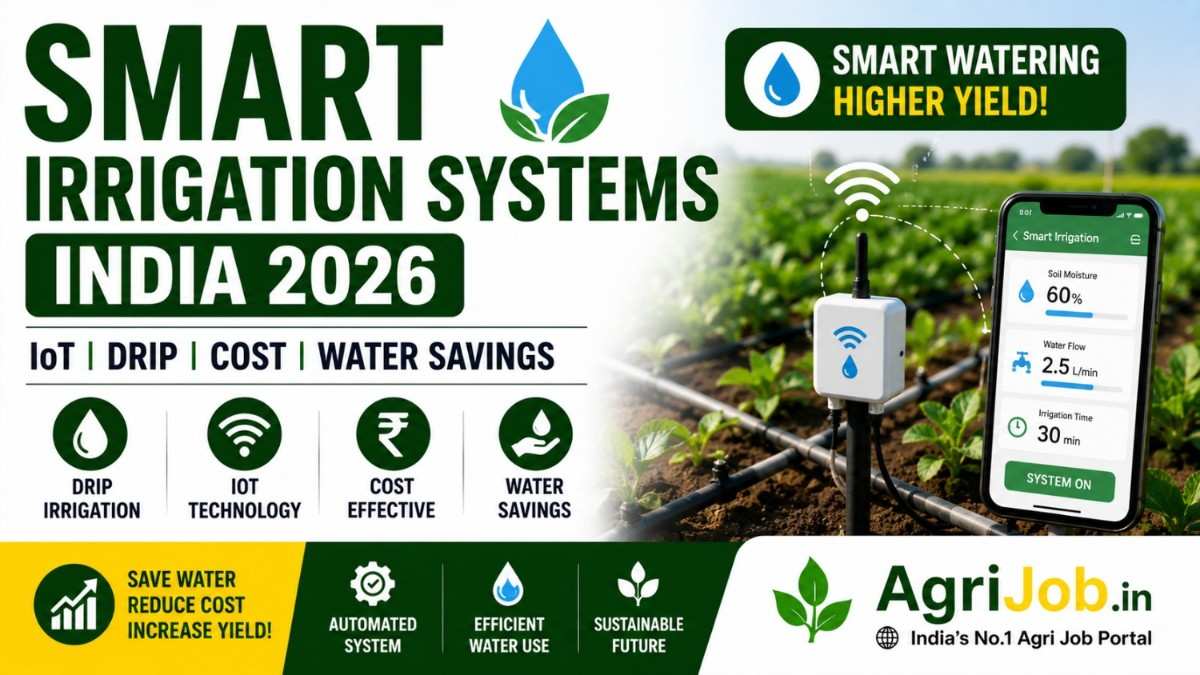
Smart irrigation systems India 2026 are the most urgent agricultural technology intervention the country needs right now. Agriculture accounts for 85% of India’s freshwater consumption, yet 80-85% of Indian farms still use flood irrigation — a method with water-use efficiency as low as 30-40%, wasting enormous volumes of a resource already in critical shortage. As of April 2026, the Central Water Commission has flagged that water levels in 166 monitored reservoirs have fallen below 45% of total capacity, while 256 out of 700 Indian districts face over-exploited or critical groundwater conditions. IoT-based smart drip irrigation is the proven solution — saving 50-70% water, increasing crop yield by 20-40%, and delivering full ROI within 1-2 seasons — and the PMKSY government scheme provides subsidies of up to 90% on setup costs for eligible farmers. This complete guide covers everything: what smart irrigation is, the India water crisis driving adoption, per-acre setup costs, IoT sensor components, government subsidies, step-by-step setup process, crop-wise water savings data, and career opportunities in 2026.

- India’s Water Crisis: Why Smart Irrigation Is Urgent in 2026
- What Are Smart Irrigation Systems India 2026?
- IoT Components of a Smart Drip Irrigation System
- Per-Acre Cost of Smart Drip Irrigation in India 2026
- Water Savings & Yield Increase: Research Data 2025-26
- PMKSY Drip Irrigation Subsidy 2026: State-Wise Guide
- Step-by-Step Setup Process for Smart Irrigation
- Who Should Adopt Smart Irrigation Systems in India?
- Smart Irrigation vs Flood Irrigation: Full Comparison
- High-Value Agritech & Water Management Terms to Know
- Crop-Wise Water Savings & ROI from Smart Drip Irrigation
- Frequently Asked Questions (FAQs)
| Drip Setup Cost (per acre) | Rs.35,000 – Rs.60,000 |
| IoT Add-on Cost (per acre) | Rs.8,000 – Rs.20,000 |
| PMKSY Subsidy (small/marginal) | 55% central; up to 90% in states like Karnataka |
| Water Saving vs Flood Irrigation | 50–70% |
| Yield Increase | 20–40% for most crops |
| ROI Period | 1–2 crop seasons |
| System Lifespan | 7–10 years |
| India Smart Irrigation Market (2033) | USD 506.57 million (CAGR 14.85%) |
| Best Crops | Grapes, cotton, tomato, chilli, banana, sugarcane |
India’s Water Crisis: Why Smart Irrigation Systems Are Urgent in 2026
Understanding why smart irrigation systems India 2026 is not optional but urgent requires a clear picture of India’s escalating water crisis. The data from the Central Ground Water Board (CGWB), Central Water Commission, and NITI Aayog paints an alarming picture that directly impacts every Indian farmer’s livelihood and productivity.
- 🚨 85% of India’s freshwater goes to agriculture — yet 80-85% of farms still use inefficient flood irrigation with just 30-40% water-use efficiency, wasting more water than any crop actually absorbs.
- 📉 Reservoirs at below 45% capacity (April 2026) — the Central Water Commission flagged that water levels in 166 monitored reservoirs have fallen critically, with southern India’s reservoirs reaching near-emergency levels.
- 🏜️ 256 out of 700 Indian districts are over-exploited — meaning groundwater extraction far exceeds annual recharge. States like Punjab, Haryana, and Rajasthan face crisis-level depletion with Haryana’s groundwater table falling 5.41 metres in just 10 years (2014-2024).
- ⚠️ Agriculture accounts for 89% of all groundwater use — and water-intensive crops like paddy and sugarcane dominate even in semi-arid regions. Subsidised electricity in states like Punjab and Haryana is making the overuse problem worse, not better.
- 👨🌾 600 million Indians face high-to-extreme water stress — and per capita water availability has declined sharply to just 1,100 cubic metres annually, below the internationally recognised water stress threshold.
- 💰 Deepening borewells cost Rs.1-3 lakh per well — as water tables fall, farmers are forced to drill deeper at enormous personal expense, contributing to the agrarian debt crisis that affects over 50% of Indian farming households.
The solution is not less farming — India must produce more food for a growing population. The solution is more crop per drop — precisely the goal of the government’s PMKSY scheme and the technology delivered by IoT-based smart drip irrigation systems. Adopting smart irrigation is no longer a choice between tradition and modernity; it is a choice between sustainable farming and eventual water-forced crop failure.

What Are Smart Irrigation Systems India 2026?
Smart irrigation systems India 2026 are automated, sensor-driven water delivery networks that combine the physical infrastructure of drip or sprinkler irrigation with the intelligence of IoT (Internet of Things) technology. Instead of a farmer opening a valve at a fixed time each day and guessing how much water crops need, a smart irrigation system continuously monitors soil moisture, temperature, humidity, and weather forecast data — and automatically delivers exactly the right amount of water at the right time, directly to crop root zones.
At the basic level, a smart irrigation system has 3 layers working together: the sensing layer (soil moisture sensors, weather sensors, flow meters), the processing layer (microcontroller or cloud-based algorithm that analyses sensor data and decides irrigation schedule), and the actuation layer (motorised valves, pumps, and drip emitters that physically deliver water). A farmer monitors and controls everything from a mobile app on their smartphone — receiving alerts, adjusting schedules, and viewing water usage reports from anywhere, at any time.
Research published in Discover Agriculture (Springer Nature, November 2025) confirmed that IoT-based smart drip irrigation systems demonstrated water savings of up to 46.88% compared to conventional drip irrigation and up to 70% compared to flood irrigation in controlled trials. Microsoft’s AI-driven smart irrigation initiative in Andhra Pradesh achieved a 30% increase in yield and up to 70% water savings through IoT-based systems, validating the technology at real Indian farm scale. A 2025 pilot using IoT-based irrigation in Indian rice fields increased yield by 15% while reducing water usage by 25%.
IoT Components of a Smart Drip Irrigation System in India 2026
A complete IoT-based smart irrigation system in India 2026 consists of the following hardware and software components, all of which work together to automate and optimise water delivery:
- 🌱 Soil Moisture Sensors (Rs.500–Rs.2,000/unit): Capacitive soil moisture sensors buried at root depth (15-30 cm) measure volumetric water content of the soil in real time. When soil moisture falls below a crop-specific threshold, the system automatically activates irrigation. Most systems deploy 1-2 sensors per acre. Leading Indian options include Decagon 5TM and low-cost DIY capacitive sensors.
- 🌡️ Weather Stations / Temperature & Humidity Sensors (Rs.3,000–Rs.15,000): Monitors ambient temperature, humidity, solar radiation, and rainfall. Integrates with weather forecast APIs (IMD, OpenWeatherMap) to predict crop water demand using evapotranspiration (ET) models. Prevents unnecessary irrigation before or after rainfall events.
- 🖥️ Microcontroller / IoT Gateway (Rs.1,000–Rs.5,000): NodeMCU (ESP8266/ESP32) or Raspberry Pi-based controllers process sensor data locally and transmit to the cloud via WiFi, GSM (2G/4G), or LoRa (long-range, low-power radio — ideal for large farms with poor WiFi coverage). These controllers cost Rs.300-Rs.800 each and have made IoT irrigation accessible even for small Indian farms.
- ⚡ Automated Solenoid Valves (Rs.800–Rs.3,000/valve): Electrically controlled valves that open and close irrigation zones based on controller commands — no manual operation required. One valve typically controls irrigation for 0.5-2 acres depending on pipe layout.
- 📱 Mobile App & Cloud Dashboard (Rs.0–Rs.5,000/year subscription): The farmer-facing interface — a smartphone app (Android/iOS) showing real-time soil moisture, irrigation history, water usage, alerts, and remote manual override. Several Indian agritech companies including Fasal, CropIn, and AgroStar offer integrated smart irrigation app platforms.
- ☀️ Solar Power Unit for Remote Farms (Rs.8,000–Rs.25,000): For farms without reliable grid power, a 50-100W solar panel with battery backup powers the entire IoT system. Solar-powered smart irrigation eliminates dependency on subsidised electricity and enables deployment in remote areas of Rajasthan, MP, and UP.
- 💧 Flow Meters & Fertigation Controllers (Rs.2,500–Rs.12,000): Digital flow meters measure exact water volumes delivered per zone per session — enabling precise water accounting and leak detection. Fertigation controllers automate nutrient injection into irrigation lines, ensuring plants receive the right fertiliser dose with each irrigation event.
Per-Acre Cost of Smart Drip Irrigation in India 2026
The total investment in a smart irrigation system India 2026 varies by crop type, land topology, water source, and level of IoT automation. Here is the complete per-acre cost breakdown for both basic drip and full smart IoT-enabled systems:
| Component | Basic Drip System (per acre) | IoT Smart System Add-on (per acre) | Total Smart System (per acre) |
|---|---|---|---|
| Main Line Pipe (HDPE/PVC) | Rs.3,000–Rs.5,000 | — | Rs.3,000–Rs.5,000 |
| Sub-Main & Lateral Pipes | Rs.5,000–Rs.8,000 | — | Rs.5,000–Rs.8,000 |
| Drip Emitters / Inline Drippers | Rs.6,000–Rs.10,000 | — | Rs.6,000–Rs.10,000 |
| Sand/Screen/Disc Filter Unit | Rs.4,000–Rs.8,000 | — | Rs.4,000–Rs.8,000 |
| Venturi Fertigation Unit | Rs.2,500–Rs.5,000 | — | Rs.2,500–Rs.5,000 |
| Pump & Pressure Regulator | Rs.8,000–Rs.15,000 | — | Rs.8,000–Rs.15,000 |
| Installation Labour | Rs.3,000–Rs.6,000 | — | Rs.3,000–Rs.6,000 |
| Soil Moisture Sensors (2 units) | — | Rs.1,000–Rs.4,000 | Rs.1,000–Rs.4,000 |
| IoT Controller (NodeMCU/ESP32) | — | Rs.500–Rs.1,500 | Rs.500–Rs.1,500 |
| GSM/WiFi Module & SIM | — | Rs.800–Rs.2,000 | Rs.800–Rs.2,000 |
| Solenoid Valves (2 zones) | — | Rs.1,600–Rs.6,000 | Rs.1,600–Rs.6,000 |
| Weather Sensor / App Subscription | — | Rs.3,000–Rs.6,500 | Rs.3,000–Rs.6,500 |
| Total Estimated Cost (per acre) | Rs.31,500–Rs.57,000 | Rs.6,900–Rs.20,000 | Rs.38,400–Rs.77,000 |
| After 55% PMKSY Subsidy (small farmer) | Rs.14,175–Rs.25,650 | Subsidy applicable on approved IoT components | Rs.17,280–Rs.34,650 |
| After 90% Subsidy (Karnataka small farmer) | Rs.3,150–Rs.5,700 | — | Rs.3,840–Rs.7,700 |
Note: Drip system costs vary significantly by crop. Row crops like sugarcane and cotton use wider emitter spacing and fewer laterals, reducing cost to Rs.25,000-Rs.40,000/acre. High-density horticulture like grapes, strawberries, and polyhouse vegetables may cost Rs.50,000-Rs.80,000/acre due to denser emitter placement and pressure-compensating drippers. The standard industry benchmark of Rs.35,000-Rs.60,000/acre applies to most vegetable and fruit crops across India.
Water Savings & Yield Increase: Research Data 2025-26
The water savings and yield improvement data from IoT smart irrigation India 2026 research is compelling and consistent across multiple independent studies:
| Study / Source | Crop / Location | Water Saving | Yield Increase | Method |
|---|---|---|---|---|
| Springer Nature, Nov 2025 (ICAR validated) | Maize, India | 46.88% vs conventional drip | Up to 15% | IoT drip at 60% depletion level |
| Microsoft + Andhra Pradesh Govt Pilot | Multiple crops, AP | Up to 70% | 30% increase | AI + IoT smart irrigation |
| IoT Rice Field Pilot, India | Rice, India | 25% | 15% increase | IoT sensor-controlled drip |
| IJRASET Research (Dec 2025) | Multiple crops | 30–40% vs manual irrigation | Significant improvement | NodeMCU + soil moisture automation |
| ScienceDirect Review, Sept 2025 | Sweet corn & eggplant, India | 12.7–35.2% | 12–14.97% | IoT-based drip vs conventional drip |
| Punjab Agricultural University + BITS Pilani (May 2025) | Drought-prone crops | 10–30% by deferring pre-rain irrigation | Crop-specific improvements | AI-forecast + IoT scheduling |
| General IoT Irrigation Studies (aggregated) | Fruits & vegetables | 30–50% vs traditional irrigation | 20–30% overall | Sensor-driven precision watering |
The data consistently confirms: even the most conservative IoT smart irrigation deployments in India save 25-30% water, and well-optimised systems on appropriate crops achieve 50-70% savings. The yield improvements of 15-30% translate directly to increased farm income — and for high-value crops like grapes (Rs.50,000-Rs.1.5 lakh/acre revenue), even a 20% yield increase adds Rs.10,000-Rs.30,000/acre/season in revenue, paying back the entire system cost in a single crop cycle.
PMKSY Drip Irrigation Subsidy 2026: State-Wise Complete Guide
The Pradhan Mantri Krishi Sinchayee Yojana (PMKSY) — specifically the Per Drop More Crop component — is the Government of India’s flagship scheme making smart irrigation systems affordable for every Indian farmer in 2026. Here is the complete state-wise subsidy guide:
| State / Category | Small & Marginal Farmers | Large Farmers | SC/ST Farmers | Portal / Application |
|---|---|---|---|---|
| Central Govt (Base PMKSY) | 55% subsidy | 45% subsidy | Up to Rs.93,750/hectare | pmksy.gov.in |
| Karnataka | Up to 90% | 75–80% | 90%+ | State agriculture portal |
| Rajasthan & Puducherry | Up to 75% | 60–65% | 75%+ | State horticulture portal |
| Punjab & Tamil Nadu | Up to 70% | 55–60% | 70%+ | State agriculture dept. |
| Maharashtra | 55–65% | 45–55% | 65%+ | mahadbt.maharashtra.gov.in |
| Uttar Pradesh | 55% (PMKSY base) | 45% | 55%+ (priority) | upagriculture.com |
| Gujarat | 55–70% | 45–60% | 70%+ | ikhedut.gujarat.gov.in |
| MP (Mountain Areas) | Up to 75% (cap Rs.25,000/acre) | 65% | 75%+ | dbt.mpdage.org |
Eligibility requirements for PMKSY drip irrigation subsidy in India 2026: the applicant must be a land-owning farmer with proper Aadhaar-linked land records; the crop type must be eligible (horticulture, vegetables, and high-value crops receive priority); the application must be submitted through the state agriculture department or official PMKSY portal at pmksy.gov.in; the system must be installed by a government-approved empanelled drip irrigation vendor; and the subsidy is transferred directly to the farmer’s bank account via Direct Benefit Transfer (DBT) after field verification. For complete scheme details, visit the Ministry of Agriculture & Farmers Welfare official website.
Step-by-Step Setup Process for Smart Irrigation System in India
Follow this exact step-by-step guide to set up a smart IoT-based drip irrigation system on your farm in India in 2026:
- ✅ Step 1 — Farm Survey & Water Availability Assessment (Day 1-2): Map your farm area, identify the water source (borewell, canal, pond), measure flow rate and static head pressure, and assess soil type (sandy, loam, clay). Soil type determines emitter spacing and flow rate required. Engage an approved drip system vendor for a free farm survey — most PMKSY-empanelled vendors provide this at no cost.
- ✅ Step 2 — System Design & Crop-Specific Layout (Day 2-5): Design the mainline, sub-main, and lateral pipe layout based on your farm map. Select emitter type (inline drippers for row crops, pressure-compensating emitters for sloped land) and spacing based on crop and soil. Identify IoT sensor placement points — typically 2-3 soil moisture sensors per acre at representative spots.
- ✅ Step 3 — PMKSY Subsidy Application (Day 5-30): Register on your state agriculture portal with Aadhaar, land records, and Farmer ID. Submit the drip irrigation subsidy application under PMKSY Per Drop More Crop. Get a quotation from an empanelled vendor. Approval typically takes 15-30 days. Begin procurement only after subsidy approval letter is received to ensure eligibility.
- ✅ Step 4 — Main Infrastructure Installation (Week 5-7): Install the filter unit (sand + screen + disc filters to prevent emitter clogging), mainline HDPE pipe from water source, sub-mains along field rows, and lateral drip tapes/pipes with emitters alongside each crop row. Ensure proper end caps and flush valves at every lateral end for easy maintenance.
- ✅ Step 5 — IoT Sensor & Controller Installation (Week 7): Bury soil moisture sensors at 15-20 cm depth at 2-3 representative points per acre. Install NodeMCU/ESP32 controller in a weatherproof enclosure near the pump. Wire solenoid valves for each irrigation zone. Connect GSM module (use a low-cost Rs.99/month data SIM) for cloud connectivity. Mount weather sensor at field height.
- ✅ Step 6 — Mobile App Configuration (Week 7-8): Install and configure your irrigation app (Fasal, AgroStar, or a custom platform provided by your vendor). Set crop-specific soil moisture thresholds — typically 40-60% depletion triggers irrigation for most field crops, 30-40% for sensitive horticulture. Set daily water budget limits and configure SMS alert for anomalies.
- ✅ Step 7 — Trial Run, Calibration & First Fertigation (Week 8): Run a full system flush to clear pipe debris. Test all solenoid valves and sensor readings. Calibrate soil moisture sensors against manual feel-test. Set up fertigation schedule — start with 50% recommended fertiliser dose via drip for the first cycle to avoid burn. Monitor pressure at the last emitter — it should be within 10% of the first emitter’s pressure. System is now ready for automated operation.
The most common failure point in drip irrigation systems in India is clogged emitters — caused by inadequate filtration, mineral deposits in hard water, or algae growth. Invest in a quality 3-stage filter system (sand + screen + disc) even if the vendor quotes a cheaper option. Clogged emitters waste water by creating uneven distribution and are the primary cause of patchy crop growth. Run a full lateral flush weekly for the first month, then fortnightly thereafter. This single maintenance habit will extend your drip system lifespan from 5 years to the full 10-year design life — protecting your entire investment.
Who Should Adopt Smart Irrigation Systems in India?
- 🌾 Farmers in water-stressed districts (Punjab, Haryana, Rajasthan, AP, Telangana): Where groundwater tables are falling rapidly, smart irrigation is both an economic survival tool and an environmental obligation. Drip irrigation reduces groundwater extraction by 50-70% per acre — critical in states where electricity subsidies have led to dangerous overextraction.
- 🍇 Horticulture and high-value crop farmers: Grapes, pomegranate, banana, citrus, strawberry, and polyhouse vegetable farmers receive the strongest financial return from smart drip adoption — premium crop prices (Rs.30-Rs.150/kg) mean even modest yield increases of 15-20% generate substantial additional revenue that pays back system costs within a single season.
- 🌿 Organic farmers seeking certification: Drip fertigation allows precise, documented nutrient delivery — a requirement for many organic and export-grade certifications. IoT records of water and fertiliser application create audit-ready documentation for FSSAI and export compliance.
- 📱 Young agripreneurs and educated farmer youth: Agriculture graduates and rural youth comfortable with smartphones can leverage smart irrigation as a competitive advantage — reducing daily labour by 2-3 hours (no manual irrigation monitoring), enabling remote farm management, and building data-driven crop management skills valued by agritech employers.
- 🏘️ Small and marginal farmers (below 2 hectares): PMKSY’s 55-90% subsidy specifically prioritises small and marginal farmers. For a 1-acre small farmer paying only Rs.5,000-Rs.15,000 net after subsidy for a system that saves Rs.5,000/year in water costs and generates Rs.10,000-Rs.20,000 in additional yield revenue — the ROI case is unambiguous.
- 🤝 FPOs and farmer cooperatives: FPOs that invest in collective drip infrastructure for 50-100 member farmers can negotiate bulk discounts of 15-25% on equipment costs, share IoT platform subscriptions, and collectively access NABARD and NHM group installation subsidies not available to individual farmers.
- 🌱 Farmers converting to protected/polyhouse cultivation: Polyhouse farming without drip-fertigation is unthinkable — the controlled environment investment is only justified if water and nutrient delivery are equally precise. Smart IoT-enabled drip is standard in all commercial polyhouse operations in India’s leading horticultural states.
- 🏦 Farmers seeking Kisan Credit Card (KCC) or NABARD loans: A documented smart irrigation system with verified water and yield records strengthens loan applications significantly. Banks and NABARD give priority and favourable rates to farmers demonstrating modern, productive farming infrastructure.
Smart Irrigation vs Flood Irrigation: Full Comparison 2026
| Parameter | IoT Smart Drip Irrigation | Traditional Flood Irrigation |
|---|---|---|
| Water-Use Efficiency | 85–95% | 30–40% (rest wasted to runoff/evaporation) |
| Water Saving | 50–70% less water used per acre | Baseline — highest water consumption |
| Yield Impact | 20–40% higher yields for most crops | Baseline — weather and soil dependent |
| Labour Required | Near-zero — fully automated via app | High — 2-4 hours/day for opening/closing channels |
| Fertiliser Efficiency | Fertigation delivers nutrients directly to roots; saves 20-30% fertiliser | Surface application; 40-60% fertiliser lost to runoff |
| Weed Growth | Minimal — only crop root zone is wet | High — entire field surface wetted encourages weeds |
| Soil Health | No soil compaction, no waterlogging | Waterlogging damages soil structure over time |
| Setup Cost (per acre) | Rs.38,000–Rs.77,000 (before subsidy) | Near zero (existing canal/borewell infrastructure) |
| Operating Cost (per acre/year) | Rs.3,000–Rs.8,000 (power, maintenance) | Rs.8,000–Rs.20,000 (power for heavy pumping, labour) |
| ROI Period | 1–2 crop seasons after subsidy | N/A — no capital investment but poor returns |
| Groundwater Impact | Dramatically reduces extraction demand | Primary driver of India’s groundwater crisis |
For any Indian farmer with access to PMKSY subsidy — which covers virtually all farmers across all states — switching from flood irrigation to IoT smart drip irrigation is the single highest-ROI agricultural investment available in 2026. The combination of 50-70% water savings (reducing electricity/borewell costs), 20-40% yield increase (raising revenue), near-zero labour (freeing time for other income), and 55-90% government subsidy makes the financial case overwhelming. India’s water crisis makes this not just a financial decision but a national necessity — and the PMKSY scheme makes it affordable for even the smallest landholding farmer.
High-Value Agritech & Water Management Terms Every Farmer Must Know
- 💧 PMKSY — Per Drop More Crop: The Government of India’s flagship micro-irrigation subsidy scheme under Pradhan Mantri Krishi Sinchayee Yojana, providing 45-90% subsidy on drip and sprinkler systems depending on farmer category and state. Budget allocation exceeds Rs.4,000 crore annually for micro-irrigation promotion.
- 🌡️ Evapotranspiration (ET) Scheduling: A precision irrigation method that calculates crop water demand based on temperature, humidity, wind speed, solar radiation, and crop growth stage — then automatically schedules irrigation to exactly replace water lost through evaporation from soil and transpiration from leaves. ET-based smart controllers are the gold standard for water efficiency in 2026.
- 📡 LoRa (Long Range) IoT Communication: A wireless protocol ideal for agricultural IoT — transmits sensor data up to 10-15 km on a single charge with minimal power consumption, making it perfect for large farms or remote locations where WiFi and GSM signals are weak. LoRa-based IoT irrigation kits are available in India from Rs.3,000-Rs.8,000.
- 🌾 Fertigation: The process of delivering water-soluble fertilisers directly through the drip irrigation system to the root zone of crops. Fertigation increases fertiliser use efficiency by 30-40% compared to surface broadcasting, reduces soil salinity, and enables precise nutrient management by growth stage — significantly cutting input costs.
- 🔋 Solar-Powered Irrigation: The PM KUSUM scheme provides up to 90% subsidy on solar pumps for farmers — eliminating electricity costs for irrigation entirely. A 3-5 HP solar pump (Rs.1.5-Rs.3 lakh before subsidy) combined with smart drip irrigation creates a zero-operating-cost irrigation system for remote farms.
- 💦 Micro-Irrigation (MI): The PMKSY umbrella category covering drip irrigation and micro-sprinkler/mini-sprinkler systems. India has a micro-irrigation coverage target of 10 million hectares under the National Mission on Micro Irrigation — currently covering approximately 6 million hectares with rapid growth through PMKSY subsidies.
- 🌐 India Smart Irrigation Market: Valued at USD 506.57 million by 2033 (CAGR 14.85%) — one of the fastest-growing agritech market segments in India. Rising water scarcity, PMKSY subsidies, IoT cost reduction, and precision farming adoption are the four primary growth drivers for the smart irrigation sector through 2026 and beyond.
- 📊 Precision Farming: The broader agritech framework that includes smart irrigation, drone-based crop monitoring, soil health mapping, and variable-rate fertiliser application. Under India’s Digital Agriculture Mission, precision farming technologies are receiving government support through ICAR research grants, state pilot programmes, and the Rs.14,000 crore Digital Agriculture Public Infrastructure investment.
- 🏛️ Atal Bhujal Yojana: A Government of India scheme specifically targeting groundwater conservation in 7 states (Gujarat, Haryana, Karnataka, MP, Maharashtra, Rajasthan, UP) — providing Rs.6,000 crore for participatory groundwater management. Smart irrigation adoption is directly rewarded under Atal Bhujal’s groundwater conservation incentive framework.
- ☁️ Cloud-Based Irrigation Management: Subscription-based platforms (Rs.2,000-Rs.10,000/year) that aggregate data from multiple IoT sensors, apply machine learning models to optimise irrigation schedules, and deliver recommendations via mobile app. Platforms like Fasal, Pusa Krishi, and international players like Netafim’s NMC are active in India’s 2026 smart irrigation market.
Crop-Wise Water Savings & ROI from Smart Drip Irrigation in India
| Crop | Water Saving (vs flood) | Yield Increase | Drip Cost/acre (est.) | Extra Revenue/acre/season | ROI Period |
|---|---|---|---|---|---|
| Grapes | 50–60% | 20–30% | Rs.55,000–Rs.80,000 | Rs.25,000–Rs.60,000 | 1–2 seasons |
| Tomato | 40–60% | 25–40% | Rs.35,000–Rs.50,000 | Rs.15,000–Rs.35,000 | 1 season |
| Cotton | 35–50% | 20–35% | Rs.30,000–Rs.45,000 | Rs.8,000–Rs.18,000 | 2–3 seasons |
| Sugarcane | 30–50% | 25–40% | Rs.40,000–Rs.60,000 | Rs.12,000–Rs.25,000 | 2 seasons |
| Banana | 40–55% | 20–30% | Rs.35,000–Rs.55,000 | Rs.15,000–Rs.30,000 | 1–2 seasons |
| Pomegranate | 45–65% | 20–35% | Rs.40,000–Rs.60,000 | Rs.20,000–Rs.50,000 | 1–2 seasons |
| Chilli / Capsicum | 40–55% | 30–45% | Rs.35,000–Rs.55,000 | Rs.12,000–Rs.30,000 | 1–2 seasons |
| Onion | 35–50% | 20–30% | Rs.30,000–Rs.45,000 | Rs.8,000–Rs.18,000 | 1–2 seasons |
| Rice (SRI + Drip) | 25–40% | 10–20% | Rs.35,000–Rs.50,000 | Rs.5,000–Rs.12,000 | 3–4 seasons |
| Polyhouse Vegetables | 50–70% | 30–50% | Rs.50,000–Rs.80,000 | Rs.40,000–Rs.1,00,000+ | 1 season |
Frequently Asked Questions — Smart Irrigation Systems India 2026
What is a smart irrigation system in India?
A smart irrigation system India 2026 is an IoT-enabled automated water delivery network combining drip/sprinkler infrastructure with soil moisture sensors, weather data, microcontrollers, solenoid valves, and mobile app controls. It supplies the exact water amount crops need — automatically and remotely — achieving 85-95% water-use efficiency compared to just 30-40% efficiency of conventional flood irrigation. The India smart irrigation market is growing at a CAGR of 14.85% and is projected to reach USD 506.57 million by 2033.
What is the cost of drip irrigation per acre in India in 2026?
The cost of a basic drip irrigation system per acre in India 2026 ranges from Rs.35,000 to Rs.60,000, depending on crop type, pipe quality, emitter specifications, and terrain. Adding an IoT smart control layer (soil moisture sensors, NodeMCU controller, solenoid valves, GSM module, and mobile app) adds Rs.8,000-Rs.20,000 per acre. Under PMKSY, small and marginal farmers receive 55-90% government subsidy, reducing effective out-of-pocket cost to Rs.3,000-Rs.20,000 per acre in most states.
How much water does IoT drip irrigation save compared to flood irrigation?
IoT-based smart drip irrigation saves 50-70% water compared to conventional flood irrigation. A Springer Nature study (November 2025, ICAR-validated) confirmed IoT drip at optimal soil moisture depletion levels saved up to 46.88% water versus conventional drip alone — and up to 70% versus flood irrigation. Microsoft’s Andhra Pradesh pilot achieved 70% water savings with AI + IoT integration. Even conservative real-world deployments consistently demonstrate 30-40% water savings per acre.
What is PMKSY drip irrigation subsidy in India 2026?
PMKSY Per Drop More Crop provides 55% subsidy for small and marginal farmers and 45% for large farmers on central norms. States significantly enhance this — Karnataka provides up to 90% for small farmers, Rajasthan and Punjab offer up to 75-70%. SC/ST farmers can receive subsidy up to Rs.93,750 per hectare nationally. Applications are submitted through state agriculture portals or pmksy.gov.in, with subsidy credited via DBT after system installation and field verification.
How much does IoT smart controller add to drip irrigation cost in India?
Adding basic IoT capability to a drip system costs Rs.8,000-Rs.20,000 per acre in India 2026. A NodeMCU/ESP32 controller costs Rs.300-Rs.800, capacitive soil moisture sensors Rs.500-Rs.2,000 each, GSM module Rs.800-Rs.1,500, and solenoid valves Rs.800-Rs.3,000 each. Full-featured commercial smart irrigation kits with weather stations and cloud analytics cost Rs.25,000-Rs.50,000 per acre for the IoT layer, though government-approved IoT components are PMKSY subsidy-eligible in most states from 2026 onwards.
Which crops benefit most from smart drip irrigation in India?
The crops with the strongest ROI from smart drip irrigation in India 2026 are grapes (20-30% yield increase; 50-60% water saving), pomegranate (20-35% yield; 45-65% water saving), tomatoes (25-40% yield; 40-60% water saving), bananas, cotton, sugarcane, and polyhouse vegetables. High-value horticulture crops like grapes in Maharashtra, tomatoes in Andhra Pradesh, and pomegranate in Karnataka deliver the fastest payback — often within a single crop season — due to premium market prices and large yield responses to precise water management.
What is the ROI of a smart irrigation system for Indian farmers?
The ROI of a smart irrigation system for Indian farmers is typically achieved within 1-2 crop seasons. A Rs.40,000/acre drip system with 55% PMKSY subsidy costs the farmer Rs.18,000 net. Benefits include Rs.3,000-Rs.5,000/acre/season water cost savings, Rs.8,000-Rs.20,000/acre/season additional revenue from 20-40% yield increase, Rs.3,000-Rs.5,000/acre labour savings, and Rs.2,000-Rs.4,000/acre fertiliser savings through drip fertigation efficiency — totalling Rs.16,000-Rs.34,000/acre/season in combined benefits against an Rs.18,000 one-time investment. System lifespan is 7-10 years.
How to apply for drip irrigation subsidy under PMKSY 2026?
To apply for PMKSY drip irrigation subsidy in India 2026: visit pmksy.gov.in or your state agriculture portal, register with Aadhaar, land records (RTC/Pahani), Farmer ID, and bank account details. Select Drip Irrigation under Per Drop More Crop component and upload a quotation from an empanelled vendor. After approval (15-30 days), install the system through the approved vendor. The subsidy is credited directly to your bank account via DBT within 30-60 days of field verification. For Karnataka farmers, the state portal provides the fastest processing. For other states, approach your Block Agriculture Officer for offline assistance.
This guide is regularly reviewed and updated for accuracy. Bookmark this page for the latest smart irrigation scheme notifications, IoT farming technology updates, and PMKSY subsidy news for 2026. For more precision farming and agritech guides, explore our Agriculture Technology and Government Schemes sections on Agrijob.in.
Last Updated: May 2026 | Sources: ICAR, PMKSY Official Portal, Central Ground Water Board, Springer Nature (Nov 2025), IMARC Group Market Report, Microsoft India AgriTech Pilot Data | Data current as of May 25, 2026.