

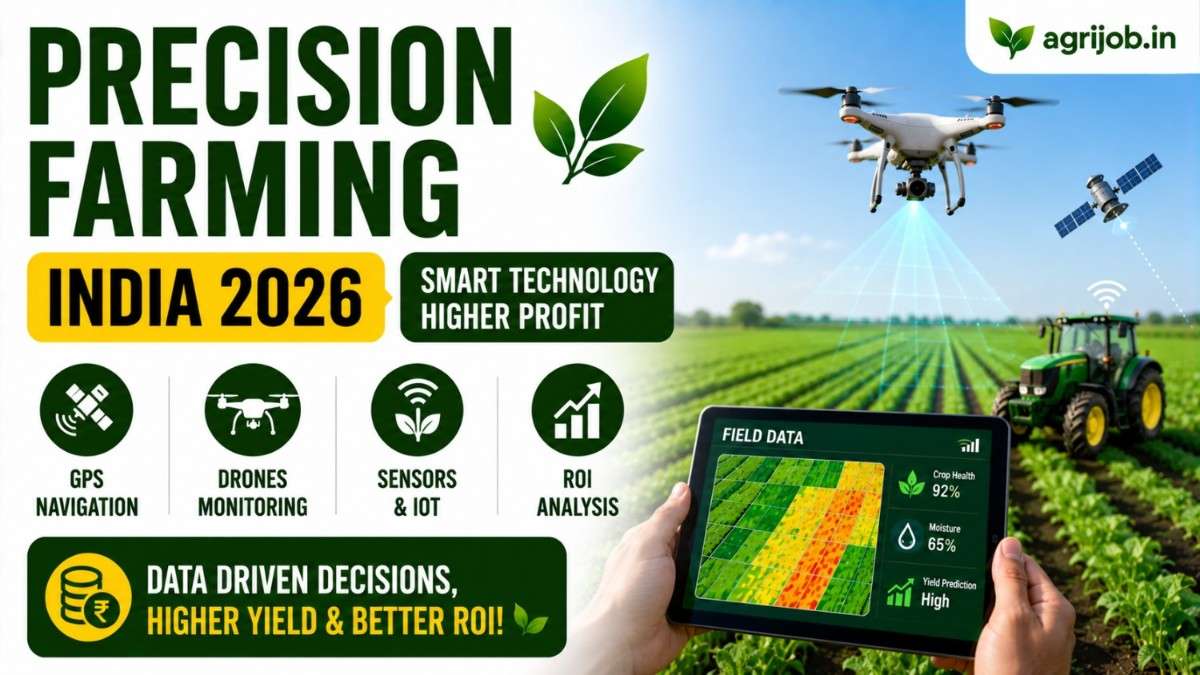
Precision Farming India 2026
Precision farming in India 2026 is no longer a concept limited to large corporate farms or research stations — it is rapidly becoming the new normal for progressive farmers across Punjab, Maharashtra, Andhra Pradesh, and Rajasthan. By harnessing GPS field mapping, agricultural drones, IoT soil sensors, and satellite remote sensing, Indian farmers are cutting input costs by up to 30%, improving yields by 15–20%, and generating measurable returns on technology investment. This complete 2026 guide covers every major precision agriculture technology, the real ROI numbers, government subsidies you can claim today, career opportunities for agri graduates, and a step-by-step roadmap to adopt precision farming on your land.

- What is Precision Farming in India?
- India Precision Agriculture Market Size 2026
- GPS Technology in Indian Agriculture – How It Works
- Agricultural Drones in India – Types, Cost & Benefits
- IoT Soil Sensors & Smart Irrigation – Complete Guide
- Precision Farming ROI Analysis – Real Numbers for Indian Farmers
- Government Subsidies for Precision Farming 2026
- Who Should Adopt Precision Farming in India?
- How to Start Precision Farming – Step-by-Step Guide
- Precision Farming vs Traditional Farming – Comparison Table
- High-Value Precision Agriculture Career Terms & Jobs 2026
- Frequently Asked Questions (FAQs)
What is Precision Farming in India? – 2026 Overview
Precision farming in India refers to a technology-driven crop management approach that uses GPS, remote sensing, IoT sensors, AI-powered analytics, and drone-based surveillance to monitor and optimise every aspect of farm production at the field level. Unlike conventional farming where inputs are applied uniformly across an entire field, precision agriculture enables site-specific management — applying the exact quantity of water, fertiliser, pesticide, or seed required at a precise location and time.
As of 2026, over 65% of global farms are expected to adopt at least one precision agriculture technology, and India is accelerating this transition through the Ministry of Agriculture & Farmers Welfare’s Digital Agriculture Mission. India’s unique agricultural challenge — over 80% of farmers operate plots under 2 hectares — makes precision tools like drone rental services, subscription-based IoT sensors, and shared GPS equipment especially relevant. The government’s investment in schemes like Namo Drone Didi Yojana and SMAM is democratising these technologies for small and marginal farmers across 28 states.

| India Agri Drone Market (2024) | USD 243.60 Million |
| Projected Market Size (2033) | USD 2,110.60 Million (CAGR 24.10%) |
| IoT Precision Agri Market India | Crossed USD 250 Million in 2025 |
| Drone Subsidy (SMAM – Individual) | 40–50% (up to Rs.5 lakh) |
| Drone Subsidy (Namo Drone Didi – SHG) | 80% (up to Rs.8 lakh) |
| Input Cost Reduction (Drones) | Up to 30% on pesticides & fertilisers |
| Yield Improvement | 15–20% with GPS + VRT adoption |
| Drone Service Rate | Rs.400–Rs.600 per acre spraying |
India Precision Agriculture Market Size 2026
India’s precision farming sector is one of the fastest growing technology markets in the country. The India agriculture drones market reached USD 243.60 million in 2024 and is projected to reach USD 2,110.60 million by 2033, growing at a remarkable CAGR of 24.10%. The broader India drone market stood at USD 1,316.48 million in 2025 and is expected to reach USD 2,731.54 million by 2034, growing at 8.45% CAGR. Meanwhile, the global Agriculture IoT market reached USD 28.65 billion in 2024 and is projected to grow to USD 54.38 billion by 2030 at a 10.5% CAGR, with India as one of the fastest-growing contributors.
Key drivers propelling precision farming growth in India in 2026 include:
- 🌾 Declining rural labour availability: India faces a steady decline in farm labour across major crop-growing states, making mechanisation and precision technology essential for timely operations.
- 💧 Water scarcity and groundwater depletion: With groundwater depletion a top concern, IoT-powered smart irrigation reduces water use by 20–40%, directly addressing India’s most critical agricultural resource challenge.
- 📈 Rising input costs: McKinsey’s 2024 survey found 48% of global farmers — including in India — cited rising input costs as their top risk. Precision technology directly cuts fertiliser and pesticide waste by 15–30%.
- 📱 Smartphone penetration and 4G/5G coverage: India’s telecom infrastructure now reaches most agricultural districts, enabling app-based precision advisory tools for smallholder farmers at near-zero cost.
- 🏛️ Government Digital Agriculture Mission: Central and state governments are actively subsidising precision technology adoption through SMAM, Namo Drone Didi, and the National Agriculture Infrastructure Fund.
GPS Technology in Indian Agriculture 2026 – How It Works
GPS (Global Positioning System) technology is the foundational layer of precision farming in India. It enables centimetre-level accuracy in field operations by linking farm machinery, sensors, and management decisions to precise geographic coordinates. As of 2026, GPS-based agriculture tools are increasingly affordable, with basic field mapping solutions starting from Rs.15,000 and advanced tractor guidance systems available from Rs.80,000–Rs.2.5 lakh.
Here is how GPS transforms farming operations in India:
- 🗺️ GPS Field Mapping and Soil Variability Assessment: Farmers can map their entire field boundary, identify soil variation zones, and generate prescription maps within hours. A maize farmer in Uttar Pradesh using GPS mapping can direct fertiliser application only to nutrient-deficient zones — preventing waste and protecting long-term soil health.
- 🚜 GPS-Guided Tractor Operations (Auto-Steer): Auto-steer systems reduce overlaps during ploughing, sowing, and spraying by maintaining straight, precise passes. This reduces fuel consumption by 10–15% and improves field coverage efficiency by 8–12%.
- 📊 Variable Rate Technology (VRT): GPS-linked VRT controllers automatically adjust the rate of seed, fertiliser, or pesticide application as the tractor moves through different soil zones. Studies show VRT adoption delivers 15–20% input cost reduction with a corresponding 10–15% yield improvement over 2–3 seasons.
- 🌧️ GPS-Based Drainage and Irrigation Planning: GPS elevation mapping identifies waterlogging-prone areas and guides the installation of subsurface drainage or raised bed systems, particularly valuable in flood-prone states like Bihar, Assam, and Odisha.
- 📍 Geo-Tagged Farm Records: GPS-tagged field operations create auditable farm management records essential for certification in organic farming, contract farming agreements, and agricultural export compliance.
| GPS Tool | Approximate Cost (India 2026) | Key Benefit | Payback Period |
|---|---|---|---|
| Basic GPS Field Mapper (smartphone + app) | Rs.0–Rs.15,000 | Field boundary + area measurement | Immediate |
| Handheld GPS Survey Device | Rs.15,000–Rs.50,000 | Soil sampling grid mapping | 1 season |
| Tractor Auto-Steer System (RTK GPS) | Rs.80,000–Rs.2.5 lakh | Reduces fuel + overlap by 10–15% | 2–4 seasons |
| VRT Fertiliser Controller + GPS | Rs.1.5–Rs.4 lakh | 15–20% input cost reduction | 2–3 seasons |
| Full Farm GPS Management Platform | Rs.3–Rs.8 lakh | Comprehensive data-driven decisions | 3–5 years |
Agricultural Drones in India 2026 – Types, Cost & Benefits
Agricultural drones are the most visible symbol of precision farming in India and represent the fastest-growing technology segment in Indian agriculture. India’s agriculture drone market is growing at a CAGR of 24.10%, driven by government subsidies, labour shortages, and the proven economics of precision spraying. A single spray drone covers 50 acres per day, compared to just 8 acres using manual or tractor-based methods — making it 6 times more productive.
The 3 main categories of agricultural drones used in India in 2026:
- ✈️ Precision Spray Drones (Most Common): Used for targeted application of pesticides, herbicides, and nano-urea across paddy, cotton, wheat, sugarcane, and vegetable crops. GPS-enabled spraying systems reduce chemical application rates by up to 30% compared to manual spraying. Service rate: Rs.400–Rs.600 per acre. Purchase price: Rs.3.5–Rs.10 lakh before subsidy. Leading brands: Garuda Aerospace, General Aeronautics, Marut Drones, IdeaForge.
- 📸 Multispectral / NDVI Imaging Drones: Equipped with multispectral and thermal sensor payloads, these drones generate NDVI (Normalised Difference Vegetation Index) maps that reveal early-stage crop stress, nutrient deficiencies, disease hotspots, and waterlogging — often 7–14 days before symptoms are visible to the naked eye. Used by CGIAR’s Drones4Rice Project across India’s 145 million rice farmers. Cost: Rs.5–Rs.18 lakh; increasingly available via drone service companies on a per-acre fee basis.
- 🛰️ Survey & Mapping Drones (LiDAR / Photogrammetry): High-precision drones used for topographic mapping, contour farming design, irrigation canal planning, and land levelling guidance. Essential for large farms, FPOs, and government-sponsored watershed projects. Cost: Rs.8–Rs.25 lakh; typically hired from specialised agri-survey companies.
IoT Soil Sensors & Smart Irrigation in India 2026
IoT (Internet of Things) soil sensors and smart irrigation systems represent the most cost-effective entry point into precision farming in India for small and medium farmers. India’s IoT precision agriculture market crossed USD 250 million by 2025, driven by falling sensor prices, smartphone connectivity, and the urgent need to manage groundwater depletion across India’s major farming states.
Key IoT precision farming tools and their India-specific applications in 2026:
- 🌱 Soil Moisture Sensors: Wireless sensors inserted at 3–4 soil depth levels (15 cm, 30 cm, 60 cm) measure real-time soil moisture. Irrigation is triggered only when moisture drops below crop-specific thresholds, reducing water use by 20–40% compared to schedule-based irrigation. Cost: Rs.3,000–Rs.15,000 per sensor node; SaaS subscription models available from Rs.200–Rs.500/month.
- 🧪 Soil Nutrient Sensors (NPK Sensors): Real-time measurement of nitrogen, phosphorus, and potassium levels enables variable rate fertiliser application. Reduces fertiliser overuse by 20–35% while maintaining or improving yields. Available as portable lab-on-chip devices from Rs.8,000–Rs.40,000 or as field-installed arrays.
- 🌡️ Weather Stations (Agro-Meteorological Stations): Hyper-local weather data including temperature, humidity, rainfall, wind speed, and solar radiation feeds into crop disease prediction models. A single station serving 50–100 acres costs Rs.25,000–Rs.80,000. Used extensively in Maharashtra vineyards, Punjab wheat belts, and Karnataka horticulture zones.
- 💧 Smart Drip Irrigation Controllers: IoT-connected controllers automate drip and sprinkler irrigation based on real-time soil moisture + weather data. Reduce irrigation labour by 60–80% and water use by 25–40%. Particularly impactful in Maharashtra, Gujarat, and Karnataka where groundwater depletion is critical.
- 📱 AI-Powered Farm Advisory Apps (Fasal, BharatAgri, DeHaat): Smartphone apps combine sensor data, satellite imagery, and machine learning to deliver personalised crop advisory in Hindi and regional languages. Fasal’s app, used by thousands of horticulture farmers across India, provides pest and disease alerts 5–7 days in advance, enabling timely low-dose interventions that reduce pesticide use by 20–25%.
Precision Farming ROI Analysis – Real Numbers for Indian Farmers 2026
The single most important question every Indian farmer asks before adopting precision technology is: what is the return on investment (ROI)? Here is a realistic, data-driven ROI breakdown for the 3 most common precision farming technologies adopted by Indian farmers in 2026:
| Technology | Investment (5 Acres) | Annual Saving | Yield Gain | Payback Period | Annual ROI |
|---|---|---|---|---|---|
| Drone Spraying (DaaS – no purchase) | Rs.0 (service model) | Rs.8,000–Rs.15,000 on chemicals | 5–10% | Immediate | 40–80% |
| GPS Field Mapping + VRT | Rs.80,000–Rs.1.5 lakh | Rs.20,000–Rs.40,000 on fertiliser | 10–15% | 2–4 seasons | 25–40% |
| IoT Soil Moisture Sensors | Rs.20,000–Rs.50,000 | Rs.12,000–Rs.25,000 on water/power | 8–12% | 2–3 seasons | 30–50% |
| Smart Irrigation Controller | Rs.35,000–Rs.80,000 | Rs.15,000–Rs.35,000 on water/labour | 8–15% | 2–3 seasons | 25–45% |
| Own Agriculture Drone (post SMAM subsidy) | Rs.2–Rs.4.5 lakh (net) | Rs.80,000–Rs.1.2 lakh/month (service income) | N/A – service income model | 6–12 months | 60–120% |
ROI calculations assume stable commodity prices, 5-acre farm size, and standard input costs for Kharif 2025–26. Individual results vary based on crop type, location, soil condition, and technology utilisation rate.
A practical example: A wheat farmer in Punjab with 10 acres who adopts IoT soil sensors (Rs.40,000 investment) and drone spraying (service model, no purchase) can expect to save Rs.18,000–Rs.30,000 annually on irrigation power and Rs.12,000–Rs.22,000 on pesticide costs. Total savings of Rs.30,000–Rs.52,000 per year represent an ROI of 75–130% in Year 1 on the sensor investment alone, with the sensor paying back within 12–18 months.
Government Subsidies for Precision Farming in India 2026
The Government of India has launched multiple schemes that directly subsidise precision farming in India, making technology adoption accessible even for small and marginal farmers. Here are the 4 most important schemes active in 2026:
- 🚁 Namo Drone Didi Yojana (2024–26 outlay: Rs.1,261 crore): Empowers 15,000 women-led Self-Help Groups (SHGs) by providing agricultural drones at 80% subsidy (up to Rs.8 lakh per drone). Includes 15 days of training (5-day drone pilot certification + 10-day agriculture-specific training). SHGs then offer drone rental services to farmers at Rs.400–Rs.600/acre, generating at least Rs.1 lakh annual income per SHG. Apply via Ministry of Rural Development or state nodal agencies.
- 🌾 Sub-Mission on Agricultural Mechanization (SMAM): Launched in 2014–15 and ongoing into 2026, SMAM provides financial assistance for drone and farm machinery purchases. Individual farmers: 40–50% subsidy (up to Rs.5 lakh). SC/ST, women, and small/marginal farmers: up to 50% (up to Rs.5 lakh). FPOs, Cooperatives, and SHGs: up to 75% (up to Rs.7.5 lakh). Custom Hiring Centres (CHCs): up to 40%. Apply at agrimachinery.nic.in.
- 🏗️ National Agriculture Infrastructure Fund (NAIF): Provides loans up to Rs.2 crore with a 3% interest rate subvention for agricultural infrastructure including precision farming technology, cold chain, post-harvest equipment, and smart irrigation systems. Target beneficiaries include FPOs, agri-entrepreneurs, cooperatives, and individual farmers.
- 📡 Digital Agriculture Mission: The Ministry of Agriculture’s umbrella programme for digital transformation, funding agritech pilots, soil health card digitisation, satellite crop monitoring across 141 million farm holdings, and farmer-centric app development. Farmers enrolled in the scheme receive access to government-funded precision advisory services via the IFFCO Kisan and Kisan Suvidha platforms.
Who Should Adopt Precision Farming in India 2026?
Precision farming in India is now relevant across a wide spectrum of farmers and agri-professionals. Here is who stands to gain the most from technology adoption in 2026:
- 🌾 Progressive farmers with 5+ acres growing commercial crops like paddy, cotton, sugarcane, wheat, or vegetables who want to cut input costs and improve yield quality to access better market prices.
- 👩🌾 Women SHG members in rural areas who can leverage the Namo Drone Didi Yojana to become certified drone operators and earn Rs.80,000–Rs.1.2 lakh per month during the crop season as drone service providers.
- 🏢 Farmer Producer Organisations (FPOs) managing collective land of 100+ acres who can deploy GPS field management, bulk drone spraying, and shared IoT infrastructure across member farms to dramatically reduce per-acre technology costs.
- 🎓 Agriculture graduates and agritech entrepreneurs who want to launch drone-as-a-service (DaaS) businesses, precision agronomy consultancy firms, or soil testing and advisory startups – an emerging and high-earning career path in 2026.
- 🌱 Horticulture farmers (fruits, vegetables, floriculture) where precision irrigation and micro-climate monitoring provide the highest ROI – grape growers in Nashik, tomato farmers in Bengaluru, and apple growers in Himachal Pradesh are leading precision farming adoption nationally.
- 🏭 Contract farmers growing for food companies (PepsiCo, ITC, Nestlé procurement programmes) where traceability, quality consistency, and sustainable farming certifications require GPS-tagged records and input management data.
- 💧 Farmers in water-stressed districts of Maharashtra, Gujarat, Rajasthan, and Karnataka where smart irrigation investment delivers the fastest ROI by addressing the highest cost item – irrigation power bills running Rs.50,000–Rs.2 lakh per season on large farms.
- 📊 Large commercial farms (50+ acres) in Punjab, Haryana, Andhra Pradesh, and Telangana where full-scale precision farming — GPS tractor guidance, drone fleet, IoT sensor networks, and yield mapping — can deliver Rs.5–Rs.20 lakh in annual input savings.
How to Start Precision Farming in India – Step-by-Step Guide 2026
- Assess Your Farm and Identify the Biggest Cost/Pain Point: Begin with a farm audit. Calculate your current annual spend on irrigation, fertilisers, pesticides, and labour. Identify which cost is highest — that is where precision technology delivers the fastest ROI. For most Indian farmers, irrigation (30–40% of costs) or fertiliser overuse (20–30%) is the starting point.
- Get a Soil Health Card and GPS Field Map: Visit your nearest Krishi Vigyan Kendra (KVK) or State Agriculture Department office for a free Soil Health Card under the government’s Soil Health Card Scheme. Simultaneously, use a free GPS mapping app (Farmonaut, KhetInfo, or Kisan Suvidha) to create a digital field boundary map of your entire holding.
- Start with Drone Spraying (Service Model – Zero Investment): Before purchasing any equipment, hire a local drone service provider for your next pesticide or nano-urea application. Compare input quantity used and crop response versus your previous manual spraying. The savings in chemical use will make the ROI immediately visible. Search for DGCA-certified drone operators via the National Apprenticeship and Skill Portal or through your state agriculture department.
- Install 2–4 IoT Soil Moisture Sensors on a Test Plot: Purchase or rent IoT soil sensors for a single crop season on a 1–2 acre trial plot. Track irrigation frequency and compare with the adjacent non-sensor plot. Most farmers see a 20–30% reduction in irrigation events within the first season, generating immediate savings on diesel or electricity for pumping.
- Apply for Government Subsidy (SMAM or Namo Drone Didi): If you plan to purchase a drone or advanced precision equipment, apply for SMAM subsidy via agrimachinery.nic.in before purchasing. Women farmers and SHGs should apply for the Namo Drone Didi Yojana through their district’s Ministry of Rural Development nodal office. Subsidy approval typically takes 45–90 days.
- Scale Precision Technology Across Your Entire Farm: Once the ROI from the pilot is validated, scale the technology across all your acres. Expand from soil sensors to GPS tractor guidance, from drone spraying to multispectral imaging, and from manual records to a digital farm management platform.
- Join an FPO or Agritech Platform for Shared Cost Benefits: Individual investment in precision tools is expensive. Join a Farmer Producer Organisation or a platform like DeHaat, AgroStar, or BharatAgri to access shared technology infrastructure, bulk procurement discounts, and group insurance for agri-technology investments.
Precision Farming vs Traditional Farming – Full Comparison 2026
| Parameter | Precision Farming (2026) | Traditional Farming (Conventional) |
|---|---|---|
| Fertiliser Application | Variable rate, zone-specific (VRT) | Uniform broadcast across entire field |
| Water Use | IoT-guided, 20–40% reduction | Schedule-based, significant waste |
| Pesticide Use | Drone-targeted, 30% reduction | Manual/tractor uniform spray |
| Yield | 10–20% higher with site-specific management | Variable, often sub-optimal |
| Labour Requirement | 60–80% lower for irrigation and spraying | High – manual operations |
| Data Availability | Real-time + historical field data | No systematic data records |
| Input Cost | 15–30% lower per acre | Higher due to inefficient application |
| Environmental Impact | Lower – reduced chemical runoff | Higher – over-application common |
| Initial Investment | Rs.20,000–Rs.5 lakh (scale-dependent) | Minimal technology cost |
| Best For | Commercial, horticulture, export farmers | Subsistence, very small holdings |
High-Value Precision Agriculture Career Terms & Jobs 2026
Precision farming in India is creating hundreds of new and high-paying career roles for agriculture graduates, engineering students, and agritech entrepreneurs. Here are the most important career terms and salary benchmarks to know in 2026:
- 🛩️ Agricultural Drone Operator / Pilot: DGCA-certified drone pilots operating spray and imaging drones for farmers and FPOs. Drone service entrepreneurs earn Rs.80,000–Rs.1.2 lakh per month during peak crop season. Employment roles at agritech companies: Rs.3.5–Rs.6 LPA.
- 📡 Remote Sensing Analyst: Processes multispectral and satellite imagery to generate NDVI crop health maps, yield forecasts, and soil maps. Companies like CropIn, Fasal, and SatSure hire remote sensing analysts at Rs.6–Rs.12 LPA. MSc in Remote Sensing, Geoinformatics, or Agriculture Geography preferred.
- 💻 Precision Agriculture Specialist: Designs and implements precision farming systems including GPS, VRT, IoT sensors, and data management platforms for large farms or agritech firms. Salary: Rs.5–Rs.10 LPA. Key employers: Syngenta, BASF, Corteva, DeHaat, Mahindra Agri.
- 📊 Farm Data Analyst / Agri-Data Scientist: Analyses farm sensor data, weather records, and yield history using Python, R, or Power BI to generate actionable crop management insights. Agritech companies pay Rs.6–Rs.12 LPA for candidates with both agriculture domain knowledge and data skills.
- ⚙️ IoT Agriculture Engineer: Designs, installs, and maintains IoT sensor networks, smart irrigation systems, and connectivity infrastructure on farms. Typically an engineering graduate (Electronics/Computer Science) with agriculture domain exposure. Salary: Rs.7–Rs.14 LPA at AgriTech startups.
- 🌾 Agri-GIS Specialist: Uses GIS (Geographic Information Systems) tools like ArcGIS and QGIS to create precision farming maps, drainage plans, and land use assessments. Government agencies (NRSA, ICAR) and private companies hire GIS-agri specialists at Rs.5–Rs.10 LPA.
- 📱 Agritech Sales Manager: Sells precision farming products and services to progressive farmers, FPOs, and state government departments. Combines agriculture domain knowledge with B2B sales skills. Salary: Rs.5–Rs.9 LPA + incentives at companies like Fasal, BharatAgri, and Trimble Agriculture India.
- 🌿 Drone-as-a-Service (DaaS) Entrepreneur: India’s fastest-growing agri business model in 2026. A certified drone operator with 1 spray drone covering 10–15 acres/day, charging Rs.400–Rs.600/acre, and working 20 days/month can generate Rs.80,000–Rs.1.8 lakh monthly revenue during the Kharif and Rabi seasons.
- 🏛️ ICAR Scientist (Precision Agriculture Division): Government research positions at ICAR institutes studying precision agriculture, drone applications, and digital farming. Pay scale: Rs.56,100–Rs.1,77,500/month (Level 10–13 as per 7th Pay Commission). Recruitment through ICAR official portal.
- 🌐 Agri Carbon Credit Consultant: An emerging 2026 career – precision farming generates measurable carbon sequestration and reduced emission data (via GPS-tracked reduced tillage, precision fertiliser use). Carbon credit consultants help farms monetise these through global carbon markets, earning Rs.8–Rs.18 LPA.
Frequently Asked Questions – Precision Farming in India 2026
What is precision farming in India?
Precision farming in India is a modern agricultural management approach that uses GPS, IoT sensors, drones, satellite imagery, AI, and data analytics to monitor and optimise crop production at the field level. Instead of applying a uniform amount of inputs across an entire farm, precision farming enables site-specific management — applying the right input, at the right place, at the right time — to reduce waste, lower costs by 15–30%, and increase yields by 10–20%. In India, adoption is growing rapidly driven by the Digital Agriculture Mission and government schemes like SMAM and Namo Drone Didi Yojana.
What is the ROI of precision farming in India?
The ROI of precision farming in India varies by technology and farm size. Drone-based precision spraying reduces pesticide use by up to 30% with costs recovering within 1–2 seasons for a 10-acre farmer. GPS-guided VRT fertiliser application typically delivers 15–20% input cost reduction with a 10–15% yield improvement. IoT soil sensors reduce water usage by 20–40%, with payback periods of 2–3 years. For a 5-acre Indian farmer investing Rs.50,000–Rs.1.5 lakh in basic precision tools, annual savings of Rs.20,000–Rs.60,000 are commonly reported, representing an ROI of 30–80%.
What government subsidies are available for precision farming in India 2026?
In 2026, multiple government schemes support precision farming adoption. The SMAM scheme offers 40–80% subsidy on drones and farm machinery (up to Rs.7.5 lakh for FPOs). The Namo Drone Didi Yojana provides 80% financial assistance up to Rs.8 lakh for women-led SHGs. The National Agriculture Infrastructure Fund (NAIF) provides loans up to Rs.2 crore with 3% interest subsidy for agri-technology investment. Apply via agrimachinery.nic.in for SMAM or through state agriculture portals.
How does GPS technology help farmers in India?
GPS technology helps Indian farmers through precision field mapping, guided tractor operations, soil variability assessment, and variable rate input application. A maize farmer in Uttar Pradesh using GPS mapping can direct fertiliser application only to nutrient-deficient zones, preventing waste and protecting soil health. GPS-guided tractors reduce fuel consumption by 10–15% by eliminating overlaps during ploughing and spraying. As of 2026, GPS-based agriculture tools start from Rs.15,000 for basic smartphone-based field mappers, making them accessible to small and medium-scale farmers.
What types of drones are used in agriculture in India?
Agricultural drones in India fall into 3 main categories: (1) Spray drones for precision pesticide and nano-fertiliser application covering 50 acres/day; (2) Multispectral imaging drones equipped with NDVI sensors for crop health monitoring, disease detection, and yield forecasting; (3) Survey and mapping drones using LiDAR for field mapping and irrigation planning. Leading Indian drone manufacturers include IdeaForge, Marut Drones, Garuda Aerospace, and General Aeronautics. The India agriculture drones market is growing at 24.10% CAGR and is expected to reach USD 2,110.60 million by 2033.
What is the India precision agriculture market size in 2026?
India’s agriculture drone market reached USD 243.60 million in 2024 and is projected to reach USD 2,110.60 million by 2033 at a 24.10% CAGR. The broader India drone market was USD 1,316.48 million in 2025. India’s IoT precision agriculture market crossed USD 250 million by 2025. The global Agriculture IoT market stands at USD 28.65 billion (2024) and is projected to reach USD 54.38 billion by 2030, with India among the fastest-growing national segments driven by the government’s Digital Agriculture Mission.
What careers are available in precision farming in India?
Precision farming in India is creating high-paying new career roles for agriculture and engineering graduates. Key profiles include Precision Agriculture Specialist (Rs.5–10 LPA), Drone Operator/Agronomist (Rs.3.5–6 LPA), Remote Sensing Analyst (Rs.6–12 LPA), Farm Data Analyst (Rs.6–10 LPA), IoT Agriculture Engineer (Rs.7–14 LPA), and Agritech Sales Manager (Rs.5–9 LPA). DaaS drone entrepreneurs can earn Rs.80,000–Rs.1.2 lakh/month. Key employers include Syngenta, BASF, DeHaat, CropIn, Fasal, AgroStar, and ICAR research institutes.
Can small farmers in India benefit from precision farming?
Yes — precision farming is increasingly accessible to India’s 86% small and marginal farmers. The Drone-as-a-Service (DaaS) model allows small farmers to hire drones for Rs.400–Rs.600 per acre without owning any equipment. IoT soil sensors on shared subscription models cost as little as Rs.200–Rs.500 per month. Government subsidies under SMAM and Namo Drone Didi Yojana reduce equipment purchase costs by 40–80%. Agritech apps like Fasal, BharatAgri, and DeHaat provide AI-based crop advisory to smallholders via smartphone at low or no cost, making precision farming accessible to even 1–2 hectare farmers.
This guide on precision farming in India 2026 is regularly reviewed and updated for accuracy. Bookmark this page for the latest agritech news, government scheme updates, and career opportunities in precision agriculture. For government agriculture recruitment notifications and agri career guidance, visit Agrijob.in — India’s #1 agriculture job portal. Refer to the Ministry of Agriculture & Farmers Welfare for official scheme details and the SMAM portal (agrimachinery.nic.in) for subsidy applications.