
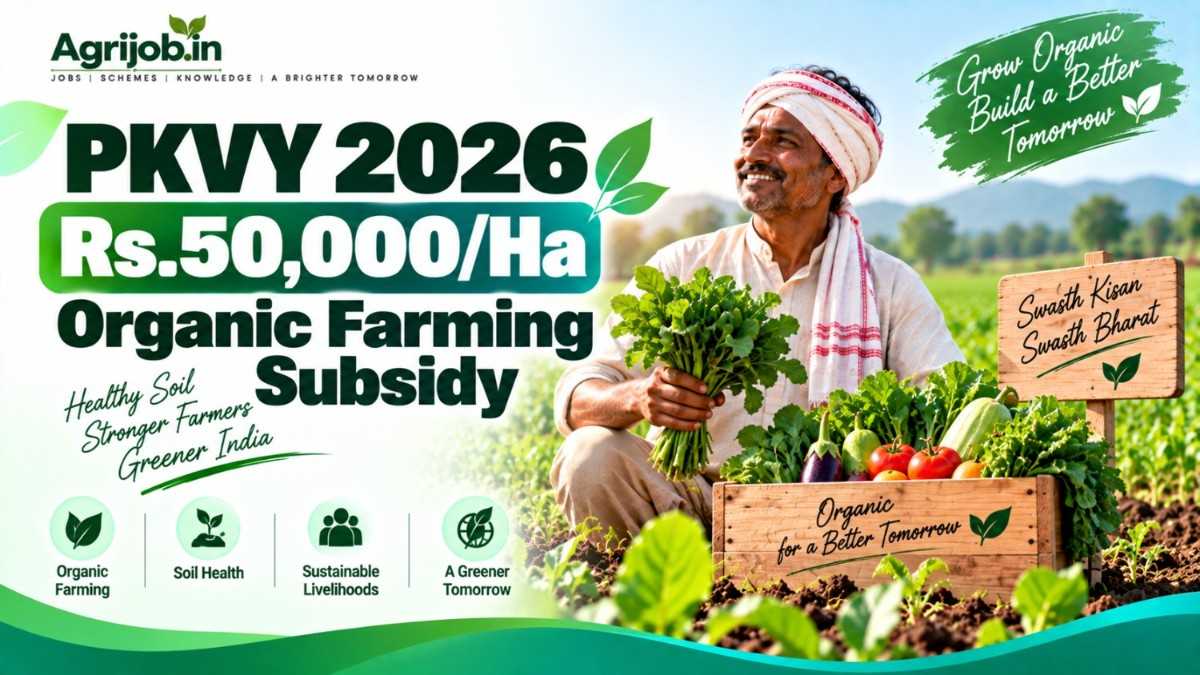
PKVY 2026 – Rs.50,000/Ha Organic Farming Subsidy & Apply
Paramparagat Krishi Vikas Yojana (PKVY) 2026 is the Government of India’s most powerful organic farming subsidy scheme, offering up to Rs.50,000 per hectare over 3 years to farmers willing to switch from chemical-intensive to sustainable, chemical-free agriculture. Launched in 2015 under the National Mission on Sustainable Agriculture (NMSA), PKVY has already benefited more than 25.30 lakh farmers across 15 lakh hectares and 52,289 clusters nationwide. If you are a small farmer, marginal farmer, or farming institution looking to boost your income while improving soil health, this 2026 updated guide covers everything — eligibility, subsidy breakdown, required documents, step-by-step application process, PGS certification, and who should apply.
| Scheme Name | Paramparagat Krishi Vikas Yojana (PKVY) |
| Launched By | Ministry of Agriculture & Farmers Welfare, Govt. of India |
| Launch Year | 2015 (Updated 2026) |
| Subsidy Amount | Up to Rs.50,000/hectare over 3 years |
| Central Assistance | Rs.31,500/hectare (Rs.15,000 via DBT direct to farmer) |
| Scheme Duration | 3 Years per cluster cycle |
| Cluster Size | 20 hectares per cluster (50 farmers minimum) |
| Certification | PGS-India (Participatory Guarantee System) |
| Apply Mode | Online (jaivikkheti.in) + State Agriculture Dept. |
| Farmers Benefited | 25.30 lakh farmers (as of 2025) |
| Total Funding Released | Rs.2,265.86 crore (2015–2025) |
| Funding Ratio | 60:40 (Centre:State); 90:10 for NE & Himalayan States |
- What is Paramparagat Krishi Vikas Yojana 2026?
- PKVY Subsidy Breakdown – Rs.50,000/Ha Explained
- Eligibility Criteria for PKVY 2026
- Who Should Apply for Paramparagat Krishi Vikas Yojana?
- Documents Required for PKVY Application
- How to Apply for PKVY Organic Farming Subsidy 2026
- PGS-India Certification Under PKVY
- PKVY vs Other Organic Farming Schemes – Comparison
- High-Value Organic Farming & Govt. Scheme Terms to Know
- Frequently Asked Questions – PKVY 2026
What is Paramparagat Krishi Vikas Yojana 2026?
Paramparagat Krishi Vikas Yojana (PKVY) is a centrally sponsored scheme under the National Mission on Sustainable Agriculture (NMSA), specifically falling under the Soil Health Management (SHM) component. Launched in 2015 by the Ministry of Agriculture and Farmers Welfare, the scheme is designed to help Indian farmers — especially small and marginal landholders — transition from chemical-intensive farming to sustainable, organic, and traditional agricultural practices.
The 2026 iteration of PKVY builds on a decade of success. As of February 2025, the scheme had brought 15 lakh hectares under certified organic farming through 52,289 clusters formed across all Indian states and Union Territories. Total government funding released stands at Rs.2,265.86 crore since inception, making PKVY one of the largest organic farming support programmes in Asia.
The core philosophy of PKVY is a cluster-based approach — groups of at least 50 farmers collectively farming 20 hectares adopt organic practices together. This reduces input costs, enables shared resources, ensures uniform certification standards, and improves bargaining power in the market. The Jaivik Kheti Portal (jaivikkheti.in) serves as the digital backbone for farmer registration, cluster management, and direct organic produce sales.
PKVY Subsidy Breakdown – Rs.50,000/Ha Explained
The Paramparagat Krishi Vikas Yojana subsidy structure is spread over 3 years and covers multiple components. Here is the complete, year-wise subsidy breakdown for 2026:
| Component | Subsidy Amount | Mode of Transfer | Annual (per Ha) |
|---|---|---|---|
| Organic Inputs (on-farm & off-farm) | Rs.15,000/ha over 3 yrs | Direct DBT to farmer | Rs.5,000/ha/year |
| PGS-India Certification & Training | Rs.4,500/ha over 3 yrs | Via cluster/NGO/agency | Rs.1,500/ha/year |
| Cluster Formation & Capacity Building | Rs.3,000/ha over 3 yrs | State Agriculture Dept. | Rs.1,000/ha/year |
| Post-Harvest Management & Branding | Rs.6,000/ha over 3 yrs | State/Central Agency | Rs.2,000/ha/year |
| Market Linkage & Value Addition | Rs.3,000/ha over 3 yrs | Via Jaivik Kheti Portal | Rs.1,000/ha/year |
| Central Assistance Subtotal | Rs.31,500/ha over 3 yrs | — | Rs.10,500/ha/year |
| State Top-Up (varies by state) | Up to Rs.18,500/ha extra | State Agriculture Budget | Varies |
| Total (Central + State) | Up to Rs.50,000/ha | DBT + State Transfer | Up to Rs.16,667/ha/year |
The funding ratio between Centre and State is 60:40. For Northeastern states, Himalayan states (Uttarakhand, Himachal Pradesh, J&K), and Union Territories, the ratio is 90:10 and 100% central funding respectively, making PKVY even more beneficial for farmers in these regions.
Eligibility Criteria for Paramparagat Krishi Vikas Yojana 2026
Before applying, every farmer must verify that they meet the Paramparagat Krishi Vikas Yojana eligibility requirements for the 2026 cycle. The criteria are designed to be inclusive of small and marginal farmers across all categories:
- 🌾 Nationality: Indian citizen engaged in agriculture
- 📏 Land Holding: Maximum 2 hectares per individual cluster member (no minimum land size)
- 📄 Land Records: Must have authenticated Khasra/Khatauni or equivalent land ownership documents
- 👨🌾 Cluster Membership: Must join or form a cluster of minimum 50 farmers covering 20 hectares collectively
- ✅ Commitment: Must agree to completely stop use of chemical fertilisers and pesticides for the 3-year scheme period
- 🏦 Bank Account: Active bank account linked to Aadhaar for DBT subsidy transfer
- 📱 Registration: Must register on the Jaivik Kheti portal or through the State Agriculture Department
- 🏛️ Institutions: Farmer Producer Organisations (FPOs), Self-Help Groups (SHGs), and cooperatives are also eligible
Category-Wise Eligibility & Priority
| Farmer Category | Eligible | Priority Status | Additional Benefit |
|---|---|---|---|
| General / OBC Farmer | ✅ Yes | Standard | Standard subsidy |
| SC Farmer | ✅ Yes | High Priority | Priority cluster selection |
| ST Farmer | ✅ Yes | High Priority | Priority cluster selection |
| Small Farmer (< 2 Ha) | ✅ Yes | Priority | Full DBT subsidy |
| Marginal Farmer (< 1 Ha) | ✅ Yes | Priority | Full DBT subsidy |
| Women Farmer | ✅ Yes | High Priority | SHG cluster encouraged |
| FPO / Cooperative | ✅ Yes | Standard | Cluster facilitation support |
| NE/Himalayan State Farmers | ✅ Yes | Priority | 90% central funding |
Who Should Apply for Paramparagat Krishi Vikas Yojana?
The Paramparagat Krishi Vikas Yojana 2026 is ideal for a wide range of farmer profiles. Here is exactly who stands to benefit the most:
- 🌱 Small & Marginal Farmers — owning less than 2 hectares who want to reduce input costs and receive free organic inputs, training, and Rs.15,000/ha directly in their bank account via DBT.
- 👩🌾 Women Farmer Groups & SHGs — Women’s Self-Help Groups engaged in farming get priority cluster formation support and can form dedicated women-led organic clusters.
- 🏘️ SC/ST Farmers — Scheduled Caste and Scheduled Tribe farmers receive priority enrollment, ensuring reservation benefits extend to organic farming subsidies.
- 🌿 Farmers Already Using Traditional Methods — Those already practicing desi or low-chemical farming can easily qualify for PGS certification and access premium organic markets within 1 year.
- 🧑💼 Farmer Producer Organisations (FPOs) — FPOs can aggregate multiple clusters, access collective market linkages on Jaivik Kheti portal, and access post-harvest branding support.
- 🏔️ Farmers in NE & Himalayan States — Benefiting from 90% central funding, these farmers face minimal state co-contribution and receive full subsidy support.
- 📈 Farmers Seeking Premium Pricing — PGS-certified organic produce fetches 20–40% higher market prices compared to conventional produce. Farmers wanting to increase net income per acre should apply.
- 🎓 Young Agri-Graduates & New Farmers — Agriculture graduates and young farmers setting up new farms can join clusters and receive capacity-building training, organic input support, and official PGS-India certification for credibility.
Documents Required for PKVY 2026 Application
- 📋 Aadhaar Card — mandatory for DBT subsidy transfer and identity verification
- 🗺️ Land Records (Khasra-Khatauni / 7/12 Extract) — to prove ownership or tenancy of the land to be brought under organic farming
- 🏦 Bank Passbook / Cancelled Cheque — active bank account linked with Aadhaar for Direct Benefit Transfer of Rs.15,000/ha subsidy
- 📸 Passport-Size Photograph — recent photograph for registration
- 📜 Caste Certificate — for SC/ST/OBC farmers to avail priority status
- ✍️ Declaration Form — undertaking to adopt 100% chemical-free organic farming for the 3-year period
- 👥 Cluster Formation Letter — signed by all cluster members (minimum 50 farmers) with a designated Cluster Lead Farmer
- 📱 Mobile Number linked to Aadhaar — for OTP verification during online registration on the Jaivik Kheti portal
How to Apply for PKVY Organic Farming Subsidy 2026 – Step-by-Step
The Paramparagat Krishi Vikas Yojana application process runs through 2 channels — online via the Jaivik Kheti portal and offline through the District Agriculture Officer. Here is the complete step-by-step process:
- Form a Cluster: Gather at least 50 willing farmers in your village or area. The combined land of all members must be a minimum of 20 hectares. Elect a Cluster Lead Farmer (CLF) who will be the main point of contact with authorities.
- Visit Jaivik Kheti Portal: Go to jaivikkheti.in — the official Govt. of India portal for organic farming. Click on “Farmer Registration” on the homepage.
- Register with Aadhaar: Enter your Aadhaar number and mobile number. Complete OTP verification. Fill in personal details, state, district, village, and landholding information.
- Submit Land Records: Upload scanned copies of your Khasra-Khatauni or 7/12 extract, Aadhaar card, bank passbook, and passport-size photograph.
- Submit Cluster Application: The Cluster Lead Farmer submits a collective cluster application listing all 50+ member farmers, total cluster area (20 ha minimum), and GPS-tagged farm boundaries if available.
- State Agriculture Department Review: The cluster application is reviewed by the Block Agriculture Officer and District Agriculture Officer (DAO) within 30–60 days. A field visit may be conducted to verify land records and farmer commitment.
- Cluster Approval & PGS Registration: Upon approval, all cluster members are registered under PGS-India certification. An Organic Farm Management Plan (OFMP) is prepared for the cluster with support from state-empanelled agencies.
- Receive DBT Subsidy: After approval, Rs.15,000/ha is credited directly to each farmer’s Aadhaar-linked bank account in annual instalments. Additional components (certification, training, marketing) are released through state agencies.
- Organic Transition Period: For the first year, the farm undergoes transition to organic methods. State-provided Krishi Mitras and master trainers provide on-field technical guidance on vermicompost, green manure, bio-pesticides, and integrated crop management.
- Market Linkage via Jaivik Kheti Portal: After completing the 1st year’s transition, farmers can list their organic produce on the Jaivik Kheti portal for direct B2C and B2B sales, accessing verified buyers and exporters registered on the platform.
If you are uncomfortable with online processes, visit your nearest Block Agriculture Office or Krishi Vigyan Kendra (KVK) with all documents. Block-level Agriculture Officers are authorised to register PKVY clusters offline and submit applications to the District Agriculture Department on your behalf. This is the recommended route for farmers in areas with low internet connectivity. Contact the Ministry of Agriculture official website (agricoop.nic.in) for state-wise contact details.
PGS-India Certification Under Paramparagat Krishi Vikas Yojana
One of the most valuable benefits of PKVY is free access to PGS-India (Participatory Guarantee System) certification — a government-recognised organic certification that allows farmers to sell their produce at premium organic prices in India and internationally. Under third-party organic certification, fees can run Rs.10,000–Rs.50,000 per farm per year. Under PKVY’s PGS-India route, the cost is covered by the scheme.
- 🏅 PGS-India is recognised by the Agricultural and Processed Food Products Export Development Authority (APEDA) for domestic organic market sales
- 🌍 PGS-certified produce can be sold at organised retail chains, e-commerce platforms (BigBasket, Amazon Fresh), and exported under Indian organic label
- 📊 The cluster’s Organic Farm Management Plan (OFMP) tracks compliance, soil tests, and input usage — all required for maintaining PGS certification
- 💰 PGS-certified organic produce typically fetches 20–40% higher market prices compared to conventional produce, significantly improving net income per hectare
- 🔗 By December 2024, over 6.23 lakh farmers, 19,016 local groups, 89 input suppliers, and 8,676 buyers were registered on the Jaivik Kheti portal, creating a robust organic marketplace
PKVY vs Other Organic Farming Schemes – Comparison 2026
| Parameter | PKVY | PM PRANAM | National Project on Organic Farming (NPOF) |
|---|---|---|---|
| Subsidy Per Hectare | Up to Rs.50,000 | No direct per-ha grant | Rs.4.65 lakh per unit (for bio-input units) |
| Direct DBT to Farmer | ✅ Yes (Rs.15,000/ha) | ❌ No | ❌ No |
| Cluster-Based | ✅ Yes (20 ha / 50 farmers) | ❌ No | ❌ No |
| Organic Certification | ✅ PGS-India (Free) | ❌ Not included | ✅ For bio-input producers |
| Market Linkage Support | ✅ Jaivik Kheti Portal | Limited | Limited |
| Training & Capacity Building | ✅ Included | Partial | ✅ Included |
| Target Beneficiary | All farmers (cluster) | States (incentive-based) | Bio-input producers & labs |
| Best For | Small/marginal farmers converting to organic | State-level fertiliser reduction | Entrepreneurs setting up organic input units |
| Scheme Nodal Ministry | MoA&FW | MoA&FW | MoA&FW (NCOF) |
For any Indian farmer wanting to convert to organic farming and earn a direct per-hectare cash subsidy with free certification and market linkage, Paramparagat Krishi Vikas Yojana (PKVY) is clearly the best available scheme in 2026. No other central government scheme provides Rs.15,000/ha directly via DBT plus PGS certification plus market access in a single integrated package. Apply immediately and form your 20-hectare cluster to secure your spot in the current cycle.
High-Value Organic Farming & Govt. Scheme Terms You Must Know
Understanding these key terms will help you navigate the Paramparagat Krishi Vikas Yojana application, certification process, and organic farming benefits in 2026:
- 🌿 Organic Farming Subsidy India — Government financial assistance given to farmers transitioning from chemical-based to chemical-free farming. PKVY is India’s largest organic farming subsidy scheme offering up to Rs.50,000/ha.
- 🔖 PGS-India Certification — Participatory Guarantee System, a free government-backed organic certification enabling farmers to sell at premium prices without paying costly third-party certification fees.
- 💸 Direct Benefit Transfer (DBT) — Govt. of India mechanism that transfers Rs.15,000/ha subsidy directly to the farmer’s Aadhaar-linked bank account, eliminating middlemen.
- 🌾 Jaivik Kheti Portal — Official Govt. of India online marketplace at jaivikkheti.in for buying and selling certified organic produce directly between farmers and consumers.
- 🏘️ Cluster-Based Organic Farming — PKVY’s unique approach of grouping 50+ farmers over 20 hectares, reducing per-farmer costs and enabling collective certification and marketing.
- 🌱 National Mission on Sustainable Agriculture (NMSA) — The parent programme under which PKVY operates, promoting water-use efficiency, soil health, and climate-resilient farming across India.
- 📊 Soil Health Card Scheme — A complementary Govt. of India scheme providing free soil testing and nutrient recommendations to farmers — essential for building PKVY organic farm management plans.
- 🏭 APEDA Organic Certification — For farmers wanting to export organic produce internationally, APEDA-accredited certification (separate from PGS-India) enables access to global organic markets worth billions of rupees annually.
- 📈 Farmer Producer Organisation (FPO) — Collective farmer business entity that can apply for PKVY as an institutional cluster, accessing bulk input procurement, market linkages, and aggregated Jaivik Kheti portal listings.
- 🌍 PM PRANAM Scheme — A complementary scheme incentivising states to reduce chemical fertiliser consumption. Farmers under PKVY who adopt bio-fertilisers benefit from both PKVY subsidies and state-level PM PRANAM incentives.
Frequently Asked Questions – Paramparagat Krishi Vikas Yojana 2026
What is Paramparagat Krishi Vikas Yojana (PKVY)?
Paramparagat Krishi Vikas Yojana (PKVY) is a flagship Govt. of India scheme launched in 2015 under the National Mission on Sustainable Agriculture. It promotes organic farming through a cluster-based approach, providing financial assistance, PGS-India certification, training, and market linkages to Indian farmers converting to chemical-free agriculture. The 2026 cycle continues with up to Rs.50,000/ha total support over 3 years.
How much subsidy is given under PKVY per hectare in 2026?
Under Paramparagat Krishi Vikas Yojana, the central government provides Rs.31,500 per hectare over 3 years. Of this, Rs.15,000/ha is transferred directly to farmers via DBT. When state government top-ups are added, total support can reach up to Rs.50,000 per hectare over the 3-year cycle, amounting to approximately Rs.16,667/ha per year in states with maximum state co-contribution.
Who is eligible for Paramparagat Krishi Vikas Yojana 2026?
Any Indian farmer with authenticated land records, willing to join or form a cluster of 50 farmers covering 20 hectares, is eligible for Paramparagat Krishi Vikas Yojana. Maximum individual landholding allowed is 2 hectares per member. SC/ST, small, marginal, and women farmers receive priority. FPOs, cooperatives, and SHGs are also eligible as institutional applicants.
How to apply for PKVY organic farming subsidy online?
To apply for Paramparagat Krishi Vikas Yojana online in 2026, visit the official Jaivik Kheti portal at jaivikkheti.in. Register with your Aadhaar and mobile number, upload land records, form a cluster of 50+ farmers, and submit the collective cluster application. The District Agriculture Officer reviews and approves the application within 30–60 days, after which DBT subsidy transfer begins.
What documents are required for PKVY application?
Documents required for Paramparagat Krishi Vikas Yojana include: Aadhaar card, land records (Khasra-Khatauni or 7/12), bank passbook linked to Aadhaar, passport-size photograph, caste certificate for SC/ST/OBC, a declaration of organic farming commitment, and a cluster formation letter signed by all 50+ member farmers with the Cluster Lead Farmer’s details.
What is PGS-India certification and how does it help farmers?
PGS-India (Participatory Guarantee System) is a free, government-recognised organic certification provided under PKVY to all cluster members. Unlike costly third-party certifications, PGS-India is community-managed and APEDA-recognised, allowing farmers to sell certified organic produce at 20–40% higher prices at retail chains, online platforms, and export markets. It is the most accessible organic certification available to Indian small farmers in 2026.
Can SC/ST and women farmers get additional benefits under PKVY?
Yes, Paramparagat Krishi Vikas Yojana prioritises SC/ST farmers and women farmers during cluster formation and allocation. These categories receive the same Rs.15,000/ha DBT subsidy directly in their accounts with priority enrollment. Women farmers are specifically encouraged to form SHG-based organic clusters, and in many states, dedicated women-led clusters receive additional state-level support under complementary schemes.
How long does PKVY subsidy last and can I re-apply?
The Paramparagat Krishi Vikas Yojana subsidy is provided over a 3-year period per cluster cycle. Once a cluster completes 3 years of certified organic farming and achieves PGS-India status, the cluster can seek renewal for continued support in subsequent PKVY cycles subject to state budget allocation. Many clusters successfully operating since 2015–2018 have transitioned to fully self-sustaining certified organic farming operations generating premium income without ongoing government support.
For the latest state-wise notifications, cluster vacancy announcements, and PKVY 2026 updates, also refer to the Ministry of Agriculture & Farmers Welfare official website (agricoop.nic.in) and your State Agriculture Department portal. You can also check Agrijob.in for the latest government scheme updates for Indian farmers and agriculture job seekers.