

Aloe vera farming government schemes in India offer subsidies of 30% to 75% on cultivation costs, making this drought-resistant medicinal crop one of the most financially accessible options for Indian farmers in 2026. With the global aloe vera market projected to reach $7.3 billion by 2033 — and India ranking as the world’s second-largest exporter — government-backed support has never been stronger. This guide is for farmers, agricultural graduates, and rural entrepreneurs aged 20–55 who want to start or scale aloe vera cultivation using official subsidies. It covers every major central and state scheme, full eligibility criteria, the step-by-step application process, profit breakdowns, and a comparison of the top schemes available today.

Aloe vera farming in India is supported by the National Medicinal Plants Board (NMPB) under the Ministry of AYUSH, which provides a 30% cultivation subsidy (cost benchmark: Rs.24,990/acre) under the National AYUSH Mission. Additional state-level schemes in Rajasthan, Gujarat, Madhya Pradesh, Uttar Pradesh, and Maharashtra offer combined support of up to 75%, covering planting material, drip irrigation, post-harvest processing, and market linkage.
- Central Scheme: National AYUSH Mission (NAM) — Medicinal Plants Component
- Implementing Body: National Medicinal Plants Board (NMPB), Ministry of AYUSH
- Subsidy Range: 30% to 75% on cultivation cost depending on plant priority category
- Aloe Vera Subsidy Category: 30% (listed under Plants Eligible for 30% Subsidy)
- NMPB Cost Benchmark: Rs.24,990 per acre (official rate; actual costs may vary by state)
- Additional NMPB Support: Up to Rs.5 crore per Medicinal Plants Business Centre
- Key States: Rajasthan, Gujarat, Madhya Pradesh, Uttar Pradesh, Maharashtra, Andhra Pradesh
- Average Profit Per Acre: Rs.1,20,000–Rs.6,00,000/year (varies by market channel)
- Market Price (2026): Rs.10–Rs.25/kg fresh leaves; Rs.25/kg for pharma/cosmetic buyers
- Harvest Cycle: First harvest in 8–10 months; production continues for 4–5 years
- Apply Via: nmpb.nic.in · State AYUSH Department · District Agriculture Office / KVK
- What Are Aloe Vera Farming Government Schemes in India?
- Who Should Apply for Aloe Vera Farming Subsidies?
- Central Government Schemes for Aloe Vera Farming
- State-Wise Schemes and Subsidies for Aloe Vera Farmers
- Aloe Vera Farming Profit and Income Per Acre in 2026
- Eligibility Criteria and Required Documents
- How to Apply for Aloe Vera Farming Government Schemes
- NMPB Scheme vs National AYUSH Mission — Comparison
- Pros and Cons of Aloe Vera Farming with Government Support
- Important Terms Related to Aloe Vera Farming Schemes
- Important Links and Official Resources
- Conclusion
- Key Takeaways
- Frequently Asked Questions
What Are Aloe Vera Farming Government Schemes in India?
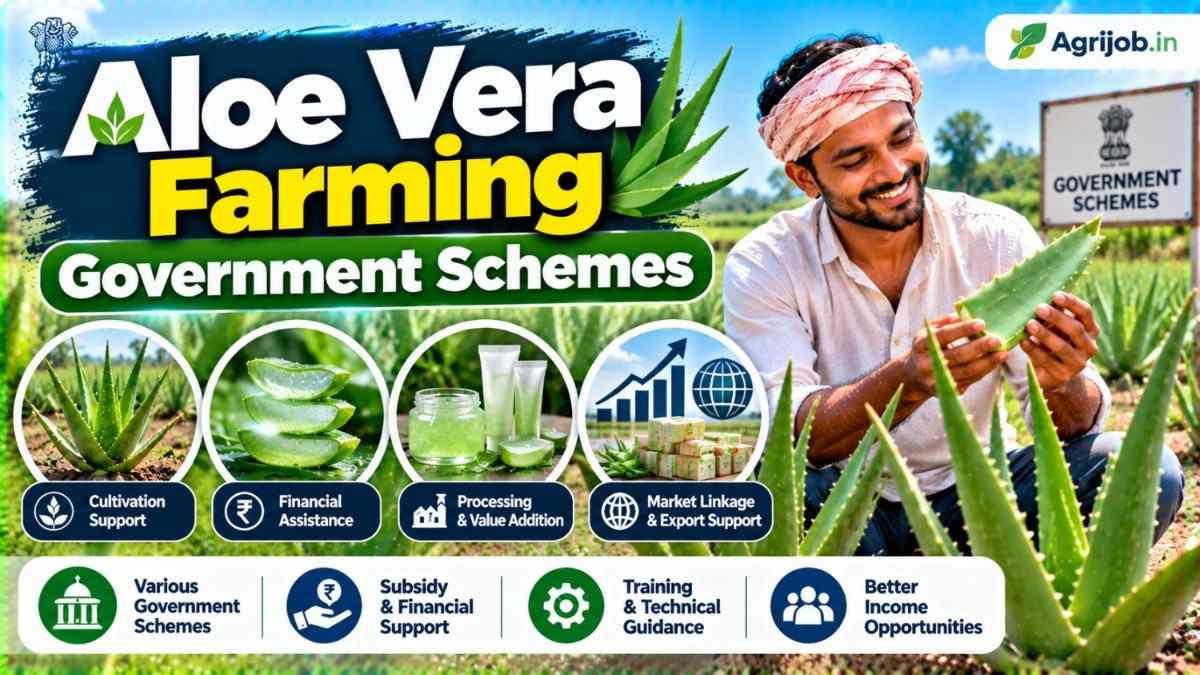
Aloe vera farming government schemes are financial assistance programs run by the central and state governments to promote the cultivation of medicinal plants — including aloe vera (botanically known as Aloe barbadensis Miller, called Ghritkumari in Hindi) — across India. These schemes reduce the upfront cost of cultivation, provide access to quality planting material, support post-harvest infrastructure, and create market linkages with AYUSH industries, pharmaceutical companies, and exporters.
The primary implementing authority is the National Medicinal Plants Board (NMPB), established on 24 November 2000 under the Ministry of AYUSH, Government of India. Aloe vera is officially listed as a priority medicinal plant under the NMPB’s National AYUSH Mission (NAM) scheme, making it eligible for a 30% cultivation subsidy with an official cost benchmark of Rs.24,990 per acre. States that have their own AYUSH or horticulture departments can layer additional support on top, pushing effective subsidy to 50%–75% in select regions.

India is the world’s second-largest exporter of aloe vera after China, supplying leaves, gel, and extracts to global pharmaceutical, cosmetic, and food industries. The global aloe vera extracts market was valued at $3.5 billion in 2023 and is expected to reach $7.3 billion by 2033, creating a massive long-term demand opportunity for Indian farmers who enter now with government-backed support.
Who Should Apply for Aloe Vera Farming Subsidies?
These schemes are designed for a wide range of beneficiaries. You should apply if you fall into any of these profiles:
- 🌾 Small and marginal farmers with 0.5–5 acres of land in Rajasthan, Gujarat, MP, UP, Maharashtra, Andhra Pradesh, Tamil Nadu, or Karnataka who want to diversify from conventional crops to a high-value medicinal plant
- 🎓 Agricultural graduates and young agripreneurs aged 18–35 looking to start a commercial medicinal plant business with government funding support
- 👨👩👧 Self-Help Groups (SHGs) and Farmer Producer Organisations (FPOs) seeking cluster farming opportunities under NMPB guidelines
- 🏭 Farmers near pharmaceutical or cosmetic manufacturing hubs in Pune, Mumbai, Ahmedabad, Jaipur, or Lucknow who want to supply directly under contract farming arrangements
- 💧 Dryland and semi-arid region farmers in Rajasthan, Gujarat, or Bundelkhand where conventional crops fail — aloe vera thrives with minimal water
- 🌱 Organic farmers who already hold or plan to obtain organic certification — organic aloe commands a significant premium (Rs.20–Rs.25/kg vs Rs.10–Rs.15/kg for conventional)
- 🔄 Intercrop farmers who grow mango, custard apple, or moringa and want a profitable ground-level companion crop
- 🏘️ Rural entrepreneurs interested in value-added aloe products — juice, gel extraction, cosmetic raw material processing — who want access to the NMPB’s Medicinal Plants Business Centre scheme (up to Rs.5 crore support)
Central Government Schemes for Aloe Vera Farming
The Indian central government runs two primary financial support frameworks for aloe vera farmers, both administered through the National Medicinal Plants Board (NMPB) under the Ministry of AYUSH.
1. National AYUSH Mission (NAM) — Medicinal Plants Component
The National AYUSH Mission (NAM) is a centrally sponsored scheme under the Ministry of AYUSH that provides state-level funding for medicinal plant cultivation in identified clusters and zones across the country. Under the NAM’s Medicinal Plants component, aloe vera is listed as a 30% subsidy crop with a benchmark cost of Rs.24,990 per acre. This means eligible farmers receive approximately Rs.7,497 per acre directly as cultivation support, in addition to assistance for post-harvest management and market infrastructure development.
The scheme covers: (a) cultivation of prioritized medicinal plants on farmer’s land; (b) establishment of nurseries with backward linkages for quality planting material; (c) post-harvest management with forward linkages; and (d) primary processing, marketing infrastructure, and value addition. Farmers apply through their State AYUSH Mission office or State Medicinal Plants Board (SMPB).
2. NMPB Central Sector Scheme — Conservation, Development & Sustainable Management
The NMPB’s Central Sector Scheme on Conservation, Development and Sustainable Management of Medicinal Plants provides project-based financial support across six components: Conservation (including Medicinal Plant Conservation Areas at Rs.5,000/hectare for strengthening existing MPCAs), Research and Development, Information and Training, Herbal Gardens, Marketing and Trade, and International Cooperation. Implemented during 2021-22 to 2025-26, this scheme particularly benefits nurseries, farmer clusters, and organizations involved in aloe vera supply chain development.
3. Medicinal Plants Business Centre Scheme — Up to Rs.5 Crore
The NMPB launched a dedicated Medicinal Plants Business Centre (MPBC) Scheme providing financial assistance of up to Rs.5 crore per centre to strengthen post-harvest infrastructure, improve market linkages, and enhance value addition in the medicinal plants and herbal sector. This is a major opportunity for farmer cooperatives, FPOs, and agri-entrepreneurs who want to set up aloe gel extraction units, drying facilities, or processing centres. Proposals must be submitted to the NMPB through state implementing agencies.
4. Mission for Integrated Development of Horticulture (MIDH)
Under the Mission for Integrated Development of Horticulture (MIDH) run by the Ministry of Agriculture and Farmers Welfare, aloe vera qualifies for infrastructure development subsidies including drip irrigation, protected cultivation, and post-harvest cold storage support. While MIDH does not directly target aloe vera cultivation, farmers who grow it as a horticultural medicinal crop can access infrastructure funding to reduce their overall input costs.
5. PM Fasal Bima Yojana — Crop Insurance
Aloe vera farmers can also enroll under the Pradhan Mantri Fasal Bima Yojana (PMFBY) for crop insurance against natural calamities, pests, and disease. Small and marginal farmers are entitled to a 50% premium subsidy shared equally between the central and state governments, protecting aloe vera cultivation investments from weather-related losses.
State-Wise Schemes and Subsidies for Aloe Vera Farmers
Beyond central government support, several states have dedicated or supplementary schemes that make aloe vera farming even more financially viable. Here is a state-wise breakdown of key support available in 2026:
| State | Key Scheme / Support | Subsidy / Benefit | Apply Via |
|---|---|---|---|
| Rajasthan | State Horticulture Department + NMPB + PM-KISAN top-up | 30–50% on cultivation; drip irrigation subsidy | rajkisan.gov.in / District Agriculture Office |
| Gujarat | Ikhedut Portal — Horticulture Scheme + NMPB integration | Up to 70% on drip irrigation (2 hectare cap); 30% on cultivation | ikhedut.gujarat.gov.in |
| Madhya Pradesh | MP Krishi Yantra Anudan + AYUSH Mission medicinal plants cluster | 50% on farm machinery; 30–50% on medicinal plants | mpfsts.mp.gov.in / District Agriculture Office |
| Uttar Pradesh | UP Horticulture Department MIDH + NMPB cluster scheme | 30–50% on cultivation costs; nursery development grants | uphorticulture.gov.in / KVK |
| Maharashtra | State Horticulture Mission + PMFBY crop insurance | 30–50% subsidy; 50% crop insurance premium subsidy | mahabhumi.gov.in / District Agriculture Office |
| Andhra Pradesh | YSR Rythu Bharosa + State AYUSH Mission | Financial input support + medicinal plant cultivation assistance | ysrrythubharosa.ap.gov.in |
| Tamil Nadu | TNAU Medicinal Plants Mission + NMPB cluster | 30% cultivation subsidy + drip irrigation support | agri.tn.gov.in / TNAU Extension |
| Karnataka | Raitha Siri Scheme + NMPB cluster support | Up to 50% on input costs; market linkage support | raitamitra.kar.nic.in |
| Haryana | Horticulture Department Medicinal Plants Scheme | 30–40% on planting material and cultivation | hortharyana.gov.in |
| Punjab | Punjab Agriculture Department Diversification Scheme | 30% cultivation subsidy; DBT mode | agripb.gov.in / Punjab Agri Dept |
Note: Subsidy percentages are based on scheme guidelines as available from official portals and NMPB documentation. Always verify current rates with your district agriculture office or KVK before investing, as state governments revise these annually.
Aloe Vera Farming Profit and Income Per Acre in 2026
Aloe vera farming is financially compelling primarily because the plant produces for 4–5 years after a single planting, meaning your initial investment is spread across multiple harvests. Here is a realistic per-acre income and cost breakdown for 2026:
| Parameter | Open Market (Rs.10/kg) | Direct to Pharma/Cosmetic (Rs.25/kg) | Contract Farming (Guaranteed) |
|---|---|---|---|
| Plants per acre | 10,000–16,000 | 10,000–16,000 | 10,000–15,000 |
| Yield (mature, Year 2+) | 12 tonnes/acre/year | 12 tonnes/acre/year | 10–12 tonnes/acre/year |
| Gross Revenue | Rs.1,20,000/acre | Rs.3,00,000/acre | Rs.1,00,000–Rs.1,50,000/acre |
| Year 1 Input Cost | Rs.40,000–Rs.55,000 | Rs.40,000–Rs.55,000 | Rs.40,000–Rs.55,000 |
| NMPB Subsidy (30%) | Rs.7,497 back on Rs.24,990 benchmark | Rs.7,497 | Rs.7,497 |
| Net Profit (Year 2+) | Rs.70,000–Rs.80,000/acre | Rs.2,40,000–Rs.2,60,000/acre | Rs.60,000–Rs.1,00,000/acre |
| 5-Year Cumulative Net | Rs.3.0–Rs.3.5 lakh/acre | Rs.10–Rs.12 lakh/acre | Rs.2.5–Rs.5 lakh/acre |
A Maharashtra farmer, Hrushikesh Dhane from Satara, demonstrates what premium market access looks like in practice: selling at Rs.25/kg to pharmaceutical companies in Pune and Mumbai, he earns Rs.1 crore annually from just 3 acres of aloe vera, including revenue from aloe-based organic pesticide products. While this represents exceptional market execution, it shows the ceiling of what is achievable with the right buyer relationships and value-added processing.
Apply for the NMPB cultivation subsidy BEFORE you spend on planting material, not after. Subsidy disbursement can take 30–90 days after approval; if you invest first and apply later, you may face a cash flow gap. Also register with at least one contract farming buyer (Patanjali, Dabur, or a local cosmetic processor) before planting — the guaranteed buyback price protects you from open-market price volatility.
Eligibility Criteria and Required Documents
To claim aloe vera farming subsidies under the NMPB/NAM scheme and most state schemes, applicants must meet the following eligibility criteria:
- Land Ownership: Must be a land owner, tenant farmer, or sharecropper with verifiable land records (7/12 extract, Khasra/Khatauni, or equivalent revenue document)
- Land Area: Minimum 0.5 acres for individual farmers; cluster schemes require 5–25 acres of contiguous or mapped group land
- Residency: Must be a permanent resident of the state in which the scheme is being applied
- Aadhaar Linkage: Aadhaar-linked bank account (DBT-enabled) mandatory for direct benefit transfer of subsidy amounts
- Crop Category: Aloe vera must be the primary or stated cultivation crop on the applied land; mixed/intercropping is permitted in many states
- Prior Scheme: Farmers who have received subsidy for the same land parcel under another central scheme in the last 3 years may be ineligible — check with your state AYUSH department
- Organic Preference: Some state schemes give priority to farmers with organic certification or those willing to adopt GAP (Good Agricultural Practices) standards
Required Documents:
- Aadhaar Card (identity proof)
- Land ownership / tenancy document (7/12, Khasra, Patta)
- Bank passbook (Aadhaar-linked, for DBT)
- Passport-size photograph
- Caste certificate (for SC/ST category subsidy enhancement where applicable)
- PM-KISAN registration number (for cross-verification in many states)
- Soil health card (recommended; required in some states)
- SHG/FPO registration certificate (for group/cluster applications)
| Applicant Category | Additional Benefit / Relaxation |
|---|---|
| Small / Marginal Farmer (<2 hectares) | Priority in beneficiary selection; enhanced subsidy in some states |
| SC/ST Farmers | Additional 10–15% subsidy enhancement under state welfare programs |
| Women Farmers / SHG Members | Priority allocation; additional grant components in several states |
| FPO Members | Eligible for cluster-level subsidy and MPBC infrastructure funding |
| Organic Certified Farmers | Eligible for GAP/organic certification cost reimbursement under NMPB |
How to Apply for Aloe Vera Farming Government Schemes — Step-by-Step
Here is the complete step-by-step process to apply for the NMPB/NAM aloe vera cultivation subsidy and state-level schemes in 2026:
- Identify your State AYUSH Mission or State Medicinal Plants Board (SMPB): Every state has either a dedicated State AYUSH Mission office or a State Medicinal Plants Board. These are your primary contact points. You can find your state’s AYUSH Mission contact at the National AYUSH Mission portal (ayush.gov.in) or directly at nmpb.nic.in.
- Visit your District Agriculture Office or Krishi Vigyan Kendra (KVK): KVKs are the on-ground implementation hubs for most NMPB scheme activities. Visit your nearest KVK to receive scheme-specific guidance, current subsidy rates for your district, approved planting material sources, and application forms.
- Register on your State’s Agricultural DBT Portal: Most states now disburse subsidies via Direct Benefit Transfer (DBT). Ensure your Aadhaar is linked to your bank account and register on your state’s agri or horticulture portal (e.g., ikhedut.gujarat.gov.in for Gujarat, rajkisan.gov.in for Rajasthan, mpfsts.mp.gov.in for MP).
- Submit a Pre-Planting Application: Apply for the cultivation subsidy BEFORE you purchase planting material or begin land preparation. Submit your application with land records, Aadhaar, bank details, and a brief cultivation plan. Most states require pre-approval before disbursement.
- Obtain Quality Planting Material from Approved Sources: Procure certified aloe vera suckers/pups from NMPB-approved nurseries or from state horticulture nurseries. Using unapproved sources disqualifies your subsidy claim. Your KVK can provide a list of approved suppliers in your district.
- Complete Cultivation and Submit Utilization Certificate: After planting and the first growing cycle, submit a utilization certificate with photographs of your crop, purchase bills for inputs, and a statement of expenditure to your SMPB or state AYUSH Mission office.
- Verification and Site Inspection: A field officer from the district agriculture or AYUSH department will visit your farm for physical verification of the crop. Ensure your land records and crop area match your application.
- Subsidy Disbursed via DBT: Once verification is complete, the approved subsidy amount is transferred directly to your Aadhaar-linked bank account. Turnaround is typically 30–90 days from the date of successful verification.
NMPB Scheme vs National AYUSH Mission — Which Is Better for Aloe Vera Farmers?
| Parameter | NMPB Central Sector Scheme | National AYUSH Mission (NAM) |
|---|---|---|
| Administering Body | NMPB, Ministry of AYUSH (Central) | State AYUSH Mission + NMPB |
| Scheme Type | Central Sector (100% central funding) | Centrally Sponsored (centre + state share) |
| Subsidy for Aloe Vera | 30% cultivation subsidy | 30–75% depending on plant category & state |
| Coverage | 140 priority medicinal plants | Priority plants in identified clusters/zones |
| Post-Harvest Support | Yes — processing and marketing | Yes — forward linkage support |
| Nursery Support | Yes — backward linkage grants | Yes — quality planting material support |
| Infrastructure Grants | Up to Rs.5 crore (MPBC) | State-level infrastructure within NAM budget |
| Apply Via | nmpb.nic.in / State SMPB | State AYUSH Mission / District Office |
| Best For | Large farmers, FPOs, clusters, processors | Individual farmers, small landholders |
| Organic Certification | Available (GAP/organic cost support) | Available at state level |
For individual aloe vera farmers with 1–5 acres, the National AYUSH Mission (NAM) through your State AYUSH Mission is the most accessible starting point — apply here first, as it has a simpler process and state-level support. If you are an FPO, cooperative, or planning a processing unit, also pursue the NMPB Medicinal Plants Business Centre scheme for the infrastructure component. Combine both with your state’s drip irrigation subsidy (50–70% in Gujarat; 30–50% in MP, Rajasthan, Maharashtra) to dramatically reduce your total input cost.
Pros and Cons of Aloe Vera Farming with Government Support
Advantages of Aloe Vera Farming with Government Subsidies:
- ✅ 30–75% cost reduction on cultivation through NMPB and state subsidies significantly lowers the entry barrier
- ✅ Drought-resistant crop — ideal for water-scarce regions like Rajasthan, Gujarat, and Bundelkhand where subsidy access is also strong
- ✅ 5-year production cycle from a single planting investment, compounding returns without annual replanting costs
- ✅ Contract farming options with Patanjali, Dabur, and pharmaceutical companies eliminate market-price risk entirely
- ✅ Rising global demand — India’s second-largest exporter status creates both domestic and export market access
- ✅ Value-added revenue streams — gel extraction, organic pesticide manufacturing, cosmetic raw material supply generate 3–5x returns vs fresh leaf sales
Disadvantages and Challenges to Consider:
- ❌ Subsidy disbursement delays — 30–90 day turnaround can create cash flow challenges if you invest before approval is in hand
- ❌ Market price volatility for open-market fresh leaf sales (Rs.10–Rs.15/kg) makes profitability dependent on buyer relationships
- ❌ Quality planting material scarcity — approved NMPB nurseries can have limited stock, especially for high-yielding AL-1 (Rajasthan Agricultural University) variety
- ❌ Bureaucratic application process — multi-department involvement (AYUSH Mission, district agriculture, KVK) requires persistence and multiple follow-ups
Important Terms Related to Aloe Vera Farming Government Schemes
- NMPB (National Medicinal Plants Board): The apex central government body under Ministry of AYUSH established in 2000 to coordinate, promote, and fund medicinal plant cultivation, conservation, research, and trade across India.
- National AYUSH Mission (NAM): A centrally sponsored scheme that funds state-level AYUSH infrastructure, including medicinal plant cultivation clusters, nurseries, and post-harvest processing with subsidies of 30%–75% for priority species.
- Ghritkumari (Aloe barbadensis Miller): The botanical and Hindi name for aloe vera — the official name used in NMPB scheme documentation and subsidy eligibility lists. It is classified as a 30% subsidy plant under NAM.
- Medicinal Plants Conservation Area (MPCA): Designated zones identified by NMPB through systematic survey and geo-referencing of natural medicinal plant populations. NMPB provides Rs.5,000/hectare for strengthening existing MPCAs.
- State Medicinal Plants Board (SMPB): State-level counterpart of NMPB that implements the National AYUSH Mission’s medicinal plant component, processes subsidy applications, and coordinates with district agriculture offices.
- GAP (Good Agricultural Practices): Standardized farming protocols for medicinal plants covering planting, irrigation, pest management, and harvesting — NMPB provides cost support for GAP and organic certification.
- Medicinal Plants Business Centre (MPBC): A value chain infrastructure facility supported by NMPB with up to Rs.5 crore per centre for post-harvest handling, processing, market linkage, and value addition in the medicinal plants sector.
- DBT (Direct Benefit Transfer): The government system through which subsidy amounts are transferred directly to Aadhaar-linked bank accounts of beneficiary farmers, eliminating middlemen and reducing processing delay.
- KVK (Krishi Vigyan Kendra): Farm Science Centres established by ICAR at the district level that serve as on-ground implementation hubs for government agricultural and medicinal plant schemes, providing technical guidance and approved planting material information.
- Contract Farming: A pre-agreed arrangement between an aloe vera farmer and a buyer (pharmaceutical company, Patanjali, Dabur, cosmetic processor) that guarantees a fixed purchase price and volume, eliminating open-market price risk for the farmer.
Important Links and Official Resources
| Resource | Official Link |
|---|---|
| NMPB Official Website (Scheme Details + Application) | nmpb.nic.in |
| Ministry of AYUSH — National AYUSH Mission | ayush.gov.in |
| PIB — NMPB Scheme Details (Official Press Release) | pib.gov.in |
| NMPB Prioritized Plants List (30% Subsidy Category) | nmpb.nic.in/content/list-prioritized-plants |
| Gujarat Farmers Portal (Ikhedut) | ikhedut.gujarat.gov.in |
| Rajasthan Farmers Portal | rajkisan.gov.in |
| PM Fasal Bima Yojana (Crop Insurance) | pmfby.gov.in |
| MIDH — Ministry of Agriculture (Horticulture Support) | midh.gov.in |
Conclusion — Final Thoughts on Aloe Vera Farming Government Schemes 2026
Aloe vera farming with government support represents one of the most financially accessible and high-return agricultural opportunities in India in 2026. Between the NMPB’s 30% cultivation subsidy, the National AYUSH Mission’s cluster support, state-level horticulture and AYUSH schemes, drip irrigation subsidies, and access to the Rs.5 crore Medicinal Plants Business Centre program, a farmer can substantially reduce the Rs.40,000–Rs.55,000 per acre first-year investment while entering a crop that delivers 4–5 years of income from a single planting cycle.
The key to maximizing returns is not just subsidy access — it is combining government support with direct buyer relationships (pharma, cosmetic, or AYUSH industry contracts) that push your price from the open-market floor of Rs.10/kg to the premium bracket of Rs.20–Rs.25/kg. Apply on nmpb.nic.in or contact your nearest KVK today — and register for the subsidy before you purchase any planting material.
- Aloe vera (Ghritkumari) is officially listed under the NMPB’s 30% subsidy category with a benchmark cultivation cost of Rs.24,990/acre under the National AYUSH Mission
- Combined central + state schemes can reduce your effective cultivation cost by 50%–75%, especially in Rajasthan, Gujarat, and Madhya Pradesh
- Mature aloe vera yields 12 tonnes/acre/year — generating Rs.1,20,000 at open market prices and up to Rs.3,00,000/acre with pharmaceutical or cosmetic buyers
- The NMPB Medicinal Plants Business Centre scheme offers up to Rs.5 crore for FPOs and agri-entrepreneurs to set up processing and value-addition infrastructure
- Apply for the subsidy BEFORE planting — pre-approval is required; subsidy is disbursed via Aadhaar-linked DBT within 30–90 days of verification
- Start your application at nmpb.nic.in, or visit your district agriculture office / KVK for state-specific guidance and approved planting material sources
Frequently Asked Questions About Aloe Vera Farming Government Schemes 2026
What is the government subsidy for aloe vera farming in India?
The National Medicinal Plants Board (NMPB) under the Ministry of AYUSH provides a 30% cultivation subsidy for aloe vera (Ghritkumari) under the National AYUSH Mission scheme. The official benchmark cost is Rs.24,990 per acre, so eligible farmers receive approximately Rs.7,497 per acre as a direct subsidy. Several states offer additional support, bringing the combined subsidy to 50%–75% of cultivation costs in states like Gujarat, Rajasthan, and Madhya Pradesh.
Which is the best state for aloe vera farming with maximum government support?
Rajasthan and Gujarat are consistently rated as the best states for aloe vera farming in India, combining natural climatic advantage (arid/semi-arid conditions with low pest pressure) with strong government subsidy frameworks. Gujarat’s Ikhedut portal offers up to 70% subsidy on drip irrigation alongside NMPB’s 30% cultivation grant. Rajasthan has dedicated horticulture scheme support plus access to the Rajasthan Agricultural University’s high-yielding AL-1 aloe vera variety. Madhya Pradesh also scores high due to active AYUSH Mission cluster support and a favorable regulatory environment for medicinal plant contracts.
How do I apply for the NMPB aloe vera farming subsidy?
Visit nmpb.nic.in to access the scheme guidelines and application portal, or contact your State Medicinal Plants Board (SMPB) directly. At the district level, your Krishi Vigyan Kendra (KVK) is the most accessible first contact point — they will guide you through the state-specific application form, documentation requirements, and approved planting material sources. Always apply before purchasing planting material, as most states require pre-planting approval before disbursing the subsidy via Aadhaar-linked DBT.
Is aloe vera farming profitable in India in 2026?
Yes. Aloe vera farming is considered highly profitable in India in 2026 due to its low water requirement, 4–5 year production cycle from a single planting, and rising demand from pharmaceutical, cosmetic, Ayurvedic, and food industries. At open market rates of Rs.10/kg, a mature farm yields Rs.1,20,000/acre/year gross income. Farmers selling directly to pharma or cosmetic companies at Rs.20–Rs.25/kg can earn Rs.2,40,000–Rs.3,00,000/acre/year — and exceptional agripreneurs like Hrushikesh Dhane of Satara earn Rs.1 crore annually from 3 acres using value-added product strategies.
What is the National AYUSH Mission and how does it support aloe vera farmers?
The National AYUSH Mission (NAM) is a centrally sponsored scheme under the Ministry of AYUSH that provides state-level funding for medicinal plant cultivation in identified clusters and zones across India. Under its Medicinal Plants component, NAM funds cultivation subsidies (30%–75% for priority plants including aloe vera), nursery development with backward linkages for quality planting material, post-harvest management with forward linkages, and primary processing and marketing infrastructure. Farmers apply through their State AYUSH Mission office or State Medicinal Plants Board.
Can I do aloe vera contract farming with companies like Patanjali or Dabur?
Yes. Patanjali, Dabur, and numerous Ayurvedic, pharmaceutical, and cosmetic processing companies across India offer contract farming arrangements for aloe vera that provide guaranteed buyback prices and volumes, eliminating open-market price risk. NMPB also actively facilitates industry-farmer partnerships through its scheme, where AYUSH industry owners and extract manufacturers participate in cultivation with pre-decided prices. Minimum land requirement for most company contracts is 1–5 acres. For organic-certified aloe vera, companies pay a significant premium above standard contract rates.
What is the yield and harvest cycle of aloe vera farming?
Aloe vera reaches its first commercial harvest in 8–10 months after planting. A mature farm (Year 2 onwards) yields approximately 12 tonnes per acre per year under good irrigation management. The plant produces commercially for 4–5 years without replanting. Each established acre also generates 8,000–12,000 pups (offshoots) annually, which can be used to expand cultivation to additional acres at zero planting material cost — effectively eliminating your replanting investment from Year 2 onwards.
What documents are needed to apply for aloe vera farming subsidy?
To apply for NMPB/NAM aloe vera cultivation subsidy, you need: Aadhaar Card (identity proof), land ownership or tenancy document (7/12, Khasra, Patta, or equivalent revenue record), Aadhaar-linked bank passbook (for DBT subsidy transfer), passport-size photograph, and PM-KISAN registration number where required for cross-verification. SC/ST farmers should include their caste certificate for enhanced subsidy eligibility. SHGs and FPOs applying for cluster-level support must attach their group registration certificate.
What is the Medicinal Plants Business Centre (MPBC) scheme and who can apply?
The Medicinal Plants Business Centre (MPBC) scheme, launched by the National Medicinal Plants Board under the Ministry of AYUSH, provides financial assistance of up to Rs.5 crore per centre to establish integrated facilities for post-harvest handling, processing, market linkage, and value addition for medicinal plants including aloe vera. It is primarily targeted at Farmer Producer Organisations (FPOs), cooperatives, state forest development corporations, and agricultural entrepreneurs with the infrastructure and experience to operate a processing centre. Proposals are submitted to the NMPB through state implementing agencies; visit nmpb.nic.in for current call for proposals.
Last Updated: October 2026 | This guide is reviewed and updated regularly for accuracy. Bookmark this page for the latest information on aloe vera farming government schemes.
Disclaimer: This article is for informational purposes only. Subsidy rates, scheme guidelines, and eligibility criteria are subject to change by the central and state governments. Always verify current scheme details with the official NMPB portal (nmpb.nic.in), your State AYUSH Mission office, or your local Krishi Vigyan Kendra (KVK) before making any investment decision.