

Biogas plant for dairy farm is now one of the most profitable investments Indian dairy farmers can make in 2026. A farmer with just 10–15 cows can generate free cooking gas, save Rs.3,500–Rs.10,000 per month on LPG and electricity, and earn additional income from biogas slurry (organic manure) — all while qualifying for a government subsidy of up to Rs.70,400 under the MNRE National Bioenergy Programme. This guide is for dairy farmers, livestock owners, gaushalas, and rural entrepreneurs in India who want to convert cow dung into clean energy and stable income. We cover setup cost, subsidy amounts, income projections from gas and manure, step-by-step application process, and how NDDB and GOBAR-DHAN Yojana can fund your project in 2026.

A dairy farm biogas plant in India costs Rs.50,000–Rs.5 lakh depending on size (1–25 m³). The MNRE government subsidy covers Rs.9,800–Rs.70,400 per plant. A 10-cow dairy farm can save Rs.3,500–Rs.5,000/month on fuel and earn Rs.1,500–Rs.5,000/month from organic slurry sales — total monthly benefit of Rs.5,000–Rs.10,000 within the first year.
- Scheme Name: National Bioenergy Programme (Biogas Programme) — MNRE
- Programme Period: FY 2021–22 to FY 2025–26 (Phase I); GOBARdhan CBG Scheme approved August 2026 (FY 2026–35)
- Government Subsidy (Small Plants 1–25 m³): Rs.9,800–Rs.70,400 per plant (CFA by MNRE)
- CBG Plant Subsidy (Large): Up to Rs.10 crore per project under new GOBARdhan unified scheme
- GOBAR-DHAN Household Subsidy: Rs.10,000–Rs.40,000 per unit
- Monthly Savings (10-cow farm): Rs.3,500–Rs.5,000 on LPG + electricity
- Slurry/Manure Income: Rs.1,500–Rs.5,000/month per plant
- Large Farm Savings (300 cows): Rs.2.5 lakh/month on electricity (documented real case)
- Cow Dung Procurement Price (NDDB): Rs.1/kg (NDDB CBG plants — July 2026)
- Apply Online: biogas.mnre.gov.in | sbm.gov.in/gbdw
📋 Table of Contents
- What Is a Biogas Plant for Dairy Farm and How Does It Work?
- Who Should Install a Biogas Plant on Their Dairy Farm?
- Biogas Plant Setup Cost for Dairy Farms in India 2026
- Government Subsidy for Dairy Farm Biogas Plant 2026 – MNRE, GOBAR-DHAN & CBG
- Income from Biogas Slurry and Organic Manure – How Much Can You Earn?
- Eligibility Criteria and Documents Required
- Step-by-Step: How to Apply for Biogas Plant Subsidy in India 2026
- Biogas Plant vs Traditional LPG & Electricity – Comparison Table
- Advantages and Disadvantages of Dairy Farm Biogas Plants
- Important Terms Related to Biogas Plants
- Important Links – Official Portals and Application Links
- Conclusion
- Key Takeaways
- Frequently Asked Questions
What Is a Biogas Plant for Dairy Farm and How Does It Work?
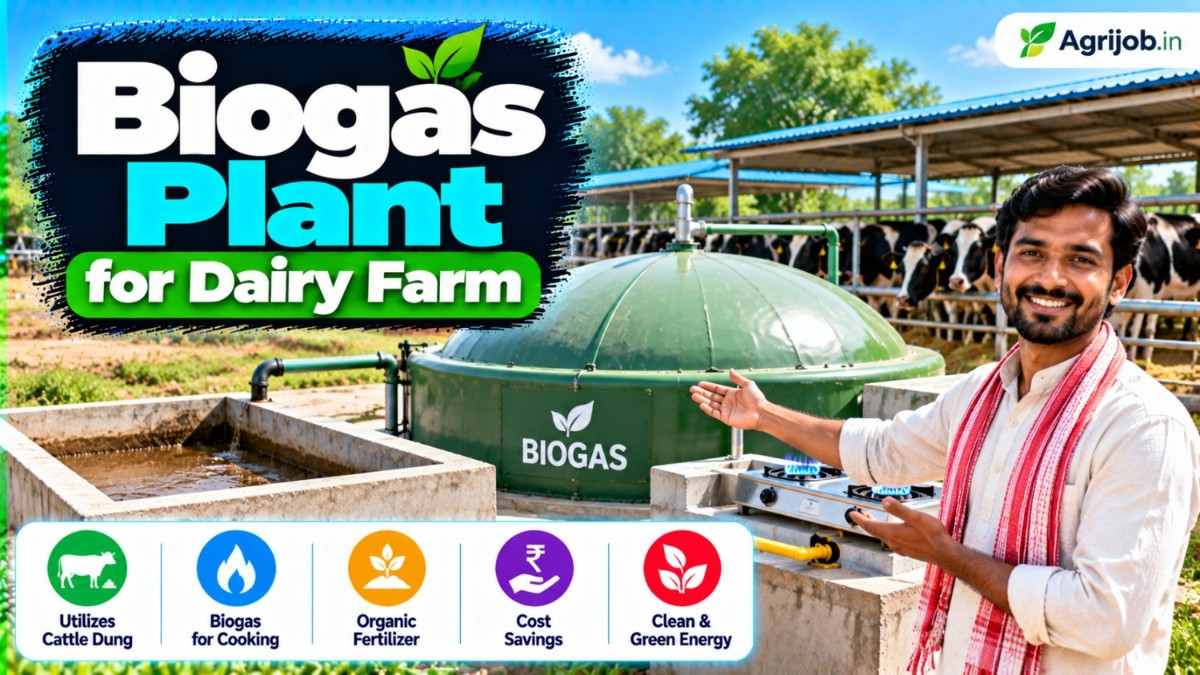
A biogas plant for dairy farm is an anaerobic digestion system that converts cattle dung and organic waste into biogas (60–65% methane) and nutrient-rich slurry. The system works without electricity and requires no external fuel once operational. Cow dung is mixed with equal parts water, fed into a sealed underground digester, and bacteria break it down over 20–30 days to produce combustible gas and liquid biofertilizer.
Every kilogram of fresh cow dung produces approximately 0.04–0.06 m³ of biogas. A single dairy cow generates 10–15 kg of dung daily — meaning a 10-cow farm produces enough raw material for a 4–6 m³ biogas plant that fully replaces 1.5–2 LPG cylinders per month. As India’s Union Cabinet approved the new GOBARdhan national unified scheme with a Rs.23,731 crore outlay in August 2026, dairy farmers now have the strongest-ever policy backing to invest in biogas.

| Component | Function |
|---|---|
| Anaerobic Digester (Dome/Tank) | Main chamber where dung ferments to produce gas |
| Inlet Pipe | Feeds fresh dung-water mixture into digester |
| Gas Holder / Dome | Collects and stores produced biogas |
| Outlet / Overflow Tank | Releases digested slurry (biofertilizer) |
| Gas Pipeline & Burner | Delivers gas to kitchen or generator |
| Biogas Generator (Optional) | Converts gas to electricity for farm use |
| Slurry Filter Unit (Optional) | Enriches slurry for higher-value organic manure |
Who Should Install a Biogas Plant on Their Dairy Farm?
Biogas plants are viable for a wide range of dairy and livestock operations. You should seriously consider installing one if you match any of the following profiles:
- 🐄 Small dairy farmers with 5–25 cows who spend Rs.1,500–Rs.3,000/month on LPG for cooking or farm heating and want to eliminate that cost
- 🏭 Commercial dairy farms with 50–300+ cattle paying Rs.10,000–Rs.2.5 lakh/month in electricity bills who want energy independence
- 🌾 Farmer-landowners with 1–5 acres of crop land who currently buy chemical fertilizers at Rs.300–Rs.500/bag and want free organic manure instead
- 🏛️ Registered Gaushalas (cow shelters) that qualify for 20% additional subsidy over standard CFA under MNRE rules
- 🤝 Farmer Producer Organizations (FPOs) looking to create a community biogas unit to serve 10–50 member households collectively
- 🏙️ Institutions and residential dairy colonies generating organic waste who want a waste-to-energy solution with government support
- 📦 Dairy entrepreneurs near NDDB CBG plants who can supply cow dung at Rs.1/kg and earn Rs.36,000–Rs.72,000/year in dung sales income
- 🌱 Organic farmers transitioning to zero-chemical farming who need a steady, free supply of certified biofertilizer from biogas slurry
Biogas Plant Setup Cost for Dairy Farms in India 2026
The total cost of setting up a dairy farm biogas plant in India depends on plant capacity (m³ of gas per day), digester design, whether electricity generation equipment is added, and civil construction at your location. Here is a detailed breakdown of indicative costs in 2026 before government subsidy:
| Plant Size | Suitable For (Cattle) | Total Cost (Before Subsidy) | MNRE CFA Subsidy | Net Cost After Subsidy |
|---|---|---|---|---|
| 1–2 m³/day | 2–5 cows (household) | Rs.25,000–Rs.50,000 | Rs.9,800–Rs.18,000 | Rs.15,000–Rs.32,000 |
| 4–6 m³/day | 8–15 cows (small farm) | Rs.50,000–Rs.1,20,000 | Rs.18,000–Rs.35,000 | Rs.32,000–Rs.85,000 |
| 10 m³/day | 20–30 cows (medium farm) | Rs.1,00,000–Rs.2,00,000 | Rs.35,000–Rs.45,000 | Rs.55,000–Rs.1,55,000 |
| 15–25 m³/day | 30–60 cows (large farm) | Rs.2,00,000–Rs.5,00,000 | Rs.55,000–Rs.70,400 | Rs.1,30,000–Rs.4,30,000 |
| 25–100 m³/day (Medium) | 60–250 cows (commercial) | Rs.5,00,000–Rs.25,00,000 | CFA as per Table-II (MNRE) | Varies by project |
| CBG Plant (100+ m³/day) | 250+ cows / institutional | Rs.50 lakh–Rs.15 crore | Up to Rs.10 crore (new GOBARdhan) | Project-specific |
Note: For 10–25 m³ plants, an additional MNRE incentive of Rs.10,000 per biogas-based generator set is available for meeting farm power and water pumping needs. NABARD offers priority-sector loans for biogas projects in rural areas at concessional interest rates. (Source: MNRE Official Biogas Programme)
Government Subsidy for Dairy Farm Biogas Plant 2026 – MNRE, GOBAR-DHAN & CBG
India’s government runs three overlapping schemes that dairy farmers can tap for biogas plant subsidies in 2026. Understanding which scheme applies to your farm size is the single most important step before investing:
1. MNRE National Bioenergy Programme – Biogas Scheme (Phase I: 2021–26)
The Ministry of New and Renewable Energy (MNRE) provides Central Financial Assistance (CFA) for small (1–25 m³) and medium (25–2,500 m³) biogas plants. For small family and farm-level plants, the CFA ranges from Rs.9,800 to Rs.70,400 per plant based on capacity. Registered Gaushalas and SC/ST beneficiaries receive 20% additional subsidy above the standard rate. An extra Rs.10,000 incentive is provided for biogas-based generator sets installed on 10–25 m³ plants. Apply at: biogas.mnre.gov.in
2. GOBAR-DHAN Yojana (Galvanizing Organic Bio-Agro Resources Dhan)
GOBAR-DHAN Yojana, implemented by the Ministry of Jal Shakti under Swachh Bharat Mission (Rural), provides Rs.10,000–Rs.40,000 per household biogas unit for converting cattle dung into clean energy. The scheme prioritizes dairy households in rural India. Benefits include free cooking gas equivalent to 1.5–2 LPG cylinders per month and organic slurry fertilizer worth Rs.5,000–Rs.8,000 per year. Apply at: sbm.gov.in/gbdw
3. New GOBARdhan CBG Scheme – August 2026 (Rs.23,731 Crore National Scheme)
In August 2026, India’s Union Cabinet approved the new GOBARdhan — National Unified Scheme for Compressed Biogas — with a Rs.23,731 crore outlay for FY 2026–27 to FY 2035–36. This scheme provides capital assistance for commercial-scale Compressed Biogas (CBG) plants — up to Rs.10 crore per project. Under the SATAT scheme, Oil Marketing Companies (IOCL, BPCL, HPCL) guarantee offtake of CBG production for 10–15 years, eliminating market risk for large dairy operators.
| Scheme | Ministry | Target | Subsidy Amount | Portal |
|---|---|---|---|---|
| MNRE Biogas Programme (Small) | MNRE | Farms with 2–60 cows | Rs.9,800–Rs.70,400/plant | biogas.mnre.gov.in |
| MNRE Biogas Programme (Medium) | MNRE | 60–2,500 m³/day plants | CFA as per Table-II | biogas.mnre.gov.in |
| GOBAR-DHAN Yojana | Jal Shakti / SBM-G | Rural dairy households | Rs.10,000–Rs.40,000/unit | sbm.gov.in/gbdw |
| GOBARdhan CBG Scheme 2026 | Multiple Ministries | Commercial CBG plants | Up to Rs.10 crore/project | TBA (August 2026 approval) |
| NDDB CBG Plants (Dung Purchase) | NDDB / Dairy Cooperatives | All dairy farmers | Rs.1/kg cow dung income | nddb.coop |
You can stack multiple benefits simultaneously: apply for the MNRE CFA subsidy for your plant, use NABARD’s priority-sector loan for the remaining cost, and register with a nearby NDDB CBG plant to sell surplus cow dung at Rs.1/kg. A 30-cow dairy farmer could earn Rs.4,380–Rs.5,475 annually from dung sales alone (assuming 15 kg dung/cow/day). Do not apply on the GOBARdhan CBG scheme if you have fewer than 60 cows — the MNRE small plant scheme is faster and has dedicated targets.
Income from Biogas Slurry and Organic Manure – How Much Can You Earn?
The income from a dairy farm biogas plant comes from three sources: fuel savings (LPG/electricity replacement), organic slurry sales, and direct cow dung sales to CBG plants. Here is a realistic breakdown by farm size, based on documented case studies from NDDB, Sistema.bio, and independent dairy farmers across India:
| Income Source | Small Farm (10 cows) | Medium Farm (35–50 cows) | Large Farm (300 cows) |
|---|---|---|---|
| LPG Savings/Month | Rs.900–Rs.1,800 | Rs.2,500–Rs.3,000 | Rs.5,000–Rs.8,000 |
| Electricity Savings/Month | Rs.2,000–Rs.3,000 | Rs.35,000–Rs.40,000 | Rs.2,00,000–Rs.2,50,000 |
| Organic Slurry Sales/Month | Rs.1,500–Rs.2,500 | Rs.3,000–Rs.5,000 | Rs.10,000–Rs.20,000 |
| Chemical Fertilizer Savings/Year | Rs.5,000–Rs.8,000 | Rs.20,000–Rs.25,000 | Rs.1,00,000–Rs.2,00,000 |
| Cow Dung Sale to NDDB (Rs.1/kg) | Rs.3,000–Rs.4,500/month | Rs.10,000–Rs.15,000/month | Rs.90,000–Rs.1,35,000/month |
| Total Monthly Benefit | Rs.5,000–Rs.10,000 | Rs.40,000–Rs.63,000 | Rs.2,50,000+ (documented) |
Real case — Moga, Punjab (Sistema.bio, 2023): Gurveer Dhanoa, a dairy farmer with 35–50 cows, installed a Sistema 120 biogas plant. His LPG savings reached Rs.30,000–Rs.35,000 annually. Fertilizer cost dropped by 50%, saving Rs.20,000–Rs.25,000 per year. Biofertilizer sales added Rs.5,000/month income. His total annual benefit exceeded Rs.1 lakh from a single biogas investment.
Real case — Kota, Rajasthan (documented in Mann Ki Baat 2023): Amanpreet Singh, operating a 300-cow dairy farm with biogas plants, saves over Rs.2.5 lakh per month on electricity bills alone. Annual farm revenue reached Rs.7 crore — a fraction of which was enabled directly by biogas-powered energy independence.
Organic Manure Market Value: Biogas slurry contains 1.5–2% Nitrogen, 1% Phosphorus, and 0.5–1% Potassium — comparable to or better than commercial organic fertilizers selling at Rs.6–Rs.10 per kg in the market. A 10-cow biogas plant producing 80 litres of slurry daily can generate approximately 2.4 tonnes of slurry per month, worth Rs.14,000–Rs.24,000 at market rates if sold to organic farmers or processed into enriched biofertilizer. (Source: NDDB — National Dairy Development Board)
Eligibility Criteria and Documents Required for Biogas Plant Subsidy
To qualify for the MNRE biogas plant subsidy and GOBAR-DHAN benefits in 2026, dairy farmers must meet these requirements:
- ✅ Must be an individual farmer, dairy farm owner, gaushala, FPO, institution, or municipal body
- ✅ Must own or have legal access to land/space of at least 50–60 square metres for plant installation
- ✅ Must have a minimum of 2–4 cattle (for 1–2 m³ small plant); more cattle required for larger plants
- ✅ Must have regular water supply availability at the installation site
- ✅ Must have a bank account in your name (for Direct Benefit Transfer of CFA subsidy)
- ✅ Registered Gaushalas and SC/ST beneficiaries receive 20% additional CFA above standard rates
- ✅ NER (North Eastern Region) state farmers receive higher CFA of Rs.14,700 per small plant
- ✅ Application must be submitted through empanelled implementing agencies (State SNA, NDDB, KVIC, Agriculture Department)
| Category of Beneficiary | Small Plant CFA (General States) | NER / Special Category |
|---|---|---|
| General / OBC Farmers | Rs.9,800–Rs.35,000 (per plant size) | +20% for NER states |
| SC / ST Farmers | Standard CFA + 20% additional | Higher rates applicable |
| Registered Gaushalas | Standard CFA + 20% additional | Higher rates applicable |
| Farmer Producer Organizations | Standard CFA (aggregate for members) | Project basis |
| Dairy Cooperatives (via NDDB) | NDDB implements separately | NDDB-specific targets |
Documents Required: Aadhaar Card · Land ownership/lease document · Bank passbook (for DBT) · Photograph of installation site · Livestock ownership certificate (from Panchayat or Patwari) · Caste certificate (if SC/ST) · Registration certificate (for Gaushalas/FPOs)
Step-by-Step: How to Apply for Biogas Plant Subsidy in India 2026
- Assess Your Farm’s Feedstock Capacity: Count your cattle and estimate daily dung production (10–15 kg per cow/day). Choose the right plant size: 4 m³ for 10 cows, 10 m³ for 25 cows, 25 m³ for 60 cows. Make sure you have 50–60 sq. metres of land and a water source nearby.
- Register Online on the MNRE Biogas Portal: Visit biogas.mnre.gov.in and create a beneficiary account with your Aadhaar and mobile number. Select your state, district, and preferred plant size. Upload all required documents digitally.
- Contact Your State Implementing Agency (SNA/Agriculture Dept.): Your application is routed to the State Nodal Agency (SNA), State Agriculture Department, NDDB, or KVIC depending on your state. They will verify your eligibility, approve the target allocation, and assign an empanelled biogas plant manufacturer to your project.
- Get a Site Inspection and Technical Sanction: An empanelled biogas mason or agency representative visits your site to confirm land availability, cattle count, and water access. A Detailed Project Report (DPR) may be required for medium/large plants.
- Plant Installation by Empanelled Contractor: Installation is done only by MNRE-empanelled biogas plant constructors/manufacturers. Standard small-plant installation takes 7–15 days. You pay the balance amount (total cost minus subsidy) to the contractor at this stage.
- Subsidy Disbursement via DBT: After installation is verified, the CFA (subsidy) is credited directly to your registered bank account via Direct Benefit Transfer (DBT) by MNRE / State Government within 60–90 days of commissioning.
- Register for GOBAR-DHAN Benefits (Parallel Process): Simultaneously apply on sbm.gov.in/gbdw for the GOBAR-DHAN Yojana household subsidy (Rs.10,000–Rs.40,000 additional benefit), especially if your plant is linked to a sanitary toilet (additional Rs.1,600 incentive from MNRE).
Biogas Plant vs Traditional LPG and Electricity – Detailed Comparison
| Parameter | Biogas Plant (Dairy Farm) | LPG + Commercial Electricity |
|---|---|---|
| Monthly Fuel Cost | Rs.0 (free after setup) | Rs.3,000–Rs.15,000/month |
| Setup Cost | Rs.50,000–Rs.5,00,000 (subsidised) | Rs.0 (but recurring bills) |
| Government Subsidy | Up to Rs.70,400 (MNRE) + NABARD loan | Nil |
| Payback Period | 2–5 years post subsidy | No payback — cost is perpetual |
| Organic Fertilizer Income | Rs.1,500–Rs.20,000/month from slurry | None |
| Environmental Impact | Reduces methane emissions; zero-waste | Carbon emissions; fossil fuel use |
| Energy Independence | Full energy independence on farm | Dependent on grid & LPG supply |
| Maintenance | Low (annual cleaning; no moving parts) | No maintenance on fuel side |
| Lifespan | 15–25 years (fixed dome digester) | Recurring monthly cost forever |
| AI Carbon Credit Potential | Yes — CBG plants can earn carbon credits | No |
For any dairy farmer with 10 or more cattle in India, installing a biogas plant is financially superior to continuing with LPG and grid electricity. The government subsidy reduces your net investment by 25–50%, NABARD loans fund the rest at concessional rates, and the organic slurry alone can generate Rs.18,000–Rs.60,000 per year in fertilizer savings and sales. The payback period on a 10-cow farm biogas plant is under 3 years — after which you earn pure profit for the plant’s 15–25 year lifespan.
Advantages and Disadvantages of Biogas Plants for Dairy Farms
Advantages (Pros):
- ✅ Zero fuel cost after setup — free cooking gas and electricity for 15–25 years
- ✅ Multiple income streams — gas savings + slurry sales + dung sales to CBG plants
- ✅ Government subsidies available — up to Rs.70,400 CFA + NABARD loans + GOBAR-DHAN benefits
- ✅ High-quality organic fertilizer produced daily — reduces dependence on costly chemical inputs
- ✅ Eco-friendly waste management — eliminates dung disposal problems and reduces farm odour
- ✅ Energy independence — no grid outages affect farm operations when biogas generator is installed
Disadvantages (Cons):
- ❌ Initial capital investment — Rs.50,000–Rs.5 lakh upfront cost can be a barrier for small farmers without access to NABARD loans
- ❌ Slurry disposal volume — large farms generate more slurry than can be used on-farm; finding buyers or drying facilities requires extra planning
- ❌ Requires skilled maintenance — shortage of trained biogas plant operators and technicians in some states (documented challenge in Uttar Pradesh)
- ❌ Seasonal feedstock variation — cattle health issues or seasonal herd changes can disrupt consistent gas production
Important Terms Related to Biogas Plants for Dairy Farms
- Anaerobic Digestion: The biological process (without oxygen) by which bacteria break down cow dung and organic matter to produce biogas. Core technology behind all biogas plants.
- CFA (Central Financial Assistance): The government subsidy provided by MNRE to eligible biogas plant beneficiaries — ranges from Rs.9,800 to Rs.70,400 for small and medium plants.
- CBG (Compressed Biogas): Biogas purified and compressed to vehicle-fuel grade — also called Bio-CNG. NDDB is setting up 15 CBG plants in 6 states in 2026 paying farmers Rs.1/kg for cow dung.
- GOBARdhan (GOBAR-DHAN): Galvanizing Organic Bio-Agro Resources Dhan — India’s flagship scheme to convert cattle dung and organic waste into energy and organic manure. New Rs.23,731 crore unified scheme approved August 2026.
- SATAT Scheme: Sustainable Alternative Towards Affordable Transportation — OMC scheme guaranteeing offtake of CBG from producers at contracted prices for 10–15 years.
- Biogas Slurry / Digestate: The liquid residue remaining after biogas production. Contains N, P, K nutrients making it a superior organic biofertilizer. Market value: Rs.6–Rs.10/kg.
- NDDB (National Dairy Development Board): India’s apex dairy development body implementing large-scale CBG plants at dairy cooperatives. Procures cow dung at Rs.1/kg from farmers. Website: nddb.coop
- SNA (State Nodal Agency): The state government body responsible for implementing MNRE biogas schemes — Agriculture Department, State Renewable Energy Agency, or KVIC at state level.
- Fixed Dome Digester: The most common underground biogas plant design in India — low cost, no moving parts, 15–25 year lifespan. Recommended for dairy farms with 5–100 cattle.
- Phosphate-Rich Organic Manure (PROM): Processed biogas slurry enriched with rock phosphate — NDDB’s 15 new CBG plants will produce 60,000 tonnes of PROM annually from 2026.
Important Links – Official Portals and Application Resources
| Resource | Link / Portal |
|---|---|
| MNRE Biogas Programme (Apply Online) | biogas.mnre.gov.in |
| GOBAR-DHAN Yojana (Apply Online) | sbm.gov.in/gbdw |
| MNRE Official Biogas Information | mnre.gov.in/bio-gas/ |
| NDDB (National Dairy Development Board) | nddb.coop |
| NABARD (Agricultural Loans for Biogas) | nabard.org |
| india.gov.in – Biogas Scheme Overview | india.gov.in |
Conclusion – Is a Biogas Plant Worth It for Your Dairy Farm in 2026?
Installing a biogas plant for your dairy farm in 2026 is not just an environmental decision — it is one of the most financially sound investments available to Indian dairy farmers today. With MNRE subsidies up to Rs.70,400, NABARD concessional loans, and the new Rs.23,731 crore GOBARdhan CBG scheme providing long-term policy support, the government is actively funding your transition from fossil fuels to clean energy. A 10-cow dairy farm can begin saving Rs.5,000–Rs.10,000 per month in combined fuel costs and manure income within its first year of operation, with the plant paying back its net cost in 2–3 years and generating returns for 15–25 years thereafter.
Apply now on biogas.mnre.gov.in and sbm.gov.in/gbdw before your state’s annual subsidy targets for FY 2026–27 are exhausted — targets are allocated state-wise and filled on a first-come-first-served basis. Bookmark this page for the latest subsidy figures and scheme updates as the new GOBARdhan framework rolls out through 2026.
- MNRE provides Rs.9,800–Rs.70,400 CFA subsidy for dairy farm biogas plants (1–25 m³) under the National Bioenergy Programme
- A 10-cow dairy farm earns Rs.5,000–Rs.10,000/month in combined fuel savings and organic slurry income within year one
- India’s new Rs.23,731 crore GOBARdhan CBG scheme (approved August 2026) offers up to Rs.10 crore subsidy for commercial-scale biogas projects
- NDDB is procuring cow dung at Rs.1/kg from farmers for its 15 new CBG plants in Gujarat, Rajasthan, Goa, Maharashtra, Odisha, and Bihar
- Gaushalas and SC/ST farmers receive 20% additional CFA above standard MNRE rates — the highest priority category
- Apply at biogas.mnre.gov.in and sbm.gov.in/gbdw before annual state targets are allocated — targets are filled on a first-come, first-served basis
Frequently Asked Questions About Biogas Plant for Dairy Farm 2026
What is the government subsidy for a biogas plant in India in 2026?
The MNRE provides CFA (Central Financial Assistance) of Rs.9,800 to Rs.70,400 per small biogas plant (1–25 m³ capacity) under the National Bioenergy Programme (Phase I, 2021–26). For household dairy units, GOBAR-DHAN Yojana adds Rs.10,000–Rs.40,000 per unit. SC/ST beneficiaries and registered Gaushalas receive 20% additional CFA above the standard rate. For large commercial CBG plants, the new August 2026 GOBARdhan scheme provides up to Rs.10 crore per project with a total national outlay of Rs.23,731 crore over 10 years.
How much does a biogas plant cost for a 10-cow dairy farm?
A 4–6 m³ biogas plant suitable for a 10-cow dairy farm costs approximately Rs.50,000–Rs.1,20,000 before subsidy. After applying the MNRE CFA of Rs.18,000–Rs.35,000, your net cost comes down to Rs.32,000–Rs.85,000. With a NABARD concessional loan covering part of this amount, the effective upfront investment for a 10-cow farmer can be as low as Rs.15,000–Rs.30,000. The plant then generates free gas and organic slurry income for 15–25 years.
How much income can a dairy farmer earn from biogas slurry (organic manure)?
Biogas slurry from a 10-cow farm yields approximately 80 litres per plant per day — roughly 2.4 tonnes of slurry per month. Sold in the organic fertilizer market at Rs.6–Rs.10/kg, this slurry is worth Rs.14,000–Rs.24,000/month at full market value. In practice, small farmers in Gujarat’s Zakariyapura model earned Rs.1,500–Rs.2,500/month from direct slurry sales. Additionally, NDDB’s Zakariyapura women’s manure cooperative reported monthly revenue growing consistently year-on-year since 2020.
Who is eligible to apply for the MNRE biogas plant subsidy?
Individual farmers, dairy farms, poultry farms, gaushalas, Farmer Producer Organizations (FPOs), industries generating organic waste, municipal bodies, and institutions are all eligible for the MNRE National Bioenergy Programme biogas subsidy in 2026. The applicant must own or have access to at least 50–60 square metres of land, have a minimum of 2–4 cattle for the smallest plant size, and have a bank account for Direct Benefit Transfer of the CFA amount.
How to apply for a biogas plant subsidy online in 2026?
Register on the official MNRE Biogas Portal at biogas.mnre.gov.in with your Aadhaar card and mobile number. Fill in your state, district, plant size, and cattle details. Upload required documents (land proof, bank passbook, livestock certificate). Your application is reviewed by the State Nodal Agency, which assigns an empanelled constructor for site inspection and plant installation. The CFA subsidy is then credited to your bank account via DBT after commissioning. For the GOBAR-DHAN household subsidy, apply separately at sbm.gov.in/gbdw.
What is the payback period for a dairy farm biogas plant in India?
The payback period for a dairy farm biogas plant in India is typically 2–5 years after accounting for the government subsidy. For a 10-cow farm with a net investment of Rs.50,000–Rs.70,000, monthly savings and income of Rs.5,000–Rs.10,000 means the plant pays for itself in 7–14 months in the best-case scenario, or 3–5 years under conservative estimates. After payback, the plant generates pure savings and income for its remaining 12–20 year operational life with minimal maintenance costs.
What is NDDB’s role in biogas for dairy farms and how can I benefit?
The National Dairy Development Board (NDDB) implements large-scale Compressed Biogas (CBG) plants in partnership with dairy cooperatives. In July 2026, NDDB announced 15 new CBG plants in 6 states (Gujarat, Rajasthan, Goa, Maharashtra, Odisha, Bihar) at Rs.50 crore each. Dairy farmers in these states can supply cow dung to these plants at Rs.1/kg — earning Rs.36,000–Rs.72,000/year per average household from dung sales alone. NDDB also implements the MNRE biogas programme through dairy cooperatives in some states, making them an additional channel for subsidy access.
Can I sell electricity generated by my dairy farm biogas plant to the grid?
Yes. For larger biogas power plants (25 m³ and above), surplus electricity generated by biogas-powered generators can be fed into the state electricity grid under net metering or direct sale arrangements. MNRE provides capital subsidy of Rs.25 lakh per MW for grid-connected biogas power plants. Under the SATAT scheme, CBG producers also benefit from guaranteed offtake contracts with Oil Marketing Companies. The MNRE additionally provides Rs.35,000–Rs.45,000 per kW of biogas power generation capacity as CFA for eligible plants.
What is the difference between GOBAR-DHAN Yojana and the MNRE Biogas Programme?
The MNRE Biogas Programme (under MNRE) focuses on technical installation of biogas plants and provides CFA subsidy of Rs.9,800–Rs.70,400 based on plant size. It is suitable for all farm sizes from household to commercial. GOBAR-DHAN Yojana (under Jal Shakti/SBM-G) specifically targets rural households with cattle, providing Rs.10,000–Rs.40,000 per unit with an emphasis on converting cow dung into household energy and organic manure within Swachh Bharat Mission villages. Both schemes can be accessed simultaneously for stacked benefits. Apply for MNRE CFA at biogas.mnre.gov.in and GOBAR-DHAN benefits at sbm.gov.in/gbdw.
Last Updated: October 2026 | Data sourced from MNRE (mnre.gov.in), NDDB (nddb.coop), GOBARdhan official portal, and published case studies. This guide is reviewed and updated regularly. Bookmark this page for the latest subsidy figures and application deadlines as the new GOBARdhan CBG framework rolls out through FY 2026–27.
Disclaimer: Subsidy amounts and scheme guidelines may be revised by the Government of India. Always verify current CFA rates and application procedures on official portals — biogas.mnre.gov.in and sbm.gov.in/gbdw — before applying. This article is for informational purposes only and does not constitute financial or investment advice.