

Post-Harvest Loss Insurance 2026 – Storage, Transport & Cold Chain
Post-harvest loss insurance 2026 is one of the most critical yet underutilised financial safety nets for Indian farmers and agri-businesses today. India loses an estimated Rs.92,651 crore worth of agricultural produce every single year to storage damage, transport spoilage, and cold chain failures — and most of these losses are fully insurable. Whether you are a small farmer, an FPO, a cold storage operator, or a food processing unit, this complete guide covers everything: what post-harvest loss insurance covers, premium costs, eligibility criteria, government schemes like PMFBY and PMKSY, how to apply, how to file claims, and a comparison of the best insurance options available in India in 2026.

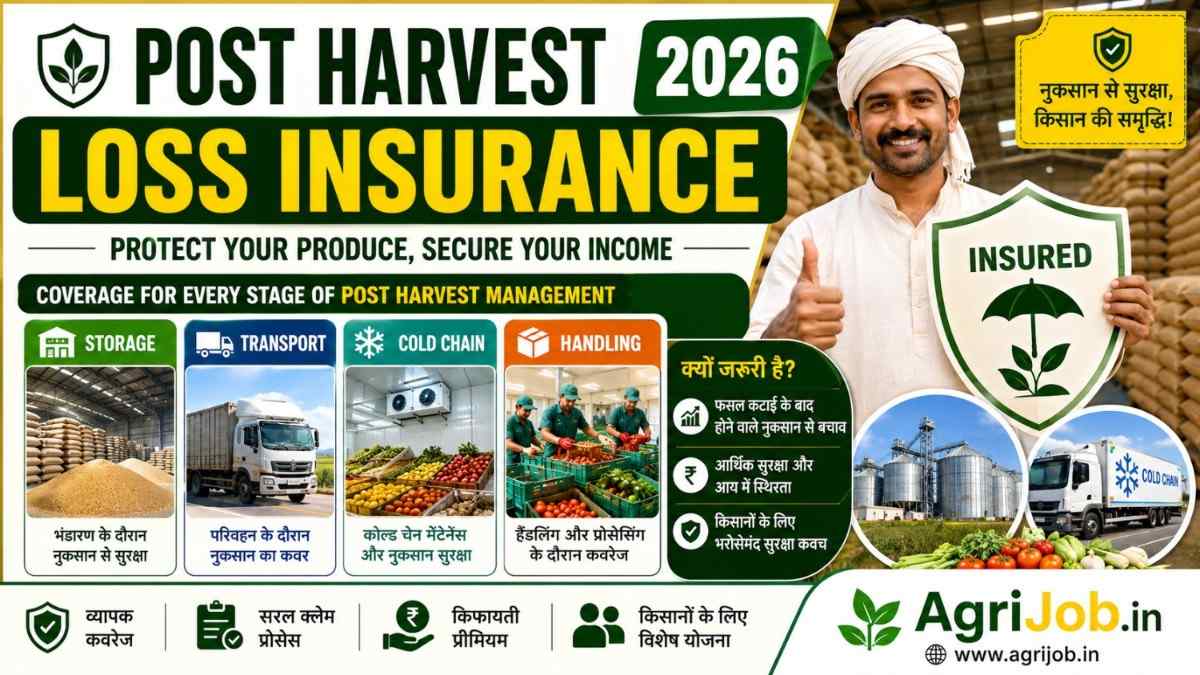
- What Is Post-Harvest Loss Insurance 2026?
- India’s Post-Harvest Loss Problem: Key Facts & Figures
- Coverage Types: Storage, Transport & Cold Chain Damage
- Premium Costs & Compensation – Complete Table 2026
- Eligibility: Who Can Apply for Post-Harvest Loss Insurance?
- How to Apply for Post-Harvest Loss Insurance – Step by Step
- Who Should Apply for Post-Harvest Loss Insurance?
- PMFBY Post-Harvest Cover vs Private Cold Chain Insurance
- High-Value Agri Insurance Terms Every Farmer Must Know
- Frequently Asked Questions (FAQs)
| Annual Loss in India | Rs.92,651 crore (Ministry of Food Processing Industries) |
| PMFBY Post-Harvest Cover | Up to 14 days after harvest; cyclone, rain, hailstorm |
| PMFBY Farmer Premium | 2% (Kharif) | 1.5% (Rabi) | 5% (Horticultural) |
| Govt Budget 2026–27 (PMFBY) | Rs.12,200 crore allocated |
| PMKSY Cold Chain Allocation | Rs.6,520 crore (total, through March 2026) |
| Claim Settlement Target | 80% of claims within 30 days (2026 framework) |
| Loss Reporting Deadline | Within 72 hours of damage event |
| Application Mode | Online: pmfby.gov.in | CSC Centres | Bank Branches |
What Is Post-Harvest Loss Insurance 2026?
Post-harvest loss insurance is a financial protection mechanism that covers the monetary losses incurred on agricultural produce after it leaves the field — whether during drying, sorting, storage in warehouses, transit to markets, or movement through the cold chain. India’s annual post-harvest food loss is staggering: Rs.92,651 crore, as documented by the Ministry of Food Processing Industries, with perishable commodities like fruits (19%), vegetables (18%), and livestock produce including eggs, fish, and meat (22%) accounting for the biggest share of losses.
In 2026, post-harvest loss insurance in India operates through 2 primary channels. First, the Government of India’s flagship Pradhan Mantri Fasal Bima Yojana (PMFBY) provides built-in post-harvest loss coverage for notified crops within 14 days of harvesting. Second, private and public-sector general insurers — including Agriculture Insurance Company (AIC) of India, New India Assurance (NICL), SBI General, and Bajaj Allianz — offer standalone storage, warehouse, and cold chain transit insurance policies for agri-businesses, Farmer Producer Organisations (FPOs), and cold storage operators. Understanding how both channels work is essential to eliminate the Rs.92,651 crore annual loss that bleeds Indian agriculture year after year.

India’s Post-Harvest Loss Problem: Key Facts & Figures 2026
The scale of India’s post-harvest loss crisis makes a compelling case for why post-harvest loss insurance 2026 is not optional — it is survival arithmetic for every farmer and agri-entrepreneur. Consider these critical numbers before we examine coverage types:
- 🌾 Rs.92,651 crore — total annual post-harvest food loss in India (Ministry of Food Processing Industries, 2022 study, adjusted for inflation in 2026).
- 🍅 30% of fruits and vegetables — approximately 40 million tonnes worth US$13 billion — are wasted annually due to cold chain gaps (ISHS data).
- 🚛 97% of fruits and vegetables are transported by road, the least efficient and most spoilage-prone method.
- ❄️ Operating costs for Indian cold storage exceed $60 per cubic metre per year — more than double the $30 average in Western nations — mainly due to energy expenses comprising 28% of total costs.
- 💰 Rs.67,717 crore in AIF loans sanctioned under the National Agriculture Infrastructure Financing Facility (as of 2024) for cold stores, reefer transport, and sorting-grading units.
- 🏗️ 50 multi-product food irradiation units being set up under PMKSY’s Rs.1,000 crore allocation to extend the shelf life of perishable produce.
- 📉 30–35% of transport losses can be prevented simply by using refrigerated containers — making cold chain transit insurance both a financial necessity and a commercially smart decision.
- 🎯 India exported Rs.3,17,831 crore worth of agricultural produce in FY25 — yet significant post-harvest losses reduce this export potential each year.
Coverage Types: Storage, Transport & Cold Chain Damage 2026
Post-harvest loss insurance 2026 in India is not a single product — it is a layered ecosystem of coverage types designed to protect produce at every stage of the supply chain from farm gate to consumer. Here is how each coverage type works:
1. PMFBY Post-Harvest Loss Coverage (Government Scheme)
Under Pradhan Mantri Fasal Bima Yojana (PMFBY) 2026, post-harvest loss coverage is available to all enrolled farmers for notified crops in notified areas. The key terms are: damage must occur within 14 days after harvesting while the crop is kept in “cut and spread” condition for field drying. Covered perils include cyclones, unseasonal rains, and hailstorms. Claims are assessed at the individual farm level — not the village or block level average — which makes PMFBY post-harvest claims faster and more equitable than general crop loss claims. From Kharif 2026, wild animal attack and paddy inundation have been added as new add-on covers under the Localised Risk category, further strengthening the scheme’s post-harvest protection.
2. Warehouse & Storage Damage Insurance
Standalone warehouse and storage insurance covers agricultural produce stored in godowns, grain silos, or cold storage facilities against fire, flood, pest infestation, structural collapse, and natural calamities. This is especially relevant for agri-traders, FPOs, and state warehousing corporations. The coverage period aligns with the storage duration, and the sum insured is typically based on the current market value of the stored commodity. Both AIC of India and NICL offer specific agricultural storage insurance products for individual farmers and commercial operators.
3. Cold Chain Transit Insurance (Reefer Transport Cover)
Cold chain transit insurance — also known as reefer transport insurance — protects perishable agricultural goods (vegetables, fruits, dairy, meat, and seafood) during road, rail, or air transportation. The policy covers losses arising from refrigeration equipment failure, power supply breakdowns, accidents, delays causing temperature excursions, and mechanical failures in refrigerated trucks. Insurance providers including Policybazaar’s corporate insurance vertical and HDFC ERGO offer specialised transit insurance for perishable goods across India’s 28 states and 8 Union Territories. Annual premiums for a commercial reefer vehicle carrying Rs.10 lakh worth of produce typically range from Rs.8,000 to Rs.20,000.
4. Integrated Cold Chain Infrastructure Insurance (PMKSY-Linked)
Under the Pradhan Mantri Kisan Sampada Yojana (PMKSY), businesses setting up integrated cold chain infrastructure — including pre-cooling units, modern processing centres, temperature-controlled transport, and distribution hubs — receive financial assistance of up to 35% of eligible project costs in general areas and 50% in difficult areas, as well as for SC/ST groups, FPOs, and cooperatives. The Rs.6,520 crore total PMKSY allocation through March 2026 (including an additional Rs.1,920 crore approved by the Union Cabinet in July 2025) directly reduces the capital cost of cold chain infrastructure, making insurance premiums on these assets more affordable.
Premium Costs & Compensation – Complete Table 2026
Understanding the exact premium rates and compensation structures for post-harvest loss insurance 2026 helps farmers and agri-businesses make informed decisions. The table below compares all major coverage types, their cost to the insured, and the compensation ceiling:
| Coverage Type | Who Pays Premium | Farmer’s Share | Annual Premium (Approx.) | Max Compensation |
|---|---|---|---|---|
| PMFBY – Kharif (Post-Harvest) | Central + State Govt (subsidised) | 2% of sum insured | Rs.150–Rs.1,500 | Up to Rs.1,50,000/hectare |
| PMFBY – Rabi (Post-Harvest) | Central + State Govt (subsidised) | 1.5% of sum insured | Rs.150–Rs.1,200 | Up to Rs.1,50,000/hectare |
| PMFBY – Horticultural Crops | Central + State Govt (subsidised) | 5% of sum insured | Rs.500–Rs.3,000 | Up to Rs.2,00,000/hectare |
| Warehouse / Storage Insurance | Farmer / FPO / Operator | 100% (no subsidy) | Rs.3,000–Rs.15,000/year | Up to 100% of market value |
| Cold Chain Transit Insurance | Business / FPO / Trader | 100% (no subsidy) | Rs.5,000–Rs.20,000/year | Up to declared cargo value |
| AIF Loan-Linked Storage Cover | Borrower + NABARD Subsidy | Reduced via 3% interest subvention | Bundled with loan | Asset + produce value covered |
Annual Earning Protection Perspective: A marginal farmer with 1 hectare of vegetables worth Rs.80,000 post-harvest pays only Rs.4,000 (5% PMFBY premium for horticulture) to protect that entire value. A Rs.20 lakh cold storage FPO pays approximately Rs.12,000–Rs.18,000 per year in storage insurance — less than 0.1% of asset value for comprehensive protection.
Eligibility: Who Can Apply for Post-Harvest Loss Insurance 2026?
Eligibility for post-harvest loss insurance 2026 varies by scheme type. Below is a complete category-wise breakdown, including application fee where applicable:
| Category | PMFBY Eligibility | Private/AIC Insurance | Application Fee |
|---|---|---|---|
| Small & Marginal Farmers (below 2 ha) | ✅ Fully eligible; compulsory for loanee farmers | ✅ Eligible | Nil (PMFBY) / Rs.500–Rs.1,000 (private) |
| Sharecroppers / Tenant Farmers | ✅ Eligible with land record proof | ✅ Eligible | Nil |
| FPOs (Farmer Producer Organisations) | ✅ Eligible as group enrollment | ✅ Eligible; group policy discounts apply | Nil (PMFBY) / Rs.2,000–Rs.5,000 (private) |
| SC/ST Farmers | ✅ Eligible; PMKSY grants up to 50% subsidy for cold chain infrastructure | ✅ Eligible; some state schemes offer premium subsidy | Nil |
| Women Farmers | ✅ Special CSC camps for enrollment in Varanasi, Patna, and other districts | ✅ Eligible | Nil |
| Cold Storage Operators | ❌ Not under PMFBY (use standalone policy) | ✅ Eligible; AIC & NICL have specific products | Rs.1,000–Rs.3,000 (varies by insurer) |
| Agri-Food Processing Units | ❌ Not under PMFBY | ✅ Eligible for cargo + equipment insurance | As per premium calculation |
| Non-resident / NRI Farmers (via proxy) | ✅ If land is in their name and farm is operational | ✅ Eligible | Nil (PMFBY) |
Mandatory documents: Aadhaar card, bank passbook (for DBT), land records (7/12 extract or Khasra), sowing certificate, and crop declaration form. For private insurance: GST registration (if applicable), warehouse licence, and commodity valuation report.
How to Apply for Post-Harvest Loss Insurance 2026 – Step by Step
Applying for post-harvest loss insurance in India in 2026 is simpler than ever, thanks to digital enrollment via pmfby.gov.in and the Crop Insurance mobile app. Follow these steps carefully to ensure your coverage is activated before the next season:
- 📱 Visit pmfby.gov.in or open the Crop Insurance App on your Android or iOS device. For private cold chain insurance, visit AIC of India (aicofindia.com) or your preferred insurer’s portal.
- 🆔 Register / Login using Aadhaar-linked mobile number. New farmers must complete one-time KYC with Aadhaar and bank account details for Direct Benefit Transfer (DBT) payouts.
- 🌾 Select your crop, season (Kharif/Rabi/Horticulture), and insurance unit (Village Panchayat or district). Ensure you are enrolling for the correct notified crop in your district.
- 📋 Fill in land details — survey number, area under cultivation (in hectares), and land ownership or tenancy proof.
- 💳 Pay the farmer’s share of premium online via UPI, net banking, or debit card. Loanee farmers (those with Kisan Credit Cards) are automatically enrolled through their bank.
- 📥 Download your insurance certificate / policy document after successful enrollment. This is your legal proof of coverage and must be kept safely throughout the season.
- 📷 In case of damage, report within 72 hours using the Crop Insurance App by uploading geo-tagged photographs, filling the loss report, and noting the date and nature of damage.
- 🏦 Cooperate with the insurance company’s loss assessment team for spot inspection. For PMFBY post-harvest losses, assessment is done at individual farm level — not at the insurance unit level.
- 💰 Claim amount is transferred directly to your Aadhaar-linked bank account via DBT within 30 days of approved claim settlement (2026 target: 80% claims in 30 days).
- 📅 Kharif enrollment deadline: Last week of July each year
- 📅 Rabi enrollment deadline: Last week of December each year
- ⏱️ Loss reporting deadline: Within 72 hours of any damage event
- 🔗 Link Aadhaar to bank account before applying — unlinked accounts will cause claim delays
- 📞 PMFBY Helpline: 14447 (toll-free) for all enrollment and claim queries
This guide is regularly reviewed and updated for accuracy. Bookmark this page for the latest 2026 notifications and updates.
Who Should Apply for Post-Harvest Loss Insurance 2026?
Post-harvest loss insurance is not only for large agri-businesses — it is a critical financial safety net for 8 specific types of stakeholders in India’s agricultural value chain. If you fall into any of these categories, enrolling before the next Kharif or Rabi season is non-negotiable:
- 🌾 Small and Marginal Farmers (below 2 hectares) — These 86% of India’s farmer community face the highest risk from post-harvest losses due to limited access to storage and transport facilities. PMFBY’s 2% premium makes it the most affordable insurance available.
- 🍅 Horticulture Farmers (fruits & vegetables growers) — Perishable produce like tomatoes, onions, mangoes, and potatoes have extremely short shelf lives. A single unseasonal rain or delayed truck can wipe out an entire season’s income. Post-harvest loss insurance is essential for these farmers.
- 🏭 Farmer Producer Organisations (FPOs) and Cooperatives — FPOs handling collective procurement, storage, and marketing of produce face aggregate losses running into crores. Group insurance policies from AIC, NICL, and SBI General offer bulk premium discounts of 10–20%.
- ❄️ Cold Storage Operators and Agri-Warehouses — Private cold storage units storing 8.38 lakh MT of produce (as of latest data) need comprehensive asset and produce liability insurance to protect against power failures, equipment breakdown, and natural calamities.
- 🚛 Reefer Transport Operators and Logistics Companies — Companies operating refrigerated trucks and reefer containers for agri-produce transport face daily exposure to transit losses. Cold chain transit insurance from Rs.5,000/year per vehicle is a basic business necessity.
- 👩🌾 Women Farmers and Self-Help Group (SHG) Members — The Govt. of India has specifically set up dedicated CSC enrollment camps for women farmers. Women-led FPOs also qualify for additional premium subsidies under select state schemes.
- 🏷️ SC/ST Farmers and Tribal Farming Communities — These communities receive a 50% subsidy on cold chain infrastructure setup under PMKSY and are fully eligible for PMFBY post-harvest coverage with no additional fee burden.
- 🌱 Agri-Startups, Food Processors, and Export-Oriented Units — With India exporting Rs.3,17,831 crore of agri-produce annually, even a minor cold chain breakdown during transit can trigger international trade losses. Cargo insurance with cold chain endorsements is mandatory for this segment.
PMFBY Post-Harvest Cover vs Private Cold Chain Insurance 2026
Choosing between PMFBY’s government-backed post-harvest loss coverage and private cold chain insurance depends on your scale of operation, type of produce, and risk exposure. This detailed comparison helps you decide which option — or combination — best protects your agricultural income in 2026:
| Parameter | PMFBY Post-Harvest Cover | Private Cold Chain Insurance |
|---|---|---|
| Premium Cost | 1.5–5% (heavily subsidised by Govt.) | Market rate; Rs.5,000–Rs.20,000/year |
| Coverage Period | Up to 14 days after harvest (field drying) | As per policy term; transit or storage duration |
| Covered Perils | Cyclone, unseasonal rain, hailstorm only | Refrigeration failure, power outage, accident, theft, temperature deviation |
| Who Can Enroll | Farmers with notified crops in notified areas only | Any business, FPO, farmer, or logistics operator |
| Claim Assessment | Individual farm basis for post-harvest claims | Surveyor assessment; spot inspection required |
| Settlement Speed | Target: 80% claims within 30 days (2026) | 15–30 days (depends on insurer) |
| Government Subsidy | Yes — Central + State Govt share majority premium | No (except under specific state schemes) |
| Best For | Individual farmers, tenant farmers, sharecroppers | FPOs, cold storage operators, traders, exporters |
| Digital Application | pmfby.gov.in + Crop Insurance App | Insurer portal or insurance broker |
For individual farmers — especially small and marginal farmers growing Kharif or Rabi crops — PMFBY post-harvest coverage at 1.5–2% premium is unbeatable value. The government subsidy makes it the lowest-cost protection available anywhere in the world. For FPOs, cold storage operators, and agri-businesses dealing with perishable produce worth Rs.10 lakh or more, a private cold chain transit and storage insurance policy is a must-have in addition to PMFBY — the two policies are complementary, not substitutes. The sweet spot for 2026: enroll all your farmers under PMFBY for the Kharif season, and separately purchase a group cold chain storage policy from AIC of India or SBI General for your collective produce handling operations.
High-Value Agri Insurance Terms Every Farmer Must Know 2026
Understanding these 10 high-value agri-insurance terms will help you navigate post-harvest loss insurance claims, applications, and coverage negotiations more effectively in 2026:
- 📌 PMFBY (Pradhan Mantri Fasal Bima Yojana) — India’s largest crop insurance scheme, covering over 5 crore farmers; has disbursed Rs.1.83 lakh crore in claims since 2016 against premiums 5 times lower than that amount. Budget 2026–27 allocation: Rs.12,200 crore.
- 📌 Post-Harvest Loss — Any reduction in quantity or quality of agricultural produce occurring after harvesting — during drying, storage, transport, or processing. Estimated at Rs.92,651 crore annually in India.
- 📌 Cold Chain Insurance — A specialised policy covering perishable goods against losses from temperature deviations, refrigeration failures, power cuts, and transit accidents. Premium: Rs.5,000–Rs.20,000/year per vehicle or Rs.10,000–Rs.50,000/year for cold storage facilities.
- 📌 Sum Insured (Scale of Finance) — The maximum compensation per hectare under PMFBY, notified district-wise by state governments. Ranges from Rs.20,000 to Rs.1,50,000 per hectare for food crops, and up to Rs.2,00,000 per hectare for high-value horticultural crops.
- 📌 DBT (Direct Benefit Transfer) — The mechanism by which PMFBY claim payouts are transferred directly to farmers’ Aadhaar-linked bank accounts, eliminating middlemen. All 2026 PMFBY claims are settled exclusively via DBT.
- 📌 RWBCIS (Restructured Weather Based Crop Insurance Scheme) — A weather-index insurance alternative to PMFBY that pays out based on rainfall, temperature, or humidity data rather than actual crop inspection — faster but less personalised for post-harvest claims. Read our detailed PMFBY vs RWBCIS comparison guide for more.
- 📌 PMKSY (Pradhan Mantri Kisan Sampada Yojana) — The Govt. of India’s food processing and cold chain infrastructure scheme with Rs.6,520 crore allocation; provides 35–50% grant for setting up cold chain units, reducing insurable asset cost.
- 📌 AIC of India (Agriculture Insurance Company) — The nodal public sector insurer for PMFBY implementation across most Indian states; also offers standalone storage, livestock, and horticulture insurance products.
- 📌 FPO Group Insurance — Collective insurance policies available to Farmer Producer Organisations covering multiple members under one master policy; group discounts of 10–20% apply. See our FPO Loan and Finance Guide 2026 for related financial protection strategies.
- 📌 Agri Infrastructure Fund (AIF) — NABARD-backed low-interest loan scheme for farm storage, cold chain, and value addition infrastructure with 3% interest subvention; Rs.67,717 crore sanctioned as of 2024. Our NABARD AIF Loan 2026 complete guide explains the full application process.
Frequently Asked Questions – Post-Harvest Loss Insurance 2026
What is post-harvest loss insurance in India?
Post-harvest loss insurance in India is a financial protection product that covers crop and produce losses occurring after harvesting — during storage, transportation, or cold chain handling. Under PMFBY, post-harvest loss coverage is available for up to 14 days after harvest for crops in cut-and-spread condition against cyclones, unseasonal rains, and hailstorms. Private insurers also offer standalone storage and transit insurance for agri-businesses, FPOs, and cold storage operators across all 28 states.
How much does post-harvest loss insurance cost per year?
Under PMFBY, post-harvest loss insurance is bundled with the main crop insurance — farmers pay only 2% for Kharif, 1.5% for Rabi, and 5% for horticultural crops; the rest is subsidised by Central and State Governments. For standalone private cold chain or storage transit insurance, annual premiums range from Rs.3,000 to Rs.20,000 per year depending on the sum insured, produce type, and insurer. Budget-conscious FPOs should compare quotes from AIC of India, NICL, and SBI General before choosing.
Who is eligible for post-harvest loss insurance in India 2026?
All farmers — small, marginal, sharecroppers, and tenant farmers — growing notified crops in notified areas are eligible for post-harvest loss coverage under PMFBY 2026. FPOs, agri-warehouses, cold storage operators, and food processing businesses are eligible for private transit and storage insurance from AIC of India, NICL, SBI General, and Bajaj Allianz. SC/ST farmers and women farmers benefit from additional subsidies under PMKSY for cold chain infrastructure setup costs.
What damages are covered under post-harvest loss insurance?
Post-harvest loss insurance 2026 covers: (1) crop damage within 14 days of harvest due to cyclones, unseasonal rains, and hailstorms under PMFBY; (2) storage loss from fire, flood, pest infestation, or structural collapse under warehouse insurance; (3) transit damage to perishable goods due to reefer failure, accidents, or delays under cold chain transit insurance; and (4) quality deterioration due to temperature fluctuations in cold storage units under cold chain equipment insurance policies.
How to claim post-harvest loss insurance under PMFBY?
To claim post-harvest loss insurance under PMFBY, report the loss to your insurer, district agriculture officer, or through the Crop Insurance App within 72 hours of the damage event. Submit required documents including land records, Aadhaar, bank passbook, and geo-tagged loss photographs. Claims are assessed at the individual farm level for post-harvest losses, and 80% of claims are settled within 30 days as per the 2026 updated PMFBY framework. For help, call the toll-free PMFBY helpline: 14447.
What is cold chain insurance and who provides it in India?
Cold chain insurance protects perishable agricultural produce — vegetables, fruits, dairy, meat, and fish — against financial losses due to temperature excursions, refrigeration equipment failure, power outages, and transit accidents. In India, cold chain insurance is provided by AIC of India, NICL (New India Assurance), SBI General, Bajaj Allianz, and HDFC ERGO for agri-businesses, food processors, and cold storage operators. Annual premiums for a Rs.10 lakh consignment typically start from Rs.8,000.
What is the maximum compensation under PMFBY post-harvest loss coverage?
Under PMFBY 2026, the maximum compensation is based on the sum insured — typically the Scale of Finance (SoF) notified by the district, which ranges from Rs.20,000 to Rs.1,50,000 per hectare depending on crop and state. For horticultural crops, the sum insured can go up to Rs.2,00,000 per hectare. Post-harvest loss claims are assessed individually — meaning each farmer’s actual field loss is calculated separately — not averaged across the insurance unit.
Is there any government subsidy for cold chain storage insurance?
Yes. Under PMKSY (Pradhan Mantri Kisan Sampada Yojana), the Government of India provides financial assistance of up to 35% of project cost in general areas and 50% for SC/ST groups, FPOs, cooperatives, and difficult areas for setting up integrated cold chain infrastructure. Additionally, NABARD’s Agriculture Infrastructure Fund (AIF) provides low-interest loans at 3% interest subvention per annum for cold storage setup, making the overall insurance cost more viable for small operators and first-time agri-entrepreneurs.
Last Updated: May 2026 | This guide is regularly reviewed and updated for accuracy. Bookmark this page for the latest post-harvest loss insurance notifications and scheme updates.