

ICAR RCER Research Centre for Makhana, Darbhanga is India’s only dedicated government research institution for the makhana (fox nut) crop — a plant that contributes to a domestic market expected to reach Rs.11,000–12,000 crore by 2029-30. If you are a scientist, researcher, or agriculture student seeking to associate with this centre, this complete 2026 guide covers its mandate, research focus, career opportunities, and how to apply.

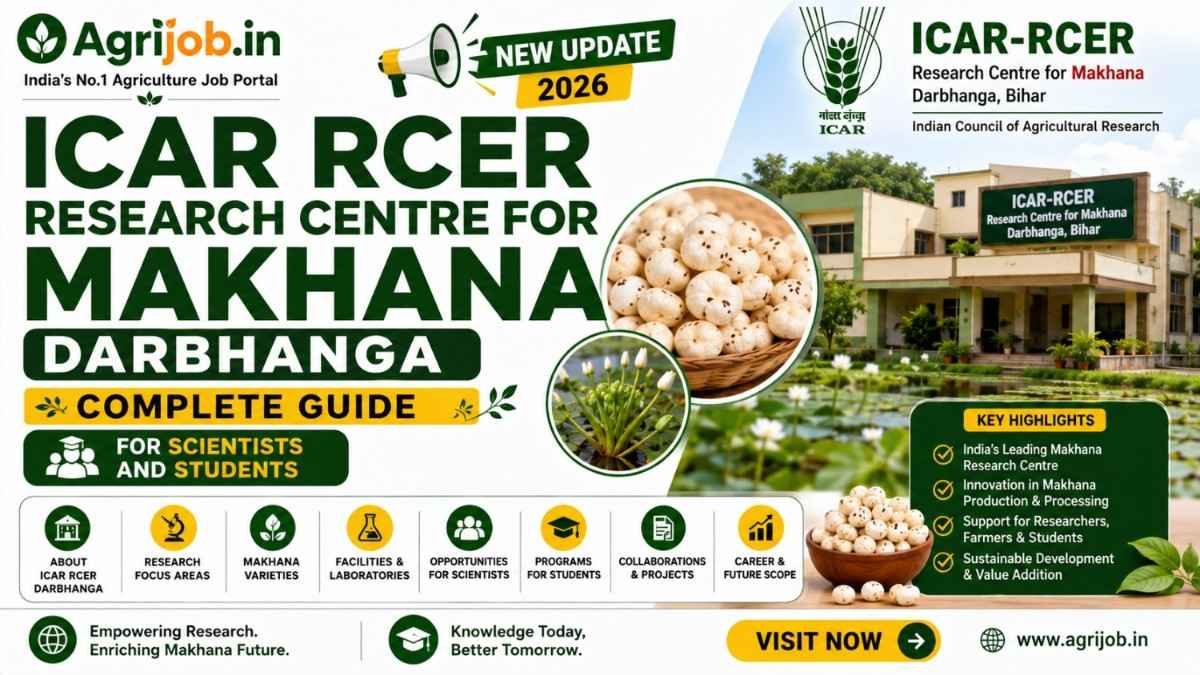
The ICAR RCER Research Centre for Makhana, Darbhanga is a regional research station under ICAR-Research Complex for Eastern Region (Patna), established in 2001 and restored to National Research Centre status in May 2023. It focuses on improving makhana yield, processing technology, and wetland farming systems across Bihar’s 35,000+ hectares of cultivation area.
- Full Name: ICAR-RCER Research Centre for Makhana (National Research Centre for Makhana), Darbhanga
- Parent Body: ICAR Research Complex for Eastern Region (ICAR-RCER), Patna
- Established: February 2001 (functioning from February 2002); NRC status restored May 2023
- Location: Darbhanga, Bihar
- Crop Focus: Makhana (Euryale ferox Salisb.) — also called fox nut, gorgon nut, phool makhana
- Cultivation Area Covered: 35,000+ hectares across Bihar
- Improved Variety Released: Swarna Vaidehi — yield potential 28–30 q/ha
- India’s Share in Global Production: 90%+ (Bihar contributes 85–90% of India’s output)
- ICAR Scientist Entry Salary: Rs.56,100/month basic pay (Pay Level 10, 7th CPC)
- JRF Fellowship (AICE JRF/SRF PhD 2026): Rs.37,000–Rs.42,000/month stipend
- Official Website: icarrcer.icar.gov.in
What Is ICAR RCER Research Centre for Makhana, Darbhanga?
The ICAR RCER Research Centre for Makhana, Darbhanga is the premier government research institution in India dedicated entirely to makhana (Euryale ferox Salisb.) — an aquatic crop grown in the shallow ponds and wetlands of northern Bihar. It operates as a regional station of the ICAR Research Complex for Eastern Region (ICAR-RCER), headquartered at Patna, Bihar.
The centre was originally sanctioned as the National Research Centre for Makhana (NRCM) during the IX Five Year Plan (1997–2002), started functioning in February 2002, and was merged under ICAR-RCER Patna in 2005 — losing its national tag. In May 2023, the Central Government restored its status to National Research Centre for Makhana, recognising the crop’s growing global and economic importance. The NRC has since been transferred under ICAR’s Agricultural Engineering Division and attached to ICAR-CIPHET, Ludhiana for administrative purposes.

Makhana cultivation has expanded from approximately 13,000 hectares to over 35,000 hectares across Bihar, driven directly by the research and extension work of this centre. Key districts covered include Darbhanga, Madhubani, Sitamarhi, Saharsa, Supaul, Katihar, Purnia, Kishanganj, and Araria.
Who Should Read This Guide?
- 🎓 B.Sc. Agriculture students looking to do internships or project work in a government research centre
- 🔬 M.Sc. and Ph.D. scholars researching aquatic crops, wetland farming, or food processing technology
- 👨🔬 ASRB NET / ICAR ARS aspirants planning a scientist career in makhana or allied crop research
- 🌾 Progressive farmers in Bihar who want to connect with the centre for training on improved makhana varieties and cultivation methods
- 📰 Agriculture journalists and policy researchers tracking makhana’s rise as a global superfood
- 🏢 Agri-entrepreneurs and food exporters seeking technical tie-ups or GI-tag clarity on Mithila Makhana
- 💼 Government job seekers monitoring ICAR-RCER Patna recruitment notifications for technical and scientific posts
- 🌐 International buyers and NGOs interested in the wetland farming systems or makhana-cum-fish integrated models
Mandate and 6 Core Research Objectives of the Centre
The ICAR RCER Research Centre for Makhana, Darbhanga operates under the following six official research objectives, as stated on the institute’s official portal:
- Generate appropriate agricultural technologies that raise the economic status of poor makhana growers — primarily the downtrodden fisherman community — through higher yield, better employment, value addition, and efficient marketing.
- Conduct mission-mode basic and applied research for the overall development of wetland areas using a total system approach. Special emphasis is placed on minimising the drudgery of women folk engaged in makhana popping.
- Conduct basic, strategic, and applied research for increasing makhana production, productivity, and standardising post-harvest processing technology.
- Serve as a repository of agro-biodiversity and scientific information on makhana — preserving germplasm collections and varietal data for future research.
- Disseminate improved technology of makhana cultivation, processing, and value addition to farmers and entrepreneurs across Bihar and India.
- Collaborate with national and international agencies — including FAO, APEDA, NABARD, and state agriculture departments — for achieving the research mandate.
Key Research Areas and Technologies Developed
The centre has pioneered multiple research breakthroughs that directly benefit makhana farmers across Bihar. Here are the most significant technology areas under active research or already released:
- Improved Varieties: Swarna Vaidehi — released by ICAR-RCER Research Centre for Makhana — has a yield potential of 28–30 q/ha, significantly higher than traditional local genotypes. Sabour Makhana-1 is another improved variety with higher pop recovery rates.
- Pond System of Cultivation: Research on optimising pond-based makhana cultivation including water depth management, nutrient inputs, and harvesting schedules for maximum yield.
- Field System of Cultivation: Demonstrating and scaling makhana cultivation in converted paddy fields — reducing dependence on traditional ponds and opening up new acreage.
- Makhana-cum-Fish Integrated Farming: A proven integrated farming system combining makhana and Indian Major Carp (IMC) cultivation using the ‘Swarna Vaidehi’ variety — boosting total farm income from the same water body.
- Post-Harvest and Processing Technology: Standardising the traditional popping (phutana) process, improving pop recovery percentage, and mechanisation of the manual drudgery-intensive operations.
- Nutrient Management Research: Understanding the optimal nutrient requirements and fertiliser schedules to increase the production potential of makhana in different agro-climatic zones.
- Value Addition and Product Development: Research into makhana-based food products for both domestic health-snack markets and export-grade processing to meet international food safety standards.
- Wetland Rehabilitation: Studies on using makhana cultivation as a tool for wetland ecosystem conservation and rehabilitation across the Gangetic plains of Bihar.
The centre’s Makhana-cum-Fish Integrated Farming research offers excellent scope for interdisciplinary projects combining aquaculture (fisheries science) with aquatic crop science. If your M.Sc. or Ph.D. thesis topic involves integrated farming systems, wetland agronomy, or food processing technology, directly contact the Head of the Centre at ICAR-RCER Darbhanga to explore collaborative project opportunities before formal application.
ICAR-RCER Makhana Centre vs Other ICAR National Research Centres
Understanding where this centre stands in the ICAR hierarchy helps scientists and students make better career and research choices.
| Parameter | ICAR-RCER Research Centre Makhana (Darbhanga) | Typical ICAR National Research Centre |
|---|---|---|
| Administrative Status | Regional station of ICAR-RCER Patna; NRC status restored May 2023 | Fully independent NRC with its own Director |
| Crop Mandate | Makhana (+ aquatic crops, fish integration) | Single commodity (e.g. ICAR-NRCG for grapes) |
| Cultivation Area Served | 35,000+ ha in Bihar & eastern India | Varies — national mandate across India |
| Improved Varieties Released | Swarna Vaidehi, Sabour Makhana-1 | Multiple varieties per crop cycle |
| Scientist Entry Pay | Rs.56,100/month (Pay Level 10, 7th CPC) | Rs.56,100/month (same ICAR ARS pay scale) |
| Student Entry (JRF/SRF) | Via ICAR AICE JRF/SRF PhD 2026 (NTA exam) | Same ICAR national exam gateway |
| Research Publications | Published in ICAR, Frontiers, ScienceDirect | Higher volume; more international citations |
| GI-Tag Linkage | Mithila Makhana GI Tag (Bihar-specific) | Varies by commodity |
| Best For | Aquatic crop specialists, wetland ecologists, food technologists | Commodity specialists at a larger scale |
For scientists and students with a specific interest in aquatic crop systems, wetland agriculture, or Bihar’s makhana industry, ICAR-RCER Research Centre Darbhanga offers a uniquely focused research environment that no other ICAR centre can match. The recently restored National Research Centre status and the Rs.11,000–12,000 crore market projections for makhana by 2029-30 make this an outstanding institution to build a research career at this time.
Salary and Career Path for Scientists at ICAR-RCER Darbhanga
Scientists posted at the ICAR RCER Research Centre for Makhana, Darbhanga are appointed through the Agricultural Scientists Recruitment Board (ASRB) under the Indian Council of Agricultural Research. The pay structure follows the 7th Central Pay Commission (7th CPC) pay matrix, which applies uniformly across all ICAR institutes.
| Position | Pay Level (7th CPC) | Basic Pay (Entry) | Gross Pay (approx., with 60% DA + HRA) |
|---|---|---|---|
| Scientist (ARS Grade) | Pay Level 10 | Rs.56,100/month | Rs.75,000–Rs.90,000/month |
| Senior Scientist | Pay Level 12 | Rs.78,800/month | Rs.1,00,000–Rs.1,20,000/month |
| Principal Scientist | Pay Level 13 | Rs.1,18,500/month | Rs.1,50,000–Rs.1,80,000/month |
| Head of Centre | Pay Band IV + RGP Rs.10,000 | Rs.43,000 (legacy PB-4) | As per 7th CPC revision + allowances |
| Director (ICAR-RCER Patna) | Pay Level 14 | Rs.1,44,200/month | Rs.2,00,000–Rs.2,50,000/month |
In addition to basic pay, ICAR scientists receive Dearness Allowance (currently 60% of basic pay as of 2026), House Rent Allowance (HRA as per city classification), Transport Allowance, and access to the National Pension System (NPS) for those appointed after January 1, 2004. Scientists are also entitled to study leave for advanced research, research publication grants, and international conference support.
How Students Can Join ICAR RCER Research Centre Makhana Darbhanga
There are four main pathways for students to associate with the ICAR RCER Research Centre for Makhana, Darbhanga in 2026:
- ICAR AICE JRF/SRF PhD 2026 (NTA Exam): The primary pathway for doctoral fellowship at ICAR institutes. The 2026 exam was scheduled for July 4, 2026, administered by NTA. Successful candidates receive Rs.37,000–Rs.42,000/month stipend plus HRA and are placed at ICAR institutes including ICAR-RCER. Apply at exams.nta.nic.in/icar.
- ICAR AIEEA PG 2026 (M.Sc. Admission): For post-graduate admission with the ICAR PG scholarship of Rs.12,640/month. This exam also admitted candidates to agricultural universities affiliated with or collaborating with ICAR-RCER Darbhanga.
- Direct Project Fellowships (Walk-In): The centre periodically announces walk-in interviews for Project Associates, Research Associates, Junior Research Fellows, and Young Professionals on externally-funded projects. These are advertised on the official ICAR-RCER website (icarrcer.icar.gov.in) and on icar.org.in. Stipends typically range from Rs.25,000–Rs.54,000/month depending on the position and project funding.
- Short-Term Internship / Training: B.Sc. Agriculture and M.Sc. students can contact the Head of the Research Centre directly by email or letter to request short-term project attachment or training. There is no centralised ICAR internship portal — applications go directly to the institute. Some paid positions offer Rs.3,000–Rs.10,000/month; others provide only a certificate.
Why the ICAR Makhana Centre Matters — the Rs.12,000 Crore Market
Makhana is no longer just a temple offering or fasting food. The crop’s growing recognition as a global superfood has transformed the economic stakes of the research being done at Darbhanga. Here are the most important market facts that contextualise the centre’s work:
- India’s makhana market has grown 17–18% annually from 2021-22 to 2024-25, driven by health awareness, premiumisation, and branded players entering the segment.
- The market is expected to reach Rs.11,000–12,000 crore by 2029-30, according to APEDA’s monthly makhana market dashboard (December 2025).
- Indian makhana exports grew nearly 4x from 6,700 MT in 2020 to 25,130 MT in 2024 — a 39% compound annual growth rate.
- India accounts for 90%+ of global makhana production, with Bihar contributing 85–90% of India’s total output.
- The four biggest producing districts are Madhubani, Darbhanga, Purnia, and Saharsa — all directly served by ICAR-RCER’s research and extension work.
- Makhana received the Geographical Indication (GI) tag as “Mithila Makhana” under the One District One Product (ODOP) initiative, boosting its premium export positioning globally.
- The Makhana Board has been allocated a budget of Rs.100 crore (INR 1 billion) to support the industry — creating new funding streams for research partnerships.
Pros and Cons of Associating with ICAR RCER Research Centre Makhana Darbhanga
- ✅ Pro: Only institution in India with a dedicated mandate for makhana research — unique positioning for publishing in an under-researched, high-value crop.
- ✅ Pro: NRC status restored in May 2023 — growing institutional importance and budget allocation.
- ✅ Pro: Directly relevant to a Rs.12,000 crore projected market — high policy and industry visibility for your research output.
- ✅ Pro: Strong collaboration with APEDA, NABARD, Bihar state agriculture department, and international bodies like FAO for externally funded projects.
- ❌ Con: Research is geographically niche — primarily applicable to Bihar’s wetland-agro ecosystem; less transferable if you later move to dry-land crop research.
- ❌ Con: Being a regional station (not yet fully independent), scientist posting and transfer decisions are governed by ICAR-RCER Patna HQ, limiting autonomy compared to fully independent NRCs.
- ❌ Con: Darbhanga has limited urban amenities compared to institutes in metro cities like Patna, New Delhi, or Pune — relevant for scientists with families.
Important Terms and Concepts Related to ICAR Makhana Research
For students and scientists new to this centre, these are the key terms you will encounter across ICAR-RCER Makhana’s research publications and project documents:
- Euryale ferox Salisb.: The scientific name for makhana — an aquatic plant of the family Nymphaeaceae, cultivated in stagnant shallow water bodies across Bihar, Odisha, Assam, and West Bengal.
- Phool Makhana: The popped (processed) form of makhana seeds — the commercially traded product with a Rs.350–950/kg wholesale price range as of 2026.
- Pop Recovery: The percentage of raw makhana seeds that successfully pop into the light, white expanded form; traditional varieties show 35–40%, while improved varieties aim higher.
- Swarna Vaidehi: The flagship improved makhana variety released by ICAR-RCER Research Centre Darbhanga with a yield potential of 28–30 q/ha under optimised cultivation.
- Pond System: Traditional method of makhana cultivation in 0.5–1.5 m deep stagnant ponds; the dominant system across Mithilanchal.
- Field System: ICAR-developed field-based makhana cultivation in converted waterlogged paddy fields — expanding the crop’s acreage potential beyond traditional ponds.
- Makhana-cum-Fish System: Integrated farming where Indian Major Carp (IMC) are co-cultivated with makhana in the same pond at 6,000 fish fingerlings per hectare — increasing per-unit-area income significantly.
- GI Tag (Mithila Makhana): Geographical Indication registration that legally certifies makhana produced in the Mithila region of Bihar as authentic, protecting it against imitation and supporting premium pricing in export markets.
- ASRB NET: Agricultural Scientists Recruitment Board — National Eligibility Test — the mandatory qualifying exam for appointment as Scientist in any ICAR institute including ICAR-RCER Darbhanga.
- AICE JRF/SRF PhD: All India Competitive Examination for Junior/Senior Research Fellowship (Doctoral) — conducted by NTA annually to allocate government-funded PhD fellowships at ICAR universities and institutes.
Important Dates and Timeline
| Event / Milestone | Date / Year |
|---|---|
| NRC for Makhana originally sanctioned (IX Five Year Plan) | 1997–2002 period |
| ICAR-RCER Research Centre Makhana started functioning | February 2002 |
| ICAR-RCER Research Complex established (HQ Patna) | 22 February 2001 |
| NRC Makhana merged under ICAR-RCER Patna (lost national tag) | 2005 |
| NRC status restored + transferred to ICAR Agricultural Engineering Division | May 2023 |
| ICAR AICE JRF/SRF PhD 2026 Notification Released | 8 May 2026 |
| ICAR AICE JRF/SRF PhD 2026 Application Deadline | 7 June 2026 |
| ICAR AICE JRF/SRF PhD 2026 Exam Date | 4 July 2026 |
| Check official portal for latest recruitment / walk-in notices | icarrcer.icar.gov.in (ongoing) |
Important Links
| Resource | Link |
|---|---|
| Official ICAR-RCER Research Centre Makhana Page | icarrcer.icar.gov.in |
| ICAR-RCER Recruitment / Vacancy Page | ICAR-RCER Recruitment |
| ICAR AICE JRF/SRF PhD 2026 (NTA Portal) | exams.nta.nic.in/icar |
| APEDA Makhana Market Dashboard (Official) | apeda.gov.in |
| ICAR Official Portal | icar.org.in |
| ICAR JRF SRF 2026 Complete Guide (Agrijob.in) | ICAR JRF SRF 2026 Guide |
| ICAR Scientist Salary 2026 Detailed Guide (Agrijob.in) | ICAR Scientist Salary 2026 |
Conclusion
The ICAR RCER Research Centre for Makhana, Darbhanga stands at the intersection of traditional wetland farming and a booming global superfood industry. With makhana cultivation expanding across 35,000+ hectares in Bihar and the domestic market heading toward Rs.12,000 crore by 2030, the research and extension mandate of this centre has never been more economically significant. Whether you are a scientist seeking a meaningful government research career, or a student looking for a focused internship in aquatic crop science, this is the right institution to target in 2026.
For the latest recruitment notices, walk-in interviews, or project fellowship announcements, bookmark the official ICAR-RCER website at icarrcer.icar.gov.in and check it regularly. Students aspiring to join via JRF/SRF should prepare for the ICAR AICE JRF/SRF PhD examination conducted annually by NTA.
- ICAR RCER Research Centre Makhana, Darbhanga is India’s only dedicated research station for the makhana (fox nut) crop — established 2001, NRC status restored May 2023.
- The centre has released the Swarna Vaidehi variety with 28–30 q/ha yield potential and pioneered makhana-cum-fish integrated farming systems.
- Makhana cultivation in Bihar covers 35,000+ hectares; the Indian market is projected to reach Rs.11,000–12,000 crore by 2029-30.
- ICAR Scientist entry salary is Rs.56,100/month (Pay Level 10); JRF fellowship at Rs.37,000–42,000/month for PhD scholars through AICE JRF/SRF 2026 exam.
- Students can join via ICAR AICE JRF/SRF PhD exam (NTA), AIEEA PG, project-based walk-in interviews, or direct short-term internship applications to the Head of Centre.
- For all current vacancies and walk-in notices, check icarrcer.icar.gov.in regularly — no centralised portal exists for project fellowships.
Frequently Asked Questions About ICAR RCER Research Centre Makhana Darbhanga
What is the full form and location of ICAR RCER Research Centre for Makhana?
ICAR RCER stands for Indian Council of Agricultural Research — Research Complex for Eastern Region. The Research Centre for Makhana is a regional research station of ICAR-RCER (headquartered at Patna, Bihar), located in Darbhanga, Bihar. In May 2023, its status was upgraded back to National Research Centre for Makhana.
When was the ICAR Research Centre for Makhana, Darbhanga established?
The National Research Centre for Makhana was originally sanctioned during the IX Five Year Plan (1997–2002) and started functioning from February 2002. It was merged under ICAR-RCER Patna in 2005, losing its national tag. The Central Government restored its NRC status in May 2023, recognising the growing economic and nutritional importance of the makhana crop.
What improved makhana variety has been released by ICAR RCER Darbhanga?
The ICAR-RCER Research Centre for Makhana, Darbhanga has released Swarna Vaidehi — an improved makhana variety with a yield potential of 28–30 quintal per hectare. Sabour Makhana-1 is another improved variety with higher pop recovery percentages compared to traditional local genotypes, which typically show only 35–40% pop recovery.
How can students join the ICAR Makhana Research Centre, Darbhanga?
Students can associate with ICAR RCER Research Centre Makhana through four routes: (1) ICAR AICE JRF/SRF PhD exam conducted by NTA — provides Rs.37,000–42,000/month fellowship for doctoral scholars; (2) ICAR AIEEA PG exam for M.Sc. admission with Rs.12,640/month scholarship; (3) Project-based walk-in interviews advertised on icarrcer.icar.gov.in; and (4) Direct email application to the Head of Centre for short-term internship or training attachment.
What is the salary of a scientist at ICAR-RCER Research Centre Makhana?
ICAR scientists (ARS grade) posted at ICAR-RCER Research Centre Makhana, Darbhanga receive a basic pay of Rs.56,100 per month at Pay Level 10 under the 7th Central Pay Commission. With 60% Dearness Allowance (2026 rate) and House Rent Allowance, the approximate gross in-hand salary ranges from Rs.75,000 to Rs.90,000 per month at the entry level.
What is the scope of the makhana industry for researchers in India?
Makhana research in India offers exceptional scope. The domestic makhana market has grown 17–18% annually from 2021-22 to 2024-25, and is projected to reach Rs.11,000–12,000 crore by 2029-30 per APEDA data. Indian exports of makhana grew 4x from 6,700 MT in 2020 to 25,130 MT in 2024 (39% CAGR). Researchers working in yield improvement, food technology, and wetland agronomy are highly sought after by the government, NABARD, and agri-food industry.
What is makhana-cum-fish integrated farming and who researches it?
Makhana-cum-fish integrated farming is a system where makhana is cultivated alongside Indian Major Carp (IMC) species in the same pond, stocked at 6,000 fish fingerlings per hectare. ICAR-RCER Research Centre Makhana, Darbhanga has actively researched this system using the Swarna Vaidehi variety, demonstrating that it significantly boosts total farm income without additional land, making it especially valuable for Bihar’s small and marginal wetland farmers.
Is there a GI tag for Bihar makhana and what is its significance for researchers?
Yes. Mithila Makhana received a Geographical Indication (GI) tag under India’s ODOP (One District One Product) initiative. The GI tag legally certifies makhana produced in the Mithila region of Bihar as authentic and supports premium pricing in international export markets. For researchers at ICAR-RCER Darbhanga, the GI tag creates new project opportunities in quality standardisation, traceability, and export-grade processing technology — all actively relevant to the centre’s mandate.
What are the key districts where ICAR-RCER Makhana research has direct impact?
ICAR-RCER Research Centre Makhana’s technologies and extension activities directly benefit farmers in Darbhanga, Madhubani, Sitamarhi, Saharsa, Supaul, Araria, Kishanganj, Purnia, and Katihar — all in Bihar. Of these, Madhubani, Darbhanga, Purnia, and Saharsa together account for 80% of India’s total processed makhana production, making them the primary beneficiaries of the centre’s improved variety releases and training programmes.
Last Updated: July 2026 | Source: ICAR-RCER Official Portal · APEDA Makhana Market Dashboard · NTA ICAR Examination Portal | This guide is reviewed and updated regularly for accuracy. Bookmark this page for the latest information on ICAR RCER Research Centre Makhana Darbhanga.
Disclaimer: This article is for informational purposes only. Recruitment, fellowship, and salary figures are sourced from official ICAR, ASRB, and NTA portals as of July 2026. For the most current data, always refer to the official notification at icarrcer.icar.gov.in or icar.org.in before taking any career or application decision.