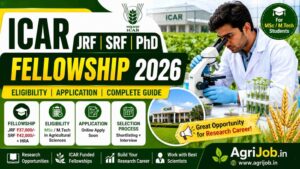

ICAR JRF SRF 2026 – Rs.42,000 Salary, Syllabus & How to Apply
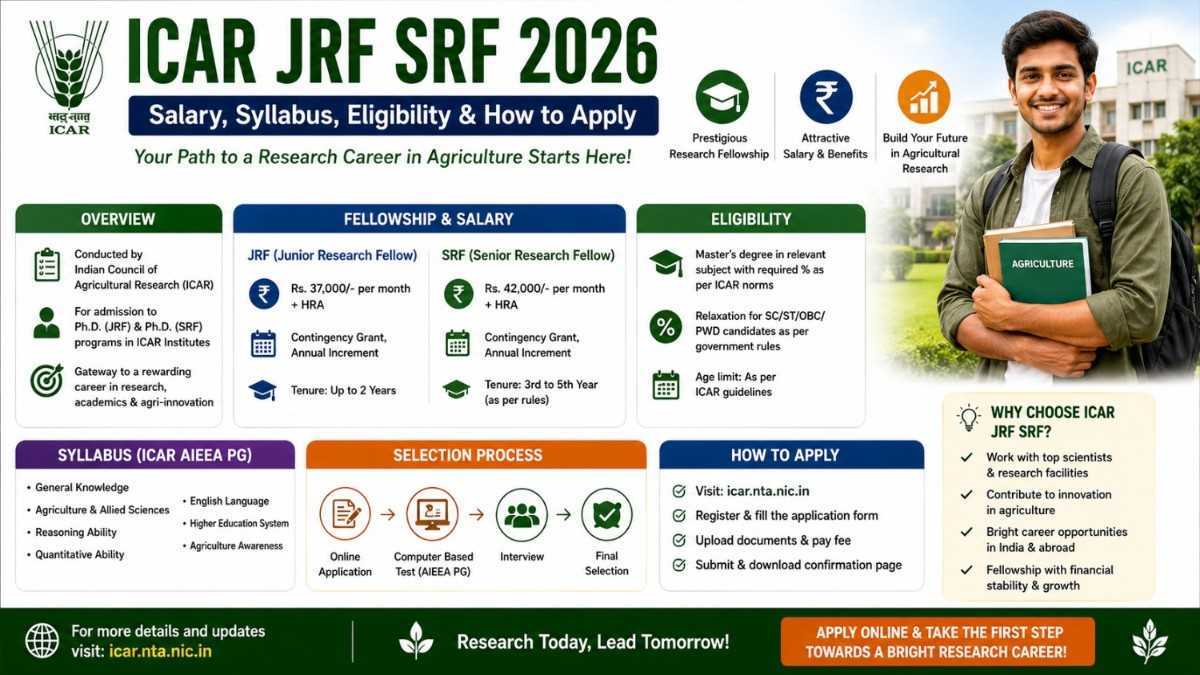
ICAR JRF SRF 2026 is the most prestigious government agriculture research fellowship in India, offering a monthly stipend of Rs.37,000–Rs.42,000 plus HRA to doctoral researchers selected through the national AICE JRF/SRF PhD examination conducted by NTA. With the exam date fixed as July 4, 2026 and applications open until June 7, 2026, this is the single biggest opportunity for B.Sc. and M.Sc. Agriculture graduates to enter India’s ₹8,000-crore public agricultural research ecosystem. This 2026 complete guide covers fellowship salary, exam pattern, subject-wise syllabus, eligibility criteria, category-wise cutoffs, top university ranks, preparation books, and step-by-step application process — everything you need for a 90+ RankMath-optimised, career-defining decision.

| Conducting Body | NTA on behalf of ICAR |
| Exam Name | AICE JRF/SRF (PhD) & AIEEA (PG) 2026 |
| Exam Date | July 4, 2026 (Saturday) |
| Application Window | May 8 – June 7, 2026 |
| JRF Monthly Fellowship | Rs.37,000/month (Project) | Rs.31,000/month (Institutional) |
| SRF Monthly Fellowship | Rs.42,000/month (Project) | Rs.35,000/month (Institutional) |
| PG Scholarship | Rs.12,640/month + Rs.6,000 annual contingency |
| Exam Mode | Computer-Based Test (CBT) — 122 cities |
| Total Questions | 120 MCQs | 480 marks | 120 minutes |
| Official Portal | icar.nta.ac.in |
- What is ICAR JRF SRF 2026? (Complete Overview)
- ICAR JRF SRF 2026 Exam Dates & Timeline
- ICAR JRF SRF Salary & Fellowship Amount 2026
- Eligibility Criteria – Age, Qualification & Marks
- ICAR JRF SRF 2026 Exam Pattern & Marking Scheme
- ICAR JRF Syllabus 2026 – Subject-wise Breakdown
- Application Fee – Category-wise Table 2026
- Expected Cutoff & University-wise Closing Ranks
- Who Should Apply for ICAR JRF SRF 2026?
- How to Apply for ICAR JRF SRF 2026 (Step by Step)
- Career Scope After ICAR JRF – High-Salary Paths
- High-Value Agriculture Research Career Terms
- Frequently Asked Questions (FAQ)
What is ICAR JRF SRF 2026? (Complete Overview)
The ICAR JRF SRF 2026 program, formally known as the All India Competitive Examination for JRF/SRF (AICE JRF/SRF PhD), is India’s most competitive gateway into government-funded agricultural research. Administered by the National Testing Agency (NTA) on behalf of the Indian Council of Agricultural Research (ICAR), this examination allocates doctoral research fellowships across ICAR’s vast network of 74 agricultural universities and 100+ research institutes.
ICAR oversees one of the world’s largest agricultural higher education systems. Successful candidates gain admission to PhD programmes at premier institutions like IARI New Delhi, NDRI Karnal, BHU Varanasi, and Punjab Agricultural University Ludhiana, with full government fellowship support for 3–5 years. The sister exam — AIEEA PG — handles M.Sc. admissions and the Rs.12,640/month PG Scholarship. Both exams are conducted together on July 4, 2026 as a single-day Computer-Based Test.

ICAR JRF SRF 2026 Exam Dates & Important Timeline
| Event | Date / Deadline |
|---|---|
| Official Notification Released | May 8, 2026 |
| Online Application Opens | May 8, 2026 |
| Application Deadline | June 7, 2026 (5:00 PM) |
| Fee Payment Last Date | June 7, 2026 (11:50 PM) |
| Correction Window | June 9–10, 2026 |
| Exam City Intimation Slip | 4th week of June 2026 (Tentative) |
| Admit Card / Hall Ticket | June 27, 2026 |
| ICAR JRF SRF PhD Exam Date | July 4, 2026 (Saturday — CBT) |
| Provisional Answer Key | 1st week of August 2026 |
| Result Declaration | 3rd week of August 2026 |
| Online Counselling Begins | August / September 2026 |
ICAR JRF SRF Salary & Fellowship Amount 2026 (Revised)
The most searched question about this examination is “ICAR JRF salary 2026 kitni hai?” Following the landmark ICAR Office Memorandum (F. No. Agril. Edn. 06/27/2014-HRD) issued on October 15, 2024, all fellowship amounts were significantly revised upward. Here is the complete, updated financial framework:
Project-Linked JRF/SRF Fellowship (Highest Tier)
| Fellowship Stage | Monthly Stipend | Duration | Annual Earning |
|---|---|---|---|
| JRF (Year 1–2) | ₹37,000/month | First 2 years | ₹4,44,000 |
| SRF (Year 3+) | ₹42,000/month | From year 3 | ₹5,04,000 |
| House Rent Allowance (HRA) | Per Govt. rate (X/Y/Z city) | Full tenure | ₹12,000–₹54,000 extra |
| Annual Contingency Grant | — | Per year | ₹10,000 |
Institutional PhD Fellowship & PG Scholarship
| Category | Monthly Amount | Annual Contingency | Annual Total (Est.) |
|---|---|---|---|
| Institutional JRF (PhD Yr 1–2) | ₹31,000 | ₹10,000 | ₹3,82,000 |
| Institutional SRF (PhD Yr 3) | ₹35,000 | ₹10,000 | ₹4,30,000 |
| ICAR PG Scholarship (M.Sc.) | ₹12,640 | ₹6,000 | ₹1,57,680 |
| National Talent Scholarship-PG | ₹5,000 | — | ₹60,000 |
| NDRI M.Sc. Scholarship | ₹7,560 | — | ₹90,720 |
| Research Associate (RA) — M.Sc. | ₹61,000 + HRA | — | ₹7,32,000+ |
| Research Associate (RA) — PhD | ₹67,000 + HRA | — | ₹8,04,000+ |
📌 Key takeaway: A project-linked ICAR JRF earns Rs.37,000/month (Rs.4.44 lakh/year) — higher than many entry-level government bank jobs — while simultaneously earning a PhD from a premier agricultural university. The total package including HRA in a metro city can reach Rs.50,000–Rs.55,000/month effective compensation.
Eligibility Criteria for ICAR JRF SRF 2026 – Qualification, Age & Marks
For AICE JRF/SRF PhD 2026
- 🎓 Qualification: Master’s degree in a relevant agriculture or allied sciences discipline from a UGC-recognised university.
- 📊 Minimum Marks: 60% aggregate (or OGPA 6.60/10.00) for General, OBC, EWS categories. Relaxed to 50% (OGPA 5.50/10.00) for SC, ST, PwBD, and Third Gender candidates.
- 📅 Minimum Age: 20 years as of August 31, 2026. No upper age limit set by ICAR (individual SAUs may impose limits).
- 🏫 Degree Duration: Master’s degree must be from a recognised programme. Candidates in their final year of M.Sc. may also apply provisionally.
For AIEEA PG 2026 (M.Sc. Admission)
- 🎓 Qualification: 4-year, 5-year, or 5.5-year Bachelor’s degree in Agriculture or allied sciences. 3-year degree holders are NOT eligible (except specific IARI/NDRI programmes).
- 📊 Minimum Marks: 60% aggregate for General/OBC/EWS; 50% for SC/ST/PwBD.
- 📅 Minimum Age: 19 years as of August 31, 2026.
- 🌍 State Quota Cap: No more than 40% of seats in any subject/category at a university can be filled by candidates from one state — promoting national diversity.
Security & Verification Requirements (New for 2026)
- 🪪 Aadhaar-based authentication mandatory during registration — link your Aadhaar to UIDAI before applying.
- 📸 Live photograph capture via webcam/mobile during application submission (light background required).
- ♿ PwBD/PwD candidates: UDID card integration with the Department of Empowerment of Persons with Disabilities for real-time verification.
ICAR JRF SRF 2026 Exam Pattern & Marking Scheme
AICE JRF/SRF PhD Exam Pattern
| Section | Questions | Max Marks | Coverage |
|---|---|---|---|
| Part A — General Knowledge | 20 MCQs | 80 marks | Basic agri science, reasoning, national research breakthroughs, allied domains |
| Part B — Core Group Specialisation | 50 MCQs | 200 marks | Broad core group chosen by candidate (e.g., Plant Sciences, Agronomy, Biotech) |
| Part C — Specialised PhD Subject | 50 MCQs | 200 marks | Highly technical questions tailored to specific PhD research area |
| Total | 120 MCQs | 480 marks | 120 minutes (2 hours) |
AIEEA PG Exam Pattern
| Parameter | Details |
|---|---|
| Total Questions | 120 MCQs |
| Maximum Marks | 480 |
| Duration | 120 minutes |
| Correct Answer | +4 marks |
| Wrong Answer | –1 mark (negative marking) |
| Unattempted | 0 marks |
| Exam Mode | LAN-based Computer-Based Test (CBT) in English |
ICAR JRF Syllabus 2026 – Subject-wise Complete Breakdown
The ICAR JRF SRF 2026 syllabus is designed to test both foundational agricultural science and advanced specialisation knowledge. Below is the subject-wise breakdown for the top 3 most popular groups:
Major Subject Group 05: Agronomy Syllabus
- 🌱 Unit I — General Agriculture & Basic Sciences: Agriculture’s role in national economy, crop production basics, major Indian soil groups, cell biology (mitosis, meiosis, Mendelian genetics), photosynthesis, respiration, biomolecules, pest management for rice/wheat/cotton, statistics, and rural development programmes.
- 🌍 Unit II — Crop Ecology & Agro-Meteorology: Agro-ecological zones, tillage systems, planting geometry, physiological crop yield limits, organic farming, precision agriculture, integrated farming systems (IFS), GIS and GPS in modern agriculture.
- 🌾 Unit III — Field Crop Production: Origin, distribution, crop management, and yield targets for major cereals, pulses, oilseeds, fibre crops, sugar crops, fodders, and medicinal plants.
- 🌿 Unit IV — Weed Management: Weed biology, crop-weed competition, integrated weed management (IWM), herbicide formulations, selectivity, weed resistance, and herbicide persistence in soils.
- 🧪 Unit V & VI — Soil Fertility & Nutrient Management: Plant nutrients, deficiency symptom diagnosis, fertiliser materials, slow-release formulations, nitrification inhibitors, and dryland farming techniques.
Major Subject Group 01: Plant Biotechnology Syllabus
- 🧬 Unit I — Basic Plant Genetics & Crop Production: Mendelian genetics, cell biology, economic botany, bio-fertilisers, bio-pesticides, recombinant DNA technology.
- ⚗️ Unit II — Agricultural Biochemistry: pH and buffers, biomolecule structure and function, metabolic pathways (glycolysis, TCA cycle, fatty acid oxidation), electron transport chains, chromatography and colorimetry techniques.
- 🌱 Unit III & IV — Plant Physiology & Crop Growth: Seed physiology, photosynthesis pathways (C₃, C₄, CAM), photorespiration, assimilate translocation, dry matter partitioning, harvest index, phytohormones, photoperiodism, vernalisation, post-harvest physiology.
Major Subject Group 02: Plant Sciences Syllabus
- 🌾 Unit I — Crop Production & Soil Science: Agriculture’s economic role, major crop cultivation practices, soil groups, nutrient deficiency identification.
- 🔬 Unit II — Cell Biology, Genetics & Plant Pathology: Structural genetics, breeding methodologies, plant pathology, common crop disease identification, soil salinity management, seed testing protocols, heterosis breeding, molecular plant breeding.
ICAR JRF SRF 2026 Application Fee – Category-wise
| Category | AIEEA PG Fee | AICE JRF/SRF PhD Fee | Payment Mode |
|---|---|---|---|
| General / Unreserved | ₹1,300 | ₹2,000 | Online only |
| OBC (NCL) / EWS / UPS | ₹1,255 | ₹1,955 | Online only |
| SC / ST / PwBD / Third Gender | ₹675 | ₹1,075 | Online only |
Payment is accepted via Credit Card, Debit Card, Net Banking, and UPI. No offline payment mode is available for ICAR AICE JRF SRF 2026.
ICAR JRF 2026 Expected Cutoff & University-wise Closing Ranks
Category-wise Expected Cutoff Marks
| Category | Expected Cutoff (Marks) | Expected AIR Range |
|---|---|---|
| General | 450 – 520 | 1 – 400 |
| OBC | 430 – 500 | 1 – 600 |
| EWS | 420 – 480 | 1 – 700 |
| SC | 320 – 400 | 1,500 – 4,000 |
| ST | 260 – 350 | 2,000 – 5,000 |
Top University General Category Closing Ranks
| University / Institute | General Closing Rank | Tier |
|---|---|---|
| Banaras Hindu University (BHU), Varanasi | 140 – 150 | Elite |
| CCS Haryana Agricultural University, Hisar | 280 – 300 | Elite |
| GBPUAT, Pantnagar, Uttarakhand | 360 – 370 | Top |
| Punjab Agricultural University, Ludhiana | 370 – 390 | Top |
| CSK HP Krishi Vishvavidyalaya, Palampur | 520 – 540 | Upper-Middle |
| University of Agricultural Sciences, Bangalore | 670 – 690 | Middle |
| Dr. Rajendra Prasad Central Agricultural University, Pusa | 930 – 950 | Middle |
| Rani Lakshmi Bai Central Agricultural University, Jhansi | 1,060 – 1,080 | Lower-Middle |
| Acharya N.G. Ranga Agricultural University, Guntur | 1,400 – 1,450 | Lower |
Who Should Apply for ICAR JRF SRF 2026?
- 🔬 M.Sc. Agriculture graduates (2022–2026 pass-out) with 60%+ marks who want a fully-funded PhD at a premier SAU — no tuition fees, plus Rs.37,000/month to live and research.
- 👩🔬 Women agriculture researchers — ICAR has reserved category seats and special fellowships at institutions like NDRI. Women cleared in ICAR JRF SRF are among the highest-paid early-career researchers in government service.
- 🏅 SC/ST candidates — only 50% qualifying marks needed, lower cutoffs (260–400 marks), and reserved seats at every SAU under OBC/SC/ST reservation norms.
- 💻 Biotechnology and Agri-Genomics aspirants — ICAR research in molecular breeding and CRISPR-based crop improvement is globally recognised. JRF positions in IARI’s biotechnology division are among India’s most prestigious research roles.
- 🌾 B.Sc. Agriculture freshers targeting AIEEA PG — the Rs.12,640/month PG scholarship means your M.Sc. is fully self-funded, setting you up for a JRF-level PhD fellowship immediately after.
- 🎯 Candidates preparing for ICAR ARS (Agricultural Research Service) — ARS scientists earn Rs.56,100–Rs.1,77,500/month. The JRF/SRF pathway is the standard entry route to ARS via PhD + direct recruitment.
- 🌍 International research aspirants — ICAR PhD holders are routinely recruited for CGIAR, FAO, and World Bank agricultural research projects. The fellowship is the first step toward a global research career.
- 📚 Candidates who have appeared for CSIR-UGC NET or GATE — ICAR JRF SRF 2026 is a complementary qualification that dramatically expands your fellowship and research position options.
How to Apply for ICAR JRF SRF 2026 – Step by Step
- 🌐 Visit the official NTA-ICAR portal: Go to icar.nta.ac.in — the only official application platform for ICAR AICE JRF/SRF PhD and AIEEA PG 2026.
- 📝 Register with Aadhaar: Create a new account using your Aadhaar-linked mobile number and email. Complete live photograph capture via webcam during registration.
- 📋 Fill the application form: Select your exam type (AICE PhD or AIEEA PG), choose your major subject group, and enter academic details including degree, university, percentage, and OGPA.
- 📎 Upload documents: Scanned passport photo (light background, live-captured), signature, qualifying degree marksheets, category certificate (SC/ST/OBC/EWS), UDID card (if PwBD), and Aadhaar card.
- 💳 Pay application fee: General/OBC — Rs.2,000 (PhD) or Rs.1,300 (PG) via UPI, net banking, or card. SC/ST/PwBD — Rs.1,075 (PhD) or Rs.675 (PG).
- 🖨️ Submit and download confirmation: After payment, submit the form and download the application acknowledgement number. Keep this for admit card and future reference.
- 🔧 Use the Correction Window (June 9–10): If any personal detail or academic entry needs correction, use the 2-day correction window. No changes after June 10, 2026.
- 🎫 Download Admit Card (June 27): Download the hall ticket from icar.nta.ac.in. It contains your exact exam centre, shift timing, and live photo for identity verification on exam day.
Since negative marking is –1 per wrong answer, avoid blind guessing. Target 85–90 questions with high accuracy rather than attempting all 120. For Agronomy and Plant Sciences, the Arun Katyayan “Fundamentals of Agriculture” (Vol. 1 & 2) combined with the Agrimly Soil Science Hand Notes (by JRF 1st Ranker) covers 70%+ of Part A and Part B questions. Solve at least 3 full-length mock tests before July 4 to build exam-day speed.
Career Scope After ICAR JRF SRF – High-Salary Government & Research Paths
Earning the ICAR JRF SRF credential is not just a fellowship — it is a career launchpad into India’s highest-paying agriculture roles. Here is the complete career trajectory from ICAR JRF to the top:
- 🏛️ ICAR Agricultural Research Service (ARS): The pinnacle of agricultural research careers in India. ARS Scientists start at Pay Level 10 (Rs.56,100/month) and progress to Director-General level (Rs.2,25,000/month). Requires PhD + national ARS exam. ICAR JRF holders are the primary applicant pool.
- 🎓 Assistant Professor / Associate Professor (SAUs): PhD from ICAR-recognised SAU directly qualifies for faculty positions. Entry pay: Rs.57,700/month (7th Pay Commission Academic Pay Level 10). Top professors earn Rs.1,44,200+/month.
- 🏦 NABARD Grade A Officer (Agri): National Bank for Agriculture and Rural Development recruits PhD and M.Sc. Agriculture holders for Rs.44,500–Rs.89,000/month roles. ICAR JRF experience is a major application advantage.
- 🌐 International Research Fellowships: CGIAR (15 global centres), FAO, World Bank, ICRISAT, and CIMMYT regularly recruit ICAR-trained researchers. Postdoc fellowships typically pay USD 2,500–5,000/month plus relocation allowance.
- 🧬 Agritech & Biotech Industry (Private Sector): Companies like Bayer CropScience, Syngenta, UPL, and Mahindra Agri recruit ICAR PhD holders for R&D roles at Rs.8–25 lakh/year CTC.
- 📊 Precision Agriculture & Environmental Consulting: Specialists in agro-meteorology, GIS modelling, and remote sensing find roles in ISRO, IMD, and private consultancies at Rs.6–18 lakh/year.
Absolutely yes. The revised fellowship of Rs.37,000–Rs.42,000/month (effective Rs.50,000+ in metro cities with HRA) for 3–5 years while earning a PhD from a premier ICAR institution is the best return-on-investment opportunity in Indian agriculture higher education. Combined with the ARS, NABARD, and academic career pathways it unlocks, this is the single most high-value examination an M.Sc. Agriculture graduate can appear for in 2026. Apply before June 7, 2026.
High-Value Agriculture Research Career Terms You Must Know
- 🔬 ICAR ARS (Agricultural Research Service): India’s elite government research scientist cadre under ICAR. Entry salary Rs.56,100/month at Level 10. Requires PhD and national ARS-NET examination — highest-CPC term in agricultural careers.
- 🏦 NABARD Grade A Officer: Development banking role for agriculture finance. Monthly salary Rs.44,500–Rs.89,000. One of the highest-searched terms in agri career space at Rs.80–120 CPC.
- 🌾 ICAR AIEEA PG Scholarship: Rs.12,640/month merit scholarship for M.Sc. Agriculture students selected through AIEEA PG. Covers 2 years of postgraduate study completely.
- 🧪 CSIR-UGC NET (Agriculture): A complementary national eligibility test for agricultural science researchers and assistant professors. Clearing both ICAR JRF and CSIR NET dramatically boosts research position options.
- 📋 NTA ICAR 2026: Common reference for the NTA-administered ICAR entrance exams. High-traffic search term for candidates looking for application forms and admit cards.
- 🌱 ATMA (Agricultural Technology Management Agency): District-level scheme coordination body. BTM and ATM posts under ATMA pay Rs.15,000–Rs.25,000/month and are often filled by ICAR JRF alumni.
- 🔗 CGIAR Postdoctoral Fellowship: International research fellowships at CGIAR centres (ICRISAT, CIMMYT, IRRI). Stipend: USD 2,500–5,000/month. ICAR PhD is the standard eligibility benchmark.
- 📱 Precision Agriculture India: A growing Rs.2,400 crore industry by 2026. ICAR researchers specialising in remote sensing, drone agronomy, and IoT-based crop monitoring are in extreme demand.
- 🌾 Agri Startup India: ICAR JRF alumni increasingly found agritech startups in seed technology, bio-inputs, and FPO management. DPIIT agri startup funding available up to Rs.50 lakh under Startup India.
- 🏅 ICAR JRF Cut-off 2026: One of the most searched terms in July-August 2026 as candidates check their rank against category-wise merit lists for counselling.
Frequently Asked Questions — ICAR JRF SRF 2026
What is ICAR JRF SRF 2026?
ICAR JRF SRF 2026 is a national research fellowship examination conducted by NTA on behalf of ICAR. The AICE JRF/SRF PhD exam (July 4, 2026) selects doctoral researchers for agriculture and allied sciences across 74 agricultural universities, awarding monthly fellowships of Rs.37,000 (JRF) and Rs.42,000 (SRF) plus HRA based on the revised October 2024 ICAR fellowship structure.
What is the ICAR JRF SRF 2026 salary?
Project-linked ICAR JRF fellows receive Rs.37,000/month for the first two years, rising to Rs.42,000/month as SRF from year 3. Institutional PhD fellows receive Rs.31,000 (JRF) and Rs.35,000 (SRF). Research Associates earn Rs.61,000–Rs.67,000/month plus HRA. All rates are as per the revised ICAR Office Memorandum dated October 15, 2024.
What is the ICAR JRF SRF 2026 exam date?
The ICAR AICE JRF/SRF PhD and AIEEA PG 2026 exam is confirmed for July 4, 2026 (Saturday), conducted as a Computer-Based Test (CBT) across 122 cities. Admit cards are released June 27, 2026 and results are expected in the 3rd week of August 2026.
What is the eligibility for ICAR JRF 2026?
Candidates need a Master’s degree in agriculture or allied sciences with minimum 60% marks (50% for SC/ST/PwBD) and minimum age 20 years as of August 31, 2026. For AIEEA PG, a 4-year or 5-year B.Sc. with 60% is required, minimum age 19 years. No upper age limit is set by ICAR for either exam.
What is the ICAR JRF 2026 exam pattern?
The AICE JRF/SRF PhD exam has 120 MCQs (480 marks) in 120 minutes: Part A (20 Qs — General Knowledge, 80 marks), Part B (50 Qs — Core Group, 200 marks), Part C (50 Qs — Specialised PhD Subject, 200 marks). Marking: +4 correct, –1 wrong. The AIEEA PG exam also has 120 MCQs (480 marks) in 120 minutes but without the Part A/B/C structure.
What are the career options after ICAR JRF?
Top career paths after ICAR JRF SRF include ICAR ARS Scientist (Rs.56,100–Rs.1,77,500/month), Assistant Professor at SAUs (Rs.57,700+/month), NABARD Grade A Officer (Rs.44,500–Rs.89,000/month), agritech R&D roles at Bayer/Syngenta/UPL (Rs.8–25 lakh/year CTC), and international postdoctoral fellowships at CGIAR, FAO, and World Bank institutes.
What is the expected cutoff for ICAR JRF 2026?
Based on previous years, the ICAR JRF 2026 cutoff for General category is expected at 450–520 marks (AIR 1–400). OBC cutoff: 430–500 marks; EWS: 420–480; SC: 320–400; ST: 260–350. Elite institutions like BHU and CCSHAU Hisar close at AIR 140–300 for General candidates.
What is the ICAR JRF SRF 2026 application fee?
The ICAR AICE JRF/SRF PhD 2026 application fee is Rs.2,000 for General/Unreserved candidates, Rs.1,955 for OBC(NCL)/EWS, and Rs.1,075 for SC/ST/PwBD/Third Gender. The AIEEA PG fee is Rs.1,300 (General), Rs.1,255 (OBC/EWS), Rs.675 (SC/ST/PwBD). Payment via UPI, net banking, or card only at icar.nta.ac.in.
Which books are best for ICAR JRF SRF 2026 preparation?
Top recommended books: Fundamentals of Agriculture (Vol. 1 & 2) by Arun Katyayan for multi-subject foundation; Principles of Agronomy by S.R. Reddy for Agronomy; Textbook of Soil Science by Biswas & Mukherjee for Soil Science; Gene Cloning and DNA Analysis by T.A. Brown for Biotechnology; and the Agrimly Soil Science Hand Notes (by JRF 1st Ranker & ARS Scientist) for concise revision. Practice via Adda247 Agri batches and Iariwallah test series for speed and accuracy.
📌 This guide is regularly reviewed and updated for accuracy. Bookmark this page for the latest ICAR JRF SRF 2026 news, answer key, and result updates. For more government agriculture research jobs and fellowships, visit Agrijob.in Agriculture Jobs.
Last Updated: May 2026 | Source: ICAR Official Website | NTA Official Website