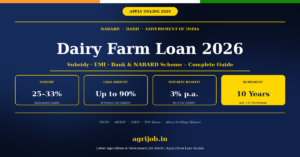

Dairy farming in India generates a net profit of Rs.40,000–Rs.55,000 per month from just 10 cows — yet most beginners lose money in the first year because they skip three critical steps before buying a single animal. India is the world’s largest milk producer, with 247 million tonnes of milk produced in 2025 (ICAR-NDRI, March 2026), and demand is projected to reach 480–606 MT by 2047 per NITI Aayog. This guide is for aspiring farmers, rural entrepreneurs, and agriculture graduates aged 18–55 who want to start a profitable dairy farm in India with a clear plan, correct breed selection, and government subsidy access. It covers investment breakdown, breed selection, NABARD subsidy eligibility, licensing, step-by-step setup, and monthly profit calculations — everything you need before spending a single rupee.

To start a dairy farm in India in 2026, you need Rs.8–12 lakh for a 10-cow unit covering cattle purchase, shed construction, equipment, and working capital. Apply for a 25% NABARD back-ended capital subsidy (33.33% for SC/ST) through the Animal Husbandry Infrastructure Development Fund (AHIDF) via any empanelled bank. A well-managed 10-cow unit earns a net profit of Rs.40,000–55,000 per month with full investment recovery in 2–3 years.
- Minimum Investment (10 cows): Rs.8 lakh – Rs.12 lakh
- Monthly Profit (10 cows, well-managed): Rs.40,000 – Rs.55,000
- NABARD Subsidy (General): 25% of approved project cost (AHIDF)
- NABARD Subsidy (SC/ST): 33.33% of approved project cost
- Best Breeds: HF Crossbred, Jersey, Murrah Buffalo, Gir Cow (A2 milk)
- Farmgate Milk Price (2026): Rs.35 – Rs.50 per litre
- ROI Timeline: Full investment recovery in 2–3 years
- India’s Milk Production (2025): 247 MT — world’s largest producer
- FSSAI Registration Fee (small unit): Rs.100 (Basic Registration)
- Government Scheme: AHIDF (Animal Husbandry Infrastructure Development Fund)
📋 Table of Contents
- What Is Dairy Farming and Why Start in India 2026?
- Who Should Start a Dairy Farm in India?
- Dairy Farm Investment & Setup Cost Breakdown 2026
- Best Cow and Buffalo Breeds for Dairy Farming in India
- NABARD Subsidy and Government Schemes for Dairy Farming 2026
- Eligibility Criteria and Documents Required
- How to Start a Dairy Farm – 10-Step Process
- Cow Dairy vs Buffalo Dairy – Which Is Better for Beginners?
- Monthly Profit and Income from Dairy Farming in India
- Pros and Cons of Dairy Farming in India
- Important Terms Related to Dairy Farming
- Important Links – Dairy Farming India 2026
- Conclusion
- Key Takeaways
- Frequently Asked Questions
What Is Dairy Farming and Why Start in India in 2026?
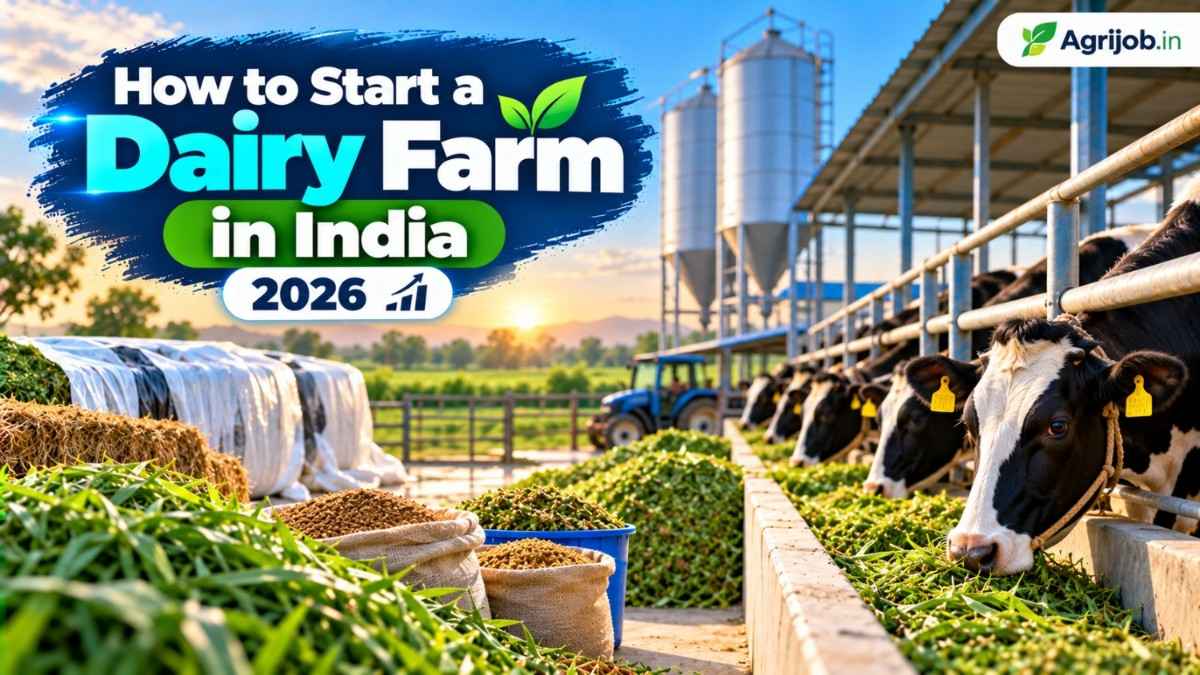
Dairy farming is the agricultural practice of raising milch animals — primarily cows and buffaloes — for the long-term commercial production and sale of milk and milk products. Unlike meat farming, dairy farming generates daily income from milk sales, making it one of the most cash-flow-positive businesses in rural India.
India produced 247 million tonnes of milk in 2025, making it the world’s largest milk producer and contributing 65% of the livestock sector’s Rs.17.25 lakh crore output (ICAR-NDRI, March 2026). The dairy sector drives 16% of India’s Gross Value Added (GVA) and supports the livelihoods of 46.1% of the population. With NITI Aayog projecting demand to reach 480–606 MT by 2047, the supply gap is massive — and profitable for new entrants right now.

In 2026, the Union Budget allocated Rs.6,153 crore for animal husbandry — a 16% increase — covering 20,000 new veterinarians, subsidised labs, and cooperative tax relief. The government’s Animal Husbandry Infrastructure Development Fund (AHIDF) remains active with a total budget of Rs.29,610 crore, providing 25–33% back-ended capital subsidies to dairy entrepreneurs. There has never been a better-funded time to enter dairy farming in India.
| Factor | Why 2026 Is the Right Year |
|---|---|
| Milk demand growth | Demand projected at 480–606 MT by 2047 vs 247 MT today |
| Government subsidy | 25–33% AHIDF capital subsidy still active |
| Budget allocation | Rs.6,153 crore for animal husbandry in Union Budget 2026 |
| Interest subvention | 3% interest subvention for dairy cooperatives announced in Budget 2024 |
| A2 milk premium | Gir cow A2 milk commands 20–50% premium over regular milk |
| Technology access | Milking machines, coolers, and automated feeding widely available at lower cost |
Who Should Start a Dairy Farm in India?
Dairy farming in India suits a wide range of people — from landholding farmers to first-generation entrepreneurs. Here are the 8 profiles best suited for starting a dairy farm in 2026:
- 🌾 Existing farmers with idle land: If you have 1–2 acres of unused land, a 10–20 cow dairy unit can generate more monthly income than seasonal crops.
- 👩🎓 Agriculture and veterinary graduates: You already have the theoretical knowledge — dairy farming is the fastest path to applying it commercially.
- 👨👩👧 Rural families seeking daily income: Milk sale provides income every single day, unlike crop farming where income is seasonal.
- 🏦 SC/ST entrepreneurs: The higher 33.33% NABARD subsidy under AHIDF makes the entry cost significantly lower for SC/ST applicants.
- 📦 Unemployed rural youth aged 18–35: Government schemes like AHIDF and state-level schemes (Haryana Hi-Tech Dairy, UP Nandi Baba Mission) specifically target self-employment for youth.
- 🥛 Entrepreneurs targeting A2 milk or organic milk: Gir cow and Sahiwal A2 milk commands premium pricing of Rs.80–Rs.120 per litre in urban markets — 2x regular milk rates.
- 🤝 SHG and cooperative members: FPOs, SHGs, and cooperatives are eligible for AHIDF subsidies and can access collective milk procurement channels like Amul and state dairies.
- 🔄 Existing small dairy operators wanting to scale: If you currently have 2–4 animals, the AHIDF loan can fund expansion to a commercial 20–50 cow unit.
Dairy Farm Investment and Setup Cost Breakdown 2026
The total investment to start a 10-cow dairy farm in India in 2026 ranges from Rs.8 lakh to Rs.12 lakh, depending on your state, land ownership, and breed selection. Here is the component-wise cost breakdown for a benchmark 10-cow unit:
| Cost Component | Estimated Cost (Rs.) |
|---|---|
| Cattle purchase (10 HF/Jersey crossbred cows) | 5,00,000 – 7,50,000 |
| Shed/housing construction (~80 sq ft per cow) | 2,50,000 – 3,50,000 |
| Milking machine and milk cans | 50,000 – 80,000 |
| Milk storage equipment (bulk cooler or cans) | 30,000 – 60,000 |
| Feed and fodder (3-month working capital) | 60,000 – 75,000 |
| Veterinary & vaccination costs (first year) | 20,000 – 30,000 |
| FSSAI registration and panchayat permissions | 5,000 – 15,000 |
| Miscellaneous (utilities, labour, insurance) | 30,000 – 50,000 |
| Total Estimated Investment | Rs.9,45,000 – Rs.13,05,000 |
Scale-wise investment guide for 2026: A 5-cow starter unit requires Rs.3.5–4.5 lakh. A 20-cow commercial unit needs Rs.18–25 lakh. A 50-cow professional dairy farm typically requires Rs.40–60 lakh including land development. With a 25% NABARD AHIDF subsidy, the effective cost of a 10-cow unit reduces to approximately Rs.7–9 lakh out of pocket.
Best Cow and Buffalo Breeds for Dairy Farming in India 2026
Choosing the right breed is the single most important decision in dairy farming. The wrong breed in the wrong climate can cut your milk yield by 40–60% and destroy profitability. Here are the top breeds recommended for Indian conditions in 2026:
| Breed | Type | Milk Yield/Day | Price per Animal (Rs.) | Best Suited For |
|---|---|---|---|---|
| HF (Holstein Friesian) Crossbred | Exotic-crossbred cow | 15–25 litres | 60,000 – 80,000 | All states, commercial scale, cooperative supply |
| Jersey Crossbred | Exotic-crossbred cow | 10–18 litres | 50,000 – 70,000 | South India, hotter climates, beginners |
| Sahiwal Cow | Indigenous cow (A2) | 8–16 litres | 60,000 – 75,000 | North India, drought-prone areas, organic farming |
| Gir Cow | Indigenous cow (A2 milk) | 6–10 litres | 40,000 – 80,000 | Premium/organic A2 milk market |
| Murrah Buffalo | High-fat buffalo | 8–14 litres | 60,000 – 90,000 | North India, ghee and paneer production |
| Surti Buffalo | Medium-yield buffalo | 6–10 litres | 40,000 – 60,000 | Gujarat, Maharashtra |
Expert recommendation for 2026 beginners: Start with Jersey Crossbred or HF Crossbred cows for the best yield-to-cost ratio. If you want a premium income stream, mix 4–5 Gir or Sahiwal cows into your herd — their A2 milk sells at Rs.80–Rs.120 per litre directly to urban consumers, 2x the cooperative rate.
NABARD Subsidy and Government Schemes for Dairy Farming 2026
The primary government support for dairy farming in India flows through two active central schemes in 2026: the Animal Husbandry Infrastructure Development Fund (AHIDF) and the National Programme for Dairy Development (NPDD). The older Dairy Entrepreneurship Development Scheme (DEDS) discontinued its individual back-ended capital subsidy from FY 2020-21 onward as per NABARD’s own records — always verify active schemes at nabard.org before applying.
| Scheme | Subsidy / Benefit | Who Can Apply | Status (2026) |
|---|---|---|---|
| AHIDF (Animal Husbandry Infrastructure Development Fund) | 3% interest subvention; 25% capital subsidy (Gen); 33.33% (SC/ST) | Individuals, MSMEs, FPOs, SHGs, cooperatives | Active — extended up to 2025-26 with Rs.29,610 crore budget |
| NPDD (National Programme for Dairy Development) | Infrastructure grants; cold chain support | State dairy federations, cooperatives | Active — implemented 2021-22 to 2025-26 |
| Rashtriya Gokul Mission | Subsidised semen, breed improvement, Gokul Grams | All dairy farmers | Active via DAHD |
| UP Nandi Baba Milk Mission | State subsidy for cow purchase + AHIDF infrastructure subsidy | UP farmers and youth (state-specific) | Active — can be combined with AHIDF |
| NLM-EDEG (National Livestock Mission) | Entrepreneurship development grants | Rural entrepreneurs | Active |
How the AHIDF subsidy works: You do not receive the subsidy cash upfront. The bank sanctions and disburses your loan. After your dairy unit becomes operational and meets scheme conditions, your bank applies to NABARD for the subsidy on your behalf. NABARD releases the subsidy to the bank, which adjusts it against your final loan EMIs — effectively reducing your total repayment by 25–33%.
In states like Uttar Pradesh, Haryana, and Rajasthan, you can combine a state government subsidy (for cattle purchase) with the central AHIDF subsidy (for shed construction and milking equipment). SC/ST applicants stacking both schemes can reduce effective out-of-pocket investment to as low as Rs.4–5 lakh for a 10-cow unit. Consult your nearest NABARD district office or empanelled bank for state-specific stacking eligibility before applying.
Eligibility Criteria and Documents Required for Dairy Farm Loan 2026
To qualify for an AHIDF dairy farm loan with NABARD subsidy in 2026, applicants must meet the following eligibility conditions:
- ✅ Individual farmer, rural entrepreneur, or member of an eligible SHG/FPO/MSME/cooperative
- ✅ Member of a milk producer company registered with NABARD (for subsidy claim eligibility)
- ✅ Willingness to install proper milking equipment at the dairy unit
- ✅ Valid land ownership or lease documentation for the proposed dairy site
- ✅ Viable project report submitted to empanelled bank
- ✅ SC/ST certificate (for the higher 33.33% subsidy tier)
- ✅ No prior loan default with any scheduled bank
| Applicant Category | Capital Subsidy | Max Project Coverage |
|---|---|---|
| General category individual | 25% of project cost | Up to Rs.5 lakh (small 10-animal unit) |
| SC/ST individual | 33.33% of project cost | Up to Rs.5 lakh (small 10-animal unit) |
| Dairy processing equipment | 25% / 33.33% | Up to Rs.12 lakh |
| Transport and cold chain | 25% / 33.33% | Up to Rs.24 lakh |
| Dairy marketing outlet/parlour | 25% / 33.33% | Up to Rs.56,000 |
Documents required for AHIDF dairy farm loan application:
- Aadhar card and PAN card (identity proof)
- Land ownership document or lease agreement
- Bank account statement (last 6 months)
- Caste certificate (SC/ST applicants)
- Detailed project report (DPR) for the proposed dairy unit
- Photographs of proposed site
- Milk producer cooperative/FPO membership certificate
- FSSAI Basic Registration (Rs.100 fee — required before milk sales)
How to Start a Dairy Farm in India – 10-Step Process 2026
Follow this step-by-step process to start a dairy farm in India in 2026 — from feasibility planning to first milk sale:
- Conduct a local market survey: Identify your nearest milk-buying channel — cooperative dairy society, private dairy company (Amul, Mother Dairy, local brand), or direct consumer retail. Confirm current farmgate price per litre in your area (typically Rs.35–Rs.50 in 2026).
- Finalise land and shed location: You need approximately 80 sq ft of covered shed space per animal, plus open yard space. Ensure clean water availability (100–150 litres per cow per day) and good road access for milk collection vehicles.
- Prepare a detailed project report (DPR): A DPR is mandatory for the AHIDF bank loan. It should include herd size, breed, expected milk yield, cost breakdown, revenue projections, and repayment schedule. Many NABARD district offices and KVKs (Krishi Vigyan Kendras) offer free DPR preparation assistance.
- Apply for AHIDF loan at an empanelled bank: Approach SBI, Bank of Baroda, or any NABARD-empanelled cooperative bank with your DPR. The bank sanctions the loan, and they apply to NABARD for the subsidy on your behalf after unit setup.
- Construct the cattle shed: Build a loose-housing system with proper drainage, ventilation, and a separate area for calves. Follow CPCB dairy-farm effluent management guidelines to avoid pollution board notices — especially for units above 20 animals.
- Purchase quality animals: Buy from NABARD-empanelled cattle fairs, government livestock markets, or reputable breeders. Get a veterinary health certificate for each animal before purchase. Prioritise 2–4 year old first-or-second lactation cows for maximum productive years.
- Complete all registrations: Obtain FSSAI Basic Registration (Rs.100 fee) before your first milk sale through FoSCoS portal. Get panchayat/municipality shed permission. Check with your state pollution control board if your unit exceeds 20–30 animals, as consent requirements vary by state.
- Set up feed and fodder supply chain: Feed costs represent 60–70% of total operating cost (DAHD). Grow your own green fodder (napier grass, maize, sorghum) on 0.5–1 acre alongside the farm to reduce costs. Balance with concentrate feed at 250–300 grams per litre of milk produced.
- Register with a milk cooperative or private dairy: Joining a milk cooperative (AMUL-affiliated or state dairy) gives you daily assured milk procurement, immediate payment, and free veterinary support. Private dairies pay slightly higher rates but procurement may be less reliable.
- Maintain daily records and health management: Keep a daily milk yield register, vaccination calendar, and expenditure ledger. Schedule FMD (foot-and-mouth disease) vaccination every 6 months, deworming every 3 months, and annual brucellosis testing as per state norms.
Cow Dairy vs Buffalo Dairy – Which Is Better for Beginners in India?
One of the most common decisions a new dairy farmer faces is whether to start with cows or buffaloes. Here is a detailed comparison to help you decide:
| Factor | Cow Dairy (HF/Jersey Crossbred) | Buffalo Dairy (Murrah) |
|---|---|---|
| Daily milk yield | 10–25 litres/cow | 8–14 litres/buffalo |
| Milk fat content | 3.5–4.5% | 6–8% (higher fat) |
| Milk price (farmgate) | Rs.35–50/litre | Rs.50–80/litre (premium fat) |
| Animal purchase cost | Rs.50,000–80,000 | Rs.60,000–90,000 |
| Feed efficiency | High (more milk per kg feed) | Lower (more feed per litre) |
| Climate tolerance | Moderate (needs shade in heat) | High (tolerates Indian heat better) |
| Breeding cycle | Shorter inter-calving interval | Longer lactation period |
| Disease resistance | Moderate (exotic breeds more prone) | High (hardy animals) |
| Income cycle | Daily — high volume, lower fat rate | Daily — lower volume, higher fat premium |
| Best suited for | Cooperative supply, beginners, volume | Ghee, paneer, premium markets |
For first-time dairy farmers selling to a cooperative, HF or Jersey crossbred cows are the better choice — higher daily volume, faster return on investment, and simpler management. Once you have 1–2 years of experience and want to add value through ghee or paneer production, add Murrah buffaloes for their higher fat content. A mixed herd of 7 crossbred cows + 3 Murrah buffaloes is an excellent beginner portfolio.
Monthly Profit and Income from Dairy Farming in India 2026
A well-managed 10-cow unit with HF or Jersey crossbred cows generates a monthly net profit of Rs.40,000–Rs.55,000 in 2026, with an annual ROI of 60–70% once the farm reaches full operational capacity. Here is the detailed profit calculation:
| Scenario | Conservative (8L/cow/day) | Moderate (10L/cow/day) | Good (15L/cow/day) |
|---|---|---|---|
| Daily milk (10 cows) | 80 litres | 100 litres | 150 litres |
| Farmgate price/litre | Rs.35 | Rs.40 | Rs.45 |
| Daily gross revenue | Rs.2,800 | Rs.4,000 | Rs.6,750 |
| Monthly gross revenue | Rs.84,000 | Rs.1,20,000 | Rs.2,02,500 |
| Feed cost (monthly) | Rs.28,000 | Rs.35,000 | Rs.45,000 |
| Labour (monthly) | Rs.10,000 | Rs.12,000 | Rs.15,000 |
| Vet + misc (monthly) | Rs.5,000 | Rs.5,000 | Rs.7,000 |
| Net Monthly Profit | Rs.41,000 | Rs.68,000 | Rs.1,35,500 |
Profit per cow per month in a well-managed Indian dairy farm averages Rs.3,000–Rs.5,500 net of all feed and operating costs. Most small dairy farmers with 10 cows report actual monthly earnings of Rs.40,000–Rs.45,000 after accounting for dry periods, seasonal yield variation, and unforeseen veterinary expenses. The annual net profit from a 10-cow unit is approximately Rs.5.5–Rs.6.5 lakh, giving full investment recovery within 2–3 years.
Pros and Cons of Dairy Farming in India
Dairy farming offers compelling advantages, but it also has real operational challenges that every beginner must understand before investing:
| Advantages (Pros) | Disadvantages (Cons) |
|---|---|
| ✅ Daily cash income from milk sales — no waiting for harvest | ❌ Daily 2-time milking schedule — 365 days, no holidays |
| ✅ Government subsidy up to 33.33% reduces investment barrier | ❌ Feed costs are 60–70% of operating expenses and fluctuate |
| ✅ Stable, inelastic demand — milk prices are relatively steady | ❌ Animal disease risk (FMD, mastitis, bloat) can cause sudden losses |
| ✅ Additional income from cow dung (biogas, organic fertiliser) | ❌ High initial investment compared to crop farming |
| ✅ Tax-free agricultural income under Indian Income Tax Act | ❌ Milk adulteration and quality testing requirements add compliance burden |
| ✅ A2 milk and organic dairy premium pricing opportunity | ❌ Labour dependency — skilled cow handlers are hard to retain |
Important Terms Related to Dairy Farming in India
Understanding these key terms will help you navigate government schemes, bank loan applications, and daily farm operations with confidence:
- AHIDF (Animal Husbandry Infrastructure Development Fund): The primary central government fund with Rs.29,610 crore budget offering 3% interest subvention and 25–33% back-ended capital subsidy for dairy infrastructure in 2026.
- Back-ended subsidy: A subsidy that is not paid upfront — the bank releases it after your project becomes operational and meets scheme conditions, then adjusts it against your final loan EMIs.
- Lactation period: The period during which a cow produces milk after giving birth — typically 305 days for crossbred cows. Cows have dry periods (60–90 days) between lactation cycles.
- Fat percentage (SNF): Milk is priced based on fat % and SNF (Solids-Not-Fat) content. Buffalo milk (6–8% fat) commands a premium over cow milk (3.5–4.5% fat) in most cooperative procurement systems.
- A2 milk: Milk from indigenous Indian breeds (Gir, Sahiwal, Tharparkar) containing A2 beta-casein protein — commands Rs.80–120 per litre in premium urban markets vs Rs.35–50 for regular cooperative milk.
- Mastitis: The most economically damaging dairy cow disease — a bacterial udder infection that reduces milk yield by 15–25% in affected cows. Preventable with clean milking practices and early detection.
- FMD (Foot-and-Mouth Disease): A viral disease requiring mandatory 6-monthly vaccination under the National Animal Disease Control Programme (NADCP) funded by DAHD. Free vaccination is available through government veterinary centres.
- Cooperative procurement: The system through which village-level dairy cooperative societies collect milk twice daily, test fat and SNF, and pay farmers daily or weekly. AMUL (Gujarat), Nandini (Karnataka), and state federations operate on this model.
- FSSAI Basic Registration: A mandatory Rs.100 annual registration required from every food business operator (including milk sellers) with turnover up to Rs.1.5 crore under the FSS Act, 2006. Apply via FoSCoS portal (foscos.fssai.gov.in).
- Biogas unit (gobar gas): Cow dung from a 10-cow unit produces approximately 20–30 kg of dung per day, generating Rs.2,000–4,000/month additional income through biogas (cooking fuel) or vermicompost sales — a significant secondary revenue stream.
Important Links – Dairy Farming India 2026
| Resource | Link |
|---|---|
| NABARD Official Website (Dairy Schemes) | www.nabard.org |
| Department of Animal Husbandry & Dairying (DAHD) | dahd.gov.in |
| FSSAI Registration Portal (FoSCoS) | foscos.fssai.gov.in |
| Rashtriya Gokul Mission (Breed Improvement) | dahd.gov.in/rashtriya-gokul-mission |
| ICAR-NDRI (National Dairy Research Institute) | www.ndri.res.in |
| Agrijob.in – Dairy Farm Business Plan 2026 | Dairy Farm Business Plan India 2026 |
| Agrijob.in – NABARD Dairy Farm Loan 2026 | NABARD Dairy Farm Loan 2026 Guide |
| Agrijob.in – Dairy Farm Loan 2026 | Dairy Farm Loan 2026 – Complete Guide |
Conclusion – Is Starting a Dairy Farm in India Worth It in 2026?
Starting a dairy farm in India in 2026 is one of the most financially sound decisions a rural entrepreneur can make — the sector is backed by Rs.6,153 crore in Union Budget funding, 25–33% NABARD AHIDF subsidies, and a demand growth trajectory that NITI Aayog projects will nearly double by 2047. A 10-cow unit generating Rs.40,000–55,000 per month net profit with 2–3 year payback and 60–70% annual ROI is not a speculative business — it is a proven, daily-income model practised by millions of Indian farmers.
Your next step: Prepare your Detailed Project Report, approach your nearest NABARD-empanelled bank (SBI, Bank of Baroda, cooperative bank), and register for FSSAI Basic Registration at foscos.fssai.gov.in before making your first milk sale. Bookmark this page — we update it every time DAHD or NABARD announces scheme changes.
- India produced 247 MT of milk in 2025 — the world’s largest producer — and demand will nearly double by 2047, creating a massive opportunity for new dairy farmers.
- A 10-cow HF/Jersey crossbred dairy farm requires Rs.8–12 lakh total investment and generates Rs.40,000–55,000 net profit per month with full ROI in 2–3 years.
- NABARD’s AHIDF scheme offers 25% capital subsidy (33.33% for SC/ST) — reducing effective out-of-pocket investment significantly when applied through an empanelled bank.
- FSSAI Basic Registration (Rs.100 fee) is mandatory before selling milk — apply online at foscos.fssai.gov.in under “Manufacturer – Dairy Units.”
- HF or Jersey crossbred cows are the best choice for beginners; Gir and Sahiwal cows offer premium A2 milk income at Rs.80–120/litre for urban direct sales.
- Start by preparing a Detailed Project Report (DPR), apply for the AHIDF loan, and join a local milk cooperative for assured daily procurement and free veterinary support.
Frequently Asked Questions About How to Start Dairy Farm India 2026
How much does it cost to start a dairy farm in India in 2026?
The total investment to start a 10-cow dairy farm in India in 2026 is Rs.8–12 lakh, covering cattle purchase (Rs.5–7.5 lakh for 10 cows), shed construction (Rs.2.5–3.5 lakh), milking equipment, and 3-month working capital. With a 25% NABARD AHIDF subsidy, your effective out-of-pocket investment reduces to approximately Rs.6–9 lakh. A smaller 5-cow starter unit requires only Rs.3.5–4.5 lakh total.
What is the monthly profit from a 10-cow dairy farm in India?
A well-managed 10-cow HF or Jersey crossbred dairy farm generates a net monthly profit of Rs.40,000–Rs.55,000 in India in 2026, after deducting feed (Rs.35,000/month), labour (Rs.12,000/month), and veterinary costs. The annual net profit is approximately Rs.5.5–Rs.6.5 lakh, with full investment recovery in 2–3 years and an annualised ROI of 60–70%.
Which cow breed is best for dairy farming in India for beginners?
For beginners in India, HF (Holstein Friesian) Crossbred or Jersey Crossbred cows are the best choice — they yield 10–25 litres per day, have good feed-to-milk conversion, and are widely accepted by milk cooperatives. For premium income, Gir cows or Sahiwal cows produce A2 milk that sells at Rs.80–120 per litre in urban markets, twice the cooperative rate. Jersey cows are better suited for hotter southern climates.
How do I get NABARD subsidy for dairy farming in 2026?
To get the NABARD AHIDF subsidy for dairy farming in 2026, approach any NABARD-empanelled bank (SBI, Bank of Baroda, cooperative bank) with a Detailed Project Report (DPR). The bank sanctions the loan for your dairy unit. After your unit becomes operational and meets scheme conditions, the bank applies to NABARD for the subsidy on your behalf — you receive 25% (general) or 33.33% (SC/ST) of the approved project cost adjusted against your final EMIs.
Is dairy farming profitable in India in 2026?
Yes, dairy farming is highly profitable in India in 2026. A 10-cow unit earns Rs.40,000–55,000 net profit per month with a 2–3 year payback period. Profitability depends on breed selection, milk yield, feed cost management, and having an assured procurement channel (cooperative or direct). The organic A2 milk segment offers even higher margins at Rs.80–120 per litre — 2x the conventional cooperative rate.
What is the FSSAI requirement for a dairy farm in India?
Every dairy farm that sells milk is required to hold a valid FSSAI registration or licence under the Food Safety and Standards Act, 2006. Small farmers with annual turnover up to Rs.1.5 crore require a FSSAI Basic Registration (fee: Rs.100 per year) filed through the FoSCoS portal at foscos.fssai.gov.in under “Manufacturer – Dairy Units.” Larger dairies with turnover Rs.1.5–50 crore need a State licence; above Rs.50 crore, a Central licence is required. As of April 1, 2026, these slabs have been updated.
How many cows are needed to start a commercial dairy farm in India?
A commercial dairy farm in India typically starts with 10–20 cows or buffaloes. A 10-cow unit is considered the minimum viable scale for profitability — generating Rs.40,000–55,000 per month net. Below 5 cows, the fixed overhead costs (shed, equipment, labour) make the operation uneconomical. Most successful beginner dairy farmers in India start with 8–10 cows and scale to 20–50 animals within 3 years using profits.
What are the main challenges of dairy farming in India?
The four main challenges of dairy farming in India are: (1) High feed costs (60–70% of operating expenses, per DAHD) that fluctuate with seasonal fodder availability; (2) Animal health risks from diseases like mastitis, FMD, and bloat requiring regular veterinary care; (3) Daily labour requirement — milking must happen twice daily, 365 days; and (4) Milk price volatility in non-cooperative channels. Joining a milk cooperative mitigates the price and procurement risk significantly.
Can I start a dairy farm without land in India?
Yes, you can start a dairy farm in India without owning land by leasing agricultural land near your village. A lease agreement is accepted as documentation for AHIDF bank loan applications. You need approximately 0.25–0.5 acres for a 10-cow shed plus fodder cultivation space. However, landless urban periurban operators must ensure lease agreements are for at least 5 years to match the loan repayment tenure typically offered by banks for dairy projects.
What is the difference between DEDS and AHIDF for dairy farming?
The Dairy Entrepreneurship Development Scheme (DEDS) was NABARD’s original dairy subsidy scheme — it officially discontinued its back-ended capital subsidy for individual applicants from FY 2020-21 onwards as per NABARD’s records. The Animal Husbandry Infrastructure Development Fund (AHIDF) is the currently active replacement scheme with a Rs.29,610 crore budget, offering 3% interest subvention and 25–33% capital subsidy to individuals, MSMEs, FPOs, SHGs, and cooperatives. Always verify current active scheme status at nabard.org and dahd.gov.in before applying.
Last Updated: October 2026 | This guide is reviewed and updated regularly for accuracy. Bookmark this page for the latest dairy farming scheme and subsidy information.
Disclaimer: This article is for informational purposes only. Subsidy percentages, scheme eligibility, and interest rates are subject to change. Always verify current scheme details at the official NABARD website (nabard.org) and the Department of Animal Husbandry and Dairying portal (dahd.gov.in) or consult your nearest empanelled bank before making any investment decision.