

- Governing Law: Geographical Indications of Goods (Registration and Protection) Act, 1999
- Registry: Geographical Indications Registry, Chennai (under CGPDTM, DPIIT)
- Registration Validity: 10 years, renewable indefinitely in further 10-year blocks
- Authorised User Form: Form GI-3 (Section 17 application)
- Export Premium: GI-tagged goods often fetch 20-40% higher prices overseas
- Featured Products: Darjeeling Tea (GI since 2004-05), Kashmir Saffron, Bikaneri Bhujia (GI since 2010)
- Core Export Bodies: APEDA, Tea Board of India, FSSAI
- Total Indian GI Tags: 600+ as of 2025, growing by 30-40 annually
- What Is a GI Tag and Why It Matters for Exporters
- Money: What GI Certification Adds to Export Pricing
- Eligibility: Who Can Become an Authorised User
- Process: Step-by-Step GI Export Registration
- Darjeeling Tea: The Original GI Export Story
- Kashmir Saffron: The World’s Costliest GI Spice
- Bikaneri Bhujia: India’s First GI-Tagged Snack
- Who Should Apply for GI Authorised User Status?
- GI-Certified Export vs Non-GI Export
- High-Value GI Export Terms You Must Know
- Frequently Asked Questions
- Useful Official Links
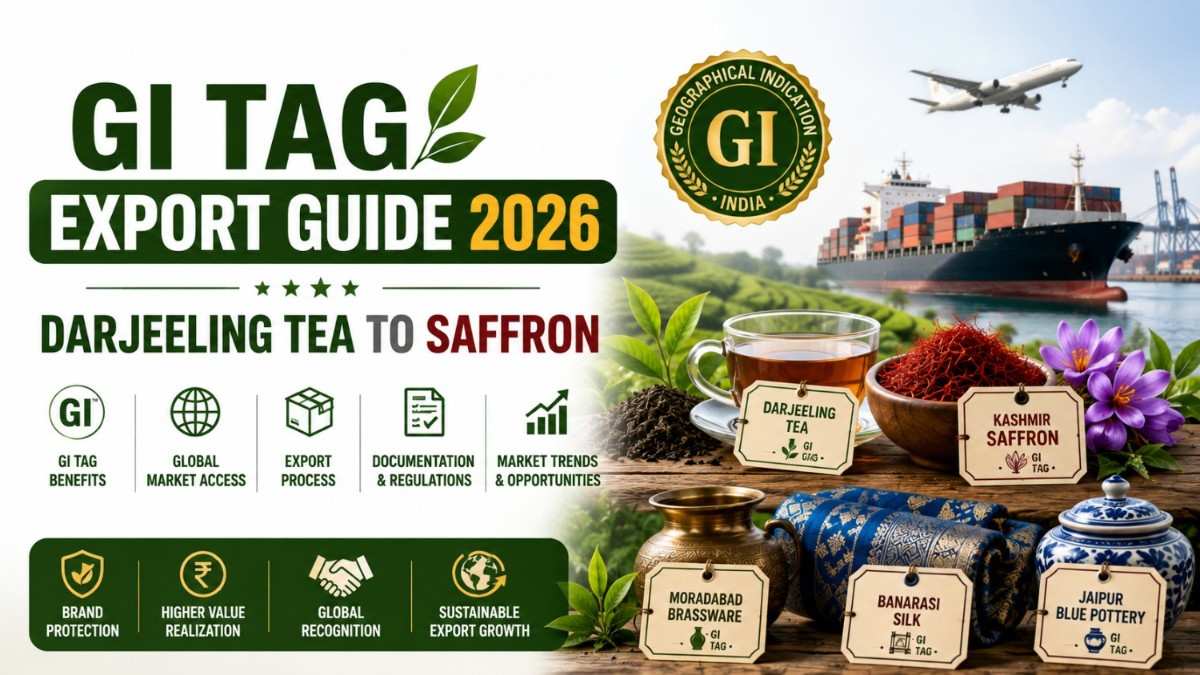
This GI tag export guide 2026 is built for Indian farmers, FPOs, agri-entrepreneurs, and exporters who want to move beyond domestic-only sales and into premium international markets using the legal protection of a Geographical Indication. Three flagship Indian GI products anchor this guide — Darjeeling Tea, Kashmir Saffron, and Bikaneri Bhujia — each representing a different export category (agricultural commodity, high-value spice, and processed food snack) and each illustrating exactly how Authorised User registration, documentation, and market positioning translate into real export revenue. This guide covers what a GI tag legally means, who is eligible to become an Authorised User, the step-by-step registration and export documentation process, dedicated deep dives on all three featured products, a comparison of GI versus non-GI export economics, high-value terminology exporters must know, and a complete FAQ section addressing the questions most Indian exporters search for online.

What Is a GI Tag and Why It Matters for Exporters
A Geographical Indication is a sign used on goods that possess a specific geographical origin along with qualities, reputation, or characteristics that are essentially attributable to that origin. In India, this is governed by the Geographical Indications of Goods (Registration and Protection) Act, 1999, with the Registrar of Trademarks also serving as the Controller-General of Patents, Designs, and Trade Marks managing the Geographical Indications Registry. The Act was introduced largely in response to controversial international disputes involving neem, turmeric, and basmati rice, where Indian-origin biological knowledge or product names were claimed elsewhere without recognition of their true source.
For an exporter, a GI tag functions very differently from a private trademark. A trademark protects a brand name or logo owned by a single company, while a GI tag protects the identity of a regional product and is collectively owned by all producers in that geographical region — meaning any tea grower physically located in Darjeeling can use the Darjeeling Tea GI mark, but only one specific company can use a private trademark like Tata Tea. This collective ownership model is precisely why GI-tag export strategy looks different from branding strategy: the legal protection travels with the region, not with any single business.

The commercial case for exporters is direct. GI-tagged products typically command 20% to 40% higher prices in international markets compared to non-GI versions of the same product, because buyers in premium markets are specifically seeking certified authenticity rather than risking imitation goods. India crossed over 600 registered GI tags as of 2025, with the number growing by roughly 30-40 new registrations every year, while Uttar Pradesh currently leads with 70-plus GI tags followed closely by Tamil Nadu with 69.
Money: What GI Certification Adds to Export Pricing
The financial upside of GI certification shows up most dramatically in high-value spice exports. Kashmiri saffron prices in the Kashmir valley rose to about Rs.3.25 lakh per kg from Rs.2 lakh per kg the previous year after the crop received its GI tag, a jump described in market reporting as making the spice roughly five times costlier than silver by weight at the time. Farmer-level price improvement was equally direct: saffron farmers in Pampore who previously received between Rs.1.30 lakh and Rs.1.5 lakh per kg saw that increase to between Rs.1.82 lakh and Rs.1.84 lakh per kg after certification, with traders confirming that saffron trade with the US, Canada, and Europe expanded as a direct result of the GI tag.
| Product | GI Registration Year | Pre-GI Indicative Price | Post-GI / Current Export Price Range | Top Export Markets |
|---|---|---|---|---|
| Darjeeling Tea | 2004-05 (India’s first GI) | Standard premium tea pricing | Premium muscatel grades, export-only volume from 87 notified gardens | UK, Germany, Japan, USA |
| Kashmir Saffron (Mongra grade) | 2020 | Rs.1.3-1.5 lakh/kg | Rs.1.82-1.84 lakh/kg (farmgate); export-grade Mongra reported up to Rs.8-15 lakh/kg in niche B2B segments | UAE, USA, Canada, Europe |
| Bikaneri Bhujia | 2010 (first Indian snack GI) | Standard namkeen pricing | Export pricing varies by HSN classification and shipment volume; reported average around $3.18 per unit under certain HS codes | UK, Italy, UAE, Gulf diaspora markets |
It is important for exporters to treat the figures above as indicative ranges rather than guaranteed quotes. Saffron pricing in particular fluctuates with harvest yields, climatic conditions, and global demand shifts, and Kashmiri saffron prices overall have risen approximately 25-35% over the past five years, driven by global demand, limited supply, and growing certification requirements rather than any single fixed government rate. Exporters should always verify current rates directly with Tea Board India, the Kashmir saffron Spice Park at Pampore, or APEDA before finalising contracts, since publicly available figures can lag real-time market movement.
Eligibility: Who Can Become an Authorised User
Eligibility for GI export benefits runs through a two-tier legal structure. First, the GI itself must already be registered by an association, producer organisation, or authority representing the interests of producers in that region. An application for registration of the Geographical Indication can be made by an association of persons or producers or any organisation or authority established by or under any law for the time being in force, who must be representing the interest of the producers of the concerned goods and desirous of registering a geographical indication in relation to such goods.
Second, and this is the step individual farmers and exporters actually need to complete, after the GI is registered, individual producers within the geographical area can apply as Authorised Users using Form GI-3, and only authorised users can legally use the GI tag on their products. An authorised user is formally defined as a person who has been registered as such under Section 17 of the Geographical Indications of Goods Act, 1999.
| Eligibility Category | Requirement |
|---|---|
| Geographical location | Production unit must be physically located within the legally notified GI boundary (e.g., the 87 notified Darjeeling gardens, or the Pampore saffron belt) |
| Producer status | Applicant must be an actual producer/processor of the GI good, not merely a trader or reseller |
| Registration form | Form GI-3, filed with the Geographical Indications Registry, Chennai |
| Registration fee | Rs.10 per authorised user as per official FAQ guidance, though procedural and professional filing charges may apply separately |
| Validity period | 10 years from date of registration, renewable |
| SC/ST/OBC/EWS/SHG/FPO applicants | No separate category-based fee waiver is specified under the GI Act itself; however, FPOs and SHGs are strongly encouraged to apply collectively through their producer association to reduce per-unit compliance burden and qualify more easily as a representative producer body |
Process: Step-by-Step GI Export Registration
The full pathway from raw GI registration through to an actual export shipment involves multiple sequential stages. Below is the consolidated step-by-step process drawn from the GI Act, GI Rules 2002, and standard APEDA export compliance requirements.
- Confirm GI registration status — Check whether your product already has a registered GI proprietor body via the Geographical Indications Registry, Chennai records.
- Identify the registered proprietor association — For Darjeeling Tea this is the Tea Board of India; for other products it is typically a state agricultural department, producer cooperative, or registered trade association.
- File Form GI-3 as an Authorised User — Submit the Authorised User application directly to the proprietor association or the GI Registry, since only authorised users can legally use the GI tag on products.
- Pay the prescribed registration fee — A nominal Rs.10 per authorised user fee applies under official guidance, alongside any documentation handling charges the proprietor body may levy.
- Receive the Authorised User certificate — Once approved, the applicant is issued a formal authorised user certificate valid for 10 years.
- Register with APEDA — Mandatory for most processed agri-food and spice exports; required for accessing official export promotion support.
- Secure FSSAI licensing — Required for any food product export, including namkeen, tea, and spices, confirming compliance with food safety standards.
- Obtain product-specific certifications — Saffron exporters commonly need ISO 3632 lab testing for crocin content; processed snacks may require HACCP, ISO 22000, or BRC certification for entry into regulated markets like the EU and North America.
- Prepare export documentation — Commercial invoice, packing list, bill of lading, certificate of origin, and phytosanitary certificate where applicable.
- Classify under the correct HSN code — Misclassification can affect duty drawback eligibility and customs clearance timelines.
- Label products correctly — Must reference the GI tag, ingredients, allergens, and shelf life as per destination country food labelling norms.
- Ship and track via verified logistics partners — Especially important for perishable or high-value goods like saffron and fresh tea consignments requiring controlled transit conditions.
Darjeeling Tea: The Original GI Export Story
Darjeeling Tea was the first product to receive a GI tag in India, in 2004-05, and it remains one of India’s most recognised and highest-value GI exports, with the UK, Germany, and Japan among its top buyers. The product’s defining characteristic is tightly bound to geography: the tea is described as “the Champagne of Teas” due to its exclusive muscatel smell, taste, and flavour, attributable to the specific climatic conditions and soil of the Darjeeling region, and is grown exclusively across the region’s 87 tea estates.
The scale of counterfeiting risk that originally justified the GI protection is striking. Actual annual production of genuine Darjeeling tea runs around 8-9 million kg, yet historically over 40 million kg of tea labelled “Darjeeling” was sold globally — meaning the bulk of what reached consumers internationally under that name was not authentic. This mismatch is precisely why the Tea Board of India pursued aggressive international enforcement. The case includes documented unauthorised use and registration of the Darjeeling name and logo by Japanese companies, prompting the Tea Board to pursue corrective action, alongside similar attempted registrations in other developed countries.
Export volumes today reflect both demand and supply tightness. According to trade data covering shipments between July 2024 and June 2025, the world recorded 1,785 Darjeeling Tea shipments through 156 verified exporters and 462 buyers, with Germany, Japan, and the United States leading as the top importing countries. For exporters and FPOs in the region, the practical implication is clear: genuine GI-certified volume is structurally limited, which keeps per-kg realisation strong for those holding valid Authorised User status, but also means new entrants must work directly through Tea Board-recognised estates rather than attempting to source generic Darjeeling-region tea informally.
Kashmir Saffron: The World’s Costliest GI Spice
Kashmir Saffron received its GI certification as a major milestone for the crop’s export positioning. Jammu and Kashmir’s then Lieutenant Governor described the GI tag as the first major step toward putting Kashmir Saffron on the world map, expected to help the spice acquire more prominence in export markets and help farmers secure better remunerative prices. Officials also noted that GI certification establishes specific geographical origin, certifies unique product qualities, and helps prevent third-party misuse of the name, while also curbing the adulteration that had previously undercut authenticated spice prices.
What makes Kashmir saffron uniquely defensible as a GI product is its extreme geographic and labour specificity. Producing just one kilogram of saffron requires roughly 150,000 flowers and over 400 hours of hand labour, and Kashmiri saffron is grown only in Pampore, Kashmir — a strictly limited region with a unique soil and climate combination that cannot be replicated elsewhere, which is part of why it commands genuinely rare and high value pricing. Lab-verified quality differentiates it from competing origins too: Kashmiri saffron has nearly 50% higher crocin content than Iranian saffron under ISO 3632 lab testing, giving it superior colour, aroma, and health benefit characteristics per gram.
For exporters evaluating this category, grading matters enormously to pricing outcomes. Kashmiri Mongra or Lacha grade, which carries the GI tag, is considered the best available, characterised by thicker threads, dark red colour, and a strong aroma, with very high crocin levels producing a deep, natural colour, while export-grade Kashmiri Mongra has been quoted in B2B trade guidance in a range of roughly Rs.8,00,000 to Rs.15,00,000 reserved for certain niche markets specifically because of GI verification and crocin content. Common export documentation for this category includes FSSAI registration, APEDA registration, a phytosanitary certificate, commercial invoice, and certificate of origin, with major export markets spanning the UAE, USA, EU, Saudi Arabia, Spain, Turkey, and China.
Bikaneri Bhujia: India’s First GI-Tagged Snack
Bikaneri Bhujia became the first Indian snack to receive a Geographical Indication tag in 2010, originating from Bikaner, Rajasthan, where it stands as a symbol of culinary heritage and regional pride, with the GI tag specifically protecting its authenticity and boosting export credibility. The product itself is straightforward to describe but distinctive in execution: it is a crispy, spicy snack made from moth bean flour, gram flour, and spices, commonly classified for export under HSN code 21069099 covering food preparations not elsewhere specified, and is shelf-stable and lightweight, making it well suited to global shipping.
The economic footprint of this single GI product within Rajasthan is substantial. Rajasthan, specifically Bikaner, is the exclusive GI-tagged production zone, and over 2.5 million people are employed in the Bhujia industry, particularly women, with major manufacturers including Bikaji Foods, Bhikharam Chandmal, and Daga Bhujiawala. Market growth supports continued export expansion: India’s ethnic snacks market is projected to reach roughly Rs.20,400 crore by FY26, with Bikaneri Bhujia holding a 15.9% share in the traditional savoury segment, while exporters in this category typically enjoy 20-30% profit margins depending on branding and packaging, with private label exports often delivering higher profitability.
Export documentation requirements for this category follow the broader processed-food compliance path. Key documents include the commercial invoice, packing list, bill of lading, certificate of origin, and FSSAI license, with compliance expected against FSSAI, APEDA, and destination country food safety norms, while labelling must include ingredients, allergens, shelf life, and a clear GI tag mention. Most leading namkeen manufacturers today also operate FSSAI-certified facilities aligned with international food safety standards like HACCP, ISO 22000, and BRC, which makes it considerably easier for Indian brands to enter highly regulated markets across Europe, North America, and the Middle East. Shelf life planning matters for export logistics too: most commercially packaged namkeen carries a shelf life of 4 to 6 months depending on product type and packaging method, with nitrogen-flushed pouches significantly extending freshness by preventing oxidation and moisture absorption during transit.
Who Should Apply for GI Authorised User Status?
- 🌱 Tea garden owners and workers within the 87 notified Darjeeling estates seeking to sell directly into export channels rather than through unverified intermediaries
- 🌾 Saffron growers in the Pampore belt of Kashmir looking to access premium B2B export pricing instead of domestic-only sale at lower realisation
- 🏭 Namkeen and snack manufacturers based in Bikaner who currently sell under generic branding and want legal authority to use the protected Bikaneri Bhujia name on export packaging
- 👩🌾 Self-Help Groups (SHGs) and Farmer Producer Organisations (FPOs) operating within any notified GI region who want to aggregate small producer output for collective export contracts
- 📦 Existing exporters and trading houses who currently source GI-region products but have not yet formalised Authorised User status for their supplier network
- 🏢 Producer cooperatives and state agricultural marketing boards seeking to act as the registered proprietor body representing a wider group of small growers
- 🎓 Agribusiness entrepreneurs and agri-startups building branded GI-certified product lines for premium domestic and export retail
- 🌐 Diaspora-focused exporters targeting Indian-origin consumer communities in the UK, US, Gulf, and EU who specifically seek authenticated regional Indian products
GI-Certified Export vs Non-GI Export
| Factor | GI-Certified Export | Non-GI Generic Export |
|---|---|---|
| Price realisation | 20-40% higher in international markets per industry guidance | Standard market pricing, no authenticity premium |
| Legal protection | Exclusive right to use the name; infringement actionable under Section 22 | No exclusive naming right; vulnerable to imitation competition |
| Buyer trust in premium markets | High — buyers can verify certified origin and lab testing | Lower — buyers cannot distinguish from imitation goods |
| Compliance burden | Authorised User registration plus standard export documentation | Standard export documentation only |
| Market access | Access to APEDA’s GI-specific export promotion support | Standard APEDA support, no GI-specific promotion |
| Counterfeiting risk to brand | Actively defended by registered proprietor body (e.g., Tea Board of India) | No collective enforcement mechanism |
| Long-term contract stability | Stronger, since buyers value supply consistency tied to verified origin | More vulnerable to price undercutting by cheaper unverified sources |
High-Value GI Export Terms You Must Know
- Authorised User — A producer formally registered under Section 17 of the GI Act who alone has the legal right to use a protected GI mark on goods, including export shipments.
- GI Infringement — Unauthorised use of a registered geographical indication, or a deceptively similar mark, on goods not genuinely originating from the protected region, punishable under Section 22.
- Statement of Case — The core documentary submission in a GI application explaining how the product’s qualities are linked to its specific geographical origin.
- APEDA Registration (RCMC) — Mandatory registration with the Agricultural and Processed Food Products Export Development Authority for most agri-food exporters, unlocking access to export promotion schemes.
- ISO 3632 — The international lab testing standard used to verify saffron quality through crocin, picrocrocin, and safranal content, central to authenticating Kashmir saffron exports.
- HSN Code — The Harmonised System of Nomenclature classification code required for customs clearance; incorrect classification can cost exporters duty drawback benefits.
- Certificate of Origin — A formal document confirming the country (and for GI goods, often the specific region) where a shipment was produced, required by most destination customs authorities.
- Phytosanitary Certificate — Required for plant-origin agricultural exports like tea and saffron, confirming the shipment is free from regulated pests and diseases.
- Geographical Indications Journal — The official publication where new GI applications are listed, opening a window for third-party opposition before final registration.
- Renewal Grace Period — The six-month window after a GI registration lapses during which renewal can still be filed before the protection is permanently removed from the register.
Frequently Asked Questions
What is a GI tag and why does it matter for exports?
A GI tag is a legal certification under the Geographical Indications of Goods (Registration and Protection) Act, 1999 that confirms a product genuinely originates from a specific Indian region and carries qualities tied to that origin. For exporters, the GI tag export guide approach matters because GI-tagged products typically command 20-40% higher prices in overseas markets, since buyers can verify authenticity and origin rather than risk imitation goods.
How do I become an Authorised User to export a GI product?
Producers within the notified geographical area must apply separately under Section 17 of the GI Act using Form GI-3, paying a nominal registration fee, after the GI itself is already registered. Only Authorised Users can legally place the GI tag on goods sold domestically or exported, and the certificate remains valid for 10 years before renewal is required.
How much does Darjeeling Tea sell for in export markets?
Darjeeling Tea, India’s first GI-tagged product since 2004-05, remains one of the country’s highest-value GI exports with the UK, Germany, Japan, and the US among its top buyers. Only tea grown across the 87 notified gardens in the Darjeeling hills qualifies, and annual output runs around 8-9 million kg, which keeps genuine supply tight and pricing premium in markets that prize the muscatel character.
Why is Kashmir saffron so expensive after getting a GI tag?
Kashmir saffron is the only GI-tagged saffron in the world, grown exclusively around Pampore at an altitude near 1,600 metres, and producing one kilogram requires roughly 150,000 flowers and 400-plus hours of hand labour. Following GI certification, farmgate prices rose sharply, with growers reporting increases from roughly Rs.1.3-1.5 lakh per kg to around Rs.1.82-1.84 lakh per kg, and certified export-grade Mongra often priced even higher in niche international markets.
What HS code applies to Bikaneri Bhujia exports?
Bikaneri Bhujia, a moth bean and gram flour snack from Bikaner, Rajasthan that became the first Indian snack to receive a GI tag in 2010, is commonly classified for export under HSN code 21069099 covering food preparations not elsewhere specified, though some shipment categories use related headings. Exporters should always confirm the precise HSN classification with their customs broker since incorrect codes can affect duty drawback eligibility.
Which documents are mandatory to export a GI-certified agricultural product from India?
Common requirements across GI agri-exports include FSSAI licensing, APEDA registration, a phytosanitary certificate, commercial invoice, packing list, bill of lading, and certificate of origin, with destination countries often layering on their own food safety norms. Authorised User status under the GI Act should also be referenced on labelling and export documentation to support the authenticity claim.
Can a non-GI-region producer ever legally export goods under a protected GI name?
No. Under the GI Act, only registered Authorised Users producing within the legally notified geographical boundary can use the protected name, and using a deceptively similar indication on goods from outside that region constitutes infringement under Section 22, which is punishable by law. This is precisely the issue the Tea Board of India has fought internationally, including contesting unauthorised Darjeeling-name registrations in Japan and other markets.
How long does a GI registration and renewal cycle last?
A GI registration is valid for 10 years from the date of filing and can be renewed indefinitely for further 10-year terms upon payment of the prescribed renewal fee, with a six-month grace window if the deadline is missed. Exporters relying on a GI tag export guide strategy should track these renewal dates closely, since a lapsed registration removes legal protection and can disrupt long-term overseas buyer contracts.
Useful Official Links
- Intellectual Property India – Official GI Registration Process
- APEDA – Agricultural and Processed Food Products Export Development Authority
- Tea Board of India – Official Portal
- FSSAI – Food Safety and Standards Authority of India
This guide is regularly reviewed and updated for accuracy. Bookmark this page for the latest GI export notifications and policy updates. Last Updated: June 2026.