

Blockchain in Agriculture India 2026 – Solving Food Fraud
Blockchain in agriculture India 2026 is no longer a futuristic concept — it is an active, government-backed technological solution reshaping how food moves from farm to fork across the country. With FSSAI reporting that nearly 1 in 5 food samples tested in 2024-25 failed quality standards, and dairy alone recording 12,057 adulteration cases in FY 2024-25, India’s food safety crisis demands urgent, scalable technology. At the same time, India loses an estimated 30-40% of its agricultural produce to post-harvest supply chain inefficiencies every year. Blockchain technology — a decentralised, tamper-proof digital ledger — directly addresses both crises by creating immutable, real-time records of every step across the agricultural supply chain. This complete guide covers what blockchain is, how it fights food fraud, its 7 key use cases in Indian agriculture, government initiatives, real success stories, career opportunities for Indian youth, and challenges ahead in 2026.

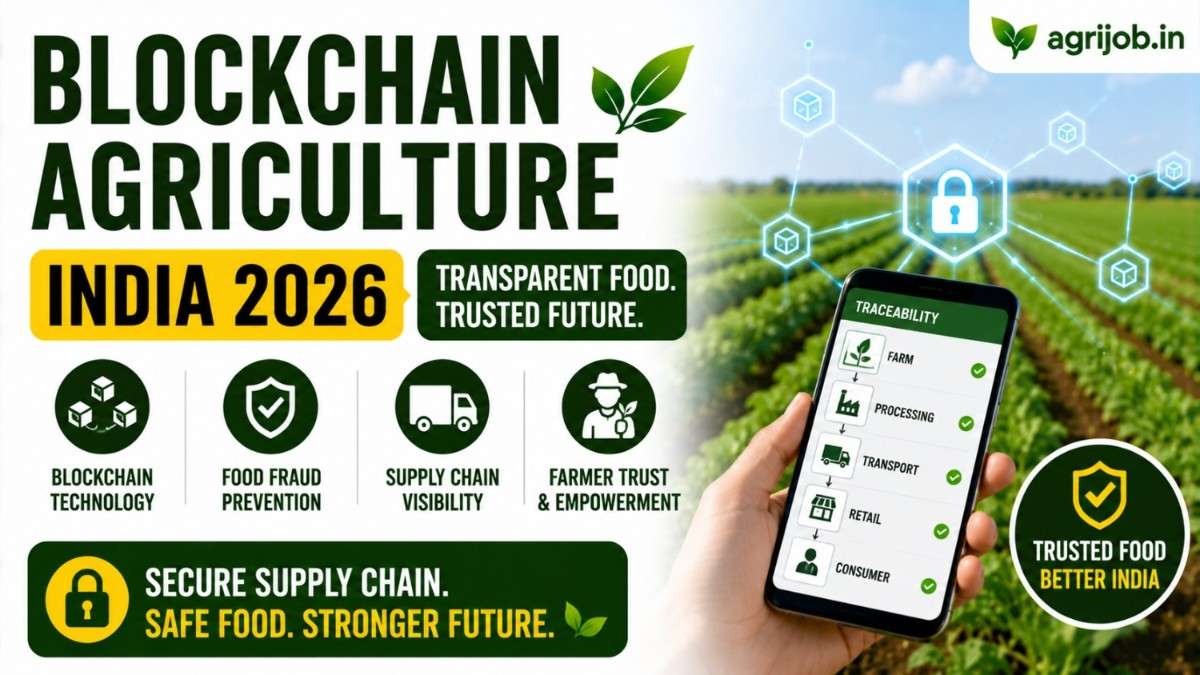
- What is Blockchain in Agriculture India 2026?
- India’s Food Fraud & Supply Chain Crisis: The Problem
- How Blockchain in Agriculture Solves These Problems
- 7 Key Use Cases of Blockchain in Indian Agriculture
- Government Initiatives Supporting Blockchain Agriculture 2026
- Real-World Examples & Success Stories in India
- Who Should Adopt Blockchain in Agriculture?
- Blockchain vs Traditional Supply Chain: Full Comparison
- High-Value Agritech Terms Every Farmer Must Know
- Agritech Career Opportunities in Blockchain Agriculture
- Challenges of Blockchain Adoption in Indian Agriculture
- Frequently Asked Questions (FAQs)
| Global Market Size (2026) | USD 1.23 Billion (growing at 48% CAGR) |
| India Growth Rate | 45% CAGR — 2nd fastest globally |
| Food Samples Failed (India 2024-25) | ~20% of all FSSAI-tested samples |
| Dairy Adulteration Cases (FY 2024-25) | 12,057 cases launched; 8,815 penalised |
| Govt Budget for Digital Agri | INR 14,000 crore (Digital Agri Mission) |
| Blockchain Farmer Cooperatives Funded | 58 (Govt of India, 2023) |
| Key Technology Partners | IBM Food Trust, Microsoft Azure, TraceX |
| Primary Beneficiaries | Farmers, FPOs, exporters, consumers |
What is Blockchain in Agriculture India 2026?
Blockchain in agriculture India 2026 refers to the application of distributed ledger technology to record, verify, and share agricultural data — from seed purchase and field operations to processing, packaging, cold chain transport, and final retail sale. Unlike a traditional centralised database managed by one party, a blockchain is simultaneously maintained across thousands of nodes, making any tampering or fraudulent alteration technically impossible without consensus from the entire network.
In simple terms, imagine every mango leaving a farm in Maharashtra being assigned a unique digital identity at harvest. Every subsequent event — refrigerated truck loading, arrival at a Mumbai warehouse, quality inspection, packing at a supermarket — is recorded as an immutable entry on the blockchain. A consumer scanning a QR code on the shelf can trace that specific mango back to the GPS coordinates of the farm, the name of the farmer, the fertiliser batch used, and the exact temperature of every cold chain leg it passed through. This is farm-to-fork traceability powered by blockchain, and it is actively being deployed across India in 2026.

As defined in India’s Ministry of Agriculture & Farmers Welfare’s Digital Agriculture Mission, blockchain is one of the priority technologies — alongside AI, drones, and remote sensing — earmarked for government-funded deployment across agri-value chains. ICAR (Indian Council of Agricultural Research) has published research validating blockchain as a tool for enhancing supply chain transparency and reducing post-harvest losses.
India’s Food Fraud & Supply Chain Crisis: The Scale of the Problem
To understand why blockchain in agriculture India 2026 is receiving such urgent attention, one must first grasp the alarming scale of India’s food fraud and supply chain inefficiency crisis. The data from FSSAI, parliamentary records, and food safety enforcement in 2024-25 reveals a systemic problem affecting millions of consumers and thousands of honest farmers every single day.
- 🚨 20% of food samples fail FSSAI quality standards: In 2024-25, FSSAI’s own admission confirmed that approximately 1 in 5 food samples tested across India — including popular chocolate brands, dairy, and spices — did not meet required safety standards.
- 🥛 12,057 dairy adulteration cases in a single year: A December 2025 parliamentary answer revealed 12,057 dairy adulteration cases were launched in FY 2024-25 alone, with 8,815 resulting in penalties or convictions. Adulterants included water, urea, starch, detergent, and synthetic milk compounds.
- 🌶️ Spice fraud at massive scale: In 2024, authorities seized 15 tonnes of adulterated spices in Delhi — powdered coriander, turmeric, and chilli mixed with wood dust, rotten leaves, spoiled millet, and industrial acid — sold under fake brand labels.
- 🧀 Paneer adulteration at 83% in Noida (2024): Surveillance in Noida recorded 83% of paneer samples failing quality checks, while Rajasthan reported 25.5% of food items as substandard or adulterated across the state.
- 📦 30-40% post-harvest supply chain losses: India’s inadequate cold chain infrastructure, lack of real-time logistics visibility, and document fraud result in enormous post-harvest losses annually — losses that blockchain traceability and IoT integration can significantly reduce.
- 🌾 Fake seeds and input fraud: Counterfeit seeds and substandard agrochemicals sold under legitimate brand names cause crop failures affecting millions of small and marginal farmers each year, with no traceability mechanism to identify the fraudulent entry point in the supply chain.
The Food Safety and Standards Authority of India (FSSAI) analysed over 1.5 lakh food samples in 2023-24, of which more than 33,000 were found non-conforming. State-wise data for 2024 reveals Uttar Pradesh alone had 52.8% of samples failing, followed by Rajasthan at 28.4%, Maharashtra at 18.7%, Tamil Nadu at 14%, and Madhya Pradesh at 13%. These numbers are not merely regulatory statistics — they represent a public health crisis, an economic fraud burden on honest businesses, and a direct threat to India’s agricultural export reputation.
How Blockchain in Agriculture Solves Food Fraud & Supply Chain Issues
Blockchain in agriculture India 2026 addresses food fraud and supply chain inefficiency through 4 core technical properties that no existing system can replicate:
- 🔒 Immutability: Once a transaction or record is entered on the blockchain, it cannot be altered, deleted, or overwritten by any single party. A milk processor cannot go back and change a test result. A spice trader cannot falsify a “pesticide-free” certificate issued at the farm gate. Every entry is permanent and date-stamped.
- 🌐 Decentralisation: Unlike a database owned by one company or government body, a blockchain is simultaneously maintained across hundreds or thousands of nodes. There is no single point of failure or corruption. Even if one participant attempts to manipulate data, the network rejects the fraudulent entry.
- 👁️ Transparency with permissioned access: All authorised participants — farmers, processors, traders, retailers, regulators, and consumers — can view relevant portions of the ledger in real time. A consumer scanning a QR code sees verified origin data; FSSAI inspectors see full test results; farmers see payment confirmations. No information asymmetry, no hidden data manipulation.
- ⚡ Smart Contracts: Self-executing digital agreements stored on the blockchain automatically trigger actions when pre-set conditions are met — for example, releasing payment to a farmer when a quality sensor confirms delivery of Grade-A produce, or automatically flagging a cold chain temperature breach to the FSSAI portal. This eliminates payment fraud, reduces disputes, and speeds up agri-insurance claim settlements from weeks to hours.
7 Key Use Cases of Blockchain in Agriculture India 2026
Here are the 7 most impactful and actively deployed use cases of blockchain in agriculture India 2026, with real-world context for each:
🌾 Farm-to-Fork Food Traceability
Every crop batch is assigned a digital identity at harvest — recording GPS farm location, sowing date, fertiliser and pesticide inputs, harvest date, and farmer ID. This record follows the produce through every supply chain stage. Consumers scan a QR code on retail packaging to access the complete verified journey. Karnataka implemented blockchain-based seed traceability in May 2023, ensuring seed authenticity and reducing theft incidents across the state’s distribution network.
🥛 Milk & Dairy Adulteration Prevention
IoT-enabled milk testing devices at the collection point record fat content, SNF (Solids-Not-Fat), pH, and adulteration test results directly on the blockchain. No manual entry, no falsification possible. This single application can address India’s single largest food fraud category — dairy adulteration — affecting millions of consumers and suppressing fair prices for honest dairy farmers across states like UP, Rajasthan, and Punjab.
🌶️ Spice & Organic Produce Certification
India exports spices worth over USD 4 billion annually. Blockchain-based certification — recording pesticide usage, soil tests, and processing conditions on an immutable ledger — allows exporters to prove compliance with EU, US, and Japanese organic standards without costly paper-based audits. Nearly 35% of agricultural exporters globally already prefer blockchain-based systems to prove organic and fair-trade compliance.
🌱 Seed & Input Authenticity Verification
Counterfeit seeds are a multi-crore annual fraud harming millions of Indian farmers. Blockchain enables seed companies to issue unique digital certificates for each seed lot — verifiable by any retailer or farmer via a mobile app — making fake seeds immediately identifiable. ICAR’s research institutes are actively piloting blockchain for seed provenance tracking across multiple states in 2026.
❄️ Cold Chain Monitoring with IoT Integration
IoT temperature and humidity sensors installed in refrigerated trucks, cold storage, and processing units automatically log real-time data on the blockchain. Any temperature breach — say, a vaccine or perishable vegetable shipment exceeding safe limits — is instantly flagged and recorded permanently, protecting both product integrity and consumer safety. About 20% of global blockchain agricultural use cases now involve IoT integration for spoilage detection and cold chain quality assurance.
💰 Smart Contracts for Farmer Payments & Crop Insurance
Smart contracts automate payment directly to farmer bank accounts (or PM-KISAN Aadhaar-linked accounts) the moment delivery is verified at the warehouse. This eliminates the 30-60 day payment delays that small and marginal farmers routinely face from aggregators and mandis. For crop insurance, smart contracts can automatically verify satellite weather data and trigger claim payments within hours of a drought or flood event — reducing the 6-12 month delay under current paper-based insurance processes. Smart contracts now represent about 25% of all new blockchain deployments in agriculture globally.
📊 Farmer Credit Scoring & Financial Inclusion
Verified blockchain records of a farmer’s production history, input purchases, quality certifications, and timely loan repayments create a tamper-proof digital financial identity. Banks, NABARD, and Kisan Credit Card lenders can use this data to extend credit to farmers who previously lacked formal credit histories. This is a direct pathway to financial inclusion for the 65% of India’s population involved in agriculture, many of whom are currently unserved by formal banking due to lack of verifiable documentation.
Government Initiatives Supporting Blockchain in Agriculture 2026
India’s government has recognised blockchain in agriculture as a strategic national priority with significant public funding committed for 2026 and beyond:
| Initiative | Nodal Body | Blockchain Component | Budget / Scale | Current Status |
|---|---|---|---|---|
| Digital Agriculture Mission | MoA&FW | Blockchain for farmer records, supply chain traceability | INR 14,000 crore (Digital Agri DPI) | Active, extended to 2026-27 |
| Farmer ID (Digital Public Infrastructure) | MoA&FW | Blockchain-linked farmer identity for 11 crore farmers by 2026-27 | INR 5,000 crore allocated | Rollout in progress |
| eNAM Integration | SFAC / MoA&FW | Blockchain-backed price discovery, transparent trading records | Pan-India; 1,000+ mandis | Pilot phase; scaling in 2026 |
| Blockchain Farmer Cooperatives | Govt of India | 58 cooperatives funded for produce traceability and market access | Grant-funded | Operational; 2023-2025 cohort |
| Karnataka Seed Traceability | Karnataka Govt | Blockchain seed authenticity across state distribution network | State-funded pilot | Implemented May 2023; expanded |
| ICAR Blockchain Research Pilots | ICAR / NITI Aayog | Rice, tea, spice export traceability; crop yield forecasting | Research grants + IBM/Microsoft MoU | Active in 2026 |
The Indian Council of Agricultural Research (ICAR) has partnered with international technology companies including IBM and Microsoft to pilot blockchain-based crop production tracking and supply chain transparency across 6 Indian states. NITI Aayog has actively endorsed blockchain as a tool for ensuring food security and farmer income enhancement, with Dr. Ramesh Chand stating that digital supply chain technologies including blockchain could help India dramatically reduce its annual post-harvest losses.
Real-World Examples & Success Stories in India
Blockchain in agriculture India 2026 is not theoretical. Here are documented real-world applications already delivering measurable results:
- 🌾 Karnataka Seed Traceability (2023-26): The Karnataka government implemented a state-wide blockchain-based seed traceability system for high-transportability crops. The system created immutable digital records for each seed lot from breeder to retailer to farmer, ensuring authenticity, increasing distribution transparency, and significantly reducing seed theft incidents that previously cost farmers crores annually.
- ☕ Tea Export Certification: Indian tea exporters are deploying blockchain platforms to certify origin, processing conditions, and quality grades for premium single-estate teas targeting the EU and Japanese markets. Verified blockchain certificates command 15-25% price premiums over conventionally certified tea in international premium markets.
- 🧅 Onion & Vegetable Supply Chains (FPO Pilots): Farmer Producer Organisations (FPOs) in Maharashtra and Gujarat have piloted blockchain-tracked produce journeys from farm to metro retailers in Mumbai and Ahmedabad, reducing payment cycle times from 45 days to under 7 days via smart contract-triggered payments.
- 🐟 Seafood Export Traceability: India’s seafood export industry — worth over USD 7 billion — is increasingly deploying blockchain to provide import-country regulators (EU, USA) with real-time, verifiable records of species, harvest location, vessel, processing unit, and cold chain data, reducing the frequency of shipment rejections due to documentation fraud.
- 🌿 Organic Produce Authentication: AgriTech companies including TraceX Technologies (Bengaluru) are operating blockchain platforms for organic produce traceability, allowing brands to issue scan-verified digital certificates to consumers and export buyers, enabling a premium pricing model that directly benefits certified organic farmers.
Who Should Adopt Blockchain in Agriculture in India?
- 👨🌾 Farmer Producer Organisations (FPOs): FPOs with 50+ farmer members are the ideal entry point for cooperative-level blockchain adoption, sharing setup costs and immediately accessing premium buyer networks that require verified supply chain documentation.
- 🌾 Organic and premium produce farmers: Any farmer producing certified organic, GI-tagged, or export-quality produce has direct financial incentive to adopt blockchain for verification — it commands 15-40% price premiums in national and international markets.
- 🏭 Food processors and packaging companies: Under FSSAI’s tightening food safety regulations in 2026, mid-size and large processors handling high-risk foods face legal liability for supply chain traceability. Blockchain provides a legally defensible, automated compliance record.
- 📦 Agri-exporters targeting EU and USA markets: The EU Farm to Fork Strategy and US FDA FSMA Rule 204 mandate enhanced traceability for imported agri-products. Blockchain is rapidly becoming a compliance requirement, not a choice, for Indian exporters of spices, rice, tea, and seafood.
- 🏛️ State government agri-departments and FSSAI: For regulators, blockchain provides an immutable audit trail that dramatically reduces the manual inspection burden. Karnataka’s model has proven the case for state-level deployment in seed distribution.
- 💼 Agritech startups and developers: India has over 1,000 registered agritech startups. Blockchain-as-a-service for agriculture is a high-demand, venture-fundable business model with active support from NABARD Venture Capital, SIDBI, and Startup India schemes.
- 🎓 Agriculture graduates seeking high-income careers: BSc Agriculture, MSc Food Technology, and Computer Science graduates who upskill in blockchain development and agritech product management are accessing salaries of Rs.8-25 lakh/year — far exceeding typical government job pay scales.
- 🏪 Retailers and supermarkets selling premium produce: Urban consumers in India’s tier-1 and tier-2 cities are increasingly willing to pay a premium for blockchain-verified, pesticide-free produce. Retailers who can offer QR-scannable farm-origin verification differentiate strongly from unverified competition.
Blockchain Supply Chain vs Traditional Supply Chain: Full Comparison 2026
| Parameter | Blockchain-Enabled Supply Chain | Traditional Supply Chain |
|---|---|---|
| Data Integrity | Immutable; tamper-proof once recorded | Easily altered; paper records falsified |
| Food Fraud Detection | Real-time; flagged automatically at entry point | Reactive; detected only after consumer harm |
| Farmer Payment Time | Near-instant via smart contracts on delivery | 30-60 days; depends on aggregator |
| Recall Speed (contamination) | Minutes — specific batch isolated immediately | Days to weeks; manual tracing across paperwork |
| Certification Fraud | Near-impossible; all records verified on-chain | Common; organic/GI certificates routinely faked |
| Export Compliance Cost | Automated; reduces audit costs by 40-60% | High; manual documentation per shipment |
| Consumer Trust Signal | QR-scan verified origin; premium price justified | No verifiable origin; consumer trust gap |
| Post-Harvest Loss Reduction | Cold chain breaches detected in real time | Losses discovered at destination; no recourse |
| Implementation Cost | Higher upfront; reduces long-term fraud losses | Low upfront; high hidden cost of fraud/losses |
For India’s agriculture sector in 2026, the question is no longer whether to adopt blockchain but how fast. With FSSAI data confirming 20% food sample failure rates, dairy adulteration cases exceeding 12,000 per year, and Indian agri-exports facing stricter foreign traceability mandates, blockchain is transitioning from competitive advantage to regulatory necessity. FPOs, exporters, and food processors that adopt blockchain-based traceability in 2026 will be positioned to access premium markets, reduce fraud liability, and command better prices — while those who delay will face increasing compliance costs and market exclusion.
High-Value Agritech Terms Every Indian Farmer & Agripreneur Must Know
- 🔗 Distributed Ledger Technology (DLT): The broader category encompassing blockchain — a database architecture where records are simultaneously maintained across multiple nodes. DLT is the foundation of all blockchain agri-traceability platforms deployed in India, including those backed by ICAR and NABARD.
- 📜 Smart Contracts: Self-executing digital agreements coded on the blockchain that automatically trigger actions (payment release, insurance claim, quality flag) when pre-defined conditions are met. Smart contracts now power automated farmer payments for FPOs in Maharashtra and Gujarat, cutting payment delays from 45 days to under 7 days.
- 📱 QR-Scan Farm-to-Fork Traceability: The consumer-facing application of blockchain in food retail — a unique QR code on each product links to its complete, blockchain-verified supply chain journey. Increasingly demanded by urban premium retail chains, hotel chains, and online grocery platforms in India.
- 🌐 eNAM (Electronic National Agriculture Market): India’s pan-India digital trading portal linking 1,000+ APMC mandis, which is being integrated with blockchain for tamper-proof price discovery and transparent transaction records benefiting farmers and removing broker manipulation.
- 🤖 IoT + Blockchain Integration: Combining Internet of Things sensors (temperature, humidity, weight, GPS) with blockchain to automatically log real-time cold chain, storage, and logistics data without human intervention — the most powerful combination for eliminating post-harvest loss fraud.
- 🏛️ FSSAI Compliance Automation: Using blockchain to auto-generate and submit required food safety documentation to FSSAI regulators in real time, dramatically reducing the manual inspection burden and enabling risk-based surveillance that targets actual fraud rather than random sampling.
- 🌿 GI Tag Verification: India has 500+ Geographical Indication (GI) tagged agricultural products (Darjeeling Tea, Basmati Rice, Alphonso Mango). Blockchain enables exporters and retailers to issue scan-verifiable GI certificates, preventing the widespread fraud of fake GI-labelled products that harm both farmers and India’s international brand reputation.
- 💳 Farmer Digital Identity (FID): The government’s INR 5,000 crore initiative to create Aadhaar-linked, blockchain-verified digital identities for 11 crore farmers by 2026-27, enabling transparent subsidy delivery, credit scoring, and market access without paper-based intermediaries.
- ☁️ Agri-Blockchain-as-a-Service (ABaaS): Cloud-hosted blockchain platforms (like TraceX, IBM Food Trust, or Microsoft Azure-based solutions) that allow FPOs, food processors, and exporters to deploy traceability systems without building blockchain infrastructure from scratch — reducing entry cost to Rs.50,000-Rs.5 lakh/year for subscription access.
- ♻️ Carbon Credit Tracking via Blockchain: A new 2026 opportunity — farmers adopting sustainable practices (zero-till, organic, water-efficient methods) can earn and trade verified carbon credits using blockchain platforms. Over 30 pilot programs globally are enabling farmers to earn additional income from carbon credits, with India expected to launch national pilots in 2026-27.
Agritech Career Opportunities in Blockchain Agriculture India 2026
The rapid growth of blockchain in agriculture India 2026 is creating a new category of high-paying, future-proof careers for Indian graduates — combining agriculture domain knowledge with digital technology skills.
| Career Role | Qualification Required | Annual Salary (India) | Key Skills | Top Employers |
|---|---|---|---|---|
| Blockchain Developer (Agriculture) | B.Tech/BCA + Blockchain certification | Rs.8–25 lakh/year | Solidity, Hyperledger, Python, IoT APIs | TraceX, IBM, TCS, Infosys AgriTech |
| AgriTech Product Manager | BSc Agri + MBA/PGDM | Rs.12–30 lakh/year | Supply chain, SaaS, market research | Ninjacart, DeHaat, AgroStar, WayCool |
| Supply Chain Data Analyst | BSc Agri / Statistics + Data tools | Rs.6–15 lakh/year | Power BI, SQL, Excel, logistics data | ITC Agribusiness, Reliance Fresh, NCDEX |
| IoT-Blockchain Integration Engineer | B.Tech Electronics / CS | Rs.10–22 lakh/year | Arduino, Raspberry Pi, Hyperledger Fabric | Mahindra Agri, Jio Platforms, Startups |
| Food Safety Compliance Officer (Digital) | BSc Food Technology + FSSAI training | Rs.5–12 lakh/year | FSSAI regulations, traceability tools, audit | FSSAI, food processing companies, retail chains |
| Agri-Blockchain Business Analyst | BSc Agri + technology exposure | Rs.7–18 lakh/year | FPO management, supply chain, blockchain basics | NABARD AgriTech, SFAC, agritech startups |
Agriculture graduates who invest 3-6 months in upskilling through courses like Hyperledger Fabric certification, IBM Blockchain Foundation, or specialised agritech product management programs at institutions like IIM Ahmedabad or MANAGE Hyderabad are positioning themselves for careers that pay 3-5x more than standard government agriculture department salaries.
Challenges of Blockchain Adoption in Indian Agriculture
Despite its transformative potential, blockchain in agriculture India 2026 faces real implementation challenges that must be honestly acknowledged:
- 📱 Digital literacy gap: Over 42% of India’s agricultural workforce has limited digital skills. Blockchain interfaces must be simplified to voice-based or feature-phone-compatible apps to achieve rural adoption. Cooperative-level onboarding with dedicated extension workers is essential.
- 🌐 Rural internet connectivity: Reliable 4G/5G coverage remains inconsistent across India’s 640,000 villages. Offline-capable blockchain data capture with automatic synchronisation when connectivity is restored is required for last-mile applicability.
- 💰 High upfront cost for small farmers: Individual farmer blockchain adoption is cost-prohibitive. The solution is cooperative FPO-level platforms where Rs.50,000-Rs.2 lakh annual subscription cost is shared across 100-500 farmer members, reducing per-farmer cost to Rs.500-Rs.2,000/year.
- 🗄️ Data standardisation across states: India’s 28 states use different formats for land records, market receipts, and quality certificates. A national agricultural data standard (currently being developed under the Digital Agriculture Mission) is essential for blockchain interoperability across state boundaries.
- 🤝 Middlemen resistance: Commission agents and aggregators whose margins depend on information asymmetry actively resist blockchain adoption. Policy intervention and FPO empowerment are required to overcome this structural resistance.
The most practical entry point for blockchain in agriculture India 2026 is not building a custom blockchain — it is subscribing to an existing Agri-Blockchain-as-a-Service (ABaaS) platform. Companies like TraceX Technologies (Bengaluru) offer affordable subscription models starting at Rs.50,000/year for FPOs, giving immediate access to QR-based traceability, smart contract payment tools, and FSSAI-compliant digital records — without any blockchain development expertise required. Start with a single high-value crop (organic produce, export-grade spices) for a 3-month pilot before scaling across your entire FPO produce portfolio.
Frequently Asked Questions — Blockchain in Agriculture India 2026
What is blockchain in agriculture in India?
Blockchain in agriculture India 2026 is a decentralised, tamper-proof digital ledger that records every transaction, movement, and quality check across the food supply chain from farm to consumer. It allows farmers, processors, retailers, and regulators to access real-time verified data about crop origin, handling conditions, and safety certifications — without paper records or intermediaries. India’s government has included it as a priority technology in its INR 14,000 crore Digital Agriculture Mission.
How does blockchain solve food fraud in India?
Blockchain solves food fraud in India by creating immutable digital records for every batch of produce. With FSSAI confirming 20% of food samples failed quality standards in 2024-25 and 12,057 dairy adulteration cases in a single year, blockchain makes falsification technically impossible — once a quality test, farm GPS, or pesticide record is entered, no one can change it. Any fraud attempt creates a detectable anomaly that FSSAI inspectors and supply chain auditors can identify instantly.
What are the main use cases of blockchain in Indian agriculture?
The 7 key use cases of blockchain in agriculture India 2026 are: farm-to-fork food traceability, dairy and milk adulteration prevention, spice and organic produce export certification, seed and input authenticity verification, IoT-integrated cold chain monitoring, smart contracts for automated farmer payments and crop insurance, and blockchain-based farmer credit scoring for financial inclusion. Each use case directly addresses documented failures in India’s current agricultural supply chain.
Which government schemes support blockchain in agriculture in India?
The Government of India supports blockchain in agriculture through the Digital Agriculture Mission (INR 14,000 crore Digital Public Infrastructure), the Farmer ID programme (INR 5,000 crore; 11 crore farmers by 2026-27), eNAM blockchain integration, 58 government-funded blockchain farmer cooperatives, and ICAR-led research pilots in rice, tea, and spice traceability. The Ministry of Agriculture & Farmers Welfare explicitly lists blockchain as a priority technology for deployment.
What is the market size of blockchain in agriculture in India 2026?
The global blockchain in agriculture and food supply chain market is valued at USD 1.23 billion in 2026, growing at a CAGR of 48.1%, and projected to reach USD 27.22 billion by 2035. India is growing at a CAGR of 45% — the 2nd fastest globally after China. Asia-Pacific holds nearly 40% of global market share, driven primarily by India and China’s government-backed deployment in seed provenance, cooperative traceability, and agri-export certification.
What agritech career opportunities does blockchain create in India?
Blockchain in agriculture India 2026 is creating careers including Blockchain Developer (Rs.8–25 lakh/year), AgriTech Product Manager (Rs.12–30 lakh/year), Supply Chain Data Analyst (Rs.6–15 lakh/year), IoT-Blockchain Integration Engineer (Rs.10–22 lakh/year), and Food Safety Compliance Officer (Rs.5–12 lakh/year). Over 1,000 agritech startups in India are actively hiring for these roles. Agriculture graduates who invest in blockchain upskilling can access salaries 3-5x higher than conventional government sector packages.
How does blockchain help Indian farmers get better prices?
Blockchain helps farmers earn 15-40% better prices by providing verifiable proof of organic certification, GI tag authenticity, or specific quality grades that premium buyers demand. Smart contracts automate direct payments on delivery, eliminating commission agent delays. Verified production records also improve farmer credit scores for easier Kisan Credit Card and NABARD loan access — allowing farmers to invest in productivity-enhancing inputs without falling into informal money-lender debt cycles.
What are the challenges of blockchain adoption in Indian agriculture?
Key challenges for blockchain in agriculture India 2026 include low digital literacy among 42% of the farming workforce, unreliable rural internet connectivity, high upfront costs for individual small farmers, lack of standardised data formats across 28 states, and middlemen resistance. However, cooperative FPO-level blockchain platforms solve the cost problem by sharing expenses across hundreds of farmers, while government-subsidised rural 5G expansion under BharatNet is addressing the connectivity gap. Agri-Blockchain-as-a-Service platforms are reducing entry barriers to Rs.500-Rs.2,000/farmer/year at FPO scale.
This guide is regularly reviewed and updated for accuracy. Bookmark this page for the latest updates on blockchain in agriculture India, government scheme notifications, and agritech career opportunities in 2026. For more modern farming and agritech business guides, explore Agriculture Technology and Agri Business sections on Agrijob.in.
Last Updated: May 2026 | Sources: FSSAI, MoA&FW Digital Agriculture Mission, ICAR, Market Research Reports (FMI, Insight Ace Analytic), Karnataka Government Notifications | Data current as of May 25, 2026.