
Best dairy cow breeds in India 2026 is the most critical decision any dairy farmer will make — choose wrong and even a Rs.10 lakh investment delivers poor returns. India produces 247.87 million tonnes of milk annually (DAHD, Basic Animal Husbandry Statistics 2025), making it the world’s largest milk producer — yet many farmers struggle with low yields simply because they chose a breed mismatched to their climate and management capacity. This guide is for Indian dairy farmers, agri-entrepreneurs, and beginners planning to start a dairy unit who want a factual, data-backed comparison of the four most important breeds: HF (Holstein Friesian), Jersey, Gir, and Sahiwal. You will find milk yield data, fat percentage, purchase price, best climate, pros and cons, and a clear recommendation for each situation.

The best dairy cow breed in India in 2026 depends on your goal: HF gives the highest volume at 25–30 litres/day but needs intensive management; Jersey gives rich, high-fat milk at 15–20 litres/day and suits smaller farms; Gir and Sahiwal produce premium A2 milk at 8–14 litres/day, commanding Rs.80–120/litre in urban markets, with far lower input and veterinary costs.
- India Milk Production (2024-25): 247.87 million tonnes — world rank #1 (DAHD 2025)
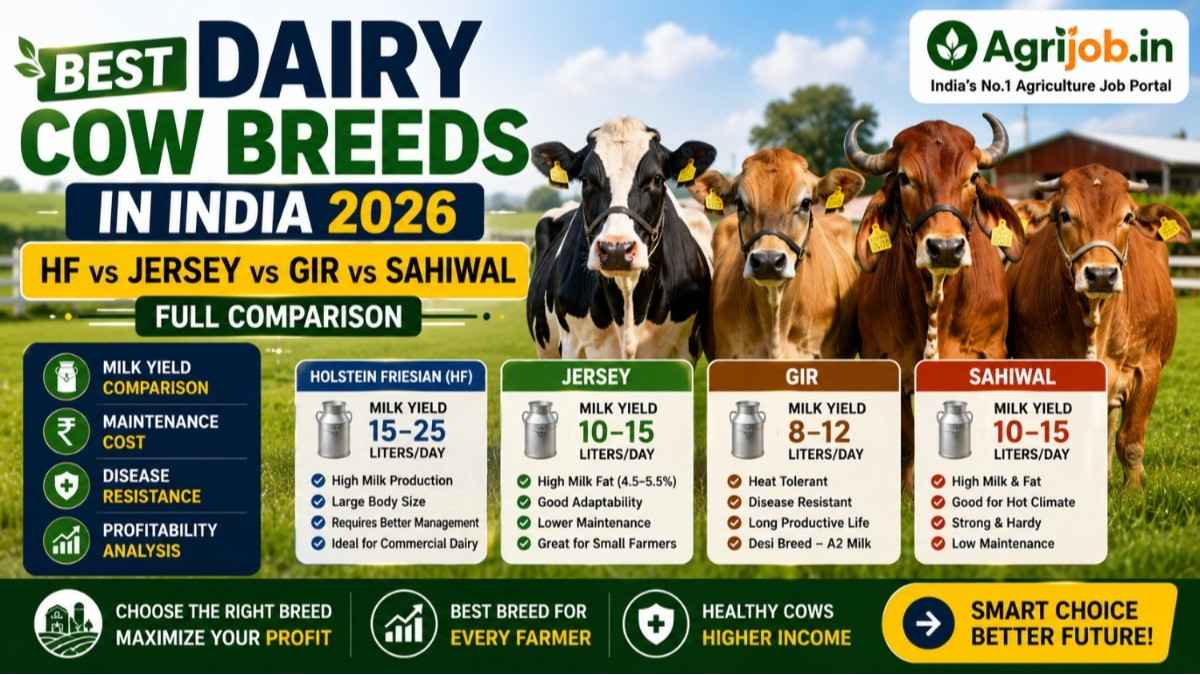
- HF Cow Yield: 25–30 litres/day (pure breed); 10–15 litres/day (crossbred)
- Jersey Cow Yield: 15–20 litres/day; milk fat 4.5%–5.5%
- Gir Cow Yield: 6–12 litres/day; A2 milk; lactation up to 325 days
- Sahiwal Cow Yield: 8–14 litres/day; A2 milk; best heat tolerance
- A2 Milk Farm Price: Rs.80–Rs.120/litre in tier-1 cities vs Rs.35–45/litre for regular milk
- HF Cow Price: Rs.40,000–Rs.1,50,000 depending on yield and location
- Gir Cow Price: Rs.40,000–Rs.2,00,000 (pedigree animals)
- Sahiwal Cow Price: Rs.45,000–Rs.1,20,000
- Jersey Cow Price: Rs.35,000–Rs.70,000
- India Dairy Market Size 2026: USD 31.95 billion, growing at 6.84% CAGR
- What Is the Best Dairy Cow Breed for India in 2026?
- Who Should Read This Breed Comparison Guide?
- Milk Yield, Fat Content & Income Potential by Breed
- Requirements & Management Capacity by Breed
- How to Choose the Right Dairy Cow Breed – Step by Step
- HF vs Jersey Cow – Full Comparison Table
- Gir vs Sahiwal – A2 Milk Breed Comparison
- Pros and Cons of Each Dairy Cow Breed
- Important Terms & Concepts for Dairy Farmers
- Important Links for Dairy Farmers 2026
- Conclusion – Which Dairy Cow Breed Is Right for You?
- Frequently Asked Questions About Best Dairy Cow Breeds India
What Is the Best Dairy Cow Breed for India in 2026?
The best dairy cow breed in India 2026 is not a single answer — it is the breed that matches your specific climate, capital, management skill, and target market. India’s dairy sector employs over 8 crore farmers directly and the average daily yield of exotic and crossbred cows stands at 8.55 kg, while indigenous breeds average 3.44 kg, as per DAHD’s Basic Animal Husbandry Statistics 2025. However, yield alone does not decide profit.
Four breeds dominate Indian dairy farming in 2026: HF (Holstein Friesian) for maximum volume, Jersey for fat-rich milk on smaller farms, Gir for premium A2 milk from Gujarat, and Sahiwal for consistent indigenous production across North India. Each breed has a distinct economic profile. HF cows give more milk but cost more to feed and manage; Gir and Sahiwal give less volume but command 2–3x the price per litre in the growing A2 milk market.

A featured-snippet definition: The best dairy cow breeds in India in 2026 are HF (Holstein Friesian) for high-volume commercial dairy with 25–30 litres/day, Jersey for fat-rich milk at 15–20 litres/day, Gir for premium A2 milk from Gujarat at 6–12 litres/day with a 325-day lactation period, and Sahiwal for consistent A2 production at 8–14 litres/day in North India. Breed selection must align with local climate, management capacity, and milk market access.
Who Should Read This Dairy Cow Breed Comparison Guide?
This guide is written for eight specific types of people in the Indian dairy sector in 2026:
- 🐄 First-time dairy farmers planning a 5–20 cow unit who need a clear, no-hype breed selection framework before spending Rs.5 lakh or more on animals.
- 🌾 Existing farmers in North India (Punjab, Haryana, UP) growing fodder and considering scaling with HF or switching to premium indigenous breeds.
- 🧑🌾 Farmers in Gujarat and Rajasthan evaluating Gir or Sahiwal for A2 milk business at Rs.80–120/litre.
- 👩🌾 Women SHG members accessing NLM or state dairy subsidies and choosing breeds eligible for government support schemes.
- 🎓 Agriculture students and ICAR exam aspirants studying livestock management, breed characteristics, and dairy productivity data.
- 💼 Agri-entrepreneurs building A2 milk, bilona ghee, or value-added dairy startups targeting urban premium markets.
- 🏦 Bank loan applicants writing a Detailed Project Report (DPR) that requires specific breed data, per-day yield, and cost estimates.
- 📱 Urban consumers wanting to understand why A2 milk from Gir and Sahiwal cows costs 2–3x more than regular milk at supermarkets.
Milk Yield, Fat Content & Income Potential by Breed in 2026
Milk yield and fat percentage are the two primary profitability drivers for any dairy breed. However, farm-level income also depends on whether you sell at cooperative rates (Rs.35–45/litre), retail (Rs.55–65/litre), or as certified A2 milk (Rs.80–120/litre). Here is a comprehensive data table for the four major breeds:
| Breed | Type | Avg. Milk/Day | Peak Milk/Day | Fat % | Lactation Period | A2 Milk? | Cow Price (Rs.) |
|---|---|---|---|---|---|---|---|
| HF (Pure) | Exotic | 25–30 litres | 35–40 litres | 3.2%–4.0% | 300–305 days | No (A1) | 40,000–1,50,000 |
| HF Crossbred | Exotic Cross | 10–15 litres | 20 litres | 3.5%–4.2% | 300 days | Partial | 35,000–70,000 |
| Jersey (Pure) | Exotic | 15–20 litres | 25–30 litres | 4.5%–5.5% | 300–310 days | Partial | 35,000–70,000 |
| Gir | Indigenous | 6–12 litres | 15–20 litres | 4.5%–5.1% | ~325 days | Yes | 40,000–2,00,000 |
| Sahiwal | Indigenous | 8–14 litres | 15–20 litres | 4.5%–5.0% | 300–305 days | Yes | 45,000–1,20,000 |
Monthly income comparison for a single well-managed cow at cooperative milk price (Rs.40/litre) vs A2 milk price (Rs.100/litre):
| Breed | Avg. Yield (litres/day) | Gross Monthly Revenue @ Rs.40/L | Gross Monthly Revenue @ Rs.100/L (A2) |
|---|---|---|---|
| HF Pure | 25 | Rs.30,000 | Not applicable (A1 milk) |
| HF Crossbred | 12 | Rs.14,400 | Not applicable |
| Jersey | 18 | Rs.21,600 | Partial — Rs.35,000–45,000 |
| Gir | 10 | Rs.12,000 | Rs.30,000 (A2 premium) |
| Sahiwal | 12 | Rs.14,400 | Rs.36,000 (A2 premium) |
Key insight: A Sahiwal cow producing 12 litres/day of certified A2 milk sold at Rs.100/litre earns Rs.36,000/month per cow — 2.5x more than an HF crossbred at regular cooperative rates. The A2 milk premium completely changes the economics of indigenous breed farming.
Requirements & Management Capacity Needed by Breed
The biggest mistake Indian farmers make is buying a high-yield exotic breed without the management infrastructure to sustain it. Each breed demands a specific level of care, feed, housing, and veterinary support. Here is what you need for each breed:
- 🐄 HF (Holstein Friesian): Requires a ventilated, temperature-controlled shed (cooling fans mandatory in states above 40°C summer), a minimum 50 kg/day feed (green fodder, silage, concentrates, bypass fat), regular veterinary check-ups every 2 months, and a reliable cooperative or dairy company offtake for daily milk. Feed cost: Rs.250–350/day per cow. Fails without quality nutrition.
- 🥛 Jersey: More adaptable to Indian heat than pure HF; requires 35–45 kg/day feed, good shelter, and regular deworming. Suited for farmers with 0.5–1 acre of fodder land. Feed cost: Rs.180–260/day per cow. Good for semi-intensive farming.
- 🌿 Gir: Performs best in dry, warm climates (Gujarat, Rajasthan, MP). Requires good nutrition to reach full yield potential — many farmers underperform Gir cows by underfeeding them. Tick-resistant; disease-hardy. Longer calving interval (14–16 months) than exotic breeds. Feed cost: Rs.150–200/day per cow under scientific management.
- ☀️ Sahiwal: Most heat-tolerant breed; thrives in Punjab, Haryana, UP, Bihar, and Rajasthan with minimal infrastructure. Performs reliably on low-quality roughage better than any exotic breed. Best choice for farmers with limited feed access. Feed cost: Rs.130–180/day per cow. Calmer temperament; easy to manage for women and first-timers.
- General Category (good milch cow): HF: Rs.60,000–1,00,000 | Jersey: Rs.50,000–70,000 | Gir: Rs.80,000–1,50,000 | Sahiwal: Rs.60,000–90,000
- Budget Category (starter animal): HF crossbred: Rs.35,000–50,000 | Jersey crossbred: Rs.35,000–45,000 | Gir (standard): Rs.40,000–70,000 | Sahiwal (standard): Rs.45,000–65,000
- Premium / Pedigree: HF imported line: Rs.1,00,000–1,50,000 | Gir (milk-recorded, NBAGR certified): Rs.1,50,000–2,00,000
How to Choose the Right Dairy Cow Breed — Step-by-Step Process
Choosing a dairy breed is a structured decision, not a guess. Follow these 7 steps before spending a single rupee:
- Assess Your Climate: If your region sees summer temperatures above 42°C regularly, avoid pure HF. Use Sahiwal, Gir, or HF crossbred. Tamil Nadu, Kerala, and AP farmers have success with Jersey. North Indian plains suit all four breeds with appropriate management.
- Calculate Your Feed Availability: If you have 1+ acre of fodder land or reliable access to green maize, napier grass, and berseem at under Rs.5/kg, any breed is viable. If feed is scarce and expensive, choose Sahiwal or Gir — they convert low-quality roughage efficiently.
- Define Your Milk Market: Selling to a cooperative or private dairy company → choose HF or Jersey crossbred for volume. Selling directly to consumers as premium A2 milk or bilona ghee → choose Gir or Sahiwal. A2 milk sells at Rs.80–120/litre vs Rs.35–45/litre cooperative price.
- Assess Management Capacity: First-time farmer with limited experience → Jersey crossbred or Sahiwal. Experienced farmer with dedicated cowshed, cooling system, and trained helper → HF pure breed. Urban agri-entrepreneur with premium market access → Gir or Sahiwal for A2 brand.
- Set Your Budget: Investment below Rs.50,000 per animal → Jersey crossbred or basic Sahiwal. Budget of Rs.70,000–1,50,000 → Gir with milk records. Rs.1,50,000+ per animal → pedigree HF or elite Gir from certified farms.
- Verify Animal Before Purchase: Always demand milk records (last 2–3 lactations) from the seller. Have the animal examined by a registered veterinarian before purchase. Insist on vaccination records and ear tag documentation for insurance eligibility.
- Plan for Artificial Insemination (AI): All government veterinary centres offer AI services at subsidised rates. Use high-genetic-value semen from breeds matching your herd to improve yields with each calving. This is the cheapest way to improve herd productivity year over year.
Never buy a dairy cow based on visual appearance alone. A Gir cow with heavy horns and a large hump may look impressive, but without a documented lactation record from the previous 2 calvings, you are taking a blind financial risk. Always request the milk diary (yield record) and cross-verify with the seller’s neighbours or the local animal husbandry officer. Pedigree-verified animals from ICAR-registered farms cost more upfront but deliver predictable returns. For the premium A2 milk market, genetic testing of the cow is strongly recommended to confirm A2 beta-casein genotype.
HF vs Jersey Cow – Full Comparison Table 2026
HF vs Jersey is the most common comparison among Indian dairy farmers choosing an exotic breed. Both are high-yielding, but they differ fundamentally in milk volume, fat content, climate adaptation, and profitability model. Here is the complete comparison:
| Parameter | HF (Holstein Friesian) | Jersey |
|---|---|---|
| Origin | Netherlands / Germany | Island of Jersey (UK/France) |
| Avg. Milk Yield / Day | 25–30 litres (pure); 10–15 litres (cross) | 15–20 litres (pure); 8–12 litres (cross) |
| Milk Fat % | 3.2%–4.0% | 4.5%–5.5% |
| Body Weight | 550–770 kg | 350–450 kg |
| Heat Tolerance | Poor — needs cooling fans above 30°C | Moderate — adapts better to Indian heat |
| Feed Requirement/Day | 40–50 kg (green + dry + concentrate) | 30–40 kg (green + dry + concentrate) |
| Daily Feed Cost | Rs.250–350/day | Rs.180–260/day |
| Disease Resistance | Low — susceptible to heat, mastitis, foot rot | Moderate — less maintenance than pure HF |
| Cow Purchase Price | Rs.40,000–1,50,000 | Rs.35,000–70,000 |
| Best For | Commercial dairy farms in North India — Punjab, Haryana, UP with cool weather and intensive management | Small and medium farms across India; value-added dairy (ghee, paneer) due to high fat |
| Milk Market | Volume-based — cooperative / private dairy company | Volume + fat premium — cooperative or direct consumer |
| A2 Milk Status | No — primarily A1 protein | Partial — not certified A2 |
Choose HF crossbred if you have an established shed with cooling infrastructure, reliable high-quality green fodder supply, and access to a cooperative paying Rs.38–45/litre. You will get the highest raw milk volume per day. Choose Jersey or Jersey crossbred if you are a small or medium farmer in a warmer climate, have 0.5–1 acre of fodder land, and want a lower-maintenance animal that still yields profitable milk for ghee, paneer, or direct consumer sales. For most beginners in states like Bihar, UP, MP, or Maharashtra, Jersey crossbred delivers the best risk-adjusted return on investment in 2026.
Gir vs Sahiwal – A2 Milk Breed Comparison 2026
Gir vs Sahiwal is the most important comparison for farmers targeting India’s rapidly growing A2 milk market. Both are premier indigenous breeds, both produce certified A2 beta-casein milk, and both are far more disease-resistant and heat-tolerant than any exotic breed. But they differ in origin, temperament, yield consistency, and market positioning.
| Parameter | Gir Cow | Sahiwal Cow |
|---|---|---|
| Origin | Gir forests, Kathiawar, Gujarat | Montgomery region, Punjab (undivided India) |
| Avg. Milk Yield / Day | 6–12 litres (standard); 15–20 litres (high-genetic) | 8–14 litres (standard); 15–20 litres (high-genetic) |
| Lactation Duration | ~325 days — longest among Indian indigenous breeds | 300–305 days |
| Total Lactation Yield | 800–3,300 kg (ICAR-NBAGR data); avg ~2,110 kg | 1,400–2,500 kg per lactation |
| Milk Fat % | 4.5%–5.1% | 4.5%–5.0% |
| A2 Beta-Casein | Yes — confirmed Bos indicus A2 breed | Yes — confirmed Bos indicus A2 breed |
| Heat Tolerance | Excellent — bred in dry, hot Saurashtra region | Excellent — thrives in Punjab heat up to 45°C+ |
| Temperament | Gentle but can be slow to milk for beginners | Very calm — ideal for women and new farmers |
| Disease Resistance | Tick-resistant; strong immune system | Highly resistant to tick-borne diseases |
| Calving Interval | 14–16 months | 13–14 months |
| Cow Purchase Price | Rs.40,000–2,00,000 (pedigree) | Rs.45,000–1,20,000 |
| Best Geography | Gujarat, Rajasthan, MP, parts of Maharashtra | Punjab, Haryana, UP, Bihar, Rajasthan |
| Premium Milk Price | Rs.80–120/litre as A2 (Gir brand commands premium) | Rs.70–100/litre as A2 |
Both breeds are excellent for the A2 milk market. Choose Gir if you are in Gujarat, Rajasthan, or MP, have access to high-genetic pedigree animals (preferably from Junagadh or Bhavnagar farms), and are targeting the premium urban A2 ghee or bilona ghee market — Gir brand recognition commands Rs.5–20/litre more than Sahiwal in tier-1 cities. Choose Sahiwal if you are in North India (Punjab, Haryana, UP, Bihar), want consistently higher average yield compared to standard Gir animals, need a cow with a calmer temperament (easier for beginners and women), and want faster calving cycles. Sahiwal delivers more predictable results under a wider range of management conditions than Gir. As per expert consensus from field practitioners: “Gir often attracts attention, but Sahiwal delivers more consistent and predictable results.”
Pros and Cons of Each Dairy Cow Breed in India 2026
A balanced view of strengths and limitations helps farmers make honest decisions that match their real-world constraints rather than textbook ideals.
HF Cow — Pros and Cons
- ✅ Highest milk volume in India — 25–30 litres/day (pure breed)
- ✅ Fastest ROI for volume-based cooperative sales
- ✅ Well-established supply chain of crossbred animals across India
- ✅ Consistent, predictable production under good management
- ❌ Extremely sensitive to heat — stressed above 30°C without shade and cooling
- ❌ Highest feed cost — Rs.250–350/day requiring premium green fodder, silage, bypass fat
- ❌ High veterinary cost — mastitis, foot rot, reproductive issues common
- ❌ A1 protein milk — not suitable for the growing A2 premium market
- ❌ Not self-sustainable — collapses quickly if management quality drops
Jersey Cow — Pros and Cons
- ✅ Higher fat % (4.5%–5.5%) — more value per litre for ghee, paneer, butter production
- ✅ More adaptable to Indian heat than pure HF
- ✅ Smaller body = lower feed intake; efficient feed conversion
- ✅ Profitable for small and medium farms with value-added dairy goals
- ❌ Lower raw volume than HF — not suitable for large cooperative dairy supply
- ❌ Not certified A2 milk — cannot command A2 premium pricing
- ❌ Can struggle in extreme heat (above 42°C) without management support
Gir Cow — Pros and Cons
- ✅ Certified A2 milk — commands Rs.80–120/litre in urban markets
- ✅ Longest lactation period — ~325 days per calving
- ✅ Superior heat and drought tolerance — ideal for Gujarat, Rajasthan
- ✅ Tick-resistant and disease-hardy — very low veterinary cost
- ✅ Premium brand recognition in A2 ghee and bilona ghee market
- ❌ Wide genetic variation — yields vary hugely between individuals without pedigree records
- ❌ Longer calving interval (14–16 months) reduces annual calves per cow
- ❌ Pedigree animals are expensive — Rs.1,50,000–2,00,000 for certified high-yield cows
- ❌ Underperforms if underfed — many farmers get poor results by assuming Gir is a “zero-input” cow
Sahiwal Cow — Pros and Cons
- ✅ Most consistent A2 milk yield among indigenous breeds — 8–14 litres/day
- ✅ Best heat tolerance in North Indian plains — performs at 45°C+
- ✅ Calmer temperament — easiest to manage for new farmers and women
- ✅ Shorter calving interval (13–14 months) — more calves per year
- ✅ Low veterinary cost — strong disease resistance, especially tick-borne diseases
- ❌ Lower brand recognition than Gir in A2 premium market
- ❌ Yield potential is lower than HF or Jersey for high-volume cooperative supply
- ❌ Availability of high-quality pedigree animals outside Punjab and Haryana can be limited
Important Terms & Concepts for Dairy Farmers in India
These high-value terms help you understand breed comparisons, government scheme documentation, and premium milk market opportunities in 2026:
- 🧬 A2 Beta-Casein Protein: A type of protein found in milk from indigenous Bos indicus breeds (Gir, Sahiwal, Red Sindhi). Considered easier to digest than A1 beta-casein found in most exotic breeds. A2 milk sells at a 30–50% premium over regular milk in India’s urban markets.
- 🥛 Lactation Period: The number of days a cow produces milk after calving — typically 300–325 days for Indian breeds. Gir holds the record among indigenous breeds at approximately 325 days.
- 🐄 Bos indicus vs Bos taurus: Bos indicus refers to humped Indian cattle (Gir, Sahiwal, Red Sindhi) — naturally adapted to tropical heat, ticks, and poor-quality feed. Bos taurus refers to European-origin breeds (HF, Jersey) bred for high yield in temperate climates.
- 🏥 Mastitis: The most common and costly dairy disease in India — inflammation of the udder, most prevalent in high-yielding HF cows under poor hygiene conditions. Cost of a single mastitis episode: Rs.3,000–8,000 in treatment and lost milk.
- 💉 Artificial Insemination (AI): Government veterinary centres across India offer AI at subsidised or free rates. Using high-genetic-value semen (HF+ or Sahiwal Elite) improves yield with each generation of calf, raising herd productivity without purchasing new animals.
- 🔬 Bilona Ghee: Traditional hand-churned ghee made from A2 milk using the vedic bilona method. Requires 25–30 litres of Gir or Sahiwal milk per litre of ghee. Sells at Rs.1,500–Rs.3,000/kg vs Rs.500–600/kg for commercial ghee — the highest value-addition opportunity in Indian dairy.
- 📊 Fat % and SNF (Solids Not Fat): Two quality parameters used by cooperatives and dairies to calculate milk payment. Higher fat and SNF = higher price per kg. Gir and Sahiwal consistently deliver 4.5%+ fat vs 3.2–3.5% for HF — critical for ghee and paneer economics.
- 🌿 Total Mixed Ration (TMR): A balanced daily feed combining roughage (green fodder, dry straw), concentrates (cattle feed pellets), and minerals in exact ratios to maximise milk yield. Essential for managing HF cows; beneficial for all breeds.
- 🏦 AHIDF (Animal Husbandry Infrastructure Development Fund): Government scheme offering 3% interest subvention on dairy farm loans for up to 8 years. Loans up to 90% of project cost. Apply at ahidf.udyamimitra.in. Active in 2026.
- 📋 ICAR-NBAGR: Indian Council of Agricultural Research — National Bureau of Animal Genetic Resources. The official body that characterises, registers, and maintains data on all Indian livestock breeds including Gir, Sahiwal, and 45+ other indigenous cattle breeds. Data on lactation yield, fat %, and breed standards are officially published here.
Important Links for Dairy Farmers 2026
| Resource | Link |
|---|---|
| DAHD — Dept. of Animal Husbandry & Dairying (Official) | dahd.gov.in |
| ICAR-NBAGR — Indigenous Breed Registry | nbagr.res.in |
| NDDB — National Dairy Development Board | nddb.coop |
| AHIDF Loan Application (3% interest subvention) | ahidf.udyamimitra.in |
| NABARD — Dairy Financing Schemes | nabard.org |
| Agrijob.in — Dairy Farm Business Plan India 2026 | Dairy Farm Business Plan 2026 – Cost, Loan & Profit Guide |
| Agrijob.in — Knowledge Hub (Dairy Category) | Dairy Farm Articles on Agrijob.in |
| Agrijob.in — Animal Husbandry Jobs | Animal Husbandry Jobs 2026 |
Conclusion – Which Dairy Cow Breed Is Right for You in 2026?
The best dairy cow breeds in India 2026 depend entirely on your climate, capital, management infrastructure, and milk market. HF delivers unmatched volume but demands intensive care and cool conditions. Jersey offers a profitable middle ground for smaller farms across India with high-fat milk ideal for ghee and paneer. Gir and Sahiwal are the undisputed champions for the booming A2 milk market, delivering lower volumes at 2–3x the per-litre price, making them highly competitive on net income per cow. For dairy farmers in Bihar, UP, Rajasthan, and Punjab seeking a sustainable, low-input, high-value option, Sahiwal or Gir are the strongest choices in 2026.
Before purchasing any animal, verify its lactation records, conduct a veterinary health check, and plan your milk sales channel first. Read our complete Dairy Farm Business Plan India 2026 for cost, loan, and profit calculations matched to each breed. Bookmark this page — it is updated regularly as breed data, government scheme details, and A2 milk market prices are revised.
- India is the world’s largest milk producer at 247.87 million tonnes (DAHD 2025) — demand still exceeds organised supply in most urban markets.
- HF pure breed gives 25–30 litres/day but requires cooling, high-quality feed at Rs.250–350/day, and strong veterinary support — not suitable for hot climates or low-input farms.
- Jersey is the best value breed for small and medium farmers across India — 15–20 litres/day, 4.5%–5.5% fat, adaptable to most Indian climates.
- Gir and Sahiwal produce certified A2 milk at Rs.80–120/litre — single-cow monthly revenue of Rs.30,000–36,000 vs Rs.14,400 for regular cooperative milk sales.
- For North Indian farmers in Punjab, Haryana, UP, and Bihar, Sahiwal is the safest, most consistent A2 breed — calmer temperament, shorter calving interval, and wider adaptability than Gir.
- Apply for AHIDF dairy loan (3% interest subvention, up to 90% loan) at ahidf.udyamimitra.in before purchasing animals — this one step can save Rs.1–3 lakh in interest over 8 years.
Frequently Asked Questions About Best Dairy Cow Breeds India 2026
Which is the best dairy cow breed in India in 2026?
The best dairy cow breed in India 2026 depends on your farming goal. For maximum milk volume, HF (Holstein Friesian) is the top choice at 25–30 litres/day under good management in cool climates. For fat-rich milk on smaller farms, Jersey gives 15–20 litres/day with 4.5%–5.5% fat content. For premium A2 milk sold at Rs.80–120/litre, Gir and Sahiwal are the best choices, with strong disease resistance and lower management costs than exotic breeds.
How many litres of milk does an HF cow give per day in India?
A pure HF cow in India gives 25–30 litres of milk per day under proper feeding, housing, and veterinary management, with top animals reaching 35–40 litres at peak lactation. HF crossbred cows, which are more common and heat-adapted, give 10–15 litres per day under normal Indian farm conditions. The nationwide average daily yield for exotic and crossbred cows in India was 8.55 kg as per the Ministry of Fisheries, Animal Husbandry and Dairying’s 2023 data.
Is Gir cow A2 milk worth the premium price in India?
Yes, Gir cow A2 milk commands a justifiable premium in India’s urban market. Certified Gir A2 milk sells at Rs.80–120/litre in tier-1 cities versus Rs.35–45/litre for regular cooperative milk. A single Gir cow producing 10 litres/day of A2 milk sold directly to consumers generates Rs.30,000/month — comparable to or better than an HF crossbred producing 12–15 litres sold to a cooperative. Additionally, bilona ghee made from Gir A2 milk sells at Rs.1,500–3,000/kg, versus Rs.500–600/kg for commercial ghee.
Which is better — Gir cow or Sahiwal cow for A2 milk farming?
Both Gir and Sahiwal produce certified A2 beta-casein milk, but they suit different regions and farmer profiles. Gir is better for Gujarat, Rajasthan, and MP farmers targeting the premium Gir A2 ghee or bilona ghee market — the Gir breed commands stronger brand recognition and slightly higher A2 milk prices in western India. Sahiwal is better for North Indian farmers in Punjab, Haryana, UP, and Bihar — it has a calmer temperament, shorter calving interval (13–14 months vs 14–16 months for Gir), and consistently delivers 8–14 litres/day with less management complexity. For most beginners, Sahiwal delivers more predictable results.
What is the milk fat percentage in HF, Jersey, Gir, and Sahiwal cow milk?
Milk fat percentages vary significantly between breeds: HF milk contains 3.2%–4.0% fat — the lowest among these four breeds; Jersey milk contains 4.5%–5.5% fat, making it ideal for value-added products; Gir milk averages 4.5%–5.1% fat with some pedigree animals reaching 5.5%; and Sahiwal milk contains 4.5%–5.0% fat. Higher fat milk produces more ghee, paneer, and butter per litre, which is why Jersey, Gir, and Sahiwal are preferred for value-added dairy processing over HF.
Which dairy cow breed is best for beginners in India?
For beginners starting dairy farming in India, Jersey crossbred or Sahiwal are the safest and most forgiving choices. Jersey crossbred cows cost Rs.35,000–50,000, give 8–12 litres/day, have moderate feed requirements, and adapt to most Indian climates. Sahiwal cows are ideal for North Indian beginners — extremely calm and easy to manage, heat-tolerant up to 45°C, and disease-resistant with low veterinary costs. Both breeds tolerate management mistakes that would cause significant production loss in a pure HF cow. Avoid pure HF for your first herd unless you have prior experience and high-quality infrastructure.
What is the price of a Gir cow in India in 2026?
Gir cow prices in India in 2026 range from Rs.40,000 for a basic milch animal to Rs.2,00,000 or more for pedigree-verified, high-yield cows with complete milk records from ICAR-NBAGR registered farms. In Gujarat (Gir’s home region), prices are generally lower: Rs.40,000–80,000 for ordinary milch Gir cows and Rs.80,000–1,50,000 for good high-yielding animals. Gir cow price in UP and other states is Rs.35,000–1,20,000 depending on purity and production records. Baby Gir cow (female calf) price is approximately Rs.10,000–25,000.
Can HF cows survive in hot climates in India like Bihar, Rajasthan, or Tamil Nadu?
Pure HF cows struggle significantly in temperatures above 30–32°C and experience severe heat stress above 40°C, causing sharp drops in milk production and increased disease risk. In hot states like Rajasthan, Bihar, and interior Tamil Nadu, pure HF cows require cooling fans, misting systems, deep-litter bedding, and extra water — adding Rs.5,000–10,000/month in operational costs. HF crossbred cows, with 50% or 75% indigenous blood, are far more viable in these climates. For extreme heat zones above 42°C, Sahiwal or Gir are strongly recommended over any HF variant to protect the investment.
How do I apply for a government dairy farming subsidy in India in 2026?
The best active dairy subsidy scheme in India in 2026 is the Animal Husbandry Infrastructure Development Fund (AHIDF), offering 3% interest subvention for 8 years on dairy farm loans up to 90% of project cost. Apply online at ahidf.udyamimitra.in by submitting your Detailed Project Report (DPR), KYC documents, and land records. For individual farmers with 5–15 animals, the National Livestock Mission (NLM) entrepreneurship component offers up to 50% capital subsidy. State-specific dairy subsidies of 25–33% are available through your district Animal Husbandry Department — visit your district office with a DPR and bank loan application to access these schemes.
📅 Last Updated: July 2026 | Reviewed against DAHD Basic Animal Husbandry Statistics 2025, ICAR-NBAGR breed data, and current farm-level milk price surveys. This guide is updated regularly — bookmark this page for the latest breed comparison data and scheme updates.
Disclaimer: Milk yield figures are based on published data from government sources (DAHD, ICAR-NBAGR, Dairy Assam government portal) and cross-verified field surveys. Individual cow performance varies based on genetics, feed quality, health management, and local conditions. This article is for informational purposes. Consult a registered veterinarian or ICAR specialist before making breed purchase decisions.