
AHIDF loan — the Animal Husbandry Infrastructure Development Fund — is India’s largest government-backed financing window for private entrepreneurs, dairy cooperatives, FPOs, and MSMEs seeking big-ticket capital to build or expand livestock infrastructure. With a revised fund corpus of Rs.29,610.25 crore extended up to FY 2025-26 and a compelling 3% interest subvention for 8 years, AHIDF has fundamentally changed how entrepreneurs access capital for dairy processing, meat processing, animal feed plants, breed multiplication farms, and veterinary vaccine facilities. This guide is for agri-entrepreneurs, dairy business owners, MSME operators, FPO leaders, and private investors aged 25–55 who need a clear, jargon-free breakdown of how AHIDF financing works, what it covers, who qualifies, and exactly how to apply.

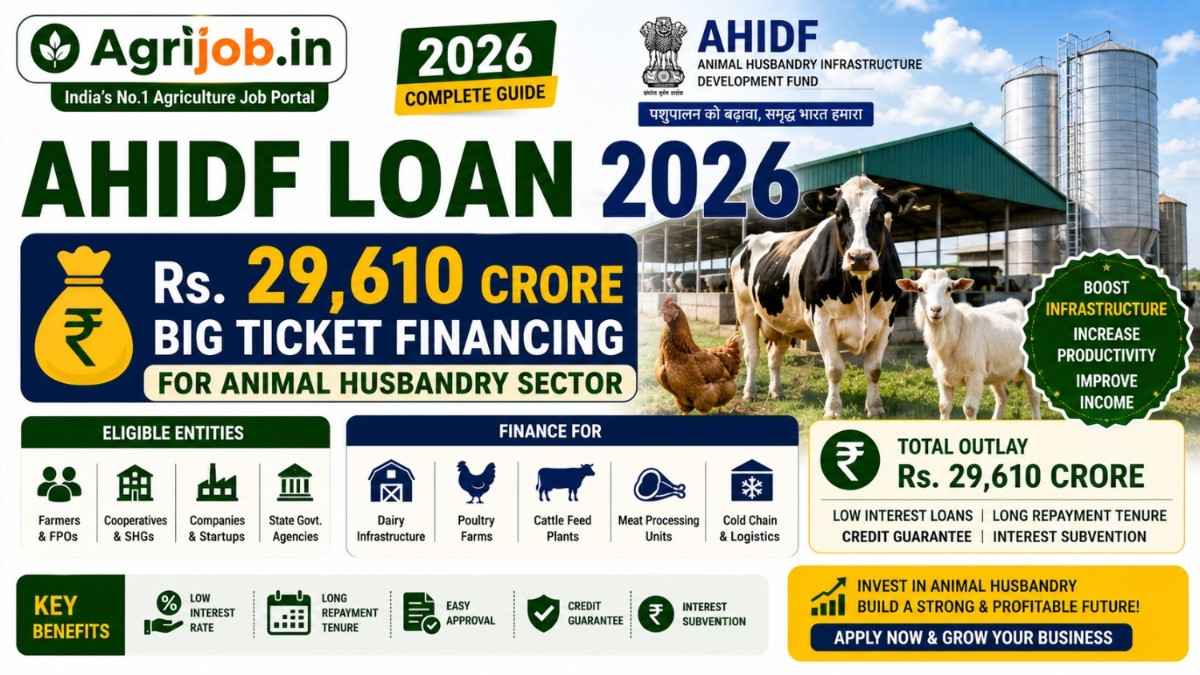
The AHIDF loan (Animal Husbandry Infrastructure Development Fund) provides up to 90% of project cost as a bank loan with a 3% annual interest subvention from the Government of India for 8 years (including a 2-year moratorium). Eligible entities include individuals, MSMEs, private companies, FPOs, Section 8 companies, and dairy cooperatives investing in dairy, meat, animal feed, breed improvement, veterinary vaccines, or waste-to-wealth projects. Apply online at ahidf.udyamimitra.in.
- Scheme Name: Animal Husbandry Infrastructure Development Fund (AHIDF)
- Total Fund Corpus: Rs.29,610.25 crore (extended up to FY 2025-26)
- Implementing Ministry: Department of Animal Husbandry & Dairying (DAHD), MoFAH&D
- Interest Subvention: 3% per annum for up to 8 years (including 2-year moratorium)
- Loan Coverage: Up to 90% of eligible project cost from scheduled banks
- Promoter Contribution: Minimum 10% (MSME) to 25% (large entities)
- Credit Guarantee: Up to 25% of loan via NABARD Credit Guarantee Fund (Rs.750 crore corpus)
- Max Repayment Period: 10 years including moratorium of up to 2 years
- Application Portal: ahidf.udyamimitra.in
- Scheme Status: Active — sanctioned projects must be approved on or before scheme closure date
📋 Table of Contents
- What Is AHIDF and Why It Matters for Livestock Entrepreneurs
- Who Should Apply for AHIDF Financing
- AHIDF Financial Benefits: Interest Subvention, Loan Coverage & Savings
- Eligible Activities and Project Categories Under AHIDF
- How AHIDF Financing Works: Step-by-Step Application Process
- AHIDF vs NLM: Which Government Scheme Is Better for Your Project?
- Pros and Cons of AHIDF Financing
- Important Terms and Concepts in AHIDF Financing
- Important Links
- Conclusion
- Key Takeaways
- Frequently Asked Questions About AHIDF Loan
What Is AHIDF and Why It Matters for Livestock Entrepreneurs
The Animal Husbandry Infrastructure Development Fund (AHIDF) is a central sector scheme launched by the Government of India under the Atmanirbhar Bharat Abhiyan stimulus package in June 2020. It was created to address a persistent structural gap: India processes less than 25% of its milk output and less than 10% of its meat in modern facilities, leaving enormous value on the table for both producers and consumers. AHIDF directly targets this gap by providing long-tenor, subsidised financing to private entities willing to invest in livestock infrastructure — making big-ticket investments affordable by slashing the effective interest burden by 3 percentage points for eight years.
The scheme was extended by the Union Cabinet in February 2024 with a revised outlay of Rs.29,610.25 crore for an additional three years up to FY 2025-26. The extended version subsumed the earlier Dairy Processing Infrastructure Development Fund (DIDF) and added new eligible activities including breed multiplication farms, veterinary vaccine and drug production, animal waste-to-wealth projects, and primary wool processing infrastructure. As of July 2026, AHIDF has approved over 439 projects worth Rs.21,190.68 crore, benefitting approximately 25 lakh farmers across India.

What makes AHIDF the defining scheme for big-ticket livestock financing is the combination of three levers: a 90% loan-to-project-cost ratio (meaning only 10% promoter equity is required for MSMEs), a government-paid 3% interest subvention that lowers the effective borrowing cost for 8 full years, and a credit guarantee backstop through NABARD’s Rs.750 crore Credit Guarantee Fund — reducing the collateral burden on eligible borrowers. No comparable scheme in the livestock sector offers this three-layer financial support simultaneously.
Who Should Apply for AHIDF Financing
AHIDF is designed for a wide range of private and institutional investors in the livestock and dairy value chain. If you are planning infrastructure investment in any of the eligible categories and need long-tenor bank financing with a government interest subsidy, this scheme is built for you.
- 🏭 Dairy processors and milk cooperatives planning to set up or modernise pasteurisation, UHT, cheese, ice cream, milk powder, or packaging facilities
- 🥩 Meat processing entrepreneurs investing in modern slaughterhouses, cold chains, value-added meat product units, or integrated processing facilities
- 🌾 Animal feed manufacturers setting up or expanding compound feed, bypass protein, or total mixed ration (TMR) plants for cattle, poultry, or aquaculture
- 🐄 Breed multiplication farm operators establishing IVF labs, sex-sorted semen centres, or high-genetic-merit cattle and buffalo breeding facilities
- 💉 Veterinary pharma and vaccine companies building or expanding production facilities for livestock biologics, vaccines, or veterinary drugs
- ♻️ Agri-waste entrepreneurs setting up biogas, vermicompost, or organic fertiliser units from livestock manure and slaughterhouse effluents
- 🧶 Wool processors establishing primary wool processing, grading, or value-addition infrastructure
- 🏢 Private companies, MSMEs, FPOs, and Section 8 companies looking for government-backed infrastructure loans with longer repayment tenors than standard commercial credit
AHIDF Financial Benefits: Interest Subvention, Loan Coverage and Savings
The financial architecture of AHIDF is designed to make large-scale infrastructure investments viable for private entities that would otherwise struggle to service high-interest commercial debt. The scheme delivers three distinct financial benefits: loan coverage, interest subvention, and credit guarantee support.
Loan Coverage: Up to 90% of Project Cost
Under AHIDF, eligible projects can receive a term loan covering up to 90% of the total eligible project cost from scheduled banks. This is significantly higher than typical commercial project finance, which usually caps at 65–75% of project cost. The minimum promoter contribution is 10% for micro and small entities and around 15–25% for medium and larger enterprises depending on the bank’s appraisal. There is no fixed upper limit on loan amount — banks finance up to 90% of the project DPR cost based on project viability.
| Financial Parameter | AHIDF Terms |
|---|---|
| Loan Coverage | Up to 90% of eligible project cost |
| Promoter Contribution (MSME) | Minimum 10% |
| Promoter Contribution (Others) | 15–25% depending on bank appraisal |
| Interest Subvention | 3% per annum — paid by Government to lending bank |
| Subvention Period | 8 years including 2-year moratorium |
| Moratorium Period | Up to 2 years from first disbursement |
| Maximum Repayment Tenor | 10 years including moratorium |
| Credit Guarantee Coverage | Up to 25% of loan amount via NABARD (MSME projects) |
| Credit Guarantee Fee | Approx. 0.25% per annum on guaranteed amount |
| MSME Loan Ceiling for CG | Up to Rs.2 crore (CGTMSE coverage) |
Interest Subvention: Real Savings Over 8 Years
The 3% annual interest subvention is the single biggest financial lever in AHIDF. The Government of India directly reimburses 3 percentage points of your applicable interest rate to the lending bank on your behalf — effectively reducing the effective interest you pay for 8 years. For a Rs.10 crore project loan, this translates to approximately Rs.24 lakh per year in interest savings, or roughly Rs.1.92 crore over the 8-year subvention window (illustrative, subject to actual interest rate and repayment schedule). The subvention applies only to regular repayments — it does not cover penal interest or periods of default.
Interest rates on AHIDF loans are determined by the lending bank. For entities within MSME defined ceilings, the rate must not exceed EBLR (External Benchmark Lending Rate) + 200 basis points. For loans above Rs.50 lakh to other eligible entities, the bank’s standard extant guidelines apply. The net effective rate after the 3% subvention is typically in the range of 7–9% per annum depending on the benchmark rate at the time of sanction — making it significantly cheaper than standard commercial term loans.
Eligible Activities and Project Categories Under AHIDF
AHIDF covers 7 broad infrastructure categories. Each category has specific sub-activities that qualify for the scheme’s financial benefits. Importantly, both new units and expansion or strengthening of existing units are eligible.
- 🥛 Dairy Processing & Value Addition: Pasteurisation plants, UHT milk processing, flavoured milk, ice cream, cheese, butter, ghee, milk powder, whey powder, paneer manufacturing, and packaging facilities
- 🥩 Meat Processing & Value Addition: Modern abattoirs, cold storage, blast freezers, value-added products (sausages, nuggets, ready-to-cook), retail-ready meat packaging, and integrated processing facilities
- 🌾 Animal Feed Plants: Compound feed manufacturing, bypass protein units, total mixed ration (TMR) plants, pellet mills, and premix facilities for cattle, buffalo, poultry, sheep, goat, and pig
- 🐄 Breed Improvement Technology & Breed Multiplication Farms: Technologically assisted breeding farms, IVF Type-A/B/C labs, sex-sorted semen production centres, high-genetic-merit breed multiplication units
- 💉 Veterinary Vaccine and Drug Production Facilities: Strengthening or establishing new manufacturing units for livestock biologics, vaccines, diagnostics, and veterinary drugs
- ♻️ Animal Waste to Wealth Management (Agri Waste Management): Biogas plants, compressed biogas (CBG) units, organic fertiliser and biofertiliser units, liquid manure processing from livestock farms and slaughterhouses
- 🧶 Primary Wool Processing Infrastructure: Wool shearing, grading, washing, carding, and scouring units — newly added under the scheme extension
AHIDF is explicitly designed to be convergeable with other Central and State government schemes. This means you can potentially stack AHIDF’s interest subvention on top of capital subsidies or grants from schemes like PM FME (Formalisation of Micro Food Enterprises), PMEGP, or State-level agri-infrastructure schemes — dramatically improving project viability. Always consult DAHD’s nodal bank or a NABARD-empanelled consultant to explore convergence before filing your DPR.
How AHIDF Financing Works: Step-by-Step Application Process
The AHIDF application process is fully online through the dedicated portal at ahidf.udyamimitra.in, operated in collaboration with SIDBI’s Udyami Mitra platform. The Department of Animal Husbandry and Dairying (DAHD) reviews applications and coordinates with empanelled scheduled banks for loan appraisal and disbursement. Here is the complete step-by-step process:
- Verify Eligibility: Confirm your entity type (individual, MSME, FPO, private company, Section 8, or dairy cooperative) and your proposed activity falls under one of the 7 eligible infrastructure categories defined by DAHD.
- Prepare a Detailed Project Report (DPR): Your DPR must cover project scope, technical specifications, land details, financial projections (3–5 years), machinery quotations, cost breakdowns, and anticipated employment generation. A professionally prepared DPR dramatically improves bank approval speed.
- Register on the AHIDF Udyami Mitra Portal: Visit ahidf.udyamimitra.in and create an account using your mobile number and OTP. This is the single online window for all AHIDF applications.
- Submit the Online Application: Fill in project and entity details, upload your DPR, KYC documents (Aadhaar, PAN, GST, MSME certificate where applicable), land documents, financial statements, and machinery quotations. Select your preferred empanelled bank from the portal.
- DAHD Eligibility Review: The Department reviews your application and marks it as eligible, returned for revision, or rejected. Eligible applications are forwarded to your chosen bank’s branch for loan appraisal.
- Bank Appraisal and Loan Sanction: The scheduled bank conducts its standard credit appraisal, assesses project viability, and issues a loan sanction letter. The bank then uploads the sanctioned proposal to DAHD via the online mechanism for approval of interest subvention.
- Project Approval Committee Review: DAHD’s Project Approval Committee (PAC) reviews proposals up to Rs.50 crore. Projects above Rs.50 crore are escalated to the Project Sanctioning Committee (PSC). This committee provides formal approval of the 3% interest subvention.
- Loan Disbursement and Infrastructure Development: Post-approval, the bank disburses the loan in tranches as per project milestones. The 2-year moratorium on principal begins from the date of first disbursement. Ensure all statutory clearances (pollution control consent, local authority approvals) are in place before seeking disbursements.
AHIDF vs NLM: Which Government Scheme Is Better for Your Project?
Two major Central government schemes serve the livestock sector — AHIDF (infrastructure focus) and the National Livestock Mission (NLM, entrepreneurship and breed development focus). Understanding which scheme fits your project is critical before filing an application.
| Parameter | AHIDF | National Livestock Mission (NLM) |
|---|---|---|
| Primary Focus | Big-ticket infrastructure (processing, feed plants, vaccines) | Entrepreneurship, breed development, fodder |
| Benefit Type | Interest subvention (3%) + Credit Guarantee | Capital subsidy (50% of project cost, max Rs.50 lakh) |
| Loan Coverage | Up to 90% of project cost | Varies by sub-component |
| Project Size Suitability | Rs.50 lakh to Rs.100+ crore (large projects) | Small to medium projects (up to Rs.1 crore) |
| Eligible Entities | Individuals, MSME, FPO, Private Co., Dairy Co-op, Section 8 | Individuals, SHGs, FPOs, JLGs, Co-operatives |
| Implementing Agency | DAHD via scheduled banks and NABARD | DAHD via State Animal Husbandry Departments |
| Application Portal | ahidf.udyamimitra.in | nlm.udyamimitra.in |
| Repayment Tenor | Up to 10 years including moratorium | Bank-determined |
| Best For | Processing plants, feed factories, vaccine facilities, breed farms | Small poultry farms, goat farms, fodder units, feed blocks |
If your project cost exceeds Rs.50 lakh and involves processing or manufacturing infrastructure (dairy plant, meat unit, feed factory, vaccine facility), AHIDF is the stronger choice — the 3% interest subvention over 8 years and 90% loan-to-cost ratio deliver far greater capital efficiency for large projects than NLM’s capped capital subsidy. For smaller entrepreneurship ventures, breed development units, or projects under Rs.50 lakh, NLM’s 50% capital subsidy may offer a better upfront benefit. For projects that qualify under both schemes, consult DAHD’s helpdesk on whether convergence is permitted for your specific activity.
Pros and Cons of AHIDF Financing
Advantages of AHIDF
- ✅ Massive loan coverage at 90%: Reduces promoter equity requirement to just 10% for MSMEs, making large projects achievable without tying up all promoter capital
- ✅ Government-paid interest subvention of 3% for 8 years: Directly lowers the effective cost of borrowing for the project’s entire early operating period
- ✅ 2-year moratorium on principal: No principal repayment during initial project commissioning and ramp-up — critical for cash flow in the first operating years
- ✅ Credit guarantee support via NABARD: Covers 25% of loan for MSME projects, reducing the collateral burden on first-generation entrepreneurs
- ✅ Convergence with other schemes: Can be combined with State or Central capital subsidies for even greater financial benefit
- ✅ Wide eligible activity coverage: 7 activity categories covering the full livestock value chain from breeding to processing to waste management
Disadvantages of AHIDF
- ⚠️ Complex DPR requirement: Banks demand professionally prepared Detailed Project Reports — first-generation entrepreneurs without financial expertise may find this challenging without consultancy support
- ⚠️ Statutory clearances mandatory before disbursement: Pollution control board consents, local authority permits, and land documents must all be in place, adding pre-disbursement timelines
- ⚠️ Interest subvention stops on default: The 3% government interest support is available only for regular repayments — any default period disqualifies that portion from subvention
- ⚠️ Bank appraisal risk: Final credit decision rests entirely with the lending bank — DAHD approval of interest subvention does not guarantee loan sanction
Important Terms and Concepts in AHIDF Financing
Understanding these 10 key terms will help you navigate AHIDF loan applications, DPR preparation, and bank discussions with confidence.
- Interest Subvention: A government-funded rebate on your loan interest — under AHIDF, 3% per annum is reimbursed by DAHD directly to the lending bank, reducing your effective interest burden
- External Benchmark Lending Rate (EBLR): The RBI-linked floating rate used as the base for bank lending rates. AHIDF loans for MSMEs are capped at EBLR + 200 bps before the 3% subvention kicks in
- Moratorium Period: The initial phase (up to 2 years from first disbursement) during which you pay interest only — no principal repayment is required, protecting early-stage cash flow
- Detailed Project Report (DPR): A comprehensive document covering project scope, technical design, land details, financial projections, machinery costs, and employment impact — the cornerstone of your AHIDF bank application
- Eligible Entity (EE): AHIDF’s term for approved applicant types — includes individuals, private companies, MSMEs, FPOs, Section 8 companies, and dairy cooperatives
- Project Management Agency (PMA): A DAHD-appointed agency that reviews bank-approved loan proposals for interest subvention eligibility under AHIDF
- NABARD Credit Guarantee Fund: A Rs.750 crore corpus managed by NABARD providing up to 25% credit guarantee coverage for eligible MSME projects under AHIDF — DAHD contributes Rs.75 crore per year for 10 years
- Project Approval Committee (PAC): DAHD’s in-house committee that approves interest subvention for projects up to Rs.50 crore
- Project Sanctioning Committee (PSC): DAHD’s senior committee that reviews and sanctions interest subvention for projects above Rs.50 crore
- CGTMSE: Credit Guarantee Fund Trust for Micro and Small Enterprises — provides credit guarantee coverage for MSME borrowers with loans up to Rs.2 crore under AHIDF’s MSME component
Important Links
| Resource | Link |
|---|---|
| Official AHIDF Application Portal | ahidf.udyamimitra.in |
| DAHD Official AHIDF Scheme Page | dahd.gov.in — AHIDF Scheme |
| AHIDF Operational Guidelines (PDF) | Download Official Guidelines (DAHD) |
| AHIDF FAQs (Official PDF) | Download Official FAQs (DAHD) |
| NABARD — Agriculture Infrastructure Financing | nabard.org |
| National Portal of India — AHIDF Information | india.gov.in — AHIDF |
| More Government Livestock Schemes | Agrijob.in — Agriculture & Livestock Guides |
Conclusion: Is AHIDF the Right Financing Route for Your Livestock Project?
The AHIDF loan (Animal Husbandry Infrastructure Development Fund) remains the most powerful big-ticket financing instrument available for private and cooperative investment in India’s livestock infrastructure sector. Its combination of 90% loan coverage, a government-paid 3% interest subvention for 8 years, and NABARD-backed credit guarantee creates a uniquely competitive borrowing environment that no standard commercial lender can match for projects in dairy, meat, animal feed, breed improvement, veterinary pharma, or waste-to-wealth. If your project cost exceeds Rs.50 lakh and falls under any of the 7 eligible categories, AHIDF is almost certainly the right financing route — provided you invest the time in a professionally prepared DPR and ensure all statutory clearances are in place before disbursement. Apply online at ahidf.udyamimitra.in and bookmark this page — we update it whenever DAHD revises the scheme guidelines.
- AHIDF provides up to 90% of project cost as a bank loan — promoters need only 10% equity (MSME category)
- The Government pays a 3% annual interest subvention for 8 years, saving lakhs in financing cost per crore borrowed
- 7 eligible categories cover the full livestock value chain: dairy, meat, feed, breeding, vaccines, waste management, and wool
- NABARD’s Rs.750 crore Credit Guarantee Fund provides up to 25% coverage for MSME-category projects, reducing collateral pressure
- Apply 100% online at ahidf.udyamimitra.in — a professionally prepared DPR is the single most important factor in bank approval speed
Frequently Asked Questions About AHIDF Loan
What is the AHIDF loan and who manages it?
The AHIDF loan is a government-backed financing facility under the Animal Husbandry Infrastructure Development Fund, managed by the Department of Animal Husbandry and Dairying (DAHD) under the Ministry of Fisheries, Animal Husbandry and Dairying. The scheme provides up to 90% of project cost as a bank term loan with a 3% annual interest subvention paid by the Government of India for 8 years, covering dairy processing, meat processing, animal feed plants, breed improvement farms, veterinary vaccine facilities, waste-to-wealth projects, and primary wool processing.
What is the total fund corpus of AHIDF?
The original AHIDF corpus was Rs.15,000 crore, launched under the Atmanirbhar Bharat Abhiyan in June 2020. The Union Cabinet approved a continuation and expansion of the scheme in February 2024 with a revised total outlay of Rs.29,610.25 crore for three additional years up to FY 2025-26. This expanded corpus also subsumed the earlier Dairy Processing Infrastructure Development Fund (DIDF) and added new eligible categories.
Who is eligible to apply for an AHIDF loan?
Eligible entities under AHIDF include individual entrepreneurs, private companies, MSMEs, Farmer Producer Organisations (FPOs), Section 8 companies, and dairy cooperatives. The entity must be investing in one of the 7 defined eligible activity categories. There is no minimum or maximum turnover requirement specified at the scheme level — eligibility also depends on the bank’s standard credit assessment of the applicant’s financial capacity to service the loan.
How much can I borrow under AHIDF and is there a maximum loan limit?
There is no fixed upper or lower loan limit specified at the scheme level under AHIDF — as confirmed by the official DAHD FAQ. Banks can finance up to 90% of the eligible project cost based on the DPR’s viability and their standard credit policies. Union Bank of India’s AHIDF product, for instance, references a maximum of Rs.100 crore per borrower for food and agro-processing. Projects above Rs.50 crore require escalation to DAHD’s Project Sanctioning Committee (PSC) for interest subvention approval.
What is the interest rate on AHIDF loans after the subvention?
The lending bank sets the gross interest rate. For MSME-category entities, the rate must not exceed EBLR + 200 basis points (approximately 10.5–11% as of mid-2026 depending on the bank’s EBLR). The Government then reimburses 3% of this rate directly to the bank, so your net effective interest cost is approximately 7.5–8% — substantially below standard commercial term loan rates. For entities outside MSME ceilings, the bank applies its extant guidelines, and the 3% subvention is still applicable, further reducing the effective rate.
What documents are required for an AHIDF loan application?
Required documents typically include: a Detailed Project Report (DPR) with financial projections; land documents (ownership, lease deed, or revenue records); KYC documents (Aadhaar, PAN, MSME or GST certificate); audited financial statements (last 2–3 years for existing entities); machinery quotations and technical specifications; statutory clearances (Pollution Control Board consent, local authority NOC where applicable); and bank statements. Individual banks may request additional documents based on their credit policy — always confirm the complete list with your chosen bank before applying.
What is the moratorium period under AHIDF and how does it work?
The AHIDF loan offers a moratorium of up to 2 years from the date of first disbursement on repayment of principal. During this period, you are required to pay interest on the disbursed amount (at the net effective rate after the 3% subvention), but no principal repayment is due. This protects cash flow during the critical project construction and ramp-up phase. The total repayment period including the moratorium must not exceed 10 years from the date of first disbursement.
How does the AHIDF credit guarantee work?
DAHD has established a dedicated Credit Guarantee Fund of Rs.750 crore managed by NABARD. DAHD contributes Rs.75 crore per year for 10 years into this fund. The credit guarantee covers up to 25% of the outstanding loan amount for projects that are viable and fall within MSME defined ceilings. For MSME borrowers with loans up to Rs.2 crore, credit guarantee is available through the CGTMSE (Credit Guarantee Fund Trust for Micro and Small Enterprises). Borrowers pay an annual guarantee fee of approximately 0.25% on the guaranteed amount. This guarantee reduces collateral pressure on first-generation entrepreneurs.
Can an existing dairy or meat processing unit apply for AHIDF financing?
Yes — AHIDF explicitly covers both new units and strengthening or expansion of existing processing units. An existing dairy processor can apply for AHIDF financing to add a new product line (e.g., UHT processing, cheese manufacturing), expand processing capacity, add cold storage, modernise packaging, or upgrade hygiene and quality infrastructure. The project must align with AHIDF’s eligible activities and the expansion component must be clearly demarcated from existing assets in the DPR.
Where do I apply for the AHIDF loan and is the process fully online?
Yes — the AHIDF application process is fully online through the dedicated portal at ahidf.udyamimitra.in, developed in collaboration with SIDBI’s Udyami Mitra platform. Applicants create an account, fill in entity and project details, upload the DPR and all supporting documents, and select their preferred empanelled bank — all in one online session. DAHD reviews the application for scheme eligibility before forwarding it to the selected bank for loan appraisal. No physical submission to DAHD is required.
Last Updated: July 2026 | Source: Department of Animal Husbandry & Dairying (DAHD), NABARD, PIB Official Release. This guide is reviewed and updated regularly for accuracy. Bookmark this page for the latest AHIDF scheme information.
Disclaimer: This article is for informational purposes only and does not constitute financial or legal advice. Interest rates, subvention conditions, and scheme terms are subject to change as per DAHD and RBI guidelines. Always verify current terms with DAHD’s official portal at dahd.gov.in or your empanelled bank before submitting an AHIDF application. Loan sanction is at the sole discretion of the lending institution.