
Free Range Egg Farm Business Plan 2026 – Setup Cost, Certification and Supermarket Access
A free range egg farm business plan in India starts making commercial sense the moment you compare retail prices: free range eggs sell at ₹23–₹26 per egg on BigBasket and Nature’s Basket, while standard cage eggs fetch just ₹5–₹6 per egg at wholesale. That is a 4x price premium for letting your hens walk outdoors — and urban supermarket chains are actively sourcing certified free range suppliers to meet booming 2026 demand. This guide is for aspiring poultry entrepreneurs, existing layer farmers wanting to upgrade, and agri-investors who want a premium egg brand. It covers every stage: farm infrastructure, licensing, FSSAI and NPOP certification, profit calculations, and a step-by-step roadmap to get your eggs onto supermarket shelves.

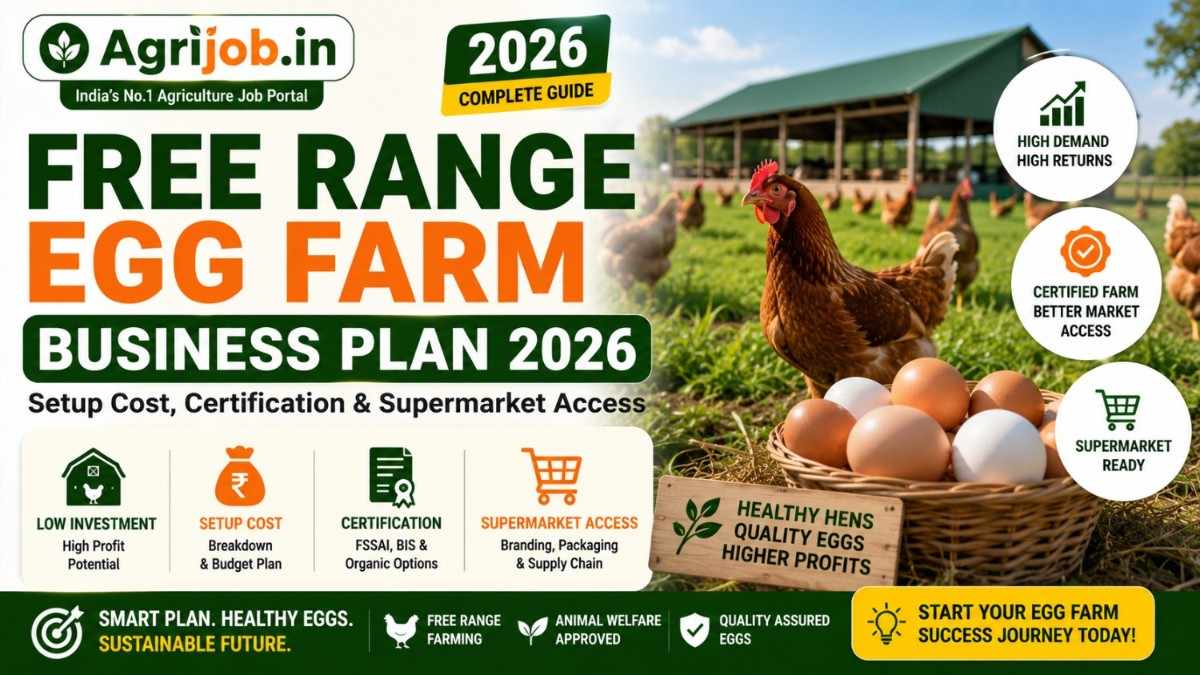
A free range egg farm business plan for 1,000 birds requires an initial investment of Rs.6 lakh to Rs.9 lakh, including land preparation, open-shed housing, fencing, and feed. Each hen produces 270–300 eggs per year, which sell at Rs.12–Rs.26 per egg in premium retail — delivering a net profit of Rs.4 lakh to Rs.7 lakh per year from a 1,000-bird farm after FSSAI licensing and supermarket onboarding.
- Initial Investment (1,000 birds): Rs.6 lakh – Rs.9 lakh
- Land Required: Minimum 1 acre (4 sq ft outdoor run per bird + housing)
- Eggs Per Hen Per Year: 270–300 eggs
- Retail Price (Premium Channel): Rs.12–Rs.26 per egg
- Wholesale Price (Standard Layer): Rs.5–Rs.6 per egg
- Primary Certification: FSSAI Food Business Operator License + NPOP (for organic label)
- NABARD Subsidy Available: 25% (General) / 33%–50% (SC/ST/Women) via NLM-PVCF
- Break-Even Period: 18–24 months at medium scale
- Best Breeds: Vanaraja, Gramapriya, Kadaknath, ISA Brown
- Supermarket Onboarding (BigBasket): GST + FSSAI + product samples + Category Manager approval
- What Is Free Range Egg Farming in India?
- Who Should Start a Free Range Egg Farm?
- Free Range Egg Farm Profit and Income Breakdown 2026
- Setup Cost and Infrastructure Requirements
- How to Start a Free Range Egg Farm – 9 Steps
- Free Range vs Cage Farming – Full Comparison
- Pros and Cons of Free Range Egg Farming
- Certification Guide – FSSAI, NPOP and Jaivik Bharat
- Important Dates and Application Timelines
- Important Links
- Conclusion
- Key Takeaways
- Frequently Asked Questions
What Is Free Range Egg Farming in India and Why It Commands a Premium in 2026?
Free range egg farming is a poultry system where hens are given continuous daytime access to outdoor grazing areas, allowing natural behaviours like foraging, dust-bathing, and socialising. Unlike battery cage or deep-litter systems where birds are confined indoors, free range hens move freely between an indoor shelter and a fenced outdoor run for several hours each day. The minimum space standard recognised by premium buyers in India is 4 square feet of outdoor access per bird, with indoor housing providing at least 1 square foot per bird.
India’s organic and free range egg market is growing rapidly. Free range and organic eggs now command 3x to 5x the wholesale price of standard cage eggs, driven by urban health awareness and increasing availability through platforms like BigBasket, Nature’s Basket, and Reliance Smart. Products such as Farm Made Free Range Eggs currently retail at ₹283–₹309 for 12 eggs on BigBasket — compared to standard eggs at ₹80–₹90 per dozen. That price gap is the commercial opportunity this business plan targets.

India ranks second globally in egg production, producing over 138 billion eggs annually, according to the Department of Animal Husbandry and Dairying (DAHD). However, premium free range and certified organic eggs account for less than 2% of that total — a massive undersupply gap relative to urban demand. Egg consumption grows at 8–10% annually, and per-capita consumption of 79 eggs per year is still far below the recommended 180 eggs per year, signalling strong long-term demand.
Who Should Start a Free Range Egg Farm in India?
- 🌾 Existing layer farmers with 1–3 acres of agricultural land who want to move up from wholesale commodity egg prices to premium retail pricing.
- 🏡 Rural and semi-rural landowners with unutilised agricultural land within 100 km of a metro or Tier-1 city — proximity to premium supermarket supply chains is a key advantage.
- 👩💼 Women entrepreneurs and SHG members who can access 33%–50% NABARD subsidy under the National Livestock Mission for SC/ST/Women categories.
- 🎓 Agriculture graduates and veterinary science students looking to start an agri-enterprise with a 3–5 year ROI horizon and daily cash flow from egg sales.
- 💼 Agri-investors and FPO members wanting to build a branded egg label that supplies premium retail without commodity price volatility.
- 🌿 Organic farming converts already holding NPOP certification for crop inputs who want to add a livestock income stream using certified organic feed.
- 👨🌾 Small and marginal farmers with 1–2 acres who want a diversified income stream alongside seasonal crops, since free range hens also improve soil fertility through manure and insect management.
- 🏙️ Peri-urban entrepreneurs within 50 km of a city with access to cold-chain logistics, who can build direct-to-consumer and B2B supply relationships with restaurants and health food brands.
Free Range Egg Farm Profit and Income Breakdown 2026
The income advantage of free range egg farming over conventional layer farming comes entirely from the price premium. A standard layer egg fetches ₹5–₹6 at wholesale; a branded free range egg in a premium supermarket fetches ₹12–₹26 per unit. Even selling at the conservative end of ₹12 per egg — a price achievable with basic FSSAI certification and BigBasket onboarding — changes the economics dramatically.
| Scale | Birds | Eggs/Month | Revenue @ Rs.12/egg | Operating Cost/Month | Net Profit/Month |
|---|---|---|---|---|---|
| Small (Starter) | 500 | 12,500 | Rs.1,50,000 | Rs.80,000 | Rs.70,000 |
| Medium | 1,000 | 25,000 | Rs.3,00,000 | Rs.1,50,000 | Rs.1,50,000 |
| Large | 3,000 | 75,000 | Rs.9,00,000 | Rs.4,20,000 | Rs.4,80,000 |
| Premium Branded (NPOP) | 1,000 | 25,000 | Rs.5,50,000* | Rs.2,00,000 | Rs.3,50,000 |
Secondary income streams add significantly to free range farm profitability. Poultry manure at ₹3–₹5 per kg can generate ₹15,000–₹25,000 per month from a 1,000-bird farm. Spent hens sold after 72–78 weeks of production fetch ₹150–₹200 per bird in meat markets, especially at festive season. Branded packaging — cartons of 6 or 12 with your farm name, FSSAI number, and “Free Range” label — commands a 20–30% premium even at local organic stores versus unbranded eggs.
Free Range Egg Farm Setup Cost and Infrastructure Requirements
Setting up a free range egg farm costs more than a conventional layer operation because outdoor fencing, predator-proofing, and open housing add to the baseline shed cost. However, the infrastructure is simpler than battery cage systems — no expensive multi-tier cage racks, no automated belt conveyors. Below is a realistic cost breakdown for a 1,000-bird starter farm in India as of 2026.
| Cost Head | Small (500 Birds) | Medium (1,000 Birds) | Large (3,000 Birds) |
|---|---|---|---|
| Land Preparation / Lease (per year) | Rs.20,000 | Rs.35,000 | Rs.80,000 |
| Open Shed Construction | Rs.1,20,000 | Rs.2,00,000 | Rs.5,50,000 |
| Outdoor Fencing & Predator Net | Rs.40,000 | Rs.70,000 | Rs.1,80,000 |
| Feeders, Drinkers, Brooders | Rs.25,000 | Rs.40,000 | Rs.1,10,000 |
| Day-Old Chicks / Pullets | Rs.30,000 | Rs.55,000 | Rs.1,50,000 |
| Feed (First 18 Weeks to Lay) | Rs.60,000 | Rs.1,10,000 | Rs.3,00,000 |
| Vaccination & Medicines | Rs.12,000 | Rs.20,000 | Rs.55,000 |
| FSSAI License + NPOP Cert (Year 1) | Rs.35,000 | Rs.50,000 | Rs.75,000 |
| Packaging, Branding, Cartons | Rs.15,000 | Rs.25,000 | Rs.65,000 |
| Miscellaneous / Working Capital | Rs.30,000 | Rs.50,000 | Rs.1,40,000 |
| Total Estimated Investment | Rs.3.87 Lakh | Rs.6.55 Lakh | Rs.17.05 Lakh |
The biggest cost difference between free range and cage systems is fencing. For 1,000 birds, you need a minimum 4,000 sq ft of fenced outdoor run (4 sq ft per bird), plus predator netting overhead to prevent losses from hawks and dogs. At ₹80–₹120 per running metre for quality galvanised wire mesh, a perimeter fence for a 1,000-bird run costs ₹40,000–₹70,000. This is a one-time capital investment that typically lasts 8–10 years.
Divide your outdoor run into 3 sections with portable electric fencing. Rotate hens across sections weekly. The resting sections regenerate grass and insect populations, which supply 10–15% of the birds’ nutrition naturally. This reduces feed cost by Rs.8,000–Rs.15,000 per month on a 1,000-bird farm — and dramatically improves yolk colour and egg nutrition that supermarket buyers test for.
How to Start a Free Range Egg Farm – 9-Step Process
- Select land with road access and water supply — Minimum 1 acre, at least 500 metres from residential areas. Proximity to a metro or Tier-1 city (within 100 km) is essential for premium supermarket logistics. Leasing rural agricultural land at ₹15,000–₹40,000 per acre per year is the capital-efficient first move.
- Register your business — Sole proprietorship, partnership, or Pvt Ltd. Obtain PAN, GSTIN, and Udyam registration (MSME). Udyam registration is mandatory to access NABARD’s Poultry Venture Capital Fund subsidy and priority sector bank loans.
- Obtain FSSAI Food Business Operator (FBO) License — Mandatory under the Food Safety and Standards Act, 2006 for any egg farm supplying retail chains or food processors. Apply online at foscos.fssai.gov.in. A State FSSAI License (turnover Rs.12 lakh–Rs.20 crore) costs Rs.2,000–Rs.5,000 per year.
- Apply for NPOP or PGS-India organic certification — Required for the “Organic” label and “Jaivik Bharat” logo. NPOP (for market and export) costs Rs.25,000–Rs.75,000 per year via an APEDA-accredited Certification Body (CB). PGS-India is free for small farmer groups of 5+ members. Timeline: 12–18 months including transition inspection. Contact APEDA at apeda.gov.in.
- Construct open housing and fenced outdoor runs — Build a simple ventilated shed with sloped roof, 1 sq ft of floor space per bird indoors, and 4 sq ft of fenced outdoor run per bird. Predator netting overhead is non-negotiable in rural and peri-urban areas. Equip with manual or automatic feeders, nipple drinkers, nesting boxes (1 per 4 hens), and brooder for chicks.
- Source certified chicks from registered hatcheries — Buy Vanaraja, Gramapriya, or ISA Brown pullets from state government-certified hatcheries or ICAR-registered suppliers. These dual-purpose and hardy breeds are bred for free range conditions and produce 250–280 eggs per year under outdoor management. Chicks cost Rs.50–Rs.80 per bird at day-old stage.
- Establish a vaccination and biosecurity protocol — Create a vaccination calendar with your District Veterinary Officer from Day 1. Mandatory vaccinations include Marek’s Disease, Newcastle Disease (Ranikhet), Infectious Bronchitis, and Fowl Pox. Maintain a footbath at the farm entry, separate visitor protocols, and weekly health records. One disease outbreak can wipe out 3 months of income.
- Set up branded packaging and cold-chain logistics — Free range eggs must be collected twice daily, graded by size (Small/Medium/Large/Jumbo), cleaned with dry methods (avoid washing — removes natural cuticle), and packed in branded cartons of 6 or 12. Apply your FSSAI number, “Free Range” claim, farm address, and best-before date. Source refrigerated transport or insulated delivery boxes for metro distribution.
- Onboard onto premium retail channels — Register as a supplier at partner.bigbasket.com with GSTIN, FSSAI, and product samples. Contact the category manager at Reliance Retail via supplierregistration.ril.com. For DMart, visit their vendor office in Thane (Maharashtra) or submit via their email portal. Simultaneously, approach local premium restaurants, organic stores, and cloud kitchens for direct B2B supply at Rs.15–₹20 per egg.
Free Range vs Cage vs Deep Litter Egg Farming – Full Comparison
| Parameter | Free Range System | Battery Cage System | Deep Litter System |
|---|---|---|---|
| Setup Cost (1,000 Birds) | Rs.6–9 Lakh | Rs.7–12 Lakh | Rs.4–7 Lakh |
| Space Required | 1+ acre | 1,500–2,000 sq ft shed | 2,000–3,000 sq ft shed |
| Eggs Per Hen/Year | 260–290 | 300–310 | 250–280 |
| Retail Price Achievable | Rs.12–Rs.26/egg | Rs.5–Rs.7/egg | Rs.6–Rs.9/egg |
| Feed Cost | Lower (10–15% natural forage) | Highest (100% commercial feed) | High (minimal forage) |
| Bird Welfare | Highest — outdoor access | Lowest — confined cages | Moderate — indoor floor space |
| Supermarket Acceptance | Premium shelf placement | Not accepted by premium chains | Accepted at standard price |
| Certification Ease | NPOP/PGS eligible | Not eligible for organic cert | Not eligible for organic cert |
| Disease Risk | Moderate (exposure to wildlife) | Low (controlled environment) | Moderate (litter management) |
| Labour Intensity | Moderate | Low (automation possible) | Moderate |
| Best For | Premium brand building | High-volume commodity supply | Small-scale rural farmers |
For farmers within 100 km of a metro who can access BigBasket, Nature’s Basket, or Reliance Smart’s fresh section, free range is the clear winner in 2026. The 4x price premium more than compensates for the slightly lower egg count per bird and higher outdoor infrastructure cost. For farmers in remote locations with no premium retail access, deep litter remains cost-effective for standard wholesale markets. Battery cage farming is increasingly difficult to position in premium retail as urban consumers and major supermarket chains move away from confined-cage sourcing.
Pros and Cons of Free Range Egg Farming in India
Advantages of Free Range Egg Farming
- ✅ 4x–5x higher selling price compared to commodity cage eggs — free range eggs retail at Rs.12–Rs.26 versus Rs.5–Rs.6 for standard wholesale.
- ✅ Access to premium supermarket channels — BigBasket, Nature’s Basket, Reliance Smart, and D-Mart premium sections actively source certified free range suppliers.
- ✅ NPOP and organic certification eligibility — opens export markets and the “Jaivik Bharat” organic labelling program managed by FSSAI and APEDA.
- ✅ Lower long-term feed cost — hens foraging outdoors derive 10–15% of nutrition from insects, grass, and worms, reducing feed bills by Rs.8,000–₹15,000/month at 1,000-bird scale.
- ✅ Additional manure revenue — free range manure is rich in nitrogen and commands Rs.5–Rs.8/kg as organic fertiliser, versus Rs.3–Rs.4 for cage manure.
- ✅ Government subsidy access — eligible for NLM-PVCF subsidy of 25–50% through NABARD-linked banks, reducing effective capital outlay by Rs.1.5–Rs.4.5 lakh.
Disadvantages and Challenges
- ⚠️ Higher outdoor infrastructure cost — fencing, predator netting, and open shed construction add Rs.1–Rs.2.5 lakh over a comparable deep litter setup.
- ⚠️ Slightly lower egg volume — free range hens produce 260–290 eggs per year versus 300–310 for battery cage hens, reflecting the energy spent on outdoor activity.
- ⚠️ Predator losses — dogs, jackals, hawks, and monitor lizards prey on hens in outdoor runs. Without proper fencing and overhead netting, mortality can run 8–12% versus 3–5% in caged systems.
- ⚠️ Certification timeline — NPOP organic certification requires 12–18 months of documented transition period before the organic label can be used, delaying the highest-price-tier income.
- ⚠️ Cold-chain logistics dependency — premium retail requires consistent cold storage and refrigerated transport, adding Rs.5,000–Rs.15,000/month in logistics cost depending on distance.
Certification Guide – FSSAI, NPOP and Jaivik Bharat for Free Range Eggs
Certification is what separates a backyard egg seller from a supermarket supplier. Without an FSSAI license, you cannot legally sell eggs to BigBasket, Reliance, or D-Mart. Without NPOP or PGS-India certification, you cannot print “Organic” or use the “Jaivik Bharat” logo on your packaging. Here is the exact certification roadmap for 2026.
FSSAI Food Business Operator (FBO) License — Mandatory for All Egg Farms
The Food Safety and Standards Authority of India (FSSAI) regulates all food businesses under the Food Safety and Standards Act, 2006. Any farm selling eggs commercially must register or obtain a license based on annual turnover. Registration (annual turnover under Rs.12 lakh) costs Rs.100/year. A State FSSAI License (Rs.12 lakh–Rs.20 crore turnover) costs Rs.2,000–Rs.5,000/year. Apply at foscos.fssai.gov.in with farm address, business PAN, and product category details. Processing time: 30–60 days.
NPOP Certification — For “Organic” Label and Jaivik Bharat Logo
The National Programme for Organic Production (NPOP), governed by APEDA under the Ministry of Commerce, is India’s official third-party organic certification accepted for both domestic retail and export. The Food Safety and Standards (Organic Foods) Regulations, 2017, notified by FSSAI, recognises NPOP certification as the basis for the “Jaivik Bharat” organic logo. NPOP certification for a poultry operation costs Rs.25,000–Rs.75,000 per year through an APEDA-accredited Certification Body such as ECOCERT or OneCert.
| Certification | Issuing Body | Cost/Year | Valid For | Label Allowed | Timeline |
|---|---|---|---|---|---|
| FSSAI Registration | FSSAI (foscos.fssai.gov.in) | Rs.100 | Domestic retail, export prep | “FSSAI Reg. No.” | 30–60 days |
| FSSAI State License | FSSAI | Rs.2,000–Rs.5,000 | Domestic retail chains | FSSAI License No. | 30–60 days |
| NPOP (Third-Party) | APEDA / Accredited CB | Rs.25,000–Rs.75,000 | Domestic + Export | “India Organic” + Jaivik Bharat | 12–18 months |
| PGS-India (Community) | Ministry of Agriculture | Free (group-based) | Domestic farmers’ markets only | “PGS-India Organic” | 6–12 months |
Other Mandatory Licenses for Free Range Egg Farms
- GSTIN: Mandatory if annual turnover exceeds Rs.20 lakh. Apply at gst.gov.in.
- State Pollution Control Board NOC: Required for farms above 500 birds in most states. Contact your district SPCB office.
- Panchayat / Municipality NOC: Needed for farm construction on agricultural land converted for commercial use.
- Udyam Registration (MSME): Optional but required for NABARD subsidy access and priority sector loans. Register at udyamregistration.gov.in.
- GS1 Barcode (for Retail): Supermarket onboarding requires a valid GS1 barcode on all product packaging. Register at gs1india.org at Rs.5,000–Rs.10,000/year.
Important Dates and Application Timelines for 2026
| Activity | Timeline / Deadline |
|---|---|
| FSSAI FBO License Application | Open year-round — apply 60 days before first sale |
| NPOP Transition Period Start | Immediately — 2–3 years before first certified harvest |
| NLM-PVCF Subsidy Application (via bank) | Open year-round via NABARD-linked banks and RRBs |
| Udyam (MSME) Registration | Open year-round — apply before bank loan submission |
| BigBasket Supplier Onboarding | Apply at partner.bigbasket.com — 30–90 days category review |
| Reliance Retail Vendor Registration | Apply at supplierregistration.ril.com — 45–90 days review |
| NABARD PVCF Subsidy Disbursement | Back-ended — released after first repayment milestone |
| GST Registration | Apply 2–4 weeks before first interstate sale |
Important Links – Free Range Egg Farm Business Plan
| Resource | Link |
|---|---|
| FSSAI FBO License Application (FoSCoS) | foscos.fssai.gov.in |
| APEDA – NPOP Organic Certification | apeda.gov.in |
| Jaivik Bharat Organic Portal (FSSAI) | jaivikbharat.fssai.gov.in |
| NABARD – National Livestock Mission PVCF | nabard.org |
| NLM Subsidy Online Application | nlm.udyamimitra.in |
| BigBasket Supplier / Vendor Portal | partner.bigbasket.com |
| Reliance Retail Supplier Registration | supplierregistration.ril.com |
| Udyam MSME Registration | udyamregistration.gov.in |
| DAHD – Animal Husbandry Statistics | dahd.nic.in |
| Organic Farming Export Guide – Agrijob.in | agrijob.in – Organic Farming Export India 2026 |
Conclusion
A free range egg farm business plan is one of the most viable agri-enterprise opportunities available to Indian farmers and rural entrepreneurs in 2026. The combination of a 4x price premium over commodity eggs, growing urban demand for certified free range products, accessible NABARD subsidies, and straightforward FSSAI and NPOP certification pathways makes this a business with a clear, proven income model. Starting with 1,000 birds, obtaining your FSSAI license in Year 1, beginning your NPOP transition simultaneously, and onboarding onto BigBasket or Reliance Smart within 90 days of your first harvest — that is the 24-month roadmap to a self-sustaining premium egg brand earning Rs.1.5 lakh or more per month in net profit. Apply for your Udyam registration and NABARD bank loan today, and bookmark this page for updated certification and retail onboarding guidance.
- Free range eggs sell at Rs.12–Rs.26 per egg in premium retail, vs Rs.5–Rs.6 per egg at commodity wholesale — a 4x–5x price advantage.
- A 1,000-bird free range farm requires Rs.6–Rs.9 lakh investment; after NABARD’s 25–33% subsidy, effective outlay drops to Rs.4–Rs.6 lakh.
- FSSAI FBO license is mandatory for all commercial egg sales; apply at foscos.fssai.gov.in at least 60 days before your first supply date.
- NPOP organic certification (Rs.25,000–Rs.75,000/year via APEDA-accredited CB) unlocks the “Jaivik Bharat” logo and commands a further 50–80% price premium over basic free range.
- BigBasket onboarding requires GSTIN, FSSAI, GS1 barcode, product samples, and Category Manager approval — budget 30–90 days for the process.
- Begin NPOP transition immediately on farm setup — the 2–3 year chemical-free conversion period is the critical path to premium organic pricing.
Frequently Asked Questions About Free Range Egg Farm Business Plan 2026
What is a free range egg farm and how is it different from a cage farm?
A free range egg farm allows hens daytime access to outdoor areas where they can forage, walk, and exhibit natural behaviour. The minimum space standard is 4 square feet of outdoor run per bird. Battery cage farms confine hens in individual metal cages with no outdoor access. Free range eggs command 3x–5x the price of cage eggs in premium supermarkets due to better nutrition, animal welfare standards, and consumer preference — and major chains like BigBasket and Nature’s Basket explicitly source free range over cage eggs for their premium category.
How much does it cost to set up a free range egg farm for 1,000 birds in India?
The total setup cost for a 1,000-bird free range farm in India in 2026 is approximately Rs.6.5 lakh to Rs.9 lakh. This includes open shed construction (Rs.2–Rs.2.5 lakh), outdoor fencing and predator netting (Rs.70,000–Rs.1 lakh), chicks and pre-lay feed (Rs.1.65 lakh), equipment (Rs.40,000), FSSAI and NPOP certification year-1 fees (Rs.50,000), branded packaging (Rs.25,000), and working capital buffer (Rs.50,000). After a 25% NABARD subsidy, the effective outlay reduces to approximately Rs.4.5–Rs.6 lakh.
What certifications are required to sell free range eggs to supermarkets in India?
At minimum, you need an FSSAI Food Business Operator (FBO) License from foscos.fssai.gov.in and a GSTIN. Supermarkets like BigBasket also require a GS1 barcode on all packaging. To use the word “Organic” or the “Jaivik Bharat” logo on packaging, you need NPOP certification from an APEDA-accredited Certification Body or PGS-India certification from the Ministry of Agriculture. NPOP is required for premium retail acceptance; PGS-India is only valid for farmers’ markets and direct-to-consumer channels.
How much profit can I earn from a 1,000-bird free range egg farm per month?
A well-managed 1,000-bird free range farm produces approximately 25,000 eggs per month (at 280 eggs per bird per year). Selling at Rs.12 per egg via BigBasket or local premium retail generates Rs.3 lakh per month in gross revenue. After feed (Rs.1–Rs.1.2 lakh), labour (Rs.15,000–₹20,000), veterinary costs (Rs.8,000), packaging and logistics (Rs.15,000–₹20,000), and miscellaneous costs, net profit ranges from Rs.1.2 lakh to Rs.1.5 lakh per month. With NPOP organic certification and selling at Rs.22/egg, net profit can reach Rs.3–Rs.3.5 lakh per month.
Which breeds are best for free range egg farming in India?
The best breeds for Indian free range conditions are Vanaraja, Gramapriya, and Srinidhi — dual-purpose breeds developed by ICAR’s Directorate of Poultry Research (DPR) specifically for backyard and free range systems. They are heat-tolerant, disease-resistant, and efficient foragers that produce 200–250 eggs per year under free range management. ISA Brown and Lohmann Brown are the best commercial hybrids for higher egg counts (270–290/year) in semi-intensive free range setups with supplemental commercial feed.
How do I register as a supplier for BigBasket to sell free range eggs?
Visit partner.bigbasket.com and submit your supplier registration application. Required documents include GSTIN, FSSAI License/Registration, PAN card, cancelled cheque, GS1 barcode registration for your SKUs, product catalogue with high-quality photos, shelf life data, and a price matrix. After document verification, BigBasket’s fresh produce or dairy and eggs category manager reviews your samples. Onboarding typically takes 30–90 days. BigBasket charges a category-based commission of 8–22% on the MRP. BBDaily’s subscription model for eggs provides especially predictable, recurring daily demand once your SKU is listed.
Is NABARD subsidy available for free range egg farming?
Yes. Free range and layer farms are eligible for capital subsidy under the National Livestock Mission (NLM) Poultry Venture Capital Fund (PVCF), channelled through NABARD-linked banks. The subsidy is 25% of project cost for General category applicants and 33.33% for SC/ST applicants, hilly regions, and North-East states. The NLM also provides a 50% capital subsidy (up to Rs.25 lakh) for backyard and rural poultry farms under its EDEG component. Apply via your nearest SBI, Canara Bank, or Regional Rural Bank (RRB) with a project report, land documents, Aadhaar, and Udyam certificate. You can also apply online at nlm.udyamimitra.in.
How long does NPOP organic certification take for an egg farm?
NPOP organic certification for a poultry operation takes 12–18 months from application to first certificate, but requires a 2–3 year chemical-free transition period on the land before the “India Organic” label can be used on products. During this transition period you can begin farming and building your FSSAI-certified free range brand, selling as “free range” (not organic) while completing the transition. Apply to an APEDA-accredited Certification Body (CB) such as ECOCERT, OneCert, or LACON India at the start of your farm setup to begin the clock. Annual certification renewal costs Rs.25,000–Rs.75,000 depending on farm size and CB chosen.
What is the break-even period for a free range egg farm in India?
The break-even period for a 1,000-bird free range egg farm in India is typically 18–24 months from first egg collection, assuming consistent sales at Rs.12–Rs.15 per egg. The primary delay is the 18–20 week pre-lay period where feed and infrastructure costs accumulate before any revenue. Farms that lock in B2B contracts with restaurants or health food stores before launch, and achieve BigBasket listing within 3 months of first harvest, break even closer to 18 months. Organic-certified farms with NPOP take longer to fully recoup because of the certification cost and transition period but command much higher margins post-certification, making the long-term ROI superior.
This guide is reviewed and updated regularly based on official government notifications from FSSAI, APEDA, NABARD, and DAHD. Bookmark this page for the latest free range egg farm business plan data, certification fee updates, and supermarket onboarding requirements.
This article is for informational and educational purposes only. Investment costs, government subsidy amounts, certification fees, and retail onboarding requirements are subject to change. Verify all figures with NABARD-linked banks, your State Animal Husbandry Department, FSSAI, and APEDA before making financial commitments. Agrijob.in does not provide financial or legal advice. Readers are advised to consult a qualified business advisor and veterinary expert before starting a poultry enterprise.