
Pashu Bima Yojana 2026
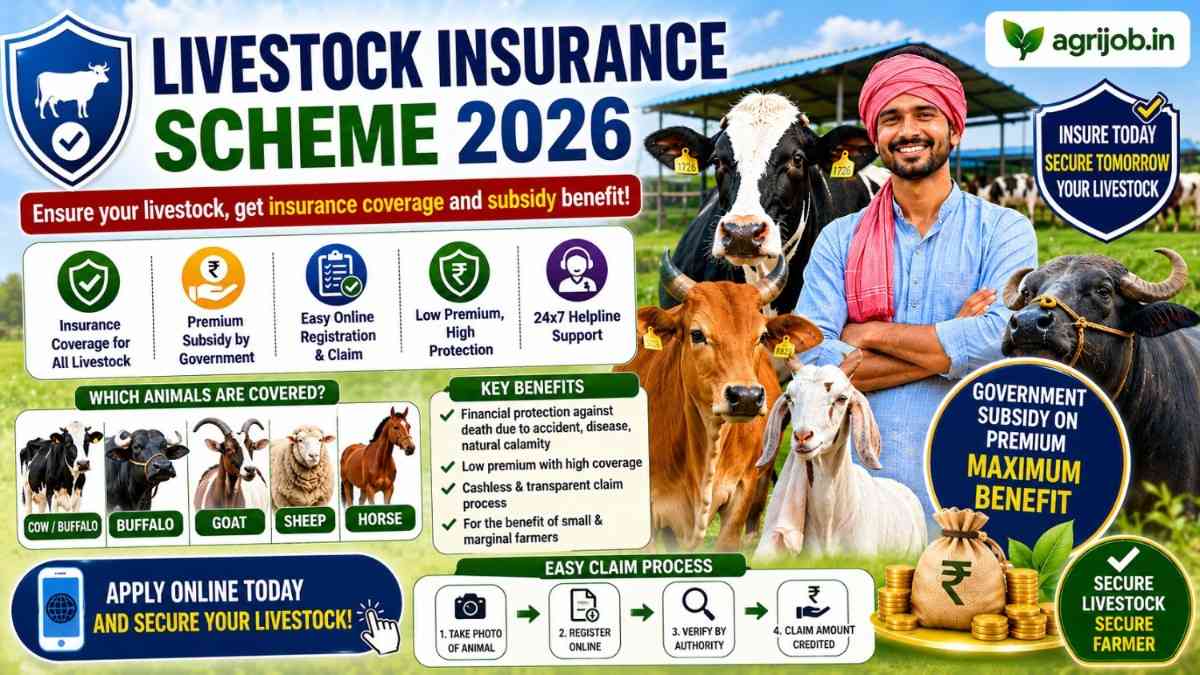
Pashu Bima Yojana 2026 gives dairy farmers and livestock owners across India financial protection against the sudden death of their cattle, buffalo, goat, or sheep through a government-subsidised insurance cover. Designed for small and marginal farmers, the scheme covers up to 90% of the animal’s market value while the government pays a major share of the premium, ranging from 35% for general category to 50-80% for BPL, SC and ST farmers. This guide covers everything you need to know: premium structure, subsidy percentage, eligibility, required documents, ear tag rules, the full online application process, the step-by-step claim procedure, empanelled insurance companies, and a state-by-state comparison of livestock insurance schemes running in 2026.

📋 Table of Contents
- What is Pashu Bima Yojana 2026?
- Key Facts at a Glance
- Premium Structure & Subsidy Breakdown (Money)
- Eligibility Criteria & Categories (Eligibility)
- Documents Required for Pashu Bima Yojana
- How to Apply Online – Step by Step (Process)
- Ear Tag Rules & Animal Identification
- Pashu Bima Claim Process After Animal Death
- Insurance Companies Offering Pashu Bima Yojana
- Who Should Apply for Pashu Bima Yojana?
- State-wise Pashudhan Bima Comparison 2026
- Central vs State Livestock Insurance: Which is Better?
- High-Value Cattle Insurance Terms You Must Know
- Frequently Asked Questions
What is Pashu Bima Yojana 2026?
Pashu Bima Yojana, also called Pashudhan Bima Yojana or cattle/livestock insurance scheme, is an umbrella term for insurance cover provided to milch and draught animals against death from accident, disease, surgical operation, or natural calamity. At the central level, it operates as the Livestock Insurance component under the National Livestock Mission (NLM), run by the Department of Animal Husbandry & Dairying (DAHD), Government of India. The central government provides subsidy up to 50% up to Rs. 30 lakh towards capital cost, which includes housing, breeding animals, transportation and insurance cost. Separately, several states run their own pashu bima schemes that top up or replace the central scheme entirely.

For example, Bihar’s Pashu Bima Yojana, run by the Directorate of Dairy Development, insures each milch cattle for up to Rs.60,000, with the state government providing a 75% subsidy on the premium. Meanwhile, Rajasthan’s Mukhyamantri Mangla Pashu Bima Yojana goes a step further — farmers do not have to pay any premium at all, with full compensation provided if the animal dies due to illness or natural disaster. This guide breaks down both the central framework and the major state variations so you know exactly what applies in your state in 2026.
Key Facts at a Glance — Pashu Bima Yojana 2026
🐄 Key Facts at a Glance
- 🏛️ Implementing Body: Dept. of Animal Husbandry & Dairying (Central) + State Animal Husbandry/Dairy Departments
- 💰 Premium Rate: 3.5% – 4% of insured market value per year
- 🎯 Subsidy: 35-50% (General/APL) | 50-80% (BPL/SC/ST)
- 📦 Maximum Cover: Up to 100% of animal’s market value (up to Rs.60,000+ for milch cattle in several states)
- ⏳ Policy Duration: 1 year (renewable); 3-year long-term policies also available
- 🎓 Eligibility: Cow, buffalo, goat, sheep, camel owners — individuals, dairy cooperative members, SHGs
- 🏷️ Mandatory: Ear tag (12-digit/RFID) — “No Tag, No Claim” rule applies
- 📲 Application Mode: Online via state dairy/animal husbandry portal, NLM portal, or designated insurer app
Premium Structure & Subsidy Breakdown (Money)
The single biggest question every farmer asks is pashu bima premium kitna hai — how much premium will I actually pay. The basic premium rate under a standard cattle insurance policy is 4% of the sum insured per annum, with concessional rates available for animals covered under government-subsidised schemes. Under most state-run pashu bima yojana programmes, this works out to roughly 3.5% of the insured market value. So, if your milch cow or buffalo is valued at Rs.60,000, the gross annual premium is approximately Rs.2,100.
| Animal Value (Sum Insured) | Premium @ 3.5% | Govt Subsidy (General – 50%) | Farmer Pays | Annual Cover Benefit |
|---|---|---|---|---|
| Rs.30,000 | Rs.1,050 | Rs.525 | Rs.525 | Up to Rs.30,000 on death |
| Rs.40,000 | Rs.1,400 | Rs.700 | Rs.700 | Up to Rs.40,000 on death |
| Rs.60,000 | Rs.2,100 | Rs.1,050 – Rs.1,575 | Rs.525 – Rs.1,050 | Up to Rs.60,000 on death |
| Rs.75,000 | Rs.2,625 | Rs.1,312 – Rs.1,968 | Rs.656 – Rs.1,312 | Up to Rs.75,000 on death |
| Rs.1,00,000 | Rs.3,500 | Rs.1,750 – Rs.2,800 | Rs.700 – Rs.1,750 | Up to Rs.1,00,000 on death |
Subsidy slabs vary by state and category. Under the National Livestock Mission, the pattern of assistance for livestock insurance is 35% central share + 25% state share + 40% beneficiary share for APL category, while BPL/SC/ST beneficiaries get 50% central share + 30% state share, leaving only 20% as the beneficiary’s contribution. In simple terms — a general category farmer typically pays around 40-65% of the premium out of pocket, while a BPL, SC, or ST farmer pays as little as 20%, and in several state-run schemes, nothing at all.
It’s worth noting that on a national level, livestock insurance penetration remains very low. Less than 1% of cattle in the country are currently insured, and the average premium charged has historically run around 4.5% of the insured sum. This is exactly why the government keeps revising subsidy structures upward — to push more farmers toward formal insurance instead of bearing 100% of the loss themselves when an animal dies.
✅ Pro Tip
Always get the animal’s market value assessed by a government veterinary doctor before applying — insurers pay claims based on this certified valuation, not on what you believe the animal is worth. Keep a copy of the valuation certificate safely; you will need it again at claim time.
Eligibility Criteria & Categories (Eligibility)
Eligibility for pashu bima yojana is fairly broad and inclusive of most livestock-owning households. The animal must be healthy, free of any visible disease or injury, and certified fit by a veterinary doctor at the time of enrolment.
- 🐮 Must be an Indian citizen and a livestock owner (cow, buffalo, goat, sheep, camel)
- 📋 Animal age generally between 1 and 10 years (varies slightly by insurer and species)
- 🩺 Animal must be certified healthy and disease-free by a registered veterinary surgeon
- 🏷️ Animal must be tagged with an approved ear tag (RFID/12-digit) at the time of policy issuance
- 🏦 Applicant must have a bank account linked to Aadhaar for subsidy/claim disbursal
- 👩🌾 Members of dairy cooperatives, milk producer societies, and SHGs get priority in several states
- 🎓 SC/ST, BPL, and women-headed households are eligible for the highest subsidy slab
| Category | Premium Subsidy Share | Farmer’s Contribution | Priority/Reservation |
|---|---|---|---|
| General / APL | 35-50% | 50-65% | Open category |
| OBC | 40-50% | 50-60% | As per state norms |
| BPL | 50-80% | 20-50% | Priority enrolment |
| SC / ST | 50-100% | 0-50% | 16% SC + 12% ST reservation (Rajasthan model) |
| Women-headed household | Same as category + state top-up | Varies | Priority in Lakhpati Didi/Gopal Card holders |
| PwBD (Divyang) | Same as category + state top-up | Varies | Priority enrolment in most states |
Documents Required for Pashu Bima Yojana
Keep these documents ready before starting your pashu bima yojana application to avoid rejection or delay:
- 🪪 Aadhaar Card of the applicant
- 🏦 Bank passbook / cancelled cheque (for subsidy and claim transfer)
- 🏠 Address proof / residence certificate
- 📸 Recent photograph of the animal showing the ear tag clearly
- 🩺 Veterinary health certificate confirming the animal is disease-free
- 📜 Caste certificate (for SC/ST/OBC category subsidy benefit)
- 💵 BPL card / income certificate (if applying under BPL category)
- 👥 Dairy cooperative membership ID, if applicable
How to Apply Online for Pashu Bima Yojana – Step by Step (Process)
The exact pashu bima online apply portal differs by state, but the broad workflow is consistent across India. Applications under Bihar’s scheme can be submitted online through the MIS Dairy portal, implemented by District Dairy Development Officers. In Rajasthan, applicants use the dedicated Mangla Pashu Bima Yojana portal.
- Visit the official state portal — for example mmpby.rajasthan.gov.in (Rajasthan) or the state dairy development MIS portal in your state.
- Register/Login using your Aadhaar-linked mobile number; an OTP will be sent for verification.
- Fill the application form — personal details, livestock details, category, and bank account information are auto-fetched from your Aadhaar/Jan Aadhaar profile in several states.
- Upload required documents — photograph of the animal with ear tag, veterinary certificate, caste/BPL certificate where applicable.
- Veterinary verification — a government veterinary officer inspects the animal, certifies health status, and finalises market value.
- Ear tag application — the insurer or animal husbandry department applies a coded ear tag, which is recorded on your certificate of insurance.
- Premium payment — pay your share of the premium online (UPI/net banking) or at the designated counter; many state schemes deduct it directly from the subsidy.
- Download policy/certificate — once approved, download your Certificate of Insurance carrying the ear tag number, sum insured, and policy validity dates.
Ear Tag Rules & Animal Identification
Ear tagging is the single most important compliance step under any pashu bima yojana. Ear tags made of suitable material are applied to the ear of the animal, and the code number is entered into the Veterinary Health Certificate; photographs of the animal may also be required for high-value animals. This tag becomes the animal’s permanent identity for the entire policy period.
The rule that trips up the most farmers is the “No Tag, No Claim” condition. Claims received without the ear tag are not admissible, and the ear tag applied to the animal must be surrendered at the time of a death claim. If the tag is accidentally lost during the policy period, re-tagging must be done immediately at the insured’s own cost, and the re-tagging certificate must be sent to the company.
- 🏷️ Tag is applied only after veterinary health certification
- 🚫 Never remove or transfer the ear tag to another animal
- 📞 Report a lost tag to the insurer immediately and arrange re-tagging
- 📷 Keep a photo of the tagged ear safe on your phone for claim-time use
Pashu Bima Claim Process After Animal Death (Pashu Bima Claim Kaise Kare)
Knowing exactly how to claim before an emergency happens can save weeks of delay. Here is the step-by-step pashu bima claim kaise kare process followed by all major insurers:
- Immediate intimation — inform the insurer or bank about the death immediately through the toll-free customer care number, mobile app, or website. Most schemes require intimation within 24-48 hours.
- Do not dispose of the carcass — never dispose of the carcass without permission, as the insurer’s veterinary officer may need to inspect it.
- Get a death certificate — obtain a death certificate from a qualified veterinarian on the company’s prescribed form, along with a post-mortem report if required.
- Take photographs — capture several clear photographs showing the animal’s ID/ear tag along with the carcass.
- Surrender the ear tag — the physical ear tag must be removed and submitted with the claim; this is non-negotiable under the “No Tag, No Claim” rule.
- Submit the claim form — fill in the duly completed claim form along with the death/disability certificate and all supporting documents.
- Veterinary inspection & processing — the company’s veterinary officer inspects the case, and claim admissibility is generally considered around two months after the veterinary/company doctor’s report.
- Claim settlement — once approved, the sum insured (or current market value, whichever is lower) is credited directly to the registered bank account.
✅ Pro Tip
Save the insurer’s toll-free claim number and your policy/certificate number in your phone the same day you buy the policy. In livestock claims, the first 24-48 hours of documentation (photos, vet certificate) decide whether your claim is approved smoothly or gets delayed in queries.
Insurance Companies Offering Pashu Bima Yojana
Multiple public and private general insurers are empanelled for pashu bima yojana across different states, typically allotted through a state-level tender process.
| Insurance Company | Type | Typical Premium Rate | Notes |
|---|---|---|---|
| New India Assurance | Public Sector | ~4% of Sum Insured p.a. | Concessional rates for govt-subsidised scheme animals |
| United India Insurance (UIIC) | Public Sector | ~3.5-4% | Pan-India cattle & livestock cover |
| Oriental Insurance Co. Ltd | Public Sector | ~3.5-4% | State-tendered cattle insurance |
| National Insurance Co. | Public Sector | ~3.5-4% | Group & individual cattle policies |
| IFFCO-Tokio General Insurance | Private (JV) | Varies by breed/area | Sole insurer for the Pashu Dhan Bima Yojana product, available fully online. |
| HDFC ERGO | Private | Varies | Offers a fully paperless cattle tagging and claims module via integrated mobile app. |
Who Should Apply for Pashu Bima Yojana?
- 🐄 Dairy farmers owning 1-10 milch cows or buffaloes
- 👩🌾 Women-headed farming households seeking financial security against livestock loss
- 🎓 SC/ST and BPL livestock owners eligible for maximum subsidy or free cover
- 🤝 Members of milk producer cooperatives and dairy SHGs
- 🐐 Goat and sheep rearers in semi-arid and drought-prone districts
- 🐫 Camel owners in desert regions of Rajasthan and Gujarat
- 🌾 Marginal and small farmers for whom livestock is the primary income source
- 🏦 Farmers who have taken a Kisan Credit Card (KCC) loan against livestock and need risk cover
State-wise Pashudhan Bima Comparison 2026
Pashu bima yojana implementation varies significantly state to state. Here is how the major state schemes compare in 2026:
| State | Scheme Name | Premium Subsidy | Max Cover | Key Feature |
|---|---|---|---|---|
| Rajasthan | Mukhyamantri Mangla Pashu Bima Yojana | 100% (fully free, no premium) | Rs.40,000 (cow/buffalo); Rs.4,000 (goat) | Lottery/first-come-first-served; 16% SC + 12% ST reservation; RFID tag mandatory |
| Bihar | Pashu Bima Yojana | 75% state subsidy | Rs.60,000 per milch animal | Implemented via District Dairy Development Officers; MIS Dairy portal |
| All-India (Central) | Livestock Insurance Scheme (NLM) | 35-50% (APL) / 50% (BPL/SC/ST), central share | Up to market value | Operational across 100 districts nationwide |
| Assam | NLM Livestock Insurance | 35% CS+25% SS (APL); 50% CS+30% SS (BPL/SC/ST) | As per market value | Routed through State Livestock Development Board |
Central vs State Livestock Insurance: Which is Better?
Many farmers get confused between the central Livestock Insurance Scheme and their own state’s pashu bima programme. Here’s a direct comparison:
| Parameter | Central Livestock Insurance (NLM) | State Pashu Bima Schemes |
|---|---|---|
| Funding Pattern | 90:10 or 60:40 Central:State (varies by component) | State budget, sometimes 100% state-funded |
| Premium Subsidy | 35-50% depending on category | 50% to 100% (free in some states) |
| Coverage Area | 100 districts nationwide | Statewide (varies by budget allocation) |
| Animal Species | Cattle, buffalo, sheep, goat, pig, camel | Usually cow, buffalo, goat, sheep, camel |
| Selection Method | Application-based, year-round | Often lottery or first-come-first-served with annual windows |
| Best For | Consistent, nationwide access | Maximum subsidy/free cover where available |
🏆 Expert Verdict
If your state runs an active free or near-free pashu bima scheme (like Rajasthan’s Mangla Pashu Bima Yojana), apply there first during the open registration window. If no such state scheme is active or you’ve missed the window, the central Livestock Insurance Scheme under NLM remains available year-round and still delivers a meaningful 35-50% premium subsidy.
High-Value Cattle Insurance Terms You Must Know
- 💰 Sum Insured: The maximum amount payable on death of the animal, generally equal to its certified market value, up to Rs.1,00,000 for high-yield cattle.
- 📉 Premium Rate: The annual cost of insurance, fixed at 3.5-4% of sum insured under most government-linked schemes.
- 🏷️ Ear Tag / RFID Tag: The unique identification code permanently linking an animal to its insurance policy; mandatory for any claim.
- 🩺 Permanent Total Disability (PTD): Cover for milch cattle that become permanently unable to conceive or yield milk; indemnity for PTD is typically limited to 75% of the sum insured.
- 📜 Veterinary Health Certificate: Mandatory document certifying the animal’s age, health, identification marks, and market value at enrolment.
- 🏦 Kisan Credit Card (KCC) Linkage: Many dairy KCC loans require livestock insurance as a risk-mitigation condition for loan disbursal.
- 👥 Group Discount: Reduced per-animal premium rates offered when a dairy cooperative or SHG insures multiple animals together.
- 📑 No Tag, No Claim: The strict rule under which a death claim is rejected if the ear tag is missing or not surrendered.
- 🐄 Schemed vs Non-Schemed Animals: “Schemed” animals are those subsidised under the National/State Livestock Development Board, while “non-schemed” animals are privately owned and insured without subsidy.
- 📆 Long-Term Policy: Multi-year cattle insurance policies are available with long-term premium discounts compared to annual renewal.
Frequently Asked Questions on Pashu Bima Yojana 2026
What is Pashu Bima Yojana 2026?
Pashu Bima Yojana 2026 is a livestock insurance scheme that protects cattle, buffalo, goat and sheep owners against financial loss from animal death. It runs under the Centrally Sponsored Livestock Insurance component of the National Livestock Mission along with several state-level top-up schemes, offering up to 50-75% premium subsidy depending on the state and category.
What is the premium under pashu bima yojana 2026?
The standard premium is calculated at 3.5% to 4% of the insured market value of the animal per year. On a milch animal insured for Rs.60,000, the gross premium works out to around Rs.2,100 to Rs.2,400, before subsidy is applied.
How much government subsidy is available on cattle insurance?
General category farmers get 35-50% subsidy on the premium depending on the state, while BPL, SC, and ST farmers can get 50-80% subsidy. Some state schemes, like Rajasthan’s Mangla Pashu Bima Yojana, offer 100% free insurance for eligible animals.
Is pashu bima yojana free for SC ST farmers?
Under the central Livestock Insurance Scheme, BPL and SC/ST farmers receive the highest subsidy slab, often totalling 70-80% of the premium. Some state schemes provide fully free insurance with zero premium for all eligible categories, including SC/ST.
What documents are required for pashu bima yojana?
You need Aadhaar card, bank passbook, address proof, a photograph of the animal with the ear tag, a veterinary health certificate confirming the animal is disease-free, and a caste certificate for SC/ST/OBC category benefits where applicable.
How do I claim pashu bima yojana after animal death?
Inform the insurer or bank within 24-48 hours of death, avoid disposing of the carcass without permission, get a death certificate and post-mortem report from a registered veterinarian, take photographs of the ear tag, and submit the claim form along with all documents and the surrendered ear tag.
Which insurance companies offer pashu bima yojana?
Major insurers include New India Assurance, United India Insurance, Oriental Insurance, National Insurance, IFFCO-Tokio General Insurance, and HDFC ERGO, depending on the state tender and district allocation.
Is ear tagging mandatory for pashu bima yojana?
Yes. Insurers apply a coded ear tag at policy issuance, and the “No Tag, No Claim” rule means a death claim can be rejected if the tag is missing or not surrendered with the claim documents.
What is the difference between central and state pashu bima schemes?
The central Livestock Insurance Scheme under NLM offers 35-50% subsidy nationwide. State schemes like Rajasthan’s Mangla Pashu Bima Yojana or Bihar’s Pashu Bima Yojana are separate state-funded top-ups that can offer higher coverage, including fully free insurance in some states.
This guide is regularly reviewed and updated for accuracy. Bookmark this page for the latest pashu bima yojana 2026 notifications, state-wise premium changes, and subsidy updates. Last Updated: June 2026.
📌 Official Resources: Department of Animal Husbandry & Dairying (DAHD) | National Livestock Mission Portal | MyScheme – Pashu Bima Yojana | Mangla Pashu Bima Yojana, Rajasthan | New India Assurance – Cattle Insurance | United India Insurance – Cattle & Livestock