
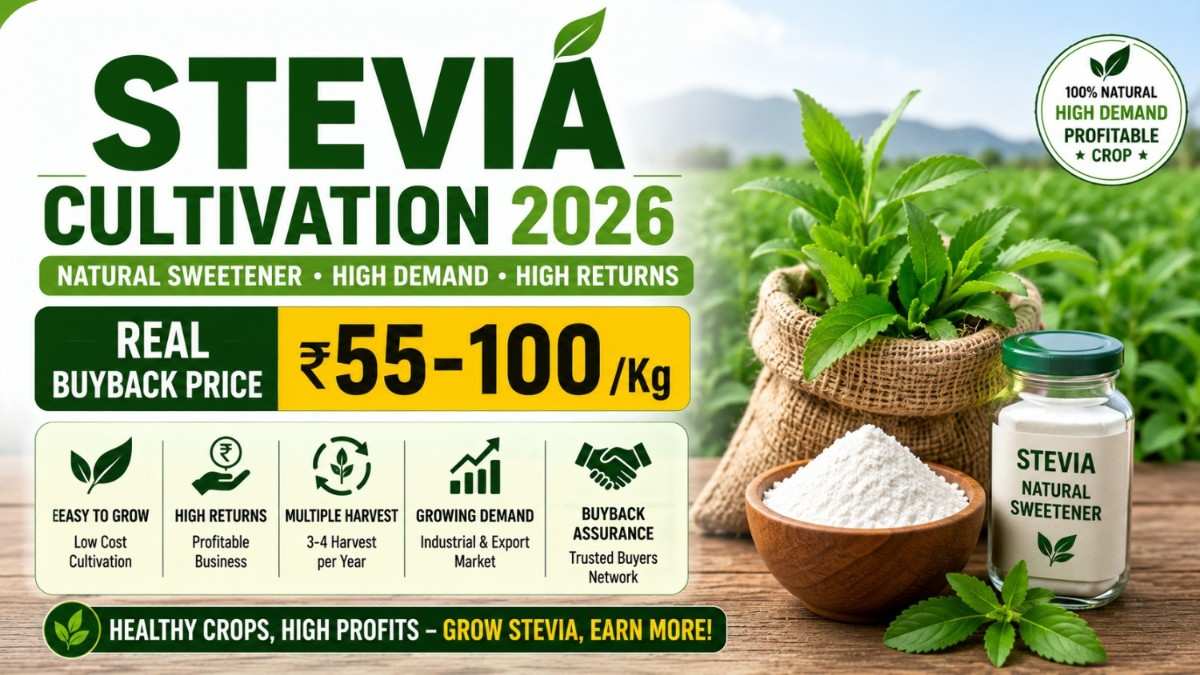
Stevia cultivation India 2026 is riding the genuine sugar-free market boom, but the buyback price you’ve likely seen advertised online needs an honest check before you plant a single sapling. This guide covers everything: the real documented buyback price per kg, the NMPB and NHB subsidy support available, a worked profit calculation per acre, named companies actually involved in stevia sourcing, and a direct look at the Rs.200-400/kg “guaranteed buyback” claim that circulates in marketing material but isn’t backed by verified sources.

- Crop: Stevia (Stevia rebaudiana, locally Madhukari)
- Year 1 Setup Cost: Rs.40,000-65,000/acre (TC planting material is biggest cost)
- Year 2+ Cost: Rs.15,000-20,000/acre/year (no replanting needed)
- Real Buyback Price: Rs.55-100/kg dried leaf (NOT Rs.200-400/kg)
- Typical Yield: 1,500-2,700 kg dried leaf/acre/year (3-4 cuts)
- Honest Net Profit: Rs.1-1.5 lakh/acre/year from year 2 onwards
- Government Subsidy: NMPB 20-30% on cultivation; NHB up to 50% on infrastructure
- Key Buyers: Patanjali, Himalaya, Baidyanath, Morita Chemicals, PureCircle
- 1. What Is Stevia Cultivation & Why the Sugar-Free Boom Matters
- 2. Who Should Consider Stevia Cultivation?
- 3. Money: Real Buyback Price, Yield & Profit Per Acre
- 4. Eligibility & NMPB/NHB Subsidy Support
- 5. Step-by-Step: How to Start Stevia Cultivation Safely
- 6. Worked Example: 1-Acre Stevia Profit Calculation
- 7. High-Value Stevia & Sweetener Market Terms You Must Know
- 8. Stevia vs Sugarcane: Which Sweetener Crop Wins?
- 9. Busting the Rs.200-400/Kg Buyback Myth & Avoiding Fraud
- 10. Frequently Asked Questions
What Is Stevia Cultivation & Why the Sugar-Free Boom Matters
Stevia (Stevia rebaudiana) is a small herbaceous plant whose leaves contain steviol glycosides, naturally 200-300 times sweeter than sugar, with effectively zero calories. India carries one of the world’s largest diabetic populations, and food, beverage and pharma companies are actively reformulating products with natural zero-calorie sweeteners instead of sugar or synthetic alternatives, which is the real engine behind rising stevia demand.
CIMAP, Lucknow (under CSIR) has developed a high-stevioside variety called CIM Mithi specifically for Indian growing conditions, and the National Medicinal Plants Board has formally listed stevia (locally known as Madhukari) under its prioritised cultivation species, which is a genuine signal of institutional confidence in the crop, separate from any marketing hype around buyback prices.

Who Should Consider Stevia Cultivation?
- 🌱 Farmers with 0.5-3 acres of well-drained sandy loam land and reliable drip irrigation
- 👥 FPOs wanting to aggregate dried leaf for better negotiating power with processors
- 🧑🌾 Agri-entrepreneurs interested in the natural sweetener and health-food supply chain
- 👩🌾 Women SHG groups, since stevia’s compact size suits smaller managed plots
- 🏞️ Growers in Punjab, Maharashtra, Gujarat, UP, MP, Rajasthan, Karnataka and Odisha, the established belts
- 📊 Anyone who has seen “guaranteed Rs.200-400/kg buyback” ads and wants the real numbers first
- 🎓 Agriculture graduates evaluating a diversified, water-efficient cash crop business plan
- 💧 Farmers with consistent water access, since stevia needs regular but moderate irrigation
Money: Real Buyback Price, Yield & Profit Per Acre
Several independent, named sources converge tightly on this picture, which is the strongest sign of reliability in agri-content: documented buyback agreements, forum-shared contract terms, and market price averages all sit in the same Rs.55-100/kg band, not the Rs.200-400/kg figure circulating in some promotional material.
| Item | Year 1 | Year 2 Onwards | Notes |
|---|---|---|---|
| Setup/planting cost | Rs.40,000-65,000/acre | — | TC planting material is the largest single cost |
| Ongoing cultivation cost | Included above | Rs.15,000-20,000/acre/year | No replanting needed from year 2 |
| Dried leaf yield | 1,500-2,700 kg/acre/year | 1,500-2,700 kg/acre/year | 3-4 cuts per year |
| Real buyback price | Rs.55-100/kg | Rs.55-100/kg | NOT Rs.200-400/kg |
| Honest net profit | Rs.50,000-1,00,000/acre | Rs.1-1.5 lakh/acre/year | See worked example, Section 6 |
Always confirm the buyback price directly with your specific company or buyer in writing before counting on any figure, since rates do vary slightly by quality grade, glycoside content and contract length.
Eligibility & NMPB/NHB Subsidy Support
- 📜 Land ownership or lease documents in the applicant’s name
- 🧾 Aadhaar, PAN and active bank account for DBT-linked subsidy disbursement
- 🌱 Soil and water test confirming suitability for stevia’s sandy loam, well-drained requirement
- 🏛️ Registration through your State Medicinal Plants Board, NMPB-recognised agency, or NHB project channel
- 👥 FPO registration helps when applying for NHB’s larger infrastructure/processing-unit subsidy
- 💰 Application fee: typically nil for NMPB cultivation subsidy; project-based norms apply for NHB infrastructure support
The National Medicinal Plants Board (NMPB) lists stevia among its prioritised medicinal plant species and offers a 20-30% subsidy on cultivation cost, confirmed directly on the NMPB’s own species page. Separately, the National Horticulture Board (NHB) has reportedly supported stevia nurseries, processing units and post-harvest infrastructure with subsidy support of up to 50% of project cost, alongside machinery subsidy of up to 25% under various schemes; confirm the current applicable rate with your State Horticulture/Medicinal Plants Board, since these slabs are revised periodically. The CSIR Aroma Mission via CIMAP, Lucknow also provides technical guidance and buyer linkage for growers adopting CIMAP’s CIM Mithi variety.
Step-by-Step: How to Start Stevia Cultivation Safely
- Test your soil for drainage and confirm warm-climate, good-sunlight conditions (20-30°C ideal).
- Shortlist your buyback route: NMPB-linked CIMAP technical support, a named transparent contract-farming company, or a direct processor relationship.
- Verify any company’s track record, office address and existing farmer references before signing anything.
- Insist on a written, dated, ideally court-stamped buyback agreement specifying the actual Rs./kg rate, not a verbal promise of a higher figure.
- Procure tissue-culture (TC) saplings from a reputable nursery; this is typically your largest year-1 cost.
- Set up drip irrigation, since stevia needs regular but moderate watering through its 90-day cutting cycles.
- Harvest 3-4 times per year, dry the leaf properly, and grade before delivering against your buyback contract.
- Apply for your NMPB/NHB subsidy share after submitting the required cultivation and project documentation.
Worked Example: 1-Acre Stevia Profit Calculation
Here is the actual arithmetic behind an honest stevia profit estimate (year 2 onwards, once the one-time setup cost is already paid off), across three realistic scenarios built entirely from the documented Rs.55-100/kg range.
| Scenario | Yield (kg/acre) | Buyback Price | Gross Revenue | Ongoing Cost | Net Profit/Acre |
|---|---|---|---|---|---|
| Conservative | 1,500 kg | Rs.55/kg | Rs.82,500 | Rs.20,000 | Rs.62,500 |
| Average | 2,000 kg | Rs.80/kg | Rs.1,60,000 | Rs.20,000 | Rs.1,40,000 |
| Optimistic | 2,500 kg | Rs.100/kg | Rs.2,50,000 | Rs.20,000 | Rs.2,30,000 |
The Average scenario, landing at Rs.1.4 lakh net profit per acre per year, matches the “Rs.1-1.5 lakh/acre/year” figure independently reported across multiple farmer guides, which is a strong sign this calculation reflects real-world outcomes rather than a best-case fantasy number built around an inflated Rs.200-400/kg rate.
High-Value Stevia & Sweetener Market Terms You Must Know
- Steviol glycosides: The natural sweet compounds (stevioside, Rebaudioside A) in stevia leaf, 200-300 times sweeter than sugar.
- CIM Mithi: CIMAP, Lucknow’s high-glycoside stevia variety developed for Indian growing conditions.
- NMPB prioritised species: The official government list, including stevia, eligible for a 20-30% cultivation subsidy.
- Buyback agreement: A signed, ideally court-stamped contract specifying the exact Rs./kg purchase rate and duration.
- Stevia extract/stevioside powder: The processed, high-value product made from leaf, priced far above raw dried leaf, often confused with farm-gate price in inflated marketing claims.
- TC (tissue culture) saplings: Lab-propagated planting material, typically the largest single cost in year one.
- FPO aggregation: Farmer Producer Organisations pooling dried leaf for better processor-level negotiating power.
- Glycoside content grading: The quality factor (sweetness concentration) that determines which end of the Rs.55-100/kg band a batch sells at.
- NHB infrastructure subsidy: Support of up to 50% of project cost for stevia nurseries and post-harvest processing units.
- Indian Stevia Association: An industry body of traders and processors tracking the crop’s growing commercial ecosystem.
Stevia vs Sugarcane: Which Sweetener Crop Wins?
| Parameter | Stevia | Sugarcane |
|---|---|---|
| Land needed for equivalent sweetness | Much smaller area, given 200-300x sweetness potency | Large area; sweetness output per acre is far lower |
| Water requirement | Moderate, manageable with drip irrigation | Very high, among the most water-intensive crops |
| Reported profit/acre/year | Rs.1-1.5 lakh (year 2 onwards) | Typically lower per-acre net margin after high input cost |
| Market structure | No formal mandi/MSP; depends on buyback or processor deal | Established mandi/MSP and mill-based procurement system |
| Health/demand trend | Rising, driven by diabetes and sugar-free reformulation | Stable to flat, facing health-conscious headwinds |
| Best for | Water-constrained land seeking high-value diversification | Established cane belts with assured mill/MSP access |
Busting the Rs.200-400/Kg Buyback Myth & Avoiding Fraud
This needs to be said plainly: no verified, named source in this research documents a Rs.200-400/kg dried-leaf buyback rate for stevia. Every credible, named buyback model found, including company-specific Quora answers, agriculture forum-shared agreements and 2026 farming guides, sits in the Rs.55-100/kg range. Several of these same sources explicitly warn that “unscrupulous companies and agents” sell an inflated dream around stevia profits, which is exactly the pattern behind a Rs.200-400/kg claim.
- 🔍 Verify the buying company’s registration, physical office and existing farmer references before paying anything
- 📝 Insist on a written, dated, court-stamped buyback agreement stating the exact rate, not a verbal promise
- 💸 Be wary of large upfront sapling payments (some documented agreements ask for 50% before planting); never pay 100% upfront to an unfamiliar agent
- 📊 Cross-check any quoted rate against the documented Rs.55-100/kg real-world range before signing
- 🏛️ Prefer NMPB/CSIR-linked technical support or well-documented companies over unverified WhatsApp/social media agents
- 👥 Speak directly to existing growers already supplying the company, not just its marketing material
Frequently Asked Questions
Is Rs.200-400 per kg guaranteed buyback for stevia real?
No verified company or government source documents a Rs.200-400/kg dried-leaf buyback rate. Real, named buyback models like Arboreal Farms and forum-documented agreements cluster around Rs.55-100/kg, so any agent quoting Rs.200-400/kg should be checked very carefully before signing anything.
What is the real stevia buyback price per kg in India?
Documented dried-leaf buyback agreements in India typically range from Rs.55 to Rs.100 per kg, with Rs.80-100/kg being the most commonly cited fixed rate from named contract-farming companies, not the inflated Rs.200-400/kg figure sometimes seen in marketing material.
Is there a government subsidy for stevia cultivation?
Yes, the National Medicinal Plants Board (NMPB) offers a 20-30% subsidy on stevia cultivation cost, and the National Horticulture Board separately offers support of up to 50% of project cost for stevia nurseries and processing infrastructure.
How much profit can I really earn per acre from stevia farming?
From the second year onwards, once replanting cost drops, most credible sources converge on roughly Rs.1 lakh to Rs.1.5 lakh net profit per acre per year, based on a typical yield of 1,500-2,700 kg dried leaf per acre sold at Rs.55-100 per kg.
Why is sugar-free stevia demand booming in India?
India has one of the highest diabetic populations in the world, and food and beverage companies are reformulating products with natural zero-calorie sweeteners, which has driven steady year-on-year growth in demand for stevia leaf and extract.
Which companies buy stevia leaves in India?
Ayurvedic and herbal majors like Patanjali, Himalaya and Baidyanath source stevia for herbal products, while global stevia-extract processors like Morita Chemicals and PureCircle drive industrial demand, alongside smaller named contract-farming companies offering direct farmer buyback.
How can I avoid stevia contract farming scams?
Be cautious of agents demanding a large upfront sapling payment, verify the company’s track record and office presence, insist on a written and court-stamped buyback agreement, and cross-check any quoted buyback rate against the documented Rs.55-100/kg real-world range before paying anything.
How does stevia farming compare to sugarcane?
Stevia uses far less land and water than sugarcane for the same sweetness output and reports stronger per-acre profit potential, but it lacks sugarcane’s established mandi/MSP-style market and depends entirely on securing a reliable buyback or processor relationship.
This guide is regularly reviewed and updated for accuracy. Bookmark this page for the latest stevia cultivation, buyback price and sugar-free market updates for 2026.
Last Updated: June 2026
Sources & further reading: National Medicinal Plants Board (NMPB) | Ministry of AYUSH | CIMAP Lucknow (ICAR) | National Horticulture Board