

Drone Spraying Agriculture India 2026
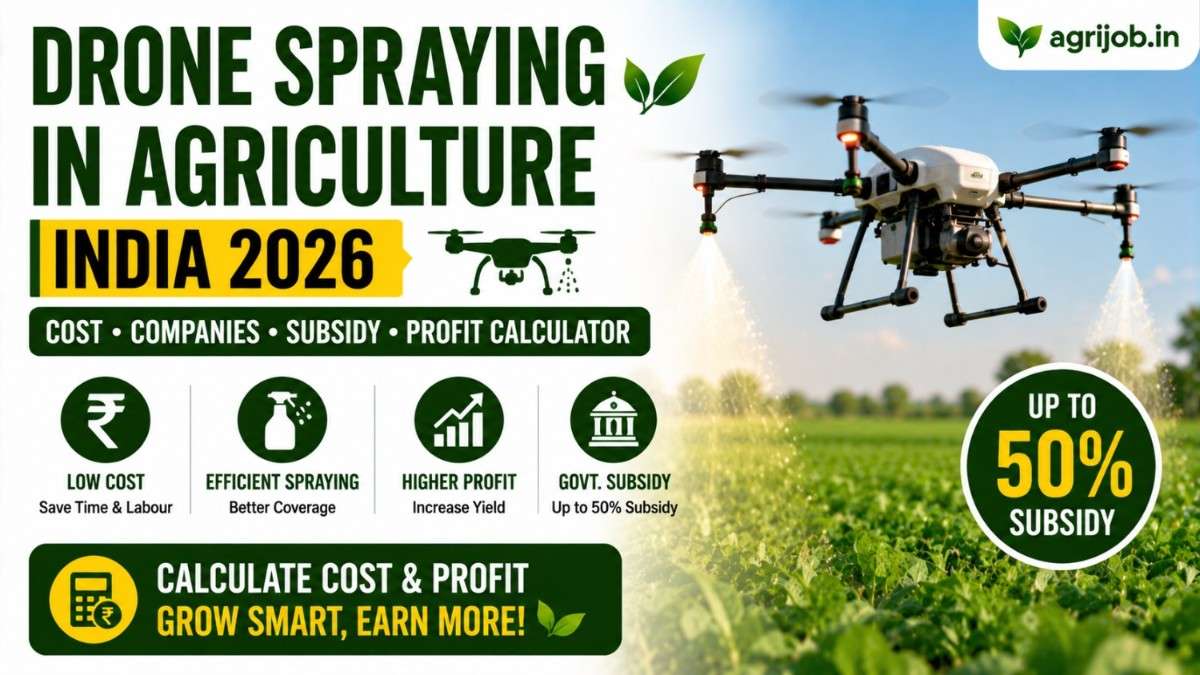
Drone spraying agriculture India 2026 is transforming how Indian farmers fight pests, apply fertilisers, and manage crops — delivering precision, speed, and cost savings that traditional methods simply cannot match. With service rates as low as Rs.300–Rs.600 per acre, government subsidies covering up to 80% of drone purchase cost, and a single drone operator earning Rs.8–18 lakh annually, this guide covers everything you need to know: per-acre costs, top 8 drone companies, SMAM and Namo Drone Didi subsidy details, DGCA certification steps, and a profit calculator to estimate your income as a drone spraying entrepreneur in 2026.

- India Agriculture Drone Market 2026 – Overview
- Drone Spraying Cost Per Acre in India – State-Wise Rates
- Agriculture Drone Purchase Price – Model & Brand Comparison
- Top 8 Agriculture Drone Companies in India 2026
- Government Subsidies for Agriculture Drones 2026 – SMAM & Namo Drone Didi
- Eligibility Criteria for Drone Purchase & Subsidy
- DGCA Certification & Remote Pilot Licence – Step-by-Step Process
- Drone Spraying Business Profit Calculator 2026
- Who Should Invest in Drone Spraying Business?
- How to Apply for Drone Subsidy – Step-by-Step Guide
- Drone Spraying vs Manual Spraying vs Tractor Boom – Comparison
- High-Value Drone Agriculture Terms You Must Know
- Frequently Asked Questions (FAQs)
India Agriculture Drone Market 2026 – Overview
India’s commercial drone industry reached a market size of USD 1.88 billion (Rs.17,000 crore) in FY26, growing at a compounded rate of 17.98% during FY25–29. Within this, the agriculture drone segment — dominated by precision spray drones — is the fastest-growing sub-sector, projected to reach USD 2,110.60 million by 2033 at a 24.10% CAGR. A landmark industry analysis compared small and medium-sized drones costing Rs.6.4–7.1 lakh (3-year operational life) against annual manual labour costs of Rs.1.7 lakh per labourer — finding that despite higher upfront cost, drones can cover 6–6.6 acres in the time manual labour covers 1 acre and cut agrochemical spraying costs by nearly 80% compared to manual methods.
| India Commercial Drone Market (FY26) | USD 1.88 Billion (Rs.17,000 Crore) |
| Agriculture Drone Market CAGR | 24.10% (to 2033) |
| Drone Spraying Service Rate | Rs.300–Rs.700 per acre |
| Daily Coverage (10–16L Drone) | 30–50 acres per drone per day |
| vs Manual Spraying Productivity | 6–6.6x faster per unit |
| Chemical Usage Reduction | Up to 30%; water saved up to 90% |
| SMAM Subsidy (Individual Farmer) | 40–50% (up to Rs.5 lakh) |
| Namo Drone Didi Subsidy (Women SHG) | 80% (up to Rs.8 lakh) |
| Drone Operator Monthly Income (Peak Season) | Rs.60,000–Rs.1.8 lakh net profit |
Drone Spraying Cost Per Acre in India 2026 – State-Wise Rates
The cost of drone spraying per acre in India varies by state, crop type, and competition among local operators. The pay-per-acre DaaS model makes professional drone spraying affordable without any capital investment from the farmer. Here is the state-wise rate guide for 2026:

| State / Region | Main Crops | Drone Spray Rate (Per Acre) | Manual Spray Cost (Per Acre) | Farmer Saving |
|---|---|---|---|---|
| Punjab / Haryana | Paddy, Wheat, Mustard | Rs.300–Rs.400 | Rs.500–Rs.700 (labour + chemical waste) | Rs.150–Rs.300/acre |
| Uttar Pradesh / Bihar | Paddy, Wheat, Sugarcane | Rs.350–Rs.450 | Rs.450–Rs.650 | Rs.100–Rs.250/acre |
| Rajasthan / MP | Soybean, Wheat, Cotton | Rs.350–Rs.500 | Rs.500–Rs.700 | Rs.150–Rs.300/acre |
| Maharashtra | Cotton, Soybean, Grapes, Onion | Rs.450–Rs.650 | Rs.600–Rs.900 | Rs.150–Rs.350/acre |
| Andhra Pradesh / Telangana | Paddy, Cotton, Chilli, Maize | Rs.400–Rs.600 | Rs.550–Rs.800 | Rs.150–Rs.300/acre |
| Karnataka | Paddy, Coffee, Horticulture | Rs.450–Rs.700 | Rs.600–Rs.900 | Rs.150–Rs.300/acre |
| Gujarat | Cotton, Groundnut, Cumin | Rs.400–Rs.550 | Rs.550–Rs.750 | Rs.150–Rs.250/acre |
| Odisha / Chhattisgarh | Paddy, Pulses | Rs.300–Rs.450 | Rs.400–Rs.600 | Rs.100–Rs.200/acre |
Note: Rates exclude the cost of pesticides/chemicals, which the farmer typically supplies separately. Drone operators charge only for the spraying service. Additional charges may apply for very small plots (under 2 acres) or complex terrain.
Agriculture Drone Purchase Price India 2026 – Model & Brand Comparison
Choosing the right drone to purchase is a critical decision for any aspiring drone spraying agriculture entrepreneur. Here is the complete price guide by tank size and use case for India 2026:
| Category | Tank Capacity | Daily Coverage | Market Price (Before Subsidy) | Net Cost (After 50% SMAM) | Best For |
|---|---|---|---|---|---|
| Entry-Level | 8–10 Litres | 15–25 acres/day | Rs.3–Rs.5 lakh | Rs.1.5–Rs.2.5 lakh | Small farms, beginners, testing |
| Mid-Range (Most Popular) | 10–16 Litres | 30–50 acres/day | Rs.5–Rs.10 lakh | Rs.2.5–Rs.5 lakh | Commercial DaaS, FPOs, CHCs |
| Commercial Grade | 16–25 Litres | 50–70 acres/day | Rs.10–Rs.15 lakh | Rs.5–Rs.7.5 lakh | Large farms, agri-companies |
| Advanced AI + Multispectral | 20–30 Litres | 60–80 acres/day | Rs.15–Rs.25 lakh | Rs.7.5–Rs.12.5 lakh | Agritech firms, R&D, export farms |
Operating costs to factor in beyond purchase price: Battery replacement (Rs.8,000–Rs.15,000 per set every 200 cycles), annual maintenance (Rs.15,000–Rs.30,000), DGCA registration fees (Rs.100), insurance (Rs.5,000–Rs.15,000/year), and remote pilot licence renewal (Rs.500 every 10 years). Total annual operating cost for a mid-range drone: approximately Rs.30,000–Rs.60,000, making per-acre profitability very high once purchase cost is recovered.
Top 8 Agriculture Drone Companies in India 2026
India’s agriculture drone manufacturing ecosystem has matured significantly, with over 30 DGCA-approved domestic manufacturers now producing precision spray drones eligible for government subsidies. Only Indian-made drones listed on the Digital Sky Platform qualify for SMAM and Namo Drone Didi subsidies — imported drones (including DJI) are not eligible. Here are the top 8 companies to know in 2026:
- ✈️ Garuda Aerospace (Chennai): One of India’s most recognised agri-drone brands, renowned for its Kisan Drone series (8L and 16L models). Priced competitively for Indian farm conditions, Garuda offers strong after-sales service and farmer training programmes across Southern and Central India. DGCA-approved GA-AD model is widely used for paddy, cotton, and vegetable spraying. The company has government procurement empanelment across multiple states.
- ⚙️ IoTechWorld Avigation (Gurugram): Haryana-based manufacturer producing the Agribot MX and IoTech AgriMX models, designed for large-field operations in Punjab, Haryana, and UP. IoTechWorld’s drones are known for durability in high-temperature plains conditions and include dedicated pilot training programmes. DGCA-approved Agribot (24.90 kg all-up weight) with 98.43-feet operational ceiling.
- 🚁 Marut Drones (Hyderabad): Known for AI-enabled precision spraying, crop disease detection, and scalable mapping solutions. Popular models include AG-365, AG-365S, AG-365H, and RPTO-M. Marut’s drones feature GPS-based navigation, smart flight systems, and adaptability to different crops and terrain types across Telangana, Andhra Pradesh, and Maharashtra.
- 🌾 General Aeronautics (Bengaluru): Develops stable, feature-rich drones for research institutions and agribusinesses. The Krishak model (49.10 kg, DGCA-approved) is a medium-class drone suited to large commercial operations. General Aeronautics works closely with ICAR and SAU research stations for precision agriculture trials and is a preferred supplier for state government demonstration programmes.
- 🛰️ BharatRohan (Delhi): Specialises in multispectral imaging drones and satellite-drone integrated crop health monitoring platforms. BharatRohan’s RPTO is one of the largest drone pilot training providers in India, having certified thousands of operators under the DGCA framework. The company offers both drone hardware and analytics SaaS subscriptions for agribusinesses.
- 📱 Leher Agri (Pan-India Service Platform): While primarily a drone-as-a-service platform rather than a manufacturer, Leher’s 10-litre spray drone with 22-minute flight time and auto-return features is available for purchase and rental across India. Leher’s mobile app allows farmers to book drone spraying services, track operations, and receive GPS-mapped spray reports — making it the most farmer-friendly DaaS platform in 2026.
- 🔬 Thanos Technologies (Telangana): Manufactures the Syena H10 and Syena H10i models (29.40 kg, DGCA-approved), popular for cotton, paddy, and sugarcane spraying in South India. Known for robust build quality, high payload efficiency, and competitive pricing that makes them a popular choice for first-time DaaS entrepreneurs under the SMAM subsidy scheme.
- 💡 IdeaForge Technology (Mumbai, NSE-listed): India’s first listed drone company (IPO 2023), IdeaForge is primarily known for defence and surveillance drones but has expanded into agriculture with the Q4i model. As India’s most established drone technology company with R&D depth, IdeaForge’s agriculture solutions are increasingly used by large agribusinesses and state government procurement programmes.
Government Subsidies for Agriculture Drones India 2026 – SMAM & Namo Drone Didi
The Indian government has created one of the most generous subsidy ecosystems in the world for agricultural drone adoption. Here is the complete 2026 subsidy guide for drone spraying agriculture India:
| Scheme | Beneficiary Category | Subsidy % | Maximum Subsidy Amount | Application Portal |
|---|---|---|---|---|
| SMAM | Individual Farmers | 40–50% | Up to Rs.4–5 lakh | agrimachinery.nic.in |
| SMAM | SC/ST / Women / Small & Marginal Farmers | 50% | Up to Rs.5 lakh | agrimachinery.nic.in |
| SMAM | FPOs / Cooperatives / SHGs | 75% | Up to Rs.7.5 lakh | agrimachinery.nic.in |
| SMAM | Custom Hiring Centres (CHC) | 40% | Up to Rs.4 lakh per drone | agrimachinery.nic.in |
| Namo Drone Didi | Women-Led SHGs (15,000 SHGs target) | 80% | Up to Rs.8 lakh | State Rural Dev. Portal / MoRD |
| NAIF (Loan) | FPOs, Agri-Entrepreneurs, Farmers | 3% Interest Subvention | Loan up to Rs.2 crore | Bank / NABARD portal |
| PLI Scheme (Drone Mfg.) | Drone Manufacturers | Production incentive | Turnover-linked | MoCA portal |
Critical Rule: Only drones from DGCA-approved Indian manufacturers listed on the Digital Sky Platform are eligible for any government subsidy. DJI drones and other imports are explicitly excluded — importing them without DGCA approval is illegal in India as of 2026. Always verify the drone model’s DGCA approval status at digitalsky.dgca.gov.in before purchase.
Namo Drone Didi Yojana 2026 – Special Highlight: With a Rs.1,261 crore central outlay for 2024–26, this scheme targets 15,000 women-led SHGs across all states. The 80% subsidy (up to Rs.8 lakh) covers the drone cost, and the scheme includes a 15-day structured training programme — 5 days of DGCA Remote Pilot Certificate training plus 10 days of agriculture-specific operations training. The government also now provides 80% financial assistance for a multi-utility vehicle to transport the drone to farms, addressing the transportation challenge faced by 42.68% of Drone Didi operators. Trained SHGs earn a minimum guaranteed income by offering spraying services at Rs.400–Rs.600 per acre.
Eligibility Criteria for Agriculture Drone Subsidy India 2026
- 📋 Individual Farmer (SMAM – 40–50% subsidy): Must be a registered farmer with valid land records (Khasra/Khatauni). Age 18–60. Must hold or commit to obtaining a DGCA Remote Pilot Certificate (RPC) within 90 days of drone purchase. No previous drone subsidy should have been claimed under the same scheme. Only DGCA-empanelled drone models are eligible.
- 👩 Women / SC / ST / Small & Marginal Farmer (SMAM – 50% subsidy): Same as above with category proof — SC/ST certificate, Women beneficiary declaration, or land records showing holding under 2 hectares. Priority allotment in states with limited subsidy windows.
- 🏢 Farmer Producer Organisation (FPO – 75% subsidy): Must be a registered FPO under the Companies Act or cooperative society. Minimum 500 farmer members. Must submit board resolution approving drone purchase and a usage plan covering member farms. FPO office-bearer must obtain DGCA RPC.
- 👩👩👦 SHG (Namo Drone Didi – 80% subsidy): Must be an active women-led SHG registered under the National Rural Livelihoods Mission (NRLM) or state SRLM. SHG members must commit to the 15-day training programme and operate the drone commercially for minimum 5 years post-subsidy. Application through district Ministry of Rural Development office or state nodal agency.
- 🏗️ Custom Hiring Centre (CHC – 40% subsidy): Must be a registered CHC or agri-service enterprise. CHC must commit to providing drone services to at least 100 farmers per season at government-prescribed rates. Preference to CHCs in aspirational districts and tribal areas.
DGCA Certification & Remote Pilot Licence for Drone Spraying – Step-by-Step 2026
Every commercial agriculture drone operator in India must be DGCA-certified. The certification process in 2026 is streamlined through the Digital Sky Platform. Here is the complete step-by-step guide:
- Register on Digital Sky Platform (Week 1): Create an account at digitalsky.dgca.gov.in. Register yourself as a Remote Pilot applicant. Upload Aadhaar, Class 10 certificate (minimum educational qualification), and a passport-size photograph. Registration fee: Rs.100. Processing time: 3–5 working days.
- Enrol with a DGCA-Approved RPTO (Week 1–2): Select a DGCA-approved Remote Pilot Training Organisation (RPTO) near your district. Leading RPTOs include BharatRohan’s RPTO, Marut Drones RPTO, Garuda Aerospace RPTO, and state agriculture department RPTOs. Training duration: 5 days theory + practical flying. Cost: Rs.15,000–Rs.40,000 (covered under Namo Drone Didi for SHG members).
- Complete RPTO Training (Week 2–3): Theory modules cover: UAS Rules 2021, airspace classifications, Digital Sky Platform operations, emergency procedures, and battery management. Practical flying covers: pre-flight checks, GPS-guided spraying missions, obstacle avoidance, emergency landing, and maintenance. Minimum 25 flying hours required before examination.
- Pass DGCA Online Examination (Week 3–4): Appear for the DGCA online RPC examination at an authorised test centre. The exam covers drone regulations, air traffic, safety protocols, and basic meteorology. Passing score: 70%. Re-attempt allowed after 7 days if failed.
- Register Your Drone & Obtain UIN (Week 4–5): After passing the exam, register your specific drone on Digital Sky Platform and obtain a Unique Identification Number (UIN). The UIN is a mandatory digital identity tag for all commercial drones in India. Processing time: 15 working days. Fee: Rs.100.
- Obtain Remote Pilot Certificate (Week 5–6): The DGCA issues the Remote Pilot Certificate (RPC) after verifying all training and examination records. RPC is valid for 10 years. Renewal fee: Rs.500. Total DGCA compliance timeline: approximately 4–6 weeks end-to-end for a new applicant.
- Get Drone Insurance (Week 6): Commercial agriculture drones must carry third-party liability insurance. Annual premium: Rs.5,000–Rs.15,000 depending on drone value. Insurance providers include New India Assurance, IFFCO-Tokio, and Tata AIG — all now offer dedicated agri-drone insurance products in 2026.
Drone Spraying Business Profit Calculator India 2026
Use this profit estimator to calculate your expected monthly and annual income as a drone spraying entrepreneur in India. All figures are based on 2026 market rates for the mid-range 10–16 litre drone segment — the most popular commercial configuration for DaaS operators:
🚁 Drone Spraying Business – Monthly Profit Calculator
| Parameter | Conservative | Moderate (Typical) | Optimistic |
|---|---|---|---|
| Acres sprayed per day | 25 | 35 | 50 |
| Operating days per month | 15 | 20 | 25 |
| Charge per acre (Rs.) | Rs.350 | Rs.450 | Rs.550 |
| Gross Monthly Revenue | Rs.1,31,250 | Rs.3,15,000 | Rs.6,87,500 |
| Battery replacement (monthly) | Rs.8,000 | Rs.12,000 | Rs.18,000 |
| Maintenance & repairs | Rs.5,000 | Rs.8,000 | Rs.12,000 |
| Fuel / transportation | Rs.6,000 | Rs.10,000 | Rs.15,000 |
| Labour (helper/assistant) | Rs.8,000 | Rs.12,000 | Rs.18,000 |
| Insurance + misc. | Rs.2,000 | Rs.2,500 | Rs.3,000 |
| Total Monthly Expenses | Rs.29,000 | Rs.44,500 | Rs.66,000 |
| Net Monthly Profit | Rs.1,02,250 | Rs.2,70,500 | Rs.6,21,500 |
| Annual Net Profit (8 active months) | Rs.8.2 Lakh | Rs.21.6 Lakh | Rs.49.7 Lakh |
| Drone Payback Period | 18–24 months | 8–12 months | 4–6 months |
*Based on 10–16L drone (net cost Rs.3–5 lakh after SMAM subsidy). 8 active months account for Kharif + Rabi seasons. Off-season income from vegetable and horticulture crops reduces actual downtime further. Numbers are estimates — actual income depends on local demand, operator skill, and competition.
Who Should Invest in a Drone Spraying Business in India 2026?
- 🎓 Agriculture graduates (BSc/Diploma) from farming communities who have local farmer networks and land knowledge — the single biggest competitive advantage in the drone spraying DaaS business is the ability to quickly build a farmer customer base in your home district.
- 👩 Women SHG members in rural areas who qualify for the Namo Drone Didi Yojana — the 80% subsidy (up to Rs.8 lakh) plus free 15-day training plus transportation vehicle support makes this the most financially attractive drone business entry point available anywhere in India in 2026.
- 🏢 FPOs and cooperatives with 500+ farmer members who can aggregate demand for drone services across member farms, qualify for 75% SMAM subsidy, and operate the drone at maximum utilisation (20–25 days/month) — generating Rs.15–20 lakh net annual income from a single drone.
- 🚀 Agri-entrepreneurs and agribusiness graduates who want to build a multi-drone DaaS fleet — starting with 1 drone (Rs.3–5 lakh after subsidy), proving profitability in Year 1, then scaling to 3–5 drones in Years 2–3 for annual revenues of Rs.25–75 lakh.
- 👨🌾 Existing Custom Hiring Centre (CHC) operators who already have a farmer relationship base and equipment lending infrastructure — adding a drone to an existing CHC generates incremental revenue with minimal incremental overhead beyond the pilot licence.
- 📱 Young rural entrepreneurs aged 20–30 who are comfortable with technology, have a two-wheeler for farm access, and are looking for a high-income rural livelihood that does not require migration to a city — drone spraying is one of India’s highest-income rural vocations in 2026.
- 🌿 Farmers with 20+ acres of own land who can use the drone commercially on their own farm first (saving Rs.15,000–Rs.30,000 annually on their own spraying costs) and then offer services to neighbours, building an additional income stream from an asset that has already proved its value at home.
- 🔬 Agritech startup founders who want to build data businesses on top of drone operations — collecting NDVI crop health data, field maps, and yield proxy data during spraying missions creates a proprietary agri-data asset that can be monetised through AI advisory subscriptions and precision agriculture services.
How to Apply for Agriculture Drone Subsidy – Step-by-Step 2026
- Identify Your Scheme (SMAM vs Namo Drone Didi): Individual farmers and FPOs should apply under SMAM at agrimachinery.nic.in. Women-led SHGs registered under NRLM/SRLM should apply for Namo Drone Didi through their state Ministry of Rural Development nodal agency or SHG cluster coordinator.
- Check Application Window: SMAM subsidy funds are released state-wise and operate on a first-come, first-served basis. Many states exhaust their annual quota within the first 3–4 months of the financial year (April–July). Check your state agriculture department portal or agrimachinery.nic.in for current status of open application windows.
- Prepare Documents: Required documents include: Aadhaar card, land records (Khasra/Khatauni), bank passbook, passport-size photo, category certificate (if SC/ST/Women), FPO registration certificate (for FPOs), and a quotation from a DGCA-empanelled drone manufacturer. Scan all documents under 500 KB each for successful portal upload.
- Select a DGCA-Approved Drone Model: Visit digitalsky.dgca.gov.in to verify which drone models from which manufacturers are DGCA-approved. Get a formal quotation from the empanelled manufacturer. Do NOT purchase before subsidy approval — in most states, you pay first and receive reimbursement via Direct Benefit Transfer (DBT) to your bank account after physical verification.
- Submit Online Application at agrimachinery.nic.in: Register your beneficiary type (Farmer / FPO / SHG / CHC). Fill the online application form with all required details. Upload scanned documents. Submit and note your Application ID for tracking. You will receive an SMS confirmation after successful submission.
- Field Verification by Agriculture Officer: A district agriculture officer will visit your location for physical verification of land, farm activity, and other eligibility criteria. Approval typically takes 30–60 days after verification. Notification is sent via SMS and email upon approval.
- Purchase the Drone and Claim Subsidy: After approval notification, purchase the DGCA-approved drone from the empanelled manufacturer. An agriculture officer inspects the purchased drone physically at your location. After inspection confirmation, the subsidy amount is credited directly to your linked bank account via DBT — typically within 15–30 days of physical verification.
Drone Spraying vs Manual Spraying vs Tractor Boom – Full Comparison 2026
| Parameter | Drone Spraying | Manual Knapsack Sprayer | Tractor Boom Sprayer |
|---|---|---|---|
| Daily Coverage | 30–50 acres | 5–8 acres (1 labourer) | 20–40 acres |
| Water Use Per Acre | 8–10 litres (90% less) | 150–200 litres | 200–400 litres |
| Chemical Efficiency | Up to 30% less chemical needed | High waste due to runoff | Moderate waste |
| Service Cost | Rs.300–Rs.700/acre | Rs.300–Rs.500 (labour only) | Rs.200–Rs.400/acre |
| Crop Damage Risk | Nil (no ground contact) | Low | High (tractor wheels damage crops) |
| Pest/Disease Detection | Yes – NDVI camera add-on | No | No |
| Labour Health Risk | Zero – fully remote | Very High – pesticide exposure | Low – enclosed cabin |
| Terrain Suitability | All terrain including hills | All terrain | Flat fields only |
| Speed of Response | Same-day booking via app | Immediate (self) | Dependent on tractor availability |
| Best For | All farmers – especially horticultural | Very small plots, standalone | Large flat commercial farms |
High-Value Drone Agriculture Terms You Must Know in 2026
- 🚁 Drone-as-a-Service (DaaS): The dominant drone business model in India — operators charge farmers Rs.300–Rs.700 per acre for spraying services without farmers needing to own any equipment. India’s fastest-growing agri-enterprise model in 2026, with estimated 50,000+ active DaaS operators nationwide.
- 📡 Remote Pilot Certificate (RPC): The mandatory DGCA licence for commercial drone operation in India. Valid for 10 years. Obtained through 5-day RPTO training and a DGCA online examination. Every commercial drone operator must hold an RPC — operating commercially without one attracts fines under UAS Rules 2021.
- 🛰️ Digital Sky Platform: India’s single-window online system for drone registration, UIN issuance, flight permissions (LAANC equivalent), and subsidy-linked drone tracking. Operated by DGCA at digitalsky.dgca.gov.in. All commercial agri drones must be registered here before first flight.
- 🌿 Nano-Urea Drone Application: IFFCO’s nano-urea liquid fertiliser (a revolutionary alternative to conventional granular urea) is ideally applied via drone spraying — covering 1 acre with just 500 ml of nano-urea vs 50 kg of conventional urea. Drone nano-urea spraying has become one of the highest-growth use cases for agri-drones in 2026.
- 📸 NDVI Mapping (Normalised Difference Vegetation Index): Multispectral drone cameras generate NDVI maps that reveal crop health, stress zones, and nutrient deficiencies in colour-coded visual maps. DaaS operators who offer NDVI mapping as an add-on service charge Rs.150–Rs.300/acre additional, significantly boosting per-acre revenue.
- ✈️ SMAM (Sub-Mission on Agricultural Mechanisation): The central government’s primary farm machinery subsidy scheme, covering agri-drones since 2022. All SMAM applications go through agrimachinery.nic.in. State-specific subsidy top-ups are available in Maharashtra (additional 10%), Punjab, and Telangana.
- 🔋 LiPo Battery (Lithium Polymer): The power source for all agricultural spray drones, typically rated for 200–400 charge cycles before replacement. Battery management is the single biggest operational cost and efficiency factor in a drone spraying business — proper storage, charging discipline, and temperature management significantly extend battery life and reduce operating costs.
- 🏭 Custom Hiring Centre (CHC): Government-supported agri-machinery rental enterprises that lease drones and other farm equipment to farmers on a per-acre basis. CHCs qualify for 40% SMAM subsidy on drone purchase and are the recommended entry structure for agri-entrepreneurs wanting a formal business entity for drone operations.
- 🌾 Kisan Drone Yojana: The umbrella branding used by several state governments for their drone adoption programmes — often referring to state-level subsidies that complement the central SMAM scheme. States including Telangana (additional Rs.1.5 lakh subsidy), Odisha, and Uttarakhand have state-specific Kisan Drone schemes running in 2026.
- 📊 Agriculture Drone PLI Scheme: The Production-Linked Incentive scheme for drone manufacturing (Ministry of Civil Aviation) has catalysed a dramatic increase in domestic Indian drone production since 2022, reducing agriculture drone prices by 25–35% compared to 2021 imported models and making DGCA-approved Indian drones affordable for SMAM subsidy applicants.
Frequently Asked Questions – Drone Spraying Agriculture India 2026
What is the cost of drone spraying per acre in India in 2026?
The cost of drone spraying per acre in India in 2026 ranges from Rs.300 to Rs.700 depending on region, crop, and operator competition. In high-competition zones like Punjab and Haryana (paddy, wheat), rates are Rs.300–Rs.400 per acre. In horticulture zones of Maharashtra and Karnataka, rates are Rs.500–Rs.700 per acre. The national average is Rs.400–Rs.500 per acre for standard Kharif and Rabi crop spraying. Farmers save Rs.150–Rs.350 per acre versus manual spraying when chemical efficiency gains are included.
What is the price of an agriculture drone in India in 2026?
Agriculture drone prices in India in 2026 range from Rs.3 lakh (basic 8L models) to Rs.25 lakh (advanced 25L AI multispectral drones). The most popular commercial segment — 10–16 litre payload drones from brands like Garuda Aerospace, IoTechWorld, and Marut Drones — costs Rs.5–10 lakh before subsidy. After applying SMAM subsidy (40–50%), net cost for individual farmers drops to Rs.2.5–Rs.5 lakh. Women SHG members under Namo Drone Didi Yojana can access drones at just 20% of market price (up to Rs.8 lakh subsidised).
What government subsidies are available for agriculture drones in India 2026?
Three major central government schemes cover agri-drone subsidies in 2026. SMAM offers 40–50% subsidy (up to Rs.5 lakh) for individuals and 75% (up to Rs.7.5 lakh) for FPOs/cooperatives — apply at agrimachinery.nic.in. Namo Drone Didi Yojana provides 80% subsidy (up to Rs.8 lakh) plus free training for women-led SHGs. NAIF provides loans up to Rs.2 crore with 3% interest subvention for CHCs. Only DGCA-approved Indian-made drones are eligible for any subsidy.
How much can a drone spraying business earn per month in India?
A drone spraying business in India can earn a net profit of Rs.1 lakh to Rs.2.7 lakh per month during active crop seasons (Kharif: June–October; Rabi: November–March) under typical operating conditions — 35 acres per day, 20 days per month, at Rs.450 per acre. Gross revenue: Rs.3.15 lakh/month; total operating expenses: ~Rs.44,500/month; net profit: ~Rs.2.70 lakh/month. Annual net income (8 active months): approximately Rs.18–22 lakh for a well-managed single-drone DaaS operation.
What DGCA certification is required for drone spraying in India?
Every commercial agriculture drone operator must hold a Remote Pilot Certificate (RPC) issued by DGCA through an approved RPTO. The process involves: registering on the Digital Sky Platform, completing 5-day RPTO training (theory + practical flying), passing the DGCA online exam (70% passing score), registering the drone for a UIN, and then receiving the RPC. Total time: 4–6 weeks. Total cost: Rs.15,000–Rs.40,000 for training. Register at digitalsky.dgca.gov.in. RPC is valid for 10 years.
Which are the top agriculture drone companies in India in 2026?
The top agriculture drone companies in India in 2026 include Garuda Aerospace (Chennai), IoTechWorld Avigation (Gurugram), Marut Drones (Hyderabad), General Aeronautics (Bengaluru), BharatRohan (Delhi), Thanos Technologies, IdeaForge Technology (Mumbai), and Leher Agri. India’s commercial drone market reached Rs.17,000 crore (USD 1.88 billion) in FY26. All SMAM-eligible drones must be purchased from DGCA-empanelled Indian manufacturers — verify at digitalsky.dgca.gov.in before purchase.
How many acres can an agriculture drone spray per day in India?
A standard 10–16 litre agriculture drone can spray 30–50 acres per day in India under typical operating conditions (8–10 hours with multiple battery charges). Entry-level 8-litre drones cover 15–20 acres per day. Advanced 20–25 litre commercial drones cover 50–70 acres per day. By comparison, manual spraying covers only 5–8 acres per labourer per day — making drones 6–6.6 times more productive and significantly reducing the urgency-based labour bottleneck during peak spray periods like disease outbreaks or pest emergencies.
Can small farmers afford drone spraying services in India?
Yes — the DaaS model makes drone spraying completely affordable for small farmers. At Rs.300–Rs.600 per acre per spray, a 5-acre farmer spends only Rs.1,500–Rs.3,000 per spraying cycle with zero capital investment. Over a 4–6 spray season, total cost is Rs.6,000–Rs.18,000 — comparable to or less than manual spraying when chemical waste reduction is factored in. The Namo Drone Didi programme ensures drone service availability in remote rural areas via trained women SHG operators. Government advisory: book drone services at least 3–5 days in advance during peak Kharif season to secure timely slots.
This guide on drone spraying agriculture India 2026 is regularly reviewed and updated for accuracy. Bookmark this page for the latest drone prices, subsidy scheme updates, DGCA rule changes, and drone business guidance. For government agriculture job notifications and agritech career guides, visit Agrijob.in — India’s #1 agriculture job portal. Refer to the SMAM portal (agrimachinery.nic.in) for subsidy applications and DGCA Digital Sky Platform for drone registration and RPC certification. This guide is regularly reviewed and updated — bookmark for the latest 2026 updates.