

Food Technology vs Agribusiness Management 2026 – Career, Salary & Scope
Choosing between Food Technology vs Agribusiness Management is one of the most common dilemmas for agriculture and science students in India 2026. Both courses lead to high-paying, future-proof careers — but they serve very different career goals, personalities, and income trajectories. Food Technology offers Rs.4–20 LPA in the food processing and FMCG sector, while Agribusiness Management (MBA ABM) opens doors to Rs.5–30 LPA roles in corporate agri-firms, NABARD, FPOs, and international agri-trade companies. This complete 2026 guide compares both courses on every parameter that matters — eligibility, fees, top colleges, salary by experience, government jobs, scope, and who should pick which course — so you can make the right decision for your career.

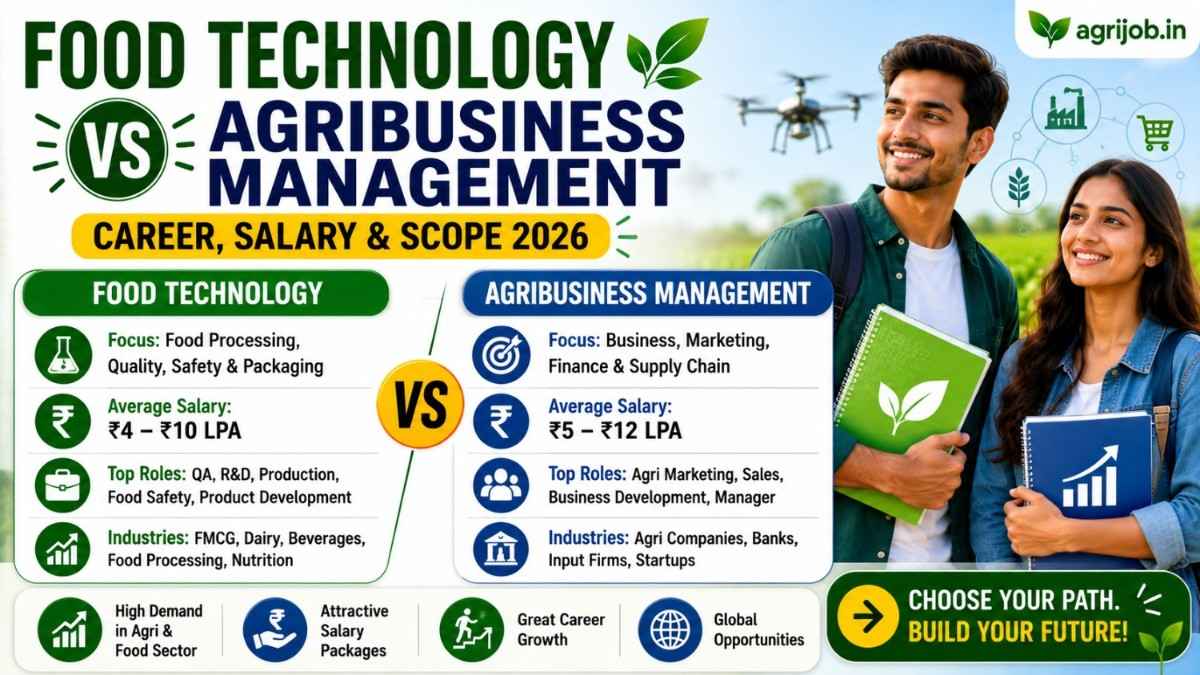
- Food Technology vs Agribusiness Management – 2026 Overview
- Eligibility & Admission – Both Courses Compared
- Salary Comparison 2026 – Food Technology vs Agribusiness Management
- Career Scope – Job Roles & Industries for Both
- Government Jobs After Food Technology vs Agribusiness Management
- Top Colleges in India for Both Courses (2026)
- Who Should Choose Food Technology or Agribusiness Management?
- Full Comparison Table – 10 Parameters Head-to-Head
- High-Value Career Terms You Must Know
- Frequently Asked Questions
| Parameter | Food Technology | Agribusiness Management |
|---|---|---|
| Course Type | B.Sc / B.Tech / M.Sc / M.Tech | MBA / PGP / PGDM (2-year PG) |
| Duration | 3–4 years (UG) / 2 years (PG) | 2 years (PG only) |
| Minimum Eligibility | 12th PCB/PCM with 50%+ | Any graduation with 50%+ |
| Entry Salary | Rs.4–6 LPA | Rs.5–8 LPA |
| Senior Salary (10 yrs) | Rs.10–21 LPA | Rs.15–30 LPA |
| Top Govt Recruiter | FSSAI, FCI, CSIR-CFTRI, ICAR | NABARD, IBPS AFO, SFAC |
| Top Private Recruiter | HUL, ITC, Nestlé, Britannia, Amul | Cargill, Olam, IFFCO, Mahindra Agri |
| Best For | Science lovers, lab/R&D careers | Business-minded, management roles |
Food Technology vs Agribusiness Management – 2026 Overview
Understanding the foundational difference between food technology vs agribusiness management is essential before comparing salaries and career paths. Food Technology is a science and engineering discipline that covers food chemistry, microbiology, processing, preservation, packaging, and quality assurance. It is regulated by FSSAI (Food Safety and Standards Authority of India) and top research is conducted at institutes like CSIR-CFTRI Mysuru and NIFTEM Kundli.
Agribusiness Management, on the other hand, is a management programme that combines agricultural science with business skills — supply chain management, rural finance, commodity trading, FPO governance, agri-marketing, and export management. India’s agribusiness sector is projected to reach USD 24 billion by 2030, creating intense demand for MBA ABM professionals across the value chain. NABARD, FPOs, agri-input companies, and export firms are the primary employers.

In 2026, both courses are experiencing strong placement demand — driven by India’s food processing sector growing at 11% CAGR and the Union Budget allocating Rs.1.63 lakh crore to agriculture. The key difference in food technology vs agribusiness management: food tech graduates work inside the supply chain (processing, quality, R&D), while ABM graduates manage the supply chain (sourcing, pricing, marketing, strategy).
Eligibility & Admission – Food Technology vs Agribusiness Management 2026
One major practical difference in food technology vs agribusiness management is entry-level eligibility. Here is the complete breakdown:
Food Technology Eligibility 2026
- 🎓 B.Sc / B.Tech Food Technology (UG): 10+2 with Physics, Chemistry, and Biology (PCB) or Mathematics — minimum 50–55% aggregate. Admission via JEE (for NITs/IITs), state agriculture university entrance exams, or merit-based at private colleges.
- 🎓 M.Sc / M.Tech Food Technology (PG): B.Sc in Food Technology, Chemistry, Microbiology, Dairy Technology, or related science with 55%+ marks. CFTRI Mysuru conducts its own entrance exam (May–June 2026). GATE score accepted at NIFTEM and IIT-based programmes.
- 📋 Age Limit: No official age limit for most UG/PG food technology admissions. Government job applications (FSSAI, FCI) typically have 18–30 years age limit with SC/ST/OBC relaxation of 3–5 years.
- 💰 Application Fee: Rs.500–Rs.1,500 for most government institution entrance exams. No fee for SC/ST candidates at CSIR-CFTRI and state agricultural universities.
Agribusiness Management Eligibility 2026
- 🎓 MBA / PGP Agribusiness Management: Any bachelor’s degree (B.Sc Agriculture, B.Tech, B.Com, BA) with minimum 50% marks from a UGC-recognised university. Agriculture background is preferred but not mandatory at most institutions.
- 🎓 MANAGE PGP-ABM (Hyderabad): B.Sc Agriculture or allied sciences with 60%+ marks. The most affordable and prestigious programme for agriculture graduates — fees under Rs.1.5 lakh for the full 1-year programme.
- 🎓 IIM Ahmedabad PGP-FABM / IRMA PGDM-RM: High-competition programmes requiring CAT 85%ile+ or XAT. Average placement package at IRMA Anand: Rs.12.84 LPA; IIM-A PGP-FABM: Rs.15.20 LPA.
- 💰 Application Fee (MBA ABM): Rs.1,000–Rs.2,500 for CAT/MAT-based programmes. MANAGE PGP-ABM application fee: Rs.500 (free for SC/ST).
| Category | Food Technology Application Fee | MBA Agribusiness Application Fee |
|---|---|---|
| General / EWS | Rs.1,000 – Rs.1,500 | Rs.1,500 – Rs.2,500 |
| OBC | Rs.750 – Rs.1,000 | Rs.1,000 – Rs.1,500 |
| SC / ST | Free – Rs.500 | Free – Rs.500 |
| PwBD | Free | Free |
| Women (some institutes) | 50% concession | 50% concession |
Salary Comparison 2026 – Food Technology vs Agribusiness Management
Salary is the most searched comparison factor in food technology vs agribusiness management. Here is the complete 2026 salary data by experience level, role, and sector:
| Experience Level | Food Technology Salary (LPA) | Agribusiness Management Salary (LPA) | Annual Earning Advantage |
|---|---|---|---|
| Fresher (0–2 years) | Rs.4 – Rs.6 LPA | Rs.5 – Rs.8 LPA | ABM +Rs.1–2 LPA |
| Mid-Level (2–5 years) | Rs.7 – Rs.10 LPA | Rs.10 – Rs.15 LPA | ABM +Rs.3–5 LPA |
| Senior (5–10 years) | Rs.10 – Rs.20 LPA | Rs.15 – Rs.25 LPA | ABM +Rs.5 LPA |
| Expert (10+ years) | Rs.20 – Rs.30 LPA | Rs.25 – Rs.50 LPA+ | ABM +Rs.10–20 LPA |
| Govt Job (entry) | Rs.5.39 – Rs.8 LPA (FSSAI) | Rs.7.2 – Rs.8.4 LPA (NABARD) | ABM marginal edge |
For specialised roles, the salary picture shifts. A Food R&D Manager at Nestlé or HUL with 8 years of experience can earn Rs.15–30 LPA — matching or exceeding many MBA ABM mid-level roles. Conversely, a Commodity Trader or Export Manager with an MBA ABM background at Cargill or Olam International can earn Rs.20–50 LPA by Year 7, well above most food technology peer roles.
The food technology vs agribusiness management salary gap narrows significantly if you pursue M.Tech Food Technology from NIFTEM or CFTRI combined with HACCP / ISO 22000 certifications — which can push food tech salaries to Rs.20–35 LPA at Quality Director and R&D Head level in MNC FMCG companies.
Career Scope – Job Roles & Industries for Food Technology vs Agribusiness Management
The food technology vs agribusiness management career scope differs significantly in industry type, work environment, and career growth pathway. Here is the full breakdown for India 2026:
Top Job Roles – Food Technology
- 🔬 Food Technologist / Food Scientist — Rs.4–10 LPA — R&D, new product development at FMCG companies like HUL, ITC, Amul, Britannia.
- 🏭 Production Manager – Food Processing — Rs.7–15 LPA — overseeing food manufacturing line operations, yield optimisation, and GMP compliance.
- ✅ Quality Assurance Manager — Rs.5–12 LPA — ISO 22000, HACCP, FSSC 22000 compliance management at food export and processing firms.
- 🔒 Food Safety Officer (FSSAI) — Rs.5.39–17 LPA (govt) — inspecting food businesses, testing food samples, enforcing FSSAI standards across India.
- 📦 Food Packaging Technologist — Rs.4–9 LPA — sustainable packaging design, shelf-life testing, barrier material selection for FMCG companies.
- 🌱 Regulatory Affairs Specialist — Rs.6–14 LPA — managing FSSAI labelling compliance, export documentation, and international food safety regulations.
Top Job Roles – Agribusiness Management
- 📊 Agribusiness Manager / Business Development Manager — Rs.6–15 LPA — managing farmer-supplier networks, input distribution, and market linkage for agri-input companies.
- 🌾 FPO CEO / FPO Manager — Rs.4–10 LPA — managing Farmer Producer Organisation operations, board governance, financial planning, and crop aggregation.
- 🏦 NABARD Grade A Officer — Rs.7.2–8.4 LPA (entry) growing to Rs.18–24 LPA — agricultural credit policy, rural development project financing, district banking supervision.
- 🌏 Agri Export Manager — Rs.7–20 LPA — managing APEDA-registered export shipments, commodity procurement, MRL compliance, and overseas buyer relationships.
- 📈 Commodity Trader / Market Analyst — Rs.6–25 LPA — mandi price analysis, futures trading, and procurement strategy for large agri-trading houses like Cargill and IFFCO.
- 💻 Agri-Tech Business Manager — Rs.8–25 LPA — product rollout, farmer onboarding, and B2B sales for agri-tech startups like DeHaat, AgroStar, and WayCool.
Government Jobs After Food Technology vs Agribusiness Management 2026
Government job opportunities are a critical factor in the food technology vs agribusiness management decision. Both courses have distinct government sector pathways in India 2026:
| Government Post | Course Required | Monthly Salary (Rs.) | Recruiting Body |
|---|---|---|---|
| Food Safety Officer | Food Technology | Rs.44,900 – Rs.1,42,400 | FSSAI |
| Food Inspector | Food Technology | Rs.35,400 – Rs.1,12,400 | State Govt / PSC |
| APEDA Technical Officer | Food Technology | Rs.40,000 – Rs.90,000 | APEDA |
| NIFTEM Scientist | M.Tech Food Technology | Rs.56,100 – Rs.1,77,500 | NIFTEM / DST |
| CSIR-CFTRI JRF | M.Sc Food Technology + GATE | Rs.37,000 stipend | CSIR-CFTRI |
| FCI Technical Officer | Food Technology | Rs.40,000 – Rs.80,000 | Food Corp of India |
| NABARD Grade A Officer | MBA Agribusiness / Any PG | Rs.60,000 – Rs.70,000 | NABARD |
| IBPS Agriculture Field Officer | Agri Degree / MBA ABM | Rs.36,000 – Rs.63,000 | IBPS (Aug 2026 Prelims) |
| SFAC Project Officer | MBA Agribusiness / B.Sc Agri | Rs.35,000 – Rs.65,000 | SFAC / Govt of India |
| State ADO (Agri Dev Officer) | B.Sc Agriculture (ABM background) | Rs.35,000 – Rs.55,000 | State PSC |
For Food Technology graduates, the FSSAI Food Safety Officer exam is the most prestigious government path, with 12,000+ officer positions expected to be filled across India by 2028. For MBA Agribusiness Management graduates, NABARD Grade A (one of India’s most competitive exams at ~0.5% selection rate) and IBPS AFO 2026 (Prelims: August 29, 2026; Mains: November 1, 2026) are the top targets.
Top Colleges in India for Food Technology vs Agribusiness Management 2026
Top Food Technology Colleges India 2026
- 🏛️ ICT Mumbai (Institute of Chemical Technology) — India’s #1 food technology institution by NIRF ranking. Avg placement: Rs.8–15 LPA.
- 🏛️ NIFTEM Kundli (National Institute of Food Technology) — Ministry of Food Processing funded. Avg package: Rs.6–12 LPA. Connects to FMCG MNCs directly.
- 🏛️ CSIR-CFTRI Mysuru — Premier research institute for M.Sc / Ph.D. food technology. Top recruiters: HUL, ITC, Infosys, Dabur. 90–95% placement rate.
- 🏛️ Tamil Nadu Agricultural University (TNAU), Coimbatore — Best state agricultural university for food science and post-harvest technology programmes.
- 🏛️ Punjab Agricultural University (PAU), Ludhiana — Strong food science and technology department with FMCG and dairy industry linkages.
- 🏛️ IIFPT Thanjavur (Indian Institute of Food Processing Technology) — MoFPI institute offering B.Tech and M.Tech Food Technology with government-subsidised fees.
Top Agribusiness Management Colleges India 2026
- 🏛️ IIM Ahmedabad – PGP-FABM — Avg placement: Rs.15.20 LPA. India’s most prestigious food and agribusiness programme. Admission through CAT.
- 🏛️ IRMA Anand (Institute of Rural Management) — Avg placement: Rs.12.84 LPA. PGDM-Rural Management, widely respected in NABARD, NGO, and agri-corporate sectors.
- 🏛️ MANAGE Hyderabad (National Institute of Agricultural Extension Management) — PGP-ABM, the most affordable prestigious programme for agriculture graduates. Fees under Rs.1.5 lakh.
- 🏛️ IIFM Bhopal (Indian Institute of Forest Management) — PGDM in Natural Resource Management. Highly relevant for agribusiness roles in NGOs, UNDP, and climate-finance firms.
- 🏛️ IARI New Delhi (Division of Agricultural Economics) — Ph.D. and M.Sc in Agricultural Economics — pathway into ICAR scientist and NABARD research roles.
- 🏛️ Sri Sri University, XIM University, BIMTECH — Private MBA ABM programmes with decent NABARD/IBPS placements. Avg package: Rs.6–10 LPA.
Who Should Choose Food Technology or Agribusiness Management?
The food technology vs agribusiness management decision ultimately comes down to your natural strengths, career goals, and financial aspirations. Here are 8 specific candidate profiles with clear guidance:
- 🔬 Choose Food Technology if: you scored well in PCB/PCM at 12th, enjoy chemistry and biology labs, and want a technical career in FMCG giants like HUL, ITC, Nestlé, or Amul’s R&D, quality, or production divisions.
- 📊 Choose Agribusiness Management if: you have a commerce, economics, or agriculture background and are drawn to business strategy, negotiations, supply chain, and managing large teams or rural networks.
- 🌾 Farmers’ children with B.Sc Agriculture: MBA ABM from MANAGE Hyderabad is the fastest route to Rs.8–15 LPA corporate roles — the PGP-ABM is specifically designed for agriculture graduates and costs under Rs.1.5 lakh in fees.
- 👩🔬 Women science graduates: Food Technology offers excellent corporate career pathways at multinational FMCG companies that have strong gender diversity hiring mandates. HUL, Nestlé, and Britannia actively recruit women food scientists.
- 🏛️ Government job aspirants (stability seekers): Food Technology is slightly better for government roles — FSSAI, CFTRI, and FCI positions have direct technical qualifications matching food tech degrees with Rs.44,000–1,77,500/month salaries.
- 💼 Entrepreneurship aspirants: MBA ABM gives you the business skills to run a food processing unit, FPO, or export company. Food Technology gives you the technical skills to produce the product. The ideal combination: a B.Sc Food Technology + MBA ABM dual qualification.
- 🌍 International career seekers: Agribusiness Management from a premium institution (IIM-A, IRMA) opens roles at Cargill, Olam, Bunge, and ADM globally, with international salaries of Rs.50 LPA–Rs.1.5 crore. Food Technology has strong overseas potential via FSSAI-equivalent roles in FDA, EFSA, or Gulf Cooperation Council (GCC) food safety agencies.
- 📉 SC/ST/OBC candidates: Both courses are accessible — CSIR-CFTRI and NIFTEM offer SC/ST fee waivers for food technology, while MANAGE Hyderabad and IRMA Anand have reserved seats and scholarship support for backward category MBA ABM candidates.
Full Comparison – Food Technology vs Agribusiness Management 2026
| Parameter | Food Technology | Agribusiness Management |
|---|---|---|
| Course Nature | Technical / Science-based | Management / Business-based |
| Entry Eligibility | 12th PCB/PCM, 50%+ | Any graduation, 50%+ |
| Duration | 3–4 years UG / 2 years PG | 2 years (PG only) |
| Annual Fees (Govt College) | Rs.20,000 – Rs.80,000 | Rs.50,000 – Rs.1,50,000 |
| Entry Salary | Rs.4 – Rs.6 LPA | Rs.5 – Rs.8 LPA |
| Senior Salary (10 yrs) | Rs.10 – Rs.21 LPA | Rs.15 – Rs.30 LPA |
| Income Ceiling | Rs.20–30 LPA (private sector) | Rs.30–50 LPA+ (MNC/international) |
| Competition for Govt Jobs | Moderate (FSSAI, FCI vacancies) | High (NABARD: ~0.5% selection rate) |
| Entrepreneurship Suitability | Food processing, testing lab, product brand | FPO management, export trading, agri-consulting firm |
| Best For | Science lovers, FMCG, Govt food safety | Business leaders, rural markets, agri-trade |
There is no universally “better” course — the winner depends entirely on your background and goals. Food Technology wins if you want a technical career in FMCG, food safety regulation, or R&D with clear government job pathways via FSSAI and CFTRI. Agribusiness Management wins if you want higher long-term income, business leadership roles, and the flexibility to work across agri-corporates, NABARD, FPOs, and international trade firms. The ideal combination in 2026: B.Sc Food Technology (4 years) + MBA Agribusiness Management (2 years) = the complete agri-food professional who commands Rs.12–25 LPA at entry and Rs.30–60 LPA at senior level.
High-Value Agri-Food Career Terms You Must Know in 2026
These 10 high-CPC career terms are directly relevant to the food technology vs agribusiness management decision and will help you navigate job markets and salary negotiations:
- 💡 Food Technology vs Agribusiness Management — the core career comparison covered in this 2026 guide. One is a technical science course, the other a management degree, and understanding their difference is essential for career planning.
- 💡 FSSAI Food Safety Officer — the highest-profile government job for Food Technology graduates, paying Rs.44,900–1,42,400/month. Demand for 12,000+ officers by 2028 makes it one of the most stable agri-food government careers.
- 💡 NABARD Grade A Officer Salary — entry package Rs.60,000–70,000/month, growing to Rs.1.5–2 lakh/month at senior levels. The top target for MBA Agribusiness Management graduates in the government sector.
- 💡 IBPS AFO 2026 — Agriculture Field Officer exam by IBPS. Prelims: August 29, 2026; Mains: November 1, 2026. Open to agriculture graduates and MBA ABM candidates. Rs.36,000–63,000/month starting package in PSU banks.
- 💡 HACCP Certification — Hazard Analysis Critical Control Points certification. A must-have for food technology professionals in export companies and MNC FMCG. Adds Rs.15,000–40,000/month to salary in quality roles.
- 💡 Agribusiness Salary India — ranges Rs.5–8 LPA (entry) to Rs.15–30 LPA (mid-senior) for MBA ABM graduates. Senior roles in Cargill, Olam, and IFFCO go Rs.30–50 LPA. Strong driver for the agribusiness management career choice.
- 💡 Food Processing Industry India 2026 — Rs.26 lakh crore sector growing at 11% CAGR. India’s 5th largest food processing country creates 50,000+ jobs annually for food technology and agribusiness professionals.
- 💡 MANAGE PGP-ABM — Post-Graduate Programme in Agribusiness Management from National Institute of Agricultural Extension Management, Hyderabad. The most affordable route to Rs.8–12 LPA agribusiness jobs for agriculture graduates.
- 💡 CFTRI MSc Food Technology — India’s most prestigious food technology postgraduate programme. CSIR-CFTRI Mysuru placement: 90–95%, top recruiters HUL and ITC, package Rs.2.7–9 LPA for M.Sc, higher for M.Tech GATE candidates.
- 💡 Agri Export Career India — one of the highest-paying niches bridging food technology and agribusiness management. APEDA-registered export professionals with dual qualifications earn Rs.10–25 LPA managing commodity export documentation, MRL compliance, and overseas buyer relations.
Frequently Asked Questions – Food Technology vs Agribusiness Management 2026
What is the difference between Food Technology and Agribusiness Management?
Food Technology is a science and engineering course focused on food processing, quality control, R&D, packaging, and food safety. Agribusiness Management is a management-focused course combining agriculture with business strategy, supply chain, marketing, and rural finance. In the food technology vs agribusiness management comparison, the key difference is whether your strength is technical science (food tech) or business leadership (MBA ABM).
Which has a higher salary – Food Technology or Agribusiness Management in India 2026?
At entry level, both courses offer Rs.4–8 LPA. At mid-level with 5 years experience, MBA Agribusiness Management leads with Rs.15–25 LPA compared to Food Technology’s Rs.10–20 LPA. At senior level (10+ years), both can reach Rs.30–50 LPA or more — though MBA ABM graduates in global agri-trading MNCs often earn higher packages. In government jobs, FSSAI Food Safety Officer (Food Tech) and NABARD Grade A (ABM) are comparable at entry.
What is the eligibility for Food Technology course in India?
For B.Sc / B.Tech Food Technology, candidates need 10+2 with Physics, Chemistry, and Biology or Mathematics — minimum 50–55% aggregate. For M.Sc / M.Tech Food Technology, a relevant bachelor’s degree with 55%+ marks from a recognised university is required. CFTRI Mysuru conducts its own entrance exam (May–June 2026 cycle), while NIFTEM Kundli accepts GATE scores for M.Tech admissions.
What is the eligibility for MBA Agribusiness Management?
MBA Agribusiness Management requires a bachelor’s degree in any discipline with minimum 50% marks. Admission is through CAT, XAT, MAT, or institution-specific tests. IRMA Anand and IIM Ahmedabad PGP-FABM are the most prestigious programmes in India. MANAGE Hyderabad PGP-ABM specifically requires B.Sc Agriculture or allied sciences — the most affordable premium programme for agriculture graduates at under Rs.1.5 lakh total fees.
Are there government jobs after Food Technology?
Yes. Food Technology graduates have strong government job pathways via FSSAI Food Safety Officer (Rs.44,900–1,42,400/month), Food Inspector at state government departments, APEDA Technical Officer, NIFTEM Scientist (Rs.56,100–1,77,500/month), CSIR-CFTRI JRF (Rs.37,000/month stipend via GATE), and FCI Technical Officer. FSSAI and NIFTEM are expanding recruitment significantly in 2026 as India strengthens food safety infrastructure.
Are there government jobs after MBA Agribusiness Management?
Yes. MBA Agribusiness Management graduates are eligible for NABARD Grade A Officer (Rs.60,000–70,000/month), IBPS Agriculture Field Officer (Rs.36,000–63,000/month; Prelims August 29, 2026), State Agriculture Department managerial roles, SFAC project positions, and APEDA or NHB officer posts. NABARD and IBPS AFO are the two biggest annual government recruitment pathways for MBA ABM graduates in India 2026.
Which is better for entrepreneurship – Food Technology or Agribusiness Management?
Both support entrepreneurship but with different strengths. Food Technology graduates can start food processing units, FSSAI-licensed product brands, HACCP-certified food testing labs, or packaged organic food ventures. MBA Agribusiness Management graduates are better equipped to run FPO management firms, agri-export trading companies, supply chain consultancies, or agri-tech ventures that raise investor funding. For investors and bank loans, MBA ABM’s business plan skills give a clear edge in entrepreneurship funding.
Which course should I choose – Food Technology or Agribusiness Management?
Choose Food Technology if you enjoy science, laboratory work, food safety, R&D, and want to work in FMCG companies like HUL, ITC, Nestlé, or FSSAI government roles with clear technical career ladders. Choose Agribusiness Management if you are interested in business strategy, rural markets, supply chain, export management, and want roles in NABARD, Cargill, corporate agri-firms, or to start your own agribusiness. The ideal answer in 2026: pursue B.Sc Food Technology first, then MBA ABM — the dual qualification commands Rs.12–25 LPA at entry in the agri-food sector.
NABARD Grade A Recruitment 2026 | ICAR Jobs 2026 | Agri Consultant Career – Earn Rs.3–10 Lakh/Month
This guide is regularly reviewed and updated for 2026 accuracy. Bookmark this page for the latest food technology and agribusiness management salary updates and exam notifications.
Authority Sources: FSSAI – Food Safety and Standards Authority of India | CSIR-CFTRI Mysuru | NABARD Official Website | MANAGE Hyderabad – National Institute of Agricultural Extension Management
Last Updated: May 2026 | Author: Nitish Singh, Agrijob.in