
MGNREGA Agriculture Work 2026 – How Farmers Can Register & Get ₹267–₹400/Day
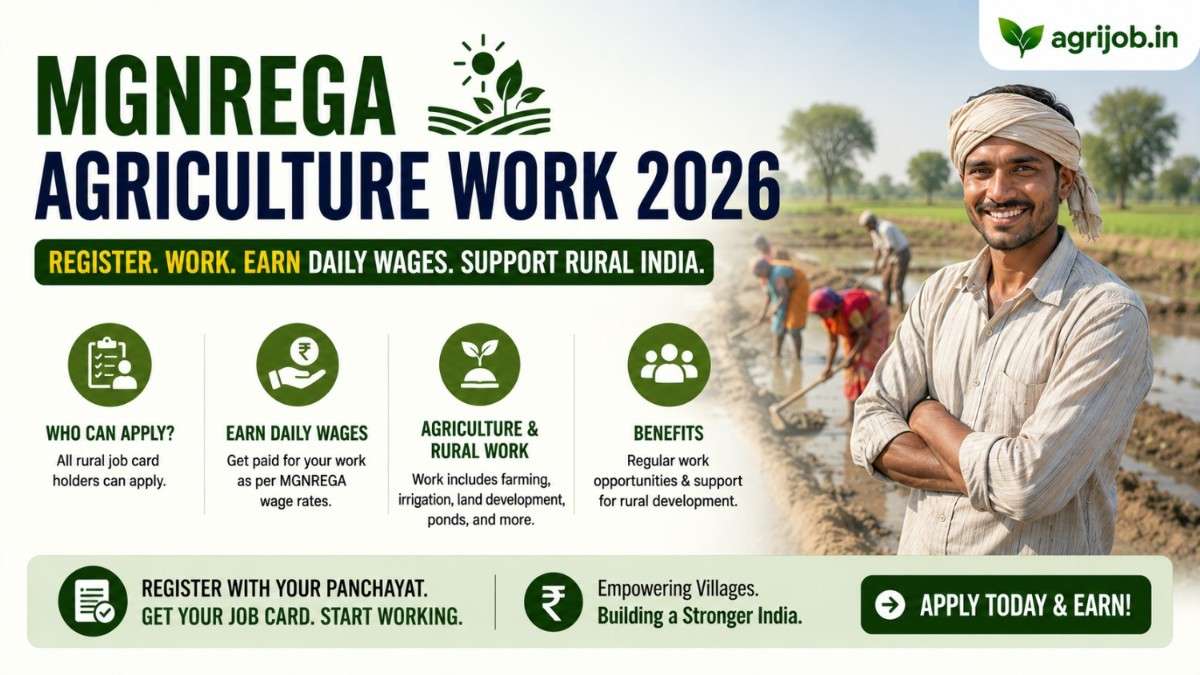
MGNREGA agriculture work 2026 is a legally guaranteed employment scheme under which every rural household in India can demand up to 100 days of paid work per financial year — including farm-related tasks like building farm ponds, digging irrigation channels, land levelling, horticulture plantation, and soil conservation — all on or near their own land. Under the Mahatma Gandhi National Rural Employment Guarantee Act (MGNREGA), the Ministry of Rural Development notified revised daily wage rates effective April 1, 2025, ranging from Rs. 267/day to Rs. 400/day depending on the state, with the national average rising to Rs. 370/day for FY 2025-26 — a 6% increase over the previous year. Over 5.66 crore rural families availed MGNREGA employment in FY 2024-25. This complete 2026 guide covers what agriculture works are permitted, how to register for your free NREGA Job Card online and offline, state-wise wage rates, how wages are paid, and how farmers can directly benefit from MGNREGA works on their own land.

| Scheme Full Name | Mahatma Gandhi National Rural Employment Guarantee Act (MGNREGA) |
| Enacted | 2005 (in force from February 2, 2006) |
| Implementing Ministry | Ministry of Rural Development, Govt. of India |
| Official Portal | nrega.nic.in |
| Guaranteed Employment | 100 days/household/year (up to 150 days for ST/drought-hit) |
| Daily Wage Range (FY 2025-26) | Rs. 267/day (lowest) to Rs. 400/day (Haryana, highest) |
| National Average Wage | Rs. 370/day (up from Rs. 349/day in FY 2024-25) |
| Annual Max Earning | Rs. 26,700 to Rs. 40,000 per household (100 days) |
| Families Covered (FY 2024-25) | Over 5.66 crore households |
| Registration Cost | Completely FREE (Job Card issued free within 15 days) |
| Wage Payment Mode | Aadhaar-Based Payment System (ABPS) — DBT to bank account |
| Works on Private Land | YES — for SC/ST, small/marginal, and BPL farmers |
| Helpline | 1800-111-555 (Ministry of Rural Development, toll-free) |
- What is MGNREGA Agriculture Work 2026?
- MGNREGA Daily Wage Rates 2026 – State-wise List
- Annual Earnings Under MGNREGA – 100 Days Calculation
- Agriculture Works Permitted Under MGNREGA
- MGNREGA Work on Farmer’s Own Land – Who Qualifies?
- Eligibility for MGNREGA Job Card Registration 2026
- Documents Required for NREGA Job Card
- How to Register for NREGA Job Card Online 2026
- How to Register Offline via Gram Panchayat
- How MGNREGA Wages Are Paid in 2026
- Who Should Apply for MGNREGA Work in 2026?
- MGNREGA Work vs Private Farm Labour – Comparison
- High-Value Rural Employment Terms You Must Know
- Frequently Asked Questions (FAQ)
What is MGNREGA Agriculture Work 2026?
The Mahatma Gandhi National Rural Employment Guarantee Act (MGNREGA) is India’s — and the world’s — largest employment guarantee programme. Enacted in 2005 and in force since February 2, 2006, it is a rights-based legal guarantee that makes the government accountable for providing paid work on demand to any rural household whose adult members are willing to do unskilled manual labour. Unlike a welfare handout, MGNREGA is a demand-driven programme: you apply for work, and the Gram Panchayat must provide employment within 15 days — or pay an unemployment allowance.
Agriculture and allied works form the backbone of MGNREGA’s permissible activity list. Farm ponds, check dams, irrigation canals, land levelling, soil conservation bunds, horticulture plantations, vermicompost pits — all these permanently improve a farmer’s land productivity while paying daily wages to the workers (who are often the farmers themselves or their family members). In FY 2025-26, the Ministry of Rural Development notified a 2.33% to 7.48% wage hike across states, with the national average moving from Rs. 349 to Rs. 370 per day — effective April 1, 2025.

A key 2026 update: under the VB-G RAM G framework, verified eligible households can now demand up to 125 days of work per financial year, up from the traditional 100-day guarantee. Aadhaar-Based Payment System (ABPS) is now mandatory for wage credit — all workers must ensure their Aadhaar is mapped to both their Job Card and their bank account.
MGNREGA Daily Wage Rates 2026 – State-wise Complete List
The MGNREGA wage rates for FY 2025-26 were notified by the Ministry of Rural Development on March 27, 2025, and came into effect from April 1, 2025. Wages are indexed annually to the Consumer Price Index for Agricultural Labourers (CPI-AL) to keep pace with rural inflation. The state-wise daily wages are:
| State / UT | Daily Wage FY 2025-26 (Rs.) | Annual Earning – 100 Days (Rs.) | % Hike vs FY 2024-25 |
|---|---|---|---|
| Haryana | Rs. 400 | Rs. 40,000 | +Rs. 26 (highest absolute hike) |
| Sikkim | Rs. 374 (general); higher in Scheduled areas | Rs. 37,400 | ~4% |
| Kerala | Rs. 371 | Rs. 37,100 | ~3.5% |
| Karnataka | Rs. 349 | Rs. 34,900 | +10.4% (one of highest %) |
| Goa | Rs. 356 | Rs. 35,600 | +7.14% (highest % FY 2024-25) |
| Andhra Pradesh | Rs. 300 | Rs. 30,000 | ~5% |
| Telangana | Rs. 300 | Rs. 30,000 | ~5% |
| Rajasthan | Rs. 266 | Rs. 26,600 | ~4% |
| Madhya Pradesh | Rs. 243 | Rs. 24,300 | ~4% |
| Chhattisgarh | Rs. 243 | Rs. 24,300 | ~5% |
| Gujarat | Rs. 280 | Rs. 28,000 | ~4% |
| Maharashtra | Rs. 297 | Rs. 29,700 | ~4% |
| Punjab | Rs. 322 | Rs. 32,200 | ~4% |
| Himachal Pradesh | Rs. 266 | Rs. 26,600 | ~4% |
| Uttarakhand | Rs. 237 | Rs. 23,700 | +3% (lowest) |
| Uttar Pradesh | Rs. 237 | Rs. 23,700 | +3% (lowest) |
| Bihar | Rs. 245 | Rs. 24,500 | ~4% |
| Jharkhand | Rs. 245 | Rs. 24,500 | ~4% |
| West Bengal | Rs. 250 | Rs. 25,000 | ~4% |
| Odisha | Rs. 254 | Rs. 25,400 | ~4% |
| Assam | Rs. 249 | Rs. 24,900 | ~4% |
| Tamil Nadu | Rs. 311 | Rs. 31,100 | ~4% |
| Arunachal Pradesh | Rs. 267 | Rs. 26,700 | ~3% |
| Nagaland | Rs. 267 | Rs. 26,700 | ~1.77% (lowest %) |
| National Average | Rs. 370 | Rs. 37,000 | ~6% |
Note: Wage rates are notified annually by the Ministry of Rural Development. The rates above reflect the FY 2025-26 notification (effective April 1, 2025). New rates for FY 2026-27 are expected to be notified in March 2026. Always check the latest notification at nrega.nic.in or the Ministry of Rural Development website for the most current figures.
Annual Earnings Under MGNREGA – 100 Days Calculation
For a rural farming household, MGNREGA employment provides a significant income supplement between crop seasons. Here is what a household can realistically earn across different states for 100 days of MGNREGA agriculture work per financial year:
| Scenario | Daily Wage | 50 Days Earning | 100 Days Earning | 150 Days Earning (ST/Drought) |
|---|---|---|---|---|
| Haryana (highest) | Rs. 400 | Rs. 20,000 | Rs. 40,000 | Rs. 60,000 |
| National Average | Rs. 370 | Rs. 18,500 | Rs. 37,000 | Rs. 55,500 |
| Bihar / Jharkhand | Rs. 245 | Rs. 12,250 | Rs. 24,500 | Rs. 36,750 |
| UP / Uttarakhand | Rs. 237 | Rs. 11,850 | Rs. 23,700 | Rs. 35,550 |
| NE States (lowest) | Rs. 267 | Rs. 13,350 | Rs. 26,700 | Rs. 40,050 |
An important fact: if the Gram Panchayat fails to provide work within 15 days of a written demand, the household is legally entitled to an unemployment allowance — a right guaranteed under the MGNREGA Act. This makes MGNREGA fundamentally different from any other government welfare scheme.
Agriculture Works Permitted Under MGNREGA 2026
The MGNREGA Schedule I lists permissible categories of work, with agriculture and water-related works forming the highest priority category. Farmers benefit both as workers earning daily wages and as landowners gaining permanent productive assets on their fields. Here are all major agriculture-related works permitted under MGNREGA:
- 🌊 Farm Pond (Dugout Pond): A water storage pond dug on a farmer’s field to collect rainwater or canal water for supplemental irrigation during dry spells. One of the most popular individual-benefit MGNREGA works — directly increases the farm’s water security and enables a second crop.
- 💧 Irrigation Canals and Field Channels: Construction of minor irrigation channels connecting water sources (wells, tanks, rivers) to agricultural fields. Micro-irrigation works including feeder channels and lift irrigation structures are also covered.
- 🏔️ Land Levelling and Development: Grading and bunding of agricultural land to improve rainwater retention, prevent soil erosion, and make the field suitable for mechanised farming. This work is allowed on land owned by SC/ST, small/marginal, and BPL farmers.
- 🌱 Horticulture Plantation: Planting of fruit trees, medicinal plants, and agroforestry species on individual farmer land. MGNREGA covers labour costs for planting and maintenance for up to 2–3 years until the trees become fruit-bearing — creating long-term income for the farmer.
- ♻️ Vermicompost Pit and NADEP Compost Pit: Construction of compost-making structures on individual farmer land, enabling low-cost organic fertilizer production. Directly reduces dependence on expensive chemical fertilizers.
- 🪨 Soil and Moisture Conservation: Building contour bunds, stone bunding, pebble bunding, boulder check structures, and gabion walls on sloping agricultural land — reduces soil erosion and increases moisture retention for rain-fed crops.
- 🏗️ Check Dam and Percolation Tank: Community water harvesting structures that capture runoff water and recharge groundwater, directly benefiting farmers in the surrounding area with improved well and borewell levels.
- 🌳 Afforestation and Tree Plantation: Drought-proofing works including plantation of trees on common land, roadsides, and degraded forest areas. Provides wage employment during lean seasons while improving the local microclimate for agriculture.
- 🏊 Renovation of Traditional Water Bodies: Desilting and restoration of village ponds (talabs), tanks, and reservoirs that have lost capacity due to siltation. Restored water bodies improve irrigation availability and groundwater recharge.
- 🚰 Dug Well / Open Well Construction: Digging new irrigation wells on SC/ST and small farmer land. Provides a permanent, independent water source for irrigation — one of the highest-impact works under MGNREGA for smallholder farmers.
- 🌾 Threshing Floor Construction: Building a permanent pucca threshing floor at the village or farm level, reducing post-harvest losses and providing a clean surface for grain processing.
- 🐄 Cattle Pond and Cattle Trough: Community water structures for livestock — directly supporting the livelihoods of pastoral and agropastoral farming households.
MGNREGA Work on Farmer’s Own Land – Who Qualifies?
One of the most powerful but least-known features of MGNREGA is the provision under Schedule I, Paragraph 1C that allows certain categories of farmers to get MGNREGA-funded works done directly on their own private agricultural land. The farmer’s family and neighbours work as MGNREGA labourers, earn the daily wage, and a permanent farm asset (like a pond or well) is created — all funded by the government:
| Farmer Category | Works Allowed on Private Land | Key Benefit |
|---|---|---|
| SC/ST farmers (any land size) | Farm pond, dug well, land levelling, horticulture, irrigation facility | Water security + wage income in one project |
| Small & marginal farmers (below 2 ha) | Same as above — all works in Para 1C | Permanent asset + Rs. 23,700–40,000/yr earning |
| BPL (Below Poverty Line) farmers | All Para 1C works including vermicompost pit | Zero-cost farm improvement + wage income |
| IAY/PMAY-G beneficiary households | Land development, bunding, horticulture | Convergence with housing scheme benefits |
| Large/general category farmers | NOT eligible for private land works | Can work as labourers on community assets |
Practical example: A Bihar SC farmer with 1.5 acres can request a farm pond under MGNREGA. The Gram Panchayat approves the work, the farmer and 2–3 neighbours work as MGNREGA labourers for 20–30 days, each earning Rs. 245/day. The farm pond — worth Rs. 50,000–80,000 in private cost — is built at zero cost to the farmer, and each worker earns Rs. 4,900–7,350 in wages. This is MGNREGA’s most impactful use for agriculture.
Eligibility for MGNREGA Job Card Registration 2026
MGNREGA has no income, caste, or educational barriers. It is one of the most universally accessible government programmes in India. The only requirements are:
- 🏡 Rural residence: Must be a resident of a rural (non-urban) area — MGNREGA does not cover urban or notified municipal areas.
- 👤 Adult household member: Any adult member (18 years or older) of a rural household willing to do unskilled manual work is eligible.
- 📝 Willingness to work: Must be willing and available to perform unskilled physical labour as assigned by the Gram Panchayat.
- 🪪 Aadhaar card: Required for ABPS wage payment mapping in 2026 — Aadhaar must be linked to the Job Card and bank account.
- 🏦 Bank account: An active bank or post office savings account linked to Aadhaar — for Direct Benefit Transfer of wages.
- 🚫 No caste or income requirement: General, OBC, SC, ST, women, persons with disabilities — all are equally eligible. There is no income ceiling for MGNREGA registration.
- 👨👩👧👦 Household registration: The NREGA Job Card is issued per household, but all adult members in the household can be listed on it and separately demand work.
Documents Required for NREGA Job Card Registration
| Document | Purpose | Mandatory? |
|---|---|---|
| Aadhaar Card | Identity verification & ABPS wage mapping | Yes (for all adult members) |
| Bank Passbook / Cancelled Cheque | DBT wage payment account linkage | Yes |
| Passport-size Photographs | Affixed to physical Job Card booklet | Yes (2 photos per household) |
| Aadhaar-linked Mobile Number | OTP verification, SMS wage alerts | Yes (for online application) |
| Caste Certificate | Priority in SC/ST private land works | For SC/ST private land works only |
| Land Records (Khata/Khasra) | Required for private land MGNREGA works | For individual land works only |
| BPL Card / Ration Card | Helps in priority processing | Optional but useful |
How to Register for NREGA Job Card Online 2026 – Step by Step
In 2026, farmers and rural workers can register for an MGNREGA Job Card through the UMANG app — the government’s unified mobile service platform — or through state-specific rural development portals:
- Download the UMANG App: Available free on Google Play Store and Apple App Store. UMANG (Unified Mobile Application for New-age Governance) provides access to over 1,200 government services including MGNREGA.
- Register on UMANG: Open the app and register using your mobile number. Verify with the OTP sent to your number. Complete your basic profile setup.
- Search for MGNREGA: Use the app’s search bar and type “MGNREGA”. The MGNREGA Service Portal will appear with multiple options.
- Select “Apply for Job Card”: Click this option to start your Job Card registration application.
- Fill your details: Enter all required information: your name, age, gender, Aadhaar number, village, Gram Panchayat, block, district, state, bank account details (IFSC code and account number), and names of all adult household members willing to work.
- Upload photograph: Upload a clear passport-size photograph of the primary applicant. Some states allow uploading photos of all adult members at this stage.
- Submit the application: Review all entries for accuracy (name on Aadhaar must exactly match bank records) and submit. Note your application reference number.
- Follow up with Gram Panchayat: Even after online submission, it is strongly recommended to follow up with your local Gram Rozgar Sahayak or Panchayat Secretary to ensure your application is processed and a physical Job Card booklet is issued within 15 working days.
How to Register for NREGA Job Card Offline via Gram Panchayat
The offline route through your Gram Panchayat office remains the most widely used and reliable method, especially in areas with limited internet connectivity:
- Visit the Gram Panchayat office: Go to your village’s Gram Panchayat during office hours. Meet the Gram Rozgar Sahayak (GRS) — the dedicated MGNREGA facilitator posted at every Gram Panchayat.
- Request the registration form: Ask for the MGNREGA Job Card Registration Form. This form is completely free — do not pay anyone claiming to charge for the form.
- Fill the form: Enter the name, age, gender, and Aadhaar number of all adult household members willing to do unskilled manual work. Provide your full address, bank account details, and Gram Panchayat name.
- Attach documents: Staple photocopies of Aadhaar cards of all members, one passport-size photograph per household, and a copy of your bank passbook (showing IFSC code and account number).
- Submit and collect acknowledgment: Hand over the completed form to the GRS or Panchayat Secretary. Always collect a written acknowledgment receipt with the submission date — this is your proof if the card is not issued within 15 days.
- Receive your Job Card: The Gram Panchayat is legally required to issue your NREGA Job Card within 15 working days of your application. The physical booklet with your photo will be handed to you at the Panchayat office or delivered to your home.
- Demand work: Once you have the Job Card, you can submit a written work demand to the Gram Rozgar Sahayak specifying the dates you want to work. Work must be provided within 15 days, or unemployment allowance is payable.
How MGNREGA Wages Are Paid in 2026
Wage payment under MGNREGA has undergone significant digital transformation in 2026. Understanding the payment system helps you avoid the most common problem — wage delays due to ABPS mapping failures:
- 📱 NMMS Attendance (mandatory from 2021): Work attendance is recorded via the National Mobile Monitoring Software (NMMS) app by the Mate (supervisor). A geo-tagged photograph of the worksite must be uploaded by 11 AM each working day — replacing the old paper muster roll. Workers should ensure their attendance is marked by the Mate every day they work.
- 📋 Muster Roll closure: Every 14 days, the muster roll closes and attendance data is submitted to the MGNREGA MIS (Management Information System) at nrega.nic.in for wage calculation.
- 💳 ABPS (Aadhaar-Based Payment System): Wages are credited exclusively via ABPS in 2026. Your Aadhaar number must be seeded to your bank account via NPCI. The wage amount calculated from your attendance is transferred directly to your bank — no intermediary, no cash.
- ⏱️ Payment timeline: Wages must be paid within 15 days of work completion. If payment is delayed beyond 15 days, workers are legally entitled to delay compensation at 0.05% of the unpaid wages per day of delay.
- 🔍 Payment tracking: Check your wage payment status anytime at nrega.nic.in by entering your Job Card number — the portal shows days marked present, wage calculated, and transaction date for every work period.
Who Should Apply for MGNREGA Agriculture Work in 2026?
MGNREGA is most impactful for certain categories of rural households. These 8 profiles benefit the most from proactive registration and work demand in 2026:
- 🌾 Small and Marginal Farmers (below 2 hectares): Can get farm ponds, irrigation wells, land levelling, and horticulture plantation done on their own land at zero cost while earning daily wages — the most powerful double benefit in MGNREGA.
- 👩🌾 Women Farmers and Rural Women: MGNREGA legally mandates that at least one-third of all workers must be women. Women receive equal wages — Rs. 267–400/day — with work sites required within 5 km. This makes it one of India’s most accessible formal employment opportunities for rural women.
- 🏘️ SC/ST Households: Eligible for private land works including farm ponds and irrigation wells regardless of land size. Priority in work allocation and special provisions under the Forest Rights Act for extended 150-day employment.
- 💧 Dryland and Rain-fed Farmers: In Rajasthan, MP, Maharashtra, and Karnataka, farm ponds and check dams built under MGNREGA can transform rain-fed single-crop farms into double-crop irrigated holdings — a game-changing infrastructure upgrade.
- 🌊 Flood and Drought-Affected Households: Areas notified as drought or flood-affected by the Ministry of Home Affairs receive an additional 50 days of MGNREGA employment (total 150 days), providing critical income security during recovery.
- 👴 Landless Agricultural Labourers: Seasonal farm workers with no land of their own can earn Rs. 23,700–40,000/year for 100 days of MGNREGA work during the agricultural off-season — reducing distress migration to cities.
- 🌱 Tribal and Forest-Fringe Farmers: ST households living in forest areas under the Forest Rights Act, 2006 receive an additional 50 days of guaranteed work (150 days total), often in afforestation, watershed development, and forest conservation works.
- 🤝 PM Kisan and Soil Health Card Beneficiaries: Farmers already benefiting from PM Kisan (Rs. 6,000/year) and Soil Health Card recommendations can stack MGNREGA earnings — a farm pond built under MGNREGA aligned with SHC recommendations creates synergy between three government schemes simultaneously.
MGNREGA Work vs Private Farm Labour – Which Pays Better?
| Factor | MGNREGA Agriculture Work | Private Farm Labour |
|---|---|---|
| Daily Wage | Rs. 237–400 (state-fixed, guaranteed) | Rs. 200–600 (seasonal, varies widely) |
| Wage guarantee | Legal right — government accountable | No guarantee; employer can default |
| Payment mode | DBT directly to bank (within 15 days) | Cash; often delayed or underpaid |
| Work availability | On demand (within 5 km, within 15 days) | Seasonal; unavailable in peak harvest |
| Annual guaranteed days | 100 days guaranteed (up to 150 for ST) | No guarantee; depends on employer need |
| Women equal pay | Yes — legally mandated | Often discriminatory lower wages |
| Unemployment allowance | Yes — if work not provided in 15 days | No protection |
| Asset created | Farm pond / well stays on your land | No lasting asset for the labourer |
| Social security | Linked to PM Kisan, PMJDY, PMFBY | No formal social security link |
High-Value Rural Employment Terms You Must Know
Understanding the MGNREGA ecosystem and related government programmes helps rural households maximise their benefits across multiple schemes simultaneously:
- 📋 NREGA Job Card: The official government-issued booklet that registers a rural household under MGNREGA and records their work history, wage payments, and employment days. The Job Card is your legal proof of entitlement — keep it safe and update it at the Gram Panchayat when family members change.
- 📱 NMMS (National Mobile Monitoring Software): The mandatory attendance app used by Mates (work supervisors) to record daily attendance with a geo-tagged photograph. Replaced paper muster rolls from 2021 — ensures transparent, real-time work verification that cannot be manipulated.
- 💳 ABPS (Aadhaar-Based Payment System): The exclusive wage payment method under MGNREGA in 2026. Links your Aadhaar number to your bank account via NPCI — eliminating intermediaries and ensuring wages reach your account within 15 days of work completion.
- 👷 Gram Rozgar Sahayak (GRS): The dedicated MGNREGA programme facilitator posted at each Gram Panchayat — your first point of contact for Job Card registration, work demands, and grievance redressal. Every Panchayat must have one.
- 🌊 Farm Pond / Dugout Pond: A water-storage structure dug on a farmer’s field under MGNREGA. Stores rainwater or surplus canal water for use in dry periods — enabling a second crop and improving farm income. One of the most impactful individual-benefit agriculture works under the scheme.
- 📊 CPI-AL (Consumer Price Index for Agricultural Labourers): The inflation index used to revise MGNREGA wages annually. Reflects the actual cost of living increase for rural agricultural labourers — the basis for the annual wage notification by the Ministry of Rural Development each March.
- 🏗️ Custom Hiring Centre (CHC): A government-supported tractor and machinery rental centre — often built using MGNREGA funds for the construction component, while SMAM provides machinery subsidies. A powerful convergence of two schemes for rural mechanisation.
- 🤝 Convergence with PMKSY: The Pradhan Mantri Krishi Sinchayee Yojana (PMKSY) often converges with MGNREGA water conservation works — farm ponds, check dams, and micro-irrigation channels are jointly planned by agriculture and rural development departments, maximising the impact of both schemes.
Frequently Asked Questions – MGNREGA Agriculture Work 2026
What is MGNREGA agriculture work 2026?
MGNREGA agriculture work 2026 refers to farm-related unskilled manual works guaranteed under the Mahatma Gandhi National Rural Employment Guarantee Act. Eligible agriculture works include building farm ponds, irrigation canals, land levelling, horticulture plantation, vermicompost pits, and soil conservation bunds. Workers earn a state-specific daily wage of Rs. 267–400 per day for up to 100 days per financial year, paid directly via Aadhaar-Based Payment System (ABPS) to their bank account.
What is the MGNREGA daily wage rate in 2026?
The MGNREGA daily wage rate for FY 2025-26 (effective April 1, 2025) was notified by the Ministry of Rural Development and ranges from Rs. 237/day in Uttar Pradesh and Uttarakhand (lowest) to Rs. 400/day in Haryana (highest in India). The national average wage is approximately Rs. 370/day — a 6% increase over the previous year’s Rs. 349. Annual earnings for 100 days range from Rs. 23,700 to Rs. 40,000 depending on the state.
How do I register for an MGNREGA job card in 2026?
Visit your Gram Panchayat office and ask the Gram Rozgar Sahayak (GRS) for the free MGNREGA registration form. Fill in the names of all adult household members willing to work, attach Aadhaar photocopies, 2 passport photos, and a bank passbook copy. The Gram Panchayat must issue your NREGA Job Card within 15 working days — completely free of charge. You can also apply online through the UMANG app under the MGNREGA service. Never pay anyone for the Job Card application.
Can farmers get MGNREGA work done on their own land?
Yes — but only for specific categories. Under MGNREGA Schedule I Paragraph 1C, SC/ST farmers, small and marginal landholders (below 2 hectares), and BPL households can get farm ponds, dug wells, horticulture plantation, land levelling, and irrigation facilities created on their own private agricultural land. The farmer’s family and neighbours work as MGNREGA labourers and earn daily wages, while the permanent farm asset is built at zero cost to the farmer.
How many days of MGNREGA work are guaranteed per year?
MGNREGA guarantees at least 100 days of wage employment per rural household per financial year. An additional 50 days (total 150 days) is provided to Scheduled Tribe households in forest areas and to households in areas affected by drought or natural calamities as notified by the Ministry of Home Affairs. Under 2026 VB-G RAM G framework updates, verified eligible households can demand up to 125 days of work.
How is the MGNREGA wage paid to workers in 2026?
From 2026, MGNREGA wages are paid exclusively via the Aadhaar-Based Payment System (ABPS) — directly to the worker’s Aadhaar-linked bank account within 15 days of work completion. Workers must ensure their Aadhaar is mapped to their NREGA Job Card and that their bank account is Aadhaar-seeded via NPCI. Daily attendance is recorded through the NMMS (National Mobile Monitoring Software) app by the site supervisor. Wage payment status can be tracked at nrega.nic.in.
What are the total annual earnings possible under MGNREGA 2026?
A rural household can earn between Rs. 23,700 (in UP/Uttarakhand at Rs. 237/day) and Rs. 40,000 (in Haryana at Rs. 400/day) for 100 days of MGNREGA work per financial year. At the national average of Rs. 370/day, 100 days of work yields Rs. 37,000 — a significant income supplement for small farming families between crop seasons. SC/ST and drought-affected households qualifying for 150 days can earn up to Rs. 60,000 in high-wage states.
What if the Gram Panchayat does not provide MGNREGA work within 15 days?
If the Gram Panchayat fails to provide work within 15 days of your written work demand, you are legally entitled to an unemployment allowance under the MGNREGA Act. The allowance rate is a percentage of the wage rate, paid by the state government. This is a legally enforceable right — file a written complaint with the Programme Officer (PO) at the Block level if work is not provided. The PO must take corrective action within the prescribed timeframe under MGNREGA rules.
Last Updated: June 2026 | This guide is regularly reviewed and updated for accuracy. Bookmark this page for the latest MGNREGA wage rates and scheme updates. For official information, always refer to nrega.nic.in, rural.nic.in, and labour.gov.in.