
Krishi Vigyan Kendra (KVK) free training 2026 is one of the most underutilised government benefits available to Indian farmers, rural youth, and farm women today. With 731+ KVKs operating across every district of India under ICAR, millions of farmers can access 100% free, certificate-bearing skill training — yet fewer than 10% of eligible beneficiaries know how to apply. This guide is for practising farmers, rural youth aged 18–35, farm women, and agricultural graduates who want to upgrade their skills, increase farm income, or start a self-employment enterprise using government-funded KVK training.

This article covers every major KVK training course available in 2026, eligibility rules, the step-by-step application process, and the income potential each course offers. Whether you grow crops, raise livestock, or want to start a food processing business from home, the right KVK training can add Rs.30,000–Rs.1,50,000 to your annual income.
KVK free training 2026 is 100% free, government-funded skill training offered at 731+ Krishi Vigyan Kendras across India under ICAR. Any Indian farmer, farm woman, or rural youth can apply with no minimum education required for most courses. Training covers 20+ topics including organic farming, mushroom cultivation, goat rearing, vermicomposting, drip irrigation, and food processing — and each programme issues an ICAR-recognised certificate on completion.
- Nodal Authority: ICAR (Indian Council of Agricultural Research), New Delhi
- Total KVKs in India (2026): 731+ (one per district)
- Training Fee: 100% Free — meals also provided by KVK
- Certificate: ICAR-recognised certificate issued on completion
- Eligibility: Farmers, farm women, rural youth — no minimum education for most courses
- Training Types: On-campus, off-campus, vocational (short 1–5 days), long-term (15–30 days)
- Courses Available: 20+ covering crops, livestock, horticulture, food processing, and more
- Income Impact: Trained farmers report Rs.30,000–Rs.1,50,000 additional annual income
- How to Find Your KVK: kvk.icar.gov.in
- Last Updated: October 2026
- What Is KVK Free Training 2026?
- Who Should Apply for KVK Training?
- 20+ KVK Training Courses: Complete List 2026
- Income Potential: How Much Can You Earn After KVK Training?
- Eligibility Criteria for KVK Training 2026
- How to Apply for KVK Training 2026 — Step-by-Step
- KVK Free Training vs Private Agricultural Courses
- Pros and Cons of KVK Training
- Important Terms Related to KVK Training
- Important Links
- Conclusion
- Key Takeaways
- Frequently Asked Questions
What Is KVK Free Training 2026? — Complete Explanation
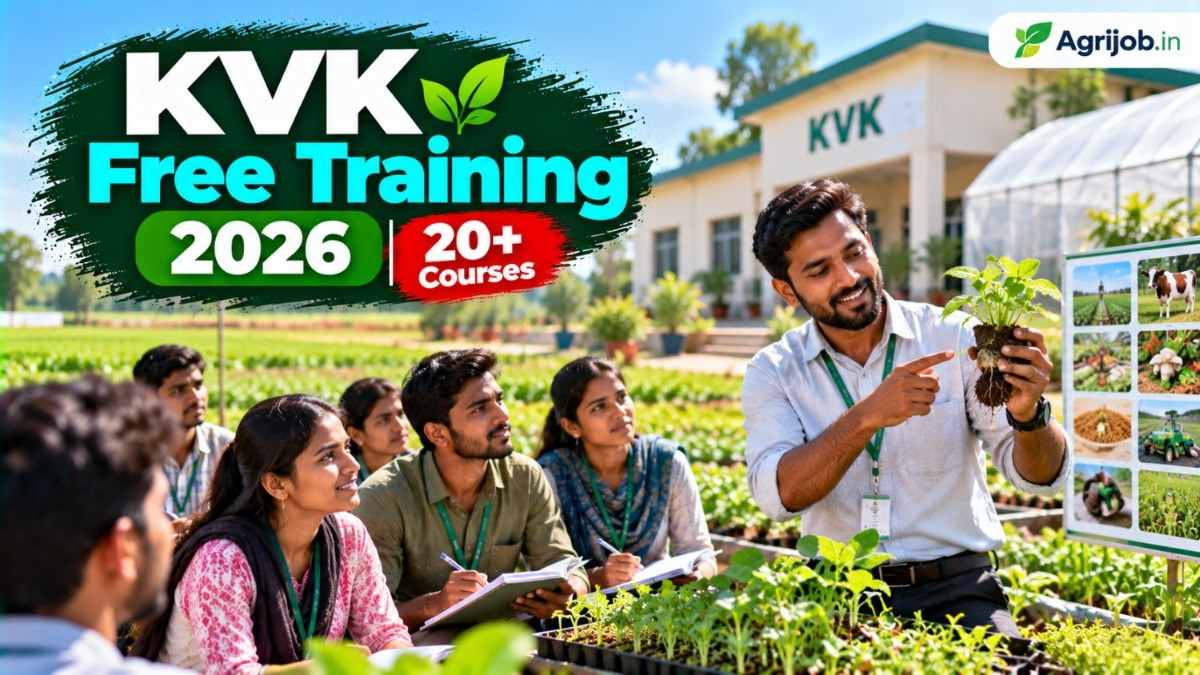
Krishi Vigyan Kendra (KVK) is a district-level Farm Science Centre established by ICAR (Indian Council of Agricultural Research) under India’s Ministry of Agriculture. KVK free training 2026 refers to the 100% government-funded vocational and skill training programmes offered at these centres to farmers, farm women, and rural youth across India. There are currently 731 KVKs operational across all Indian states and union territories, making this the largest free agricultural training network in the world.

The concept of KVK was first recommended by a committee under Dr. Mohan Singh Mehta of Seva Mandir, Udaipur, in 1973. The first KVK was established at Pondicherry in 1974 on a pilot basis. Since then, the network has grown to cover every district of India. Every KVK operates with at least 20 hectares of instructional farm land where technologies are tested and demonstrated before being taught to farmers.
KVK training is not just classroom learning — the famous “Learning by Doing” methodology means farmers practise skills on real equipment, live crops, and actual livestock during the training itself. This hands-on approach is why KVK-trained farmers show significantly better adoption rates compared to those who only attend lectures or read pamphlets.
What Are the 4 Core Mandates of KVK?
Every KVK operates under 4 official ICAR mandates: (1) On-Farm Testing (OFT) to identify location-specific technologies; (2) Front-Line Demonstrations (FLDs) on farmer fields; (3) Training of farmers and extension functionaries; and (4) Working as a Knowledge and Resource Centre for the district. Training is the most accessible mandate for ordinary farmers — and it is entirely free.
Who Should Apply for KVK Training 2026?
KVK training is designed for a wide range of beneficiaries. Here are the 8 specific profiles who benefit most from enrolling in 2026:
- 🌾 Practising Farmers — Small and marginal farmers who want to adopt new technologies to increase crop yield and reduce input costs
- 👩🌾 Farm Women — Women involved in agriculture or interested in home-based enterprises like mushroom growing, food processing, or poultry rearing
- 👨🎓 Rural Youth (aged 18–35) — Unemployed youth in villages who want to start an agri-enterprise such as goat farming, beekeeping, or vermicompost production
- 🐄 Livestock Owners — Farmers raising cattle, goats, poultry, or fisheries who want scientific knowledge on feeding, disease management, and productivity improvement
- 🥦 Vegetable and Horticulture Growers — Farmers wanting to learn protected cultivation, nursery management, or post-harvest value addition
- 🌱 Organic Farming Aspirants — Farmers wanting to transition from chemical to organic or natural farming and earn a premium price in markets
- 📱 Extension Workers and Krishi Sakhis — Block-level agricultural assistants and NGO workers who support government schemes in their district
- 🎓 Agriculture Students — BSc/MSc agriculture students looking for hands-on field training, OFT participation, and ICAR certificate experience
20+ KVK Training Courses 2026 — Complete List by Category
KVK free training courses are broadly organised into 6 major categories. The exact training calendar varies by district KVK based on local crop patterns and farmer needs — but the following 20+ courses are offered at most KVKs across India as of 2026.
Category 1: Crop Production & Soil Health
| Course Name | Duration | Key Skills Covered |
|---|---|---|
| Integrated Crop Management (ICM) | 2–3 days | Balanced nutrition, crop protection, variety selection |
| Integrated Nutrient Management (INM) | 2 days | Soil testing, organic + chemical fertiliser balance, INM planning |
| Integrated Pest & Disease Management (IPDM) | 2–3 days | Pest scouting, biocontrol agents, pesticide safety |
| Seed Production Technology | 3–5 days | Certified seed production, seed health, storage |
| Organic Farming & Certification | 3–5 days | Jeevamrutha, Beejamrutha, NPOP certification, PGS-India |
| Natural Farming Techniques | 1–2 days | Zero-budget inputs, mulching, soil microbiome |
| Precision Farming & Micro Irrigation | 2 days | Drip/sprinkler systems, PMKSY subsidy, water-use efficiency |
Category 2: Horticulture & Post-Harvest
| Course Name | Duration | Income Potential |
|---|---|---|
| Mushroom Cultivation & Spawn Production | 1–3 days | Rs.30,000–Rs.80,000/year |
| Vegetable Cultivation (Commercial) | 1–2 days | Rs.50,000–Rs.1,20,000/year |
| Nursery Management | 2 days | Rs.40,000–Rs.1,00,000/year |
| Post-Harvest Management & Value Addition | 2–3 days | Rs.20,000–Rs.60,000/year additional |
| Protected Cultivation (Polyhouse/Greenhouse) | 2 days | Rs.1,00,000–Rs.3,00,000/year |
| Kitchen Garden for Family Nutrition | 1 day | Saves Rs.10,000–Rs.20,000/year |
Category 3: Livestock, Poultry & Fisheries
- 🐐 Scientific Goat Farming — 2–3 days; covers breed selection, housing, feeding, disease prevention, and marketing of meat and milk
- 🐄 Dairy Farming & Milk Processing — 2 days; covers cattle management, AI, milk hygiene, and value addition
- 🐔 Backyard Poultry Rearing — 1–2 days; covers low-cost layer and broiler units for rural households
- 🐝 Beekeeping (Apiculture) — 2–3 days; colony management, honey extraction, marketing
- 🐟 Integrated Fish Farming — 2 days; pond management, feed management, multi-species systems
- 🐇 Rabbit & Quail Management — 1–2 days; fast-growing livestock for meat and manure
Category 4: Organic Inputs & Composting
- 🪱 Vermicomposting Technology — 1–2 days; earthworm species, pit construction, compost harvesting, packaging, and selling
- 🌿 Bio-fertiliser & Bio-pesticide Production — 2 days; Trichoderma, Pseudomonas, Rhizobium, Panchagavya preparation
- 🌾 Crop Residue Management — 1 day; in-situ decomposition, happy seeder use, avoiding stubble burning
Category 5: Rural Entrepreneurship (ARYA Scheme)
Under the ARYA (Attracting and Retaining Youth in Agriculture) scheme, KVKs specifically target rural youth aged 18–35 for enterprise-oriented training. ARYA-tagged courses at KVK often include additional input support and market linkage facilitation beyond the basic free training. Courses include goat rearing, beekeeping, mushroom cultivation, vermicompost production, food processing, and agri-tourism. This scheme is implemented by KVK as the nodal training agency in each district.
Category 6: Off-Campus Village Training
Many KVKs offer off-campus training directly in farmers’ villages. A minimum of 25 farmers from the same village need to register collectively to request an off-campus training session. The KVK scientist travels to the village, conducts hands-on demonstrations, and distributes inputs. This is particularly useful for elderly or women farmers who cannot travel to the KVK campus.
ICAR studies show that farmers trained in mushroom cultivation who continued the enterprise increased their family income by an average of 24%, while those trained in beekeeping saw an income increase of 49%. Choose a KVK course in the enterprise that suits your land size, local market, and available time — not just the most popular one.
Income Potential: How Much Can Farmers Earn After KVK Training?
KVK free training directly translates into additional household income when the skill is put into practice. Below is a realistic income projection for the most popular training courses based on farmer feedback collected by ICAR KVKs across India.
| Training Course | Startup Cost (Approx.) | Monthly Income Potential | Annual Additional Income |
|---|---|---|---|
| Mushroom Cultivation | Rs.5,000–Rs.15,000 | Rs.3,000–Rs.8,000 | Rs.36,000–Rs.96,000 |
| Goat Farming (10 goats) | Rs.30,000–Rs.60,000 | Rs.5,000–Rs.12,000 | Rs.60,000–Rs.1,44,000 |
| Vermicomposting (small unit) | Rs.3,000–Rs.8,000 | Rs.2,000–Rs.5,000 | Rs.24,000–Rs.60,000 |
| Beekeeping (5 boxes) | Rs.10,000–Rs.20,000 | Rs.3,000–Rs.8,000 | Rs.36,000–Rs.96,000 |
| Commercial Vegetable Farming (1 bigha) | Rs.10,000–Rs.25,000 | Rs.5,000–Rs.15,000 | Rs.60,000–Rs.1,80,000 |
| Backyard Poultry (50 birds) | Rs.5,000–Rs.12,000 | Rs.2,000–Rs.5,000 | Rs.24,000–Rs.60,000 |
| Post-Harvest Value Addition | Rs.5,000–Rs.20,000 | Rs.3,000–Rs.10,000 | Rs.36,000–Rs.1,20,000 |
| Nursery Management | Rs.10,000–Rs.25,000 | Rs.4,000–Rs.10,000 | Rs.48,000–Rs.1,20,000 |
Note: Income figures are based on farmer surveys conducted by ICAR KVKs. Actual income depends on market prices, local demand, land availability, and enterprise scale. As per ICAR data (check icar.org.in for latest figures).
Eligibility Criteria for KVK Training 2026
KVK training has very inclusive eligibility rules — designed so that no farmer is excluded due to lack of formal education. Here is the complete eligibility framework for 2026:
- ✅ Age: No strict minimum or maximum for most courses (ARYA scheme targets youth aged 18–35 specifically)
- ✅ Education: No minimum education required for vocational/short-term training; Class 10 pass preferred for certificate courses
- ✅ Occupation: Practising farmer, farm woman, rural youth, self-help group member, livestock owner, extension worker
- ✅ Geography: Priority given to farmers from the KVK’s operational district; off-district applicants accepted based on seat availability
- ✅ Income: Preference to small and marginal farmers and Below Poverty Line (BPL) beneficiaries; no income bar for general admission
- ✅ Gender: Open to all — dedicated programmes for farm women are organised separately in most KVKs
- ✅ Caste: Special reserved batches for SC/ST farmers under ICAR’s TSP (Tribal Sub Plan) and SC Sub Plan schemes
| Applicant Category | Minimum Eligibility | Special Benefits |
|---|---|---|
| Practising Farmer | Must be engaged in farming | Free meals, certificate, input kits |
| Farm Woman | No minimum education | Dedicated women batches, SHG linkage |
| Rural Youth (18–35) | Class 8 preferred | ARYA scheme — enterprise support, market linkage |
| SC/ST Farmer | No minimum | Free inputs distributed post-training under TSP |
| Agriculture Graduate | BSc Agriculture or equivalent | Research linkage, internship certificates |
| Extension Worker | Working in agriculture dept. | In-service training with TA/DA from employer |
How to Apply for KVK Training 2026 — Step-by-Step Process
There is no single centralised national portal for KVK farmer training applications — each district KVK manages its own registration. However, the process is the same across all KVKs and is very simple:
- Find Your District KVK: Visit kvk.icar.gov.in and use the interactive map or state/district dropdown to find your nearest KVK. Each KVK listing includes address, phone number, email, and website link.
- Check the Training Calendar: Visit your district KVK’s website or call the Programme Coordinator to ask for the current training calendar. Most KVKs publish a monthly or quarterly calendar showing course names, dates, and venue (on-campus or village).
- Submit Your Application: Applications can be submitted in three ways — (a) visit the KVK in person and register with the scientist; (b) send an email to the KVK’s official email with your name, village, mobile number, and the training you wish to attend; or (c) call the KVK on their published phone number to register over the phone.
- Receive Confirmation: The KVK will inform you of your selection by phone or SMS. Selection is based on eligibility criteria including age, income, farming background, and availability of materials for the chosen training.
- Attend Training: On the training day, arrive at the KVK campus or village venue as directed. Bring your Aadhaar card, a passport-size photo, and any documents relevant to your farming activity (land record, farmer ID, etc.).
- Collect Your Certificate: At the end of the training programme, an ICAR-recognised participation/completion certificate is issued. This certificate is valuable for bank loan applications, government scheme eligibility, and FPO membership.
If you cannot travel to the KVK campus, organise a group of at least 25 farmers from your village and request an off-campus training programme from your district KVK. The KVK scientist will come to your village, and the training is still 100% free. This is the most convenient option for women farmers and elderly farmers.
KVK Free Training vs Private Agricultural Courses — Which Is Better?
| Parameter | KVK Free Training 2026 | Private Agricultural Courses |
|---|---|---|
| Cost | 100% Free — meals also included | Rs.5,000–Rs.50,000 per course |
| Certificate | ICAR-recognised (useful for bank loans) | Private institute certificate (variable value) |
| Eligibility | No minimum education — open to all | Often requires Class 10/12 or graduation |
| Duration | 1–30 days (flexible, near home) | 1 month to 1 year (often requires relocation) |
| Technology | Location-specific, field-tested by ICAR | Generalised or commercially promoted |
| Market Linkage | Facilitated through FPOs, ARYA scheme | Not typically provided |
| Input Support | SC/ST farmers receive free inputs post-training | No input support |
| Reach | 731+ centres — available in every district | Concentrated in urban and peri-urban areas |
| Follow-up Support | KVK scientists available for on-farm consultancy | Limited or paid consultancy |
| Best For | Practising farmers, rural youth, farm women | Agriculture students, urban entrepreneurs |
For practising farmers and rural youth, KVK free training is the clear winner in 2026. It is free, location-specific, uses ICAR-tested technology suited to your district’s soil and climate, and comes with an official certificate that banks and government schemes recognise. Private courses are only worth considering when you need advanced specialisation beyond what your local KVK offers, or when you are targeting urban agri-business markets.
Advantages and Disadvantages of KVK Training 2026
Advantages of KVK Free Training
- ✅ Completely Free — No tuition fee, no registration fee; KVK even covers meals during on-campus training
- ✅ ICAR-Recognised Certificate — Certificate is accepted by banks for agri-loan applications and by government agencies for scheme eligibility
- ✅ Location-Specific Technology — Training is based on technologies OFT-tested in your own district’s climate and soil conditions
- ✅ Hands-On Learning — “Learning by Doing” method produces real skill retention, not just theoretical knowledge
- ✅ Ongoing Support — KVK scientists remain contactable post-training for on-farm diagnosis and advice
- ✅ Enterprise Linkage — ARYA and other ICAR schemes connect trained youth to FPOs, bank loans, and market networks
Disadvantages of KVK Training
- ⚠️ No Central Portal — Application process varies by district; some KVKs lack updated websites, making it hard to find training calendars online
- ⚠️ Limited Seats — Popular courses fill up quickly; early registration is essential
- ⚠️ Short Duration — Most courses are 1–5 days, which is sufficient for basics but not for deep specialisation
- ⚠️ Quality Variation — The depth and quality of training varies across KVKs depending on available scientists and infrastructure
Important Terms Related to KVK Free Training 2026
- ICAR (Indian Council of Agricultural Research): The apex government body funding all 731+ KVKs. Funded 100% from the central government budget. Official portal: icar.org.in
- ATARI (Agricultural Technology Application Research Institute): 11 ICAR zonal offices that supervise KVKs regionally. All KVKs report to their respective ATARI.
- OFT (On-Farm Testing): KVK trials new crop varieties and technologies at actual farmer fields before training farmers to use them.
- FLD (Front-Line Demonstration): Live demonstration of proven technology on farmer fields to generate production data and build farmer confidence.
- ARYA Scheme: Attracting and Retaining Youth in Agriculture — ICAR scheme that provides enterprise-based training and start-up support to rural youth aged 18–35 through KVKs.
- Vermicomposting: Production of organic manure using earthworms (Eisenia foetida). KVK-trained farmers sell vermicompost at Rs.5–Rs.10 per kg, generating Rs.24,000–Rs.60,000/year from a small unit.
- PKVY (Paramparagat Krishi Vikas Yojana): Government scheme for organic farming cluster development. KVKs serve as nodal training centres in many districts under PKVY.
- PMKSY (Pradhan Mantri Krishi Sinchai Yojana): Drip and sprinkler irrigation subsidy scheme. KVK precision farming training includes guidance on availing PMKSY subsidy — up to 90% for SC/ST farmers.
- PGS-India (Participatory Guarantee System): Low-cost organic certification system operated through KVKs for small farmer groups. Certified produce fetches Rs.2–Rs.5 per kg premium in local markets.
- Jeevamrutha / Beejamrutha: Natural farming inputs taught at KVK natural farming courses. Jeevamrutha costs less than Rs.50 to prepare per litre and replaces chemical fertilisers for many crops.
Important Links — KVK Training 2026
| Resource | Link |
|---|---|
| Find Your District KVK (Official Portal) | kvk.icar.gov.in |
| ICAR Official Website | icar.org.in |
| ARYA Scheme (Rural Youth Enterprise) | icar.org.in/content/arya |
| National Centre for Organic & Natural Farming | ncof.dacnet.nic.in |
| PM Kisan Samman Nidhi (farmer ID linked to KVK) | pmkisan.gov.in |
| Agrijob.in — ICAR & Agriculture Jobs Guide | Agrijob.in |
| NDRI Karnal Free Dairy Training Guide | NDRI Karnal Training 2026 |
Conclusion — Final Thoughts on KVK Free Training 2026
KVK free training 2026 remains the single most accessible, most affordable, and most location-relevant skill development programme available to Indian farmers today. With 731+ Kendras covering every district, a massive catalogue of 20+ courses in crop science, livestock, organic farming, and food processing — and a 100% free entry with meals — there is no logical reason for any farmer, farm woman, or rural youth to miss this opportunity.
The key is to act early: contact your district KVK, ask for the current training calendar, register for 2–3 courses aligned with your farming goals, and use the resulting ICAR certificate to access bank loans and government scheme benefits. The best course for you is the one that matches your land size, existing resources, local market demand, and available time — not just the most popular one.
Visit kvk.icar.gov.in today to find your nearest KVK and register for free training. Bookmark this page — we update it every time ICAR releases new training programme information.
- KVK free training 2026 is 100% funded by ICAR — no fees, no minimum education required for most courses
- India has 731+ KVKs covering every district; your nearest one is accessible via kvk.icar.gov.in
- Top courses include mushroom cultivation, goat farming, vermicomposting, organic farming, and drip irrigation
- Trained farmers can earn Rs.30,000–Rs.1,80,000 additional income per year depending on the enterprise
- ICAR-issued completion certificate is recognised by banks for agricultural loan applications
- Apply by contacting your district KVK directly — by phone, email, or in person — before seats fill up
Frequently Asked Questions About KVK Free Training 2026
Is KVK training completely free for all farmers in 2026?
Yes. KVK free training 2026 is 100% funded by ICAR (Indian Council of Agricultural Research) from the central government budget. There is no registration fee, no course fee, and no material cost for trainees. Most KVKs also provide free meals during on-campus training sessions. SC/ST farmers additionally receive free inputs like seeds, vermicompost starter kits, or bio-fertilisers after completing training under ICAR’s Special Component Plan and Tribal Sub Plan schemes.
What is the minimum educational qualification to join KVK training?
For most short-term and vocational training programmes, there is no minimum educational qualification required. Any practising farmer, farm woman, rural youth, or livestock owner can join. For certificate courses lasting 15–30 days, some KVKs prefer applicants who have passed at least Class 8 or Class 10, though this is a preference rather than a strict bar. Agriculture graduates can access internship-level training with deeper research exposure.
How do I find and contact my nearest Krishi Vigyan Kendra?
Visit the official ICAR KVK portal at kvk.icar.gov.in and use the state/district search or the interactive map to locate your district’s KVK. Each listing includes the full address, phone number, Programme Coordinator’s name, and official email ID. You can also contact your Block Agriculture Officer (BDO/BAO) who will have the local KVK contact details.
How long does KVK training last and will I get a certificate?
KVK training duration ranges from 1 day (awareness programmes) to 30 days (long-term vocational courses). The most common format is 2–5 day short-term training. Upon successful completion, the KVK issues an ICAR-recognised participation certificate. This certificate is accepted by banks like SBI and Bank of Baroda for processing agricultural enterprise loans, and is useful for FPO membership and government scheme applications.
Can farm women apply separately for KVK training?
Yes. Most KVKs conduct dedicated training batches for farm women, often focusing on home-based enterprises such as mushroom cultivation, backyard poultry, pickle and preserve making, vermicomposting, and kitchen gardening. Farm women who form Self-Help Groups (SHGs) can also request KVK scientists to conduct village-level training at their village with no travel required, provided the group has at least 25 participants.
Is there any stipend or allowance paid during KVK training?
KVK training is not stipend-bearing for regular on-campus programmes — however, meals are provided free during training. For in-service training (for government extension workers), the trainee’s department typically pays TA/DA as per service rules. Under the ARYA scheme for rural youth, selected entrepreneurs may receive enterprise start-up support including seed capital or input kits worth Rs.5,000–Rs.25,000 after completing training and submitting an enterprise plan.
Which KVK training course is best for increasing farm income quickly?
For fastest income addition, mushroom cultivation and vermicomposting are the best KVK training choices in 2026. Mushroom cultivation requires a startup investment of just Rs.5,000–Rs.15,000 and can generate Rs.3,000–Rs.8,000 per month within 45–60 days of starting. Vermicomposting is equally low-cost to start and provides both soil-improving inputs for your own farm and a sellable product. Beekeeping offers the highest reported income increase — up to 49% additional family income according to ICAR Punjab research — but requires 2–3 years to build up to optimal colony size.
Can KVK training certificates be used to get a bank loan?
Yes. KVK-issued training certificates — particularly those from vermicompost, mushroom cultivation, goat farming, and beekeeping courses — are recognised by public sector banks like SBI, Bank of Baroda, and NABARD for agricultural enterprise loans under KCC (Kisan Credit Card) and MUDRA Shishu/Kishore schemes. Some KVKs, like KVK Kannur, have established dedicated loan windows with SBI at the KVK campus itself for trained beneficiaries.
How many KVKs are there in India in 2026 and which states have the most?
As of May 2025, there are approximately 731 KVKs across India, with at least one in every district. States with the largest number of KVKs include Uttar Pradesh, Maharashtra, Rajasthan, and Madhya Pradesh due to their large number of agricultural districts. All KVKs operate under 11 ICAR-ATARI zonal offices. The complete district-wise list is available at the official ICAR KVK dashboard at kvk.icar.gov.in/dashboard.aspx.
Disclaimer: Training programme availability, dates, and eligibility criteria vary by district KVK. Information in this guide is compiled from official ICAR sources and individual KVK websites as of October 2026. Always verify current training schedules directly with your district KVK before travelling. This article does not guarantee admission to any specific training programme.
Last Updated: October 2026 | This guide is reviewed and updated regularly for accuracy. Bookmark this page for the latest KVK training information.