

ICAR — Indian Council of Agricultural Research — is India’s apex body for coordinating, guiding, and managing agricultural research and education, and it directly shapes what ends up on 1.4 billion plates every day. Established on 16 July 1929, ICAR today oversees 113 research institutes and 74 agricultural universities across the country — one of the largest national agricultural systems in the world. This guide is for students, agriculture graduates, UPSC aspirants, farmers, and anyone who wants to understand exactly what ICAR does, why it matters, and how it transformed India from a food-deficit nation into the world’s second-largest agricultural producer. You will find ICAR’s full form, founding history, core objectives, key institutes, landmark achievements, current initiatives for 2026, and answers to all frequently asked questions — in one complete reference.

ICAR stands for Indian Council of Agricultural Research — an autonomous body under the Department of Agricultural Research and Education (DARE), Ministry of Agriculture and Farmers Welfare, Government of India. Founded on 16 July 1929 and headquartered in New Delhi, ICAR oversees 113 research institutes and 74 agricultural universities, and played a direct role in India achieving its record foodgrain output of 376.56 million tonnes in 2025–26.
- Full Form: Indian Council of Agricultural Research
- Founded: 16 July 1929 (as Imperial Council of Agricultural Research)
- Headquarters: Krishi Bhawan, New Delhi
- Type: Autonomous Organisation under Government of India
- Parent Ministry: Ministry of Agriculture and Farmers Welfare (via DARE)
- President of ICAR: Union Minister of Agriculture and Farmers Welfare
- Research Institutes: 113 national institutes
- Agricultural Universities: 74 universities affiliated/coordinated
- Krishi Vigyan Kendras (KVKs): 731+ district-level extension centres
- Varieties Released (2025–26): 339 crop varieties for different agro-climatic zones
- India’s Foodgrain Output 2025–26: Record 376.56 million tonnes (est.)
- Official Website: icar.org.in
📋 Table of Contents
- What Is ICAR? Full Form and Definition
- History and Founding of ICAR
- Who Should Read This Guide?
- Core Objectives of ICAR
- Key Functions and Roles of ICAR in Indian Agriculture
- Major ICAR Research Institutes and Universities
- ICAR and the Green Revolution — India’s Food Security Story
- Landmark Achievements of ICAR (2026 Updated)
- ICAR vs DARE — What Is the Difference?
- ICAR’s Current Initiatives and Programmes in 2026
- Advantages and Challenges of ICAR
- Important Terms Related to ICAR and Agricultural Research
- Important Links
- Conclusion
- Key Takeaways
- Frequently Asked Questions About ICAR
What Is ICAR? Full Form and Definition
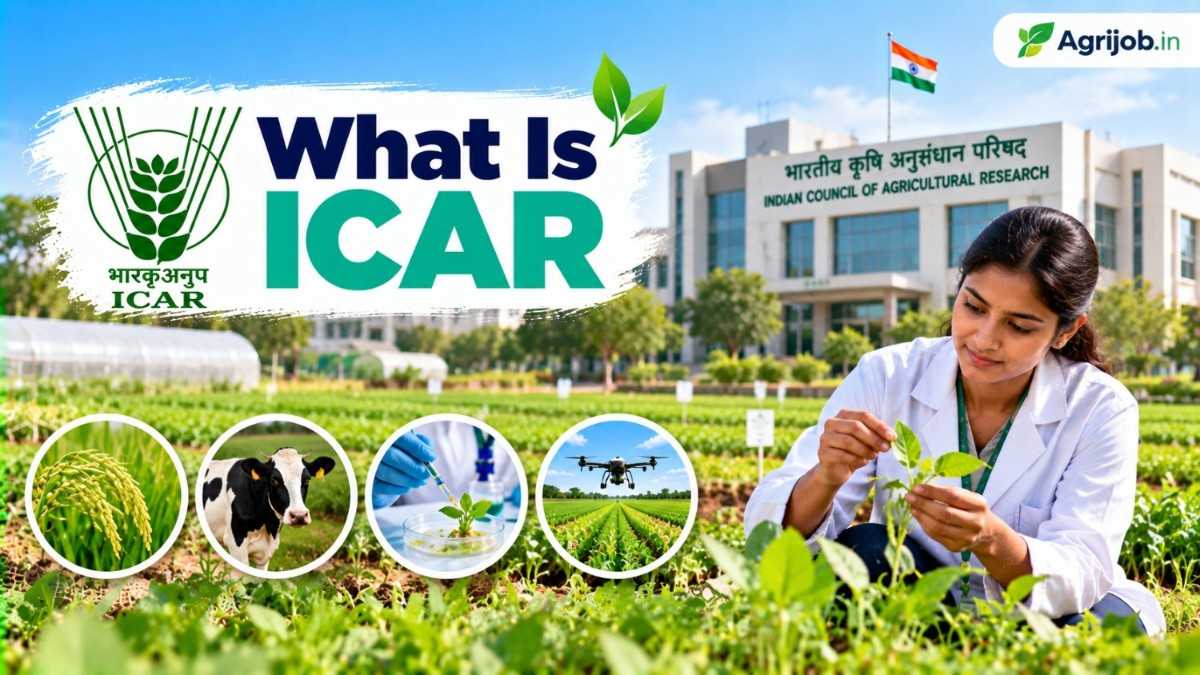
ICAR full form is Indian Council of Agricultural Research. It is the apex autonomous organisation in India responsible for coordinating, guiding, and managing all research and education in agriculture — including horticulture, fisheries, and animal sciences — across the entire country. ICAR operates under the Department of Agricultural Research and Education (DARE), which falls under the Ministry of Agriculture and Farmers Welfare, Government of India.
In plain terms: if a farmer in Punjab grows a new high-yield wheat variety, if a fisherman in Kerala adopts disease-resistant fish stock, or if a student at an agricultural college in Karnataka earns a quality degree — there is a very high probability that ICAR’s research, accreditation, or technology sits behind that outcome. ICAR is not a university, not a ministry, and not a regulator in the traditional sense. It is India’s national engine for agricultural science — bridging research laboratories and farm fields.

The Union Minister of Agriculture and Farmers Welfare serves as the President of ICAR, while the Director General of ICAR leads day-to-day operations. ICAR is formally recognised as one of the largest national agricultural research systems in the world, comparable to systems in the United States (USDA-ARS) and China’s Chinese Academy of Agricultural Sciences.
History and Founding of ICAR
ICAR was established on 16 July 1929 as the Imperial Council of Agricultural Research under British colonial administration, reflecting the colonial government’s need for systematic agricultural science in India. After independence in 1947, the organisation was renamed the Indian Council of Agricultural Research, reflecting its national character and expanded mandate to serve independent India’s food and livelihood goals.
In 1966, all major agricultural research institutes across the country were brought under ICAR’s purview — a landmark consolidation that gave India a unified, nationally coordinated research architecture for the first time. This structural decision proved critical: it meant that when the Green Revolution arrived in the late 1960s, India had one central body capable of scaling high-yield variety (HYV) programmes rapidly across states. ICAR celebrated its 97th Foundation Day on 16 July 2025, marking nearly a century of continuous contribution to Indian agriculture.
ICAR — Timeline of Key Milestones
| Year | Milestone |
|---|---|
| 1929 | Established as Imperial Council of Agricultural Research under British rule |
| 1947 | Renamed Indian Council of Agricultural Research after Independence |
| 1966 | All national agricultural research institutes brought under ICAR |
| 1966–79 | Green Revolution — ICAR develops HYV wheat and rice, foodgrain output rises by 2.7 MT annually |
| 1970s–80s | White Revolution — ICAR supports dairy research via NDRI and Operation Flood |
| 2006 | ICAR develops climate-resilient agriculture strategies |
| 2008 | India-Brazil-South Africa Joint Working Group on Agriculture initiated |
| 2024 | Launched ‘One Scientist–One Product’ programme to deepen research focus |
| 2025 | 97th Foundation Day; India’s foodgrain output reaches record 353.95 MT in 2024–25 |
| 2025–26 | Released 339 crop varieties; foodgrain production estimated at record 376.56 MT |
| July 2026 | Released India’s first hectare-level digitised soil texture map |
Who Should Read This Guide?
- 🎓 UPSC and State PSC aspirants — ICAR features regularly in General Studies and Agriculture optional papers; this guide covers all exam-relevant facts.
- 🌾 Agriculture students and researchers — Understand the institution that shapes your curriculum, funding, and career opportunities.
- 👩🔬 Scientists and PhD scholars in agricultural sciences — ICAR’s network of 113 institutes is your primary research ecosystem for grants, fellowships, and collaborative projects.
- 👨🌾 Farmers and progressive agriculturists — Know where India’s best crop varieties, pest management solutions, and farming technologies originate.
- 💼 Government job seekers — ICAR recruits annually through ASRB (Agricultural Research Service); knowing the organisation improves your interview performance.
- 📰 Journalists and policy researchers — ICAR data and reports are primary sources for India’s agricultural policy analysis.
- 📚 School and college students — This is the complete reference for ICAR class notes, assignments, and competitive exam preparation.
- 🏢 Agri-business professionals and startups — ICAR technology licensing, public-private partnerships, and innovation programmes are open to industry.
Core Objectives of ICAR
ICAR’s mandate is built around five core objectives that together define its role in India’s agricultural and scientific ecosystem. These objectives are not abstract — each one translates into funded programmes, active research stations, and measurable outcomes that affect millions of farmers every year.
- Plan, undertake, aid, promote, and coordinate agricultural research — ICAR designs the national research agenda for crops, livestock, fisheries, and natural resources, and ensures that research efforts across 113 institutes do not overlap or contradict each other.
- Provide higher education and training in agriculture and allied sciences — ICAR accredits and supports 74 agricultural universities and four deemed universities, ensuring that India’s agricultural graduates meet global standards.
- Apply and transfer research findings to farmers — Through 731+ Krishi Vigyan Kendras (KVKs) and Agricultural Technology Application Research Institutes (ATARIs), ICAR bridges the gap between laboratory science and farm-level adoption.
- Enhance food and nutritional security — ICAR directs research toward high-yield, biofortified, and climate-resilient crop varieties that increase production while improving nutritional quality for India’s population.
- Advance sustainable and climate-smart agriculture — Through programmes like the National Innovations in Climate Resilient Agriculture (NICRA), ICAR builds India’s agricultural resilience against climate change, water scarcity, and soil degradation.
Key Functions and Roles of ICAR in Indian Agriculture
Understanding what ICAR actually does requires going beyond its mandate and examining its operational functions — the real-world activities that make it indispensable to Indian agriculture.
1. Agricultural Research and Development
ICAR’s primary function is conducting and coordinating cutting-edge research in agronomy, plant genetics, soil science, animal health, fisheries, post-harvest technology, and agricultural engineering. During 2025–26 alone, ICAR released 339 crop varieties suited to different agro-climatic regions, alongside 152 production and protection technologies. Over the 2014–2025 period, ICAR developed and released 3,821 high-yielding varieties, including 3,103 climate-resilient and 205 biofortified varieties — a scale of scientific output unmatched by any other agricultural institution in India.
2. Education and Accreditation of Agricultural Universities
ICAR provides accreditation to agricultural universities, colleges, and programmes through its National Agricultural Education Accreditation Board (NAEAB). This is not a mandatory affiliation process, but it signals quality: an accredited institution meets ICAR’s curriculum standards, infrastructure norms, and research output benchmarks. ICAR also designs model curricula for undergraduate, postgraduate, and doctoral programmes in agriculture and allied sciences, ensuring national consistency in what India’s 74 agricultural universities teach.
3. Technology Extension via Krishi Vigyan Kendras (KVKs)
One of ICAR’s most impactful functions is its network of 731+ Krishi Vigyan Kendras (KVKs) — district-level farm science centres spread across every agro-climatic zone in India. KVKs translate ICAR’s laboratory research into farmer-ready demonstrations, training programmes, and frontline extension services. They serve as the last-mile link between a new variety released in a research station and the farmer who will grow it on the field. KVKs also conduct on-farm trials, provide seed distribution, and offer vocational training in modern farming practices.
4. Policy Advisory to the Government
ICAR provides scientific and technical advice to the Union and State governments on agricultural policies, schemes, and programmes. All major agriculture missions announced in India’s Union Budget 2025–26 are closely aligned with ICAR’s mandate. ICAR’s data, variety releases, and technology assessments directly inform procurement policies, minimum support price (MSP) decisions, and crop insurance frameworks.
5. International Collaboration
ICAR maintains active partnerships with global institutions including the Food and Agriculture Organisation (FAO), the Consultative Group on International Agricultural Research (CGIAR), the International Food Policy Research Institute (IFPRI), and bilateral partnerships with countries including the USA, Israel, Australia, and Brazil. These collaborations bring cutting-edge genetic resources, climate models, and agricultural technologies into India’s research pipeline.
Major ICAR Research Institutes and Universities
ICAR’s 113 research institutes are spread across all major agro-climatic zones of India, with each institute specialising in a specific crop, livestock species, fishery type, or natural resource domain. The four ICAR Deemed Universities represent the pinnacle of agricultural higher education in India.
ICAR’s Four Deemed Universities
| Institute | Location | Primary Focus |
|---|---|---|
| Indian Agricultural Research Institute (IARI) — “Pusa Institute” | New Delhi | Crop improvement, soil science, post-harvest technology, agricultural engineering |
| National Dairy Research Institute (NDRI) | Karnal, Haryana | Dairy science, animal nutrition, milk processing, livestock genetics |
| Indian Veterinary Research Institute (IVRI) | Izatnagar, Uttar Pradesh | Animal health, veterinary vaccines, livestock disease management |
| Central Institute of Fisheries Education (CIFE) | Mumbai, Maharashtra | Fisheries science, aquaculture management, marine biology education |
Key National Research Institutes by Sector
| Institute | Location | Research Focus |
|---|---|---|
| National Rice Research Institute (NRRI) | Cuttack, Odisha | Rice varietal development, paddy agronomy |
| Central Potato Research Institute (CPRI) | Shimla, Himachal Pradesh | Potato breeding, cold storage technology |
| Central Arid Zone Research Institute (CAZRI) | Jodhpur, Rajasthan | Dryland farming, desertification control |
| Central Marine Fisheries Research Institute (CMFRI) | Kochi, Kerala | Marine fisheries, mariculture, coral reef research |
| Central Plantation Crops Research Institute (CPCRI) | Kasaragod, Kerala | Coconut, arecanut, cocoa research |
| Indian Institute of Horticultural Research (IIHR) | Bengaluru, Karnataka | Fruits, vegetables, floriculture, spices |
| Central Institute for Cotton Research (CICR) | Nagpur, Maharashtra | Cotton breeding, pest management |
| Indian Institute of Millets Research (IIMR) | Hyderabad, Telangana | Millets improvement, nutrition research |
| Central Soil Salinity Research Institute (CSSRI) | Karnal, Haryana | Soil health, salinity management, land reclamation |
| National Academy of Agricultural Research Management (NAARM) | Hyderabad, Telangana | Agricultural management education, leadership training |
ICAR and the Green Revolution — India’s Food Security Story
No story about ICAR is complete without the Green Revolution. When India faced severe food shortages in the mid-1960s and was critically dependent on food aid, it was ICAR’s scientific network that provided the technological backbone for one of the most dramatic agricultural turnarounds in history.
During the Green Revolution period (1966–1979), ICAR coordinated the development and mass distribution of high-yielding varieties (HYVs) of wheat and rice bred to respond powerfully to irrigation and chemical fertilisers. The result: India’s foodgrain production grew by approximately 2.7 million tonnes per year during the Green Revolution era. Between 1950–51 and 2021–22, ICAR’s cumulative contribution to Indian agriculture produced extraordinary results — foodgrain production grew 6.21 times, fish production grew 21.61 times, milk output grew 13.01 times, and egg production grew a staggering 70.74 times.
Today, 85% of India’s wheat area is under ICAR-developed varieties — a direct legacy of Green Revolution research that continues to deliver results. In 2025–26, India achieved its projected highest-ever foodgrain output of 376.56 million tonnes, with rice at 154.02 MT, wheat at 120.65 MT, and maize reaching a record 55.09 MT — all primarily under ICAR varieties. From 2013–14 to 2025, annual foodgrain production growth accelerated to 8.1 million tonnes per year — three times the Green Revolution era rate.
For UPSC and competitive exam preparation, remember this key fact: ICAR’s contribution to India’s food self-sufficiency is measured not just in yield numbers but in the entire system it built — from seed to soil science to farmer training. The Green Revolution was not just about imported Mexican wheat seeds; it was ICAR that adapted, tested, and disseminated those varieties for Indian conditions at national scale. This distinction is frequently tested in examinations.
Landmark Achievements of ICAR (2026 Updated)
ICAR’s track record across nearly a century of operation includes achievements that span crop genetics, disaster response, climate adaptation, and technology innovation. Below are the most significant milestones with current data.
- Green Revolution leadership (1966–79): Developed and scaled HYV wheat and rice varieties that ended India’s food import dependency within a decade.
- 3,821 varieties in 11 years (2014–2025): Released 3,103 climate-resilient and 205 biofortified crop varieties — more than any equivalent period in ICAR’s history.
- Record foodgrain output 2025–26: India’s estimated production of 376.56 million tonnes represents a 46% increase over 2014–15, with ICAR varieties underpinning the majority of area coverage.
- India’s first soil texture map (July 2026): ICAR released a hectare-level digitised soil texture map of India — the first of its kind — enabling precision farming and targeted soil health interventions at a scale previously impossible.
- Genome editing in 40 crops: ICAR is currently advancing genome editing research across 40 crop species to build next-generation climate resilience and nutritional value.
- 679 field crop varieties released (97th Foundation Day period): Including 27 bio-fortified varieties designed to address nutritional deficiencies in vulnerable populations.
- 115.3 MT wheat production: With 85% of wheat area under ICAR varieties, India’s wheat output reached this milestone level confirming ICAR’s continued dominance in variety adoption.
- White Revolution support: ICAR’s NDRI and dairy research network supported India’s milk production growth from under 30 MT in 1970 to over 230 MT in 2024–25 — making India the world’s largest milk producer.
- Sugarcane record 2025–26: Sugarcane production reached 500.06 million tonnes — a record — partly attributed to ICAR sugar crop research institutes.
- ‘One Scientist–One Product’ Programme (2024): A focused accountability programme launched on ICAR’s Foundation Day to sharpen research output and commercialisation.
ICAR vs DARE — What Is the Difference?
A common source of confusion — especially in competitive exams — is the relationship between ICAR and DARE. The two are closely linked but have distinct roles and identities.
| Dimension | ICAR | DARE |
|---|---|---|
| Full Form | Indian Council of Agricultural Research | Department of Agricultural Research and Education |
| Type | Autonomous Society / Organisation | Government Department under Ministry of Agriculture |
| Primary Role | Executes research, education, and extension programmes | Policy-making, funding, and oversight of agricultural research |
| Relationship | Reports to DARE; receives financial grants via DARE | Acts as financial conduit and policy parent for ICAR |
| Head of Organisation | Director General of ICAR (scientist) | Secretary, DARE (IAS officer) |
| Manages Universities | Yes — accredits and coordinates 74 agricultural universities | No — not directly |
| Research Institutes | Yes — operates 113 research institutes | No — does not operate institutes directly |
| President | Union Minister of Agriculture | N/A (Department, not a Society) |
| Budget Flow | Receives grants from DARE for operations | Channels Ministry of Agriculture budget to ICAR |
| Best Described As | India’s agricultural science engine | India’s agricultural science ministry arm |
Think of DARE as the policy and funding arm and ICAR as the execution arm. DARE decides the national agricultural research priorities and controls the budget; ICAR actually hires the scientists, runs the institutes, conducts the research, and trains the students. In any exam question asking “under which body does ICAR operate?”, the answer is DARE (Department of Agricultural Research and Education) — not directly under the Ministry of Agriculture, though DARE itself is a department within that Ministry.
ICAR’s Current Initiatives and Programmes in 2026
ICAR in 2026 is no longer focused solely on conventional crop breeding. Its current research agenda addresses climate change, digital agriculture, genome editing, natural farming, and global food systems. Here are ICAR’s most significant active programmes as of 2026.
- National Innovations in Climate Resilient Agriculture (NICRA): India’s flagship climate-smart agriculture programme coordinated by ICAR, testing and scaling climate-adaptive farm practices across vulnerable districts.
- Natural Farming Research: ICAR is advancing the scientific basis for natural and zero-budget farming to reduce dependence on chemical inputs while maintaining yield.
- Clean Plant Programme: A disease-free planting material initiative for horticultural crops, ensuring that nurseries distribute certified, pathogen-free planting stock to farmers.
- Genome Editing in 40 Crops: Using CRISPR and related technologies to develop climate-resilient, nutritionally enhanced, and pest-resistant varieties beyond what conventional breeding can deliver.
- India’s First Soil Texture Map (July 2026): ICAR’s National Bureau of Soil Survey and Land Use Planning (NBSS&LUP) released a digitised, hectare-level soil texture classification map — a critical tool for precision agriculture and soil health mission implementation.
- Nano-Research in Agriculture: ICAR is advancing nano-fertilisers, nano-pesticides, and nano-sensor technologies to improve input efficiency and reduce environmental burden.
- AI and Precision Farming Integration: ICAR is integrating artificial intelligence, the Internet of Things (IoT), drones, and satellite data into research programmes to modernise India’s agricultural monitoring and advisory systems.
- One Organisation–One Purpose–One Narrative (2025–26 Guiding Principle): ICAR’s institutional theme for 2025–26, aimed at aligning all 113 institutes behind India’s food security and agricultural transformation mission.
- All India Coordinated Research Projects (AICRPs): 77 active multi-location coordinated projects testing crop varieties and technologies simultaneously across agro-climatic zones to accelerate variety release timelines.
Advantages and Challenges of ICAR
Advantages of ICAR
- ✅ Largest national agricultural research system — 113 institutes and 74 universities provide unmatched research depth and geographic reach across all of India’s diverse agro-climatic zones.
- ✅ Direct food security impact — ICAR varieties cover the majority of India’s wheat, rice, and cotton area, making its research outcomes measurable at national production scale.
- ✅ Integrated research-to-extension pipeline — From ICAR institutes to KVKs to farm fields, India has a rare end-to-end system that many developing countries lack.
- ✅ Climate-resilient variety pipeline — 3,103 climate-resilient varieties released in 2014–2025 provide a buffer against extreme weather events that increasingly affect Indian agriculture.
- ✅ International collaboration and global standing — ICAR partnerships with FAO, CGIAR, IFPRI, and bilateral science programmes bring global knowledge into India’s research system.
Challenges Facing ICAR
- ⚠️ Research-to-adoption gap: Despite strong variety release numbers, average farm-level adoption of the latest ICAR varieties remains slower than the pace of release, partly due to seed system bottlenecks.
- ⚠️ Funding and infrastructure gaps in smaller institutes: While flagship institutes like IARI are well-resourced, several regional and commodity-specific institutes face chronic infrastructure and manpower shortages.
- ⚠️ Climate change outpacing conventional research cycles: Traditional breeding cycles of 8–12 years are too slow for the pace of climate disruption, pushing ICAR to accelerate genome editing and speed breeding programmes.
- ⚠️ Balancing productivity and sustainability: The Green Revolution legacy created soil health and groundwater challenges in Punjab and Haryana that ICAR research must now help reverse while maintaining output.
Important Terms Related to ICAR and Agricultural Research
Understanding ICAR fully requires familiarity with the key terms and concepts that define India’s agricultural research landscape.
- DARE: Department of Agricultural Research and Education — the parent department of ICAR within the Ministry of Agriculture and Farmers Welfare.
- IARI: Indian Agricultural Research Institute, New Delhi — India’s premier agricultural university and research institute, often called “Pusa Institute”; known globally for developing Pusa Basmati and other key varieties.
- KVK (Krishi Vigyan Kendra): Farm science centres operating at district level across India; ICAR’s primary farmer-outreach mechanism with 731+ active centres.
- AICRP: All India Coordinated Research Projects — multi-location research programmes run simultaneously across several institutes and agricultural universities to generate location-specific data for variety and technology release.
- NAEAB: National Agricultural Education Accreditation Board — ICAR’s body for accrediting agricultural universities and programmes to ensure quality standards.
- NICRA: National Innovations in Climate Resilient Agriculture — ICAR’s flagship climate adaptation programme targeting weather-vulnerable farming districts.
- HYV (High-Yielding Variety): Crop varieties bred for higher productivity under optimal input conditions; the technological foundation of the Green Revolution.
- ARS (Agricultural Research Service): ICAR’s cadre of permanent research scientists recruited through the ASRB (Agricultural Scientists Recruitment Board) competitive examination.
- ASRB: Agricultural Scientists Recruitment Board — the body that conducts National Eligibility Test (NET) and Agricultural Research Service (ARS) examinations for recruitment into ICAR’s scientific cadre.
- ATARI: Agricultural Technology Application Research Institute — regional bodies under ICAR that coordinate the activities of KVKs within a geographic zone and facilitate technology transfer at scale.
Important Links
| Resource | Link |
|---|---|
| ICAR Official Website | icar.org.in |
| ICAR Annual Report 2025–26 | ICAR Annual Report (ebook.icar.org.in) |
| DARE — Ministry of Agriculture | agricoop.nic.in |
| ASRB — ARS Recruitment Exams | asrb.org.in |
| Ministry of Agriculture and Farmers Welfare | pib.gov.in (Official Press Releases) |
| FAO India Country Profile | fao.org/india |
| Agrijob.in — Agriculture Job Alerts | agrijob.in |
Conclusion
ICAR — the Indian Council of Agricultural Research — is far more than an acronym students memorise for examinations. It is the institutional backbone that enabled India to feed over 1.4 billion people, become the world’s largest milk producer, and project record foodgrain output of 376.56 million tonnes in 2025–26. With 113 research institutes, 74 agricultural universities, and 731+ KVKs operating across every agro-climatic zone, ICAR represents one of the most comprehensive national agricultural research systems ever built. Whether you are a student preparing for UPSC, an agriculture graduate planning your research career, or a farmer wanting to understand where India’s best crop varieties come from — ICAR is the organisation whose work shapes your world every day. Bookmark this page for the latest updates; we review and update this guide every time official data changes.
- ICAR full form is Indian Council of Agricultural Research — established 16 July 1929 and headquartered in New Delhi.
- ICAR operates 113 research institutes and 74 agricultural universities, making it one of the world’s largest national agricultural research systems.
- India’s foodgrain production grew 6.21 times from 1950–51 to 2021–22, with ICAR’s research directly underpinning every major production milestone including the 376.56 MT record in 2025–26.
- ICAR operates under DARE (Department of Agricultural Research and Education), which itself is under the Ministry of Agriculture and Farmers Welfare — the Union Minister of Agriculture serves as ICAR’s President.
- ICAR’s 731+ Krishi Vigyan Kendras (KVKs) are the last-mile link between laboratory research and farmer adoption across every district of India.
- For career opportunities in ICAR, apply through the ASRB (Agricultural Scientists Recruitment Board) — visit asrb.org.in for current notifications and eligibility.
Frequently Asked Questions About ICAR Full Form Indian Agriculture 2026
What is the full form of ICAR?
ICAR stands for Indian Council of Agricultural Research. It is an autonomous organisation under the Department of Agricultural Research and Education (DARE), Ministry of Agriculture and Farmers Welfare, Government of India. ICAR serves as the apex body for coordinating, guiding, and managing research and education in agriculture, horticulture, fisheries, and animal sciences throughout India.
When was ICAR established and where is it headquartered?
ICAR was established on 16 July 1929 as the Imperial Council of Agricultural Research under British administration. After India’s independence in 1947, it was renamed the Indian Council of Agricultural Research. Its headquarters is located at Krishi Bhawan, New Delhi. ICAR celebrated its 97th Foundation Day on 16 July 2025.
How many institutes does ICAR have in India?
As of 2026, ICAR oversees 113 research institutes and coordinates with 74 agricultural universities across India. Its extension network includes 731+ Krishi Vigyan Kendras (KVKs) operating at the district level, along with 11 Agricultural Technology Application Research Institutes (ATARIs) at the regional level. This makes ICAR’s network one of the largest national agricultural research systems in the world.
Which ministry controls ICAR?
ICAR reports to the Department of Agricultural Research and Education (DARE), which is a department under the Ministry of Agriculture and Farmers Welfare, Government of India. DARE acts as the financial conduit and policy parent for ICAR. The Union Minister of Agriculture and Farmers Welfare serves as the President of ICAR, while a senior scientist holds the position of Director General for day-to-day administration.
What was ICAR’s role in the Green Revolution?
ICAR played a pivotal role in India’s Green Revolution (1966–1979) by coordinating the development, testing, and nationwide distribution of high-yielding varieties (HYVs) of wheat and rice. These varieties, bred to respond to irrigation and fertilisers, increased India’s annual foodgrain production growth to approximately 2.7 million tonnes per year during that period. Today, 85% of India’s wheat area is still under ICAR-developed varieties — the direct legacy of Green Revolution research.
What is the difference between ICAR and IARI?
ICAR is the apex body that oversees the entire national agricultural research and education system in India. IARI (Indian Agricultural Research Institute), also known as Pusa Institute, is one of the four deemed universities within ICAR’s network and is located in New Delhi. IARI conducts its own research, offers postgraduate and doctoral degrees, and is among India’s most prestigious agricultural institutions — but it operates under ICAR’s institutional umbrella, not independently.
How can I get a job in ICAR?
Recruitment into ICAR’s scientific cadre is conducted through the Agricultural Scientists Recruitment Board (ASRB) via two key examinations: the National Eligibility Test (NET) for eligibility for assistant professor positions at agricultural universities, and the Agricultural Research Service (ARS) examination for direct recruitment as ICAR research scientists. Non-scientific and technical positions are also advertised directly by ICAR institutes. Check asrb.org.in and icar.org.in for current notifications.
What are Krishi Vigyan Kendras (KVKs) and how are they connected to ICAR?
Krishi Vigyan Kendras (KVKs) are district-level farm science centres that function as the primary extension arm of ICAR. Operating at the grassroots level, KVKs translate ICAR’s laboratory research into farmer-ready technology demonstrations, on-farm trials, seed distribution, and agricultural training programmes. India has over 731 KVKs spread across all districts, each coordinated by one of ICAR’s 11 regional ATARIs. KVKs are the critical last-mile bridge between agricultural science and the Indian farmer.
What is ICAR’s contribution to food security in India in 2026?
ICAR’s contribution to India’s food security in 2025–26 is measurable and significant. India’s foodgrain production in 2025–26 is estimated at a record 376.56 million tonnes — approximately 46% higher than 2014–15 levels — with ICAR varieties dominating area coverage in wheat, rice, maize, and other major crops. During 2025–26, ICAR released 339 crop varieties and 152 production and protection technologies. ICAR also released India’s first hectare-level soil texture map in July 2026, which will enable precision agriculture at a scale previously not possible in India.
Is ICAR accreditation mandatory for agricultural colleges in India?
ICAR accreditation through the National Agricultural Education Accreditation Board (NAEAB) is not mandatory — it is a voluntary quality certification that colleges and universities seek to demonstrate academic and research excellence. However, accreditation carries significant value: it signals to students, employers, and funding bodies that an institution meets ICAR’s rigorous curriculum, infrastructure, and research standards. An agricultural degree from an unaccredited private university may be viewed less favourably in competitive recruitment processes, including ICAR’s own ARS examinations.
Last Updated: October 2026 | This guide is reviewed and updated regularly for accuracy. Bookmark this page for the latest ICAR information.
Disclaimer: This article is for informational and educational purposes only. For official recruitment notifications, eligibility criteria, and policy updates, always refer to icar.org.in and asrb.org.in as the authoritative sources.