

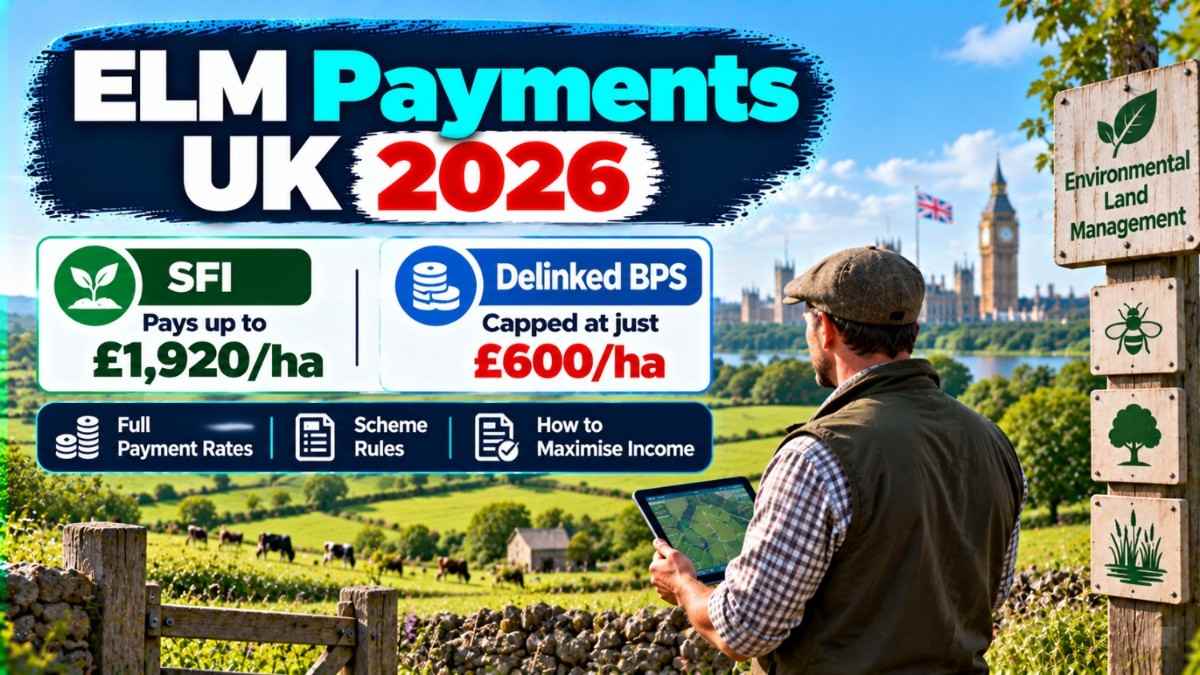
ELM payments UK 2026 are now the primary source of government support for English farmers — yet the reality of what farms are actually receiving is vastly different from what many expected. Delinked Basic Payment Scheme (BPS) income has collapsed to a maximum of just £600 per farm in 2026, while the Sustainable Farming Incentive (SFI) is now paying up to £1,920 per hectare for the right actions on the right land. This guide is for English farmers, land managers, and rural advisors aged 25–65 who need accurate, up-to-date figures on every ELM stream in 2026 before making financial planning decisions.This article covers: SFI 2026 payment rates by action, Countryside Stewardship Higher Tier updates, Landscape Recovery funding, the dramatic collapse of delinked BPS payments, who qualifies for each scheme, a step-by-step application guide, and a full comparison of ELM vs the old BPS regime.

ELM payments UK 2026 are delivered through three schemes: SFI 2026 (up to £1,920/ha for top fruit organic management), Countryside Stewardship Higher Tier (complex habitat sites, at least £50 million available in 2026), and Landscape Recovery (£500 million committed over 20+ years). Delinked BPS payments have collapsed to a maximum of £600 per farm in 2026 — a 98% reduction from the historic reference amount.
- Scheme Name: Environmental Land Management (ELM) — England only
- Three Pillars: Sustainable Farming Incentive (SFI) | Countryside Stewardship Higher Tier (CSHT) | Landscape Recovery
- Delinked BPS Cap 2026: £600 per farm (down from £7,200 in 2025)
- SFI Highest Payment Rate: £1,920/ha (OFC5 — organic top fruit conversion)
- SFI Agreement Length: 3 years (reduced from 5 years in SFI24)
- SFI Min. Land Requirement: 3 hectares registered with RPA as of January 2026
- SFI Agreement Cap: £100,000 per year per farm business
- SFI June Window: Small farms (3–50ha) and those without an existing ELM agreement
- SFI September Window: All eligible farms
- Management Payment: Removed for all new SFI 2026 agreements
- Total SFI Spend 2025–26: £738 million (Defra Farming Annual Report 2026)
- Landscape Recovery Spend 2025–26: £25 million
- Administering Body: Rural Payments Agency (RPA)
- What Is the Environmental Land Management Scheme?
- Who Should Read This ELM Payments Guide?
- SFI 2026 Payment Rates — Every Action and What It Pays
- Delinked BPS Payments 2026 — The Collapse Explained
- Countryside Stewardship Higher Tier 2026 — What Farmers Receive
- Landscape Recovery Payments — Long-Term Funding Explained
- How to Apply for SFI 2026 — Step-by-Step Process
- ELM Payments vs Old BPS — Honest Comparison
- Pros and Cons of the ELM Scheme for UK Farmers
- Important Terms Related to ELM Payments UK 2026
- Key ELM Dates and Deadlines 2026
- Important Links for ELM Applications
- Conclusion
- Key Takeaways
- Frequently Asked Questions About ELM Payments UK 2026
What Is the Environmental Land Management Scheme and How Does It Work in 2026?
The Environmental Land Management (ELM) scheme is England’s post-Brexit replacement for the EU Common Agricultural Policy (CAP). Rather than paying farmers simply for owning or farming land — as the Basic Payment Scheme did — ELM pays farmers and land managers for delivering specific environmental and public goods: cleaner water, biodiversity, carbon sequestration, flood mitigation, and sustainable food production. In 2026, ELM is the dominant vehicle for all agricultural public funding in England.

ELM consists of three distinct tiers, each with its own payment logic and eligibility criteria. The Sustainable Farming Incentive is the universal entry-level tier, open to all farms over 3 hectares. Countryside Stewardship Higher Tier targets the most environmentally important sites, such as Sites of Special Scientific Interest (SSSIs), ancient woodlands, and upland habitats. Landscape Recovery funds transformational, landscape-scale projects through long-term bespoke agreements of 20-plus years.
Scotland, Wales, and Northern Ireland operate separate schemes. ELM and SFI 2026 apply to England only. Farmers in devolved nations should check with their respective agriculture departments for equivalent programmes.
Who Should Read This ELM Payments UK 2026 Guide?
This guide is essential for anyone making farm business decisions in England in 2026. The specific audiences who will benefit most include:
- 🌾 Arable farmers with combinable crops who want to understand which SFI soil, nutrient, and wildlife actions stack best on their land
- 🐌 Grassland and livestock farmers considering converting improved or unimproved grassland to higher-value organic or habitat management
- 🏔️ Upland and moorland graziers whose payments have historically relied on BPS and Higher Level Stewardship, now facing transition to CSHT
- 🌲 Estate and land managers exploring Countryside Stewardship Higher Tier or Landscape Recovery for SSSI or priority habitat land
- 📊 Farm business advisors and rural chartered surveyors building ELM income models for client farms in 2026/27
- 👨💼 Tenant farmers who held off under SFI24 and need to know the new 3-year agreement terms in SFI26
- 🌿 Organic farmers who may be eligible for the highest SFI 2026 rates through organic conversion and management actions
- 💷 Farm owners facing an inheritance tax review who need to understand how ELM agreements interact with the new agricultural property relief thresholds from April 2026
SFI 2026 Payment Rates — Every Action and What It Pays Per Hectare
SFI 2026 offers 71 actions across multiple land management themes. The scheme moved from 102 actions in SFI 2024, with some removed, some rates adjusted, and the management payment eliminated entirely. Below are the most significant payment rates confirmed for 2026 across key categories.
Arable, Soil and Nutrient Actions
| Action Code | Action Name | SFI 2026 Payment Rate |
|---|---|---|
| SAM1 | Assess soil, produce a soil management plan | £97/ha |
| SAM2 / CSAM2 | Multi-species winter cover crop (3+ species) | £129/ha |
| SOH1 | No-till farming | £73/ha |
| SOH3 | Multi-species summer-sown cover crop | £163/ha |
| NUM1 | Assess and record nutrient management | £40/ha |
| CNUM2 | Legumes on improved grassland | £102/ha |
| CNUM3 | Legume fallow (reduced from previous rate) | £532/ha |
| SAM3 / CSAM3 | Herbal leys (reduced for 2026) | £224–£382/ha |
| PRF1 | Variable rate application of nutrients | £27/ha |
| PRF4 | Mechanical robotic weeding | £150/ha |
Farmland Wildlife and Habitat Actions (Arable)
| Action Code | Action Name | SFI 2026 Payment Rate |
|---|---|---|
| CAHL1 | Pollen and nectar flower mix | £739/ha |
| CAHL2 | Winter bird food on arable/horticultural land (reduced) | £648/ha (was £853/ha) |
| CAHL3 | Grassy field corners or blocks | £590/ha |
| AHW3 | Beetle banks | £764/ha |
| AHW5 | Nesting plots for lapwing | £765/ha |
| AHW6 | Basic overwinter stubble | £58/ha |
| AHW7 | Enhanced overwinter stubble (now under 25% cap) | £589/ha |
| AHW8 | Whole crop spring cereals and overwinter stubble | £596/ha |
| AHW9 | Unharvested cereal headland | £1,072/ha |
| AHW10 | Low input harvested cereal crop | £354/ha |
| AHW11 | Cultivated areas for arable plants | £660/ha |
| IPM2 | Flower-rich grass margins and plots | £798/ha |
Grassland, Organic and Agroforestry Actions
| Action Code | Action Name | SFI 2026 Payment Rate |
|---|---|---|
| CIGL2 | Winter bird food on improved grassland | £515/ha |
| CLIG3 | Manage grassland with very low nutrient inputs | £151/ha |
| GRH1 | Manage rough grazing for birds | £121/ha |
| GRH7 | Haymaking supplement | £157/ha |
| GRH8 | Haymaking supplement (late cut) | £187/ha |
| SCR1 | Create scrub and open habitat mosaics | £588/ha |
| SCR2 | Manage scrub and open habitat mosaics | £350/ha |
| AGF1 | Maintain agroforestry (30–50 trees/ha) | £248/ha |
| AGF2 | Low density agroforestry (51–130 trees/ha) | £385/ha |
| UPL1 | Moderate livestock grazing on moorland | £35/ha |
| UPL2 | Low livestock grazing on moorland (increased rate) | £89/ha |
Organic Conversion and Management — Highest SFI Rates
| Action Code | Action Name | SFI 2026 Payment Rate |
|---|---|---|
| OFC1 | Organic conversion: improved permanent grassland | £187/ha |
| OFC2 | Organic conversion: unimproved permanent grassland | £96/ha |
| OFC3 | Organic conversion: rotational land | £298/ha |
| OFC4 | Organic conversion: horticultural land | £874/ha |
| OFC5 | Organic conversion: top fruit (highest rate in scheme) | £1,920/ha |
| OFM3 | Organic land management: enclosed rough grazing | £97/ha |
| OFM4 | Organic land management: rotational land | £132/ha |
| OFM5 | Organic land management: horticultural land | £707/ha |
| OFM6 | Organic land management: top fruit | £1,920/ha |
Most SFI 2026 actions can be stacked on the same parcel, provided they are compatible and Defra is not paying twice for the same management. A 200ha arable farm combining SAM2 (£129/ha), CAHL1 (£739/ha on margins), AHW9 (£1,072/ha on headlands) and PRF1 (£27/ha) could generate significantly more than a single-action approach. Always use the RPA’s compatibility checker before submitting to avoid post-application rejections.
Delinked BPS Payments 2026 — The Collapse That Every Farmer Needs to Understand
The Basic Payment Scheme ended in England in 2023. Delinked payments — successor transitional payments based on historic BPS averages from 2020–2022 — replaced it. In 2026, those delinked payments have been slashed to a 98% reduction on the first £30,000 of a farmer’s reference amount, leaving a maximum payment of just £600 per farm. In 2025, the same farms could receive up to £7,200. The total delinked payment pot shrank from £330 million in 2025 to approximately £20 million in 2026.
| Year | Max Delinked Payment Per Farm | Total National Pot | Reduction Applied |
|---|---|---|---|
| 2024 | ~£19,500 | Significant | ~50% on lowest band |
| 2025 | £7,200 | £330 million | 76% on first £30,000 |
| 2026 | £600 | ~£20 million | 98% on first £30,000 |
| 2027 | Final year | TBC | Further reduction expected |
The NFU has described each successive reduction as “another financial blow” to farmers who have had insufficient time to plan. The RPA calculates reductions using each farmer’s reference amount — based on average BPS 2020–2022 payments — rather than the value of their 2025 payment. Farmers receive individual payment statements from the RPA confirming their position.
Countryside Stewardship Higher Tier 2026 — What Farmers with Complex Sites Are Receiving
Countryside Stewardship Higher Tier (CSHT) is the second pillar of ELM, designed for the most environmentally significant sites in England: SSSIs, ancient semi-natural woodland, upland habitats, and scheduled monuments. In 2026, CSHT is expanding, with at least £50 million available for new agreements and payment rates for moorland and rough grazing actions being increased to align with equivalent SFI actions.
Priority for 2026 CSHT applications is given to: existing Higher Tier and Higher Level Stewardship (HLS) agreement holders whose agreements expire in 2026 or early 2027; farmers with Countryside Stewardship Mid-Tier agreements containing priority habitats or scheduled monument options due to expire; and a limited number of other qualifying applications. CSHT agreements run for 5 or 10 years, reflecting the longer-term commitment required for complex habitat management. Defra pays quarterly, with the first payment made approximately 4 months after agreement acceptance.
The government invested £30 million specifically to increase Higher Level Stewardship (HLS) payment rates in May 2025, bringing them closer to CSHT and SFI equivalents. Farmers in legacy HLS agreements are being supported to transition into new CSHT or SFI agreements without penalty where possible.
Landscape Recovery Payments UK 2026 — Long-Term Environmental Income
Landscape Recovery is the third and most ambitious pillar of ELM, designed for transformational, landscape-scale nature restoration covering 500 hectares or more. The government has committed £500 million to Landscape Recovery projects, invested over at least a 20-year period. In 2025–26, £25 million was spent on the scheme, with 34 projects approved in Round 2, involving more than 700 farmers and landowners covering over 200,000 hectares across England.
Payment rates for Landscape Recovery are negotiated individually on a project-by-project basis, benchmarked against other government schemes to ensure value for money. Further application rounds are expected in 2026. The scheme is open to any group or individual able to deliver large-scale projects, not just farmers — conservation organisations, local authorities, and landowner consortia all qualify.
Projects that entered implementation after their development phase include species recovery and habitat restoration initiatives. Three projects exited the scheme during 2025–26, illustrating that Landscape Recovery involves genuine delivery obligations over a multi-decade timeframe.
How to Apply for SFI 2026 — Step-by-Step Application Process
- Check your eligibility: You must have at least 3 hectares of agricultural land registered with the Rural Payments Agency (RPA) as of January 2026. Your farm business must be registered in England. Confirm you do not already hold a capped SFI agreement that would conflict with a new application.
- Register on the Rural Payments service: Visit GOV.UK Rural Payments and ensure your Single Business Identifier (SBI), land parcels, and bank details are fully up to date before applying. Errors here cause payment delays.
- Identify your actions: Use the full SFI 2026 action list (71 actions) to identify which actions your land qualifies for. Note the 25% area cap that now applies to 10 specific actions including AHW7 (enhanced overwinter stubble) and CAHL2 (winter bird food). Use the RPA compatibility checker to confirm actions do not overlap or conflict.
- Apply in the correct window: Window 1 (June 2026) is reserved for small farms (3–50ha) and farms without an existing ELM revenue agreement. Window 2 (September 2026 onwards) is open to all eligible farms. Applying in Window 1 if eligible is strongly recommended, as the June budget is separate and may fill quickly.
- Submit your application online: Applications are submitted entirely through the Rural Payments digital service. There is no paper application route for SFI 2026. You select actions, specify land parcels, confirm agreement terms, and submit for RPA review.
- Receive your agreement offer: The RPA will issue a formal agreement offer after reviewing your application. Read the offer carefully — the actions, payment rates, and land parcels are legally binding once accepted.
- Accept and begin management: Once you accept the 3-year agreement, you must begin carrying out the agreed actions as specified in the SFI 2026 scheme rules. Payments are made annually. Keep records — inspections do occur and evidence of action delivery is required.
ELM Payments vs Old BPS — An Honest Financial Comparison
| Factor | Old Basic Payment Scheme (BPS) | ELM (SFI 2026) |
|---|---|---|
| Payment Basis | Land area owned or farmed | Environmental actions delivered |
| Maximum Payment | Uncapped (top 10% got 50% of funds) | £100,000/year per farm |
| Entry Requirement | Eligible land registered with RPA | 3ha+ registered land + action eligibility |
| Agreement Length | Annual claims | 3-year binding agreement (SFI26) |
| Certainty | Annual — could change year to year | Fixed for 3-year term |
| Management Changes Required | None — payment for land ownership | Yes — must deliver specific actions |
| Income Potential | Flat rate, predictable | Variable — depends on actions selected and land type |
| 2026 Delinked Maximum | £600 (was £7,200 in 2025) | Up to £100,000/year depending on actions |
| Organic Farming Bonus | None specifically | Yes — up to £1,920/ha for top fruit conversion |
| Tenant Farmer Access | Required landlord consent in some cases | No landlord consent needed for SFI |
For farms that can stack multiple SFI actions across varied land types, ELM income potential significantly exceeds historic BPS. However, farms that benefited most from BPS — those with large areas of land and minimal environmental management obligation — face the sharpest income decline. The transition is non-negotiable: delinked payments end in 2027. Any English farm not yet engaged with SFI 2026 is leaving guaranteed income on the table and running out of time to replace lost BPS revenue.
Pros and Cons of the ELM Scheme for UK Farmers in 2026
Advantages of ELM Payments
- Higher income ceiling for active land managers — a well-planned SFI agreement on mixed farmland can far exceed old BPS payments
- Tenant farmer access without landlord consent — SFI 2026 payments go directly to the person delivering the actions, not the landowner
- 3-year income certainty — once an agreement is signed, payment rates are fixed for the full term regardless of policy changes
- Stackable actions — most actions can be combined on the same land parcel, compounding income per hectare
- Additional capital grants available — the standalone ELM Capital Grants offer (£45 million in 2025/26) provides infrastructure investment separate from revenue agreements
Disadvantages and Challenges
- BPS collapse is immediate and severe — farms receiving £20,000–£40,000 in delinked payments in 2025 receive just £600 in 2026, with no comparable ELM income guaranteed
- Management obligations are real — unlike BPS, SFI requires specific actions to be carried out and evidenced; non-delivery can trigger clawback
- Not all land qualifies equally — intensive lowland arable land with few habitat features has fewer high-value action options than mixed or upland farms
- 25% area cap on 10 actions — limits the amount of income from the highest-demand wildlife actions on any single farm
Important Terms Related to ELM Payments UK 2026
Understanding these key terms is essential for navigating ELM applications and maximising your farm income in 2026:
- Environmental Land Management (ELM): England’s post-Brexit agricultural payment framework, replacing CAP and BPS. Pays farmers for delivering public environmental goods rather than for land ownership alone.
- Sustainable Farming Incentive (SFI): The universal, entry-level tier of ELM. Open to all farms over 3ha, with 71 actions available in 2026 and a maximum payment of £100,000/year per farm.
- Countryside Stewardship Higher Tier (CSHT): The second tier, covering complex, high-value environmental sites including SSSIs, ancient woodland, and upland habitats. Agreement lengths of 5–10 years.
- Landscape Recovery: The third, transformational tier for landscape-scale projects covering 500ha or more. Bespoke 20-plus-year agreements with negotiated payment rates. £500 million committed by government.
- Delinked Payments: Transitional payments replacing BPS in England from 2024 to 2027, based on historic 2020–2022 BPS averages. Capped at £600 per farm in 2026 (a 98% reduction).
- Reference Amount: The individual figure used by the RPA to calculate each farm’s delinked payment, based on average BPS payments received in 2020, 2021 and 2022.
- Rural Payments Agency (RPA): The Defra executive agency responsible for administering SFI, CS, delinked payments, and most ELM schemes in England.
- 25% Land Cap: A rule in SFI 2026 limiting 10 specific actions (including AHW7, CAHL2, and others) to a maximum of 25% of the total farm area, preventing excessive concentration of wildlife actions at the expense of food production.
- ELM Revenue Agreement: Any RPA-administered agreement generating annual payments, including SFI, Countryside Stewardship Mid Tier, and Countryside Stewardship Higher Tier agreements.
- Higher Level Stewardship (HLS): A legacy agri-environment scheme, pre-dating ELM. Defra invested £30 million in 2025 to increase HLS payment rates, and holders with expiring agreements are being prioritised for CSHT transition.
Key ELM Dates and Deadlines for 2026
| Date / Period | ELM Event or Deadline |
|---|---|
| January 2026 | RPA land registration cut-off for SFI 2026 small farm eligibility (3–50ha) |
| June 2026 | SFI 2026 Window 1 opens — small farms and farms without existing ELM agreement |
| June 2026 | CSHT expansion announced — at least £50 million for new agreements |
| Summer 2026 | CSHT applications open to wider group including certain Mid-Tier holders |
| Summer 2026 | ELM standalone Capital Grants offer re-opens (£45 million available) |
| August 2026 | Delinked BPS payments (maximum £600) issued by RPA |
| September 2026 | SFI 2026 Window 2 opens — all eligible farms may apply |
| 2027 | Final year of delinked payments — ELM becomes the only public farm support in England |
| April 2026 | Agricultural property relief threshold change: full IHT relief on first £2.5 million of qualifying assets |
Important Links for ELM Payments and Applications
| Resource | Link |
|---|---|
| SFI 2026 Scheme Rules and Guidance (GOV.UK) | gov.uk — SFI26 Scheme Rules |
| Defra Farming Blog — SFI26 Details | defrafarming.blog.gov.uk — SFI26 Definitions |
| CSHT Rolling Out Update (Defra Blog) | defrafarming.blog.gov.uk — CSHT 2026 |
| Rural Payments — Apply for SFI | gov.uk — Rural Payments Service |
| ELM Update — GOV.UK Policy Paper | gov.uk — ELM Payment Policy |
| Defra Farming Annual Report 2025–26 | gov.uk — Farming Annual Report 2025–26 |
| NFU — Landscape Recovery Guidance | nfuonline.com — Landscape Recovery |
Conclusion — ELM Payments UK 2026 and What Farmers Must Do Now
ELM payments UK 2026 mark the decisive transition away from the old subsidy era. The delinked BPS payment cap of £600 per farm is not a temporary dip — it is the near-end of direct income support in England, with delinked payments ceasing entirely after 2027. For the great majority of English farms, SFI 2026 is now the primary available government income stream, and engaging with it is no longer optional for businesses that relied on BPS. The highest-paying actions — organic conversion of top fruit at £1,920/ha, unharvested cereal headlands at £1,072/ha, beetle banks at £764/ha — reward farms willing to commit to real environmental management over a 3-year agreement.
Farms on environmentally significant sites should also be reviewing Countryside Stewardship Higher Tier eligibility and contacting the RPA now, ahead of the wider summer 2026 opening. If your HLS or CSHT agreement is expiring, you are a priority applicant. Do not wait: bookmark the SFI 2026 scheme rules on GOV.UK and speak to your rural advisor or the Farming Advice Service before the September window closes.
- Delinked BPS payments collapsed to a maximum of £600 per farm in 2026, down from £7,200 in 2025 — this income stream is ending.
- SFI 2026 offers 71 actions paying from £27/ha to £1,920/ha, with a cap of £100,000 per year per farm business.
- The SFI management payment has been removed for all new 2026 agreements, reducing income for small farms entering the scheme.
- Window 1 (June 2026) is reserved for small farms (3–50ha) and farms without an existing ELM agreement — apply early as the budget is separate and limited.
- Defra spent £738 million on SFI in 2025–26 and committed £500 million to Landscape Recovery over at least 20 years.
- Any farm not yet in an ELM agreement should apply via the GOV.UK Rural Payments service before the September 2026 window closes.
Frequently Asked Questions About ELM Payments UK 2026
What are ELM payments in the UK?
ELM payments UK are government payments made through the Environmental Land Management scheme, which replaced the EU Common Agricultural Policy Basic Payment Scheme after Brexit. The scheme pays English farmers and land managers for delivering environmental benefits — such as wildlife habitat, cleaner water, and soil health — rather than for simply owning land. In 2026, ELM comprises three tiers: the Sustainable Farming Incentive (SFI), Countryside Stewardship Higher Tier (CSHT), and Landscape Recovery.
How much do ELM payments pay per hectare in 2026?
ELM payments UK 2026 vary widely by action. Under SFI 2026, payments range from £27/ha for variable rate nutrient application (PRF1) to £1,920/ha for organic top fruit conversion (OFC5). Common mid-range actions include beetle banks at £764/ha, pollen and nectar flower mixes at £739/ha, and winter bird food at £648/ha. The SFI 2026 annual payment is capped at £100,000 per farm business.
What happened to BPS payments in England in 2026?
Basic Payment Scheme (BPS) payments ended in England in 2023. Delinked transitional payments replaced them, based on historic BPS averages from 2020–2022. In 2026, Defra applied a 98% reduction to the first £30,000 of each farm’s reference amount, leaving a maximum payment of just £600 per farm. The total delinked payment pot shrunk from £330 million in 2025 to approximately £20 million in 2026. Delinked payments will cease entirely after 2027.
Who can apply for SFI 2026?
SFI 2026 is open to farmers and land managers in England who have at least 3 hectares of agricultural land registered with the Rural Payments Agency as of January 2026. The scheme is limited to one SFI26 agreement per farm business. Agreements are capped at £100,000 per year. Tenant farmers can apply without needing landlord consent, and payments go directly to the person carrying out the management actions.
What is the SFI 2026 management payment?
The SFI management payment — previously worth £50 per hectare per year plus a first-year uplift under SFI 2024 — has been removed entirely for all new SFI 2026 agreements. This is one of the most significant reductions in income for small farms entering the scheme for the first time in 2026. Existing SFI 2024 agreement holders are not affected, but new applicants must plan without this flat-rate payment.
What is Countryside Stewardship Higher Tier and how do I get into it?
Countryside Stewardship Higher Tier (CSHT) is the second tier of ELM, designed for complex, high-value environmental sites including SSSIs, ancient woodland, and upland habitats. In 2026, CSHT expanded with at least £50 million available for new agreements, with payment rates for moorland and rough grazing actions increased to match SFI equivalents. Priority in 2026 is given to holders of expiring Higher Tier or HLS agreements. To apply, email ruralpayments@defra.gov.uk with ‘CSHT’ in the subject line and your SBI number.
Can I be in both SFI and Countryside Stewardship at the same time?
Yes. Farmers can hold both an SFI 2026 agreement and a Countryside Stewardship Higher Tier agreement simultaneously. However, the same action on the same parcel of land cannot be paid for twice — Defra’s compatibility rules and the RPA’s pre-submission checker flag any overlapping actions. Effective land management planning, often with the help of a rural advisor, is essential to identify which actions can be stacked and which must be ring-fenced to one scheme.
What is the 25% land cap in SFI 2026?
SFI 2026 introduced a 25% area cap on 10 specific high-value wildlife actions. This means that no more than 25% of the total farm area can be entered into these capped actions combined. The 10 capped actions include enhanced overwinter stubble (AHW7), winter bird food on arable land (CAHL2), in-field grass strips, grassy field corners, and flower-rich grass margins. The cap was introduced to prevent farms from removing too much productive land from food production in pursuit of wildlife payments.
What does Landscape Recovery pay farmers?
Landscape Recovery does not publish fixed per-hectare payment rates. Payments are negotiated individually on a project-by-project basis, benchmarked against comparable government schemes. The government has committed £500 million to Landscape Recovery over at least 20 years. In 2025–26, £25 million was spent on the scheme. Projects involve collaborative, landscape-scale nature restoration across 500 hectares or more, and agreements last 20-plus years. Further application rounds are expected during 2026.
Last Updated: October 2026. This guide is reviewed and updated regularly to reflect official DEFRA and RPA announcements. Bookmark this page for the latest ELM payment information as scheme rules evolve through the 2026/27 transition period.
Disclaimer: This guide is for informational purposes only and does not constitute financial or agricultural advice. Payment rates, eligibility criteria and scheme rules are set by DEFRA and the Rural Payments Agency and may change. Always verify current figures and terms at GOV.UK Funding for Farmers before making business decisions. Consult a qualified rural advisor for farm-specific financial planning.