
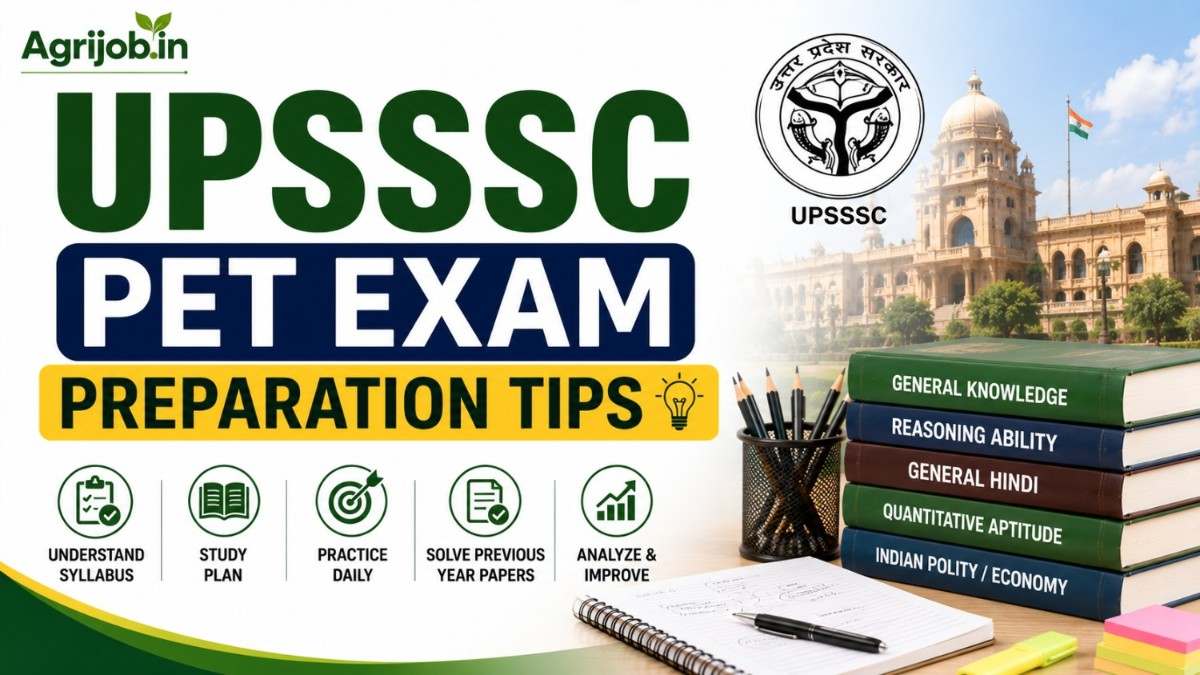
UPSSSC PET exam preparation tips 2026 are now the most searched topic among lakhs of candidates eyeing Group C government jobs in Uttar Pradesh. The Uttar Pradesh Subordinate Services Selection Commission released the official PET 2026 notification on 1 August 2026 under Advertisement No. 16-Pariksha/2026, and applications closed on 7 September 2026. This guide is for 10th-pass candidates aged 18–40 years who want to clear the Preliminary Eligibility Test and unlock posts like Lekhpal, VDO, Junior Assistant, Forest Guard, and more. Below, you will find the complete syllabus, updated exam pattern, subject-wise strategy, best books, and a week-by-week preparation plan — everything you need to score 85+ out of 100.

UPSSSC PET 2026 is a 100-mark, 2-hour objective exam with 15 subjects and 0.25 negative marking per wrong answer. A score of 85+ out of 100 is needed to secure shortlisting for top Group C posts like Lekhpal (salary Rs.21,700–Rs.69,100/month). The PET score is valid for 3 years, making this single exam your gateway to multiple UP government recruitments.
- Conducting Body: Uttar Pradesh Subordinate Services Selection Commission (UPSSSC)
- Notification Date: 1 August 2026 (Advt No. 16-Pariksha/2026)
- Application Window: 3 August – 7 September 2026
- Exam Mode: Offline (OMR-based)
- Total Questions: 100 MCQs | Total Marks: 100
- Duration: 2 Hours (120 Minutes)
- Negative Marking: 0.25 marks per wrong answer
- Eligibility: Class 10 pass | Age 18–40 years (as on 1 July 2026)
- Application Fee: Rs.185 (General/OBC) | Rs.95 (SC/ST) | Rs.25 (PwBD)
- Score Validity: 3 years from result declaration date
- Official Website: upsssc.gov.in
📋 Table of Contents
- What is UPSSSC PET 2026 and Why It Matters
- Who Should Apply for UPSSSC PET 2026
- UPSSSC PET 2026 Exam Pattern — Complete Breakdown
- UPSSSC PET 2026 Syllabus — All 15 Subjects Covered
- Salary and Posts After Clearing UPSSSC PET 2026
- UPSSSC PET Preparation Strategy 2026 — How to Score 85+
- Subject-Wise Preparation Tips for UPSSSC PET 2026
- Best Books for UPSSSC PET 2026
- UPSSSC PET vs Mains Exam — Key Differences
- Pros and Cons of Preparing for UPSSSC PET 2026
- Important Terms Related to UPSSSC PET 2026
- Important Dates for UPSSSC PET 2026
- Important Links
- Conclusion
- Frequently Asked Questions
What is UPSSSC PET 2026 and Why It Matters for Government Jobs
UPSSSC PET 2026 (Preliminary Eligibility Test) is the mandatory first-stage screening examination conducted by the Uttar Pradesh Subordinate Services Selection Commission to qualify candidates for Group B and Group C government posts across Uttar Pradesh. Without a valid PET score, you cannot apply for any subsequent UPSSSC main recruitment exam — including Lekhpal, VDO, Junior Assistant, Forest Guard, and Stenographer. Think of it as the gateway that opens multiple doors simultaneously.

The PET was introduced to streamline UP government recruitment and eliminate the need for repeated eligibility testing. One valid PET score card, earned through 2 hours of focused effort, keeps you eligible for every Group C recruitment UPSSSC announces during its 3-year validity window. In previous cycles, PET-qualified candidates accessed over 20,000 vacancies across departments. The 2026 edition follows the same two-tier pattern: PET first, then post-specific Mains.
Who Should Apply for UPSSSC PET 2026
- 🎓 Class 10 pass candidates from any recognised board who want a stable UP government job
- 👨🌾 Rural youth from UP targeting Lekhpal or Village Development Officer (VDO) posts
- 👩💼 Female candidates aged 18–40 eligible for Women Health Worker and Junior Assistant roles
- 🌲 Forest and environment enthusiasts aiming for Forest Guard recruitment via PET score
- 🏥 Students with science background seeking X-Ray Technician or Lab Technician positions
- 📊 Commerce graduates targeting Internal Accountant or Auditor posts (salary: Rs.29,200–Rs.92,300)
- 🚜 Agriculture diploma holders aiming for Agricultural Technical Assistant vacancies
- 🖥️ Candidates with computer skills targeting Junior Assistant and Clerk-grade posts in UP departments
UPSSSC PET 2026 Exam Pattern — Complete Breakdown
The UPSSSC PET 2026 exam pattern is straightforward: 100 objective-type multiple-choice questions for 100 marks, to be solved in 2 hours in offline OMR mode. Each correct answer earns 1 mark; each wrong answer deducts 0.25 marks. Questions for academic subjects (serial numbers 1–9) are set at NCERT Secondary/Senior Secondary difficulty level.
| S. No. | Subject | Questions / Marks |
|---|---|---|
| 1 | Indian History | 05 |
| 2 | Indian National Movement | 05 |
| 3 | Geography (India & World) | 05 |
| 4 | Indian Economy | 05 |
| 5 | Indian Constitution & Public Administration | 05 |
| 6 | General Science | 05 |
| 7 | Elementary Arithmetic | 05 |
| 8 | General Hindi | 05 |
| 9 | General English | 05 |
| 10 | Logic & Reasoning | 05 |
| 11 | Current Affairs | 10 |
| 12 | General Awareness | 10 |
| 13 | Hindi Unseen Passage (2 passages) | 10 |
| 14 | Graph Interpretation (2 graphs) | 05 |
| 15 | Table Interpretation & Analysis (2 tables) | 10 |
| Total | 100 | |
Key pattern insight: Subjects 11–15 collectively carry 45 marks — nearly half the paper. Current Affairs, General Awareness, Hindi Passages, and Data Interpretation are dynamic, high-weightage sections that most candidates underestimate. Mastering them separates 70-scorers from 85+ scorers.
UPSSSC PET 2026 Syllabus — All 15 Subjects Covered in Detail
The UPSSSC PET 2026 syllabus covers 15 sections designed to assess general knowledge, reasoning ability, language skills, mathematical aptitude, and data interpretation. The academic subjects follow NCERT Secondary and Senior Secondary standards. Here is a complete subject-wise breakdown to structure your preparation.
| Subject | Key Topics to Study |
|---|---|
| Indian History | Ancient India, Medieval India (Mughals, Delhi Sultanate), British Rule, social and economic impact of British policies |
| Indian National Movement | Freedom struggle, Congress sessions, Gandhian movements, revolutionary movements, Partition and Independence |
| Geography | Physical features of India, rivers, climate, natural resources, world geography basics, UP-specific geography |
| Indian Economy | Planning, economic reforms, agriculture, industry, Five-Year Plans, government schemes, GDP/inflation basics |
| Indian Constitution & Public Administration | Fundamental Rights, DPSP, Parliament structure, President/PM roles, Panchayati Raj, local governance, amendments |
| General Science | Basic Physics (force, light, electricity), Chemistry (elements, acids, metals), Biology (cell, nutrition, diseases), environment |
| Elementary Arithmetic | HCF/LCM, percentages, profit-loss, simple/compound interest, ratio-proportion, averages, time-work, data interpretation |
| General Hindi | Grammar (संधि, समास, विलोम, पर्यायवाची), vocabulary, sentence correction, idioms, comprehension |
| General English | Tenses, prepositions, articles, synonyms/antonyms, sentence structure, reading comprehension, one-word substitution |
| Logic & Reasoning | Series, analogies, coding-decoding, blood relations, direction sense, syllogism, odd-one-out, Venn diagrams |
| Current Affairs | National events (last 12 months), UP government policies, international events, sports, awards, appointments |
| General Awareness | UP culture, heritage, art, famous personalities, sports events, important days, UN/international bodies |
| Hindi Unseen Passage | Inference, vocabulary in context, tone, main idea — 2 passages of moderate difficulty |
| Graph Interpretation | Bar graphs, line graphs, pie charts — data trends, comparisons, percentage calculations |
| Table Analysis | Data tables — reading, comparing, drawing logical conclusions from raw numbers |
Salary and Posts Unlocked After Clearing UPSSSC PET 2026
Clearing the UPSSSC PET 2026 does not itself carry a salary — it qualifies you for multiple Group C Mains exams. Once you clear the post-specific Mains and join service, you receive pay under the 7th Pay Commission matrix as adopted by the Uttar Pradesh Government. The salary range across common PET-linked posts is detailed below.
| Post Name | Minimum Salary (Rs.) | Maximum Salary (Rs.) | Pay Level |
|---|---|---|---|
| Revenue Lekhpal | 21,700 | 69,100 | Level-3 |
| Village Development Officer (VDO) | 21,700 | 69,100 | Level-3 |
| Junior Assistant / Clerk | 21,700 | 69,100 | Level-3 |
| X-Ray Technician | 21,700 | 69,100 | Level-3 |
| Women Health Worker | 21,700 | 69,100 | Level-3 |
| Agricultural Technical Assistant | 19,900 | 63,200 | Level-2 |
| Forest Guard | 19,900 | 63,200 | Level-2 |
| Sugarcane Supervisor | 25,500 | 81,100 | Level-4 |
| Internal Accountant / Auditor | 29,200 | 92,300 | Level-5 |
| Laboratory Technician | 29,200 | 92,300 | Level-5 |
In addition to basic pay, selected candidates receive Dearness Allowance (DA), House Rent Allowance (HRA based on city type), Travelling Allowance (TA), medical facilities, and pension under the National Pension System. With promotions over a career span, pay can reach well above Rs.1,00,000/month for senior positions.
UPSSSC PET Preparation Strategy 2026 — How to Score 85+ Marks
A smart preparation strategy covers four pillars: understanding the syllabus, building subject-wise concepts, practising with mock tests, and strategic revision. Here is the step-by-step approach experts recommend for the 2026 PET cycle.
- Map the Syllabus on Day 1: Print the official 15-subject syllabus from upsssc.gov.in and mark each topic as Strong, Average, or Weak. This honest self-assessment prevents wasted study time on topics you already know.
- Prioritise High-Weightage Sections: Subjects 11–15 (Current Affairs, General Awareness, Hindi Passages, Graph/Table Analysis) account for 45 marks. Treat them as non-negotiable daily practice areas.
- Complete NCERT Books First: For History, Geography, Economy, Science, and Constitution (subjects 1–6), NCERT Class 6–10 books provide exactly the right difficulty level. Cover them before moving to coaching guides.
- Read a Newspaper Daily (30 Minutes): Dedicate 30 minutes each morning to reading Dainik Jagran or Hindustan for UP-specific current affairs. Make a one-liner note on each important event for quick revision.
- Solve 50 Questions Daily Minimum: From Day 1, solve at least 50 MCQs daily across all subjects. This builds the exam temperament needed to complete 100 questions in 120 minutes without panic.
- Attempt Full-Length Mock Tests Weekly: Start weekly full-length mock tests from the 3rd week of preparation. Analyse every wrong answer; pattern recognition from mocks improves scores by 10–15 marks on average.
- Master Negative Marking Management: Never attempt a question if confidence is below 60%. With 0.25 negative marking, 4 wrong answers wipe out 1 correct answer. Skip-and-return is a better strategy than random guessing.
- Revise with Short Notes Every Weekend: Maintain a compact revision notebook — one page per subject with formulas, key dates, important names, and facts. Reading this notebook over 15 minutes each weekend keeps retention high.
In the last 15 days before UPSSSC PET 2026, stop studying new topics entirely. Spend 100% of your time on full-length mock tests + revision of your short notes. Candidates who attempt 10+ full mocks in the final fortnight consistently score 8–12 marks higher than those who keep studying new material right until exam day.
Subject-Wise Preparation Tips for UPSSSC PET 2026
Each subject in the UPSSSC PET 2026 syllabus requires a distinct approach. Here are targeted tips for the most impactful subjects.
| Subject | Marks | Top Preparation Tip |
|---|---|---|
| General Hindi | 05 (paper) + 10 (passage) | Practise grammar rules daily; focus on sandhi, samas, idioms, and passage comprehension |
| Current Affairs | 10 | Read news daily; focus on last 12 months; make date-wise event list for quick revision |
| General Awareness | 10 | Focus on UP-specific GK — culture, festivals, schemes, famous places, sports persons |
| Table / Graph Analysis | 15 | Practise 5 DI sets daily; focus on percentage calculations and trend reading |
| Hindi Passage | 10 | Read Hindi newspapers; practise inference-type questions; vocabulary in context is key |
| Indian History & National Movement | 10 | Use NCERT Class 8–10; make timeline of freedom struggle events; focus on Gandhian era |
| Logic & Reasoning | 05 | Solve 20 reasoning questions daily; series and analogy questions are fastest to improve |
| Elementary Arithmetic | 05 | Master percentage, profit-loss, and time-work; these 3 topics cover 70% of maths questions |
| Indian Constitution | 05 | Focus on Fundamental Rights, DPSP, Panchayati Raj — these repeat frequently in PET |
| General Science | 05 | NCERT Class 9–10; focus on everyday science — diseases, nutrition, basic physics concepts |
Best Books for UPSSSC PET 2026 Preparation
| Subject | Recommended Book / Resource |
|---|---|
| General Knowledge (All Subjects) | Lucent’s General Knowledge (latest edition) |
| UP-Specific GK | Arihant’s Uttar Pradesh General Knowledge |
| History, Geography, Economy, Science | NCERT Class 6–10 textbooks (free on ncert.nic.in) |
| Indian Constitution / Polity | M. Laxmikanth’s Indian Polity (select chapters) |
| General Hindi / Grammar | Hardev Bahri Hindi Grammar; Vasant Series |
| General English | Wren and Martin High School Grammar (selected chapters) |
| Arithmetic / Maths | RS Aggarwal Quantitative Aptitude; Ghatna Chakra Maths |
| Reasoning | RS Aggarwal Verbal and Non-Verbal Reasoning |
| Current Affairs | Monthly GK Today magazine; Dainik Jagran / Amar Ujala (daily) |
| Previous Year Papers + Mock Tests | Ghatna Chakra UPSSSC PET Solved Papers; adda247.com mock tests |
UPSSSC PET 2026 vs Mains Exam — Key Differences
| Feature | UPSSSC PET 2026 | UPSSSC Mains (Post-Specific) |
|---|---|---|
| Purpose | Common eligibility qualifying exam | Post-specific recruitment selection |
| Marks | 100 marks, 100 questions | Varies by post (150–200 marks typically) |
| Duration | 2 hours | 2–3 hours depending on post |
| Mode | Offline (OMR-based) | Offline or Computer-based (varies) |
| Negative Marking | 0.25 per wrong answer | Varies by post notification |
| Syllabus | General — 15 subjects | Post-specific (technical/departmental) |
| Score Validity | 3 years from result date | Single recruitment cycle only |
| Frequency | Once per year | As and when posts are announced |
| Mandatory? | Yes — without PET, you cannot apply for Mains | Only for specifically notified posts |
| Best Target Score | 85+ out of 100 | Depends on post cut-off |
The PET is significantly easier than the Mains exam in terms of depth, but harder to score high on because of breadth — 15 subjects in 2 hours demands speed and accuracy simultaneously. Candidates who score 85+ in PET consistently outperform in shortlisting even when competition is high. Treat PET seriously: a good PET score, valid for 3 years, multiplies your opportunities across every UPSSSC recruitment cycle without reappearing for the qualifying test.
Advantages and Disadvantages of Preparing for UPSSSC PET 2026
Advantages (Pros):
- ✅ One exam, multiple opportunities: A single PET score unlocks access to all Group C Mains for 3 years
- ✅ Low eligibility barrier: Class 10 pass is the only academic requirement — no graduation needed
- ✅ Guaranteed government job security: All PET-linked posts are permanent state government positions with pension
- ✅ Salary with allowances: Rs.28,000–Rs.95,000+ in-hand monthly depending on post and city
- ✅ Accessible syllabus: Class 10 NCERT-level content — no advanced degree topics required
Disadvantages (Cons):
- ❌ High competition: Lakhs of candidates appear — securing a top percentile requires consistent preparation
- ❌ No direct job from PET: Clearing PET alone does not guarantee a post; you must also clear the post-specific Mains
- ❌ Negative marking risk: Overconfident random guessing can reduce a good raw score significantly
Important Terms Related to UPSSSC PET 2026
Understanding these key terms will help you navigate official notifications, score cards, and the recruitment process without confusion.
- PET (Preliminary Eligibility Test): Common screening exam for UPSSSC Group C recruitment — mandatory first stage
- OTR (One Time Registration): Mandatory one-time online registration on upsssc.gov.in before applying for any exam
- Normalised Score: If PET is held in multiple shifts, raw marks are adjusted statistically to ensure fairness across shifts
- Group C Posts: Non-gazetted government positions like Lekhpal, VDO, Junior Assistant — filled via UPSSSC
- 7th Pay Commission (CPC): Salary framework applicable to UP government employees; determines basic pay, DA, and HRA
- OMR (Optical Mark Recognition): Answer sheet format used in offline exams; bubbles must be darkened correctly with a ball pen
- Merit List / Shortlisting: PET scores are used to prepare a rank list; top-ranked candidates qualify for post-specific Mains
- DV (Document Verification): Final stage after Mains where original certificates are checked before appointment
- NPS (National Pension System): Pension scheme applicable to all UPSSSC recruits joining after 2004
- DA (Dearness Allowance): Inflation-linked allowance revised every 6 months; currently over 50% of basic pay for UP employees
Important Dates for UPSSSC PET 2026
| Event | Date / Status |
|---|---|
| Official Notification Released | 1 August 2026 |
| Application Start Date | 3 August 2026 |
| Application Last Date | 7 September 2026 (Extended) |
| Form Correction / Fee Adjustment Window | 8 September 2026 |
| Admit Card Release | To Be Announced — upsssc.gov.in |
| UPSSSC PET 2026 Exam Date | To Be Announced (expected Oct–Nov 2026) |
| Result Declaration | To Be Announced |
| Score Card Download | To Be Announced |
Important Links for UPSSSC PET 2026
| Link Name | URL |
|---|---|
| Official UPSSSC Website | upsssc.gov.in |
| Official PET 2026 Notification PDF | Download from upsssc.gov.in |
| NCERT Books (Free Download) | ncert.nic.in |
| UP Government Official Portal | up.gov.in |
| UPSSSC PET Previous Year Papers Guide | Agrijob.in Government Jobs |
| NABARD Recruitment 2026 Guide | Agrijob.in Latest Jobs |
Conclusion — Your UPSSSC PET 2026 Action Plan Starts Today
UPSSSC PET exam preparation tips 2026 boil down to one principle: smart, consistent, strategy-driven effort beats last-minute cramming every time. With 15 subjects to cover, 45 high-weightage marks in Current Affairs and Data Interpretation, and 0.25 negative marking keeping overconfident guessers in check, the candidates who qualify with 85+ scores are those who started early, practised daily, and treated every mock test as the real exam. Your PET score, once earned, stays valid for 3 years — making every hour of preparation today an investment that compounds across multiple UP government recruitments.
Download the official syllabus PDF from upsssc.gov.in, begin with NCERT textbooks, start your daily current affairs reading, and attempt your first full mock test by the end of this week. Bookmark this page — we update it with every official announcement from UPSSSC.
- UPSSSC PET 2026 notification released on 1 August 2026; application extended to 7 September 2026 at upsssc.gov.in
- The exam is 100 marks, 100 MCQs, 2 hours — with 0.25 negative marking; a score of 85+ is needed for top post shortlisting
- Subjects 11–15 (Current Affairs, Awareness, Hindi Passages, Graph/Table Analysis) carry 45 marks — the biggest scoring opportunity
- Salary after selection ranges from Rs.19,900 to Rs.92,300/month depending on post and pay level under the 7th Pay Commission
- PET score is valid for 3 years — qualifying once gives you access to every UPSSSC Group C recruitment announced through 2029
- Begin preparation with NCERT books + Lucent GK + daily newspaper reading + weekly full-length mock tests
Frequently Asked Questions About UPSSSC PET Exam Preparation Tips 2026
What is the eligibility for UPSSSC PET 2026?
Candidates must have passed Class 10 (High School) or an equivalent examination from a recognised board. Candidates with higher qualifications — Class 12, diploma, or graduation — are also eligible. Age must be between 18 and 40 years as on 1 July 2026. Reserved category candidates receive age relaxation as per UP Government rules (OBC: +3 years, SC/ST: +5 years, PwBD: +10 to +15 years).
How many subjects are in the UPSSSC PET 2026 syllabus?
The UPSSSC PET 2026 syllabus covers 15 subjects: Indian History, Indian National Movement, Geography, Indian Economy, Indian Constitution and Public Administration, General Science, Elementary Arithmetic, General Hindi, General English, Logic and Reasoning, Current Affairs, General Awareness, Hindi Unseen Passage (2 passages), Graph Interpretation (2 graphs), and Table Analysis (2 tables). Each carries between 5 and 10 marks, totalling 100 marks.
Is there negative marking in UPSSSC PET 2026?
Yes. The UPSSSC PET 2026 carries negative marking of 0.25 marks (1/4 mark) for every incorrect answer. This means four wrong answers effectively cancel one correct answer. Candidates should avoid guessing randomly and skip questions where confidence is low, revisiting them with the remaining time.
How long is the UPSSSC PET score valid?
The UPSSSC PET 2026 score is valid for 3 years from the date UPSSSC declares the result and uploads it on the official website, as per Government Order No. 316/47-Ka-3-2025 dated 28 April 2025. During this window, candidates can apply for multiple UPSSSC Group C Mains examinations using the same PET score without reappearing for the qualifying test.
What is the application fee for UPSSSC PET 2026?
The application fee for UPSSSC PET 2026 is Rs.185 for General and OBC category candidates, Rs.95 for SC and ST candidates, and Rs.25 for PwBD (Physically Handicapped) candidates. The fee can be paid online through credit card, debit card, internet banking, UPI, or SBI e-Challan. No offline payment mode is accepted.
Which books are best for UPSSSC PET 2026 preparation?
The most recommended books for UPSSSC PET 2026 preparation are Lucent’s General Knowledge for static GK, Arihant’s Uttar Pradesh General Knowledge for UP-specific topics, NCERT Class 6–10 textbooks for History, Geography, Economy, and Science, RS Aggarwal for Arithmetic and Reasoning, and Ghatna Chakra’s UPSSSC PET Solved Papers for previous year question practice. For current affairs, reading Dainik Jagran or Amar Ujala daily alongside a monthly GK digest is recommended.
How many marks do you need to score to pass UPSSSC PET 2026?
There is no fixed pass mark for UPSSSC PET 2026 — it is a merit-based qualifying exam. Shortlisting for Mains exams is done based on normalised PET scores and the number of available vacancies for each post. Based on previous PET cycles and high competition, aiming for 80–90+ out of 100 significantly improves your chances of shortlisting for top posts like Lekhpal and VDO, especially in General category.
What posts can I apply for after clearing UPSSSC PET 2026?
After clearing UPSSSC PET 2026, candidates become eligible to apply for a wide range of UP Group C posts announced over the next 3 years, including Revenue Lekhpal, Village Development Officer (VDO), Junior Assistant, Forest Guard, Women Health Worker, X-Ray Technician, Agricultural Technical Assistant, Sugarcane Supervisor, Internal Accountant, Auditor, and Laboratory Technician, among others.
What is the difficulty level of UPSSSC PET 2026 exam questions?
For subjects 1 through 9 (academic subjects like History, Geography, Economy, Science, Arithmetic, Hindi, English, and Reasoning), the difficulty level is set at NCERT Secondary and Senior Secondary standard — equivalent to Class 10 to Class 12. Current Affairs, General Awareness, and Data Interpretation (subjects 10–15) require awareness of recent events and analytical skills rather than textbook knowledge. Overall, the paper is moderate in difficulty with some demanding Data Interpretation sets.
Last Updated: September 2026 | Source: Official UPSSSC PET 2026 Notification, upsssc.gov.in | This guide is reviewed and updated regularly. Bookmark this page for the latest UPSSSC PET 2026 updates.
Disclaimer: This article is for informational purposes only. Candidates are advised to check the official UPSSSC website at upsssc.gov.in for the latest notification, exam dates, and eligibility details before applying.