
UPPSC Food Safety Officer Syllabus 2026 – Technical Domain Complete Guide
The UPPSC Food Safety Officer Syllabus 2026 is the foundation of every serious aspirant’s preparation strategy. UPPSC officially released the FSO Recruitment 2026 Notification (Advt. No. A-2/E-1/2026) under the Combined State/Upper Subordinate Services (PCS) Examination 2026, with applications open from 25 June to 27 July 2026. The post carries a pay scale of Rs.44,900–Rs.1,42,400/month (Pay Level-7, 7th CPC) in the Food Safety and Drug Administration Department, Government of Uttar Pradesh. This guide is for science graduates in Food Technology, Biotechnology, Microbiology, Dairy Technology, Agricultural Science, Veterinary Sciences, Bio-Chemistry, and Chemistry who want a complete breakdown of every technical domain tested in the exam — plus related FSO exams you can crack with the same preparation.

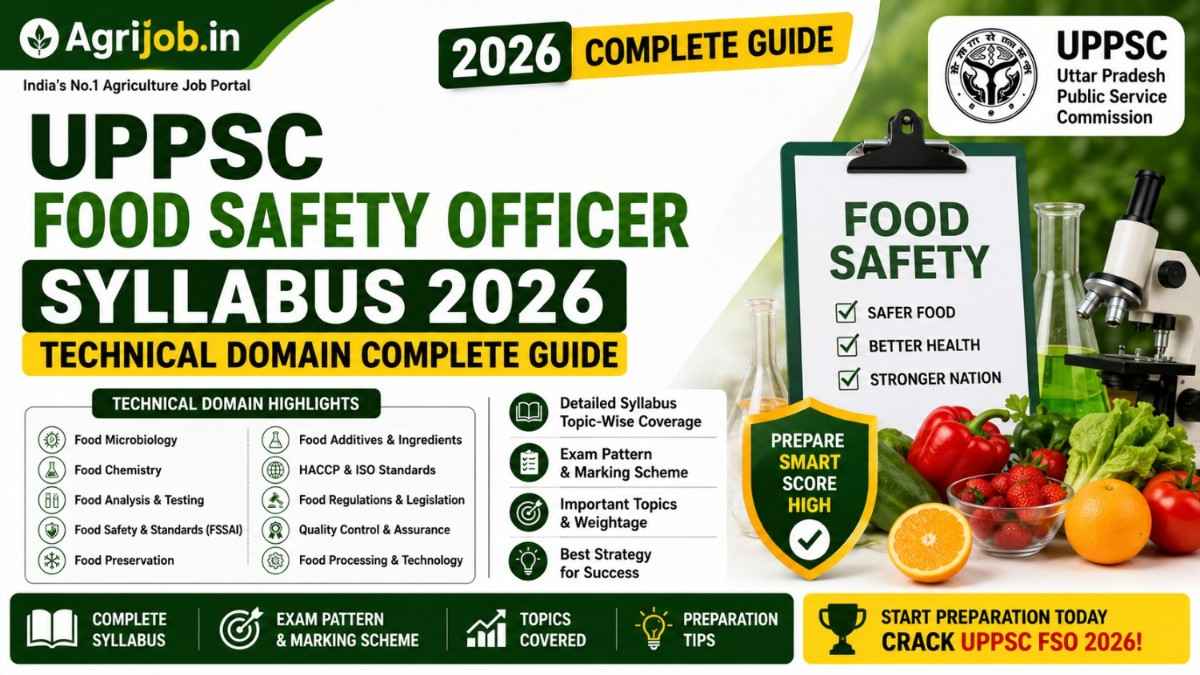
The UPPSC FSO Technical Syllabus 2026 covers 8 core domains: Food Chemistry, Food Microbiology, Food Preservation and Processing, Food Technology (Fruits/Veg/Dairy/Meat), Nutrition and Dietetics, Food Quality and Analysis, Food Laws (FSSA 2006 + FSSAI), and Food Packaging. The technical paper carries 200 marks in the Mains and is the key differentiator for final merit — most seats are won or lost here.
- Conducting Body: Uttar Pradesh Public Service Commission (UPPSC)
- Post: Food Safety Officer (FSO), Food Safety and Drug Administration Dept., UP
- Advertisement No.: A-2/E-1/2026 (PCS Combined Exam 2026)
- Application Period: 25 June 2026 to 27 July 2026
- Pay Scale (7th CPC): Rs.44,900 – Rs.1,42,400/month (Pay Level-7)
- Prelims Exam Date: 6 December 2026 (as per UPPSC Exam Calendar 2026)
- Prelims Total Marks: 400 (Paper I: 200 marks + Paper II CSAT: 200 marks qualifying)
- Mains Total Marks: 1,500 (8 descriptive papers)
- Interview: 100 marks (Personality Test)
- Negative Marking (Prelims): 0.33 marks deducted per wrong answer
- Age Limit: 21–40 years as on 1 July 2026
- Application Fee: Rs.125 (General / OBC / EWS)
- Official Website: uppsc.up.nic.in
📋 Table of Contents
- What Is the UPPSC FSO Technical Domain Syllabus 2026?
- Who Should Prepare for UPPSC FSO Technical Domain?
- UPPSC FSO Salary and Pay Structure 2026
- UPPSC FSO Exam Pattern 2026 – All Stages Explained
- UPPSC FSO Technical Domain Syllabus – All 8 Modules in Detail
- Domain 1: Food Chemistry and Chemical Constituents
- Domain 2: Food Microbiology and Food Hygiene
- Domain 3: Food Preservation and Processing Technology
- Domain 4: Food Technology – Fruits, Vegetables, Dairy and Meat
- Domain 5: Nutrition, Dietetics and Public Health
- Domain 6: Food Quality Control and Analysis
- Domain 7: Food Laws – FSSA 2006, FSSAI and International Standards
- Domain 8: Food Packaging, Additives and Enzymology
- Related FSO Exams You Can Crack With the Same Technical Preparation
- UPPSC FSO vs FSSAI CFSO – Technical Syllabus Comparison
- Important Links
- Conclusion
- Key Takeaways
- Frequently Asked Questions About UPPSC Food Safety Officer Syllabus 2026
What Is the UPPSC FSO Technical Domain Syllabus 2026?
The UPPSC Food Safety Officer Technical Domain Syllabus 2026 refers to the subject-specific scientific content that differentiates FSO recruitment from a general PCS exam. While the FSO exam is conducted under the UPPSC Combined PCS Examination framework — which includes General Studies Papers, General Hindi, and Essay — the core technical knowledge of food science is embedded in the GS Paper III (Food Processing and Related Industries), and the FSO-specific technical depth is what separates candidates who qualify with merit from those who miss the cutoff.
The technical domain spans 8 major subject areas: food chemistry, food microbiology, food preservation and processing, food technology (sub-divided by commodity), human nutrition and public health, food analysis and quality control, food laws and regulations (especially FSSA 2006 and FSSAI), and food packaging and enzymology. Candidates holding a B.Sc. in Food Technology, Dairy Technology, Biotechnology, Agricultural Science, Veterinary Sciences, Bio-Chemistry, or Microbiology, or a PG degree in Chemistry or a medical degree, are the primary target audience for this post.

Who Should Prepare for UPPSC FSO Technical Domain?
This guide is specifically built for candidates who match at least one of the following profiles:
- 🎓 B.Sc. / B.Tech in Food Technology or Dairy Technology — core technical background aligns directly with 7 of 8 FSO technical domains
- 🔬 B.Sc. in Biotechnology or Microbiology — strong for domains 2 (microbiology), 6 (quality control), and 7 (food laws)
- 🌾 B.Sc. in Agricultural Science — strong for commodity-wise food technology (fruits, vegetables, cereals)
- 🐄 B.V.Sc. (Veterinary Sciences) — excellent for meat and dairy technology chapters in domain 4
- ⚗️ M.Sc. in Chemistry or B.Sc. with Chemistry — strong for food chemistry (domain 1), analysis (domain 6), and packaging (domain 8)
- 💊 MBBS / Medical Degree holders — strong for nutrition (domain 5) and food-borne illness sections under microbiology
- 📘 Candidates targeting multiple FSO exams — FSSAI CFSO, UKPSC FSO, MPPSC FSO, and RPSC FSO all test the same core technical topics
- 🏛️ Working professionals in food industry or labs — seeking a permanent government position with secure income and career growth
UPPSC FSO Salary and Pay Structure 2026
The UPPSC Food Safety Officer post is classified under Pay Level-7 of the 7th Central Pay Commission, one of the strongest pay levels for a Group B government post in Uttar Pradesh. As confirmed on the official Agrijob.in UPPSC FSO Recruitment 2026 page and cross-verified with the FSSAI CFSO salary structure (which uses the same Pay Level-7), here is the full salary breakdown:
| Salary Component | Amount (Approx.) |
|---|---|
| Basic Pay (Pay Level-7, 7th CPC) | Rs.44,900/month (starting) |
| Maximum Basic Pay | Rs.1,42,400/month |
| Dearness Allowance (DA) | As per UP Government DA rate (revised quarterly) |
| House Rent Allowance (HRA) | 8–24% of basic pay (based on city category X/Y/Z) |
| Transport Allowance (TA) | As per UP govt rules |
| Medical and Other Allowances | Applicable as per service rules |
| Estimated Gross Monthly Salary | Rs.65,000 – Rs.85,000+/month (including allowances) |
| Annual Package (Approximate) | Rs.7.8 lakh – Rs.10 lakh+ per year |
| Pension | National Pension Scheme (NPS) |
In addition to the salary, FSOs are entitled to medical reimbursement, LTC (Leave Travel Concession), study leave, and annual increments of 3% of basic pay. The 8th Pay Commission, which is expected to revise government salaries from 2026 onward, may further revise pay levels upward significantly — with reports suggesting near-doubling of salaries in the new matrix.
UPPSC FSO Exam Pattern 2026 – All Stages Explained
The UPPSC FSO selection process follows the standard UPPSC PCS Combined Examination structure. There are three stages: Preliminary Examination, Main Written Examination, and Personality Test (Interview). Here is the complete exam pattern with marks and duration:
Stage 1: Preliminary Examination (Objective Type)
| Paper | Subject | Questions | Marks | Duration | Nature |
|---|---|---|---|---|---|
| Paper I | General Studies I | 150 | 200 | 120 Minutes | Merit-based |
| Paper II | General Studies II (CSAT) | 100 | 200 | 120 Minutes | Qualifying (33% cutoff) |
Negative Marking: 0.33 marks deducted for each wrong answer in Prelims. The CSAT paper is qualifying in nature — candidates must score at least 33% but its marks are not counted in merit. Only Paper I marks determine qualification for Mains.
Stage 2: Main Written Examination (Descriptive/Conventional)
| Paper No. | Subject | Marks | Duration |
|---|---|---|---|
| Paper 1 | General Hindi | 150 | 3 Hours |
| Paper 2 | Essay (3 essays × 700 words) | 150 | 3 Hours |
| Paper 3 | General Studies I (History, Culture, Geography) | 200 | 3 Hours |
| Paper 4 | General Studies II (Constitution, Polity, Governance) | 200 | 3 Hours |
| Paper 5 | General Studies III (Economy, Food Processing, Disaster Mgmt) | 200 | 3 Hours |
| Paper 6 | General Studies IV (Ethics and Aptitude) | 200 | 3 Hours |
| Paper 7 | General Studies V (UP Special – History, Culture, Economy) | 200 | 3 Hours |
| Paper 8 | General Studies VI (UP Special – Geography, Governance) | 200 | 3 Hours |
| Total Mains Marks | 1,500 | ||
Stage 3: Personality Test (Interview)
Candidates who qualify in the Mains are called for a Personality Test (Viva-Voce) worth 100 marks. The final merit list is prepared based on Mains marks + Interview marks. For the FSO post, interviewers may ask technical food science and food law questions in addition to general aptitude assessments.
UPPSC FSO Technical Domain Syllabus – All 8 Modules in Detail
The FSO technical syllabus is primarily tested through GS Paper 5 (Food Processing and Related Industries in India) in the Mains, along with relevant technical content embedded across GS Papers 3–6. Candidates preparing specifically for the FSO post must master all 8 technical domains below, as the same content also appears in related FSO exams across India.
Domain 1: Food Chemistry and Chemical Constituents of Foods
Food chemistry forms the backbone of the FSO technical syllabus. This domain covers the molecular science of everything present in food — from macronutrients to trace minerals — and their role in food quality, safety, and spoilage. Expect 15–20% of FSO technical questions to come from this area.
- Desirable and Undesirable Food Constituents: Natural food components vs. contaminants; their health significance and regulatory thresholds
- Water Activity (Aw): Free and bound water; water activity vs. microbial growth; water activity standards in food preservation
- Carbohydrates: Monosaccharides, disaccharides, polysaccharides; starch gelatinization, retrogradation, dextrinization; dietary fiber and resistant starch
- Lipids: Classification of fats and oils; fatty acid structure (saturated, MUFA, PUFA, trans fats); rancidity (hydrolytic and oxidative); lipid oxidation and antioxidants; smoke point and frying chemistry
- Proteins: Amino acid classification (essential and non-essential); protein structure (primary, secondary, tertiary, quaternary); denaturation; Maillard reaction and Browning reactions; Protein Quality: PER, NPU, BV, PDCAAS
- Vitamins: Fat-soluble (A, D, E, K) and water-soluble (B-complex, C) vitamins; stability in processing; deficiency diseases; RDA values
- Minerals: Macro-minerals (Ca, P, Mg, Na, K, Cl, S) and micro-minerals (Fe, Zn, I, F, Cu, Se, Mn); bioavailability; anti-nutritional factors affecting mineral absorption
- Chemical Bonds and Forces in Food: Ionic, covalent, hydrogen bonds, van der Waals forces; their role in texture, gelation, and emulsification
- Organic Chemistry Basics: Aliphatic and aromatic hydrocarbons; preparation and properties of alcohols, phenols, aldehydes, amines; chemical equilibrium; solutions; surface chemistry
- Food Colorants and Pigments: Chlorophylls, carotenoids, anthocyanins, myoglobin; stability during processing; natural vs. synthetic colors; FSSAI-permitted food colors
Domain 2: Food Microbiology and Food Hygiene
Food microbiology is the single highest-weighted technical domain in the UPPSC FSO exam, reflecting the FSO’s primary duty of ensuring microbiological safety of food in UP. Questions from this domain regularly appear in both Prelims Paper I (General Science) and Mains GS Papers.
- Classification of Microorganisms: Bacteria, fungi (molds and yeasts), viruses, protozoa — classification, morphology, physiology, growth curves (lag, log, stationary, decline phases)
- Microbial Growth Requirements: Intrinsic factors (Aw, pH, nutrients, redox potential, antimicrobial constituents) and extrinsic factors (temperature, RH, O2 level, CO2)
- Pure Culture Techniques: Streak plate, pour plate, spread plate methods; maintenance and preservation of cultures
- Control of Microorganisms: Physical methods (heat, radiation, filtration, UV); chemical methods (preservatives, sanitizers, disinfectants); their mechanisms of action
- Sources of Contamination: Raw materials, water, air, equipment, human handling (personnel hygiene); cross-contamination pathways
- Microbiological Standards of Foods: FSSAI-prescribed limits for Total Plate Count (TPC), Coliform Count, E. coli, Salmonella, Listeria, Staphylococcus aureus in various food categories
- Food Poisoning and Foodborne Infections: Salmonellosis, Listeriosis, E. coli O157:H7, Campylobacteriosis, Shigellosis (infections); Staphylococcal toxin, Botulism (Clostridium botulinum), Bacillus cereus (intoxications); symptoms, incubation periods, causative organisms
- Food Toxins: Mycotoxins (Aflatoxin B1, Ochratoxin, Deoxynivalenol — DON); bacterial toxins; natural plant toxins (solanine, cyanogenic glycosides, tannins)
- Food Plant Sanitation: Cleaning-in-Place (CIP) systems; SSOP (Sanitation Standard Operating Procedures); pest control; waste management
- Inspection and Control: Food establishment licensing; sampling procedures; rapid testing methods; hold-and-test protocols as per FSSAI regulations
- Beneficial Microorganisms in Food Fermentation: Lactic Acid Bacteria (Lactobacillus, Streptococcus); Saccharomyces cerevisiae; Aspergillus oryzae; Acetobacter; their role in dairy, bread, beverages, and traditional fermented Indian foods
- Fermented Foods Technology: Manufacture of vinegar, soya sauce, beer, wine; traditional Indian fermented foods (idli, dosa, kanji, dhokla); dairy fermentation (curd, yoghurt, cheese, butter, ghee)
- Food Spoilage Microorganisms: Pseudomonas, Clostridium, Bacillus, Aspergillus, Penicillium — their substrates, spoilage types, and detection methods
Domain 3: Food Preservation and Processing Technology
Food preservation principles bridge food chemistry, microbiology, and engineering. This domain is critical for the FSO technical paper, as food safety enforcement directly involves assessing whether preservation methods are adequate and correctly implemented by food business operators (FBOs).
- Heat Processing: Pasteurization (HTST, LTLT, UHT); sterilization; blanching; thermal death time (TDT); D-value, Z-value, F-value concepts; retort processing and canning; heat penetration in food systems
- Low-Temperature Preservation: Refrigeration; freezing; freeze-drying (lyophilization); Individual Quick Freezing (IQF); cold chain management; effect of freezing on food quality
- Dehydration and Drying: Sun drying, spray drying, drum drying, tunnel drying, fluidized bed drying; vacuum drying; moisture content and water activity post-drying
- Chemical Preservation: Common preservatives — benzoic acid, sorbic acid, propionic acid, sodium metabisulphite, potassium metabisulphite; FSSAI-permitted limits; mechanism of action; permitted vs. prohibited preservatives under FSS Regulations 2011
- Fermentation and Pickling: Lactic acid fermentation; acetic acid fermentation; brine pickling; pH reduction as a preservation mechanism
- Irradiation: Types of ionizing radiation (gamma, X-ray, electron beam); approved doses for different food categories; FSSAI regulations on food irradiation; effect on microbial load and nutrients
- Emerging / Novel Technologies: High-Pressure Processing (HPP); Pulsed Electric Field (PEF); ohmic heating; microwave processing; dielectric heating; infrared heating; thermosonication; microfiltration; bactofugation; ultra-high voltage electric fields; hurdle technology (combining multiple preservative factors)
- Aseptic Processing: Aseptic filling and packaging; sterile product + sterile container; commercially sterile vs. microbiologically safe
- Food Fortification: Addition of micronutrients (iron, iodine, Vitamin A, Vitamin D, folic acid) to commonly consumed foods; FSSAI food fortification standards; FSSAI’s +F logo for fortified foods
Domain 4: Food Technology – Fruits, Vegetables, Dairy, Meat and Cereal Products
Commodity-specific food technology covers the manufacture, packaging, storage, and quality standards of major food groups. This is one of the largest sections of the UPPSC FSO technical syllabus with questions distributed across all food categories.
4A — Technology of Fruits and Vegetable Products
- Juices, pulps, purees, pastes, ketchups, sauces, soups, concentrates, and powders
- Squashes, cordials, beverages — still and carbonated; health drinks and energy drinks
- Jams, jellies, marmalades, and preserves — pectin chemistry; gel formation; FSSAI sugar and fruit content standards
- Pickles and chutneys: salt and oil-based preservation; FSSAI standards for acidity and salt levels
- Minimally processed fruits and vegetables: Modified Atmosphere Packaging (MAP); edible coatings; pre-cut and ready-to-eat produce
- Dehydrated vegetables and powders: onion, tomato, potato flakes; rehydration characteristics
- Spice processing: grinding, extraction of essential oils and oleoresins; adulteration detection in common spices
- Beverages: tea (black, green, white, oolong — processing differences); coffee (roasting, grinding, extraction); cocoa processing and chocolate manufacture
4B — Dairy Technology
- Composition of milk: fat, SNF, proteins (casein, whey), lactose, minerals; FSSAI compositional standards for milk types (Full cream, Toned, Double Toned, Skimmed, Standardised)
- Pasteurization and sterilization of milk: HTST, LTLT, UHT processes; homogenization
- Cream, butter, and ghee manufacture: cream separation (centrifugal); churning; FSSAI standards for fat content
- Cheese and paneer: starter cultures; rennet coagulation; curd cutting, pressing, salting; FSSAI standards for various cheese varieties
- Yoghurt, curd, and fermented dairy products: Lactobacillus bulgaricus + Streptococcus thermophilus; flavored yoghurt; dahi vs. yoghurt distinction
- Condensed and evaporated milk; milk powder (SMP and WMP); infant formula composition
- Ice cream manufacture: overrun; stabilizers; emulsifiers; FSSAI standards for milk fat and MSNF in ice cream
- Khoa, rabri, and traditional Indian dairy products; adulteration tests for common milk adulterants
4C — Meat, Poultry, Fish and Egg Technology
- Composition and structure of muscle tissue; myoglobin and color changes in meat
- Post-mortem changes: rigor mortis, ATP depletion, pH drop, conditioning; PSE and DFD meat
- Meat preservation: chilling, freezing, curing (salt, nitrite), smoking, dehydration, canning, radiation
- Processed meat products: sausages, ham, bacon, burgers; FSSAI standards for meat products
- Poultry processing: slaughter, defeathering, evisceration, chilling; quality grades
- Fish spoilage: bacterial spoilage; TVB-N (Total Volatile Base Nitrogen) as a freshness indicator; TMAO reduction; K-value
- Fish preservation and processing: icing, freezing, smoking, salting, drying, canning; surimi; FSSAI standards for fishery products
- Egg structure and composition; quality grading (Haugh Unit); egg products (powders, pasteurized liquid)
4D — Cereal, Legume and Oilseed Technology
- Wheat milling: extraction rate; flour quality (gluten strength, falling number, ash content); FSSAI wheat flour standards
- Rice milling: degree of milling; parboiling; rice bran oil extraction; FSSAI rice quality standards
- Bread and bakery products: yeast fermentation; role of gluten; bread improvers; FSSAI standards for bread
- Pulse processing: milling to dals; anti-nutritional factors (trypsin inhibitors, phytic acid, lectins, hemagglutinins) and their removal
- Oil extraction: mechanical expelling; solvent extraction (hexane); refining steps (degumming, neutralization, bleaching, deodorization, winterization/dewaxing)
- Oilseed cake and meal: protein concentrates and isolates; FSSAI standards for edible oils and fats
Domain 5: Nutrition, Dietetics, and Public Health
The nutrition and public health domain links food science to population-level health outcomes — directly relevant to the FSO’s mandate to protect consumer health. This section overlaps with General Studies Paper V (UP Special) regarding state nutrition programs.
- Balanced Diet and RDA: Recommended Dietary Allowances (ICMR RDA 2020) for different age and gender groups; concept of balanced diet; food pyramid and My Plate guidelines
- Energy Metabolism: Basal Metabolic Rate (BMR) calculation; Specific Dynamic Action (SDA); Energy requirements for different activity levels; caloric values: carbohydrate 4 kcal/g, protein 4 kcal/g, fat 9 kcal/g
- Protein Quality Evaluation: Biological Value (BV), Net Protein Utilization (NPU), Protein Efficiency Ratio (PER), Net Protein Ratio (NPR), PDCAAS; reference proteins; limiting amino acids
- Macronutrient Deficiencies: Protein-Energy Malnutrition (PEM); Marasmus (severe energy + protein deficit); Kwashiorkor (severe protein deficit); Marasmic-Kwashiorkor
- Micronutrient Deficiencies: Vitamin A (night blindness, xerophthalmia); Vitamin D (rickets, osteomalacia); Vitamin C (scurvy); Vitamin B1 (beriberi); Vitamin B3 (pellagra); Vitamin B12 + Folic acid (megaloblastic anemia); Iron (microcytic anemia); Iodine (goitre, cretinism)
- Lifestyle / Non-Communicable Diseases (NCDs): Obesity (BMI ≥30); Type 2 diabetes; hypertension; cardiovascular disease; role of diet in prevention and management
- Special Groups Nutrition: Infants (exclusive breastfeeding for 6 months; complementary feeding; infant formula standards); maternal nutrition (folic acid, iron, calcium requirements during pregnancy); elderly nutrition (osteoporosis, sarcopenia)
- National Nutrition Programs: Poshan Abhiyan (POSHAN 2.0); Mid-Day Meal Scheme (PM POSHAN); ICDS (Integrated Child Development Services); National Iron Plus Initiative; National Program for Prevention and Control of NCDs; PM Matru Vandana Yojana
- Therapeutic Diets: Diet in diabetes; diet in hypertension (DASH diet); renal diet; gluten-free diet for celiac disease; elimination diets for food allergies; enteral and parenteral nutrition
Domain 6: Food Quality Control and Food Analysis
Quality control and food analysis form the technical core of day-to-day FSO work — the FSO collects samples, sends them to FSSAI-notified laboratories, and interprets results against FSSAI food product standards. A deep understanding of food testing methods is non-negotiable.
- Principles of Food Analysis: Proximate composition analysis (moisture, ash, protein by Kjeldahl, fat by Soxhlet, carbohydrates by difference, crude fiber); Official methods of analysis (AOAC, BIS, FSSAI methods)
- Sampling Methods: Random sampling; stratified sampling; composite vs. grab sampling; FSSAI food sampling protocols under FSS (Food Sampling and Analysis) Regulations 2011; three-sample system (one for analysis, one for referral, one for the food business operator)
- Physical Testing Methods: Specific gravity; refractive index; viscosity; turbidity; color measurement (Hunter Lab, CIE); texture profile analysis; Bostwick consistometer for sauces
- Chemical Analysis — Classical Methods: Gravimetry; titrimetry (acid-base, permanganate, iodometric); Fehling’s test for reducing sugars; Dumas method for nitrogen; Winkler’s method for DO; flash point and smoke point determination for fats
- Instrumental Analytical Methods: UV-Visible spectrophotometry; FTIR spectroscopy; Raman spectroscopy; Flame photometry; Atomic Absorption Spectroscopy (AAS); ICP-MS (heavy metal analysis)
- Chromatographic Techniques: Thin Layer Chromatography (TLC) for dye detection; Gas Chromatography (GC) for fatty acid profiling; HPLC for vitamins, preservatives, and dyes; LC-MS/MS for pesticide residue confirmation; GC-MS for volatile compounds and adulterant identification
- Microbiological Analysis of Foods: Standard Plate Count (SPC/TPC); MPN method for coliforms; membrane filtration; ELISA-based detection; PCR-based methods; immunochromatographic rapid test kits; VIDAS system
- Adulteration Detection: Detection of common adulterants in milk (water, SNF reduction, starch, urea, detergent, hydrogen peroxide — FSSAI prescribed tests); adulteration in oils (argemone oil, mineral oil — Baudouin test); spice adulteration (chalk in flour, metanil yellow in turmeric — detection tests); honey adulteration (NMR test, C4 sugar test)
- Food Quality Systems: HACCP (Hazard Analysis and Critical Control Points) — 7 principles and 12 steps; GMP (Good Manufacturing Practices); GHP (Good Hygiene Practices); GAP (Good Agricultural Practices); GLP (Good Laboratory Practices); ISO 22000:2018 (Food Safety Management System); FSSC 22000; BRC Global Standards
- Food Labeling Requirements: Mandatory declarations on food labels as per FSS (Labelling and Display) Regulations 2020; Net weight, date of manufacture, best before, nutritional information table, allergen declaration, vegetarian / non-vegetarian logos; FSSAI logo and license number requirements
Domain 7: Food Laws – FSSA 2006, FSSAI, and International Standards
The Food Safety and Standards Act, 2006 (FSSA 2006) is the legislative backbone of every FSO’s authority. Questions from this domain appear in both Mains GS Paper 3 and the Personality Test. A Food Safety Officer who does not know FSSA 2006 thoroughly cannot function effectively in the field.
- Food Safety and Standards Act, 2006 (FSSA 2006): Objectives, definitions (Section 3), regulatory structure; Food Safety and Standards Authority of India (FSSAI) — its constitution, powers, and functions; Central Advisory Committee; Scientific Panels and Scientific Committee
- FSSAI Licensing and Registration: Petty food business operators (PFBO) — registration; food business operators (FBO) — State License (turnover Rs.12 lakh – Rs.20 crore) and Central License (turnover >Rs.20 crore or multi-state); licensing conditions and documents required
- Food Safety Officers — Powers and Duties: Power to enter, inspect, search, and seize under FSSA 2006; food sampling procedure; sending samples to NABL-accredited / FSSAI-notified laboratories; consequences of unsafe food; Adjudicating Officer and Food Safety Appellate Tribunal
- Penalties Under FSSA 2026: Penalty for sub-standard food (Section 51) — up to Rs.5 lakh; adulterated food (Section 50) — up to Rs.10 lakh or imprisonment; misleading advertisement (Section 53) — up to Rs.10 lakh; penalty for unsafe food causing injury/death — up to life imprisonment
- FSS Regulations and Standards: FSS (Food Products Standards and Food Additives) Regulations 2011; FSS (Contaminants, Toxins and Residues) Regulations 2011; FSS (Prohibition and Restrictions on Sales) Regulations 2011; FSS (Packaging and Labelling) Regulations; FSS (Import) Regulations; FSS (Organic Foods) Regulations 2017; FSS (Health Supplements, Nutraceuticals…) Regulations 2022
- Prevention of Food Adulteration Act (PFA): History and repeal by FSSA 2006; key concepts retained in FSSA framework
- Codex Alimentarius Commission (CAC): Joint FAO/WHO body; Codex standards; Codex Alimentarius — definition and purpose; India’s participation; Codex standards as reference for FSSAI
- WTO Agreements: SPS Agreement (Sanitary and Phytosanitary Measures) — allows countries to set food safety standards; TBT Agreement (Technical Barriers to Trade) — ensures food standards do not create unnecessary trade barriers; TRIPS; role of FSSAI in WTO-related food trade disputes
- International Accreditation Bodies: ISO/IEC 17025 for testing and calibration laboratories; NABL (National Accreditation Board for Testing and Calibration Laboratories); FSSAI-notified laboratories; role of referral laboratories
- Eat Right India Initiative: FSSAI’s flagship campaign — Eat Right India, Eat Smart Cities Challenge, Annapurna Canteens, RUCO (Repurpose Used Cooking Oil) initiative; food fortification with +F logo; Clean Street Food Hub
Domain 8: Food Packaging, Food Additives, and Enzymology
The final technical domain covers food additives (highly examined due to adulteration issues), packaging materials (directly relevant to FSO enforcement work), and enzyme science (critical for food chemistry and technology).
8A — Food Packaging
- Packaging materials: glass, tin/steel cans, aluminum cans, aluminum foil, paper and paperboard, plastics (LDPE, HDPE, PET, PP, PVDC, EVA), multilayer/laminate packaging
- Plastic food contact materials: migration of monomers and additives; FSSAI regulations on food-grade plastics; ban on single-use plastics (SUP) — current Indian regulations 2022+
- Active Packaging: oxygen scavengers, moisture absorbers (silica gel), ethylene scavengers, antimicrobial packaging; their role in extending shelf life
- Modified Atmosphere Packaging (MAP): gas mixtures (CO2, N2, O2) for different food categories; benefits and limitations
- Aseptic and Retort Packaging: Tetra Pak; retortable pouches; metal cans — seam integrity and vacuum testing
- Biodegradable and eco-friendly packaging: bioplastics (PLA, PHA); cellulose-based packaging; sustainability trends
- Packaging regulations: FSS (Packaging and Labelling) Regulations; BIS standards for food packaging; food contact material safety standards
8B — Food Additives
- Classification: preservatives, antioxidants, emulsifiers, stabilizers, thickeners, gelling agents, acidity regulators, anti-caking agents, flavor enhancers, colors, sweeteners, bulking agents, firming agents
- FSSAI-permitted additives list under FSS (Food Products Standards and Food Additives) Regulations 2011; INS (International Numbering System) codes; ADI (Acceptable Daily Intake) concept
- Commonly tested additives: BHA, BHT, TBHQ (antioxidants); Tartrazine, Sunset Yellow, Carmoisine (permitted synthetic colors); Aspartame, Acesulfame-K, Saccharin (artificial sweeteners); MSG (monosodium glutamate) — permitted uses; EDTA (chelating agent); BPA in plastics
- Prohibited additives: FSSAI-banned substances; coal tar dyes; Sudan dyes; Rhodamine B; argemone oil adulterant
8C — Enzymology in Food Systems
- Nomenclature and classification of enzymes: oxidoreductases, transferases, hydrolases, lyases, isomerases, ligases
- Enzyme kinetics: Michaelis-Menten equation; Km and Vmax; inhibition (competitive, non-competitive, uncompetitive)
- Enzymes in food modification: amylase (starch hydrolysis in baking); protease (tenderization of meat; cheese ripening); lipase (dairy flavour development; rancidity); pectinase (fruit juice clarification); glucose oxidase (dough strengthening); lactase (lactose-free milk production)
- Single Cell Protein (SCP): production from Spirulina, Chlorella, yeast; nutritional value; regulatory status under FSSAI
- Metabolic pathways relevant to food: glycolysis; Krebs cycle; beta-oxidation of fatty acids; amino acid catabolism — their relevance to food composition, fermentation, and spoilage
- Immobilized enzymes: techniques; applications in food processing (HFCS production using immobilized glucose isomerase)
Download and read the FSSAI Food Safety Manual and Schedule 1 of FSS (Food Products Standards and Food Additives) Regulations 2011 directly from fssai.gov.in — they list exact compositional standards for 200+ food categories. FSO exams across all states (UPPSC, FSSAI, UKPSC, MPPSC) routinely test these standards. Knowing the exact fat % in full-cream milk or the permitted BHA level in edible oil is a guaranteed score-booster that most candidates skip.
Related FSO Exams You Can Crack with the Same Technical Preparation
The UPPSC FSO technical syllabus is nearly identical across all state and central FSO recruitment exams in India. Preparing thoroughly for one exam effectively prepares you for all of them simultaneously. Here are the key related exams to target in parallel:
| Exam / Recruiting Body | Post | Pay Scale | Technical Syllabus Overlap | Key Difference |
|---|---|---|---|---|
| FSSAI CFSO (Central Govt) | Central Food Safety Officer | Rs.44,900–Rs.1,42,400 (Pay Level-7) | ~95% overlap — food laws, chemistry, microbiology, analysis, HACCP | No state GS papers; CBT format; 2-stage CBT |
| UKPSC FSO (Uttarakhand) | Food Safety Officer | Per UKPSC 7th CPC norms | ~90% overlap — food chemistry, microbiology, food laws, FSSAI | Additional Uttarakhand state GK; 200-question objective paper + 25-mark interview |
| MPPSC FSO (Madhya Pradesh) | Food Safety Officer | Rs.36,200+ (Pay Matrix Level-10) | ~85% overlap — food science, microbiology, preservation, food laws | MP-specific food industry and state GK |
| RPSC FSO (Rajasthan) | Food Safety Officer | Per RPSC 7th CPC norms | ~85% overlap — food chemistry, microbiology, nutrition, food laws | Rajasthan GK; food processing industries of Rajasthan |
| FSSAI Food Analyst (FAE) | Food Analyst | Pay Level-7 (central govt) | ~70% overlap — food laws, chemistry, microbiology, analytical methods | Deep analytical methods (chromatography, spectrometry); lab system planning; mandatory practical exam |
| APPSC FSO (Andhra Pradesh) | Food Safety Officer | Per AP Pay Commission | ~85% overlap — food laws, microbiology, nutrition, food technology | AP-specific food industries and state GK |
| TSPSC FSO (Telangana) | Food Safety Officer | Per TS Pay Commission | ~85% overlap — food chemistry, microbiology, FSSA 2006, quality control | Telangana-specific food processing industry |
| OSSC FSO (Odisha) | Food Safety Officer | Pay Level-9 (ORSP-2017) | ~80% overlap — food chemistry, Indian food laws, public health | 3-stage exam; includes Computer Skill Test (qualifying) |
We recommend targeting UPPSC FSO + FSSAI CFSO + UKPSC FSO simultaneously. These three exams share 90–95% of their technical syllabus. Master the 8 technical domains in this guide, add UPPSC-specific GS preparation for UP papers, and you will have a comprehensive preparation strategy covering 3 different high-paying government posts at once. The FSSAI CFSO (central government post) offers better service conditions and national posting but requires CBT-format preparation. UPPSC FSO carries the advantage of home state posting with equivalent pay.
UPPSC FSO vs FSSAI CFSO – Technical Syllabus Comparison
| Parameter | UPPSC FSO 2026 | FSSAI CFSO 2026 |
|---|---|---|
| Conducting Body | UPPSC (State PSC) | FSSAI (Central Govt) |
| Exam Mode | Offline (OMR + Written) | Online CBT (Computer-Based Test) |
| Exam Stages | Prelims → Mains → Interview | CBT Stage 1 → CBT Stage 2 → Interview |
| Technical Paper Marks | Part of GS Paper III (Mains) — 200 marks | Part B of Stage 1 — weighted technical section |
| Food Laws Coverage | FSSA 2006 + GS framework | Deep FSSAI Act, Regulations, Codex, WTO |
| Food Science Depth | Standard FSO level | Slightly deeper food analysis focus |
| General Studies | 6 GS papers + Hindi + Essay (Mains) | Part A: General Aptitude + Computer Literacy |
| UP-Specific Content | Yes — 2 full Mains papers on UP | No state-specific content |
| Pay Scale | Rs.44,900–Rs.1,42,400 (State Govt, UP) | Rs.44,900–Rs.1,42,400 (Central Govt, FSSAI) |
| Posting Location | Within Uttar Pradesh | Anywhere in India |
| Negative Marking | 0.33 per wrong answer (Prelims) | Applicable in CBT |
| Best For | UP domicile candidates wanting home state posting | Candidates seeking central govt service with national reach |
Important Links for UPPSC FSO 2026
| Resource | Link |
|---|---|
| UPPSC Official Website | uppsc.up.nic.in |
| FSSAI Official Website (Food Laws Reference) | fssai.gov.in |
| Food Safety and Standards Act 2006 (Full Text) | FSSA 2006 PDF – fssai.gov.in |
| FSSAI Food Products Standards and Additives Regulations 2011 | FSSAI Regulations – fssai.gov.in |
| ICMR RDA 2020 (Nutrition Standards Reference) | icmr.gov.in |
| UPPSC FSO Recruitment 2026 – Agrijob.in | UPPSC FSO Recruitment 2026 Details |
| Government Jobs in Food Technology 2026 | Food Technology Jobs – Agrijob.in |
Conclusion: Your FSO Technical Preparation Starts Here
The UPPSC Food Safety Officer Syllabus 2026 technical domain is broad but highly structured — 8 clear subject areas, each with a defined scope and predictable question types. Candidates who master Food Chemistry, Food Microbiology, Food Preservation, Food Technology (commodity-wise), Nutrition, Quality Analysis, FSSA 2006, and Packaging will command the technical portion of the exam and build a sustainable advantage in the final merit list. With a pay scale of Rs.44,900–Rs.1,42,400/month and the same technical preparation unlocking 7+ related FSO exams across India, this is one of the highest-return investments a food science graduate can make. Begin with FSSA 2006 and FSSAI Regulations directly from fssai.gov.in — the primary law document is your most important study material. Bookmark this page — we update it every time official UPPSC or FSSAI notifications revise the syllabus.
- UPPSC FSO 2026 pay scale is Rs.44,900–Rs.1,42,400/month (Pay Level-7, 7th CPC) with gross in-hand of Rs.65,000–Rs.85,000+/month
- The technical domain covers 8 core subjects: Food Chemistry, Microbiology, Preservation, Technology, Nutrition, Quality Analysis, Food Laws, and Packaging
- FSSA 2006 and FSSAI Regulations are the single most important documents — FSO powers, penalties, sampling procedures, and standards all come from here
- The same technical syllabus covers FSSAI CFSO, UKPSC FSO, MPPSC FSO, RPSC FSO, FSSAI Food Analyst, and 4 more state FSO exams
- Last date to apply for UPPSC FSO 2026 is 27 July 2026 at uppsc.up.nic.in — complete OTR at least 72 hours before applying
- Prelims scheduled for 6 December 2026; negative marking of 0.33 per wrong answer applies
Frequently Asked Questions About UPPSC Food Safety Officer Syllabus 2026
What is the UPPSC Food Safety Officer technical domain syllabus 2026?
The UPPSC FSO technical domain syllabus 2026 covers 8 major subjects: Food Chemistry (carbohydrates, lipids, proteins, vitamins, minerals), Food Microbiology (pathogens, spoilage, fermentation, hygiene), Food Preservation (heat processing, freezing, dehydration, novel technologies), Food Technology (fruits, vegetables, dairy, meat, cereals), Nutrition and Public Health (RDA, deficiency diseases, national nutrition programs), Food Analysis and Quality Control (HACCP, GMP, analytical methods, adulteration detection), Food Laws (FSSA 2006, FSSAI regulations, Codex, WTO), and Food Packaging and Additives (packaging materials, permitted additives, enzymology).
What is the salary of UPPSC Food Safety Officer 2026?
The UPPSC Food Safety Officer 2026 salary is Rs.44,900 per month (basic pay, starting) to Rs.1,42,400 per month (maximum) under Pay Level-7 of the 7th Pay Commission. After adding Dearness Allowance (DA), House Rent Allowance (HRA), and other allowances as per UP Government norms, the estimated gross monthly salary is Rs.65,000 to Rs.85,000+. The post also comes with annual increments, NPS pension, medical benefits, and LTC.
What is the exam pattern for UPPSC FSO 2026?
The UPPSC FSO 2026 exam follows a 3-stage selection process. The Preliminary Examination has two papers: Paper I (General Studies, 150 questions, 200 marks, 2 hours) and Paper II (CSAT, 100 questions, 200 marks, 2 hours — qualifying with 33% cutoff). The Main Examination has 8 descriptive papers totaling 1,500 marks, including General Hindi, Essay, 4 General Studies Papers (GS I to IV), and 2 UP-specific papers (GS V and GS VI). The final stage is a Personality Test (Interview) worth 100 marks. Negative marking of 0.33 applies in Prelims only.
Is the FSSA 2006 important for the UPPSC FSO exam?
Yes, the Food Safety and Standards Act 2006 (FSSA 2006) is the single most important legislation for FSO examination preparation. It defines the FSO’s legal powers (inspection, sampling, seizure), the structure of FSSAI, penalties for food offences (adulteration, sub-standard food, unsafe food), licensing and registration requirements for FBOs, and the framework for food standards and regulations. Questions on FSSA 2006 appear across the Mains GS Paper III (Food Processing and Related Industries section) and in the Personality Test where technical knowledge is directly assessed.
Which other exams can I prepare for with the UPPSC FSO technical syllabus?
The UPPSC FSO technical syllabus shares 85–95% overlap with FSSAI CFSO (Central Food Safety Officer), UKPSC FSO (Uttarakhand), MPPSC FSO (Madhya Pradesh), RPSC FSO (Rajasthan), FSSAI Food Analyst Exam (FAE), APPSC FSO (Andhra Pradesh), TSPSC FSO (Telangana), and OSSC FSO (Odisha). Mastering the 8 technical domains in the UPPSC FSO syllabus effectively positions you to appear and qualify in all these exams simultaneously, maximizing your chances of securing a government job in food safety.
What are the most important topics in UPPSC FSO technical domain for scoring?
Based on previous year patterns, the highest-scoring technical areas in FSO exams are: Food Microbiology (foodborne pathogens, HACCP, spoilage — appears in every FSO exam), FSSA 2006 and FSSAI Regulations (penalties, sampling, licensing — highly predictable questions), Food Adulteration Detection (specific tests for milk, oils, spices, honey — direct enforcement knowledge), Food Chemistry (macronutrient properties, Maillard reaction, rancidity — tested in every FSO paper), and Food Preservation Technologies (D-value, Z-value, HTST pasteurization, novel technologies — numerical questions possible).
What educational qualification is required for UPPSC FSO 2026?
Candidates must hold a Bachelor’s Degree in Food Technology, Dairy Technology, Biotechnology, Oil Technology, Agricultural Science, Veterinary Sciences, Bio-Chemistry, or Microbiology — OR a Post Graduate Degree in Chemistry — OR a Degree in Medicine from a recognized University, or any equivalent qualification notified by the Central Government. The age limit is 21 to 40 years as on 1 July 2026, with standard SC/ST/OBC relaxations as per UP Government rules.
What are the best books for UPPSC FSO technical domain preparation?
Top recommended references for the UPPSC FSO technical domain are: “A Textbook of Food Science and Technology” by S. Roday (covers processing, preservation, microbiology, and nutrition comprehensively); “Food Safety and Standards Act 2006 with Rules and Regulations” by Commercial Law Publishers (essential for food laws); “Introduction to Food Science” by B. Srilakshmi (food chemistry and nutrition); “Microbiology of Foods” by J.M. Jay (microbiology domain); and the FSSAI Manual of Methods of Analysis of Foods (for food analysis methods). Always supplement book study with FSSAI Regulations downloaded directly from fssai.gov.in.
How does UPPSC FSO compare with FSSAI CFSO for career growth?
Both UPPSC FSO and FSSAI CFSO start at the same Pay Level-7 (Rs.44,900/month basic pay). FSSAI CFSO offers central government benefits including higher HRA (for X-category cities), better career progression to Senior FSO and higher central service levels, and national posting. UPPSC FSO offers stable home-state (UP) posting, state government service advantages, and the well-established UP Government promotion structure. For candidates preferring UP posting and state service benefits, UPPSC FSO is the preferred choice; those comfortable with national transfer should prioritize FSSAI CFSO.
Last Updated: July 2026 | Author: Nitish Singh, Agrijob.in | This guide is reviewed and updated regularly for accuracy. Bookmark this page for the latest UPPSC FSO syllabus and related food safety exam updates.
Disclaimer: This article is for informational and educational purposes only. Candidates are advised to verify all exam pattern details, syllabus, salary, and eligibility criteria from the official UPPSC notification PDF available at uppsc.up.nic.in before applying. Syllabus details are based on the official UPPSC PCS Combined Examination 2026 notification and publicly available information from FSSAI, ICMR, and UPPSC. Data sourced from FSSAI (fssai.gov.in), UPPSC (uppsc.up.nic.in), ICMR (icmr.gov.in), and PIB (pib.gov.in).