
OSSSC Sevak Sevika Syllabus 2026 is the foundation every serious aspirant must master before attempting either the Prelims or Mains exam. The Odisha Sub-Ordinate Staff Selection Commission (OSSSC) conducts this recruitment under the ST & SC Development, M & BCW Department with 2,243 Sevak/Sevika vacancies — making it one of the most competitive teacher-grade exams in Odisha this cycle. This guide is for candidates who have cleared the eligibility bar (OTET qualified, +2 with C.T./D.El.Ed) and need a precise, subject-wise breakdown of both papers, the marking scheme, and a proven week-by-week strategy to score above the 35% cutoff and land a seat.

The OSSSC Sevak Sevika Syllabus 2026 covers two papers: Paper-I (GK, Arithmetic, Reasoning, English, Computer Literacy & Pedagogy) for Prelims, and Paper-II (English, Odia, Mathematics & EVS with pedagogy) for both Prelims and Mains. Each exam is 100 MCQs in 90 minutes with 0.33 negative marking. Pay scale is Rs.23,600–Rs.74,800 per month under Pay Level-06.
- Recruiting Body: Odisha Sub-Ordinate Staff Selection Commission (OSSSC)
- Post: Sevak / Sevika & Tribal Language Teacher (TLT)
- Vacancies: 2,243 (Sevak/Sevika) + 236 (TLT)
- Exam Mode: MCQ / Objective — OMR or CBRT
- Total Questions: 100 per stage
- Duration: 90 Minutes (1.5 hours)
- Negative Marking: 0.33 marks per wrong answer
- Pay Scale: Rs.23,600 – Rs.74,800/month (Level-06, Cell-01)
- Min. Qualifying Marks — Mains: 35% (General/SEBC), 30% (SC/ST/PwD)
- Official Portal: osssc.gov.in
📋 Table of Contents
- What Is OSSSC Sevak Sevika Syllabus 2026?
- Who Should Read This Syllabus Guide?
- OSSSC Sevak Sevika Salary & Pay Structure 2026
- Eligibility & Requirements
- Exam Pattern — Prelims vs Mains
- Paper-I Syllabus (Prelims Only)
- Paper-II Syllabus (Prelims + Mains)
- Prelims vs Mains — Complete Comparison
- Pros & Cons of This Exam Structure
- How to Crack OSSSC Sevak Sevika Exam — 8-Step Strategy
- Important Terms Related to OSSSC Sevak Sevika
- Important Links
- Conclusion
- Key Takeaways
- Frequently Asked Questions
What Is OSSSC Sevak Sevika Syllabus 2026?
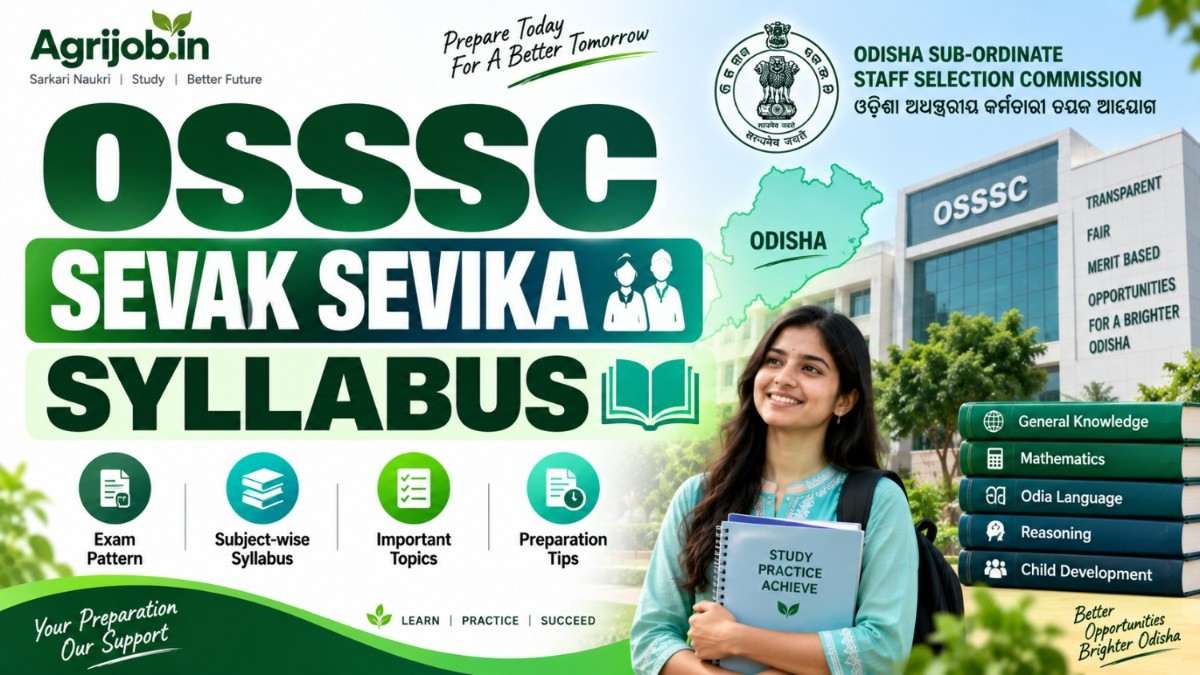
The OSSSC Sevak Sevika Syllabus 2026 is the official subject-and-topic map prescribed by the Odisha Sub-Ordinate Staff Selection Commission for candidates appearing in the Sevak, Sevika, and Tribal Language Teacher (TLT) recruitment exam. It defines precisely what you will be tested on across both the Preliminary Examination (screening stage) and the Main Examination (merit-ranking stage).
The syllabus is divided into two papers. Paper-I applies only to the Prelims and covers general aptitude, language, and computer literacy. Paper-II applies to both the Prelims and the Mains, and tests subject-specific pedagogy and content knowledge in English, Odia, Mathematics, and Environmental Studies — the core of what a Sevak or Sevika teacher will actually teach in primary classrooms under the ST & SC Development Department.
Understanding the syllabus in full before starting preparation is not optional — it is the single most effective time-saving decision a candidate can make. Candidates who study off-syllabus topics routinely waste 30–40% of their preparation time without improving their score.
Who Should Read This OSSSC Sevak Sevika Syllabus Guide?
- 🎓 OTET-qualified candidates who have cleared Paper-I or Paper-II and want a government teaching post in Odisha.
- 📚 +2 pass candidates with C.T./D.El.Ed training looking for the complete Paper-I and Paper-II topic list before beginning serious preparation.
- 🗓️ First-time OSSSC exam takers who need to understand the Prelims vs Mains structure and the role of negative marking.
- 🔁 Repeat aspirants who attempted previous cycles and want to identify which syllabus sections changed or where they lost marks.
- 🌐 Tribal Language Teacher (TLT) applicants (Soura, Kuvi, Kui, Ho, Santali, Mundari, Bonda, etc.) who need to verify their specific language eligibility alongside the shared syllabus.
- ⏱️ Working candidates with limited study time who want a priority-ranked study plan based on marks weightage per section.
- 📖 Pedagogy-focused candidates who want to understand how Child Development, Inclusive Education, and TLM content is tested in Paper-II.
- 🏆 High-scorers targeting district merit lists who want to benchmark their preparation against the 35% (General) and 30% (SC/ST/PwD) qualifying cutoffs.
OSSSC Sevak Sevika Salary & Pay Structure 2026
The OSSSC Sevak Sevika pay scale is governed by the Odisha Revised Scales of Pay (ORSP) Rules 2017, placing the post at Pay Matrix Level-06, Cell-01. This is one of the most stable and attractive government teaching roles for +2-level educated candidates in Odisha.
| Pay Component | Amount (Rs.) |
|---|---|
| Basic Pay (Entry Level – Level-06, Cell-01) | Rs.23,600/month |
| Maximum Basic Pay (Level-06 top) | Rs.74,800/month |
| Dearness Allowance (DA) | As per state revision (revised bi-annually) |
| House Rent Allowance (HRA) | Based on city classification |
| Transport Allowance (TA) | As per posting location |
| City Compensatory Allowance | Applicable in select cities |
| Estimated In-Hand Salary (Initial) | Rs.28,000 – Rs.33,000/month |
| Pay Scale Range | Rs.23,600 – Rs.74,800/month |
In addition to the monthly salary, confirmed Sevak/Sevika employees receive government pension benefits, medical reimbursement, annual increments, and career advancement opportunities to Senior Sevak/Sevika or supervisory roles. The position is a district-cadre post under the ST & SC Development Department, offering long-term job security.
Eligibility & Requirements for OSSSC Sevak Sevika 2026
Before studying the syllabus, confirm you meet all eligibility criteria. Applying without meeting them wastes both application fees and preparation time.
- Educational Qualification: Passed +2 Arts, Science or Commerce (or equivalent) from a recognised board.
- Training Requirement: Must have completed C.T. or D.El.Ed (D.I.E.T.) teacher training.
- OTET: Must have qualified OTET Paper-I (for primary level) or Paper-II (for upper primary), as applicable. TLT applicants need OTET Paper-I plus specific tribal language proficiency.
- Odia Language: Must have passed Class VII/ME School with Odia as a subject or medium, or Matriculation with Odia — as per applicable state rules.
Age Limit & Relaxation
| Category | Age Limit |
|---|---|
| General | 21 – 42 years |
| SC / ST / SEBC / Women | 5 years relaxation (up to 47 years) |
| Persons with Disabilities (PwD) | 10 years relaxation |
| Ex-Servicemen | Relaxation for entire defence service period |
Application Fee
| Category | Application Fee |
|---|---|
| General / SEBC | Rs.100/- |
| SC / ST / PwD (Odisha domicile) | Nil (as per official notification) |
OSSSC Sevak Sevika Exam Pattern 2026 — Prelims vs Mains
The OSSSC Sevak Sevika selection process involves 3 stages: Preliminary Examination → Main Examination → Document Verification. Understanding the role of each stage prevents the common error of treating Prelims and Mains as equal in weight — they are not.
| Feature | Prelims | Mains |
|---|---|---|
| Purpose | Screening only | Merit ranking |
| Shortlisting ratio | Approx. 5× vacancies | Approx. 125% of vacancies |
| Total Questions | 100 MCQs | 100 MCQs |
| Total Marks | 100 | 100 |
| Duration | 90 Minutes | 90 Minutes |
| Mode | OMR / CBRT | OMR / CBRT |
| Negative Marking | 0.33 per wrong answer | 0.33 per wrong answer |
| Papers covered | Paper-I + Paper-II | Paper-II only |
| Marks count for final merit? | No | Yes |
Critical insight: Your Prelims score is used only for shortlisting — it does not carry into final merit. Only your Mains score determines your rank. This means candidates should use Prelims preparation to get through the gate efficiently, then shift maximum effort to the Paper-II content (which is the sole Mains syllabus) to build the score that matters.
Paper-I Syllabus — OSSSC Sevak Sevika Prelims 2026
Paper-I applies exclusively to the Preliminary Examination. It tests general aptitude, language skills, and basic computer knowledge across five sections. Candidates who are already OTET-qualified will find several overlaps with their OTET preparation — particularly in Pedagogy and Reasoning.
Section I — General Knowledge & Current Affairs
- Current events of Odisha, India, and international importance
- History of Odisha and India, Indian National Movement
- Indian and World Geography
- Indian Polity and Governance
- Economic and Social Development
- Everyday Science (applied and basic concepts)
Preparation tip: Odisha-specific GK (geography, culture, history, government schemes) consistently carries 8–10 questions. Prioritise Odisha state content over national-level general knowledge for this section.
Section II — Arithmetic
- Number System
- HCF and LCM
- Squares and Square Roots, Cubes and Cube Roots
- Percentage, Average
- Ratio and Proportion
- Simple Interest and Compound Interest
- Profit, Loss and Discount
- Partnership
Section III — Reasoning Ability
- General Mental Ability
- Logical Reasoning and Analytical Ability
- Decision Making and Problem Solving
- Basic Numeracy
- Data Interpretation (graphs, charts, tables)
Section IV — English Language
- Verbs, Tenses, Modals
- Active and Passive Voice
- Subject-Verb Agreement
- Connectors, Types of Sentences
- Direct and Indirect Speech, Degree of Comparison
- Articles, Nouns, Pronouns, Prepositions
- Unseen Passage Comprehension (~400–450 words)
Section V — Computer Literacy
- Basic ICT concepts and use of ICT in classroom teaching
- Computer hardware and operating systems
- Common software applications
- Networking, Internet, Social networking
- Digital citizenship
Section VI — Pedagogy, Educational Management, Policies & Evaluation
- Child Development: Principles, stages, physical/cognitive/social/emotional/moral development, role of heredity and environment
- Learning Process: Nature of learning, individual differences, learning through observation, motivation, creative thinking
- Inclusive Education: CWSN, girls, SC/ST learners, talented and creative children
- Teaching Approaches: Teacher-centred, learner-centred, competency-based, activity-based, TLM use, mono-grade and multi-grade teaching
- Assessment: Continuous and Comprehensive Evaluation (CCE), scholastic and co-scholastic assessment, sharing outcomes and remediation
Paper-II Syllabus — OSSSC Sevak Sevika Prelims + Mains 2026
Paper-II is the most important section of the entire exam. It appears in both the Prelims and Mains, and exclusively forms the Mains paper — the one that determines your district merit rank. Every hour spent on Paper-II gives a double return: it helps you clear the Prelims AND builds your final score.
Section I — English Pedagogy & Content
Pedagogy topics: Aims and objectives of teaching English at elementary level; principles of English language teaching; four language skills (LSRW — Listening, Speaking, Reading, Writing); phonic, word and story methods; composition and writing strategies; assessment of language proficiency.
Content topics: Unseen prose passages and comprehension questions; grammar covering Nouns, Verbs, Adjectives, Adverbs, Prepositions, Articles; Tense and Time; Punctuation; vocabulary.
Section II — Odia Pedagogy & Content
Pedagogy topics: Aims and objectives of teaching Odia as mother tongue; LSRW skills in Odia; intensive and extensive reading; role of grammar in communication; addressing language errors among diverse learners.
Content topics: Parts of Speech (Nouns, Pronouns, Verbs, Adverbs, Adjectives, Conjunctions); Word formation with prefix and suffix; Synonyms and Antonyms; Phrases and Idioms.
Section III — Mathematics Pedagogy & Content
Pedagogy topics: Nature and characteristics of Mathematics; patterns and mathematical thinking; objectives of teaching Mathematics; inductive and deductive methods; analysis-synthesis; play-way method; constructivist and activity-based approaches; diagnostic evaluation; remedial teaching.
Content topics (elementary level): Natural, Whole, Rational and Real Numbers; basic mathematical operations; fractions and decimals; HCF, LCM, percentages; measurement (length, weight, capacity); time and AM/PM; perimeter and area (rectangles and squares); geometry (points, lines, rays, angles, triangles, quadrilaterals, circles, symmetry); 3D solids (cube, cuboid, sphere, cylinder, cone); data handling (pictographs, bar graphs, histograms, pie charts); numerical and figural patterns.
Section IV — Environmental Studies (EVS) Pedagogy & Content
Pedagogy topics: Significance and integrated nature of EVS; relationship between Science and Social Science in EVS; survey, practical activities, observation, project-based learning; discussion method; evaluation techniques; diagnostic testing.
Content topics: Local Self-Government; State and Central Judiciary; Freedom Movement (India and Odisha); Physical features of Odisha and India; climate and natural resources; agriculture and industries; balanced diet, nutrition, and nutritional deficiency diseases; air and water pollution; waste management; first aid; human body systems (respiratory, circulatory, digestive, excretory); plant structures; properties of matter; force, work and energy; planetary movements.
OSSSC Sevak Sevika Prelims vs Mains — Complete Comparison
| Parameter | Preliminary Exam | Main Exam |
|---|---|---|
| Role in selection | Screening / shortlisting | Determines final merit rank |
| Syllabus | Paper-I + Paper-II | Paper-II only |
| No. of Questions | 100 | 100 |
| Marks | 100 | 100 |
| Time | 90 min | 90 min |
| Subjects tested | GK, Arithmetic, Reasoning, English, Computer, Pedagogy + English/Odia/Maths/EVS | English + Odia + Mathematics + EVS (all with pedagogy) |
| Negative marking | 0.33/wrong answer | 0.33/wrong answer |
| Min. qualifying % | Not separately specified | 35% (General/SEBC), 30% (SC/ST/PwD) |
| Counts for final rank? | No | Yes (100% weightage) |
| Difficulty level | Moderate | Moderate to High |
Given that only Paper-II marks determine your final merit rank, allocate at least 60–65% of your total study time to Paper-II (English, Odia, Maths, and EVS with their respective pedagogy sections). Use the remaining 30–35% to clear the Prelims hurdle via Paper-I GK, Arithmetic, Reasoning, English, and Computer sections. Candidates who balance time 50:50 between both papers typically clear Prelims but underperform in Mains.
Pros & Cons of the OSSSC Sevak Sevika Exam Structure
Advantages
- ✅ Single paper format (100 MCQs): No descriptive writing, making it accessible for candidates comfortable with objective tests.
- ✅ Clear Paper-II focus for Mains: Knowing that only 4 subjects determine merit simplifies preparation planning significantly.
- ✅ OTET overlap: Candidates who prepared for OTET already know a large portion of the Pedagogy and language content required for both papers.
- ✅ Stable salary scale: Pay Level-06 with Rs.23,600 starting pay plus allowances is competitive for a +2-level government post in Odisha.
- ✅ 2,243 vacancies: Large vacancy count increases the probability of selection compared to posts with fewer than 100 seats.
Disadvantages
- ❌ 0.33 negative marking: Aggressive guessing on uncertain questions can drop your score by 5–8 marks — a difference that often determines merit rank.
- ❌ Prelims is a separate burden: Studying Paper-I topics (Computer Literacy, Arithmetic, Reasoning) solely for the screening stage requires extra preparation time with no merit payoff.
- ❌ High competition: Tens of thousands of OTET-qualified candidates in Odisha compete for the same 2,243 seats, pushing cutoffs higher each cycle.
- ❌ District-cadre posting: Selected candidates are typically posted within the district they applied for, limiting mobility compared to state-cadre posts.
How to Crack OSSSC Sevak Sevika Exam 2026 — 8-Step Strategy
A structured, syllabus-first approach beats generic studying every time. Here is an 8-step strategy based on the actual exam structure, section weightages, and the 0.33 negative marking penalty.
- Map the syllabus to a 10-week calendar: Divide your preparation into two phases — Phase 1 (Weeks 1–3) for Paper-I GK, Arithmetic, Reasoning, and Computer Literacy; Phase 2 (Weeks 4–10) for Paper-II English, Odia, Mathematics, and EVS with their pedagogy sections.
- Master pedagogy before content: In Paper-II, each subject is tested on both pedagogy (teaching methods) and content knowledge. Pedagogy questions typically account for 40–50% of the Paper-II marks. Begin each subject with pedagogy — Child Development, CCE, Inclusive Education — before moving to the language or science content.
- Prioritise Odia GK for Paper-I: In Section I (General Knowledge), Odisha-specific questions on history, geography, culture, and government schemes consistently form 8–12 questions. These are the highest-ROI questions for Odisha candidates with local knowledge.
- Practice Arithmetic with focus on core topics: Questions on Percentage, Ratio and Proportion, Simple and Compound Interest, and Profit & Loss make up the majority of Arithmetic marks. Complete at least 50 questions on each of these topics before exam day.
- Build a Computer Literacy checklist: The Computer Literacy section (Section V) is conceptual and predictable. Create a one-page checklist covering ICT basics, hardware, networking, internet, social media, and digital citizenship. Review it every 3 days — this section rewards regular revision over deep study.
- Apply the 0.33 rule strictly: With 0.33 negative marking, leaving an uncertain question blank costs zero. Getting it wrong costs 0.33 marks. If your confidence in a question is below 60%, skip it. Target 70–75 confident attempts rather than 90+ speculative ones.
- Solve previous year OTET and OSSSC papers: OTET Paper-I and Paper-II questions overlap significantly with the Sevak/Sevika Pedagogy content. Solving 3–5 previous OTET papers is one of the fastest ways to cover the Pedagogy and language sections in Paper-II.
- Revise EVS content with Odisha focus: The EVS section rewards candidates who know Odisha’s geography, local government structure (panchayats, Zila Parishad), and state-specific environmental data. Layer national EVS content (nutrition, human body systems, environment) over this Odisha-specific foundation.
Do not skip Computer Literacy even if it feels low-priority. Section V typically contributes 10–12 questions in the Prelims. Candidates who score full marks here gain a significant buffer that offsets incorrect answers in Arithmetic or Reasoning. Prepare a 1-page revision sheet for all computer terms and review it twice a week.
Important Terms Related to OSSSC Sevak Sevika 2026
Understanding these terms helps you read official notifications accurately, plan preparation intelligently, and avoid common application errors.
- OSSSC: Odisha Sub-Ordinate Staff Selection Commission — the recruiting authority that conducts this exam and issues all official notifications, admit cards, and results.
- OTET (Odisha Teacher Eligibility Test): A mandatory qualifying test conducted by BSE Odisha. Candidates must hold a valid OTET Paper-I or Paper-II certificate to apply for Sevak/Sevika posts. OTET score does not add to OSSSC merit — it is only an eligibility gate.
- C.T. / D.El.Ed: Certificate in Teaching / Diploma in Elementary Education — the teacher training programme required alongside the +2 qualification. Also referred to as D.I.E.T. training.
- Continuous and Comprehensive Evaluation (CCE): A school-based student assessment system directly tested in the Pedagogy (Paper-II) portion of the Sevak Sevika exam. Expect 3–5 questions from CCE concepts.
- Pay Matrix Level-06: The pay scale tier under Odisha Revised Scales of Pay (ORSP) 2017 that applies to the Sevak/Sevika post, with an entry pay of Rs.23,600 rising to Rs.74,800.
- TLT (Tribal Language Teacher): A related post covered in the same recruitment notification, requiring proficiency in one of 15 tribal languages (Soura, Kuvi, Kui, Ho, Santali, Mundari, Bhuyan, Juang, Bonda, etc.).
- CBRT (Computer-Based Recruitment Test): The online mode in which OSSSC may conduct the exam. Functionally identical to OMR-based tests but answers are entered on a computer terminal.
- Document Verification (DV): The third and final stage where shortlisted candidates present original certificates — age proof, educational qualifications, OTET certificate, C.T./D.El.Ed, Odia medium proof, and caste certificate if applicable.
- SEBC (Socially and Educationally Backward Classes): A reservation category in Odisha with a minimum qualifying mark of 35% in the Mains, but entitled to 5 years age relaxation under state reservation policy.
- Shortlisting ratio: Prelims shortlists approximately 5× the advertised vacancies. Mains shortlists 125% of vacancies for DV — for every 100 posts, 500 candidates proceed to Mains and 125 are called for Document Verification.
Important Links — OSSSC Sevak Sevika 2026
| Resource | Link |
|---|---|
| OSSSC Official Portal | www.osssc.gov.in |
| Odisha Government (Official) | odisha.gov.in |
| BSE Odisha (OTET Official) | bseodisha.ac.in |
| National Career Service Portal | ncs.gov.in |
| OSSC Agriculture Field Officer Syllabus | OSSC AFO Syllabus Guide |
| OPSC Assistant Horticulture Officer Recruitment | OPSC AHO Recruitment 2026 |
| OSSC CGLRE Specialist Recruitment | OSSC CGLRE 2026 |
Conclusion — OSSSC Sevak Sevika Syllabus 2026
The OSSSC Sevak Sevika Syllabus 2026 is clear, structured, and manageable — but only for candidates who study it strategically. With 100 MCQs in 90 minutes, 0.33 negative marking, and a final merit rank determined entirely by Paper-II performance, the single most important decision you can make is to front-load Paper-II (English, Odia, Mathematics, and EVS with pedagogy) in your study schedule rather than treating both papers equally. Verify all final eligibility conditions, dates, and any syllabus updates directly on the official OSSSC portal at osssc.gov.in before your exam — bookmark this page and check back for any official updates.
- The OSSSC Sevak Sevika exam has 2 stages: Prelims (Paper-I + Paper-II) and Mains (Paper-II only) — each with 100 MCQs in 90 min.
- Salary is Rs.23,600–Rs.74,800/month under Pay Level-06; estimated in-hand is Rs.28,000–Rs.33,000 at entry level.
- Paper-II (English, Odia, Maths, EVS with pedagogy) is the only paper that determines your final merit rank — prioritise it.
- Negative marking is 0.33 per wrong answer — skip questions where confidence is below 60% to protect your score.
- OTET qualification (Paper-I or II from BSE Odisha) is mandatory before applying — it is an eligibility gate, not a merit addition.
- Check osssc.gov.in for final notification, admit card, and result updates before and after the exam.
Frequently Asked Questions About OSSSC Sevak Sevika Syllabus 2026
What is the complete syllabus for OSSSC Sevak Sevika 2026?
The OSSSC Sevak Sevika Syllabus 2026 is divided into Paper-I and Paper-II. Paper-I (Prelims only) covers General Knowledge & Current Affairs, Arithmetic, Reasoning Ability, English, Computer Literacy, and Pedagogy/Educational Management. Paper-II (Prelims + Mains) covers English, Odia, Mathematics, and Environmental Studies — each with a dedicated Pedagogy section and a Content section. Both papers are tested in the Prelims (100 MCQs, 90 min), while only Paper-II appears in the Mains (100 MCQs, 90 min).
Is there negative marking in the OSSSC Sevak Sevika exam?
Yes. Both the Preliminary and Main Examinations carry a negative marking penalty of one-third (0.33) of a mark for every incorrect answer. The same deduction applies if a candidate marks multiple answers for a single question. Unanswered questions carry no penalty — leaving an uncertain question blank is always safer than guessing when your confidence is below 60%.
What are the minimum qualifying marks in the OSSSC Sevak Sevika Mains?
The minimum qualifying marks for the Main Examination are 35% for General and SEBC candidates and 30% for SC, ST, PwD, Ex-Servicemen, and Sportsperson candidates. Candidates who score below the applicable minimum in the Mains are not eligible for Document Verification regardless of Prelims performance.
Does Prelims score count in the final OSSSC Sevak Sevika merit list?
No. The Preliminary Examination is a screening test only. Marks obtained in the Prelims are used solely to shortlist approximately 5× the number of advertised vacancies for the Mains. The final merit list and district-wise selection rank are determined entirely by Main Examination scores, not Prelims performance.
What is the OSSSC Sevak Sevika salary in 2026?
The OSSSC Sevak Sevika pay scale is Rs.23,600 to Rs.74,800 per month under Pay Matrix Level-06, Cell-01 as per ORSP Rules 2017. The estimated in-hand (take-home) salary at the entry level is approximately Rs.28,000–Rs.33,000 per month after adding Dearness Allowance, House Rent Allowance, and Transport Allowance and deducting statutory contributions.
Is OTET compulsory for OSSSC Sevak Sevika 2026?
Yes. OTET (Odisha Teacher Eligibility Test) qualification is a mandatory eligibility condition — not an optional one. Candidates applying for the Sevak/Sevika post must hold a valid OTET Paper-I certificate (for primary-level teaching) or Paper-II (as applicable). For the Tribal Language Teacher (TLT) post, OTET Paper-I plus proficiency in the specific tribal language is required. OTET is conducted by BSE Odisha — see bseodisha.ac.in for current certificate validity rules.
Which tribal languages are covered under OSSSC TLT recruitment?
The Tribal Language Teacher (TLT) posts cover 15 tribal languages: Soura, Kuvi, Kui, Oram, Munda/Mundari, Sadri, Bhuyan, Ho, Santali, Juang, Desia, Gadaba, Kisan, Koya, and Bonda. Candidates applying for TLT must specify the language post they are applying for and demonstrate the required proficiency as specified in the official notification.
How should I prepare for the OSSSC Sevak Sevika Pedagogy section?
The Pedagogy section in both Paper-I (Child Development, Inclusive Education, CCE, TLM) and Paper-II (subject-specific pedagogy for English, Odia, Maths, and EVS) can be prepared efficiently using OTET study material, as the topics overlap significantly. Focus on: principles of child development (Piaget, Vygotsky), CCE process, inclusive education (CWSN provisions), activity-based and competency-based teaching methods, and the specific objectives of teaching each subject at the elementary level. Previous OTET question papers are an excellent practice source.
What documents are required at OSSSC Sevak Sevika Document Verification?
At the Document Verification stage, shortlisted candidates must present original copies (plus self-attested photocopies) of: age proof (HSC / birth certificate), +2 mark sheet and certificate, C.T./D.El.Ed pass certificate, valid OTET certificate, Odia medium/subject pass certificate (Class VII or Matriculation level), caste certificate (for SC/ST/SEBC/PwD candidates), and any other documents specified in the official DV call letter issued by OSSSC. Always carry at least 2 sets of attested photocopies of every document.
Last Updated: September 2026 | This guide is reviewed regularly for accuracy. Bookmark this page for the latest OSSSC Sevak Sevika syllabus updates. Always verify official dates, vacancies, and eligibility conditions at osssc.gov.in.
Disclaimer: This article is for informational and preparation guidance purposes only. All vacancy counts, eligibility criteria, exam dates, and syllabus details are subject to official OSSSC notifications. Agrijob.in is not affiliated with OSSSC or the Government of Odisha. Candidates are advised to verify all information from the official OSSSC portal before applying.