

Food Security in India 2026 – Policy, Crisis & Climate Risk
Food security in India 2026 stands at a defining crossroads — the world’s largest food distribution programme covers 81.35 crore citizens, yet climate shocks, an energy supply crisis, shrinking international aid, and outdated beneficiary data threaten to widen the gap between policy promise and ground reality. Whether you are a student preparing for UPSC, a policy researcher, an agriculture professional, or a job seeker targeting government roles in food and agriculture departments, understanding the full landscape of food security in India 2026 is essential. This comprehensive, updated guide covers every dimension: government schemes and budgets, climate risk data, the global hunger crisis, international aid, career opportunities, and India’s role on the world stage — all in one place.

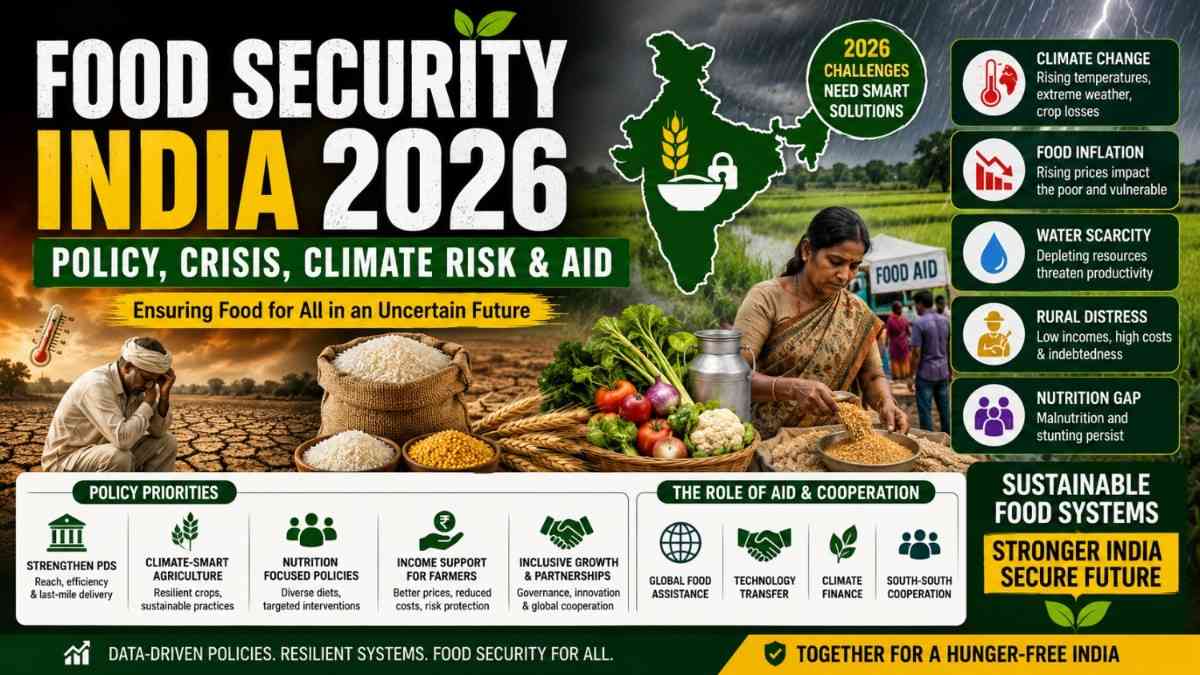
- Key Facts at a Glance – Food Security India 2026
- What Is Food Security in India 2026? Definition & Scope
- Government Schemes & Policy Budget 2026
- Climate Risk: How Weather Threatens India’s Food Supply
- Global Food Crisis 2026 – India in the World Picture
- International Aid & Funding Gap Analysis
- Who Should Follow Food Security News & Career Opportunities
- PMGKAY vs NFSA: Key Differences Compared
- High-Value Agriculture & Food Policy Terms You Must Know
- Frequently Asked Questions (FAQs)
Key Facts at a Glance – Food Security India 2026
| Flagship Scheme | PM Garib Kalyan Anna Yojana (PMGKAY) |
| Legal Backing | National Food Security Act (NFSA), 2013 |
| Total Beneficiaries | 81.35 crore (56.81% of India’s population) |
| PMGKAY Outlay (5 yrs) | Rs.11.80 lakh crore (Jan 2024 – Dec 2028) |
| Free Grain per Person | 5 kg rice/wheat per month (PHH); 35 kg/family (AAY) |
| Climate-Vulnerable Districts | 310 of 651 districts (ICAR 2026 data) |
| Global Acutely Hungry | 266+ million (47 countries, 2025 data) |
| Nodal Ministry | Ministry of Consumer Affairs, Food & Public Distribution |
What Is Food Security in India 2026? Definition & Scope
Food security in India 2026 is defined as every citizen’s guaranteed, stable access to sufficient, safe, affordable, and nutritious food at all times. The National Food Security Act (NFSA) 2013 is the cornerstone legal framework, shifting India’s food policy from a welfare-based charity model to a rights-based entitlement approach. Under NFSA, up to 75% of rural households and 50% of urban households are entitled to subsidised food grains through the Public Distribution System (PDS).
Food security in India is typically measured across 4 pillars: availability (adequate domestic production), access (physical and economic reach), utilisation (nutritional absorption), and stability (consistent supply over time). In 2026, India scores reasonably on availability and access but continues to face challenges on utilisation — particularly hidden hunger, or micronutrient deficiency — and stability, due to climate and energy disruptions.

- 🌾 Availability: India produces over 320 million tonnes of food grain annually, making it one of the world’s top producers of rice, wheat, pulses and vegetables.
- 🛒 Access: PMGKAY and the PDS together ensure zero-cost grain reaches 81.35 crore Indians monthly through 5.4 lakh Fair Price Shops (FPS) nationwide.
- 🥦 Utilisation: Hidden hunger remains a critical gap — micronutrient deficiencies in iron, zinc and protein affect hundreds of millions, especially women and children.
- 📉 Stability: Climate shocks, energy price spikes and global supply chain disruptions continue to threaten price stability and crop output consistency.
Government Schemes & Policy Budget for Food Security 2026
The Govt. of India’s food security architecture in 2026 rests on a multi-layered system of schemes, digital reforms, and procurement mechanisms. Here is a breakdown of the key programmes, their budgets, and their beneficiary reach:
| Scheme | Beneficiaries | Key Benefit | Status in 2026 |
|---|---|---|---|
| PMGKAY (NFSA Integrated) | 81.35 crore | 5 kg free grain/person/month | Active till Dec 2028; Rs.11.80 lakh crore outlay |
| Antyodaya Anna Yojana (AAY) | 2.37 crore families | 35 kg grain/family/month @ zero cost | Active; sugar subsidy @ Rs.18.50/kg extended |
| One Nation One Ration Card (ONORC) | All NFSA beneficiaries | PDS access from any FPS in India | Fully operational in all 36 states/UTs |
| Mission Aatmanirbharta – Pulses & Oilseeds | Farmers + consumers | Reduce import dependency, stabilise prices | Active 2025-26 to 2026-27 |
| World’s Largest Grain Storage Plan (PACS) | Rural India | Decentralised silos and cold chains at PACS level | Implementation phase 2026 |
| PM-KUSUM Yojana | Farmers | Solar pumps, up to 90% subsidy | Approved till 2026-27; Rs.10,900 crore budget |
The Union Budget 2026-27 allocation for the Department of Food and Public Distribution has seen a marginal 0.1% decrease over revised estimates for 2025-26, reflecting tightening fiscal space as the food subsidy bill now constitutes nearly 4–5% of India’s total annual budget. Digital reforms like the Mera Ration 2.0 app and eKYC completion for NFSA beneficiaries are key priorities in 2026 to reduce leakage and ensure efficient last-mile delivery.
A critical gap identified in 2026: the NFSA beneficiary list is still based on the 2011 Census data. With no fresh census conducted, an estimated 10 crore needy citizens remain excluded from NFSA coverage. The government is fast-tracking the linkage of the e-Shram portal with NFSA to plug this exclusion error and incorporate migrant workers, gig workers, and newly poor households.
Climate Risk: How Weather Threatens Food Security in India 2026
Climate change is the most structurally dangerous long-term threat to food security in India 2026. According to the Indian Council of Agricultural Research (ICAR), 310 of India’s 651 districts are classified as climate-vulnerable, with 109 districts in the “very high risk” category. Between 2019 and 2024, nearly 80% of Indian farmers experienced at least one climate-related crop loss. In 2024 alone, 3.2 million hectares of cropland were devastated by extreme weather events — floods in Bihar and Assam, droughts in Karnataka and Maharashtra, and heatwaves in Rajasthan and Uttar Pradesh.
- 🌡️ Heatwave risk: Rising temperatures during the Rabi and Kharif growing seasons reduce wheat and paddy yields. The Economic Survey 2024-25 confirmed extreme heat events have directly disrupted agricultural production and triggered price volatility for vegetables and pulses.
- 🌧️ Monsoon variability: World Bank projections estimate a 15% increase in year-to-year monsoon variability as global warming intensifies — directly threatening rain-fed areas that cover a large share of India’s net sown area.
- 💧 Groundwater depletion: Over-irrigation, falling water tables, and aquifer stress make large parts of Punjab, Haryana and western UP chronically water-insecure — threatening the country’s primary wheat and rice belts.
- 🦟 Hidden hunger acceleration: Elevated CO₂ levels reduce the protein, zinc, and iron concentration in food crops including pulses — worsening micronutrient deficiency in a country where legumes are the primary protein source for hundreds of millions.
- ⚡ Energy-fertiliser crisis: As of March 2026, over 26% of India’s fertiliser imports originate in West Asia. Disruptions in LNG supplies have cut urea production by nearly 50%, sharply increasing input costs ahead of the Kharif 2026 season.
- 🌊 La Niña threat: La Niña weather patterns in 2026 risk causing uneven rainfall distribution across India’s southern and central regions, potentially triggering localised droughts alongside flood events simultaneously.
The Govt. of India’s response includes promoting climate-smart millets (following India’s leadership of the International Year of Millets 2023), distributing fortified rice through PDS, and implementing crop diversification and drought-resistant seed distribution through the Ministry of Agriculture & Farmers Welfare. The AgriStack digital platform is being expanded to provide farmers with real-time soil, weather, and market data for smarter decision-making.
Global Food Crisis 2026 – Where Does India Stand?
The global food security crisis in 2026 is deeply alarming. Over 266 million people across 47 countries faced acute food insecurity in 2025, with conflict — not climate — now the leading driver. Famines in Gaza and Sudan, combined with a collapse in humanitarian funding, have pushed the global hunger crisis to levels not seen in a decade. The WFP’s 2026 Global Outlook estimates 318 million people will face crisis-level hunger this year, but the agency can realistically reach only 110 million — a shortfall that reflects a $6.5 billion funding gap.
India plays a dual role in this global picture. On one hand, India is a net food exporter — particularly rice and wheat — and provides humanitarian food aid to crisis-affected nations including Afghanistan and several African states. On the other hand, India’s own food security ecosystem faces structural fragility: an energy shock has stranded rice exports worth roughly Rs.25,000 crore annually, with shipping disruptions due to West Asia instability leaving produce stuck at ports. Bananas from Barwani and onions from Nashik are piling up, unable to reach Gulf markets.
| Global Indicator | 2025 Data | 2026 Projection |
|---|---|---|
| People facing acute food insecurity | 266 million (47 countries) | 318 million (WFP estimate) |
| WFP funding requirement | $13 billion | Expected shortfall of ~50% |
| WFP survey interviews conducted | 800,000 (–30% vs prior year) | Further reduction expected |
| FAO household survey coverage | 118,000 (–31% vs 2024) | Declining further |
| India climate-vulnerable districts | 310 of 651 | Increasing risk in 109 “very high” zones |
| India PMGKAY beneficiaries | 81.35 crore | Same; census update pending |
International Aid & Funding Gap: Impact on Food Security 2026
The decline in international aid is one of the most consequential threats to food security globally in 2026 — and India is not insulated from these trends. Humanitarian and development financing for food sectors in crisis-affected countries has fallen back to levels last seen in 2016–2017, even as acute food insecurity has remained stubbornly high. The US defence budget exceeds $1 trillion in 2026, while non-defence discretionary spending faces cuts of approximately 23% — directly reducing US contributions to WFP, FAO, and UNICEF food programmes.
For India, the shrinking aid landscape has several direct implications. India provides emergency food assistance to nations like Afghanistan and multiple African countries through WFP distribution mechanisms. As global funding contracts, India’s role as a net food aid contributor becomes harder to sustain while managing its own domestic food security obligations. The World Food Programme (WFP) has warned that responsibility is being transferred to national systems and communities without the financing, procurement capacity, or governance protections needed to sustain it.
India’s strategic response to the international aid gap centres on 3 pillars: (1) strengthening domestic self-sufficiency through Mission Aatmanirbharta in pulses and oilseeds; (2) championing developing-nation rights at WTO negotiations on public stockholding; and (3) promoting millets — India’s climate-resilient gift to the world — as a low-cost, high-nutrition solution for food-insecure nations.
Who Should Follow Food Security in India 2026?
Food security in India 2026 is a topic of critical importance for a wide range of individuals — from students and professionals to farmers and policymakers. Here are 8 profiles who need to stay updated:
- 🎓 UPSC & State PSC Aspirants: Food security, PMGKAY, NFSA, and climate risk are perennial GS Paper 2 and Paper 3 topics — frequently asked in Prelims and Mains examinations.
- 🌾 Farmers & Agricultural Workers: Understanding PM-KUSUM, AgriStack, and ICAR’s climate-risk district maps helps farmers make better crop planning and insurance claim decisions.
- 👩💼 Government Job Seekers: FCI, NAFED, NABARD, ICAR, and state food departments regularly recruit thousands of officers, assistants, and inspectors — all roles directly tied to food security implementation.
- 📚 Agriculture Students & Researchers: Understanding the interplay of climate, energy, and food systems is essential for agri-research careers, fellowships, and policy internships.
- 👩🍳 Women & SHG Members: Schemes like PMGKAY and AAY have specific provisions for women-headed households; understanding entitlements helps in grievance redressal and benefit access.
- 🏘️ Rural SC/ST/OBC Communities: Category-wise age relaxation and priority beneficiary status under NFSA gives historically marginalised groups preferential access — knowing these rights is essential.
- 🌍 NGO & Development Sector Professionals: Food security policy analysis, last-mile PDS monitoring, and nutrition programme implementation are core functions of hundreds of civil society organisations.
- 📰 Journalists & Policy Analysts: The intersection of climate risk, energy disruption, international aid cuts, and domestic food policy makes this the most important economic-governance story of 2026.
PMGKAY vs NFSA 2026: Key Differences Compared
Many people confuse PMGKAY with the broader NFSA framework. Here is a clear side-by-side comparison to help you understand how food security in India 2026 works at the policy level:
| Parameter | NFSA 2013 | PMGKAY 2026 |
|---|---|---|
| Nature | Permanent law (Act of Parliament) | Govt. scheme (Cabinet decision) |
| Coverage | 75% rural, 50% urban households | All NFSA beneficiaries (81.35 crore) |
| Grain Price | Subsidised (Rs.1–3/kg historically) | Completely FREE (zero cost) |
| Entitlement | PHH: 5 kg/person; AAY: 35 kg/family | Same entitlement, zero price |
| Duration | Permanent (ongoing) | Extended: Jan 2024 – Dec 2028 |
| Budget outlay | Part of annual food subsidy bill | Rs.11.80 lakh crore (5-year total) |
| Nodal agency | DFPD + FCI + State Govts | DFPD + FCI + Ministry of Finance |
| Key reform in 2026 | eKYC, ONORC, Mera Ration 2.0 | e-Shram–NFSA linkage, AgriStack |
High-Value Agriculture & Food Security Policy Terms You Must Know
Mastering these key terms will strengthen your understanding of food security in India 2026 — whether for UPSC preparation, career research, or policy analysis:
- 🏛️ National Food Security Act (NFSA) 2013: The foundational law making food grain access a legal right for eligible citizens. Covers up to 81.35 crore Indians through PDS and AAY channels.
- 🌾 Public Distribution System (PDS): India’s 5.4-lakh-FPS nationwide grain distribution network — the delivery backbone of food security policy, now enhanced with ONORC and Mera Ration 2.0 for portability.
- 🌱 AgriStack: India’s digital public infrastructure for agriculture, providing end-to-end farmer services — from soil health to direct market access via e-NAM — to improve productivity and reduce wastage.
- 🌻 PM-KUSUM Yojana: Solar pump scheme offering up to 90% subsidy to farmers, reducing dependence on diesel-powered irrigation and lowering food production costs. Budget: Rs.10,900 crore.
- 📦 Food Corporation of India (FCI): The Govt. of India’s nodal grain procurement and storage agency. FCI manages buffer stocks of wheat and rice, procures at Minimum Support Price (MSP), and distributes to states. Recruitment: Rs.25,000–Rs.80,000/month salary range.
- 🧪 Hidden Hunger: Micronutrient deficiency affecting hundreds of millions of Indians who consume enough calories but lack adequate protein, iron, zinc, and vitamins — worsened by CO₂-driven reduction in nutritional quality of crops.
- 🌍 WFP Global Outlook 2026: The World Food Programme’s annual projection estimating 318 million people at crisis-level hunger globally, with a $6.5 billion funding gap threatening the agency’s reach to the most vulnerable.
- 🏗️ PACS Grain Storage Plan: The Govt. of India’s initiative to build decentralised, modern grain silos and cold storage at the Primary Agricultural Credit Societies (PACS) level — reducing post-harvest losses estimated at Rs.70,000 crore annually.
- 🌾 Minimum Support Price (MSP): The guaranteed floor price at which Govt. of India procures crops from farmers, protecting agricultural income stability and ensuring domestic food grain availability. MSP for wheat (2026): Rs.2,275/quintal.
- 🥗 IIED Food Security Index 2026: A global index highlighting India’s vulnerability due to large population, existing malnutrition, climate change exposure, and regional disparities — calling for integrated social protection and climate-resilient agriculture.
Frequently Asked Questions – Food Security in India 2026
What is food security in India 2026?
Food security in India 2026 refers to the Govt. of India’s comprehensive policy framework — anchored in the NFSA 2013 and PMGKAY — that guarantees 81.35 crore citizens free access to 5 kg of rice or wheat per person per month. The five-year PMGKAY extension (January 2024 to December 2028) carries a total outlay of Rs.11.80 lakh crore, making it the world’s largest food security programme.
How many people get free food grain under PMGKAY in 2026?
PMGKAY in 2026 provides free food grain to 81.35 crore people — approximately 56.81% of India’s population. Priority Household (PHH) beneficiaries receive 5 kg per person per month, while Antyodaya Anna Yojana (AAY) households — India’s poorest 2.37 crore families — receive 35 kg per family per month, all at zero cost under the integrated NFSA framework.
What is the food security budget for India in 2026-27?
The Union Budget 2026-27 allocation for food and public distribution has seen a marginal 0.1% decrease over revised estimates for 2025-26. The food subsidy bill under PMGKAY now represents approximately 4–5% of India’s total annual budget. The five-year PMGKAY extension (2024–2028) carries a cumulative outlay of Rs.11.80 lakh crore.
How does climate change affect food security in India?
Climate change poses the most serious long-term threat to food security in India 2026. ICAR data classifies 310 of 651 districts as climate-vulnerable. Between 2019 and 2024, 80% of Indian farmers experienced climate-related crop losses. In 2024 alone, 3.2 million hectares of farmland were damaged by extreme events. Rising temperatures, monsoon variability, groundwater depletion, and reduced nutritional quality of crops due to elevated CO₂ are all active threats.
What is the global food crisis situation in 2026?
Over 266 million people across 47 countries faced acute food insecurity in 2025, with conflict overtaking climate as the main driver globally. The WFP’s 2026 Global Outlook projects 318 million people at crisis-level hunger, but the agency faces a funding gap of approximately $6.5 billion. Humanitarian and development financing for food sectors has fallen back to 2016–2017 levels, sharply limiting the global response capacity.
What is One Nation One Ration Card (ONORC) and how does it work?
ONORC is India’s national food portability system that allows any NFSA beneficiary — especially migrant workers — to collect their free grain entitlement from any of India’s 5.4 lakh Fair Price Shops, regardless of the state where they registered. As of 2026, ONORC is fully operational across all 36 states and union territories, using Aadhaar-based biometric authentication. It has eliminated the earlier problem of migrant workers losing their food entitlement when moving cities for work.
What government jobs are available in food security departments in India?
Food security in India 2026 generates thousands of government recruitment opportunities annually. FCI (Food Corporation of India) recruits Junior Engineers, Watchmen, Typists, and Management Trainees at salaries of Rs.25,000–Rs.80,000/month. NAFED, NABARD, and state agriculture departments hire district supply officers, nutrition officers, and food inspectors. ICAR offers research-based posts at Rs.56,100–Rs.1,77,500/month (Level 10–14 pay matrix). Check Agrijob.in regularly for the latest 2026 notifications.
How does India contribute to international food security?
India contributes to global food security through multiple channels: humanitarian food aid to crisis nations (Afghanistan, Sudan, African states) via WFP distribution mechanisms; promotion of climate-resilient millets as a global food solution post the International Year of Millets 2023; WTO negotiations defending public stockholding rights for developing nations; and as a major global exporter of rice and wheat — though export capacity has been constrained in 2026 by energy supply disruptions and shipping bottlenecks linked to West Asia instability.
This guide is regularly reviewed and updated for accuracy. Bookmark this page for the latest food security India 2026 updates, scheme notifications, and government job alerts.
Related Reads on Agrijob.in: NABARD Recruitment 2026 | ICAR Recruitment 2026 | FCI Recruitment 2026
Last Updated: May 2026 | Source: PIB India, PRS India, ICAR, WFP, ODI, National Herald India, Rice IAS