

India’s Rural Fintech 2026 – How Digital Lending Is Transforming Farmer Finance
India rural fintech 2026 is no longer a promise — it is a Rs.32.5 lakh crore reality. For the first time in the history of Indian agriculture, digital platforms are delivering crop loans in hours, not weeks, cutting out moneylenders who charge 24–60% interest, and connecting 140 million smallholder farming households to formal credit through their smartphones. From the government’s AgriStack initiative aiming to create 11 crore Farmer IDs, to startups like AryaDhan disbursing Rs.2,000 crore annually with NPAs below 0.5%, India’s rural fintech transformation is the most consequential shift in farmer finance since the Green Revolution. This complete guide covers every key player, scheme, technology, salary, and career opportunity in India’s rural fintech 2026 ecosystem.

| Agri Credit Target FY26 | Rs.32.5 lakh crore (record high, set by RBI and NABARD) |
| KCC Loan Interest Rate 2026 | 4% effective (after 3% prompt-repayment incentive) |
| KCC Loan Limit 2026 | Rs.5 lakh (raised from Rs.3 lakh in Budget 2025-26) |
| AgriStack Farmer ID Target | 11 crore digital Farmer IDs by 2026-27 |
| Jai Kisan Credit Facilitated | Rs.6,000 crore to 800,000 farmers + 100,000 rural enterprises |
| AryaDhan Annual Disbursals | Rs.2,000 crore (own balance sheet) + Rs.10,000 crore (partner banks) |
| Farmers Still Using Moneylenders | ~70% lack formal credit access — the fintech opportunity |
| Global Agri-Fintech Market by 2035 | USD 64.69 billion (CAGR 21.27% from USD 7.29 billion in 2024) |
- The Rs.70% Credit Gap: Why India Rural Fintech 2026 Matters
- AgriStack 2026: The Digital Backbone of Farmer Finance
- Kisan Credit Card 2026: 4% Loans, Rs.5 Lakh Limit and New RBI Reforms
- Top Agri-NBFC and Digital Lending Platforms in India 2026
- How Digital Agri Credit Scoring Works in 2026
- NABARD and RBI’s Role in Rural Fintech 2026
- Who Should Apply for Digital Agri Loans in India 2026?
- Rural Fintech Careers: Salaries and Job Roles in 2026
- NBFC Agri Loan vs KCC Bank Loan: Which Is Better?
- High-Value Rural Fintech Terms Every Professional Must Know
- 5 Biggest Challenges Facing India Rural Fintech in 2026
- Frequently Asked Questions
The Rs.70% Credit Gap: Why India Rural Fintech 2026 Matters
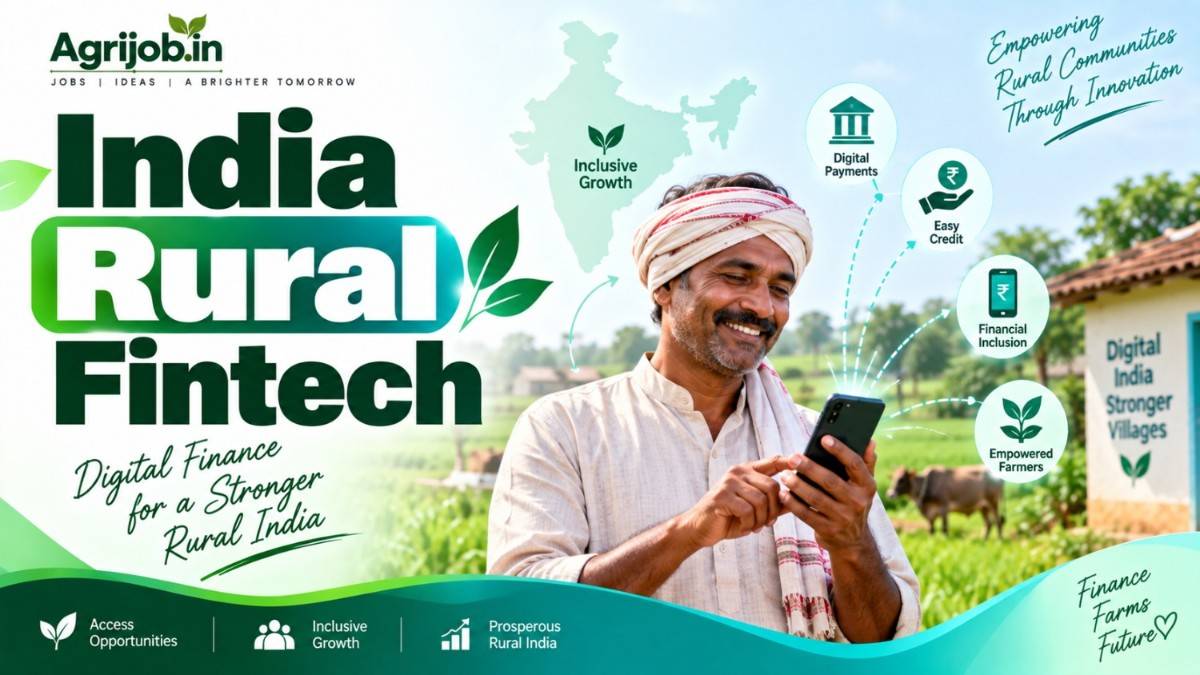
India’s agriculture sector employs over 46% of the national workforce and contributes approximately 18% to GDP — yet nearly 70% of farmers still cannot access formal institutional credit. For decades, this gap was filled by village moneylenders charging interest rates of 24% to 60% per annum. A farmer borrowing Rs.50,000 for a kharif crop at 36% interest pays Rs.18,000 in interest alone — often more than the season’s profit on marginal land. This is the structural problem that India rural fintech 2026 is systematically dismantling.
The formal credit system has grown dramatically — ground-level credit flow from commercial banks rose from Rs.8.45 lakh crore in FY15 to Rs.25.49 lakh crore in FY24. But the growth has been uneven. Small and marginal farmers, tenant cultivators, sharecroppers, and oral lessees — who constitute the majority of India’s 140 million farming households — frequently lack the land records, credit history, or collateral demanded by traditional banks. Digital fintech platforms are now addressing this last-mile gap using smartphone penetration (70%+ of farmers own a phone), UPI payment rails, satellite crop data, and AI-based credit scoring to deliver loans without paperwork, without branch visits, and within hours of application.

The market opportunity is enormous. The global agri-fintech market was valued at USD 7.29 billion in 2024 and is projected to reach USD 64.69 billion by 2035, advancing at a CAGR of 21.27%. India — with its 140 million smallholder households, rapidly expanding digital infrastructure, and government mandates for 18% priority sector lending to agriculture — is positioned to capture a major share of this growth. Over 200 fintech startups now focus specifically on agri-lending in India, having collectively disbursed loans worth Rs.30,000 crore (approximately USD 3.6 billion).
AgriStack 2026: The Digital Backbone of India Rural Fintech
The single most important infrastructure development enabling India rural fintech in 2026 is AgriStack — the government’s national digital agriculture framework built on InDEA 2.0 standards. Often described as “the next UPI for farmers,” AgriStack is creating a centralised, verifiable farmer identity database that will eliminate the documentation barriers that have historically blocked smallholder access to formal credit.
AgriStack’s core components and 2026 milestones:
- 🪪 Farmer ID (Digital Farmer Identity): A unique digital identity for every farmer linking their Aadhaar, land records, cropping pattern, bank account, and government scheme entitlements. The government is targeting 11 crore Farmer IDs by 2026-27, creating a verified database lenders can query for instant credit underwriting.
- 🏦 Kisan Rin Portal (fasalrin.gov.in): A unified loan application portal where PM-KISAN beneficiaries can apply for Kisan Credit Card loans with a single-page form, pre-filled details, and approval tracking — all digitally, without visiting a branch.
- 🤖 Bharat-VISTAAR: A multilingual AI tool (Virtually Integrated System to Access Agricultural Resources) providing real-time crop advisory, market price information, and scheme eligibility assessment to farmers in their native language.
- 📡 PTPFC Integration: NABARD’s e-KCC loan origination portal is integrated with the Public Tech Platform for Frictionless Credit (PTPFC) of RBI Innovation Hub, enabling instant digital KCC loan processing through 351+ district and state cooperative banks and Regional Rural Banks.
- 💰 Digital Agricultural Mission (DAM): The government scheme with initial funding exceeding Rs.2,800 crore that powers AgriStack development, aiming to provide a single verified data source for all lenders to prevent fraud and duplicate lending.
The practical impact is profound: a farmer in Bihar or Odisha who previously spent 3–4 visits to a bank branch submitting paperwork over 30–45 days can now apply for a KCC crop loan on pmkisan.gov.in, have their Farmer ID verified automatically, and receive loan approval within 7–14 working days — with disbursement directly to their Aadhaar-linked bank account. For digital agri-credit platforms, AgriStack reduces the cost of credit assessment from Rs.800–1,200 per borrower to under Rs.200, making small-ticket loans economically viable at scale.
Kisan Credit Card 2026: 4% Loans, Rs.5 Lakh Limit and New RBI Reforms
The Kisan Credit Card (KCC) remains the cornerstone of India rural fintech 2026 — the world’s largest government-backed agricultural credit scheme, providing a revolving credit facility to India’s farmers at subsidised interest rates. In 2026, the KCC has been significantly upgraded with higher limits, extended validity, and digital-first access through the Kisan Rin Portal.
| KCC Parameter | Earlier (Pre-2025) | 2026 Updated |
|---|---|---|
| Maximum Loan Limit | Rs.3 lakh | Rs.5 lakh (raised in Budget 2025-26) |
| Effective Interest Rate | 4% (for timely repayers) | 4% (unchanged — most affordable farm credit) |
| Base Interest Rate | 7% | 7% (3% incentive for prompt repayment) |
| KCC Validity | 5 years | 6 years (RBI 2026 draft reform) |
| Collateral-free limit | Rs.1.6 lakh | Rs.2 lakh (RBI 2026 reform) |
| Application Mode | Branch only | Online via fasalrin.gov.in + branch |
| Crop Tenure Standardisation | Variable | 12 months (short-duration), 18 months (long-duration) |
| Marginal Farmer Flexi Limit | Rs.10,000–40,000 | Rs.10,000–50,000 (up to 1 hectare) |
The KCC’s impact as an India rural fintech tool is measurable: a small farmer borrowing Rs.1 lakh at 4% KCC rate pays Rs.4,000 annually in interest — versus Rs.24,000–36,000 at a moneylender’s rate of 24–36%. This Rs.20,000–32,000 annual saving per farmer, multiplied across crore of KCC holders, represents a massive economic transfer from informal lenders to productive farm investment.
In 2026, the RBI also issued draft revised KCC norms proposing inclusion of expenses on agri-tech initiatives — soil testing, weather forecasting, and organic certification — within eligible KCC loan components. This is a landmark shift: for the first time, technology adoption costs will be financeable under India’s flagship farm credit scheme, directly accelerating the uptake of precision agriculture, IoT sensors, and digital advisory platforms among India’s smallholder farmers.
Farmers can apply for KCC loans in 2026 through: PM-KISAN portal (pmkisan.gov.in), the Jan Samarth platform, any public sector bank branch, Regional Rural Bank, or cooperative bank. For a complete 2026 KCC application guide including step-by-step process, eligibility, and documents required, visit Agrijob.in’s Kisan Credit Card 2026 Guide.
Top Agri-NBFC and Digital Lending Platforms in India Rural Fintech 2026
Beyond the government-backed KCC, India rural fintech 2026 is powered by a dynamic ecosystem of NBFCs, fintech platforms, and agritech companies with lending arms that serve the 70% of farmers not yet covered by formal bank credit. Here are the 5 leading platforms shaping rural digital lending in 2026:
| Platform | Type | Annual Disbursals | Interest Rate | Farmers Served | Unique Feature |
|---|---|---|---|---|---|
| AryaDhan (Arya.ag) | NBFC | Rs.2,000 crore (own) + Rs.10,000 crore (partner banks) | 12.5–12.8% | 10 lakh+ | Warehouse receipt financing; NPA below 0.5% |
| Jai Kisan | Rural Fintech + NBFC | Rs.6,000 crore facilitated | Market-linked | 8 lakh farmers + 1 lakh rural enterprises | Bharat Khata platform; co-lending with PSU banks |
| Samunnati | Agri-Finance NBFC | Large-scale FPO lending | 14–18% | Lakh of FPO members | Value-chain finance; FPO-focused credit |
| NABKISAN Finance | NABARD subsidiary | Hundreds of crore | Concessional | Agri startups, FPOs, SHGs | NABARD-backed; lowest-cost institutional credit |
| Kissandhan | Agri-NBFC | Commodity-backed financing | 12–15% | Warehouse-linked farmers | Commodity-Based Financing (CBF) model |
AryaDhan (the NBFC arm of Arya.ag) stands out as the most sophisticated rural fintech lender in India 2026. Farmers can borrow against stored grain in Arya.ag’s 12,000+ warehouses at 12.5–12.8% — dramatically lower than the 24–36% charged by traditional commission agents. The warehouse receipt serves as collateral, automated systems track commodity prices continuously, and if prices fall below defined thresholds, margin calls are triggered electronically. The result: gross NPAs below 0.5% despite serving a segment traditionally labelled “high risk” by mainstream banks.
Jai Kisan, India’s leading rural fintech platform founded in 2017, has facilitated approximately Rs.6,000 crore in agricultural credit to 800,000 farmers and 100,000 rural enterprises through its Bharat Khata platform. After receiving RBI approval for its NBFC acquisition (Kushal Innovation Capital), Jai Kisan can now co-lend with government banks directly — enabling cheaper, faster rural credit at massive scale. The company partners with over 350 corporates along the agri supply chain, embedding credit at the point of sale for seeds, fertilisers, and equipment.
For a complete comparison of Agri-NBFCs with interest rates, eligibility and loan products, refer to the Agri-NBFCs India 2026 Guide on Agrijob.in.
How Digital Agri Credit Scoring Works in India 2026
The most transformative shift in India rural fintech 2026 is the move from collateral-based lending to data-based lending. Traditional banks required farmers to pledge land titles, gold, or fixed assets — documents that over 70% of marginal farmers simply do not possess. Digital platforms are replacing this with a multi-dimensional, real-time credit score built from alternative data sources:
- 📡 Satellite Crop Monitoring: Remote sensing data from platforms like CropIn and ISRO’s RISAT satellites provides real-time crop health, area under cultivation, expected yield, and historical performance — directly informing credit limits and repayment scheduling.
- 💳 UPI and Digital Payment History: With 70%+ smartphone penetration in rural India, farmers’ UPI transaction history (seed purchases, fertiliser payments, produce sales) provides 12–24 months of financial behaviour data for creditworthiness assessment.
- 🌦️ Weather and Climate Data: AI-powered weather risk models integrated with platforms like Fasal and Skymet layer hyper-local rainfall predictions, drought risk scores, and crop-loss probability onto individual loan files — enabling risk-based interest pricing.
- 🏭 Supply Chain Behaviour: Embedded finance platforms (Jai Kisan, DeHaat’s credit arm) track input purchase frequency, repayment of prior seasons’ credit, and offtake agreements with buyers — building a longitudinal credit profile without any formal credit bureau data.
- 🆔 AgriStack Farmer ID: The government’s verified digital farmer identity links land records, crop insurance claims, PM-KISAN DBT history, and market-sale receipts (eNAM transactions) into a single verified file that any lender can query — reducing the “know your customer” cost to near zero.
The practical output: a farmer with no formal credit history but 3 years of consistent fertiliser purchases through DeHaat, 2 years of eNAM transactions, and a verified AgriStack Farmer ID can access a Rs.1–3 lakh unsecured digital loan within 24 hours — at an interest rate 60–70% below what a moneylender would charge. Early warning AI systems simultaneously monitor portfolio-level weather events and price shocks, alerting lenders to potential defaults weeks before they occur.
NABARD and RBI’s Role in India Rural Fintech 2026
India rural fintech 2026 would not be possible without the regulatory and refinancing architecture built by two institutions: the National Bank for Agriculture and Rural Development (NABARD) and the Reserve Bank of India (RBI). Their roles in 2026 are more active than at any point in the past two decades:
- 🏦 NABARD’s Rs.32.5 lakh crore refinance pipeline: NABARD provides low-cost refinance to commercial banks, RRBs, and cooperative banks for onward agri-lending, enabling them to achieve the Rs.32.5 lakh crore FY26 credit target. Banks must allocate 18% of their Adjusted Net Bank Credit (ANBC) to agriculture under RBI’s priority sector lending norms, with an 8% sub-target for small and marginal farmers.
- 🤝 NABARD-RBIH Digital Lending Partnership (2026): NABARD has partnered with RBI Innovation Hub (RBIH) to integrate its e-KCC loan origination portal with the Public Tech Platform for Frictionless Credit (PTPFC), enabling instant digital KCC loan processing for 351+ cooperative banks and RRBs — delivering what NABARD Chairman Shaji K.V. described as “instant doorstep delivery of credit to farmers.”
- 📋 RBI’s 2026 KCC Draft Reform: The Reserve Bank’s February 2026 draft revised KCC norms propose: extended 6-year KCC validity, inclusion of agri-tech costs (soil testing, weather forecasting) as eligible loan components, collateral-free limit raised to Rs.2 lakh, and standardised crop tenures of 12 and 18 months for short and long-duration crops respectively.
- 💰 Government’s Rs.1.6 trillion rural credit allocation: The Union Budget allocated approximately Rs.1.6 trillion (USD 20 billion) for rural credit, with the Interest Subvention Scheme providing 1.5% interest subvention on short-term agri loans up to Rs.3 lakh — making institutional credit decisively cheaper than informal lending.
For the latest NABARD refinance rates, agri-credit guidelines, and rural banking schemes, visit the official NABARD portal (nabard.org). For RBI’s agri-lending regulations and KCC draft norms, access the RBI official website (rbi.org.in).
Who Should Apply for Digital Agri Loans in India Rural Fintech 2026?
- 🌾 Small and marginal farmers (under 2 hectares): The primary beneficiary of India rural fintech 2026. Switch from 24–36% moneylender rates to 4% KCC or 12–15% NBFC loans and save Rs.15,000–90,000 per year in interest on a Rs.1 lakh credit requirement.
- 🤝 Tenant farmers and sharecroppers: Who lack formal land titles and were historically excluded from bank credit — digital NBFC platforms like Jai Kisan and Samunnati now extend credit based on supply chain behaviour and crop data rather than collateral.
- 🧑🤝🧑 FPO members (Farmer Producer Organisations): Group credit from Samunnati and NABKISAN offers FPO-level financing at institutional rates — covering input procurement, post-harvest storage, and collective marketing operations at scale.
- 🐄 Dairy and animal husbandry farmers: KCC 2026 covers allied activities — cows, buffaloes, goats, sheep, poultry — with up to Rs.2 lakh additional collateral-free credit on top of crop loan limits.
- 🏭 Agri-MSME operators: Food processors, cold chain operators, agri-input dealers, and agro-warehousing businesses — eligible for NBFC agri-business loans at Rs.5–50 lakh from AryaDhan, NABKISAN, and Agriwise Finserv.
- 🎓 Agriculture graduates starting farm businesses: Several agri-NBFCs explicitly finance agri-startup capital for agriculture graduates — under NABKISAN’s startup financing and NABARD’s ABPF (Agriculture Business and Promotion Fund) scheme.
- 👩 Women SHG members in rural areas: Self-Help Group (SHG) credit linkage under NABARD’s SHG-Bank Linkage Programme — the world’s largest microfinance programme — disburses crore annually to rural women farmers at 7–14% group-guarantee rates.
- 📱 Smartphone-enabled farmers in remote areas: Any farmer with an Aadhaar-linked bank account, a smartphone, and an AgriStack Farmer ID can now access formal digital credit entirely without visiting a branch — the most inclusive development in India rural fintech 2026.
Rural Fintech Careers: Salaries and Job Roles in India 2026
India rural fintech 2026 is not just transforming farmer finance — it is creating one of the fastest-growing job markets for agriculture graduates, finance professionals, and technology specialists. Every NBFC expansion, every new digital loan product, and every AgriStack integration creates predictable hiring demand across 5 key functions:
| Role | Employer | Salary (Annual) | Qualification |
|---|---|---|---|
| AI Credit Scoring Engineer | AryaDhan, Jai Kisan, DeHaat | Rs.10–25 LPA | B.Tech CS + Python/ML skills |
| Agri-NBFC Credit Analyst | Samunnati, AryaDhan, NABKISAN | Rs.8–18 LPA | MBA Finance / CA / B.Com |
| Rural Field Credit Officer | Jai Kisan, Arya.ag, Gramophone-Unnati | Rs.4–8 LPA | B.Sc. Ag / Any Graduate |
| FPO Finance Specialist | Samunnati, NABKISAN, Omnivore-backed fintechs | Rs.6–12 LPA | MBA Agri-Business / M.Sc. Ag |
| AgriStack Integration Developer | RBIH, NABARD vendors, agritech platforms | Rs.8–18 LPA | B.Tech CS / MCA |
| Rural Banking Correspondent | All PSU banks, RRBs, cooperative banks | Rs.2.5–4 LPA + incentives | 10+2 / Any Graduate |
| Agri Insurance Product Manager | Digit Insurance, PMFBY partner insurers | Rs.10–20 LPA | MBA + Actuarial/Agri background |
| Rural Sales and Onboarding Manager | Jai Kisan, Arya.ag, Agriwise | Rs.5–10 LPA | B.Sc. Ag + Sales Experience |
The highest-demand combination for India rural fintech careers in 2026 is agriculture domain knowledge + basic data analytics skills. A B.Sc. Agriculture graduate who learns SQL, Python basics, and credit underwriting fundamentals can command Rs.8–15 LPA at AryaDhan, Jai Kisan, or Samunnati — significantly above the Rs.3–5 LPA range for pure field advisory roles. Platforms like Agrijob.in list verified rural fintech openings daily. Set alerts for keywords: “agri NBFC,” “rural credit,” “field credit officer,” and “agri-fintech analyst.” Apply within 48 hours of posting for best results.
NBFC Agri Loan vs KCC Bank Loan: Which Is Better for Farmers in 2026?
| Parameter | KCC Bank Loan | NBFC / Digital Agri Loan |
|---|---|---|
| Interest Rate | 4–7% (highly subsidised) | 12–18% (market rate) |
| Loan Limit | Up to Rs.5 lakh (KCC 2026) | Rs.10,000–50 lakh (varies) |
| Collateral Required | Nil up to Rs.2 lakh; land record above | Nil for digital NBFCs; warehouse receipt at AryaDhan |
| Disbursal Speed | 7–30 days (with AgriStack, 7–14 days) | 24–72 hours (fully digital) |
| Eligibility | Landowner/tenant with formal documentation | Supply chain participant + smartphone |
| For tenant/sharecropper | Difficult — documentation challenge | Yes — Jai Kisan, Samunnati serve tenants |
| Insurance included | Yes — PMFBY and PAIS bundled | Optional — some platforms bundle |
| Crop coverage | All kharif and rabi crops | Platform-specific; often commodity-linked |
| Best for | Landowners seeking cheapest credit | Tenant farmers, supply chain participants, FPOs |
If you own land and have documentation — apply for KCC first. The 4% effective interest rate is unbeatable and should be the first credit tool every eligible farmer uses. If you are a tenant, sharecropper, FPO member, or lack formal land records — use a digital NBFC platform. Platforms like Jai Kisan, Samunnati, and AryaDhan are specifically designed for your profile and will approve credit based on supply chain data and Farmer ID that bank branches will not accept. In 2026, the smartest strategy is to use both in combination: KCC for crop production capital at 4%, and NBFC agri-loans for post-harvest storage, input procurement, or equipment at 12–15%.
High-Value India Rural Fintech Terms Every Professional Must Know in 2026
- 💳 Kisan Credit Card (KCC): India’s flagship revolving credit facility for farmers, providing up to Rs.5 lakh at 4% effective interest for crop production, post-harvest, and allied activities. Over 7 crore KCC accounts are active, with NABARD projections showing credit flows exceeding Rs.32.5 lakh crore in FY26.
- 🏦 Priority Sector Lending (PSL): RBI’s mandate requiring all domestic scheduled commercial banks to lend 40% of their Adjusted Net Bank Credit to priority sectors — with 18% specifically earmarked for agriculture and 8% for small and marginal farmers. PSL drives over Rs.25 lakh crore in annual agri-credit.
- 🪪 AgriStack Farmer ID: A unique digital identity linking every Indian farmer’s Aadhaar, land records, and financial data — the foundation for instant credit underwriting. Targeting 11 crore registrations by 2026-27, AgriStack is described as “the next UPI” for rural financial inclusion.
- 🏭 Warehouse Receipt Financing: A post-harvest loan product where farmers pledge stored grain as collateral and borrow 60–75% of current market value, at AryaDhan’s rate of 12.5-12.8%, avoiding distress sales at harvest when prices are lowest. Arya.ag’s 12,000 warehouses enable Rs.12,000 crore in annual warehouse-receipt credit.
- 🤝 Co-Lending Model: An RBI framework where a bank and an NBFC jointly originate a loan — the NBFC provides technology, farmer relationships, and credit assessment while the bank provides low-cost capital. Jai Kisan uses co-lending with PSU banks via its NBFC arm to deliver Rs.6,000 crore in credit at below-market rates.
- 📊 FPO Financing: Institutional credit extended to Farmer Producer Organisations — registered collectives of 300–3,000 farmers — at group-guarantee rates. Samunnati specialises in FPO value-chain finance, enabling collective post-harvest marketing and input procurement that increases member incomes by 15–25%.
- 🌦️ Parametric Crop Insurance: An insurance product that pays farmers automatically when a measurable parameter (rainfall below X mm, temperature above Y degrees) is triggered — without requiring individual loss assessment. Faster payouts reduce the working capital pressure that drives farmer distress.
- 💰 Interest Subvention Scheme: The Government of India’s subsidy that reduces the effective interest rate on short-term crop loans up to Rs.3 lakh from 7% to 4% — providing 1.5% interest subvention to financial institutions and an additional 3% incentive to farmers for prompt repayment.
- 🔄 Embedded Agri-Finance: Credit products integrated directly into agri-input platforms, so a farmer buying seeds or fertiliser on DeHaat or BigHaat is simultaneously offered a “buy now, pay at harvest” credit option — without visiting a bank or filling a separate application form.
- 📱 PTPFC (Public Tech Platform for Frictionless Credit): RBI Innovation Hub’s digital infrastructure connecting banks, NBFCs, account aggregators, and government databases (land records, Aadhaar, ITR) in one system — enabling fully digital, paperless loan underwriting for rural borrowers in minutes.
5 Biggest Challenges Facing India Rural Fintech in 2026
Despite the transformative progress, India rural fintech 2026 faces significant structural challenges that limit the pace of financial inclusion for the most vulnerable farming communities:
- Financial Literacy Gap: Only 27% of farmers possess adequate financial knowledge per NABARD data. The majority cannot evaluate competing loan products, understand interest rate differentials, or navigate digital application platforms without assisted onboarding. This slows adoption of even the most farmer-friendly digital credit products and creates vulnerability to predatory digital lending.
- Digital Infrastructure Dark Spots: While 70%+ of farmers own smartphones, reliable 4G/5G connectivity remains unavailable in approximately 25–30% of Indian villages, particularly in hilly, tribal, and remote areas. Digital loan applications, AgriStack Farmer ID verification, and UPI payments all require stable internet — creating a two-tier rural fintech market where the most remote and vulnerable farmers remain excluded.
- Land Documentation Complexity: India’s land records system remains fragmented across 29 states with varying digitisation levels. Tenant farmers (approximately 30% of all cultivators) have no formal documentation of their cultivation rights — making them ineligible for bank KCC loans and pushing them toward more expensive NBFC credit. Resolving this requires state-level land reforms that are progressing but remain incomplete.
- Climate and Price Volatility Risk: India’s agri-credit system is built on seasonal repayment cycles — but climate change is making monsoon patterns increasingly erratic. Crop failures caused by unseasonal rainfall, drought, or pest outbreaks can trigger mass defaults even in well-underwritten loan portfolios. AryaDhan’s sub-0.5% NPA is exceptional precisely because its warehouse-receipt model decouples repayment from crop cycle uncertainty — a model that cannot yet be replicated for all farmer profiles.
- Regulatory Compliance Burden on Small NBFCs: RBI’s tightening of NBFC regulations — stricter capital adequacy requirements, enhanced KYC norms, and limits on digital lending partnerships — has increased compliance costs for smaller rural fintech startups. This consolidation pressure is pushing smaller agri-fintech platforms to seek merger or acquisition rather than operate independently, contributing to the broader agri-food tech M&A wave of 2026.
Frequently Asked Questions – India Rural Fintech 2026
What is India rural fintech 2026?
India rural fintech 2026 refers to the ecosystem of technology-driven financial services — crop loans, warehouse finance, crop insurance, digital payments, and credit scoring — being delivered to farmers and rural businesses through platforms like Jai Kisan, AryaDhan, Samunnati, and the government’s AgriStack and KCC systems. In 2026, the sector is defined by a record Rs.32.5 lakh crore agri-credit target, the KCC loan limit raised to Rs.5 lakh at 4% interest, and NABARD’s partnership with RBI Innovation Hub to digitise agricultural loan processing end-to-end.
What is the agri credit target for FY26 in India?
The agricultural credit target for FY2025-26, set jointly by the Reserve Bank of India and NABARD, is Rs.32.5 lakh crore — a record high. This represents a major expansion from Rs.25.49 lakh crore disbursed in FY24. The target is backed by RBI’s priority sector lending mandate (18% of ANBC for agriculture), the Interest Subvention Scheme, and NABARD’s refinance lines to 351+ cooperative banks and Regional Rural Banks. Achieving this target would represent a transformational reduction in farmer dependence on informal moneylenders charging 24–60% interest.
What is the KCC loan interest rate in 2026?
The Kisan Credit Card effective interest rate in 2026 is 4% per annum for farmers who repay their short-term crop loans on time. The base rate is 7%, reduced to 4% by a 3% prompt-repayment incentive under the Government of India’s Interest Subvention Scheme. The KCC loan limit was raised to Rs.5 lakh in Budget 2025-26, and the RBI’s 2026 draft norms propose extending KCC validity from 5 to 6 years. Farmers above 60 years need a co-borrower (legal heir) for KCC applications, but there is no upper age bar under the scheme.
What is AgriStack and how does it help farmer credit in 2026?
AgriStack is India’s national digital agriculture framework — a centralized database linking every farmer’s Aadhaar, land records, crop data, and bank accounts into a single verified Farmer ID. The government is targeting 11 crore Farmer IDs by 2026-27. For lenders, AgriStack eliminates the documentation barriers that previously blocked 70% of farmers from formal credit — a verified Farmer ID enables instant credit assessment without branch visits or paper-based KYC. The Digital Agricultural Mission (DAM) with Rs.2,800 crore+ in initial funding powers this initiative, which NABARD’s chairman describes as enabling “instant doorstep delivery of credit to farmers.”
Which are the top digital agri lending platforms in India 2026?
The 5 leading digital agri lending platforms in India rural fintech 2026 are: AryaDhan (Arya.ag’s NBFC — Rs.12,000 crore annual disbursals including partner bank origination, NPA below 0.5%), Jai Kisan (Rs.6,000 crore facilitated for 800,000 farmers via co-lending with 350+ corporates), Samunnati (FPO-focused value chain finance), NABKISAN Finance (NABARD-backed, lowest-cost institutional credit), and Kissandhan (commodity-based warehouse financing). Together, these platforms are replacing moneylenders at 24–60% with formal digital credit at 12–18%.
How much do rural fintech jobs pay in India in 2026?
India rural fintech 2026 jobs pay Rs.4–25 LPA depending on role and specialisation. The highest-paying roles are AI credit scoring engineers (Rs.10–25 LPA at AryaDhan and Jai Kisan) and agri-NBFC credit analysts (Rs.8–18 LPA at Samunnati, AryaDhan, and NABKISAN). Rural field credit officers earn Rs.4–8 LPA, FPO finance specialists earn Rs.6–12 LPA, and rural banking correspondents earn Rs.2.5–4 LPA with performance incentives. Agriculture graduates with data analytics skills command premium salaries across all digital lending platforms. Check live openings at Agrijob.in.
What is the difference between a KCC loan and an NBFC agri loan?
A Kisan Credit Card loan is issued by scheduled commercial banks, RRBs, or cooperative banks at 4–7% interest under a government scheme with NABARD refinance support — it is the cheapest formal agri-credit available in India. An NBFC agri loan is issued by a non-banking financial company like AryaDhan or Jai Kisan at 12–18% with faster disbursal (24–72 hours), less documentation, and flexible terms designed for farmers without formal collateral. The KCC is ideal for landowners with documentation; NBFC platforms serve tenant farmers, sharecroppers, FPO members, and supply chain participants who cannot access bank credit.
What is the biggest challenge for rural fintech in India 2026?
The 5 biggest challenges facing India rural fintech in 2026 are: low financial literacy among farmers (only 27% have adequate knowledge per NABARD); digital connectivity gaps in remote areas; land documentation complexity excluding tenant farmers; climate and price volatility creating repayment risk; and increasing regulatory compliance costs for smaller agri-NBFC platforms. Despite these challenges, the sector is seeing strong momentum through government infrastructure (AgriStack, PTPFC), record credit targets (Rs.32.5 lakh crore), and proven NBFC models like AryaDhan with sub-0.5% NPAs, indicating that rural fintech in India is building durable, not speculative, financial infrastructure.
This guide is regularly reviewed and updated for accuracy. Bookmark this page for the latest India rural fintech 2026 developments, scheme updates, and career opportunities. Last Updated: June 2026.