
Farm equipment lease vs buy is the single biggest capital decision most Indian farmers and agri-entrepreneurs face before every cropping season. Get it wrong, and a tractor or harvester purchase can trap Rs.5-15 lakh in a depreciating asset for years. Get it right, and the same decision can free up working capital, cut your tax burden, and still put the right machine in your field exactly when you need it. This guide is built for farmers, FPOs, custom hiring entrepreneurs, and agri-business owners weighing a 7-year ownership horizon in 2026. This guide covers everything: current GST and loan-rate data, a full 7-year Total Cost of Ownership (TCO) model, Custom Hiring Centre (CHC) rental economics, tax and depreciation treatment, a side-by-side comparison table, and answers to the most common questions farmers search for before signing a loan or lease agreement.
- Topic: Farm Equipment Lease vs Buy Analysis (Tractors & Machinery)
- Analysis Period: 7 years
- Typical Tractor Loan Rate (2026): 8%-14% p.a. (SBI from ~9%)
- GST on Tractors: 0% (exempt); Implements & Machinery: 5%
- SMAM Purchase Subsidy: 40% (general), 50% (SC/ST, women, small & marginal, NE farmers)
- CHC Rental Range: Rs.400-Rs.2,500/hour depending on machine class
- Average Annual Depreciation: 8%-12% (after initial 2-3 year dip)
- Application Mode: Bank branch, NBFC portal, or SMAM DBT portal
- What Does “Lease vs Buy” Actually Mean for Farm Equipment?
- Money: The Real 7-Year Cost of Buying a Tractor
- Money: The Real 7-Year Cost of Leasing / Renting via a CHC
- Eligibility: Loans, Subsidies & Who Qualifies for What
- Process: Step-by-Step, From Decision to Deployment
- Who Should Buy vs Who Should Lease? Find Your Profile
- Lease vs Buy: Full Comparison Table
- High-Value Farm Finance Terms You Must Know
- Tax & Depreciation Treatment Explained
- Frequently Asked Questions
What Does “Lease vs Buy” Actually Mean for Farm Equipment?
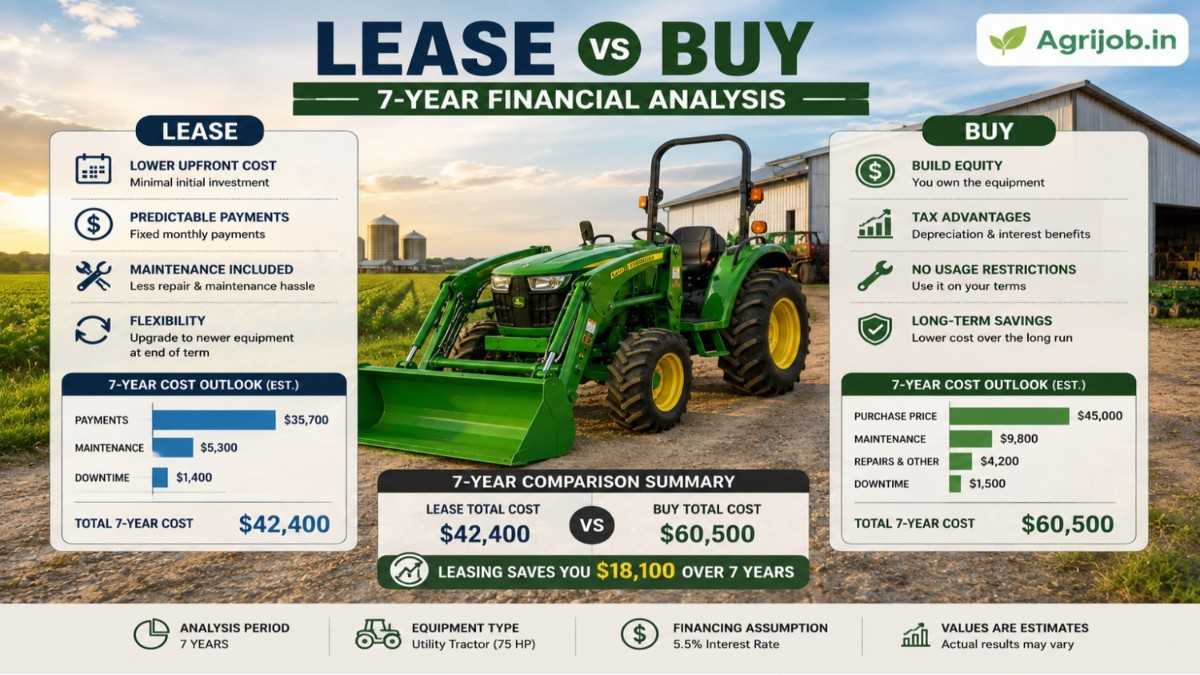
Before running any numbers, it helps to be precise about terms, because in Indian agriculture, “leasing” rarely looks like a Western equipment lease with fixed monthly payments and a residual buyout. In practice, the farm equipment lease vs buy choice usually comes down to three real-world paths:
- 🚜 Buy (own outright or on loan): You take a tractor loan from a bank/NBFC, pay EMIs over 3-7 years, and own a depreciating asset with resale value at the end.
- 🔄 Lease (organised equipment leasing): A financier or dealer retains ownership; you pay a fixed lease rental for a fixed term, with an option to buy at a residual value at the end. This model is common for combine harvesters and high-HP tractors bought by custom hiring entrepreneurs.
- ⏱️ Rent per-use (via a Custom Hiring Centre): You pay only for the hours or acres you use, with zero ownership. This is the dominant “lease-like” model for small and marginal farmers in India, backed by the government’s Sub-Mission on Agricultural Mechanization (SMAM).
For this analysis, we treat “leasing” as the combined rent/lease-via-CHC path, since that’s how over 90% of small and marginal Indian farmers actually access machinery without ownership. We compare it against outright purchase financed through a standard tractor loan.
Money: The Real 7-Year Cost of Buying a Tractor
Let’s build a realistic, current 2026 model. Assume a mid-range 45-50 HP tractor with an on-road price of Rs.7,00,000, a common choice for a 5-10 acre operation. Note that tractor prices rose an estimated 12%-18% in April 2026 across major brands like Mahindra and Swaraj, a move manufacturers linked to input costs even after the GST rate cut, so factor in current dealer pricing rather than older listed prices.
Upfront & Financing Costs
| Cost Component | Rural Buyer | Urban/Semi-Urban Buyer |
|---|---|---|
| On-Road Tractor Price | Rs.7,00,000 | Rs.7,00,000 |
| Down Payment (15-25% margin) | Rs.1,05,000 (15%) | Rs.1,75,000 (25%) |
| Loan Amount | Rs.5,95,000 | Rs.5,25,000 |
| Typical Interest Rate (p.a.) | 9%-11% | 10%-12.25% |
| Loan Tenure | 5-7 years | 5-7 years |
| Processing/Documentation Fee | 0.5%-1% of loan | 0.5%-1% of loan |
| Insurance (Annual, comprehensive) | Rs.12,000-Rs.18,000 | Rs.12,000-Rs.18,000 |
7-Year Total Cost of Ownership (TCO) Table
Using a loan of Rs.5,95,000 at 10% p.a. reducing balance over 7 years, here’s what the full ownership picture looks like, including maintenance and the offsetting resale value at the end:
| Year | EMI Outflow (Approx.) | Fuel + Maintenance | Depreciated Value (Year End) |
|---|---|---|---|
| 1 | Rs.1,22,600 | Rs.35,000 | Rs.5,95,000 (after ~15% dip) |
| 2 | Rs.1,22,600 | Rs.38,000 | Rs.5,05,750 |
| 3 | Rs.1,22,600 | Rs.42,000 | Rs.4,45,000 (after 2nd sharp dip) |
| 4 | Rs.1,22,600 | Rs.46,000 | Rs.4,00,500 (8-12% p.a. now) |
| 5 | Rs.1,22,600 | Rs.50,000 | Rs.3,60,000 |
| 6 | Nil (loan closed) | Rs.55,000 | Rs.3,25,000 |
| 7 | Nil | Rs.60,000 | Rs.2,95,000 (resale value) |
Add it up: total EMI outflow over 5 years is roughly Rs.6,13,000, total 7-year fuel and maintenance is roughly Rs.3,26,000, plus the down payment of Rs.1,05,000 and insurance across 7 years of roughly Rs.1,00,000. That’s a gross 7-year outflow near Rs.11,44,000. Subtract the estimated resale value of Rs.2,95,000 at year 7, and your net 7-year cost of ownership lands near Rs.8,49,000, or roughly Rs.1,21,000 per year of usable ownership.
Money: The Real 7-Year Cost of Leasing / Renting via a CHC
Custom Hiring Centres are the backbone of India’s rent-instead-of-buy model, and the numbers work very differently. Documented CHC rental rates for larger machines like combine harvesters run Rs.1,800-Rs.2,500 per hour, while tractor-plus-implement combinations for basic operations (ploughing, sowing, harrowing) run considerably lower, typically in the Rs.400-Rs.900 per hour range depending on region and machine class.
7-Year Rental Cost Model (5-10 Acre Operation)
Assume a 5-10 acre farm needs roughly 60-80 tractor-hours per year across land prep, sowing, and inter-cultivation (two cropping seasons), at an average blended rate of Rs.650/hour:
| Year | Estimated Hours Needed | Rental Cost (@ Rs.650/hr avg) | Cumulative Cost |
|---|---|---|---|
| 1 | 70 | Rs.45,500 | Rs.45,500 |
| 2 | 70 | Rs.47,000 (5% inflation) | Rs.92,500 |
| 3 | 72 | Rs.49,500 | Rs.1,42,000 |
| 4 | 72 | Rs.52,000 | Rs.1,94,000 |
| 5 | 75 | Rs.55,000 | Rs.2,49,000 |
| 6 | 75 | Rs.58,000 | Rs.3,07,000 |
| 7 | 78 | Rs.61,000 | Rs.3,68,000 |
The 7-year cumulative rental outflow lands near Rs.3,68,000, with zero down payment, zero depreciation risk, zero insurance liability, and no maintenance costs since the CHC bears those. There is also no residual asset at the end, meaning you own nothing at year 7 versus the buyer’s Rs.2,95,000 resale asset. On a pure cash-outflow basis, leasing/renting is the cheaper path for a 5-10 acre operation by a wide margin, roughly Rs.4,81,000 less over 7 years than the net cost of ownership.
If your annual usage stays under roughly 300-400 tractor-hours a year, the math almost always favours renting through a CHC. Ownership only pulls ahead once your usage crosses that threshold, or when you plan to generate custom-hiring income yourself by renting your own tractor out to neighbouring farmers between your own field operations.
Eligibility: Loans, Subsidies & Who Qualifies for What
Both the buy and lease/rent paths have distinct eligibility rules in 2026. Here’s the full breakdown by category:
| Category | Purchase Subsidy (SMAM) | Typical Loan Margin Required | Land Holding Norm |
|---|---|---|---|
| General Category Farmer | 40% | 15%-25% | Min. 2-2.5 acres (bank-dependent) |
| SC/ST Farmer | 50% | 15%-20% | Min. 2-2.5 acres |
| Women Farmer | 50% | 15%-20% | Min. 2-2.5 acres |
| Small & Marginal Farmer | 50% | 15%-20% | Applicable up to 2 hectares |
| North-East Region Farmer | 50% | 15%-20% | Region-specific norms apply |
| FPO / Cooperative (CHC setup) | 40%-80% (project cost, CHC establishment) | Balance via NABARD-linked credit | Min. 5 registered members |
The SMAM subsidy is credited directly against the purchase cost or loan principal via Direct Benefit Transfer (DBT), which lowers your effective interest burden from day one. On the leasing/renting side, there’s no personal eligibility test at all; any farmer can walk into a registered CHC and pay per hour or per acre. The government has actively expanded this access, with roughly 45,000 CHCs already established under SMAM and a target of 22,000 more by 2025-26, so availability keeps improving.
Process: Step-by-Step, From Decision to Deployment
If You Choose to Buy
- Shortlist 2-3 tractor/equipment models matching your acreage and crop type.
- Compare on-road prices across dealers; confirm current pricing since April 2026 hikes affected most brands.
- Check SMAM subsidy eligibility and apply via the DBT portal before finalising the purchase.
- Approach 2-3 lenders (SBI, HDFC, Bank of Baroda, or NBFCs) and compare interest rates, margin requirements, and tenure options.
- Submit KYC, land records, income proof, and margin money/down payment.
- Complete loan sanction, insurance tie-up, and RC registration.
- Take delivery and begin EMI repayment, ideally aligned to Kharif/Rabi harvest-linked cycles.
If You Choose to Lease or Rent via a CHC
- Locate your nearest CHC using the “CHC-Farm Machinery” mobile app or a state-specific platform.
- Check machine availability and confirm per-hour or per-acre rates for your required operation.
- Book your slot in advance during peak sowing/harvesting windows to avoid delays.
- Pay the rental fee (cash, UPI, or app-based payment depending on the CHC).
- Confirm the operator arrives with the equipment; most CHCs include a trained operator in the rate.
- Inspect the completed work before the operator leaves the field.
- Rebook as needed for the next operation or season; no renewal paperwork required.
Book CHC equipment at least 5-7 days ahead of peak sowing or harvesting windows. Demand spikes sharply in the first two weeks of the Kharif and Rabi windows, and popular machines like combine harvesters get booked out fast in mechanised belts like Punjab, Haryana, and western Uttar Pradesh.
Who Should Buy vs Who Should Lease? Find Your Profile
The right choice depends heavily on your acreage, usage pattern, and cash position. Here’s how to place yourself:
Buy Outright If You Match These Profiles
- 🚜 Farmers with 10+ acres who need machinery for 400+ hours a year across multiple operations.
- 💰 Custom hiring entrepreneurs planning to generate rental income by hiring the tractor out to neighbouring farms.
- 🏆 SC/ST, women, and small & marginal farmers eligible for the 50% SMAM subsidy, which sharply lowers the effective cost of ownership.
- 📈 Farmers with stable, diversified income who can comfortably absorb EMI outflows without straining cash flow during a poor harvest.
- 🌾 Multi-crop operations needing year-round equipment access rather than seasonal bursts.
- 🏦 Farmers building a credit history who want the tractor loan to strengthen future borrowing capacity for land or irrigation investment.
Lease or Rent Instead If You Match These Profiles
- 🌱 Small and marginal farmers with under 2-5 acres and seasonal, low-hour usage needs.
- 💵 Cash-constrained farmers who cannot afford a 15-25% down payment without disrupting working capital for seeds and inputs.
- 🎯 Farmers needing specialised, high-cost machinery like combine harvesters or laser land levellers only during specific windows.
- 🆕 First-time or transitioning farmers still evaluating which crops and operations suit their land before committing capital.
- 📉 Risk-averse operations that want to avoid depreciation, resale hassle, and maintenance liability entirely.
- 🌍 Farmers in areas with strong CHC density, particularly Punjab, Haryana, Andhra Pradesh, and Tamil Nadu, where availability is high.
Lease vs Buy: Full Comparison Table
| Factor | Buy (Own via Loan) | Lease/Rent (via CHC) |
|---|---|---|
| 7-Year Net Cost (5-10 acre farm) | ~Rs.8,49,000 | ~Rs.3,68,000 |
| Upfront Cash Required | Rs.1,05,000-Rs.1,75,000 | Nil |
| Depreciation Risk | Borne by owner | None |
| Maintenance Responsibility | Owner | CHC operator |
| Asset at End of 7 Years | Resale value (~Rs.2,95,000) | None |
| Flexibility to Switch Machines | Low | High |
| Best For | 10+ acre, high-usage farms | Under 5-10 acre, seasonal-use farms |
| Subsidy Support | SMAM 40-50% | Indirect (CHC setup subsidised) |
| Credit History Built | Yes | No |
For most operations under 10 acres, renting through a CHC wins on pure 7-year cost. But the equation flips for larger, high-usage farms and for farmers eligible for the 50% SMAM subsidy, where ownership can become the cheaper, wealth-building option once the resale value and subsidy support are factored in. The right answer depends less on the machine and more on your annual hours of use.
High-Value Farm Finance Terms You Must Know
- Total Cost of Ownership (TCO): The full 7-year cost of owning equipment, including EMI, fuel, maintenance, and insurance, minus the resale value at the end. This is the true buy-side number, roughly Rs.8,49,000 in our model.
- Reducing Balance Interest: The method most Indian tractor loans use, where interest is charged only on the outstanding principal, not the original loan amount.
- Residual Value: The estimated resale worth of equipment at the end of a lease or loan term, typically 35-45% of original price after 7 years for well-maintained tractors.
- SMAM DBT Subsidy: Direct Benefit Transfer subsidy of 40-50% credited against machinery purchase cost under the Sub-Mission on Agricultural Mechanization.
- Custom Hiring Centre (CHC): A pay-per-use facility offering tractors, harvesters, and implements on an hourly or per-acre basis without ownership.
- Margin Money: The borrower’s own contribution (down payment) required by the bank, typically 15-25% of the equipment’s on-road price.
- Straight-Line Depreciation: An accounting method spreading an asset’s value loss evenly across its useful life, commonly used for farm equipment tax purposes.
- Kisan Credit Card (KCC)-Linked Finance: A route through which some banks extend tractor and machinery finance at subsidised, priority-sector rates.
- Farm Machinery Bank (FMB): A village-level equivalent of a CHC, receiving up to 80% project subsidy, positioned closer to individual farmers than district-level CHCs.
- Priority Sector Lending (PSL): The RBI classification that makes tractor loans eligible for lower interest rates since agriculture is a mandated lending priority for banks.
Tax & Depreciation Treatment Explained
Tax treatment materially affects which option makes more sense, especially for GST-registered agri-businesses and FPOs rather than individual farmers, who are largely outside the income tax net on farm income. Under the current GST structure effective from September 22, 2025, tractors themselves remain fully GST-exempt (0%), while implements, parts, and accessories now attract just 5% GST, down from the earlier 12% and, in some categories, 18-28% slabs. This directly lowers the effective purchase cost for the buy path in 2026 compared to prior years, even though sticker prices from manufacturers rose separately due to input costs.
For depreciation, most farm equipment follows a pattern of steep initial value loss, roughly 15-20% in year one and year two, before settling into a more predictable 8-12% annual decline for the remainder of its useful life, which typically runs 10-12 years for a well-maintained tractor. Businesses using straight-line depreciation can offset a portion of taxable income each year against this decline, a benefit unavailable on the pure-rental path since there’s no asset to depreciate. On the leasing/CHC side, the entire rental payment is typically treated as a deductible operating expense in the year it’s incurred for registered agri-businesses, offering simpler, immediate tax treatment without the multi-year depreciation schedule.
This guide is regularly reviewed and updated for accuracy. Bookmark this page for the latest notifications on GST rates, loan schemes, and SMAM subsidy updates.
Frequently Asked Questions
What is the main difference between farm equipment lease vs buy?
Buying means taking a loan to own the tractor or machine outright, paying EMIs, and holding a depreciating asset with resale value at the end. Leasing or renting through a CHC means paying only for the hours you use, with zero ownership, no depreciation risk, and no maintenance liability.
Is leasing or renting cheaper than buying a tractor over 7 years?
For a typical 5-10 acre farm, renting via a CHC comes out roughly Rs.4,81,000 cheaper over 7 years in our model. However, this flips for larger farms crossing 300-400 tractor-hours of annual usage, where ownership becomes more cost-effective.
What subsidy is available for buying farm equipment in 2026?
Under the Sub-Mission on Agricultural Mechanization (SMAM), general category farmers get a 40% subsidy, while SC/ST, women, small and marginal, and North-East region farmers get a 50% subsidy on machinery purchase cost, credited via Direct Benefit Transfer.
What is the current GST rate on tractors and farm equipment?
Tractors remain GST-exempt at 0%. Farm implements, machinery, and accessories attract 5% GST following the September 2025 GST reform, down from the earlier 12% slab that applied to most agricultural machinery.
What interest rate can I expect on a tractor loan in 2026?
Tractor loan interest rates in 2026 typically range from 8% to 14% per annum depending on the lender, with SBI offering some of the most competitive rates starting around 9% for qualifying farmers with adequate land holding.
How much does it cost to rent a tractor from a Custom Hiring Centre?
Basic tractor-and-implement rentals typically range from Rs.400 to Rs.900 per hour depending on region and machine class, while specialised equipment like combine harvesters can cost Rs.1,800 to Rs.2,500 per hour.
Does buying a tractor help build credit history for future farm loans?
Yes. Successfully repaying a tractor loan builds a documented credit history with your lender, which can improve eligibility and interest rates for future loans covering land purchase, irrigation, or additional machinery.
How does farm equipment depreciation affect the buy decision?
Tractors typically lose 15-20% of value in the first two years, then depreciate 8-12% annually afterward. This front-loaded depreciation is a major reason low-usage buyers often find renting more cost-effective than ownership.
Disclaimer: This article is for general informational and educational purposes only and does not constitute financial, tax, or legal advice. Loan rates, subsidy percentages, and GST rules are subject to change; always verify current figures with your bank, a chartered accountant, or the official SMAM/GST portals before making a purchase or leasing decision.
Last Updated: July 2026