
John Deere vs Case IH vs New Holland total cost of ownership is the most important question any serious farmer or tractor buyer must answer before signing the loan papers — because the ex-showroom price tag is only the beginning. Over 5 years of actual farm use, your real costs include fuel bills, annual maintenance, spare parts, insurance, and the resale value you recover when you upgrade. This complete 2026 guide honestly compares all three global tractor giants across every cost factor that matters: initial price (Rs.6–72 lakh range in India), fuel efficiency, maintenance schedules, dealer support, precision farming technology value, and the full 5-year resale picture. Whether you farm 5 acres of wheat in UP or 50 acres of sugarcane in Maharashtra, this guide covers purchase cost, running cost, hidden costs, and the expert verdict — so you make the smartest tractor investment of your life in 2026.
| John Deere India Price Range | Rs.6.13 lakh – Rs.72 lakh (28–130 HP, 62+ models) |
| New Holland India Price Range | Rs.3.38 lakh – Rs.36 lakh (17–110 HP, 42 models) |
| Case IH India Availability | Very limited — primarily a global/North American brand |
| John Deere 3-Year Resale Value | 65–72% of purchase price (best in class) |
| New Holland 3-Year Resale Value | 55–62% of purchase price |
| Fuel Efficiency Advantage | New Holland (10–15% better than JD in paddy operations) |
| Precision Farming Leader | John Deere (JDLink, AutoTrac, Operations Center) |
| John Deere Warranty (India) | 5-year / 5,000-hour (whichever is earlier) |
| India Service Centres (JD) | 166+ centres nationwide |
| Net 5-Year TCO Difference (50 HP) | JD approx. Rs.1.25–1.50 lakh higher than New Holland |
- What Is Tractor Total Cost of Ownership?
- Purchase Price: John Deere vs Case IH vs New Holland
- Fuel Efficiency and Annual Fuel Cost Breakdown
- Maintenance Cost and Service Schedule Comparison
- Resale Value and Depreciation: 5-Year Picture
- Technology and Precision Farming Value
- Dealer Network and After-Sales Support in India
- Who Should Buy Which Tractor Brand?
- Complete 5-Year TCO Comparison Table
- Key Tractor Ownership Terms You Must Know
- Frequently Asked Questions
What Is Total Cost of Ownership for Tractors in 2026?
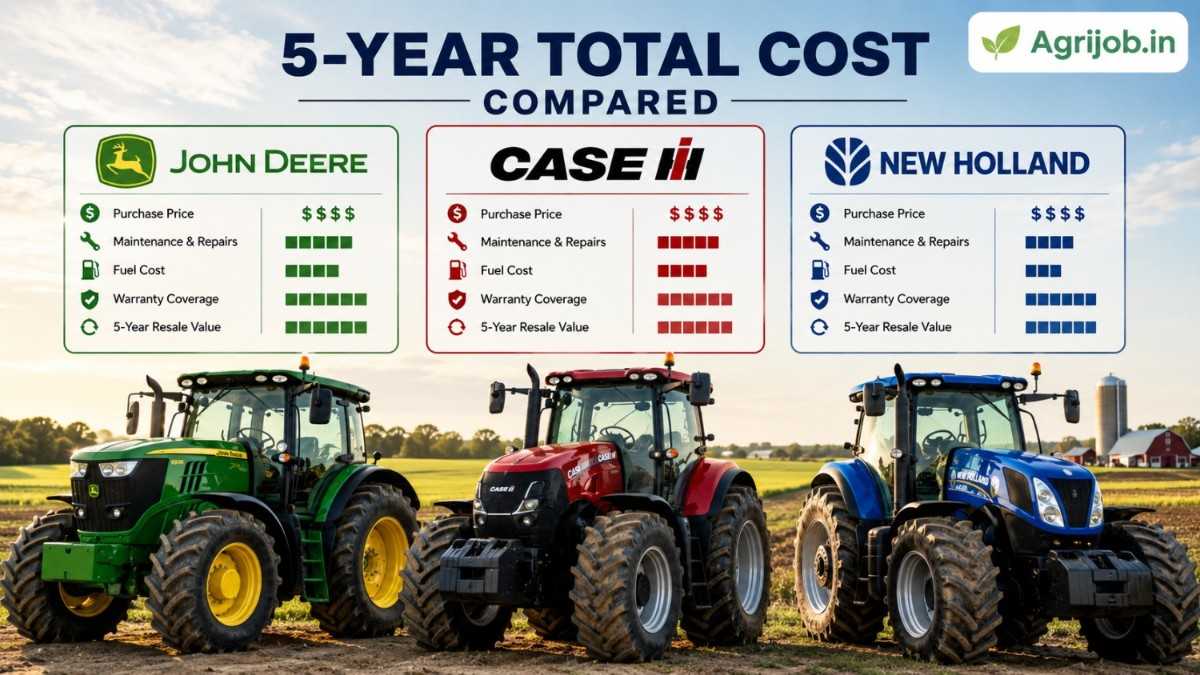
Total cost of ownership (TCO) is the complete financial picture of owning a tractor over a defined period — typically 5 years — that goes far beyond the ex-showroom sticker price. For Indian farmers investing Rs.7–36 lakh in a premium international brand like John Deere, Case IH, or New Holland, understanding TCO is the difference between a profitable farm asset and an expensive mistake. Many farmers focus only on the purchase price and discover the real cost much later.
The 5-year TCO for any tractor includes 6 core cost components:
- 🏷️ Purchase price (ex-showroom + on-road): The starting investment including RTO registration, insurance, and dealer handling — typically 8–12% above ex-showroom price across Indian states.
- ⛽ Fuel cost: Diesel consumption at your field’s horsepower load, multiplied by annual operating hours and current diesel price (approx. Rs.94–102/litre in 2026 across Indian states).
- 🔧 Maintenance and servicing: Scheduled oil changes, filter replacements, hydraulic fluid, and unscheduled repairs across 5 years of farm use — the most variable cost component.
- 📉 Depreciation: The value your tractor loses each year — front-loaded in Years 1 and 2, when the drop is steepest at 20–26% of purchase price in the first year alone.
- 💰 Resale value: What you recover when you sell or trade in — this directly offsets your net ownership cost and is where John Deere’s real advantage lies.
- 📡 Technology and precision farming value: GPS guidance, telematics, and smart farm data platforms that reduce input costs and improve yield per acre over time.
When you account for all 6 factors, the brand with the lowest sticker price does not always win — and the most expensive brand does not always lose. Let’s go through each factor for John Deere, Case IH, and New Holland in 2026 with honest numbers.
Purchase Price Comparison: John Deere vs Case IH vs New Holland 2026
The first and most visible component of the John Deere vs Case IH vs New Holland total cost of ownership comparison is the purchase price. In 2026, India’s tractor market ranges from Rs.2.44 lakh (11 HP mini-tractors) to Rs.72 lakh (130 HP high-horsepower models). Here is how the three brands stack up across HP segments:
| HP Category | John Deere (India 2026) | New Holland (India 2026) | Case IH (India Availability) |
|---|---|---|---|
| Mini / Compact (17–35 HP) | Rs.6.13–7.50 lakh | Rs.3.38–6.50 lakh | Not widely available in India |
| Mid-Range 2WD (36–50 HP) | Rs.7.60–10.50 lakh | Rs.5.78–9.80 lakh | Limited India dealer presence |
| 4WD Utility (50–75 HP) | Rs.11–23.79 lakh | Rs.9.80–18 lakh | Very limited India market |
| High HP (75–130 HP) | Rs.24–72 lakh | Rs.18–36 lakh | Global: USD 50,000–1,00,000+ |
| Price Premium vs New Holland | +10–25% premium across segments | Base pricing benchmark | Higher than both globally |
| 4WD Entry Gap (45–60 HP) | Rs.80,000–1.5 lakh more | More affordable 4WD entry | Not applicable (India) |
In the 45–60 HP 4WD segment — the most popular segment for Indian medium-scale farmers — New Holland is typically Rs.80,000 to Rs.1.5 lakh cheaper than a comparable John Deere model. John Deere’s pricing premium reflects its stronger technology package, JDLink connectivity infrastructure, and the higher residual value it commands in India’s secondary tractor market. As HP increases to the 75–100 HP range, the price gap between John Deere and New Holland narrows to Rs.50,000–Rs.1 lakh.
Case IH, while a genuine global powerhouse with models ranging from USD 3,750 to USD 1,067,000 internationally, has very limited dealer infrastructure in India in 2026. Both John Deere and New Holland qualify for NABARD agricultural equipment loans and are eligible for PM-KISAN linked tractor subsidy programmes across multiple Indian states — an important cost consideration that can reduce your net outlay by 25–50% depending on state scheme availability.
Fuel Efficiency and Annual Fuel Cost: John Deere vs New Holland vs Case IH
Fuel is the single largest recurring cost in tractor ownership, often 2–3 times higher than annual maintenance spend. For Indian farmers running tractors 400–800 hours per year at diesel prices of approximately Rs.95/litre in 2026, even a 10% fuel efficiency difference translates to a real Rs.22,800–Rs.47,500 annual saving. Understanding John Deere vs New Holland fuel consumption rates is essential to calculating your true 5-year cost of ownership.
| Fuel Metric | John Deere (55–75 HP) | New Holland (55–75 HP) | Case IH (global 55–75 HP) |
|---|---|---|---|
| Fuel Consumption (litres/hour) | 3.2–3.5 L/hr | 2.8–3.2 L/hr | 3.0–3.4 L/hr (global est.) |
| Annual Fuel Use (600 hrs) | 1,920–2,100 litres | 1,680–1,920 litres | 1,800–2,040 litres |
| Annual Fuel Cost @ Rs.95/litre | Rs.1,82,400–Rs.1,99,500 | Rs.1,59,600–Rs.1,82,400 | Rs.1,71,000–Rs.1,93,800 |
| 5-Year Fuel Cost Estimate | Rs.9.12–9.97 lakh | Rs.7.98–9.12 lakh | Rs.8.55–9.69 lakh |
| Efficiency Advantage | Base benchmark | 10–15% better than JD | Comparable to New Holland |
| Engine Technology (India) | PowerTech / TREM IV | NEF Engine / Turtle Mode | FPT Industrial (CNH) |
New Holland’s NEF engine with Turtle mode delivers class-leading fuel efficiency — particularly in paddy and light-duty field operations. Case IH uses FPT Industrial engines (same CNH Industrial parent company as New Holland), giving it broadly similar fuel consumption profiles to New Holland globally. Over a 5-year ownership period, New Holland’s fuel advantage can save Rs.1–1.9 lakh versus John Deere — meaningfully narrowing (though not eliminating) the net TCO gap. For paddy-farming states like Punjab, Haryana, and West Bengal where tractors operate extensively in wet, load-heavy conditions, New Holland’s fuel efficiency edge becomes a genuinely important operational advantage worth calculating before purchase.
Maintenance Cost and Service Schedule: John Deere vs New Holland vs Case IH
Annual maintenance cost for tractors depends primarily on whether you perform the service yourself or use the authorised dealer network. Dealer-performed maintenance typically doubles the cost of owner-performed service. Here is the honest 2026 breakdown for mid-sized utility tractors in the Indian context, running 400–600 hours annually:
| Maintenance Item | John Deere | New Holland | Case IH (global) |
|---|---|---|---|
| Engine Oil Change Interval | Every 100–200 hours | Every 100–200 hours | Every 100–200 hours |
| Hydraulic Fluid Replacement | At 1,000 hours | At 1,000 hours | At 1,000 hours |
| Extended Service Intervals | Standard intervals | Up to 750 hours (select models) | Standard intervals |
| Annual Cost — Owner Service | Rs.30,000–Rs.85,000 | Rs.25,000–Rs.75,000 | USD 300–1,000 (global est.) |
| Annual Cost — Dealer Service | Rs.60,000–Rs.1,70,000 | Rs.50,000–Rs.1,50,000 | USD 600–2,000 (global est.) |
| Genuine Parts Cost | Higher (premium pricing) | 10–15% less than JD | Comparable to New Holland |
| Aftermarket Parts Savings | 20–30% cheaper | 20–30% cheaper | 20–30% cheaper |
| Major Overhaul (5,000–8,000 hrs) | Rs.1.5–3.5 lakh | Rs.1.2–3 lakh | Comparable |
| 5-Year Maintenance Estimate | Rs.3–8.5 lakh | Rs.2.5–7.5 lakh | Comparable to New Holland |
New Holland’s extended 750-hour service intervals on select 2026 models give it a practical advantage in reducing downtime frequency and annual dealer visit costs. John Deere’s comprehensive 5-year / 5,000-hour warranty (available on India models) provides significant financial protection that can offset its higher genuine part costs in the critical early ownership years. Research consistently shows that disciplined, timely maintenance reduces total machinery repair costs by approximately 25% across all brands — meaning your own servicing discipline matters as much as brand selection when calculating 5-year TCO.
Resale Value and Depreciation: 5-Year Picture for Indian Farmers
Resale value is the great equaliser in the John Deere vs New Holland total cost of ownership comparison — and the most overlooked factor by first-time buyers. A tractor that depreciates slowly effectively returns money to you when you upgrade, directly reducing your net 5-year ownership cost. This is precisely where John Deere’s premium pricing begins to justify itself for Indian farmers who trade or upgrade on a 5–7 year cycle.
| Resale Metric | John Deere | New Holland | Case IH (India context) |
|---|---|---|---|
| 3-Year Resale Value (India) | 65–72% of purchase price | 55–62% of purchase price | Limited India secondary market data |
| 5-Year Resale Value (India) | 60–70% (well-maintained) | 50–58% (well-maintained) | Not widely tracked in India |
| First-Year Depreciation | 20–23% | 22–25% | 23–26% (global average) |
| Resale Demand in India | Very High — strong brand recall | High — strong in paddy states | Low — very limited India market |
| Net Value Loss on Rs.12L tractor (3 yr) | Rs.3.36–4.20 lakh | Rs.4.56–5.40 lakh | Higher loss due to low demand |
| Resale Speed in Secondary Market | Fast (strong buyer pipeline) | Moderate | Slow in India |
| Key Resale Driver | Brand recognition + JDLink service record | Paddy state demand + fuel economy | Not applicable for India |
The numbers that matter most: On a Rs.12 lakh 50 HP tractor, John Deere’s superior 3-year resale retention means you recover Rs.1.20–2.04 lakh more than New Holland when you sell. This directly narrows the initial Rs.1.5 lakh purchase price gap to almost nothing over a full ownership cycle. John Deere’s higher purchase price is partially offset by stronger resale — making the net 5-year depreciation cost competitive and sometimes comparable to the apparently cheaper brand. Globally, research shows John Deere 5-year residual values of 55–65% and New Holland’s large wheeled tractors achieving up to 76.78% 5-year residual in specialised studies — demonstrating that both brands can hold value strongly when well-maintained and matched to their strongest segment.
Technology and Precision Farming Value: JDLink vs AFS Connect vs PLM Intelligence
In 2026, precision agriculture technology is no longer optional for competitive farming. GPS guidance, telematics, and smart farm data directly reduce input costs and improve yield per acre — and the technology platform you choose when buying a John Deere, Case IH, or New Holland tractor determines your farm’s digital capability for the next decade.
| Technology Factor | John Deere | New Holland | Case IH |
|---|---|---|---|
| Telematics Platform | JDLink™ — industry leader | PLM Intelligence | AFS Connect™ |
| GPS Auto-Guidance | AutoTrac — best in class | IntelliSteer | AFS AccuGuide |
| Remote Diagnostics | Yes — real-time mobile alerts | Yes — in-cab display | Yes — real-time monitoring |
| India Availability | Full ecosystem available | Partial — select premium models | Very limited in India |
| Connectivity Subscription | Required on some models | Available on select models | Included free (global) |
| Ecosystem Maturity | Most mature globally | Closing the gap in 2026 | Strong in North America |
| Smart Farming Value (India) | Highest practical value | Growing rapidly | Minimal — limited India access |
John Deere’s Operations Center, AutoTrac, and JDLink represent the most widely deployed precision agriculture ecosystem available to Indian farmers today. For large-scale commercial farms covering 20 or more acres, the input cost savings from GPS-guided auto-steering, variable rate fertiliser technology, and real-time machine diagnostics can deliver Rs.25,000–Rs.1 lakh per season in saved inputs — effectively paying for John Deere’s technology premium within 2–3 growing seasons. Case IH’s AFS Connect is internationally respected, but its very limited India dealer availability makes this technology largely inaccessible to Indian farmers in 2026. Visit the Ministry of Agriculture and Farmers Welfare portal for the latest precision farming subsidy support available in your state.
Dealer Network and After-Sales Support: John Deere vs New Holland in India 2026
Dealer proximity matters more than any specification sheet when your tractor breaks down during paddy harvest or sugarcane cutting season. A 3-day wait for a spare part during peak harvest can cost more than your entire annual maintenance budget in lost labour and delayed work. Here is the honest picture of tractor after-sales support in India 2026:
- 🏆 John Deere India — 166+ authorised service centres: Manufacturing plants in Pune (Maharashtra) and Dewas (Madhya Pradesh). John Deere India crossed the historic 1 million tractor production milestone at its Pune plant in October 2025 — reflecting deep manufacturing and supply chain roots. John Deere retailed 8,788 tractors in December 2025 (up 69.26% year-on-year), and 6,039 units in May 2026 alone. Customer care helpline: 1800 209 5310 (toll-free).
- 🏭 New Holland India — strong regional network: Manufacturing plant in Greater Noida, Uttar Pradesh. Over 650,000 tractors sold in India and export markets since 1998. Particularly strong dealer presence in Punjab, Haryana, Rajasthan, and northeastern rice-belt states — well-suited for paddy, wheat, and wet-field operations where New Holland’s fuel efficiency shines.
- ⚠️ Case IH India — very limited network: Case IH has minimal authorised dealer and service infrastructure in India compared to John Deere and New Holland. Farmers considering Case IH for Indian operations should rigorously verify local dealer availability before purchase — limited service access can dramatically increase downtime costs and effectively nullify any purchase price advantages.
- 🔩 Spare parts availability: John Deere genuine parts are available nationwide through its distribution network. New Holland parts cost 10–15% less on average and are widely available in Punjab and Haryana. Both brands support aftermarket parts ecosystems with 20–30% cost savings over genuine parts without affecting basic performance.
- 📱 Digital service support: John Deere’s JDLink app enables real-time remote diagnostics, reducing emergency dealer visits and downtime. New Holland’s PLM connectivity platform is growing in capability across Indian premium models but has not yet reached JDLink’s depth of rural India deployment.
Who Should Buy Which Tractor Brand?
The most honest answer to the John Deere vs Case IH vs New Holland question is: it depends entirely on who you are, what you grow, and how long you plan to keep the machine. Here is a practical, farmer-by-farmer breakdown for 2026:
- 🌾 Large-scale mixed-crop farmer (20+ acres, UP / MP / Maharashtra): Choose John Deere. Superior technology (JDLink, AutoTrac), the widest India dealer network, and best-in-class resale value justify the higher upfront cost on large operations where precision farming ROI is measurable and highest.
- 🌾 Paddy and rice farming household (Punjab, Haryana, West Bengal): Choose New Holland. Its NEF engine’s 10–15% fuel efficiency advantage and proven wet-field paddy performance make it the practical champion for these operations — with lower 4WD entry price as a bonus.
- 💼 Commercial tractor contractor (haulage and contract farming): Choose John Deere. Strong resale value, wide service network, and durable build quality make John Deere the preferred brand when the tractor must work commercially and be sold or traded efficiently within 3–5 years.
- 👨🌾 First-time tractor buyer (budget under Rs.10 lakh): New Holland’s NX or Excel series offers genuine value at lower cost. John Deere’s D Series is also competitive at entry price levels. Compare dealer proximity before deciding.
- 🏔️ Hilly terrain farmer (Uttarakhand, Himachal Pradesh, northeastern states): Choose New Holland 4WD. New Holland’s 4WD models are engineered for hilly, wet, and uneven terrain — and priced Rs.80,000–1.5 lakh lower than equivalent John Deere 4WDs in the entry segment.
- 📡 Precision farming adopter (GPS guidance, auto-steer, data management): Choose John Deere without hesitation. JDLink and AutoTrac remain India’s most mature and comprehensively supported precision agriculture ecosystem in 2026.
- 🌍 Large North American or global farmer (200+ acres): Seriously evaluate Case IH’s Maxxum, Puma, or Steiger series. Case IH frequently prices 5–10% below John Deere in the 100+ HP large agricultural segment while delivering fully comparable productivity and technology through AFS Connect.
- 🌱 SC/ST or OBC farmer seeking maximum subsidy: Both John Deere and New Holland qualify for state and central government tractor subsidy schemes. Check your district’s latest subsidy percentage on the Ministry of Agriculture portal before purchase — subsidies can reduce your net outlay by 25–50%.
John Deere vs Case IH vs New Holland: Complete 5-Year TCO Comparison Table
The table below presents an estimated 5-year total cost of ownership for a typical 50–55 HP utility tractor used in the Indian farming context — 600 operating hours per year, diesel at Rs.95/litre, owner-serviced model. All figures are grounded in 2026 market data and are illustrative for comparison purposes. Actual costs will vary by state, dealer, and usage pattern.
| TCO Factor (5-Year, 50 HP) | John Deere 5050D | New Holland 3630 TX | Case IH Farmall (global) |
|---|---|---|---|
| Purchase Price (India, est.) | Rs.10.50 lakh | Rs.9.00 lakh | Not standard in India |
| On-Road Premium (10%) | Rs.1.05 lakh | Rs.0.90 lakh | — |
| 5-Year Fuel Cost | Rs.8.55–9.50 lakh | Rs.7.60–8.55 lakh | Comparable to NH |
| 5-Year Maintenance (owner) | Rs.3–5 lakh | Rs.2.50–4.50 lakh | Comparable |
| Insurance (5 years) | Rs.1–1.50 lakh | Rs.0.90–1.30 lakh | Proportional |
| Gross 5-Year Cost | Rs.24.10–27.55 lakh | Rs.20.90–24.25 lakh | — |
| Resale Value (Year 5) | Rs.6.30–7.35 lakh (60–70%) | Rs.4.50–5.22 lakh (50–58%) | Low in India |
| Net 5-Year TCO | Rs.16.75–21.25 lakh | Rs.15.68–19.73 lakh | — |
| Net TCO Difference vs New Holland | Approx. Rs.1.25–1.52 lakh more | Base — lower net cost | — |
| Technology Value (India) | High — JDLink, AutoTrac available | Moderate — PLM on premium | High globally; minimal in India |
| Overall TCO Verdict | Best for large farms and resale cycles | Best for fuel savings and entry cost | Best for North American large ag |
Key Tractor Ownership and Agricultural Finance Terms You Must Know
Understanding these high-value agricultural equipment and finance terms will help you negotiate better, evaluate tractor loans smarter, and manage your investment professionally from Day 1:
- 💰 Total Cost of Ownership (TCO): The complete 5-year financial picture including purchase price, fuel, maintenance, insurance, and net depreciation after resale. Every tractor buyer should calculate TCO before choosing a brand.
- 📉 Depreciation: The annual reduction in your tractor’s market value. Typically 20–25% in Year 1 for most brands, slowing to 8–12% per year in Years 4 and 5. John Deere depreciates slowest among the three brands in Indian markets.
- 🔑 Resale Value / Residual Value: The percentage of the original purchase price a tractor retains after a set number of years. John Deere India 5-year residual: 60–70%; New Holland India 5-year residual: 50–58%.
- 🌐 JDLink™: John Deere’s telematics and remote monitoring system providing real-time diagnostics, fuel usage tracking, and GPS location via mobile app — available on select India models in 2026.
- 📡 AFS Connect (Case IH): Advanced Farming Systems Connect — Case IH’s precision agriculture and fleet management platform. Industry-leading globally but with very limited India availability in 2026.
- 🌿 PLM Intelligence (New Holland): New Holland’s Precision Land Management platform including IntelliSteer GPS auto-guidance and remote machine monitoring. Closing the gap with JDLink on select 2026 premium models.
- 🔧 TREM IV / TREM V: Tractor Emission Regulation norms governing diesel engine emissions in India. Both John Deere and New Holland are TREM IV compliant in 2026. The Government of India has proposed TREM V norms from October 2026 — factor this into your next purchase decision.
- 🏦 NABARD Tractor Loan: National Bank for Agriculture and Rural Development’s concessional agricultural equipment finance. Both John Deere and New Holland qualify for NABARD-backed loans with preferential interest rates for eligible farmers.
- ⚙️ PTO (Power Take-Off) HP: The shaft that transfers tractor engine power to implements like rotavators, threshers, and water pumps. PTO HP — not just rated engine HP — determines real implement compatibility and performance in the field.
- 🚜 4WD vs 2WD: Four-wheel drive tractors provide superior traction in wet paddy fields, hilly terrain, and deep tillage. New Holland holds a Rs.80,000–1.5 lakh price advantage in the 4WD entry segment over John Deere — a meaningful saving for first-time 4WD buyers.
After comparing all 6 cost pillars with 2026 data, here is the clear verdict:
John Deere wins on: Resale value (65–72% at 3 years in India), dealer network depth (166+ centres), technology ecosystem (JDLink, AutoTrac), long-term brand trust, and 5-year/5,000-hour warranty security.
New Holland wins on: Fuel efficiency (10–15% better in paddy operations), lower purchase price (Rs.80,000–1.5 lakh less in the 4WD segment), 750-hour service intervals on select models, and paddy/hilly terrain engineering.
Case IH wins on: 100+ HP large-scale global farming where it undercuts John Deere by 5–10% with comparable productivity — but is not a practically available option for most Indian farmers in 2026.
The bottom line: The real net 5-year TCO difference between John Deere and New Holland in India is only approximately Rs.1.25–1.52 lakh on a 50 HP tractor — far smaller than the sticker price gap suggests. For large commercial farms and frequent upgraders: John Deere. For budget-conscious, fuel-focused, paddy, and hilly terrain farmers: New Holland.
Frequently Asked Questions
Which tractor has the best 5-year total cost of ownership — John Deere, Case IH, or New Holland?
New Holland offers the lowest 5-year total cost of ownership in absolute terms due to its lower purchase price, 10–15% better fuel efficiency in paddy operations, and competitive parts pricing. However, John Deere significantly narrows the gap through superior resale value — retaining 65–72% of purchase price after 3 years versus 55–62% for New Holland. On a Rs.12 lakh 50 HP tractor, the net 5-year TCO difference between the two brands is only approximately Rs.1.25–1.52 lakh in New Holland’s favour. Case IH is not widely available in India’s tractor market in 2026, making this comparison primarily relevant between John Deere and New Holland for Indian farmers.
What is the price difference between John Deere and New Holland tractors in India 2026?
In the popular 45–60 HP 4WD segment, New Holland tractors are typically Rs.80,000 to Rs.1.5 lakh cheaper than comparable John Deere models in India 2026. John Deere prices span Rs.6.13 lakh to Rs.72 lakh across 62+ models (28–130 HP). New Holland India prices range from Rs.3.38 lakh to Rs.36 lakh across 42 models (17–110 HP). In the higher 75–100 HP range, the price gap narrows to Rs.50,000–Rs.1 lakh. John Deere’s premium reflects its stronger technology integration, broader India dealer network, and superior resale value.
Which tractor brand has better resale value in India — John Deere or New Holland?
John Deere has significantly better resale value in India’s secondary tractor market in 2026. After 3 years, a well-maintained John Deere tractor retains approximately 65–72% of its original purchase price. New Holland retains 55–62% in the same period. Over 5 years, John Deere can still retain 60–70% of its value — among the highest in the Indian tractor market. This resale advantage is driven by John Deere’s strong brand recall, nationwide dealer demand, and easy access to genuine spare parts across India’s rural districts.
Which tractor brand is most fuel-efficient — John Deere, Case IH, or New Holland?
New Holland delivers the best fuel efficiency in the India-relevant comparison. New Holland’s NEF engine with Turtle mode averages 2.8–3.2 litres per hour in the 55–75 HP range, compared to John Deere’s 3.2–3.5 litres per hour — a 10–15% efficiency advantage. At 600 operating hours per year and Rs.95/litre diesel, this saves approximately Rs.22,800–Rs.47,500 annually in New Holland’s favour. Case IH uses FPT Industrial engines (same parent CNH group as New Holland) with broadly comparable fuel economy to New Holland globally.
Is John Deere worth the higher price compared to New Holland in India?
Yes, John Deere is worth the premium for large commercial farms covering 20 or more acres, for frequent tractor upgraders who resell every 3–5 years, and for precision farming adopters who will use JDLink and AutoTrac. The combination of superior resale value, JDLink telematics, 166+ India service centres, and strongest brand recall in India’s secondary market means John Deere’s total net cost over 5 years is only marginally higher than New Holland. For smaller farms, budget-sensitive buyers, paddy operations, and hilly terrain, New Holland offers equal or better practical value at a lower upfront price.
What are the annual maintenance costs for John Deere vs New Holland tractors?
Annual maintenance for a 50–75 HP John Deere tractor in India ranges from Rs.30,000–Rs.85,000 for owner-performed service and Rs.60,000–Rs.1,70,000 for dealer-performed service. New Holland’s annual maintenance typically runs 10–15% lower due to less expensive genuine parts, with Rs.25,000–Rs.75,000 for owner-performed service. New Holland’s extended 750-hour service intervals on select models further reduce frequency of service visits. Both brands follow similar core schedules: oil changes every 100–200 hours, hydraulic fluid at 1,000 hours, and major overhauls at 5,000–8,000 hours.
Is Case IH available in India in 2026?
Case IH has very limited dealer and service infrastructure in India as of 2026. While Case IH is a global leader in 100+ HP large agricultural tractors — particularly in North American row crop farming — Indian farmers primarily choose between John Deere, New Holland, Mahindra, Swaraj, and Sonalika. For Indian tractor buyers, the practical decision is between John Deere and New Holland. Limited Case IH spare parts availability and service network in India significantly increase total ownership risk and cost, and should be carefully evaluated before any purchase decision.
Which tractor brand has the best dealer network and service support in India?
John Deere leads with 166+ authorised service centres across India, manufacturing plants in Pune (Maharashtra) and Dewas (Madhya Pradesh), and a dedicated toll-free helpline at 1800 209 5310. John Deere India’s 1 million tractor production milestone in October 2025 reflects deep supply chain roots ensuring consistent parts availability nationwide. New Holland (manufactured in Greater Noida, UP) has a strong network particularly in Punjab, Haryana, and paddy-growing states. Case IH’s India network remains very limited in 2026. For rural and remote farming districts, John Deere’s broader network provides the most reliable after-sales support for managing total cost of tractor ownership.
Last Updated: July 2026. This guide is regularly reviewed and updated for accuracy. Bookmark this page for the latest tractor cost comparison data, updated pricing, and new model launches from John Deere, New Holland, and Case IH in India.