
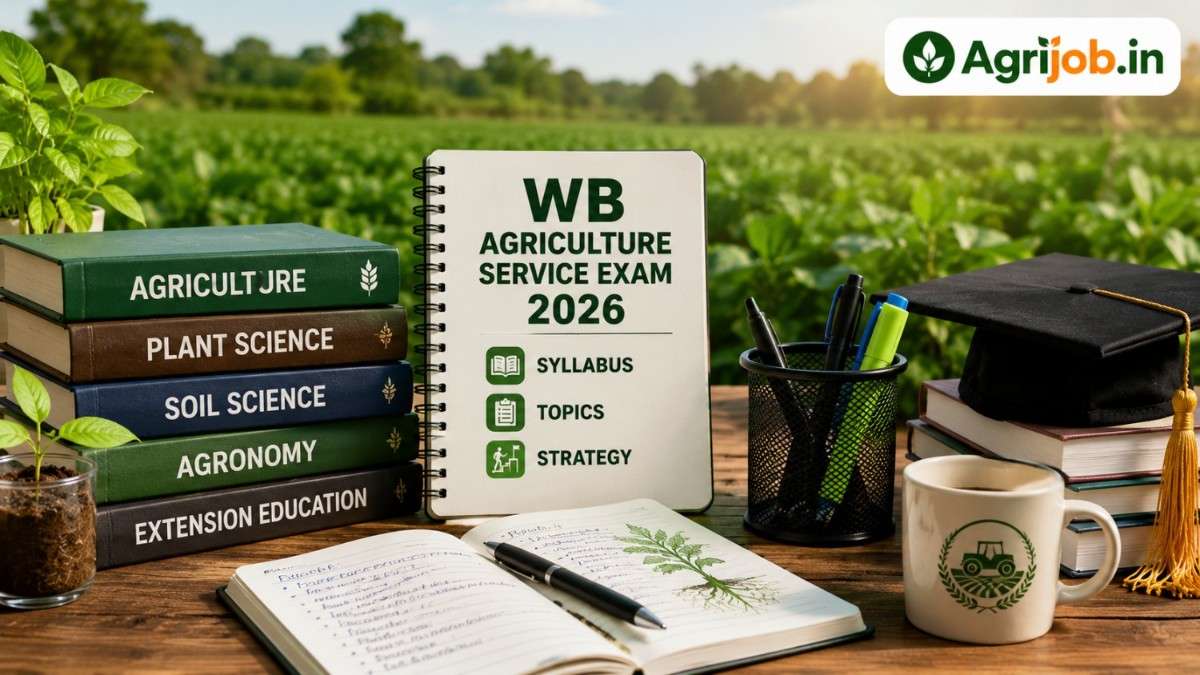
WB Agriculture Service Exam 2026 – Syllabus, Topics & Strategy
West Bengal Agriculture Service Exam 2026 agriculture graduates ke liye West Bengal mein ek prestigious government naukri ka sabse seedha rasta hai. WBPSC dwara conduct ki jaane wali yeh exam Agriculture Officers, Assistant Agronomists, Soil Scientists aur allied posts ke liye candidates select karti hai — jinhe West Bengal Agriculture Department ke under Rs.40,000–Rs.55,000/month tak salary milti hai. Yeh guide complete syllabus analysis, topic-wise weightage, exam pattern, eligibility criteria, preparation strategy, aur frequently asked questions cover karta hai — taaki aap 2026 cycle mein ek informed aur focused strategy bana sakein.

| Conducting Body | West Bengal Public Service Commission (WBPSC) |
| Posts Covered | Agriculture Officer, Asst. Agronomist, Asst. Agricultural Chemist, Jr. Soil Scientist |
| Exam Type | Objective (MCQ) — 100 marks, 2 hours |
| Qualification | B.Sc. Agriculture / Allied Sciences (UGC-recognised university) |
| Age Limit (General) | 21–36 years (as of notification date) |
| Salary (Approx.) | Rs.40,000–Rs.55,000/month (Group B); Rs.56,100+ (Group A) |
| Official Website | psc.wb.gov.in |
| Negative Marking | As applicable per official notification |
- WB Agriculture Service Exam 2026 — Overview
- Exam Pattern & Marks Distribution
- Complete Syllabus — Paper I: Crop Production & Agronomy
- Complete Syllabus — Paper II: Crop Improvement & Horticulture
- Topic-Wise Weightage Analysis 2026
- West Bengal-Specific Topics You Cannot Miss
- Eligibility Criteria, Age Limit & Salary
- Who Should Apply for WB Agriculture Service Exam?
- WB Agriculture Service vs WBCS Agriculture Optional
- High-Value Agriculture Career Terms You Must Know
- Preparation Strategy & Best Books 2026
- Frequently Asked Questions (FAQs)
WB Agriculture Service Exam 2026 — Overview
The West Bengal Public Service Commission (WBPSC) periodically recruits candidates for various posts under the West Bengal Agriculture Department through a dedicated Screening Test. Posts covered under this recruitment include Assistant Agronomist in W.B. Agricultural Service (Research), Assistant Agricultural Chemist, Analytical Chemist, Junior Soil Scientist, and Agriculture Officers at the block and district level. These are Grade B and Grade A gazetted government posts — among the most sought-after agriculture government jobs in West Bengal.
The West Bengal Agriculture Service exam differs from the WBCS exam in a key way: it is a subject-specific technical exam that tests candidates purely on agricultural science — agronomy, soil science, horticulture, plant protection, genetics, and agri-extension — making it ideal for B.Sc. Agriculture graduates. Salaries start from approximately Rs.40,000 per month (Group B) and can exceed Rs.56,100 (Group A, pay level 10 under 7th Pay Commission), with DA and HRA added on top. Given West Bengal’s status as India’s number one paddy and vegetable producer with a cropping intensity of 184%, agriculture officers here manage diverse, high-stakes field operations — making the role both rewarding and impactful.

West Bengal Agriculture Service Exam Pattern 2026
The WBPSC Agriculture Service Screening Test follows a straightforward objective pattern. Understanding this pattern is the foundation of any smart preparation plan for the 2026 cycle.
| Parameter | Details |
|---|---|
| Exam Mode | Offline (OMR-based objective MCQ) |
| Total Marks | 100 marks |
| Duration | 2 hours |
| Number of Questions | 100 (1 mark each) |
| Syllabus Coverage | General Topics + Crop Production & Protection |
| Medium of Exam | English / Bengali |
| Negative Marking | As per official notification (typically -0.25 per wrong answer) |
| Selection Stage | Written Test → Interview / Personality Test |
The paper is structured under 2 broad sections: General Topics (covering agri-extension, agro-ecology, precision farming, and allied concepts) and Crop Production and Protection (covering major crop agronomy, soil science, plant breeding, horticulture, and pest/disease management). Both sections together test graduation-level knowledge, with a strong bias toward subjects directly relevant to West Bengal’s agriculture.
Complete Syllabus — Crop Production, Soil Science & Agronomy
The West Bengal Agriculture Service Exam 2026 syllabus for the agronomy and general agriculture section is the most heavily tested area. Candidates must build deep conceptual clarity across the following topic clusters.
A. Agro-Ecological Factors & Crop Distribution
- 🌿 Agro-ecological factors — plant growth and distribution across regions; role of climate and weather in crop production; weather forecasting including modern satellite-based methods.
- 🌡️ Greenhouse effect and global warming — impact on West Bengal’s cropping systems; changes in Aman, Aus, and Boro paddy seasons.
- 🛰️ Precision farming — Remote Sensing (RS) and Geographic Information System (GIS) applications in Indian agriculture; site-specific nutrient management.
- 🗺️ Vernalization — its role in rabi crop production; impact on wheat and potato cultivation in West Bengal.
- 📊 Crop distribution — agro-climatic zones of West Bengal (Sub-Himalayan Terai, Gangetic Plains, Coastal Saline Zone, Plateau zone); region-specific crops.
B. Cropping Systems & Package of Practices
- 🌾 Cropping pattern and cropping system — distribution, objectives, types, impact of HYV, scope and limitations; multiple cropping; crop rotation principles.
- 🍚 Package of Practices — Cereals: Rice (Aman, Aus, Boro; HYV — IR-8, IR-36, Satabdi, Ratna, Jaya, Mashuri), Wheat, Maize — sowing time, fertilizer dose, water management, harvesting.
- 🌱 Pulses: Green gram (Mung), Black gram (Urd), Red gram (Arhar), Lentil (Masur), Peas — cultivation package and yield targets.
- 🌻 Oil Seeds: Mustard (key WB rabi crop), Sesamum, Groundnut, Linseed, Sunflower — production technology and state-specific variety recommendations.
- 🌿 Fibre Crops: Jute (West Bengal is India’s leading jute producer), Sunhemp, Mesta — agronomic package, retting, fibre quality.
- 🍬 Sugarcane & Forage Crops: Sugarcane production; forage crops — Sorghum, Napier, Para, Berseem, Lucerne, Cowpea, Oat, Dinanath grass.
- 💧 Public Distribution System (PDS) — role in food security; linkage with crop production planning in West Bengal.
C. Weed Science, Agroforestry & Conservation
- 🌾 Weeds — definition, characteristics, dissemination, and types of control (cultural, mechanical, biological, chemical); importance in rice-jute cropping systems of West Bengal.
- 🌳 Agroforestry — definition of forest; types: social forest, rural forest, urban forest, farm forestry; forest products. Afforestation and conservation importance for West Bengal’s agri-environment.
D. Soil Science & Soil Fertility
- 🟤 Soil definition, process and factors of soil formation — physical, chemical, and biological properties; soil conservation techniques.
- 🧪 Soil fertility — problems of soil degradation and their reclamation; saline, sodic and acid soils; organic matter management.
- 🌿 Nutrition — essential macro and micro elements; role of each nutrient in plant growth; deficiency symptoms; Integrated Nutrient Management (INM) and biofertilizers (Rhizobium, Azospirillum, PSB, BGA).
- 💧 Water use efficiency and dryland farming — criteria for scheduling irrigation; methods and systems of irrigation; rainwater harvesting; dryland farming definition, prospects, and management techniques — particularly relevant to West Bengal’s western plateau districts (Purulia, Bankura).
E. Farm Management & Agricultural Extension
- 🏡 Farm management — scope, importance, farm planning, farm budgeting, cost of cultivation concepts.
- 📈 Agro-economics — farm income, crop insurance, MSP, procurement policy.
- 📢 Agricultural Extension — importance and role; methods: training, demonstration, publications; evaluation of extension programmes; role of KVK (Krishi Vigyan Kendra) in technology transfer — key topic for WBPSC agri exams.
- 💻 Information Technology in Agriculture — role and scope; e-Choupal, Digital Agriculture Mission; mobile-based advisory services.
- 🤝 Self Help Groups (SHGs) in agriculture; livelihood management through agri-enterprises; Farmer Producer Organizations (FPOs) under government schemes.
- 🛒 Marketing — its channels, pricing, marketing intelligence; storage with special reference to cold storage and warehousing; public distribution system in West Bengal context.
Complete Syllabus — Crop Improvement, Horticulture & Plant Protection
A. Crop Improvement & Plant Breeding
- 🔬 Cell structure and functions; Mendel’s laws of heredity; chromosome structure and aberrations; polyploidy; mutation breeding.
- 🌱 History of plant breeding; modes of reproduction; selfing and crossing techniques; crop genetic resources — conservation and utilization in gene banks.
- 🧬 Application of breeding methods: pure line selection, pedigree method, mass selection, recurrent selection; heterosis breeding (hybrid varieties).
- 🔗 Molecular markers, DNA fingerprinting, and genetically modified (GM) crops — Bt cotton, GM mustard; IPR and WTO implications for Indian agriculture.
- 🌾 Somatic hybridization; biotic and abiotic stress breeding; tissue culture and its agricultural applications.
B. Plant Physiology & Seed Technology
- 🍃 Principles of plant physiology — absorption and translocation of water and nutrients; photosynthesis (C3, C4, CAM mechanisms); respiration; factors affecting growth and development.
- 🌞 Photoperiodism and vernalization — role in West Bengal’s three cropping seasons (Kharif, Rabi, Zaid).
- 🌿 Plant growth substances (PGRs) — auxins, gibberellins, cytokinins, ethylene, ABA; their role in crop production and postharvest management.
- 🌡️ Stress physiology — drought, flooding, salinity, and temperature stress responses; importance for West Bengal’s flood-prone and saline coastal zones.
- 🌾 Seed production, testing, certification, and storage — seed quality parameters, germination tests, seed certification agencies, seed banks.
C. Horticulture — Fruits, Vegetables & Floriculture
- 🥭 Cultivation practices of major commercial fruits — Mango, Litchi, Pineapple, Banana, Guava (West Bengal leads nationally in several of these); propagation, orchard management, harvesting.
- 🥔 Vegetables — Potato (WB is India’s 2nd largest producer), Tomato, Brinjal, Cauliflower, Cabbage, Okra, Cucurbits; package of practices and protected cultivation.
- 🌸 Flowers and Plantation crops — Marigold, Tuberose, loose flower production; Tea plantation management (Darjeeling/Dooars); Spices cultivation (Ginger, Turmeric, Chili).
- 🌿 Medicinal and aromatic crops — Lemongrass, Basil, Aloe vera; scope for export from West Bengal.
- 🏡 Landscaping — principles, features, and designs; urban horticulture.
- 📦 Postharvest technology — storage losses, cold chain logistics, value addition; protected cultivation (polyhouse, greenhouse) — important for vegetable farmers of WB.
D. Plant Protection — Pests, Diseases & IPM
- 🦟 Pests and diseases of commercially important crops — fruit, vegetable, flowers, plantation, spices, medicinal and aromatic crops.
- 🛡️ Integrated Pest Management (IPM) — principles, components: cultural, mechanical, biological, chemical; role of natural enemies; economic threshold level (ETL).
- 🌾 Rice pests: Rice stem borer, Brown Plant Hopper (BPH), Gall Midge; Rice diseases: Blast, Bacterial Leaf Blight, Sheath Blight — West Bengal’s most critical crop protection challenge.
- 🌿 Jute pests and diseases: Yellow Mite, Hairy Caterpillar; Stem Rot disease — specific to West Bengal’s major cash crop.
E. Food Security & Agri-Export
- 🍽️ Food and nutrient security — definitions, indicators; National Food Security Act (NFSA); Zero Hunger goals; West Bengal’s role in national food production.
- ✈️ Scope for export of agricultural products — APEDA guidelines, organic certification (NPOP), export of mangoes, litchi, pineapple, flowers from West Bengal.
Topic-Wise Weightage Analysis for WB Agriculture Service Exam 2026
Based on the official WBPSC syllabus structure and previous year question patterns of the West Bengal Agriculture Service exam, here is the estimated topic-wise weightage distribution for the 100-mark objective paper:
| Topic / Subject Area | Estimated Weightage | Priority Level |
|---|---|---|
| Agronomy — Package of Practices (Rice, Jute, Mustard, Potato, Vegetables) | 20–25 marks | 🔴 Very High |
| Soil Science, Soil Fertility & INM / Biofertilizers | 15–18 marks | 🔴 Very High |
| Horticulture (Fruits, Vegetables, Floriculture) | 12–15 marks | 🟠 High |
| Plant Breeding & Crop Improvement (Genetics, GM crops) | 10–12 marks | 🟠 High |
| Plant Protection / IPM / Pest & Disease Management | 10–12 marks | 🟠 High |
| Agricultural Extension, KVK, IT in Agriculture | 8–10 marks | 🟡 Medium |
| Plant Physiology & Seed Technology | 7–10 marks | 🟡 Medium |
| Agro-ecological Factors, Precision Farming (RS/GIS) | 5–8 marks | 🟡 Medium |
| Farm Management, Agri-Economics, Marketing | 5–7 marks | 🟢 Standard |
| Agroforestry, Weed Science, Food Security | 4–6 marks | 🟢 Standard |
West Bengal-Specific Topics You Cannot Miss in 2026
The West Bengal Agriculture Service Exam 2026 places special emphasis on state-specific agricultural knowledge. WBPSC examiners consistently test awareness of West Bengal’s unique agro-climatic conditions, crop leadership positions, and state government schemes. Ignoring these topics is one of the biggest reasons candidates fail to clear the cut-off.
- 🌾 Three crop seasons: Aus (Kharif I), Aman (Kharif II — largest paddy season; Aman paddy harvested Oct–Dec), Boro (Rabi paddy, irrigated); total rice production makes WB India’s #1 state.
- 🗺️ 5 Agro-climatic zones of West Bengal: Sub-Himalayan Terai & Foothill Zone, Old Alluvial Zone, New Alluvial Zone, Undulating Red & Laterite Zone, and Coastal Saline Zone — each with distinct soil types and crop suitability.
- 🌿 Jute — West Bengal’s leading cash crop: India’s largest jute producer; know jute retting methods (water, dew), Mesta cultivation, jute improvement programmes by ICAR-CRIJAF (Barrackpore, WB).
- 🥔 Potato — major Rabi crop: WB is India’s 2nd largest potato producer; cold storage network; varieties like Kufri Jyoti, Kufri Sindhuri; West Midnapore and Hooghly as major districts.
- 🌻 Mustard (Sarson/Rai): Primary oilseed rabi crop of WB; variety recommendations; integrated management of Alternaria blight and aphid.
- 🏭 State government schemes: Krishak Bandhu Scheme (crop insurance + death benefit for farmers), Banglar Matir Swadh (organic food scheme), Bangla Shasyabima, PM-KISAN, PM Fasal Bima Yojana implementation in WB.
- 🌊 Flood and salinity management: Sundarbans salinity-resistant rice varieties; flood-tolerant rice breeding; Damodar Valley Corporation (DVC) irrigation system.
- 🍵 Tea plantation: Darjeeling tea (GI Tag); Dooars region; tea pest and disease management (red spider mite, helopeltis bug, blister blight).
Eligibility Criteria, Age Limit & Salary — WB Agriculture Service 2026
| Criterion | Details |
|---|---|
| Educational Qualification | B.Sc. Agriculture / B.Sc. (Hons.) Agriculture from a UGC-recognised university; for Soil Scientist posts — B.Sc. with Soil Science specialization; for Agricultural Chemist — B.Sc. Agricultural Chemistry |
| Minimum Age | 21 years (as on the date specified in the notification) |
| Maximum Age (General) | 36 years |
| Age Relaxation — OBC-A / OBC-B (WB) | +3 years (upper limit: 39 years) |
| Age Relaxation — SC / ST (WB) | +5 years (upper limit: 41 years) |
| Language Requirement | Must read, write, and speak Bengali (except candidates whose mother tongue is Nepali) |
| Nationality | Indian Citizen |
| Application Fee (General) | As per WBPSC notification (typically Rs.210); SC/ST/PwD of WB — exempt |
Salary Structure — West Bengal Agriculture Service Posts 2026
| Post Category | Pay Band / Pay Level | Basic Pay (Approx.) | Gross Monthly Salary (Approx.) | Annual CTC (Approx.) |
|---|---|---|---|---|
| Agriculture Officer (Group B) | Pay Band 3: Rs.15,600–42,000 + GP Rs.5,400 | Rs.21,000 | Rs.40,000–50,000 | Rs.4.8–6.0 Lakh |
| Assistant Agronomist (Group B) | Pay Band 3: Rs.15,600–42,000 + GP Rs.5,400 | Rs.21,000 | Rs.40,000–52,000 | Rs.4.8–6.2 Lakh |
| Jr. Soil Scientist (Group B) | Pay Band 3: Rs.15,600–42,000 + GP Rs.5,400 | Rs.21,000 | Rs.40,000–50,000 | Rs.4.8–6.0 Lakh |
| Asst. Director of Agriculture (Group A) | Pay Level 10: Rs.56,100–Rs.1,77,500 | Rs.56,100 | Rs.75,000–95,000 | Rs.9.0–11.4 Lakh |
Note: Gross salary includes Dearness Allowance (DA), House Rent Allowance (HRA), and other state government perks. Exact figures are subject to the current DA rates notified by the Government of West Bengal.
Who Should Apply for West Bengal Agriculture Service Exam 2026?
- 🎓 B.Sc. Agriculture graduates from West Bengal State University, Bidhan Chandra Krishi Viswavidyalaya (BCKV), Uttar Banga Krishi Viswavidyalaya (UBKV), or any UGC-recognised institution who want a direct government job in their own field.
- 🌿 Final year B.Sc. Agriculture students appearing in 2025–26 examinations who will hold the degree before interview — ideal time to start preparation now and apply when notification releases.
- 👩🌾 Women agriculture graduates — this is a permanent government post with job security, fixed working hours, and maternity/child care leave benefits under state government rules; highly recommended for women seeking stable employment in the agriculture sector.
- 🧑🔬 Soil Science and Agricultural Chemistry specialization holders looking for posts like Junior Soil Scientist or Analytical Chemist under WBPSC.
- 📚 WBCS aspirants with Agriculture optional — syllabus overlap of approximately 70% makes it highly efficient to prepare for both exams simultaneously.
- 🌍 SC/ST/OBC candidates from West Bengal — 5-year age relaxation for SC/ST and 3-year for OBC effectively extends the preparation window; reservation benefits apply to vacancies as per West Bengal government norms.
- 🏡 Candidates from rural West Bengal backgrounds (Murshidabad, Burdwan, Nadia, Hooghly, West Midnapore districts) who have practical farming experience alongside formal education — fieldwork knowledge directly helps in answering application-based questions.
- 🔄 ICAR JRF / IBPS AFO aspirants looking to diversify their state-level government job attempt portfolio — significant syllabus overlap means joint preparation is highly efficient.
WB Agriculture Service Exam vs WBCS Agriculture Optional — Key Differences
| Parameter | WB Agriculture Service Exam | WBCS Agriculture Optional |
|---|---|---|
| Purpose | Recruits Agriculture Officers, Soil Scientists, Agronomists | One optional paper in WBCS Mains for civil service posts |
| Post Type | Technical/Scientific (Group A & B) | Administrative/Civil Service (Group A & B) |
| Exam Format | 100-mark MCQ objective, 2 hours | 2 descriptive papers × 200 marks = 400 marks |
| Qualification Required | B.Sc. Agriculture (mandatory) | Any graduation + Agriculture as optional subject |
| Syllabus Level | Graduation level, applied & WB-specific | Graduation level, theoretical + conceptual |
| Salary | Rs.40,000–Rs.95,000/month | Rs.56,000–Rs.1,50,000/month (IAS-equivalent Group A) |
| Job Role | Field agriculture officer / scientist | Administrative/policy officer in any department |
| Competition Level | Moderate (agriculture graduates only) | Very High (open to all graduates) |
| Best For | Agriculture BSc holders wanting direct agri career | Aspirants targeting WB civil services with agriculture background |
High-Value Agriculture Career Terms You Must Know
These 10 high-value terms frequently appear in the West Bengal Agriculture Service Exam 2026 and related agriculture competitive exams. Understanding these concepts deeply will help you score in both objective questions and interview rounds.
- 📊 Integrated Nutrient Management (INM) — Combines organic manures, biofertilizers, and chemical fertilizers to maintain soil health and optimize crop yield. INM is the core soil health strategy recommended by ICAR for sustainable agriculture in eastern India.
- 🌾 High Yielding Varieties (HYV) — Improved crop varieties developed for high productivity under optimal management. West Bengal’s rice economy is anchored on HYVs like Satabdi, Ratna, and IR-36 introduced during the Green Revolution. Knowing variety-wise yield and resistance traits is exam-critical.
- 🌿 Integrated Pest Management (IPM) — Uses 4+ methods (cultural, biological, mechanical, chemical) to keep pest populations below economic threshold. IPM reduces chemical pesticide costs for farmers by 30–40%.
- 🛰️ Precision Farming (RS + GIS) — Technology-driven crop management using Remote Sensing and Geographic Information Systems for site-specific nutrient and water application. West Bengal’s agriculture department is increasingly adopting precision farming tools.
- 🔬 Biofertilizers — Living microorganisms that fix nitrogen or solubilize phosphorus: Rhizobium (legumes), Azospirillum (non-legumes), Blue-Green Algae (BGA) for rice paddies, Phosphate-Solubilizing Bacteria (PSB). Biofertilizer use in WB rice fields can save Rs.1,000–Rs.2,000/acre on fertilizer costs.
- 🌱 Cropping Intensity — Ratio of total cropped area to net sown area × 100. West Bengal’s cropping intensity of 184% is among India’s highest, reflecting the state’s year-round cultivation capability. A question on this appears almost every year.
- 💧 Dryland Farming — Agriculture in regions with annual rainfall less than 750 mm without assured irrigation. Relevant to Purulia, Bankura, and Birbhum districts of West Bengal’s red laterite zone.
- 🌡️ Stress Physiology — Study of plant responses to abiotic stresses (drought, flooding, salinity, high temperature). Key for understanding flood-tolerant rice (Swarna Sub1) and salinity-tolerant varieties in Sundarbans.
- 🤝 Krishi Vigyan Kendra (KVK) — Farm Science Centres under ICAR that demonstrate and transfer technology to farmers. West Bengal has 28+ KVKs across its districts. WBPSC exams regularly test the role of KVKs in agricultural extension.
- 📦 Postharvest Management — Reduction of harvest losses (estimated 20–30% in WB vegetables) through proper harvesting, grading, packaging, cold chain, and value addition. Connected to APEDA export promotion schemes and West Bengal horticulture department initiatives.
Preparation Strategy & Best Books for WB Agriculture Service Exam 2026
Step-by-Step Preparation Roadmap — West Bengal Agriculture Service Exam 2026:
- 📥 Download the official syllabus PDF from psc.wb.gov.in (check under Syllabus section); align all your reading to the exact topics listed.
- 🗺️ Master West Bengal Agro-Climatic Zones first — study each of the 5 zones, their soil types, major crops, irrigation sources (DVC, Teesta Barrage, Kangsabati Project), and typical pest/disease challenges.
- 🌾 Build Package of Practices (PoP) mastery — for each major WB crop (Aman rice, Boro rice, Jute, Mustard, Potato, Vegetables): varieties, seed rate, sowing time, fertilizer schedule, irrigation schedule, major pests/diseases, harvesting indicator, yield target.
- 🧪 Soil Science chapter-by-chapter — soil formation, soil pH, organic matter, INM, biofertilizers, soil testing; practice numericals on fertilizer calculation.
- 🔬 Plant Breeding & Genetics — revise Mendelian genetics, breeding methods, GM crops, molecular markers; link each concept to a crop example.
- 🌿 Horticulture in 2 phases — Phase 1: Fruit science (Mango, Litchi, Pineapple, Banana); Phase 2: Vegetable science (Potato, Brinjal, Tomato) + floriculture + postharvest tech.
- 📢 Agricultural Extension & Farm Economics — revise KVK structure, extension methods (T&V, FFS, radio, TV, mobile advisory), farm planning, market channels.
- 📝 Solve previous year question papers — WBCS Agriculture optional papers + ICAR JRF previous year papers are the best proxies for WB Agriculture Service exam-level questions.
Best Books for West Bengal Agriculture Service Exam 2026
| Book Title | Author | Topic Covered |
|---|---|---|
| Principles of Agronomy | T. Yellamanda Reddy | Agronomy, Cropping Systems |
| Soil Science | D.K. Das | Soil Science, Soil Fertility |
| Principles of Plant Breeding | B.D. Singh | Genetics, Plant Breeding |
| Introduction to Horticulture | K.L. Chadha | Fruit, Vegetable, Floriculture |
| Fundamentals of Plant Pathology | S.P. Singh | Plant Diseases, IPM |
| Principles of Plant Physiology | J. Bonner & A.W. Galston | Plant Physiology, Stress |
| Agriculture at a Glance | R.K. Sharma | Comprehensive revision |
| WBCS Agriculture Optional PYQ Collection | WBPSC / various publishers | Exam-pattern practice |
Frequently Asked Questions (FAQs) — WB Agriculture Service Exam 2026
What is the West Bengal Agriculture Service Exam 2026?
The West Bengal Agriculture Service Exam is conducted by WBPSC to recruit Agriculture Officers, Assistant Agronomists, Assistant Agricultural Chemists, and Junior Soil Scientists under the West Bengal Agriculture Department. The exam tests candidates on agronomy, soil science, horticulture, plant protection, and allied agricultural subjects at graduation level. This is one of the most coveted agriculture government jobs in West Bengal for B.Sc. Agriculture graduates.
What is the eligibility for WB Agriculture Service Exam 2026?
Candidates must hold a B.Sc. Agriculture or equivalent degree from a UGC-recognised university. Age limit is 21–36 years for the General/Unreserved category, with 3 years relaxation for OBC-A/OBC-B and 5 years for SC/ST candidates of West Bengal. Proficiency in Bengali (read, write, speak) is also required except for Nepali mother tongue candidates.
What is the salary for West Bengal Agriculture Service Officer 2026?
A West Bengal Agriculture Service Officer (Group B) earns an approximate gross monthly salary of Rs.40,000–Rs.55,000, including DA and HRA. Group A posts like Assistant Director of Agriculture offer pay level 10 starting at Rs.56,100 basic pay, with gross monthly earnings of Rs.75,000–Rs.95,000. All posts come with state government perks including pension under the West Bengal State Contributory Pension Scheme.
Which are the highest-weightage topics in WB Agriculture Service Exam?
The highest-weightage topics in the West Bengal Agriculture Service Exam are: Agronomy (package of practices for rice, jute, mustard, potato — 20–25 marks); Soil Science and INM (15–18 marks); Horticulture (12–15 marks); Plant Breeding and Genetics (10–12 marks); and Plant Protection/IPM (10–12 marks). West Bengal-specific topics like jute cultivation, Aman/Boro rice agronomy, agro-climatic zones, and state schemes contribute 15–20 marks every year.
Is the WB Agriculture Service Exam conducted every year?
The WBPSC Agriculture Service Screening Test is conducted periodically — not necessarily every year — based on vacancy requirements reported by the West Bengal Agriculture Department. In some cycles, multiple posts (Agriculture Officer, Agronomist, Soil Scientist) are clubbed in one combined screening test. Candidates should monitor psc.wb.gov.in regularly and also check Agrijob.in for latest West Bengal agri exam notifications.
How is WB Agriculture Service Exam different from WBCS Agriculture optional?
The WB Agriculture Service Exam is a dedicated technical recruitment exam for agriculture-specific posts — objective format, 100 marks, B.Sc. Agriculture mandatory. WBCS Agriculture Optional is one of 30+ optional subjects available in the WBCS Mains exam for Group A/B civil service posts open to all graduates — it is descriptive format, 400 marks across 2 papers, and leads to administrative posts not restricted to the agriculture department. Both exams have ~70% syllabus overlap and can be prepared jointly.
What are the best books for WB Agriculture Service Exam 2026?
Top books recommended for the West Bengal Agriculture Service Exam 2026 include: Principles of Agronomy (T. Yellamanda Reddy), Soil Science (D.K. Das), Principles of Plant Breeding (B.D. Singh), Introduction to Horticulture (K.L. Chadha), Fundamentals of Plant Pathology (S.P. Singh), and Agriculture at a Glance (R.K. Sharma). Additionally, solving WBCS Agriculture optional previous year question papers from psc.wb.gov.in is the most targeted practice available.
Can I prepare for WB Agriculture Service and IBPS AFO simultaneously?
Yes — the WB Agriculture Service Exam 2026 and IBPS AFO (Agriculture Field Officer) exam share a very high syllabus overlap of approximately 75–80%. Both exams test agronomy, soil science, horticulture, plant protection, and agri-economics at graduation level. Candidates preparing for IBPS AFO 2026 can simultaneously target the WB Agriculture Service exam by adding West Bengal-specific content (agro-climatic zones, state crops, WB government schemes) on top of their core preparation.
Last Updated: June 2026 | This guide is regularly reviewed and updated for accuracy. Bookmark this page for the latest WB Agriculture Service Exam 2026 notifications and syllabus updates.